Project Report
BEng
The Conceptual Design of a Two Seater
Electrically Powered Training Aircraft
Name: Benjamin James Johnson
Supervisor: Liz Byrne
May 2015
SCHOOL OF ENGINEERING AND TECHNOLOGY
School of Engineering and Technology BEng Final Year Project Report
BACHELOR OF ENGINEERING DEGREE WITH HONOURS IN
AEROSPACE ENGINEERING
BEng Final Year Project Report
School of Engineering and Technology
University of Hertfordshire
The Conceptual Design of a Two Seater Electrically Powered
Training Aircraft
Report by
Benjamin James Johnson
Supervisor
Liz Byrne
Date
20 APR 2015
The Conceptual Design of a Two Seater Electrically Powered Training Aircraft
i
School of Engineering and Technology BEng Final Year Project Report
DECLARATION STATEMENT
I certify that the work submitted is my own and that any material derived or quoted from the
published or unpublished work of other persons has been duly acknowledged (ref. UPR
AS/C/6.1, Appendix I, Section 2 – Section on cheating and plagiarism)
Student Full Name: Benjamin James Johnson
Student Registration Number: 11379847
Signed: …………………………………………………
Date: 20 APR 2015
The Conceptual Design of a Two Seater Electrically Powered Training Aircraft
ii
School of Engineering and Technology BEng Final Year Project Report
ABSTRACT
This document is the main report within this project, it gives an overview of the project from the
research and initial design stages to the technical design and finally the outcome of the project
including a comparison between the designed aircraft and the chosen competitor aircraft.
Attached to this document are several appendices, these appendices contain the details of how
specific areas were designed and contain most of the technical calculation of aircraft
parameters and thus will be referenced throughout this report in the view that the reader refer to
these documents for further detail. This document will also reference several electronic
documents due to their size and complexity however where details have been described
screenshots will be provided and the electronic documents should be referred to if the reader
requires further detail.
The Conceptual Design of a Two Seater Electrically Powered Training Aircraft
iii
School of Engineering and Technology BEng Final Year Project Report
LINKED DOCUMENTS
Appendix 1 – Research
Appendix 2 – Initial Technical Design
Appendix 3 – Concept Design and Design Development
Appendix 4 – Aerofoil and Wing Design
Appendix 5 – Fuselage Design and Drag Analysis
Appendix 6 – Propulsion System Design and Performance Analysis
Appendix 7 – Landing Gear and Structural Design and Analysis
Appendix 8 – Stabiliser Design, Control Surface Design and Stability and Control Analysis
Appendix 9 – Aircraft Design and 3D Modelling
Appendix A – Main Report Appendix
Appendix B – Project Log Book
Appendix C – A3 Portfolio
Appendix D – A0 Project Poster
The Conceptual Design of a Two Seater Electrically Powered Training Aircraft
iv
School of Engineering and Technology BEng Final Year Project Report
ACKNOWLEDGEMENTS
With thanks to:
Hayley Varney
Charlotte Johnson
Steven Johnson
Gillie Lomax
The Conceptual Design of a Two Seater Electrically Powered Training Aircraft
v
School of Engineering and Technology BEng Final Year Project Report
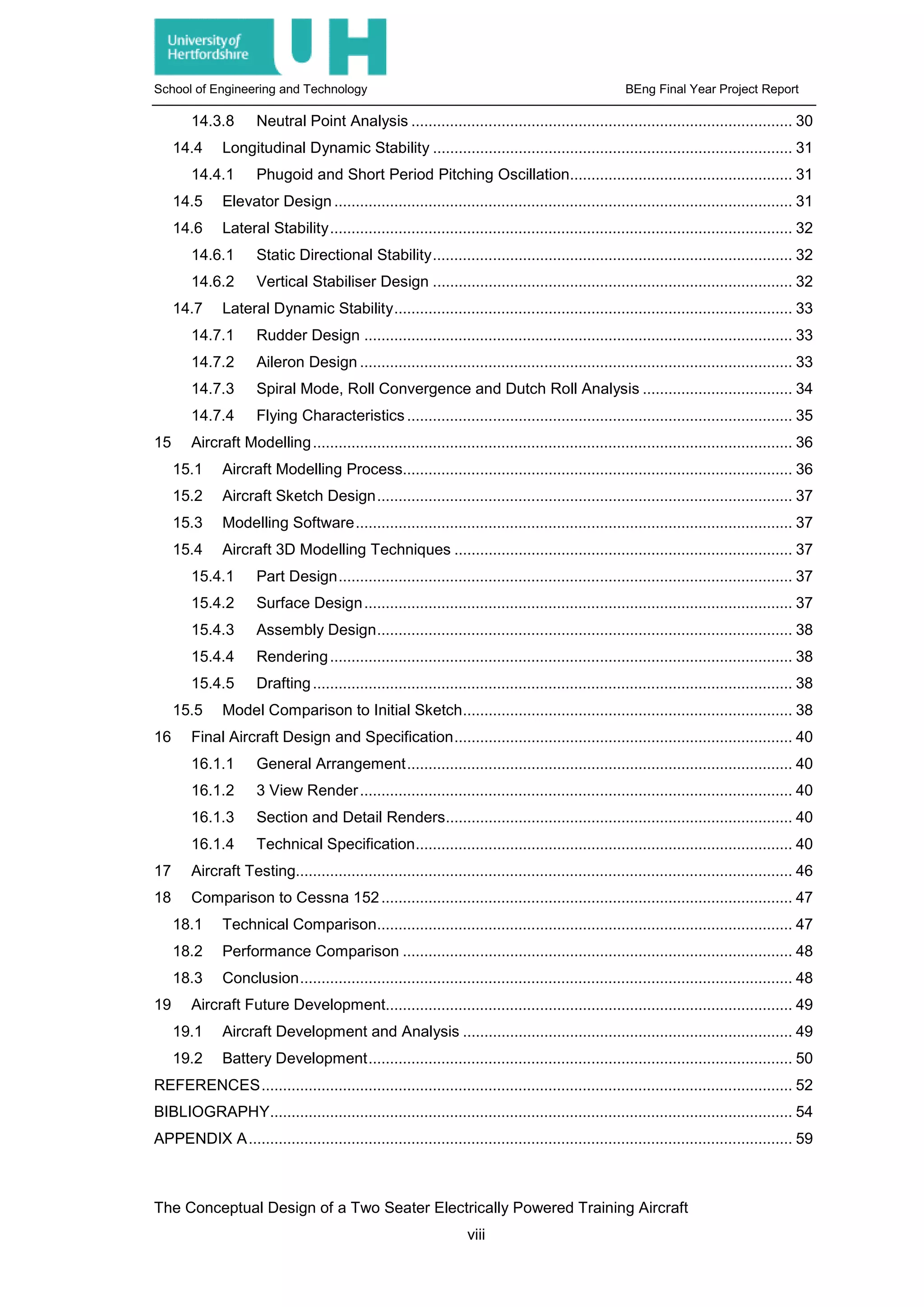
TABLE OF CONTENTS
DECLARATION STATEMENT.......................................................................................................ii
ABSTRACT ...................................................................................................................................iii
LINKED DOCUMENTS .................................................................................................................iv
ACKNOWLEDGEMENTS ..............................................................................................................v
TABLE OF CONTENTS ................................................................................................................vi
LIST OF FIGURES........................................................................................................................ix
GLOSSARY...................................................................................................................................xi
1 Introduction........................................................................................................................... 1
1.1 Project Introduction ....................................................................................................... 1
1.2 Project Aim .................................................................................................................... 1
1.3 Project Objectives ......................................................................................................... 1
2 Subject Review..................................................................................................................... 2
2.1 Market Analysis ............................................................................................................. 2
2.1.1 Global Warming..................................................................................................... 2
2.1.2 Energy Prices ........................................................................................................ 3
2.1.3 Electric Energy ...................................................................................................... 5
2.2 Electric Aircraft .............................................................................................................. 6
2.2.1 E-FAN 2.0.............................................................................................................. 7
2.2.2 E-FAN 4.0.............................................................................................................. 7
2.3 Training Aircraft History................................................................................................. 8
3 Concept Generation ............................................................................................................. 9
3.1 Development Process ................................................................................................... 9
4 Development of Aircraft Requirements .............................................................................. 11
4.1 Existing Aircraft Data................................................................................................... 11
4.1.1 Cessna 152 ......................................................................................................... 11
4.1.2 Cessna Aircraft Company History ....................................................................... 11
5 Initial Design Specification.................................................................................................. 12
5.1 Matching Plot............................................................................................................... 12
5.2 Matching Plot Analysis ................................................................................................ 12
6 Wing Design ....................................................................................................................... 14
6.1 Wing Aerofoil Selection ............................................................................................... 14
6.1.1 Aircraft Flight Profile ............................................................................................ 14
6.1.2 Lift Coefficient Requirements .............................................................................. 14
6.1.3 Wing Aerofoil Cruise Lift Coefficient, 𝑪𝑪𝑪𝑪𝑪𝑪32T ............................................................ 15
6.1.4 Wing Aerofoil Gross Maximum Lift Coefficient, 𝑪𝑪𝑪𝑪 𝑴𝑴𝑴𝑴𝑴𝑴 𝑮𝑮𝑮𝑮𝑮𝑮𝑮𝑮𝑮𝑮32T ........................ 15
6.1.5 Wing Aerofoil Net Maximum Lift Coefficient, 𝑪𝑪𝑪𝑪 𝑴𝑴𝑴𝑴𝑴𝑴32T ......................................... 15
6.1.6 Aerofoil Selection ................................................................................................ 15
The Conceptual Design of a Two Seater Electrically Powered Training Aircraft
vi
School of Engineering and Technology BEng Final Year Project Report
6.2 3D Wing Design .......................................................................................................... 16
6.2.1 Taper Ratio.......................................................................................................... 16
6.2.2 Twist .................................................................................................................... 16
6.2.3 Resulting Wing .................................................................................................... 17
6.3 High Lift Device Design............................................................................................... 17
7 Fuselage Design................................................................................................................. 18
8 Drag Analysis...................................................................................................................... 19
8.1 Parasitic Drag.............................................................................................................. 19
8.2 Induced Drag............................................................................................................... 19
8.3 Total Aircraft Drag ....................................................................................................... 20
8.4 Minimum Drag Condition............................................................................................. 21
9 Landing Gear Design.......................................................................................................... 22
10 Structural Design ................................................................................................................ 23
10.1 Flight Critical Components .......................................................................................... 23
10.2 Failure and Crash Critical Components ...................................................................... 23
11 Propulsion System Design ................................................................................................. 24
11.1.1 Propulsion System Type Selection ..................................................................... 24
11.1.2 Fuel System Type Selection................................................................................ 24
11.2 Thrust Requirements................................................................................................... 25
11.3 Power Requirements................................................................................................... 25
11.4 Motor Selection ........................................................................................................... 25
11.5 Propeller Design.......................................................................................................... 25
12 Performance Analysis......................................................................................................... 26
12.1 Take-Off Performance................................................................................................. 26
12.2 Aircraft Climb Performance ......................................................................................... 26
13 Aircraft Power Source Design ............................................................................................ 27
13.1 Energy Requirement ................................................................................................... 27
13.2 Battery Specifications.................................................................................................. 27
14 Stabiliser Design, Control Surface Design and Stability and Control Analysis .................. 28
14.1 Centre of Gravity ......................................................................................................... 28
14.1.1 Centre of Gravity Analysis................................................................................... 28
14.2 Longitudinal Stability ................................................................................................... 28
14.3 Longitudinal Static Stability ......................................................................................... 28
14.3.1 Pitching Moment.................................................................................................. 28
14.3.2 Stabiliser Moment Arm........................................................................................ 29
14.3.3 Aerofoil Selection ................................................................................................ 29
14.3.4 Horizontal Stabiliser Design ................................................................................ 29
14.3.5 Horizontal Stabiliser Vertical Position ................................................................. 30
14.3.6 Horizontal Stabiliser Setting Angle...................................................................... 30
14.3.7 Stick Fixed Static Longitudinal Stability of Aircraft .............................................. 30
The Conceptual Design of a Two Seater Electrically Powered Training Aircraft
vii
School of Engineering and Technology BEng Final Year Project Report
14.3.8 Neutral Point Analysis ......................................................................................... 30
14.4 Longitudinal Dynamic Stability .................................................................................... 31
14.4.1 Phugoid and Short Period Pitching Oscillation.................................................... 31
14.5 Elevator Design ........................................................................................................... 31
14.6 Lateral Stability............................................................................................................ 32
14.6.1 Static Directional Stability.................................................................................... 32
14.6.2 Vertical Stabiliser Design .................................................................................... 32
14.7 Lateral Dynamic Stability............................................................................................. 33
14.7.1 Rudder Design .................................................................................................... 33
14.7.2 Aileron Design ..................................................................................................... 33
14.7.3 Spiral Mode, Roll Convergence and Dutch Roll Analysis ................................... 34
14.7.4 Flying Characteristics .......................................................................................... 35
15 Aircraft Modelling................................................................................................................ 36
15.1 Aircraft Modelling Process........................................................................................... 36
15.2 Aircraft Sketch Design................................................................................................. 37
15.3 Modelling Software...................................................................................................... 37
15.4 Aircraft 3D Modelling Techniques ............................................................................... 37
15.4.1 Part Design.......................................................................................................... 37
15.4.2 Surface Design.................................................................................................... 37
15.4.3 Assembly Design................................................................................................. 38
15.4.4 Rendering............................................................................................................ 38
15.4.5 Drafting................................................................................................................ 38
15.5 Model Comparison to Initial Sketch............................................................................. 38
16 Final Aircraft Design and Specification............................................................................... 40
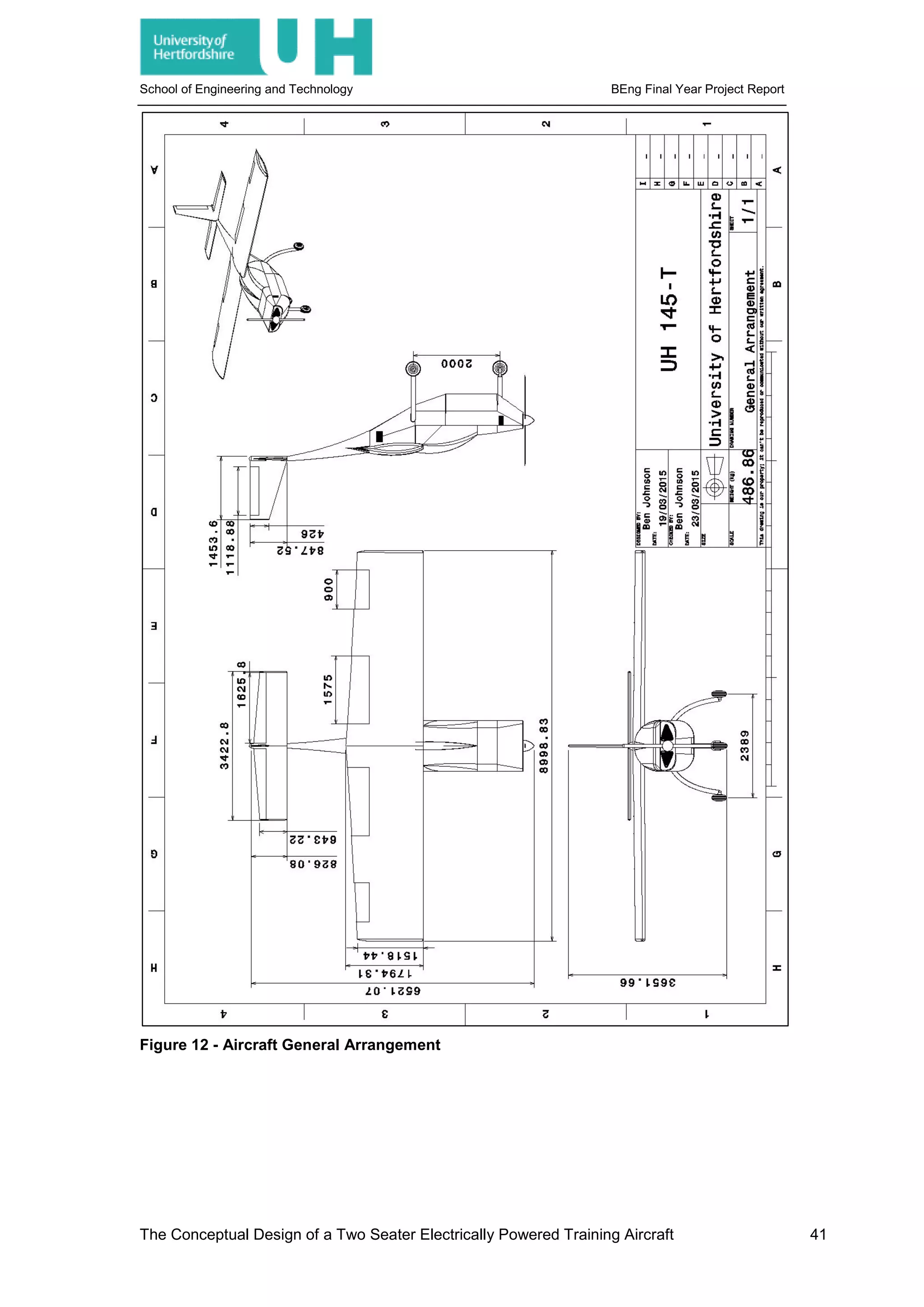
16.1.1 General Arrangement.......................................................................................... 40
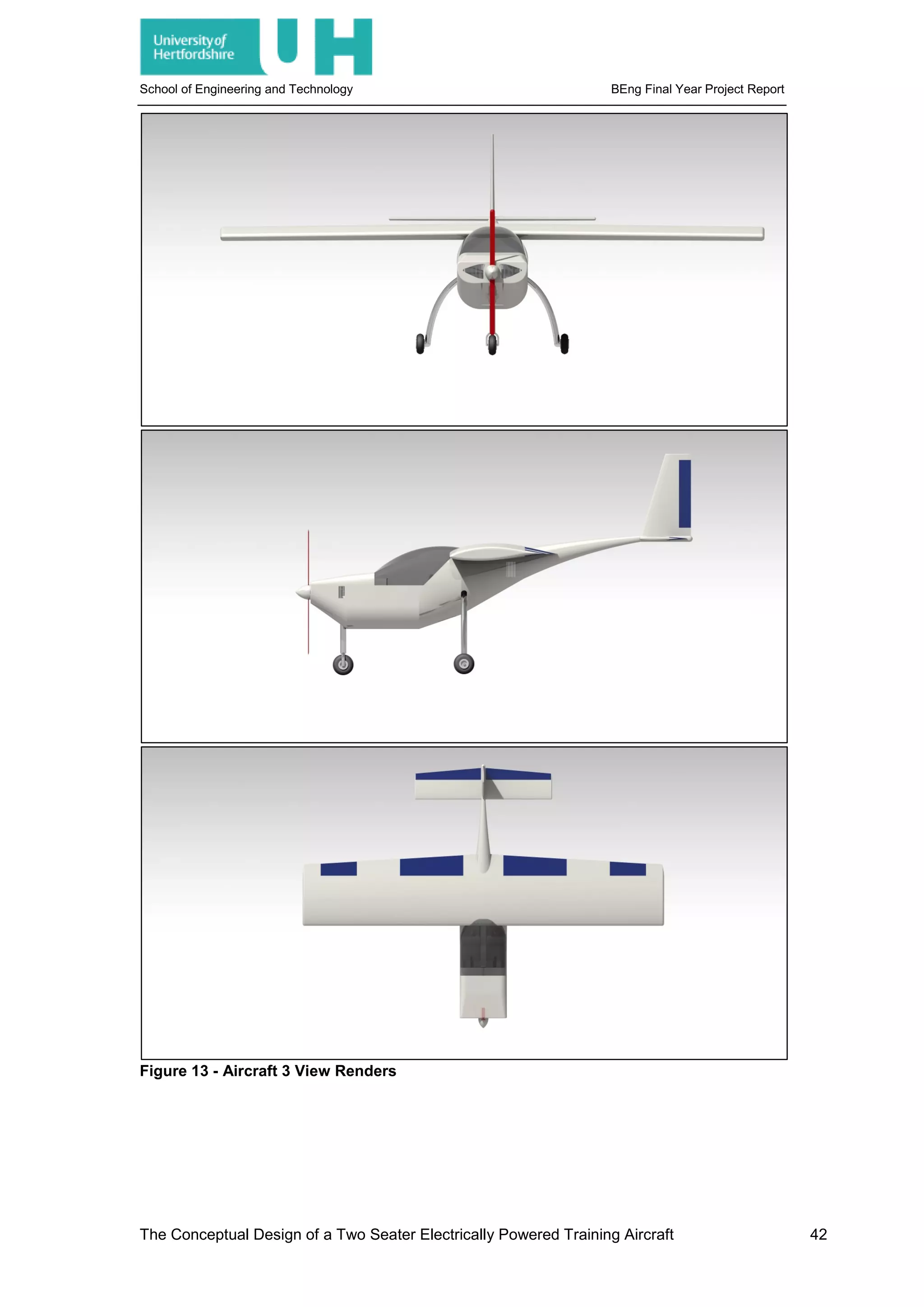
16.1.2 3 View Render..................................................................................................... 40
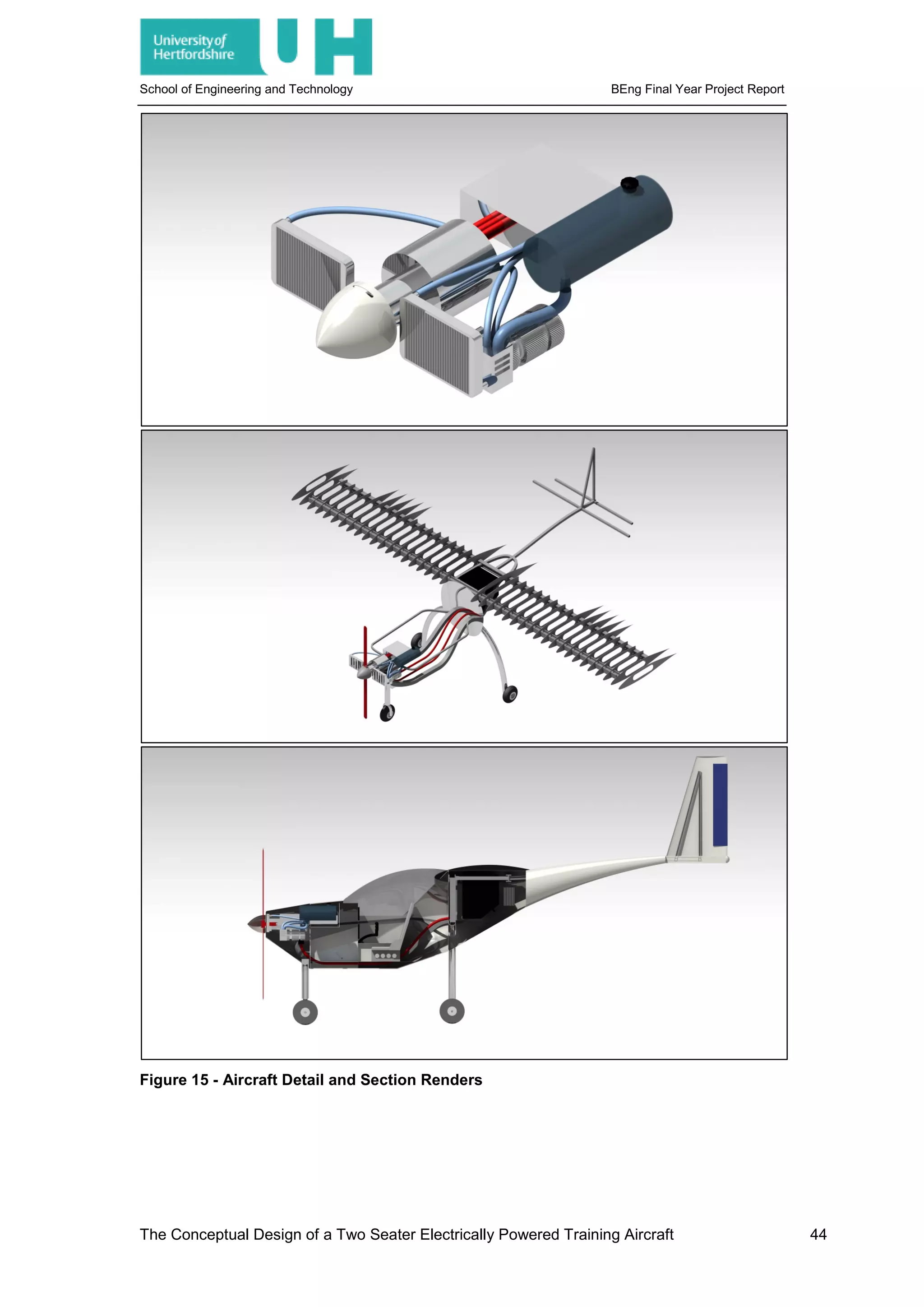
16.1.3 Section and Detail Renders................................................................................. 40
16.1.4 Technical Specification........................................................................................ 40
17 Aircraft Testing.................................................................................................................... 46
18 Comparison to Cessna 152................................................................................................ 47
18.1 Technical Comparison................................................................................................. 47
18.2 Performance Comparison ........................................................................................... 48
18.3 Conclusion................................................................................................................... 48
19 Aircraft Future Development............................................................................................... 49
19.1 Aircraft Development and Analysis ............................................................................. 49
19.2 Battery Development................................................................................................... 50
REFERENCES............................................................................................................................ 52
BIBLIOGRAPHY.......................................................................................................................... 54
APPENDIX A............................................................................................................................... 59
The Conceptual Design of a Two Seater Electrically Powered Training Aircraft
viii
School of Engineering and Technology BEng Final Year Project Report
LIST OF FIGURES
Figure 1 - Jet Fuel and Crude Oil Price - [6] ................................................................................. 4
Figure 2 - Crude Oil Worldwide Distribution - [7] .......................................................................... 5
Figure 3 - E-FAN 2.0 - [15]............................................................................................................ 7
Figure 4 - E-FAN 4.0 - [15]............................................................................................................ 8
Figure 5 - Final Design Concept Sketch ....................................................................................... 9
Figure 6 - Design Development Process - [17] ........................................................................... 10
Figure 7 - Matching Plot .............................................................................................................. 13
Figure 8 - Cockpit Elevation Sketches ........................................................................................ 18
Figure 9 - Induced Drag - [19] ..................................................................................................... 20
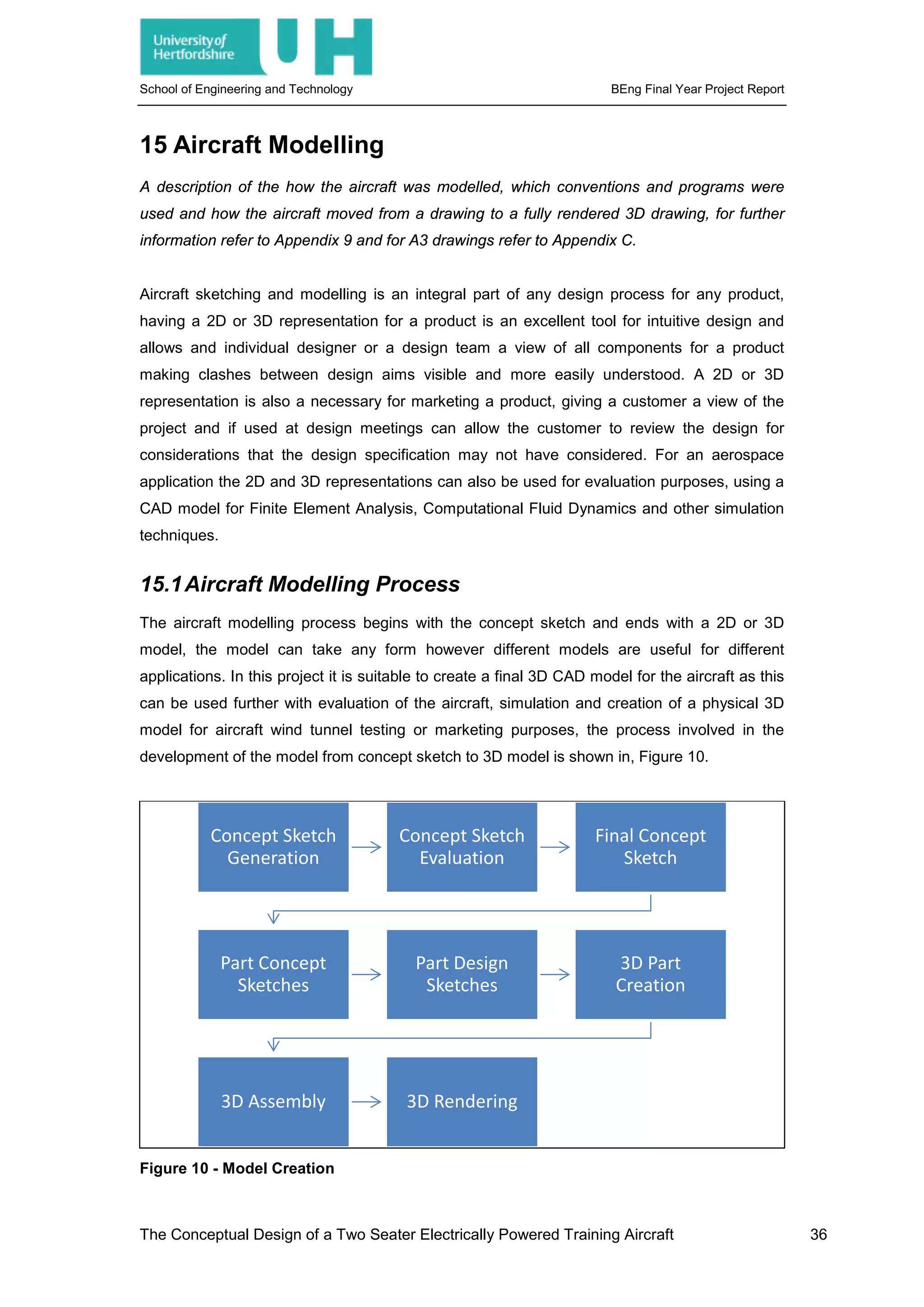
Figure 10 - Model Creation ......................................................................................................... 36
Figure 11 - Sketch Comparison .................................................................................................. 39
Figure 12 - Aircraft General Arrangement................................................................................... 41
Figure 13 - Aircraft 3 View Renders............................................................................................ 42
Figure 14 - Isometric Aircraft Render.......................................................................................... 43
Figure 15 - Aircraft Detail and Section Renders ......................................................................... 44
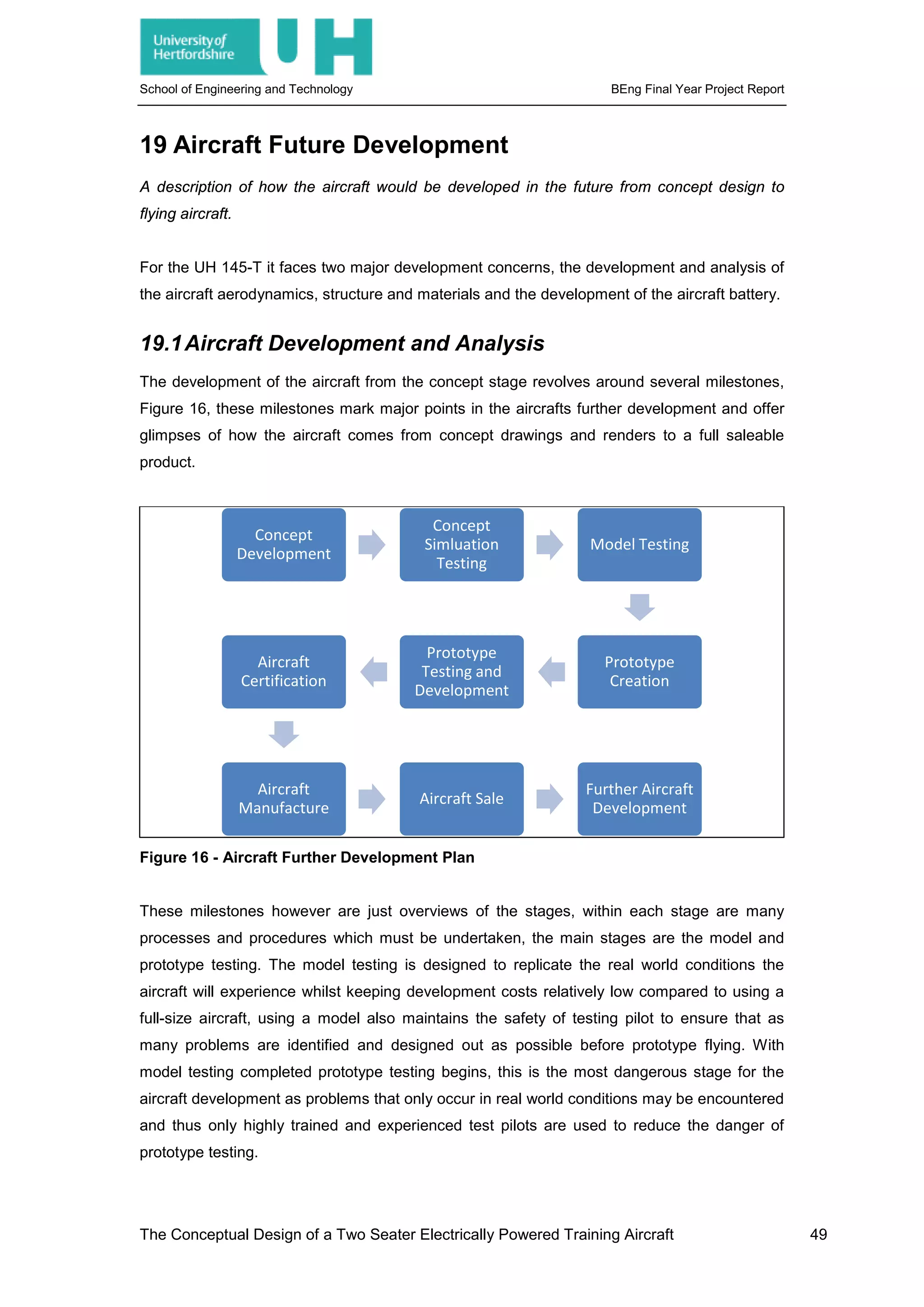
Figure 16 - Aircraft Further Development Plan ........................................................................... 49
Figure 17 - Energy Density Increases - [24], [25] ....................................................................... 50
Figure 18 - Cessna 152 3 View Sectional Drawing - [27] ........................................................... 62
Figure 19 - Aircraft Flight Profiles................................................................................................ 64
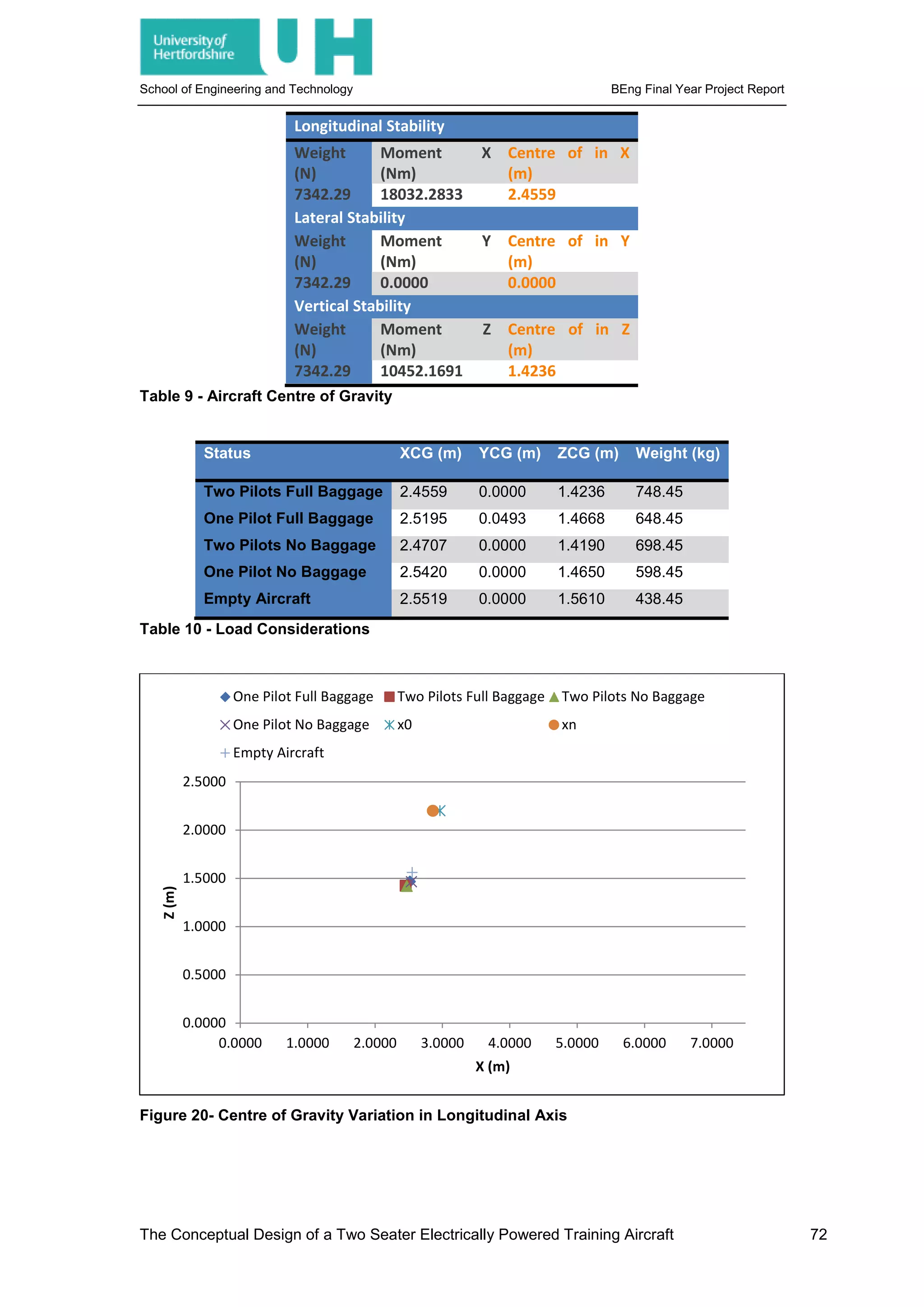
Figure 20- Centre of Gravity Variation in Longitudinal Axis ........................................................ 72
Table 1 - Longitudinal Approximation Results ............................................................................ 31
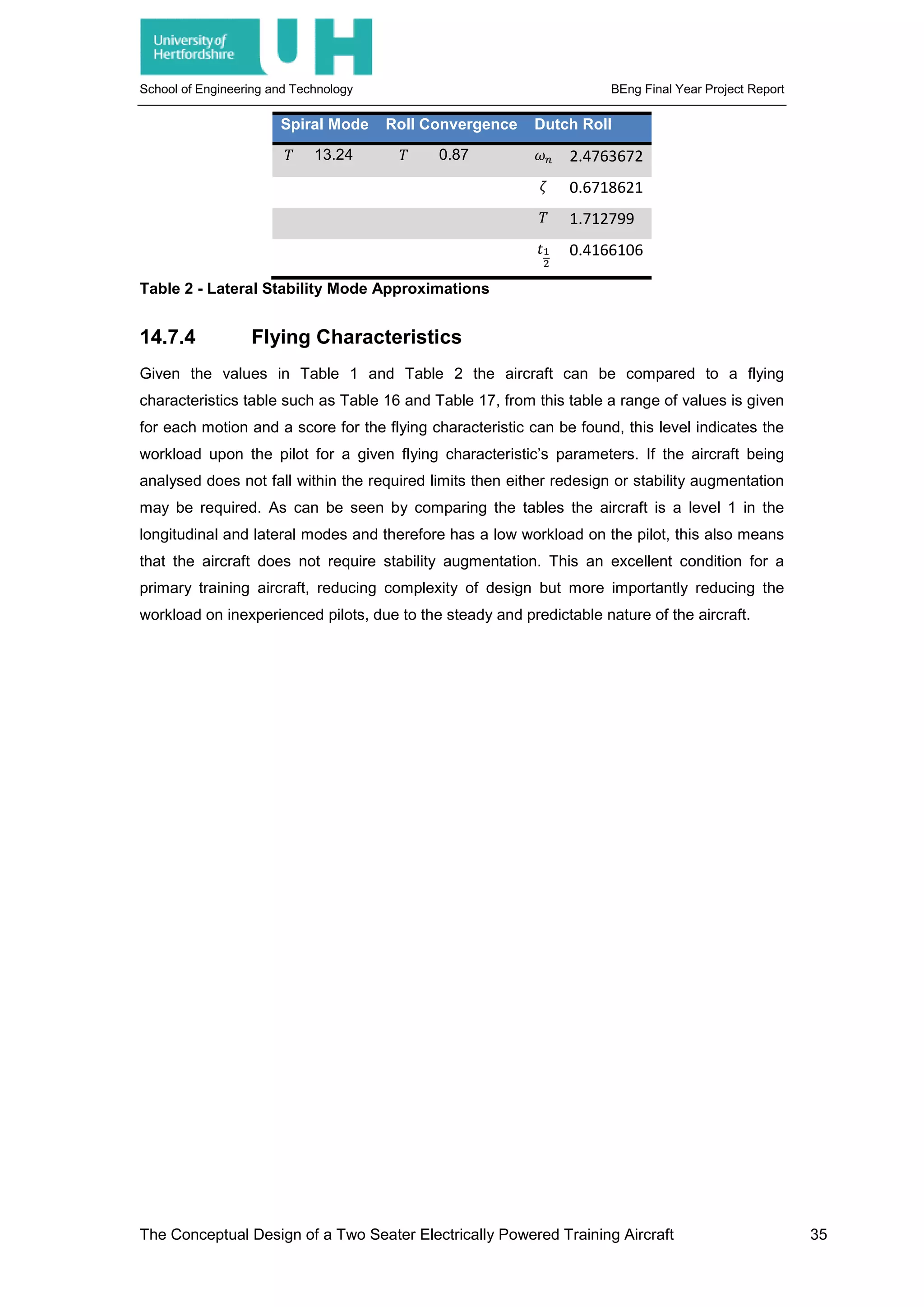
Table 2 - Lateral Stability Mode Approximations ........................................................................ 35
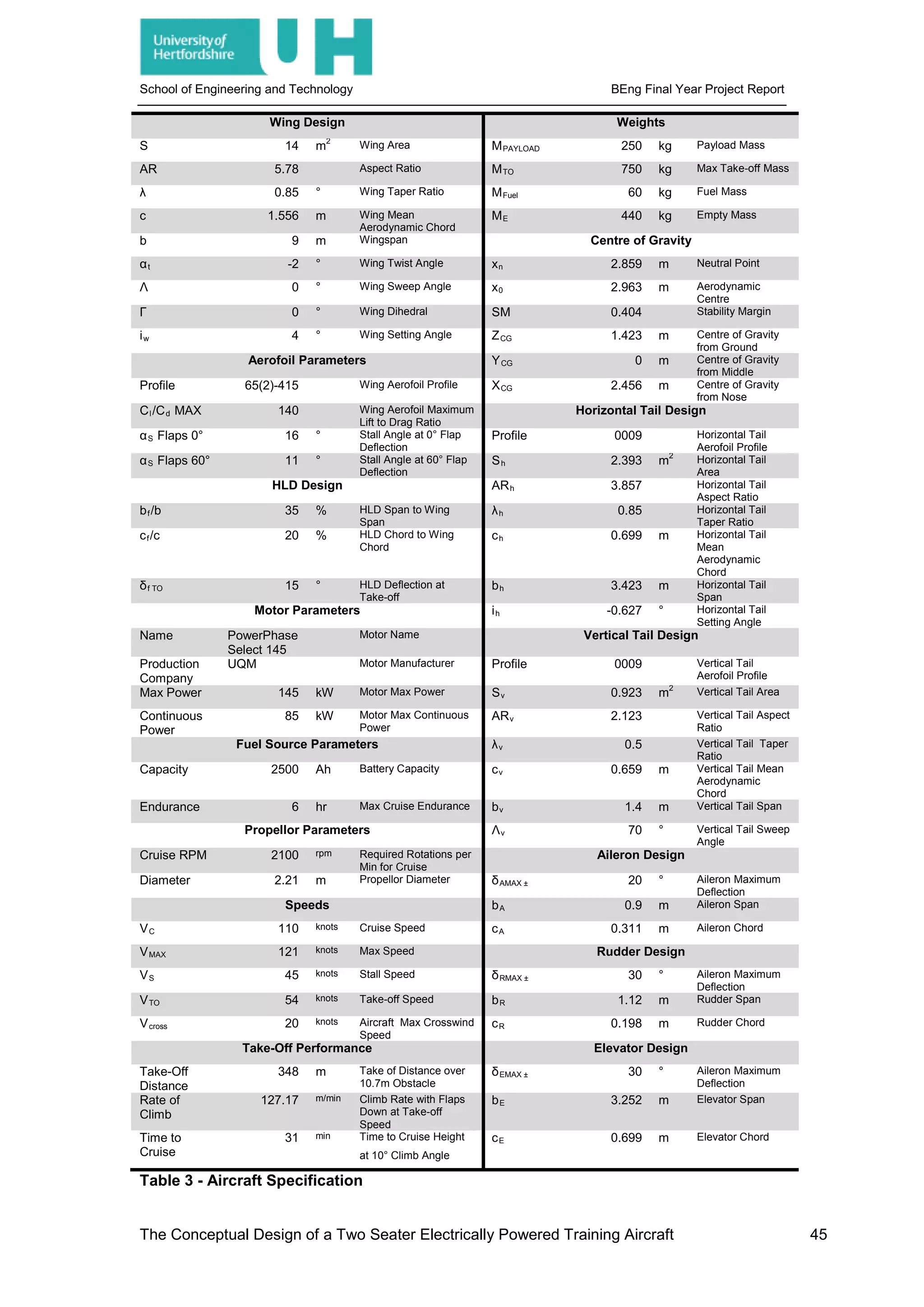
Table 3 - Aircraft Specification .................................................................................................... 45
Table 4 - Excel Comparison Table.............................................................................................. 59
Table 5 – Cessna 152 Technical Specification - [26].................................................................. 61
Table 6 - Design Specification .................................................................................................... 63
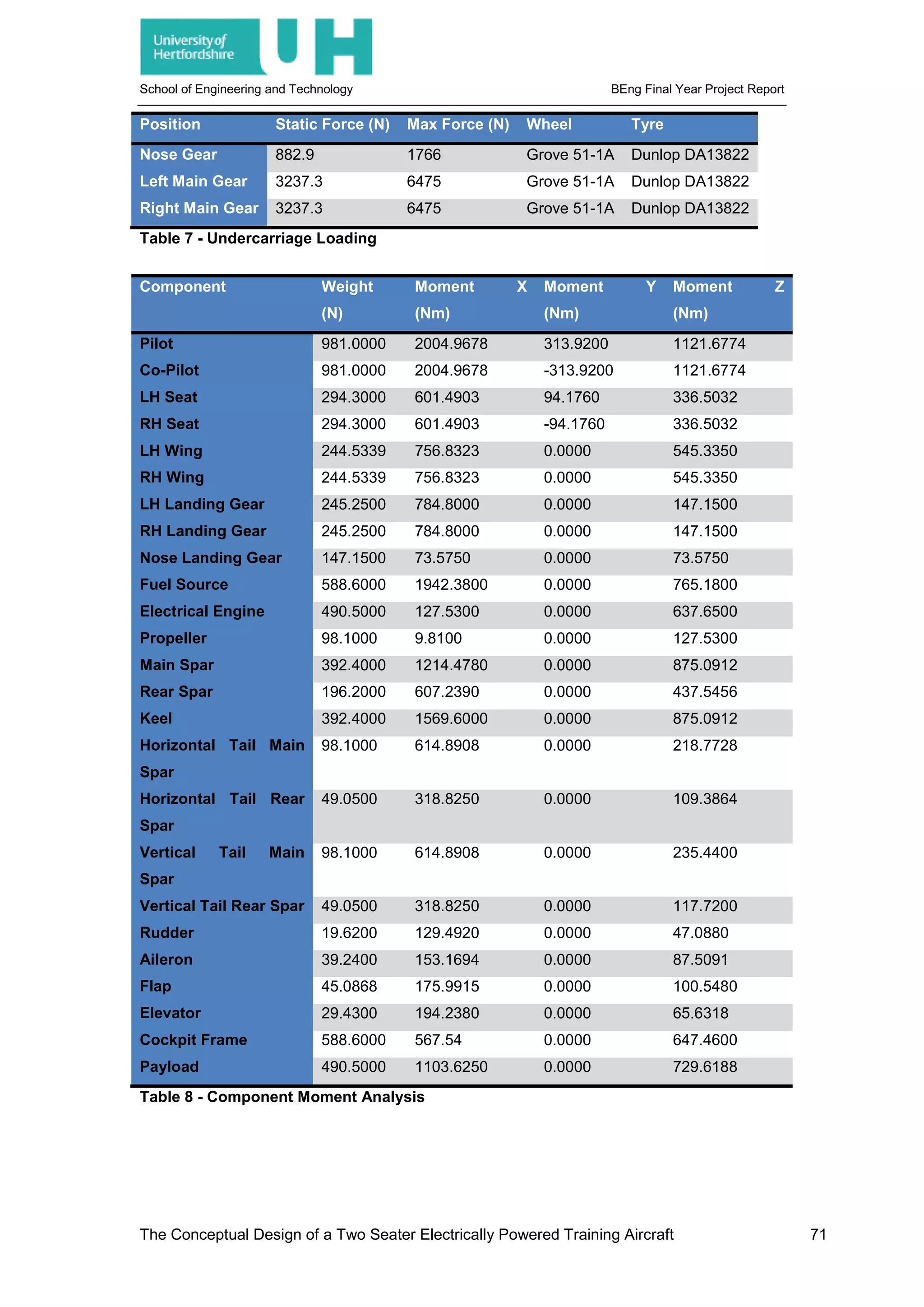
Table 7 - Undercarriage Loading ................................................................................................ 71
Table 8 - Component Moment Analysis...................................................................................... 71
Table 9 - Aircraft Centre of Gravity ............................................................................................. 72
Table 10 - Load Considerations .................................................................................................. 72
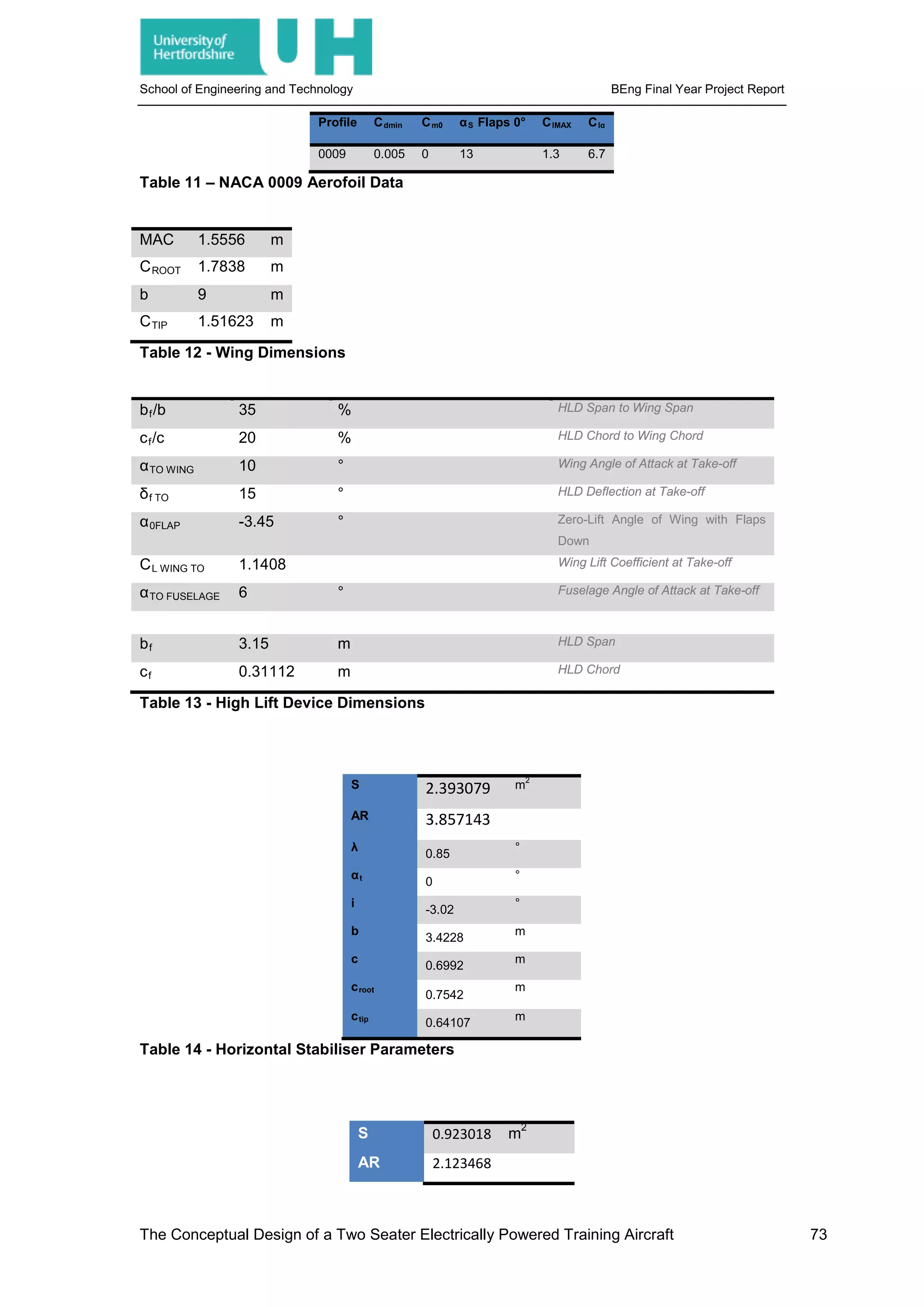
Table 11 – NACA 0009 Aerofoil Data ......................................................................................... 73
Table 12 - Wing Dimensions ....................................................................................................... 73
Table 13 - High Lift Device Dimensions...................................................................................... 73
Table 14 - Horizontal Stabiliser Parameters ............................................................................... 73
Table 15- Vertical Stabiliser Parameters..................................................................................... 74
Table 16 - Longitudinal Flying Characteristics - [28]................................................................... 74
The Conceptual Design of a Two Seater Electrically Powered Training Aircraft
ix
School of Engineering and Technology BEng Final Year Project Report
Table 17 - Lateral Flying Characteristics - [28] ........................................................................... 74
Code 1 - Wing Lift Distribution - [16] Modified by Benjamin James Johnson ............................. 67
Code 2 - Wing Lift Distribution Inputs.......................................................................................... 67
Code 3 - Final Wing Inputs.......................................................................................................... 69
Graph 1 - Wing Lift Distribution Comparison .............................................................................. 17
Graph 2 - Comparison of Component Drag at Cruise................................................................. 20
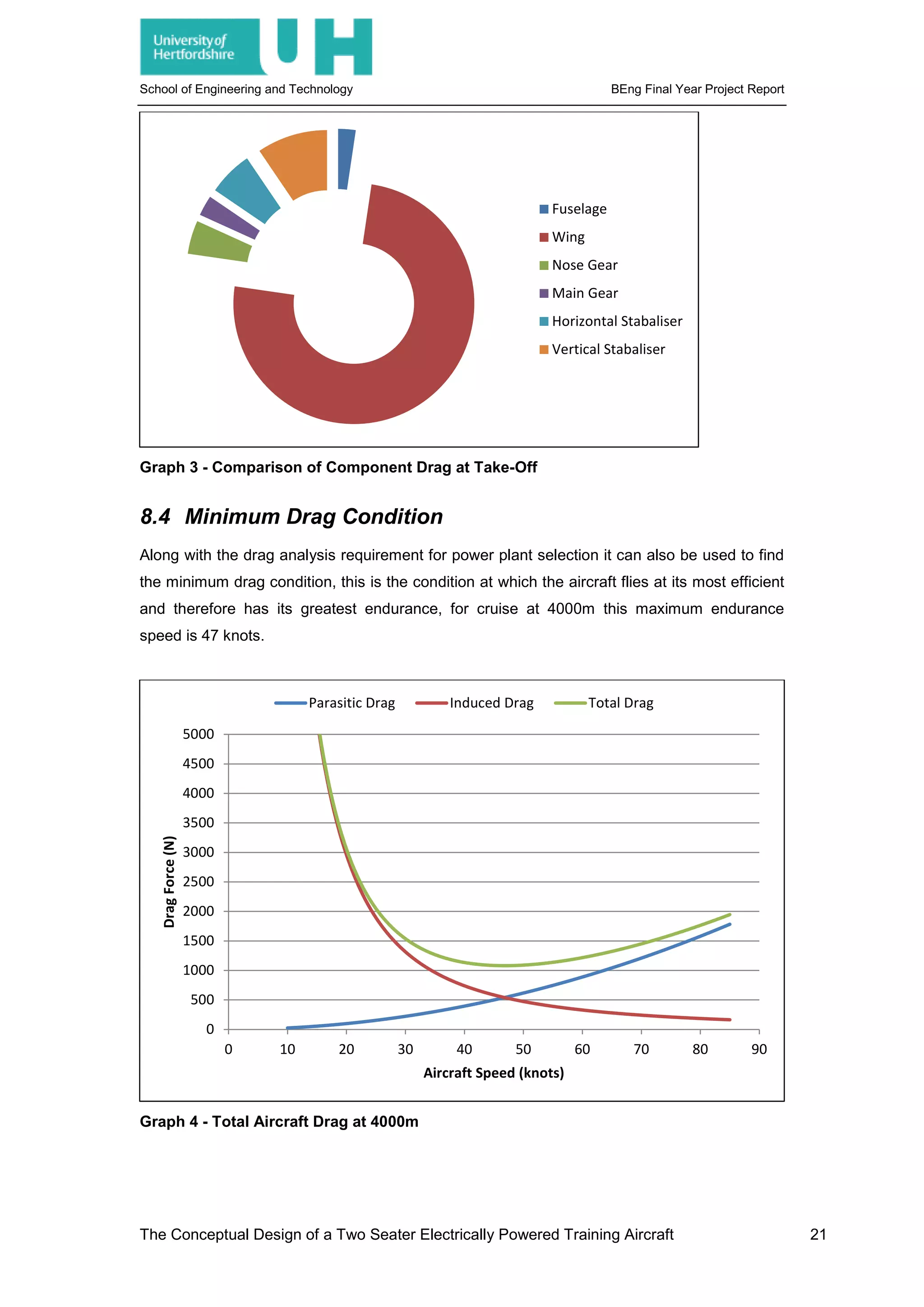
Graph 3 - Comparison of Component Drag at Take-Off............................................................. 21
Graph 4 - Total Aircraft Drag at 4000m....................................................................................... 21
Graph 5 - Comparison of Range against Maximum Take-off Weight and Thrust to Weight Ratio
..................................................................................................................................................... 60
Graph 6 - Comparison of Wing Loading and Maximum Take-off Weight ................................... 60
Graph 7 - Coefficient of Drag against Coefficient of Lift for NACA 652-415 ............................... 65
Graph 8 - Pitching Moment Coefficient against Coefficient of Lift for NACA 652-415 ................ 65
Graph 9 - Coefficient of Lift against Angle of Attack for NACA 652-415..................................... 66
Graph 10 - Lift/Drag Ratio against Angle of Attack for NACA 652-415....................................... 66
Graph 11 - Base Wing Lift Distribution – CL=0.5121 .................................................................. 68
Graph 12 - Final Wing Lift Distribution – CL=0.4793................................................................... 69
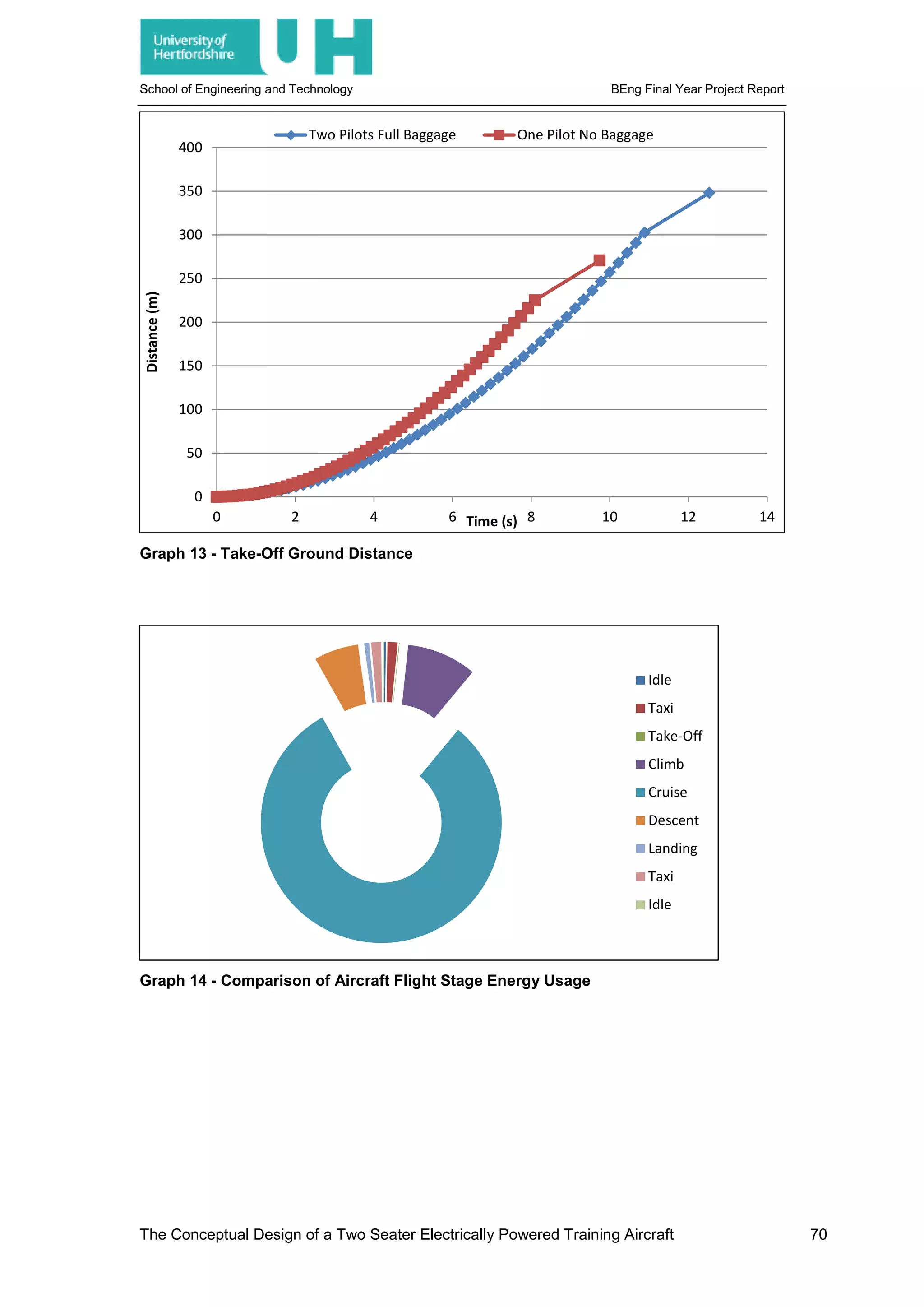
Graph 13 - Take-Off Ground Distance........................................................................................ 70
Graph 14 - Comparison of Aircraft Flight Stage Energy Usage.................................................. 70
The Conceptual Design of a Two Seater Electrically Powered Training Aircraft
x
School of Engineering and Technology BEng Final Year Project Report
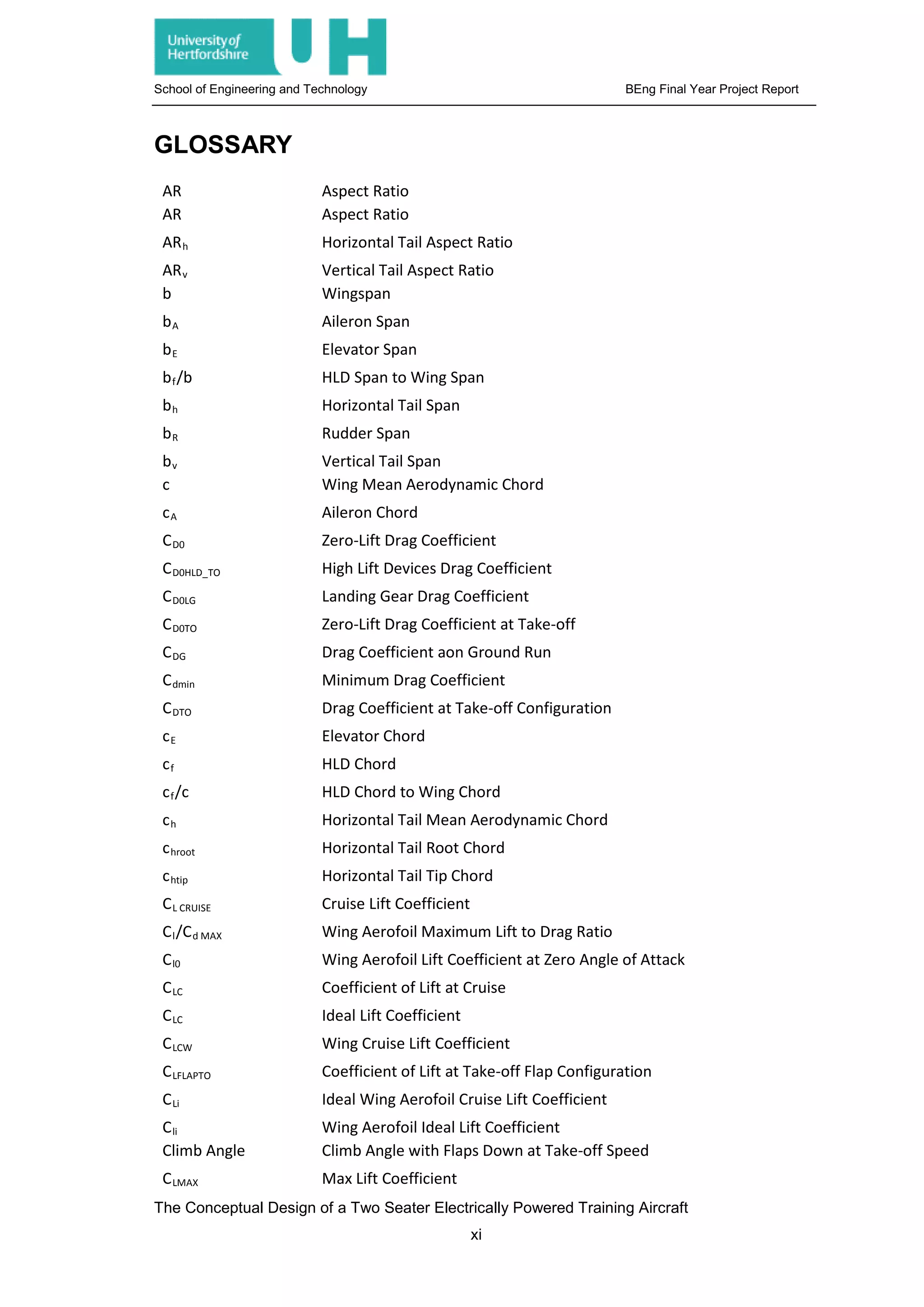
GLOSSARY
AR Aspect Ratio
AR Aspect Ratio
ARh Horizontal Tail Aspect Ratio
ARv Vertical Tail Aspect Ratio
b Wingspan
bA Aileron Span
bE Elevator Span
bf/b HLD Span to Wing Span
bh Horizontal Tail Span
bR Rudder Span
bv Vertical Tail Span
c Wing Mean Aerodynamic Chord
cA Aileron Chord
CD0 Zero-Lift Drag Coefficient
CD0HLD_TO High Lift Devices Drag Coefficient
CD0LG Landing Gear Drag Coefficient
CD0TO Zero-Lift Drag Coefficient at Take-off
CDG Drag Coefficient aon Ground Run
Cdmin Minimum Drag Coefficient
CDTO Drag Coefficient at Take-off Configuration
cE Elevator Chord
cf HLD Chord
cf/c HLD Chord to Wing Chord
ch Horizontal Tail Mean Aerodynamic Chord
chroot Horizontal Tail Root Chord
chtip Horizontal Tail Tip Chord
CL CRUISE Cruise Lift Coefficient
Cl/Cd MAX Wing Aerofoil Maximum Lift to Drag Ratio
Cl0 Wing Aerofoil Lift Coefficient at Zero Angle of Attack
CLC Coefficient of Lift at Cruise
CLC Ideal Lift Coefficient
CLCW Wing Cruise Lift Coefficient
CLFLAPTO Coefficient of Lift at Take-off Flap Configuration
CLi Ideal Wing Aerofoil Cruise Lift Coefficient
Cli Wing Aerofoil Ideal Lift Coefficient
Climb Angle Climb Angle with Flaps Down at Take-off Speed
CLMAX Max Lift Coefficient
The Conceptual Design of a Two Seater Electrically Powered Training Aircraft
xi
School of Engineering and Technology BEng Final Year Project Report
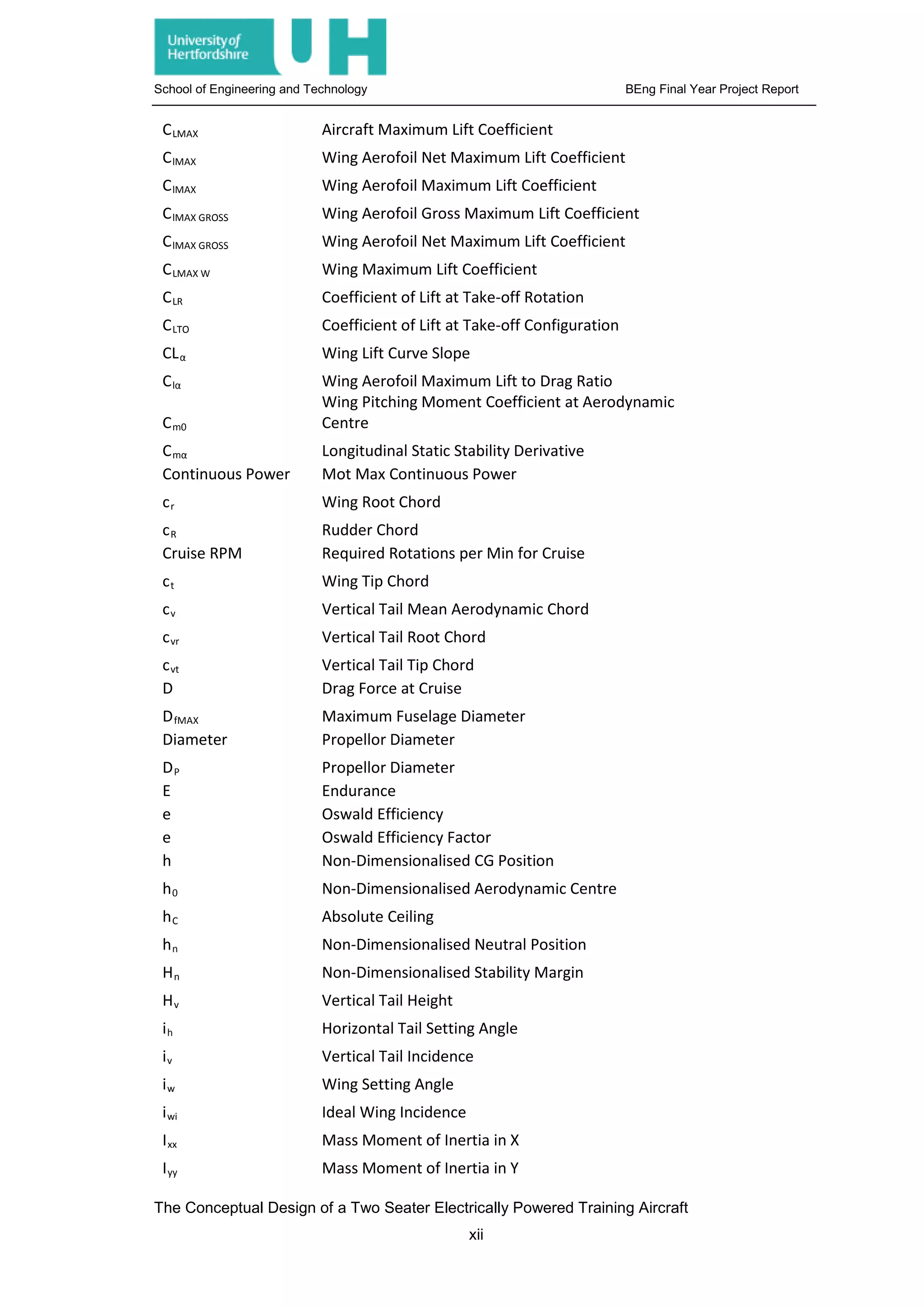
CLMAX Aircraft Maximum Lift Coefficient
ClMAX Wing Aerofoil Net Maximum Lift Coefficient
ClMAX Wing Aerofoil Maximum Lift Coefficient
ClMAX GROSS Wing Aerofoil Gross Maximum Lift Coefficient
ClMAX GROSS Wing Aerofoil Net Maximum Lift Coefficient
CLMAX W Wing Maximum Lift Coefficient
CLR Coefficient of Lift at Take-off Rotation
CLTO Coefficient of Lift at Take-off Configuration
CLα Wing Lift Curve Slope
Clα Wing Aerofoil Maximum Lift to Drag Ratio
Cm0
Wing Pitching Moment Coefficient at Aerodynamic
Centre
Cmα Longitudinal Static Stability Derivative
Continuous Power Mot Max Continuous Power
cr Wing Root Chord
cR Rudder Chord
Cruise RPM Required Rotations per Min for Cruise
ct Wing Tip Chord
cv Vertical Tail Mean Aerodynamic Chord
cvr Vertical Tail Root Chord
cvt Vertical Tail Tip Chord
D Drag Force at Cruise
DfMAX Maximum Fuselage Diameter
Diameter Propellor Diameter
DP Propellor Diameter
E Endurance
e Oswald Efficiency
e Oswald Efficiency Factor
h Non-Dimensionalised CG Position
h0 Non-Dimensionalised Aerodynamic Centre
hC Absolute Ceiling
hn Non-Dimensionalised Neutral Position
Hn Non-Dimensionalised Stability Margin
Hv Vertical Tail Height
ih Horizontal Tail Setting Angle
iv Vertical Tail Incidence
iw Wing Setting Angle
iwi Ideal Wing Incidence
Ixx Mass Moment of Inertia in X
Iyy Mass Moment of Inertia in Y
The Conceptual Design of a Two Seater Electrically Powered Training Aircraft
xii
School of Engineering and Technology BEng Final Year Project Report
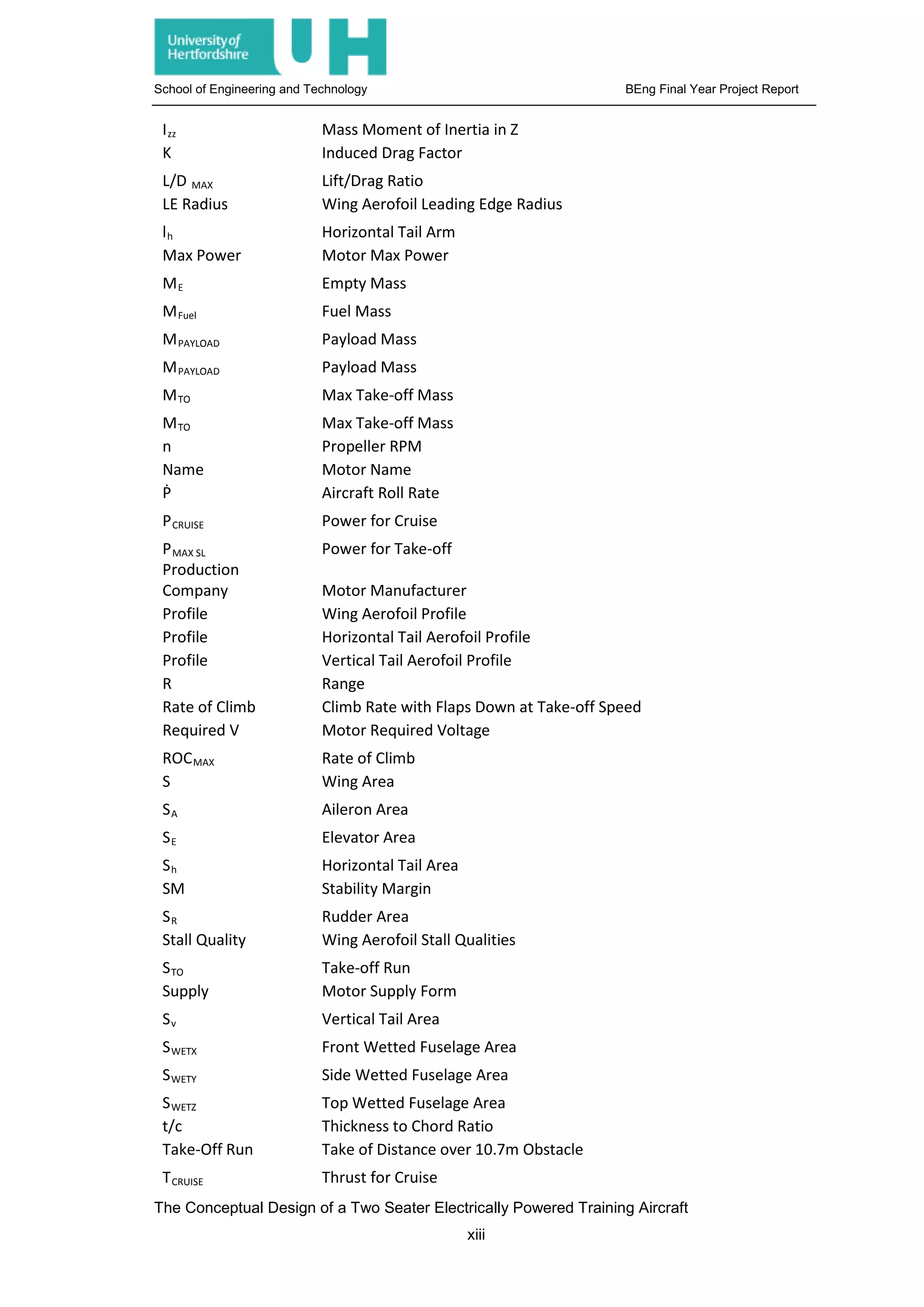
Izz Mass Moment of Inertia in Z
K Induced Drag Factor
L/D MAX Lift/Drag Ratio
LE Radius Wing Aerofoil Leading Edge Radius
lh Horizontal Tail Arm
Max Power Motor Max Power
ME Empty Mass
MFuel Fuel Mass
MPAYLOAD Payload Mass
MTO Max Take-off Mass
n Propeller RPM
Name Motor Name
Ṗ Aircraft Roll Rate
PCRUISE Power for Cruise
PMAX SL Power for Take-off
Production
Company Motor Manufacturer
Profile Wing Aerofoil Profile
Profile Horizontal Tail Aerofoil Profile
Profile Vertical Tail Aerofoil Profile
R Range
Rate of Climb Climb Rate with Flaps Down at Take-off Speed
Required V Motor Required Voltage
ROCMAX Rate of Climb
S Wing Area
SA Aileron Area
SE Elevator Area
Sh Horizontal Tail Area
SM Stability Margin
SR Rudder Area
Stall Quality Wing Aerofoil Stall Qualities
STO Take-off Run
Supply Motor Supply Form
Sv Vertical Tail Area
SWETX Front Wetted Fuselage Area
SWETY Side Wetted Fuselage Area
SWETZ Top Wetted Fuselage Area
t/c Thickness to Chord Ratio
Take-Off Run Take of Distance over 10.7m Obstacle
TCRUISE Thrust for Cruise
The Conceptual Design of a Two Seater Electrically Powered Training Aircraft
xiii
School of Engineering and Technology BEng Final Year Project Report
Time to Cruise
Altitude Time to Cruise Height at 10° Climb Angle
Vapp Minimum Approach Speed
VC Cruise Speed
VC Cruise Speed
Vcross Aircraft Max Crosswind Speed
VMAX Max Speed
VMAX Max Speed
VMC Aircraft Minimum Control Speed
VR Rotation Speed
VR Rotation Speed
VS Stall Speed
VS Stall Speed
VTO Take-off Speed
VTO Take-off Speed
Weight Motor Weight
x0 Aerodynamic Centre
XCG Centre of Gravity from Nose
xLE Wing Leading Edge Position from Nose
xLE Leading Edge Position
xn Neutral Point
xT Thrust Location in X
YCG Centre of Gravity from Middle
yT Thrust Location in Y
ZCG Centre of Gravity from Ground
zLE Wing Leading Edge Position from Ground
zT Thrust Location in Z
α0 Wing Aerofoil Zero Lift Angle of Attack
α0FLAP Zero-Lift Angle of Wing with Flaps Down
αli Wing Aerofoil Angle of Attack for Ideal Lift Coefficient
αS Flaps 0° Stall Angle at 0° Flap Deflection
αS Flaps 60° Stall Angle at 60° Flap Deflection
αt Wing Twist Angle
αt Fuselage Angle at Cruise
αTO WING Wing Angle of Attack at Take-off
Γ Wing Dihedral
Γh Horizontal Tail Dihedral
Γv Vertical Tail Dihedral
δ Wing Downwash
δAMAX ± Aileron Maximum Deflection
The Conceptual Design of a Two Seater Electrically Powered Training Aircraft
xiv
School of Engineering and Technology BEng Final Year Project Report
δEMAX ± Aileron Maximum Deflection
δf TO HLD Deflection at Take-off
δRMAX ± Aileron Maximum Deflection
ηP Propellor Efficiency
ηT Propellor Efficiency at Take-off
λ Wing Taper Ratio
Λ Wing Sweep Angle
λh Horizontal Tail Taper Ratio
Λh Horizontal Tail Sweep Angle
λv Vertical Tail Taper Ratio
Λv Vertical Tail Sweep Angle
μ Runway Friction Coefficient
ω Propeller Angular Speed
The Conceptual Design of a Two Seater Electrically Powered Training Aircraft
xv
School of Engineering and Technology BEng Final Year Project Report
1 Introduction
1.1 Project Introduction
With the modern advances in electric propulsion for motor vehicles and the constraints being
placed upon the aerospace industry by organisations, such as the European Commission and
its “Flight Path 2050”, the aerospace industry is in the spotlight to become drastically more
efficient by at least 2050. Modern motor vehicles have begun to adopt green options such as
biofuels and electric engines which are seen as cutting their carbon footprint, and although
problematic at first have now been seen as the future, at least for the present. Therefore the
aerospace industry needs to exploit the new and advancing technology in an effort to
maintain its current status as a viable mode of transport. As well as the green issue, the
reduction and therefore increasing cost of fossil fuel based fuels could make flying even more
expensive and remove it from competitive markets. This project is aimed at exploring the
viability of an electrically powered aircraft, discovering whether a more economical concept
for pilot training and pleasure flying can be found using electric propulsion technology and
designing an aircraft to fill tis role.
1.2 Project Aim
The aim of this project is to research and design a concept, two seat, electrically powered
aircraft, creating a technical report on all work done with a final presentation on the aircraft.
1.3 Project Objectives
• To report on the feasibility of conceptually designing an aircraft in the given
timeframe.
• To report on the current aircraft using electric propulsion.
• To report on the planned future for electric propulsion in aircraft.
• To report on the current advantages and disadvantages of electric propulsion in
aircraft.
• To produce a design specification for a concept aircraft using electric propulsion.
• To create several concepts in line with the design specification.
• To report on the feasibility and suitability of a chosen concept to further develop.
• To produce a technical report on the developed concept including technical drawings,
component information and predictions of aircraft performance.
• To report on the future development of the concept up to manufacture.
• To produce a Logbook for all work done throughout the project.
• To produce and give a technical presentation on the project.
The Conceptual Design of a Two Seater Electrically Powered Training Aircraft 1
School of Engineering and Technology BEng Final Year Project Report
2 Subject Review
2.1 Market Analysis
For the initial development of any product an investment must be made, this investment is
time and money. The return from this investment is generally money or knowledge and
therefore a market or sector must be identified in which the product will fill a niche. This target
market sets the product aside and makes it desirable therefore offering a return on the
investment, the larger the target or the more important the larger the return. Therefore the
initial stage of any development project is the identification of the market.
2.1.1 Global Warming
It is widely acknowledged that global warming is having a negative impact upon the planet,
the problems caused by rising sea levels and changing climate are costing organisations both
time and money. To stop these problems global warming must be stopped or at least slowed,
this can only be accomplished through massive innovation across all sectors. The most
accepted cause of global warming is the increase in greenhouse gases and the ‘greenhouse
effect’, the increase in the blanketing of the earth by gases which trap heat within the Earth’s
atmosphere which would otherwise be radiated into space. Without this effect Earth would not
be able to support life; however man’s effect upon the atmosphere has increased the amount
of greenhouse gases and caused the atmosphere to retain too much heat therefore warming
the planet. The Intergovernmental Panel on Climate Change stated that; “Continued emission
of greenhouse gases will cause further warming and long-lasting changes in all components
of the climate system, increasing the likelihood of severe, pervasive and irreversible impacts
for people and ecosystems. Limiting climate change would require substantial and sustained
reductions in greenhouse gas emissions which, together with adaptation, can limit climate
change risks.” [1] The currently recognised effects associated with climate change are;
“Glaciers have shrunk, ice on rivers and lakes is breaking up earlier, plant and animal ranges
have shifted and trees are flowering sooner…loss of sea ice, accelerated sea level rise and
longer, more intense heat waves.” [2] However, other unknown effects may be seen which
haven’t been predicted including economic and social effects.
The main gases that contribute to the greenhouse gases are; water vapour, Carbon Dioxide,
Methane, Nitrous Oxide and Chlorofluorocarbons. Each of these gases has a particular effect
upon the Earth’s atmosphere and each come from a particular source:
• Water Vapour; the most abundant greenhouse gas, increases as the Earth’s
atmosphere warms but does not actively effect global warming itself.
• Carbon Dioxide; produced by respiration, the burning of fossil fuels and certain
natural events such as volcanic eruptions is the most stable and therefore most
The Conceptual Design of a Two Seater Electrically Powered Training Aircraft 2
School of Engineering and Technology BEng Final Year Project Report
persistent greenhouse gas. Humans have increased the concentration of Carbon
Dioxide in the atmosphere by 33% since 1760.
• Methane; produced by human activities as well as natural sources, is a more
problematic greenhouse gas, however is in much less abundance.
• Nitrous Oxide; is produced by burning fossil fuels and using commercial and organic
fertilizers.
• Chlorofluorocarbons; are the only gas in the atmosphere that are entirely of human
creation, as well as being a greenhouse gas they destroy the ozone layer causing
more of the suns radiation to heat the atmosphere.
To combat the heating of the atmosphere and the increases in greenhouse gases much of
the research and development in industry has been aimed at reducing the use of fossil fuels.
This has either been through using renewable or sustainable energy sources, creating
recyclable products or increasing the efficiency of existing systems. For the European aviation
industry the European Commission released a report entitled; Flightpath 2050 Europe’s
Vision for Aviation, stating; “Environmental protection has been and remains a prime driver in
the development of air vehicles and new transport infrastructure. In addition to continuously
improving fuel efficiency, the continued availability of liquid fuels, their cost impact on the
aviation sector and their impacts on the environment have been addressed as part of an
overall fuel strategy for all sectors.” [3].
This report lays out the European Commission’s goals for the aviation industry in 2050: [3]
• In 2050, technologies and procedures available allow a 75% reduction in CO2
emissions per passenger kilometre to support the Air Transport Action Group (ATAG)
target, and a 90% reduction in nitrogen oxide (NOx) emissions. The perceived noise
emission of flying aircraft is reduced by 65%. This is relative to the capabilities of
typical new aircraft in 2000.
• Aircraft movements are emission-free when taxiing.
• Air vehicles are designed and manufactured to be recyclable.
• Europe is established as a centre of excellence on sustainable alternative fuels,
including those for aviation, based on a strong European energy policy.
• Europe is at the forefront of atmospheric research and takes the lead in the
formulation of a prioritized environmental action plan and establishment of global
environmental standards.
2.1.2 Energy Prices
Alongside the problems with atmospheric changes by the increase in greenhouse gases is
the problem presented by the reduction in remaining fossil fuel reserves. “There are an
estimated 1.3 trillion barrels of proven oil reserve left in the world’s major oil fields, which at
present consumption rates will be sufficient to last 40 years…it is likely by then that the
The Conceptual Design of a Two Seater Electrically Powered Training Aircraft 3
School of Engineering and Technology BEng Final Year Project Report
world’s population will be twice as large, more industrialization” [4], this suggests that oil
based fuels cannot be relied upon unless there is a dramatic decrease in the consumption of
oil or more oil is discovered. The reduction in oil and its impending rarity has also driven the
price of oil up, “a barrel that cost $10 in 1998 cost $64 in 2007 and today costs $135” [4] that
is an increase of 1250% in less than 15 years. This increase has massive economic impacts;
the direct impact of rising oil prices is a rise across all forms of fuel created from crude oil, in
JAN 2007 the UK’s average price for a litre of unleaded petrol was 90.8 pence in OCT 2014
this had risen to 126.7 pence [5], over the same period the price of Jet fuel rose from $50 a
barrel to $100 (Figure 1) this is an 100% increase in fuel costs for aircraft operators.
Figure 1 - Jet Fuel and Crude Oil Price - [6]
However the increased price of fuel is not the only effect, increased fuel prices increases the
cost of using machinery to harvest crops, this in turn increases the price farmers charge for
their crop and the price the final vendor charges for the product. In the aerospace industry the
increased cost of aviation fuel increases the cost of the flight, this increased cost is reflected
as an increase in ticket price, charter cost or freighter charges. These in turn can lead to
customers seeking alternate options to those given by the aerospace industry, due to the
relatively higher cost the industry becomes less popular and profits fall. Alongside services
provided by the aerospace industry its pilots must also be trained, as simulation is not
completely true to reality, training and flying hours must be maintained on an airframe, this
means that pilots must regularly fly, this requires fuel and therefore if fuel costs more it
increases the cost of pilots maintaining their qualifications. The same approach applies to
training new pilots, for a Private Pilot’s License it’s expected that between 45 and 60 hours
flying is required, therefore for a Cessna 152 flying 45 hours it will use approximately 1518.75
litres of fuel, as a Cessna 152 uses MOGAS, unleaded petroleum, at the current price in fuel
alone the PPL costs £1924.26 a fuel cost increase of 10 pence increases the total PPL fuel
cost by £151.87 a 7.3% increase. The Cessna is a relatively typical training aircraft but 45
hours is the minimum time required it can typically take up to 60 hours to complete the PPL
and these costs increase relatively. These costs increase massively as the aircraft fuel
The Conceptual Design of a Two Seater Electrically Powered Training Aircraft 4
School of Engineering and Technology BEng Final Year Project Report
consumption increases especially with commercial pilot training and airline transport pilot
(ATP) training requiring a minimum of 1500 hours flying, in a Boeing 767 this equates to
8176500 litres of fuel used, at a cost of 41 pence per litre overall costs £3,352,365, a 10
pence increase in jet fuel would cost an extra £817,650. This assumption is not entirely valid
however; if fuel prices could be lowered or a sustainable suitable, cheaper alternative to
current fuels found, this massive cost to the aerospace industry could be lowered
substantially.
2.1.3 Electric Energy
A widely recognized alternative to fossil fuels is electrical energy; generated from burning
fossil fuels, nuclear fission or fusion, solar energy harvesting or chemical reaction, electrical
energy can be suited to most applications that a fossil fuel is currently the only solution.
Energy is invaluable to everyone, it is required for all of life but it can be quantified, stored and
sold, the form that it is sold in can be more or less valuable to a customer and so energy
prices are varied. This is due to the differences in energy density for different storage
methods, three of the most recognized forms of energy are Oil, Natural Gas and Coal, these
energy forms are then refined and used or transferred into a different more usable energy
form. However each of these energy forms must be mined or harvested, due to the value of
the energy being harvested these sites are often the focus of huge contest from company to
country level. As can be seen from Figure 2 the location of oil is focused in several places,
this presents a problem for those countries that rely on oil but have either no or little oil
themselves; this problem is energy security and a lack of. Fossil fuels by their very nature are
only found in large quantities in fixed locations; however renewable energy sources tend to be
available to all countries. Electrical energy can be generated in many different ways and
therefore offers a high energy security as long as the ability to generate it is available; this
makes it a desirable form of energy as, along with its high security, it also has many uses.
Figure 2 - Crude Oil Worldwide Distribution - [7]
Electrical energy however is currently hard to store, 1 litre of unleaded petrol has
approximately 8.5 kWh of energy in it [8], and an average sized car battery can store around
2 kWh. This means that to store the same amount of energy on an aircraft that’s uses fuel
The Conceptual Design of a Two Seater Electrically Powered Training Aircraft 5
School of Engineering and Technology BEng Final Year Project Report
using car batteries you would need around 4.25 times the fuel capacity in batteries. A Cessna
152 has a fuel capacity of 98 litres meaning that it would require 416.5 car batteries for the
same quantity of energy, along with this batteries will only typically last 12 to 15 years unlike a
fuel tank which unless damaged will last the aircraft lifetime [9]. However an engine specific
fuel consumption of anything less than 100% will mean that an engine isn’t turning all the
available energy in the fuel into power, thus it is storing fuel that isn’t converted into
propulsive force. A typical car engine has an SFC of 30% to 40% [10] meaning that less than
half of the stored energy is transferred into power, where as an electric motor has an
efficiency of around 80%-90% meaning that the energy storage is around 4 times the size
when converting to electrical energy but the motor efficiency is double so only half the energy
is required.
Most importantly however the use of electrical energy by motors produces zero tail pipe
emissions, therefore if the electricity is generated in a zero emission way the whole cycle can
have zero effect upon the atmosphere. The tail pipe emissions are not the only form of
pollution caused by a fossil fuel engine, noise has always been an issue whenever aircraft are
concerned, be it expanding airports or low flying aircraft the noise from a large or particularly
loud aircraft can cause problems. Along with the disruption the noise also represents
inefficiency, the energy used to create the noise must come from the fuel used by the engine
and thus again the engine is not running at 100% efficiency. Electrical motors transfer energy
in a much more efficient manner, generally on a small motor the only sound heard is that of
the bearings on the main shaft and the machine that is attached to the motor. On larger
motors these do become more apparent along with other noises but they are still much
quieter than relative conventional fossil fuel engines.
2.2 Electric Aircraft
Currently compared to conventional aircraft, successful electrical aircraft are few and far
between, however the concept has been explored since 1884. The La France airship was the
first aircraft to fly using an electric motor and the first fully controlled flight of any aircraft, the
flight lasted approximately 23 minutes and the aircraft flew 8 kilometres returning to the start
point it had left from. [11] The first flight of a manned electrical aeroplane was on 21 OCT
1973 with the flight of the MB-E1; it flew for 9 minutes and 5 seconds and marked the first
ever manned flight by a solely electric powered aircraft. [12] 1979 marked the first flight of a
solar powered manned aircraft, that being the flight of the Mauro Solar Riser, this flight
covered 800m at heights of around 3m. [13] The next achievement marked by an electrically
powered aircraft was that set by the NASA Environmental Research Aircraft and Sensor
Technology Program (ERAST), the Pathfinder, Pathfinder Plus, Centurion and Helios were
solar powered unmanned aircraft and through their research, development and flights set the
altitude records for solar powered, electric powered, propeller driven and FAI class U-1.d
aircraft. [14] Since these achievements and advancements in electric propulsion and storage
The Conceptual Design of a Two Seater Electrically Powered Training Aircraft 6
School of Engineering and Technology BEng Final Year Project Report
technologies electrical aircraft have become more abundant with several being available as
kit aircraft for private flying. The most applicable to this project is the E-FAN 2.0 and E-FAN
4.0 shown below however others can be found in Appendix 1:
2.2.1 E-FAN 2.0
Description: “It is as clean as a butterfly and hums like a bee: with a 600-kilogram weight
and maximum speed of 160 km/h, E-Fan is the first aircraft with fans to have fully electric
propulsion. The plane has zero carbon dioxide emissions in flight and is significantly quieter
than a conventionally powered aircraft. Lower noise levels of electric propulsion would
potentially benefit airport operations by allowing extended flight operation times and therefore
allowing increases in air traffic.” [15]
Mission: A fully electrically-powered aviation training aircraft
Weight: 600kg
Power Plant: 2x 30kW Electric Ducted fans
Energy Storage: 2x 250V Lithium Ion Polymer Batteries made by KOKAM
Figure 3 - E-FAN 2.0 - [15]
2.2.2 E-FAN 4.0
Description: “The 2.0 version will be followed by the E-Fan 4.0, a four-seater plane targeted
for full pilot licensing and the general aviation market. A company wholly owned by Airbus
Group, named Voltair SAS, will develop, build and offer service for the two E-Fan production
versions. The final assembly facilities will be located at Bordeaux-Mérignac Airport in the
framework of French government-backed projects for the country’s future industrialisation,
called La Nouvelle France Industrielle.” [15]
Mission: 4 Seater Training Aircraft
The Conceptual Design of a Two Seater Electrically Powered Training Aircraft 7
School of Engineering and Technology BEng Final Year Project Report
Figure 4 - E-FAN 4.0 - [15]
2.3 Training Aircraft History
Ever since man first took flight it has been known the pilots need training and that an aircraft
specially designed for this purpose will allow a pilot to be trained faster and more effectively,
some recognize the first trainer aircraft as the Curtiss JN-4D Jenny produced for the US Army
in 1915 it used the modern technologies of current aircraft and based them in a robust and
easily adaptable structure, its estimated that 95% of all WW1 Allied pilots trained in a JN-4.
During WW2 and with further advances in aerodynamic understanding and technology aircraft
such as the de Havilland Tiger Moth and North American T-6 Texan emerged, both were
primary trainers showing simple but robust structures with predictable flying characteristics
and cheap maintenance. After WW2 and the invention of the jet engine and its application in
aircraft there was a split into prop and jet trainers, with primary learning staying with propeller
aircraft due to their relatively lower maintenance costs and slower, more easily controlled
flying characteristics. With the huge spending in technology and defence during the Cold War
many new ideas and innovations came to life as company budgets were near unlimited,
nearly any imaginable aircraft configuration was designed, created and tested creating a huge
array of aircraft which all required more training and research. In line with the advances in
military aviation after WW2 and still to the present civil aviation, particularly passenger flight
advanced tremendously. Older air frames and old technologies became available to the
civilian market as military organizations modernized and looked to sell older aircraft, these
aircraft were then used by entrepreneurs to advance airlines and freight businesses, as these
companies became more proliferate; aircraft manufacturers began to design aircraft
especially for them. The advances and the increased spending in the aviation industry also
lead to new methods and decreased costs in manufacturing which allowed smaller companies
with niche markets to develop.
The Conceptual Design of a Two Seater Electrically Powered Training Aircraft 8
School of Engineering and Technology BEng Final Year Project Report
3 Concept Generation
A description of how an initial concept for the aircraft is created and how a concept is selected
to be advanced through the design process, also contained within this chapter is a description
of the design process to be used through the aircraft concept development, refer to Appendix
3 for a full list of created concepts and their analysis.
To begin the design process a view for the aircraft is created, this gives the designer a view of
the final product and can help to rectify discrepancies in the theoretical design; therefore it is
imperative that throughout the design process the sketch or multiple sketches are updated in
line with any changes made to the design. However the designer must first produce an initial
sketch as a start point for the aircraft, this is done by creating and analysing several different
designs and choosing the most favourable. In this instance 12 initial concepts are created and
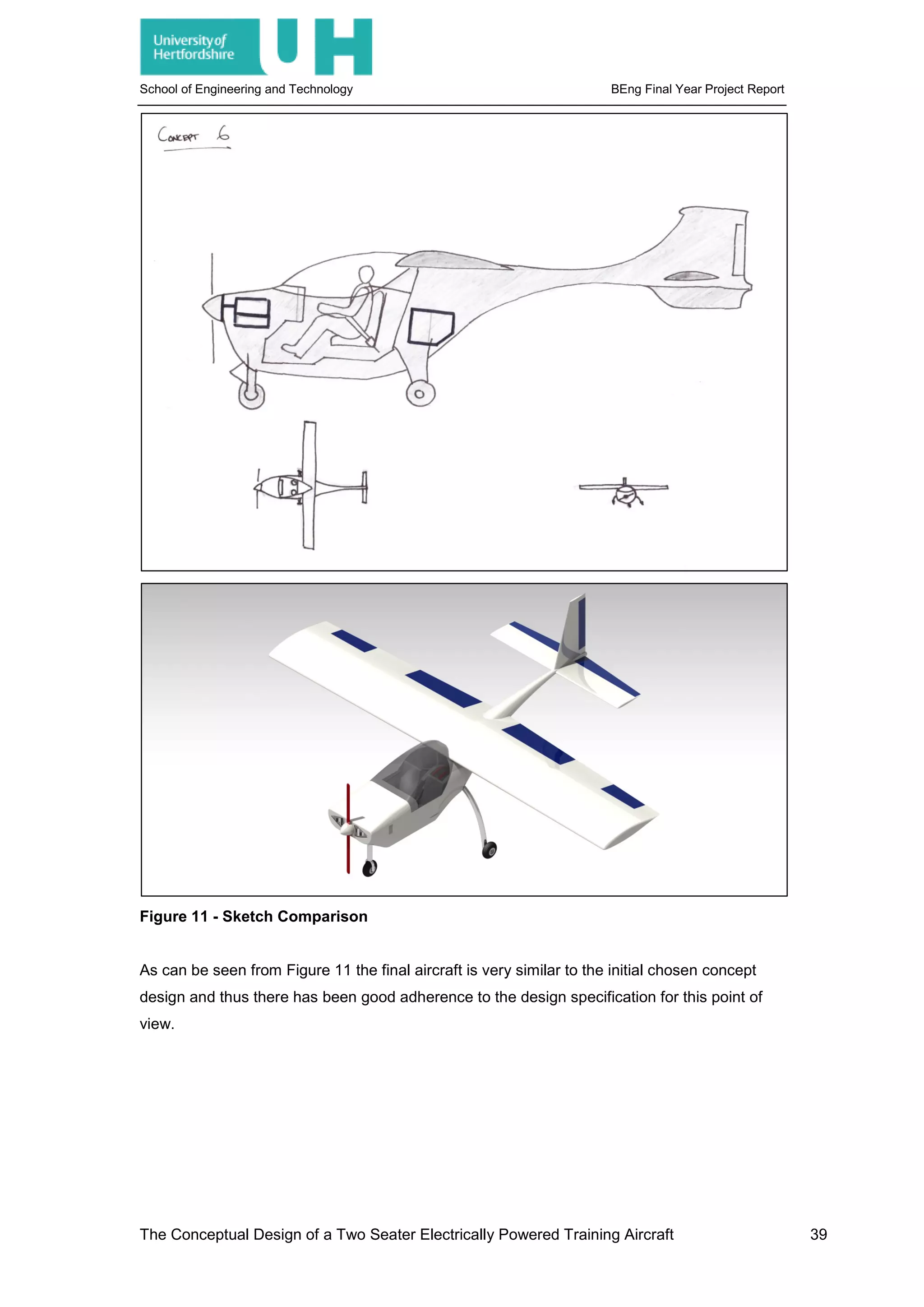
analysed with concept 6, Figure 5 being taken forward through the design process.
Figure 5 - Final Design Concept Sketch
3.1 Development Process
The development process adopted is a combination taken from [16] and [17], with the
theoretical methods used taken from [16] and a basis for the development process taken from
[17]. This development process will take the concept aircraft from initial concept to full 3D
model with an in depth analysis of critical characteristics and flying ability.
The Conceptual Design of a Two Seater Electrically Powered Training Aircraft 9
School of Engineering and Technology BEng Final Year Project Report
The development process is shown below:
Figure 6 - Design Development Process - [17]
This design development process will be used to develop the concept previously shown into a
full specification and final assembly; however it does not mark the end of the development
process. Further analysis into the structure, aerodynamic properties and flying qualities using
CFD, FEA and other simulations will be used to fully understand and improve the aircraft
characteristics which may not have shown during the design process. After this manufacturing
limitations will have to be assessed and finally several prototype aircraft would have to be
built and tested to verify the entire process. Even after the aircraft is manufactured however,
advances in technology and manufacturing may allow further development of the aircraft
technologies, and different but similar requirements may encourage development of different
aircraft variations upon the same initial design.
First Estimate
• MTOW
• Wing Area
• Drag Estimate
• Thrust at Cruise
Fuselage Design Wing Design First Layout Sketch
Second Estimate
• Drag
• Thrust Centre of Gravity Analysis Tail Design Second Layout Sketch
Third Estimate
• Drag
• Thrust Landing Gear Design Structural Design Drag and Thrust Analysis
Control Surface Design Third Layout Sketch
Final Weight and Centre of
Gravity
Final Performance
Analysis
Final Stability and Control
Analysis
Final Specification Fianl Assembly
The Conceptual Design of a Two Seater Electrically Powered Training Aircraft 10
School of Engineering and Technology BEng Final Year Project Report
4 Development of Aircraft Requirements
A description of how the aircraft requirements are selected from use of existing aircraft data
and a matching plot method is used to start the technical design of the aircraft, refer to
Appendix 1, Appendix 2 and Appendix 3 for further detail.
4.1 Existing Aircraft Data
Initially research revolves around analysing current aircraft used in general aviation and
training roles, this information can then be used to make assumptions around the wing
loading, structural weight, propulsion required and general dimensions of the aircraft. These
can give the designer an insight into the initial requirements for the aircraft design. It can also
be used to identify a market niche in terms of aircraft ability; this can be of particular interest if
the aircraft being designed is a cargo or freight aircraft for maximum take-off weight or for a
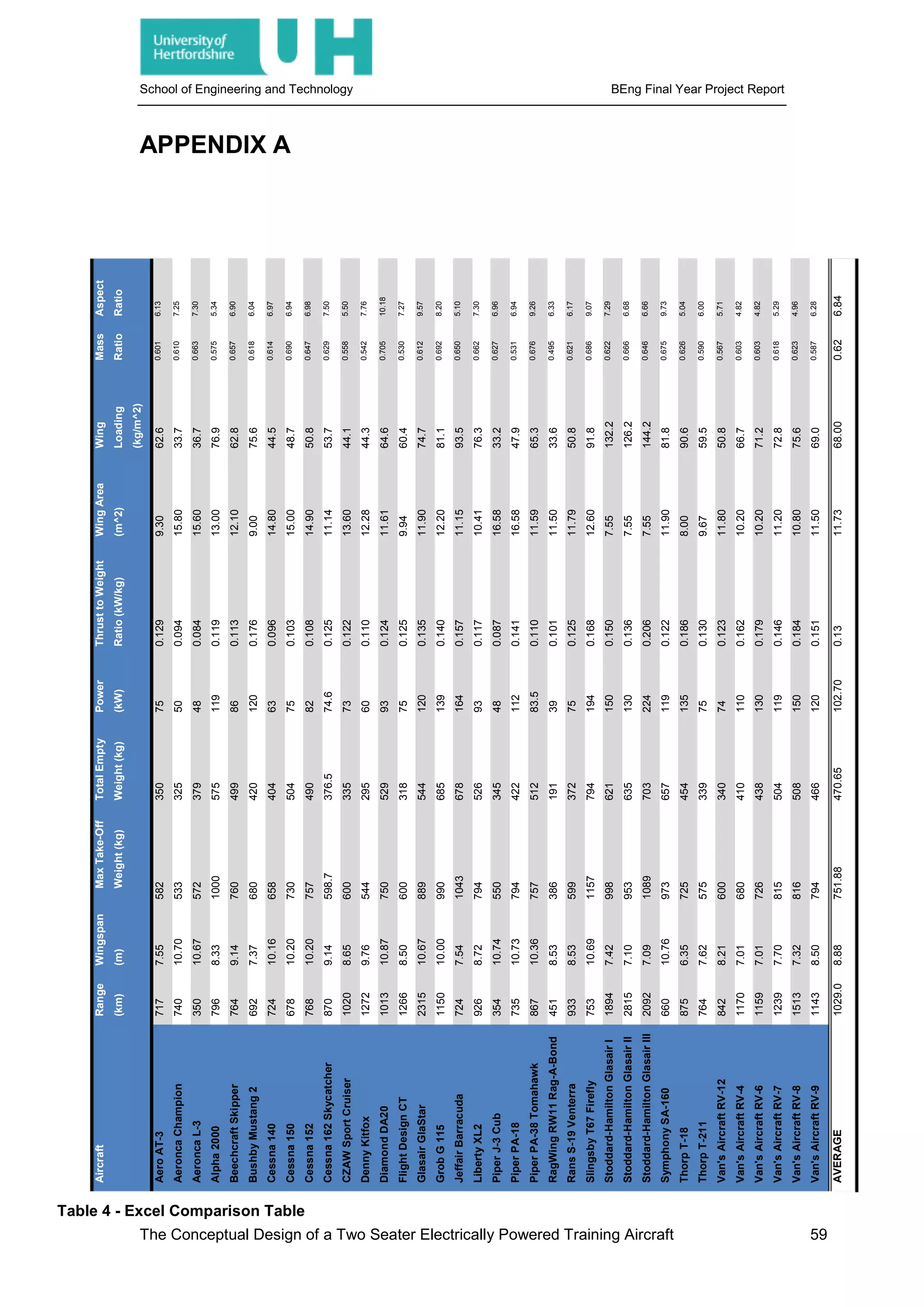
passenger aircraft for increased range. The data gathered is input into an excel table, Table
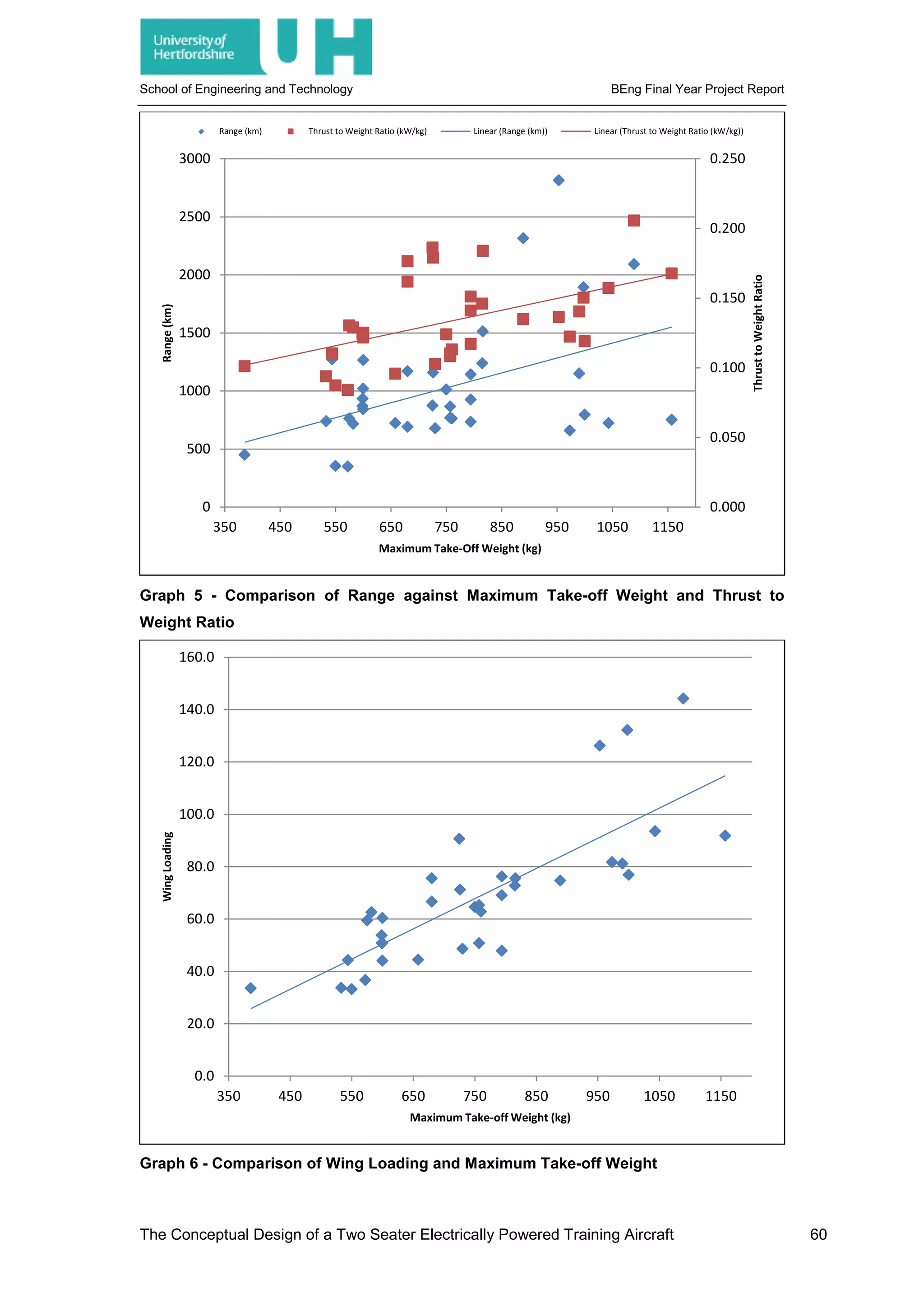
4, and several graphs are created to create an initial design specification. For this aircraft the
most useful comparisons are shown in Graph 5 and Graph 6 giving an estimated wing loading
for an aircraft of this type and an estimate of range and thrust to weight ratio.
4.1.1 Cessna 152
From analysis of the data found through the research process it can be seen that the Cessna
Aircraft Company 152 is the most successful aircraft of this type, therefore it will be the
benchmark for the aircraft development. By aiming the aircraft to be a similar but improved
aircraft to the Cessna 152 it can fill the same market sector as a modern replacement.
4.1.2 Cessna Aircraft Company History
Opening in 1911 Cessna began building test aircraft and in 1929 certified its first aircraft, with
the certification occurring on the same day as the 1929 stock market crash the Cessna DC-6
sold less than 25 airframes and the company closed in 1932. In 1934 it reopened and began
manufacturing for the US Army in 1940, in 1956 Cessna released the Cessna 172 the most
popular aircraft in aviation history selling over 43000 airframes and still in production. The
Cessna 172 as a 4 seat aircraft was developed and in 1958 the Cessna 152 was created, a 2
seat variant of the Cessna 172 with much the same airframe, over 22500 Cessna 152 have
been manufactured. With both these aircraft being recreational aircraft and aimed solely at
the civilian market it naturally became the primary trainer of choice for many flying schools,
with many still being used by flying schools today.
The Conceptual Design of a Two Seater Electrically Powered Training Aircraft 11
School of Engineering and Technology BEng Final Year Project Report
5 Initial Design Specification
A description of the use of existing aircraft data to create a design specification and the
creation of a matching plot to begin the technical design stage, refer to Appendix 2 for further
information.
From analysing the data found in Appendix 1 a selection of design aims can be chosen and a
design specification can be created, the design specification will drive all design decisions
and the final aircraft should fulfil all requirements laid out by it. In most cases, such as this,
the design specification can be used as a benchmark for the final aircraft, where if the aircraft
exceeds the requirements of the design specification it is more desirable. However in some
other cases, by exceeding the design specification given by a customer the aircraft may
become less desirable as it may become more costly, may fall into a category it wasn’t
intended for or may be less efficient such as carrying more cargo than available.
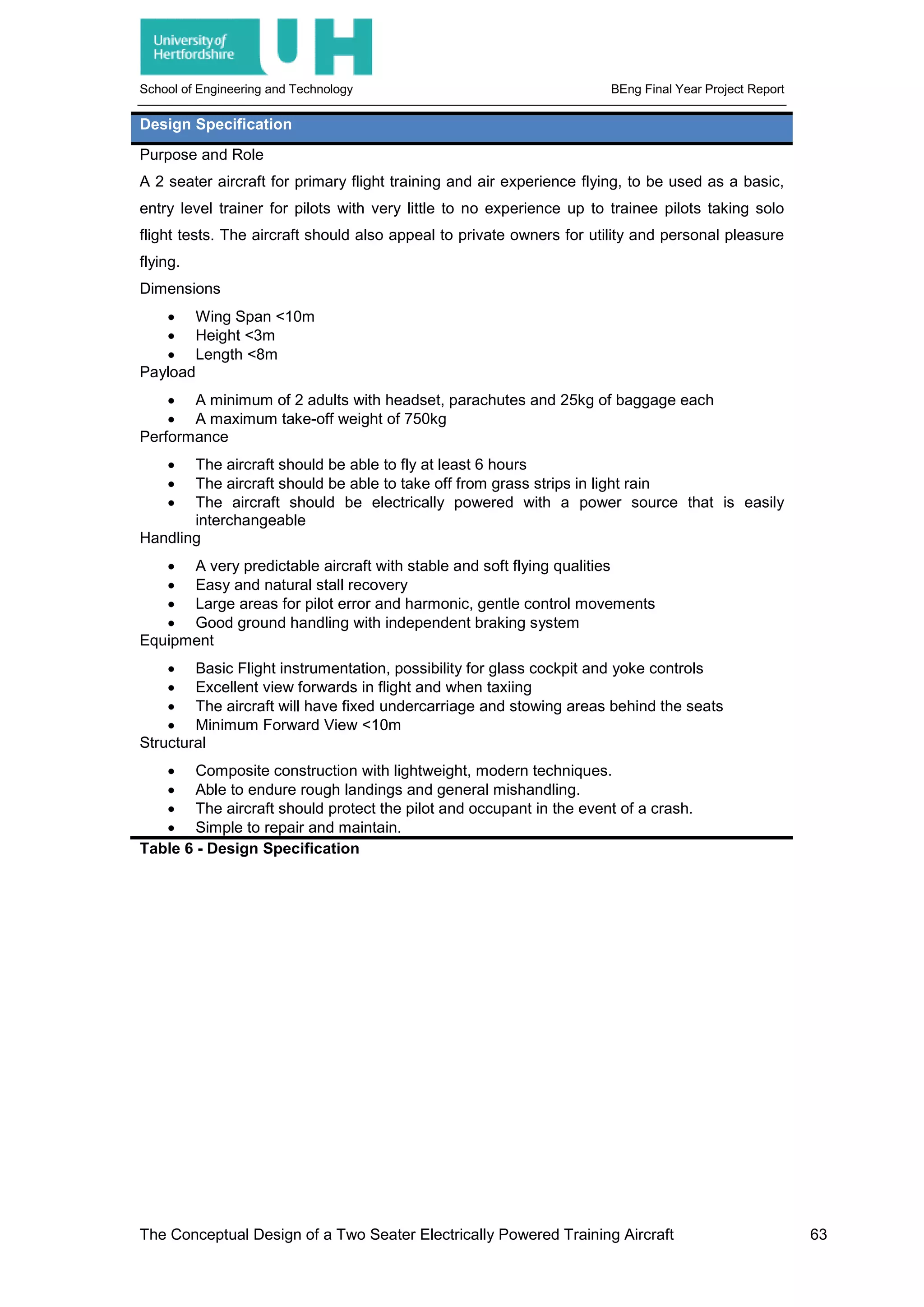
The data given in Appendix 1 is sorted and design aims are selected to beat the competitor
aircraft and therefore offer a more capable aircraft, using these aims a final design
specification can be created, Table 6, this design specification will be the minimum
acceptable specification for the final aircraft.
5.1 Matching Plot
To begin the design process a matching plot will be created, this uses a series of estimations
against the design aims to find the most critical design consideration for the aircraft, this gives
the most important requirement for the aircraft and thus the wing loading and power loading
so that the design process can begin. There are several parts to the matching plot all of which
are plotted and can be analysed, these are:
• Stall Speed
• Max Speed
• Take-Off Run
• Rate of Climb
• Ceiling
To begin the creation of the matching plot each of these is calculated in line with the design
aims.
5.2 Matching Plot Analysis
From calculation of all the required parts the matching plot can be constructed and analysed.
The Conceptual Design of a Two Seater Electrically Powered Training Aircraft 12
School of Engineering and Technology BEng Final Year Project Report
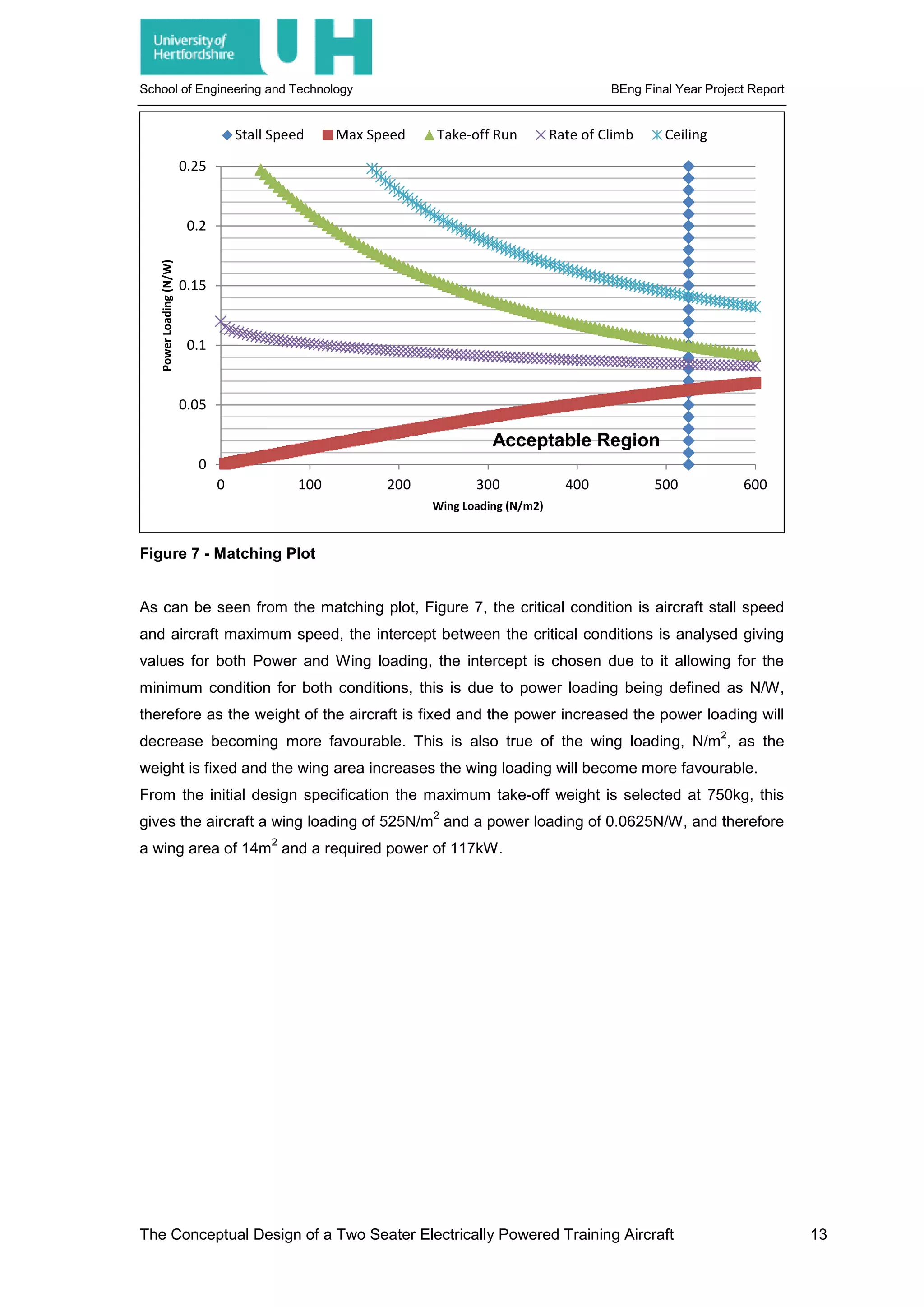
Figure 7 - Matching Plot
As can be seen from the matching plot, Figure 7, the critical condition is aircraft stall speed
and aircraft maximum speed, the intercept between the critical conditions is analysed giving
values for both Power and Wing loading, the intercept is chosen due to it allowing for the
minimum condition for both conditions, this is due to power loading being defined as N/W,
therefore as the weight of the aircraft is fixed and the power increased the power loading will
decrease becoming more favourable. This is also true of the wing loading, N/m
2
, as the
weight is fixed and the wing area increases the wing loading will become more favourable.
From the initial design specification the maximum take-off weight is selected at 750kg, this
gives the aircraft a wing loading of 525N/m
2
and a power loading of 0.0625N/W, and therefore
a wing area of 14m
2
and a required power of 117kW.
0
0.05
0.1
0.15
0.2
0.25
0 100 200 300 400 500 600
PowerLoading(N/W)
Wing Loading (N/m2)
Stall Speed Max Speed Take-off Run Rate of Climb Ceiling
Acceptable Region
The Conceptual Design of a Two Seater Electrically Powered Training Aircraft 13
School of Engineering and Technology BEng Final Year Project Report
6 Wing Design
A description of the how the aircraft wing aerofoil is selected and how Pradtl lifting line theory
is utilised to analyse and manipulate the lift distribution across the wing surface, refer to
Appendix 4 for further information.
6.1 Wing Aerofoil Selection
To begin the technical design of the aircraft the main lifting surface or wing must be designed,
the wing is made from an aerofoil cross section or multiple aerofoils and may have a twist,
camber, sweep and taper, each affecting the way it generates lift across its span. From
Appendix 2 and section 5.1 only one parameter for the wing is known and this is the wing
loading, a measure of how much force is upon each unit area of the wing.
6.1.1 Aircraft Flight Profile
To begin the wing design process the aircraft flight profile must be analysed, the flight profile
is a plotted flight for the aircraft giving the altitude and range or endurance of a single flight, in
the design process the flight profile is an idealised flight of the aircraft to allow for design
decisions to be made such as cruise altitude, cruise speed, range, endurance and climb
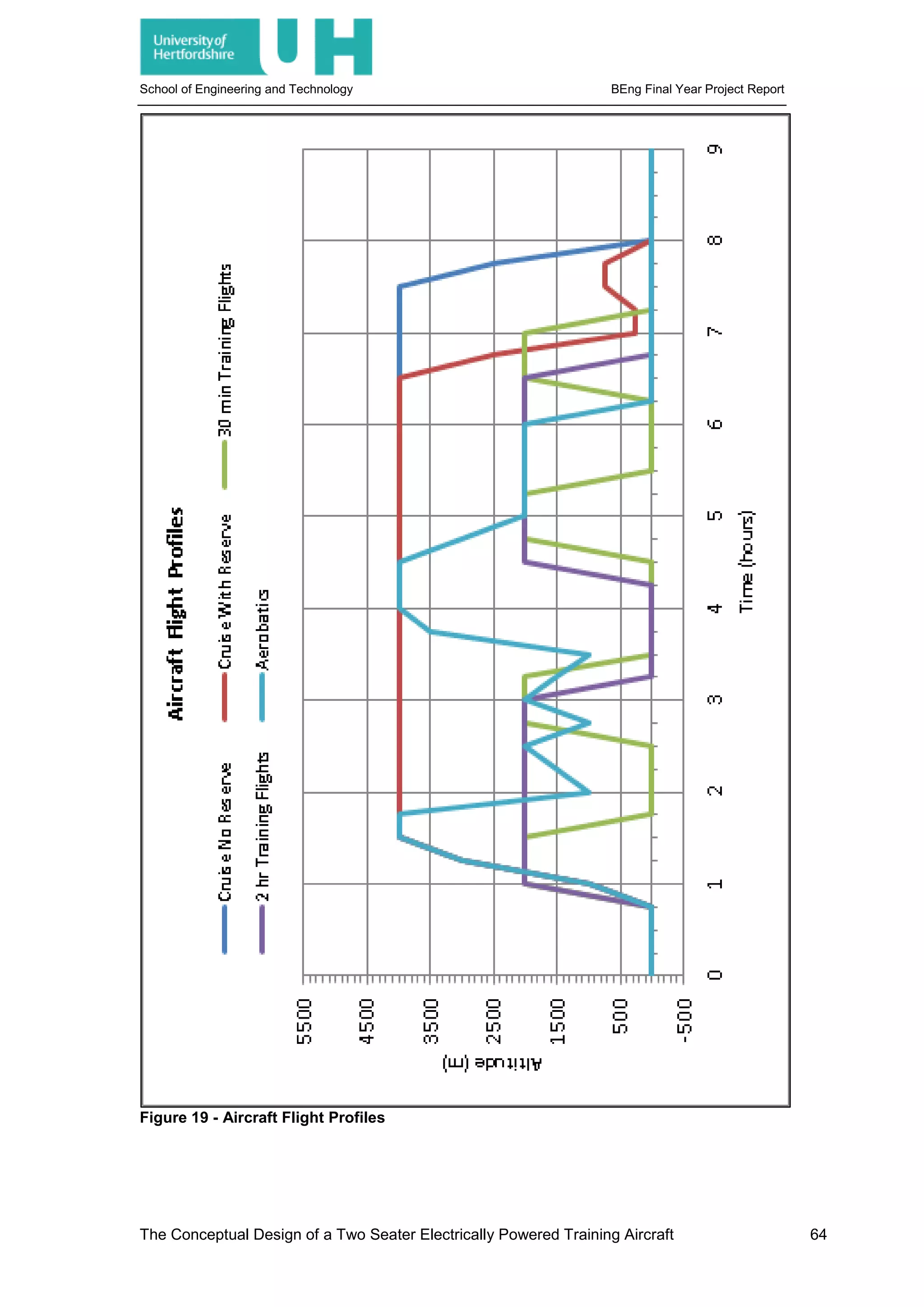
rates. The aircraft flight profiles are created and shown in Figure 19, it is then clear that the
aircraft will cruise at a height of 4500m for approximately 5 hours with reserve fuel left.
Therefore the aircraft wing must be able to produce lift at an altitude of 4500m, therefore the
requirement for wing lift can be analysed and the wing can be designed.
6.1.2 Lift Coefficient Requirements
The wing design requires an aerofoil or several to create the wing, as the aircraft flight profile
is now available the lift coefficients required of the wing can be found and a suitable aerofoil
can be designed or selected. Initially for this process 3 parameters are required;
• Ideal wing aerofoil cruise lift coefficient, 𝐶𝐶𝑙𝑙𝑙𝑙, the lift coefficient required of the aerofoil
to maintain straight and steady level flight.
• Wing aerofoil gross maximum lift coefficient, 𝐶𝐶𝑙𝑙 𝑀𝑀𝑀𝑀𝑀𝑀 𝐺𝐺𝐺𝐺𝐺𝐺𝐺𝐺𝐺𝐺, the lift coefficient required of
the aerofoil at take-off with flaps.
• Wing aerofoil net maximum lift coefficient, 𝐶𝐶𝑙𝑙 𝑀𝑀𝑀𝑀𝑀𝑀, the lift coefficient required of the
wing aerofoil at take-off without flaps.
With these three parameters calculated an aerofoil can be selected from those already
designed or a completely new aerofoil can be designed, due to the low cost market that this
aircraft is targeting an existing aerofoil will be selected as this reduces development costs.
The Conceptual Design of a Two Seater Electrically Powered Training Aircraft 14
School of Engineering and Technology BEng Final Year Project Report
6.1.3 Wing Aerofoil Cruise Lift Coefficient, 𝑪𝑪𝒍𝒍𝒍𝒍
The calculation of 𝐶𝐶𝑙𝑙𝑙𝑙 requires three already chosen parameters, maximum take-off weight,
wing loading and aircraft cruise speed, these two can be input into the general lift equation
and 𝐶𝐶𝑙𝑙𝑙𝑙 can be calculated. Therefore using the aircraft cruise speed of 110 knots, mass of
750kg, wing area of 14m
2
and a cruise altitude of 4500m it is found that the 𝐶𝐶𝑙𝑙𝑙𝑙 required is
approximately 0.5.
6.1.4 Wing Aerofoil Gross Maximum Lift Coefficient, 𝑪𝑪𝒍𝒍 𝑴𝑴𝑴𝑴𝑴𝑴 𝑮𝑮𝑮𝑮𝑮𝑮𝑮𝑮𝑮𝑮
The calculation of 𝐶𝐶𝑙𝑙 𝑀𝑀𝑀𝑀𝑀𝑀 𝐺𝐺𝐺𝐺𝐺𝐺𝐺𝐺𝐺𝐺 again requires parameters lain out in section 6.1.3, however for
this calculation the stall speed is used instead of cruise speed, this gives the worst flying
condition required of the wing and thus the greatest amount of lift it must produce with flaps.
Using a stall speed of 45 knots, mass of 750kg, wing area of 14m
2
and altitude of 0m it is
found that the 𝐶𝐶𝑙𝑙 𝑀𝑀𝑀𝑀𝑀𝑀 𝐺𝐺𝐺𝐺𝐺𝐺𝐺𝐺𝐺𝐺 required is approximately 1.87.
6.1.5 Wing Aerofoil Net Maximum Lift Coefficient, 𝑪𝑪𝒍𝒍 𝑴𝑴𝑴𝑴𝑴𝑴
The calculation of 𝐶𝐶𝑙𝑙 𝑀𝑀𝑀𝑀𝑀𝑀 is the calcualtion of the maximum lift coefficient of the wing without
the effect of flaps, this is calculated by analysing the lift coefficient of similar aircraft with flaps
and substituting this from the 𝐶𝐶𝑙𝑙 𝑀𝑀𝑀𝑀𝑀𝑀 𝐺𝐺𝐺𝐺𝐺𝐺𝐺𝐺𝐺𝐺, a general aviation aircraft of this weight generally
has a ∆𝐶𝐶𝑙𝑙 𝐻𝐻𝐻𝐻𝐻𝐻 of around 0.7 [16] and therefore the aircraft 𝐶𝐶𝑙𝑙 𝑀𝑀𝑀𝑀𝑀𝑀 𝐺𝐺𝐺𝐺𝐺𝐺𝐺𝐺𝐺𝐺 is approximately 1.17.
With this calculation complete all required lift coefficients have been found for the aircraft and
thus an aerofoil can be selected. For benefits in manufacturing and development the wing will
consist of a single aerofoil profile across its length therefore reducing development time and
costs and reducing manufacturing complexity, time and cost.
6.1.6 Aerofoil Selection
When selecting the aerofoil there are several parameters that must be considered;
• Lift coefficients, 𝐶𝐶𝑙𝑙𝑙𝑙, 𝐶𝐶𝑙𝑙 𝑀𝑀𝑀𝑀𝑀𝑀 𝐺𝐺𝐺𝐺𝐺𝐺𝐺𝐺𝐺𝐺 and 𝐶𝐶𝑙𝑙 𝑀𝑀𝑀𝑀𝑀𝑀, all of which are calculated.
• Drag coefficient, 𝐶𝐶𝑑𝑑 𝑚𝑚𝑚𝑚 𝑚𝑚, the minimum drag condition of the aerofoil at the ideal lift
coefficient, this must be as small as possible to reduce the amount of drag produced
by the wing at cruise.
• Pitching moment coefficient, 𝐶𝐶𝑚𝑚0, the pitching moment of the aerofoil at 0° alpha, this
must be as small as possible to reduce the pitching moment produced by the wing at
cruise and thus reduce horizontal stabiliser size.
• Stall angle, ∝𝑆𝑆, the stall angle of the aerofoil at both 0° and 60° flap extension, this
must be as high as possible therefore allowing lift at higher angles of attack and
increasing flight safety.
• Stall quality, the qualities of the aerofoil after the stall, due to the requirement for the
aircraft to be a docile primary trainer and general private aviation aircraft the stall
The Conceptual Design of a Two Seater Electrically Powered Training Aircraft 15
School of Engineering and Technology BEng Final Year Project Report
quality of the aerofoil must be moderate or soft to reduce the danger of the stall upon
the aircraft flight.
As stated already the aerofoil will be selected from those already designed, these are
available in several texts such as [18], the available aerofoils can then be placed into a table
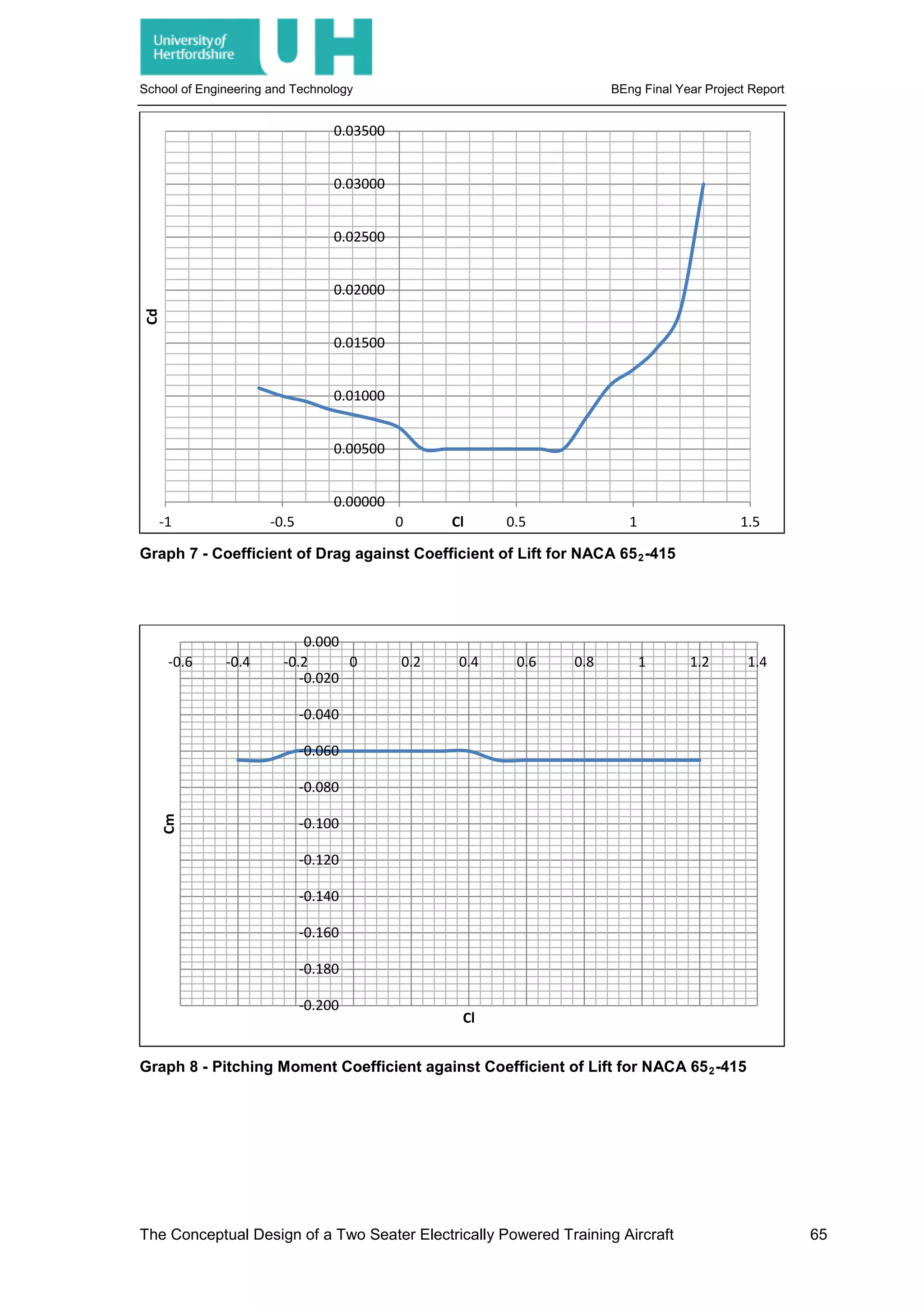
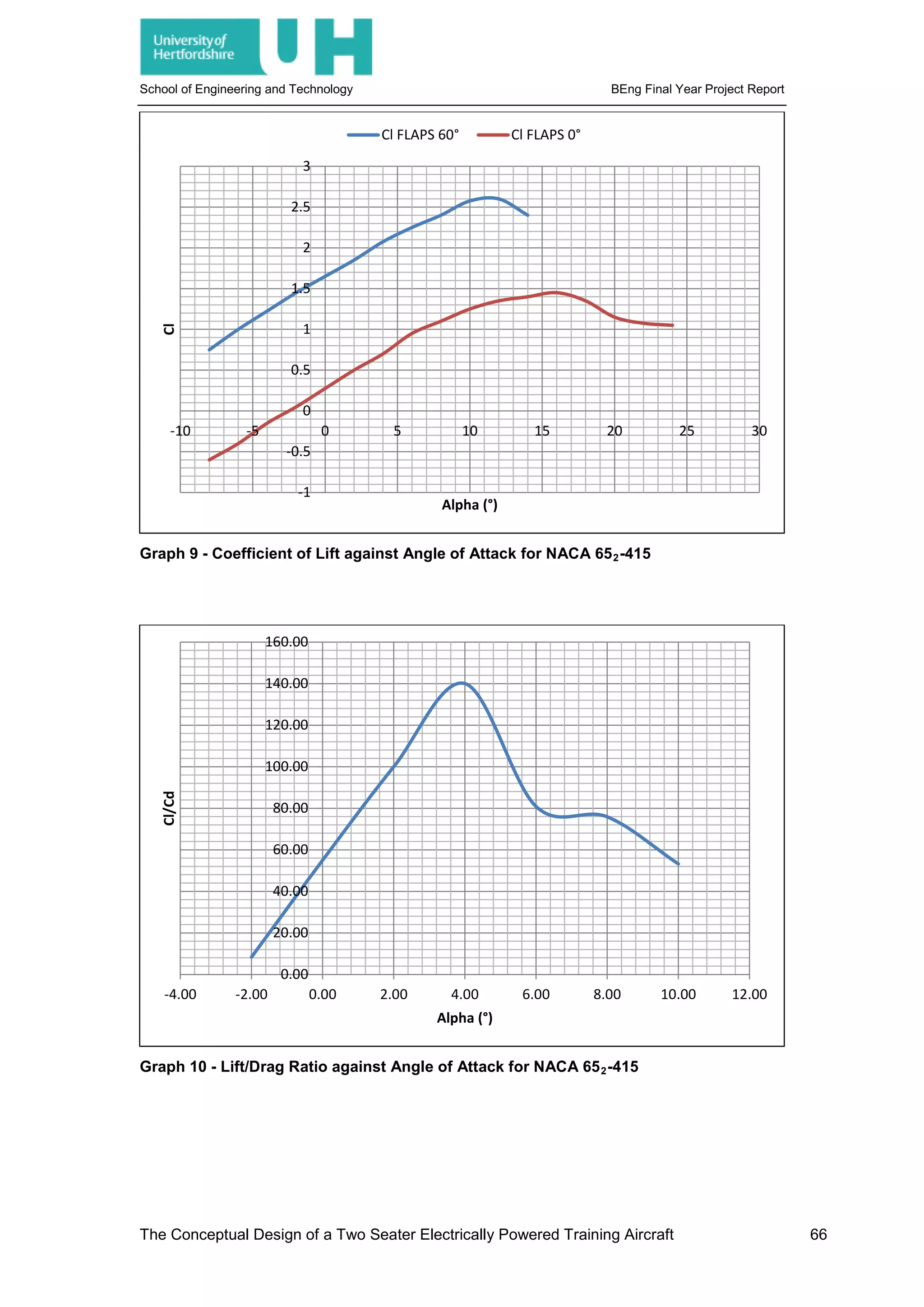
and analysed for their suitability. It is found that NACA Profile 652-415 is the most suitable
due to its appropriate lift coefficients, low drag coefficients, low pitching moment, high stall
angles and soft stall qualities. The aerofoil graphs are shown in Graph 7, Graph 8, Graph 9
and Graph 10.
6.2 3D Wing Design
With the selection of an aerofoil the wing can be designed, to analyse the 3D properties of the
wing Pradtl lifting line theory is used in MatLab, Code 1, Pradtl’s lifting line theory is generally
accurate and offers an excellent insight into how a lifting surface will perform for a given set of
parameters. The base wing is then turned into several variables, Code 2, and an iterative
process can be started to maximise the efficiency of the wing and make sure it’s suitable for
its intended application.
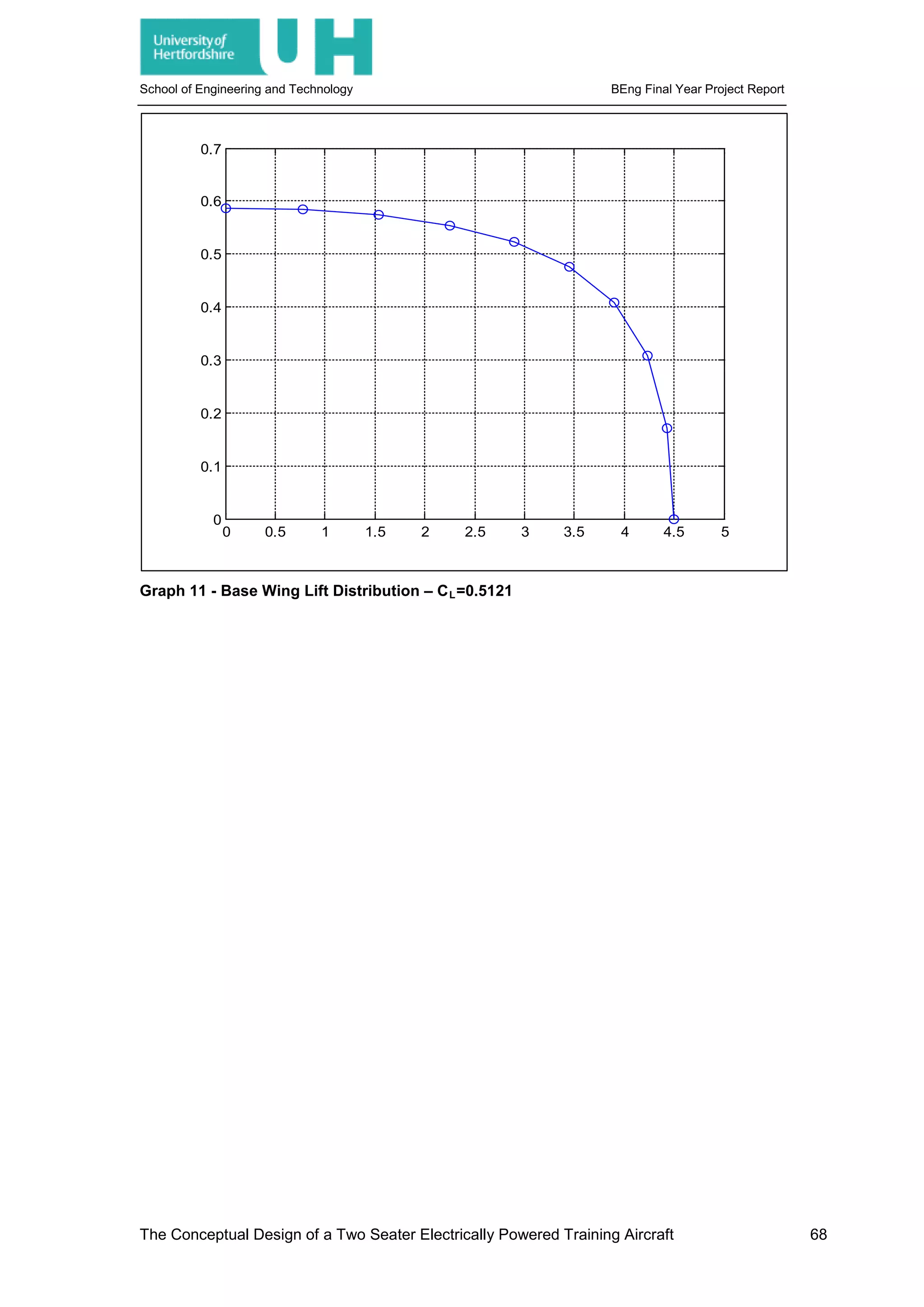
As can be seen from Graph 11 the lift distribution across the wing is non-elliptical, this has
several non-desirable consequences but most importantly for this aircraft the non-elliptical
distribution will promote tip stall, this condition is when the tip of the wing stalls at the same
time as, or before, the root of the wing. This causes a loss of roll control and makes recovery
from the stall more difficult, in a training aircraft this condition is entirely undesirable and
therefore must be designed out. There are several ways this condition can be designed out,
these include the introduction of taper, twist, sweep and a change in aspect ratio, as the
aspect ratio is fixed and sweep is unnecessary due to the sweep being more important in
transonic and supersonic aircraft the change in twist and taper must be analysed.
6.2.1 Taper Ratio
As the taper ratio increases the lift generated at the tip of the aerofoil increases, however so
does the lift across the entire surface, it can be seen that the rectangular wing has a good lift
distribution where as a wing with a taper ratio of 0 has a very undesirable wing lift distribution
for a training aircraft.
6.2.2 Twist
As the twist of the wing increases the lift generated at the tip of the aerofoil decreases,
however so does the lift across the entire surface, it can be seen that as the wing increases
twist the lift distribution becomes more elliptical and thus more suitable, however this is at the
expense of lift.
The Conceptual Design of a Two Seater Electrically Powered Training Aircraft 16
School of Engineering and Technology BEng Final Year Project Report
6.2.3 Resulting Wing
Through an iterative process, comprising many wing configurations the most suitable
configuration is selected, this wing offers a good compromise between the parameters whilst
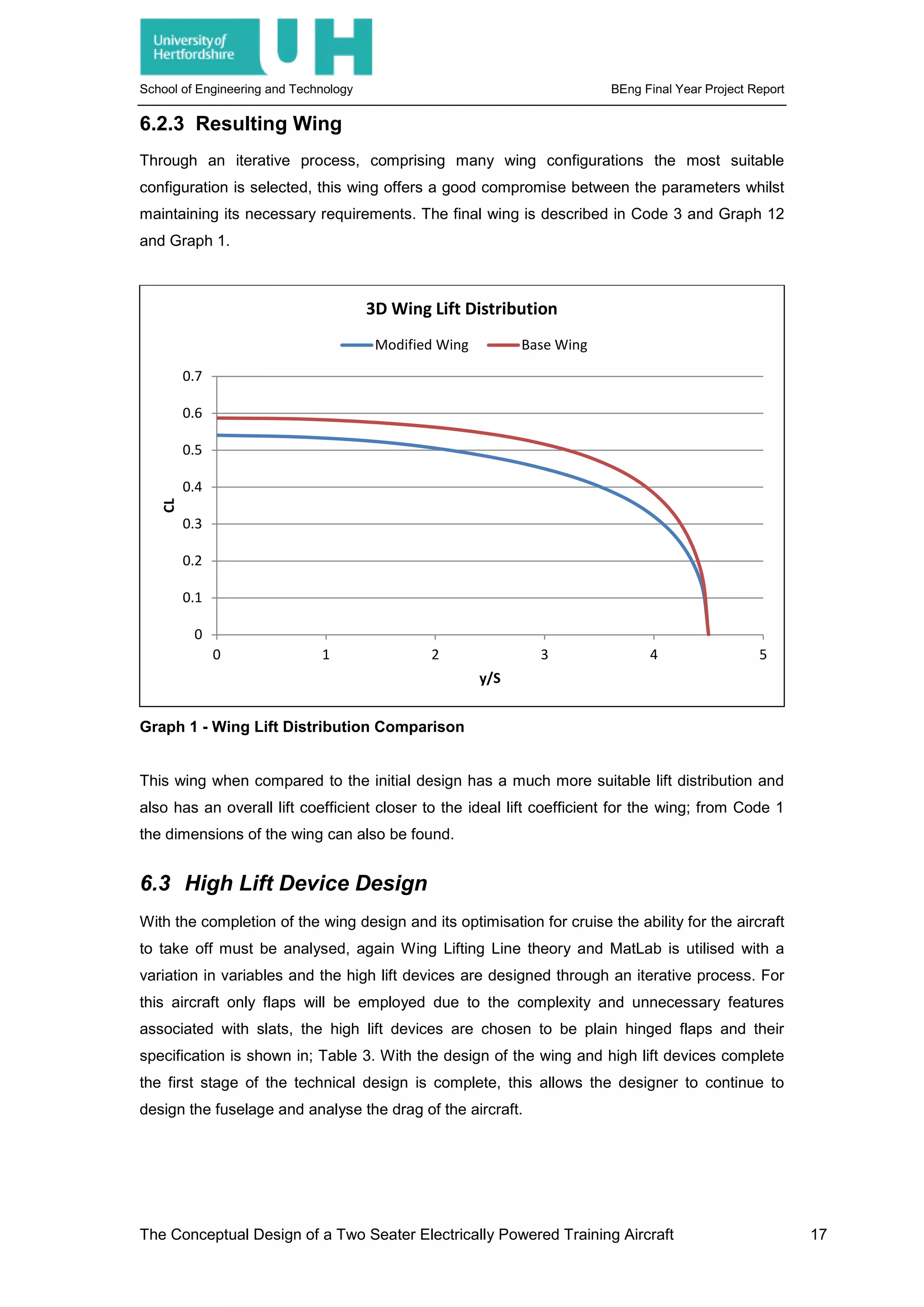
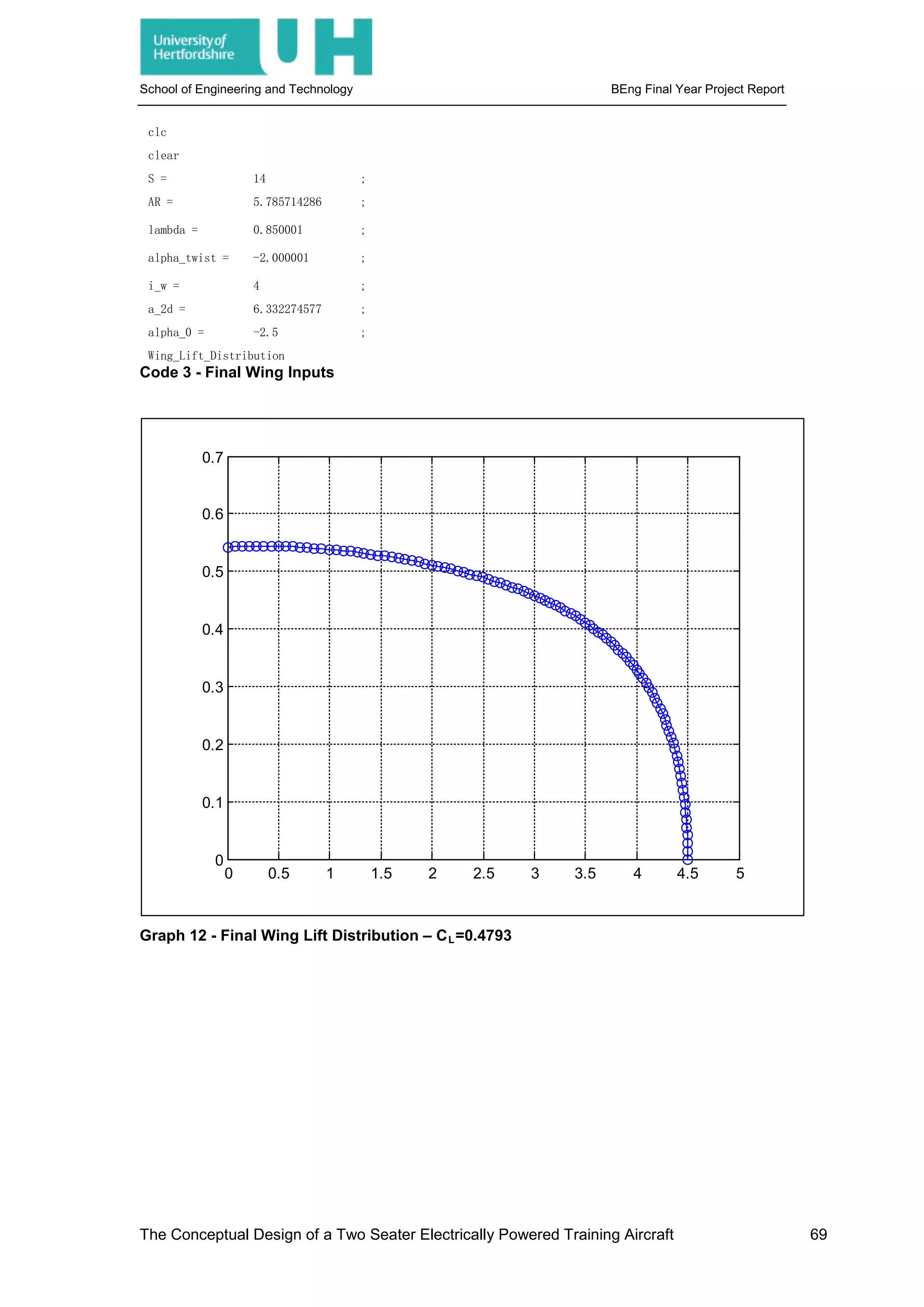
maintaining its necessary requirements. The final wing is described in Code 3 and Graph 12
and Graph 1.
Graph 1 - Wing Lift Distribution Comparison
This wing when compared to the initial design has a much more suitable lift distribution and
also has an overall lift coefficient closer to the ideal lift coefficient for the wing; from Code 1
the dimensions of the wing can also be found.
6.3 High Lift Device Design
With the completion of the wing design and its optimisation for cruise the ability for the aircraft
to take off must be analysed, again Wing Lifting Line theory and MatLab is utilised with a
variation in variables and the high lift devices are designed through an iterative process. For
this aircraft only flaps will be employed due to the complexity and unnecessary features
associated with slats, the high lift devices are chosen to be plain hinged flaps and their
specification is shown in; Table 3. With the design of the wing and high lift devices complete
the first stage of the technical design is complete, this allows the designer to continue to
design the fuselage and analyse the drag of the aircraft.
0
0.1
0.2
0.3
0.4
0.5
0.6
0.7
0 1 2 3 4 5
CL
y/S
3D Wing Lift Distribution
Modified Wing Base Wing
The Conceptual Design of a Two Seater Electrically Powered Training Aircraft 17
School of Engineering and Technology BEng Final Year Project Report
7 Fuselage Design
A description of the how the aircraft fuselage was designed with the final elevation views for
the cockpit section; refer to Appendix 5 for further information.
The fuselage design centres around the design specification and the drag of the aircraft, it
encompasses the design of all major fuselage components including the cockpit layout,
engine compartment layout, landing gear and wing box layout and any required compartment
or cargo space required. Like all other process involved in the design development the
fuselage will be subject to iterations to maintain the required specifications and reduce drag
for the aircraft. Initially for the fuselage design the most important requirements must be
analysed; in this case, for a two seater training aircraft and using the design specification the
most important requirements are identified as:
• Two seats Side by Side
• Storage for Baggage
• Storage for Removable Fuel Source
• Good Fore and Lateral View
From the concept analysis in Appendix 3 there are several more requirements:
• High Wing
• Tricycle Undercarriage
• Fore Mounted Motor
From these requirements the most important and largest is the cockpit section and thus it
begins the design process, using a modelling tool such as Dassault Systems CATIA software
the aircraft is 3D modelled however this will be discussed in section 15, the initial fuselage
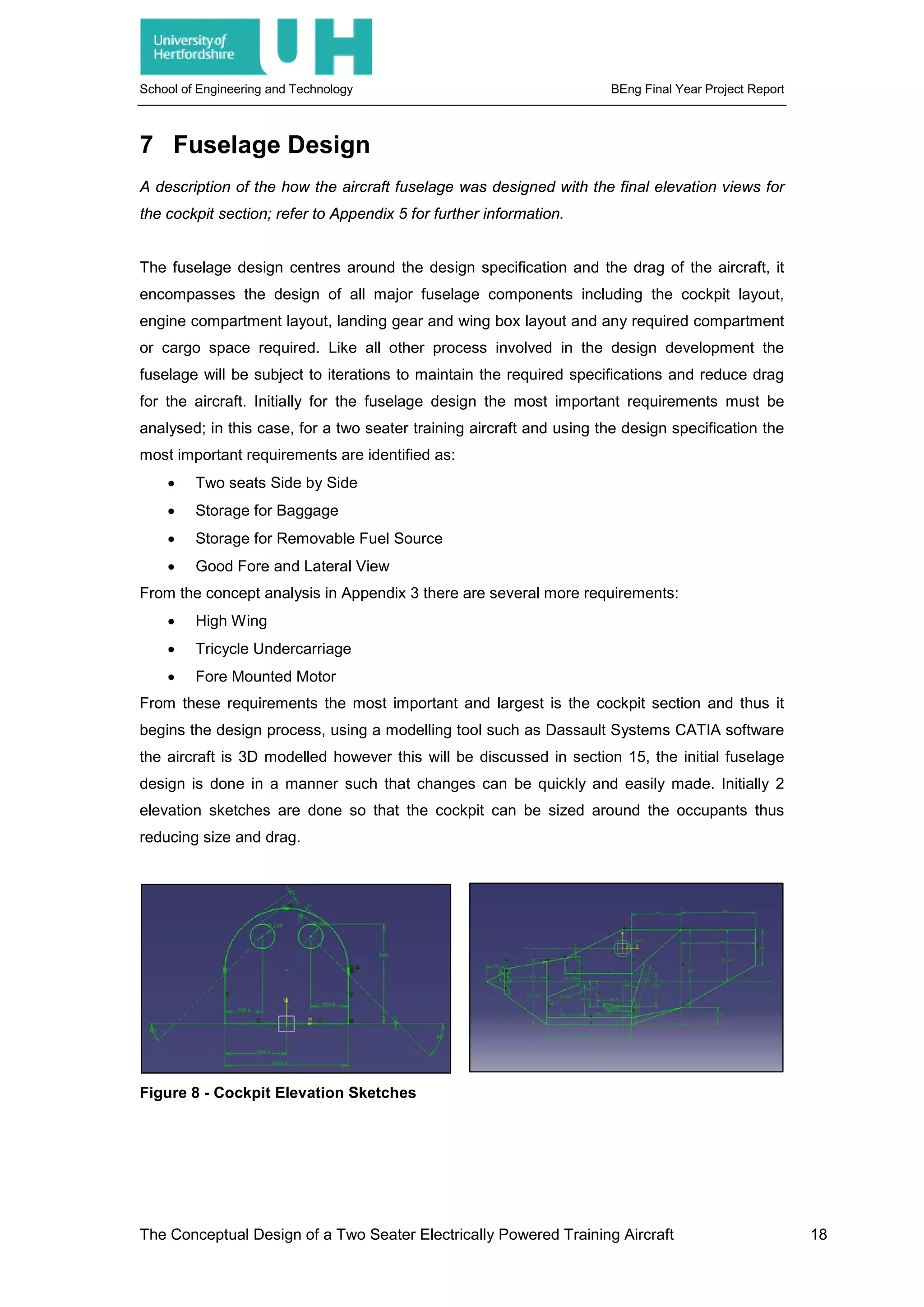
design is done in a manner such that changes can be quickly and easily made. Initially 2
elevation sketches are done so that the cockpit can be sized around the occupants thus
reducing size and drag.
Figure 8 - Cockpit Elevation Sketches
The Conceptual Design of a Two Seater Electrically Powered Training Aircraft 18
School of Engineering and Technology BEng Final Year Project Report
8 Drag Analysis
A description of the how the aircraft drag is analysed and how each component contributes to
the overall drag of the aircraft, refer to Appendix 5 for further information.
Using data taken from Appendix 4, 7 and 8 the drag analysis can begin, the drag upon an
aircraft is the force exerted by the air the aircraft is travelling through due to the mass
component of air. However due to the density of air changing with altitude drag forces
decrease as aircraft gain altitude, along with decreased drag however the less dense air
causes decreased lift therefore limiting the height the aircraft can fly and the drag reduction
they can exploit. Along with the physical mass effect of air against the motion of the aircraft,
parasitic drag is the induced drag created by the wing lift.
8.1 Parasitic Drag
Aircraft parasitic drag is the resistance to the aircraft movement caused by all components of
the aircraft and their contact with the air, parasitic drag comes in several forms and can
account for most of the drag generated by a light general aviation aircraft, the forms of
parasitic drag are;
• Profile drag compromised of:
o Pressure Drag, the effect of the pressure field within the boundary layer of air
around the component.
o Skin Friction Drag, the mechanical effect of the air particles against the
surfaces of the aircraft within the boundary layer.
• Interference Drag, the effect of the interaction between the boundary layers and
pressure distributions between components of an aircraft that are in close proximity to
one another.
• Cooling Drag, the effect of ducting air through heat exchangers and cooling
components and the pressure drop associated.
• Wave Drag, the effect of shock waves associated with supersonic and hypersonic air
flow.
8.2 Induced Drag
Induced drag is the drag caused as a result of the aerodynamic lift created by the wing and
the vortex systems behind the aircraft that this creates, as shown in Figure 9 the effect of the
wing upon the airflow causes it to be pushed in a slight downwards direction, this causes the
lift to be produced at an angle behind perpendicular to the aerofoil and thus a drag
component is introduced into the lift production.
The Conceptual Design of a Two Seater Electrically Powered Training Aircraft 19
School of Engineering and Technology BEng Final Year Project Report
Figure 9 - Induced Drag - [19]
This induced drag factor increases and decreases with the amount of lift created by the
aerofoil and similarly to parasitic drag decreases with altitude, however due to the high
amount of lift required when an aircraft is flying slowly induced drag is very high when an
aircraft is at take-off and can cause dangerous conditions at the stall.
8.3 Total Aircraft Drag
With the calculation of parasitic and induced drag, the total drag for the aircraft can be
analysed for the most extreme aircraft conditions, this is calculated for both the aircraft take-
off condition and the aircraft cruise condition giving the results shown below in; Graph 2 and
Graph 3.
Graph 2 - Comparison of Component Drag at Cruise
Fuselage
Wing
Nose Gear
Main Gear
Horizontal Stabaliser
Vertical Stabaliser
Incident
airflow
Lift
Net direction of airflow past aerofoil
Net direction of airflow
past aerofoil
Incident
airflow
Induced drag
Lift
The Conceptual Design of a Two Seater Electrically Powered Training Aircraft 20
School of Engineering and Technology BEng Final Year Project Report
Graph 3 - Comparison of Component Drag at Take-Off
8.4 Minimum Drag Condition
Along with the drag analysis requirement for power plant selection it can also be used to find
the minimum drag condition, this is the condition at which the aircraft flies at its most efficient
and therefore has its greatest endurance, for cruise at 4000m this maximum endurance
speed is 47 knots.
Graph 4 - Total Aircraft Drag at 4000m
Fuselage
Wing
Nose Gear
Main Gear
Horizontal Stabaliser
Vertical Stabaliser
0
500
1000
1500
2000
2500
3000
3500
4000
4500
5000
0 10 20 30 40 50 60 70 80 90
DragForce(N)
Aircraft Speed (knots)
Parasitic Drag Induced Drag Total Drag
The Conceptual Design of a Two Seater Electrically Powered Training Aircraft 21
School of Engineering and Technology BEng Final Year Project Report
9 Landing Gear Design
A description of the how the aircraft landing gear configuration is specified and designed,
including the calculation of the static and dynamic loads upon each wheel and the
specification of brake systems and tyres, for further information refer to Appendix 7.
The landing gear for an aircraft is the components on which the aircraft stands, designed to
hold the aircraft off the ground for engine or propeller clearances and a means of landing the
aircraft without damaging aircraft components, landing gear may be of many forms, with
wheels being common but other forms such as skids, skies, floats or keels can also be used.
The aircraft has been chosen to use a tricycle undercarriage arrangement utilising a fixed
wheeled landing gear configuration, the landing gear design process begins with the ranking
of the landing gear requirements so that the worst condition for the landing gear can be
identified.
The propeller clearance is the worst case scenario for the undercarriage and thus the
propeller clearance will dictate the length of the undercarriage, the aircraft landing gear height
is calculated as 0.77m from the aircraft fuselage and 1.36m from the aircraft centreline. With
the height of the landing gear selected the aircraft track and base must be defined, the
landing gear track is the distance between the main gear laterally and the base is the distance
between the main and nose or tail gear. For an aircraft with tricycle landing gear around 85%
of the aircraft weight is required on the main gear and to maintain control during the taxi
around 15% of the aircraft weight is required on the aircraft nose gear [16]. The main gear
position is found to be at 0.2m behind the foremost aircraft centre of gravity, using the tricycle
undercarriage loading requirement force on the main gear is found to be 6475N and the force
at the nose gear is found to be 883N, it is found that the aircraft requires a base of 1.67m
placing the main gear at 2.66m from the nose and the main gear 1m from the nose. However
the landing gear must be specified for landing, with the downward velocity of the aircraft
causing the dynamic loading upon the aircraft to be greater than the static loading. To
account for this velocity component a factor of 1.5 – 2 can be applied to the force upon the
landing gear and thus the maximum expected loading upon each wheel is shown in Table 7,
again for decreased cost and development time an existing component is selected, specified
in Appendix 7a and Appendix 7b. The landing gear is also used for braking during landing.
The aircraft will land between 54knots and 45 knots, causing at maximum 144583Nm of
Kinetic Energy per wheel, the brakes will consist of two Kevlar based brake pads clamping
onto a steel brake disc by means of a hydraulic brake system.
The Conceptual Design of a Two Seater Electrically Powered Training Aircraft 22
School of Engineering and Technology BEng Final Year Project Report
10 Structural Design
A description of the how the aircraft structural configuration is specified and designed, refer to
Appendix 7 for further information.
The structure of the aircraft has two main functions, one to hold all components of the aircraft
together and prevent structural failure of any component and two, to protect the passengers in
the event of a failure or crash. Therefore the structure must be strong enough the both
maintain structural integrity during all flight conditions and strong enough to protect the pilot
and co-pilot in the event of a crash, however due to its relatively high weight component it
must also be as light as possible, the aim of the structural design is to fulfil both these
conditions in the most efficient way possible. Therefore the aircraft structure is split into two
sections with failure and crash critical components being those that are critical to the survival
of passengers during a crash or failure and flight critical being those components that are
critical to the flight of the aircraft.
10.1Flight Critical Components
The flight critical components are the components which the aircraft requires to fly, the wings
of the aircraft are considered initially due to the similarity of the structure to those of the
horizontal and vertical stabiliser, using Pradtl’s lifting line theory again the wing lift distribution
of the aerodynamic surface is analysed and the force upon several sections is calculated, the
structure in the wing will be required to offset this force at its maximum, each wing structure
will consist of a main and rear spar and several ribs. The tail arm is required to resist the force
of the horizontal and vertical stabiliser as its corrects the aircraft pitching moment and thus
must be strong enough in both the lateral and vertical motion, the engine bay must also be
strong enough to hold all major engine components throughout the flight and resist the torque
effect of the motor throughout the flight.
10.2Failure and Crash Critical Components
The failure and crash critical components are the components which the aircraft requires to
maintain structural integrity in the event of failure or a crash scenario, again this category can
be split into two sub-categories being crash condition and catastrophic failure condition with
the cockpit structure being required in the crash condition and firewall structure being required
in a catastrophic failure such as engine fire or battery fire. The most important of these is the
survival of the cockpit section in a crash situation and thus the structure in this section must
be built to a suitable standard. The design of the aircraft structures for failure and crash
critical components is discussed in Appendix 9; the design however has been built to
withstand a force of around 29430N which represents a 4g crash.
The Conceptual Design of a Two Seater Electrically Powered Training Aircraft 23
School of Engineering and Technology BEng Final Year Project Report
11 Propulsion System Design
A description of the how the aircraft propulsion system is specified and designed, including
the calculation of the thrust and power requirements for the electric motor, selection of the
electric motor and specification of the propeller.
The aircraft power plant is the system the aircraft uses to produce thrust, offsetting the drag of
the aircraft and producing forward velocity and thus lift, the power plant is selected based on
the thrust requirements of the aircraft at cruise and take-off, for this aircraft a sole electric
propulsion system is selected using a removable fuel source and an electric motor.
11.1.1 Propulsion System Type Selection
Initially a propulsion method is selected, for a conventional aircraft this would be a selection
between a prop driven or jet aircraft, and then a selection between turbo-prop, conventional
prop, turbo fan, turbo jet, ram jet or a combination of these or others. However the designed
aircraft is not conventional, the selection of an electric fuel source limits the current available
technology to an electric motor and thus a prop driven aircraft, however electric jet engines
are in development using the same principles as conventional jet engines however currently
these are highly inefficient for the application proposed, mostly being used as propulsion for
model aircraft or spacecraft during orbital manoeuvres. Therefore as the aircraft would be
aimed at targeting a near future customer the electric motor is selected with a prop driven
aircraft configuration.
11.1.2 Fuel System Type Selection
With the propulsion system type selected a power source is required, within the design
specification the power source is required to be removable, this limits the available types of
power source that can be used. Most simply a battery could be used to store the electric
energy and this could be ducted to the motor much like a conventional aircraft, also
conceivable is a mixture of solar and battery power, much like that used on some solar
aircraft today, the combination of battery and solar ‘recharge’ would work much like a
conventional aircraft fuel system with the batteries being topped up through the flight. Other
modern technologies that could be exploited are Formula 1’s kinetic energy recovery system
or ram air turbines exploiting the wasted energy created in braking and through flight however
neither could be the sole provider of power for the aircraft. Also conceivable is the use of
hydrogen power cells to generate the required power working in an almost identical way to
conventional fuel aircraft however this would require the storage of hydrogen on the aircraft
which may not be easily removable. Less conceivable but still a concept possibility is the use
of nuclear fission or fusion reactors, if these could be created in a small enough format but
still produce the required output this may be a possible fuel type however again due to the
The Conceptual Design of a Two Seater Electrically Powered Training Aircraft 24
School of Engineering and Technology BEng Final Year Project Report
near future market of this aircraft a battery system will be developed first, however it will be in
a format that could be used for several other fuel types and thus could be easily changed.
11.2Thrust Requirements
The initial stage of the technical design of the propulsion system is the calculation of the
thrust requirement; this is initiated at the cruise condition with the requirement for steady
flight. At steady flight the aircraft is not accelerating nor decelerating, it is also not climbing or
falling thus both thrust and drag, and lift and weight are equal respectively, therefore from the
analysis of the aircraft drag it is clear that the thrust required for steady flight is 865.9N.
11.3Power Requirements
As the propulsion system type has been selected as an electric motor a more conventional
unit of measurement is required so that a motor can be selected, also due to the prop driven
nature of the aircraft a correction factor is required due to the efficiency of the propeller, as
the propeller is an aerodynamic surface it is not 100% efficient and thus the motor will require
more power to negate the efficiency losses. The cruise power required is 61.24kW and the
take-off power required is 99.23kW. These power requirements allow a motor to be selected
or designed, for similar reasons as those used in section 6 and section 8 the motor is chosen
to be selected from an existing manufacturer rather than developing a new unit, this is to
reduce development time and costs for the aircraft.
11.4Motor Selection
With the required power from the motor calculated the power plant can be selected, as
previously stated the motor selected will be of current design to fulfil the low cost and low
development time requirements for the aircraft. Several motors are selected for evaluation
from UQM Technologies due to the good availability of information for their products, plus
their suitability for the aircraft, the PowerPhase Select 145 is selected, and detailed in
Appendix 6a.
11.5Propeller Design
To accompany the motor a propeller is designed, again the propeller would be selected to
reduce costs and development time however in this text only the propeller requirements are
calculated using assumptions of propeller performance, this is to both size the propeller for
the landing gear requirement in Appendix 7 and to size a gearbox for the aircraft, the propeller
tip static speed is calculated as 243.51ms
-1
and the required RPM is 2100.06 the most
efficient RPM for the motor at this power output is around 4000 RPM therefore the gearbox
will be required to half the output RPM of the motor and thus has a gear ratio of around 2:1.
The Conceptual Design of a Two Seater Electrically Powered Training Aircraft 25
School of Engineering and Technology BEng Final Year Project Report
12 Performance Analysis
A description of the how the aircraft propulsion system is performs and the calculation of
aircraft take-off run and climb rate, refer to Appendix 6 for further information.
12.1Take-Off Performance
To begin the analysis the relevant speeds for the aircraft must be determined:
• Minimum Control Speed,𝑉𝑉𝑀𝑀𝑀𝑀, the speed at which the aircrat control surfaces start to
become effective.
• Stall Speed,𝑉𝑉𝑆𝑆, the speed at which the aircraft stalls.
• Critical Engine Failure Speed,𝑉𝑉1, the speed at which the pilot can safely carry out the
take-off in the event of engine failure.
• Rotation Speed,𝑉𝑉𝑅𝑅, the speed at which the aircraft begins rotation to increase wing
angle of attack.
• Minimum Unstick Speed, 𝑉𝑉𝑀𝑀𝑀𝑀, the speed at which the aircraft can take-off even with
one engine inoperative.
• Lift-Off Speed,𝑉𝑉𝐿𝐿𝐿𝐿𝐿𝐿, the speed at which the aircraft lifts off the ground.
• Take-Off Climb Speed, 𝑉𝑉2, the speed at which the aircraft has achieved 10.7m in
altitude and begins climb away.
Through calculation of the take-off distance the entire ground run for the aircraft with 15° flaps
down at take-off over a 10.7m screen height can be plotted in Graph 13.
12.2Aircraft Climb Performance
The second required performance statistic is the aircraft climb angle and rate, the aircraft
climb performance is analysed by finding the excess thrust that the aircraft has available and
utilising this to climb. Utilising the data from Appendix 5 it is found that the aircraft will climb at
a 14.6° angle, with the wing setting angle at 4° the aircraft will climb at a fuselage angle of
10.6° at a rate of 127.7m/min however this is a very conservative calculation and would
require further analysis of the thrust and drag of the aircraft to find the climb performance of
the aircraft more accurately.
The Conceptual Design of a Two Seater Electrically Powered Training Aircraft 26
School of Engineering and Technology BEng Final Year Project Report
13 Aircraft Power Source Design
A description of the how the aircraft power source is specified, refer to Appendix 6 for further
information.
With the crucial performance characteristics of the aircraft found and the flight profile data
available from Appendix 4 the aircraft fuel source can be specified, as stated in section 11.1.2
the fuel type to be used is a battery bank, this is due to the development of battery technology
in recent years with the research and development of the Airbus E-FAN 2.0 and other aircraft
plus the interest in green technologies for the motorsport and automotive industries as stated
in Appendix 1.
13.1Energy Requirement
From analysis of the aircraft flight profile the worst flight situation for the aircraft is the cruise
no reserve, this condition should never be encountered however it must be considered as the
worst case, the battery must be designed to idle, climb, cruise, descend, land and idle again
for a 9 hour period, this is a huge difference to the 1 hour endurance of the E-FAN 2.0
however with advances in technology this concept may be possible in the near future. The
calculation for the required power begins with the calculation of the power required for each
stage of flight, for a flight with a cruise of 6 hours at 4000m it is found that the batteries are
required to provide at least 645.7708kWh of energy or 2324.775MJ.
13.2Battery Specifications
The motor and controller require a voltage of 340V to 430V DC, with a power of 145kW giving
a maximum current of 453.125A reducing to 265.625A, therefore the battery is found to need
a capacity of 2018.035Ah, however as the transfer cannot be 100% efficient the battery is
chosen to hold 2500Ah giving an efficiency of approximately 80% in line with Appendix 1.
The battery has been chosen to weigh 30kg each through Appendix 10 and the design
requirement for easy handling, therefore the specific energy of each battery is required to be
around 10.76kWh/kg or 77.4925MJ/kg.
The Conceptual Design of a Two Seater Electrically Powered Training Aircraft 27
School of Engineering and Technology BEng Final Year Project Report
14 Stabiliser Design, Control Surface Design and
Stability and Control Analysis
A description of the how the aircraft stabilisers are designed and an analysis of the aircraft
stability, refer to Appendix 8 for further information.
14.1Centre of Gravity
An aircraft’s centre of gravity is the datum from which all calculation of stability comes;
therefore defining an aircraft’s most extreme centre of gravity limits is one of the most
important parts of designing one. If a consumer was to load an aircraft such that the centre of
gravity fell outside the fore or aft limits it could not fly in a stable condition therefore the first
stage in analysing the stability of an aircraft is to find these limits, a process of computing and
analysing the centre of gravity variation for different load cases and conditions that the design
requires. The calculation of the centre of gravity of an aircraft requires only the weight and
location of each component, for a small general aviation aircraft where component weights
are relatively similar each component must be considered as each effect the centre of gravity
greatly.
14.1.1 Centre of Gravity Analysis
To start the design process information gathered during the initial research stages is input into
a table, this table serves as the foundation of the centre of gravity analysis, whenever a
component is updated or changed the table must be updated to account for this, the main
data required is the location and weight of each component, each of the components masses
is multiplied by gravitational acceleration to give weight in newton’s, this is then multiplied by
the distance in each axis to produce a moment in the x, y and z axis for each component in a
more conventional format.
14.2Longitudinal Stability
Longitudinal stability is the stability in the XZ, or longitudinal axis of the aircraft. The main
effectors upon longitudinal stability are the centre of gravity, aerodynamic centre and
horizontal stabiliser. The horizontal stabiliser is a second lifting device used to offset the
moment created by the wings lift about the centre of gravity.
14.3Longitudinal Static Stability
14.3.1 Pitching Moment
Longitudinal stability is defined as; “the tendency of a body (or system) to return to equilibrium
when disturbed.” [20]. The moment created by the wing aerodynamic centre upon the centre
The Conceptual Design of a Two Seater Electrically Powered Training Aircraft 28
School of Engineering and Technology BEng Final Year Project Report
of gravity of the aircraft is called the pitching moment or 𝐶𝐶𝑚𝑚𝑚𝑚𝑚𝑚, as stated this is negated by the
horizontal stabiliser making the aircraft longitudinally statically stable. Therefore for straight
and level, steady flight the pitching moment must be equal to 0.
14.3.2 Stabiliser Moment Arm
From the analysis of the centre of gravity the designing of the horizontal stabiliser can begin,
initially data from the wing and data from the centre of gravity analysis is used alongside the
aircraft design to find the key dimensions, of which the most important are the aerodynamic
centre of the wing, centre of gravity and horizontal stabiliser arm. The centres of gravity
parameters are available from previous analysis; however the wing aerodynamic centre must
be found using a combination of aerofoil data and wing analysis. For a wing the aerodynamic
centre is generally located at 25% of the mean aerodynamic chord however it be found in
aerofoil summary books such as Theory of Wing Sections by [18], this measurement along
with the centre of gravity are non-dimensionalised by the mean aerodynamic chord, the
horizontal stabiliser arm is designed through iteration and physical limitation of the aircraft and
design specification. From this process the tail arm is chosen to be 2.730m placing it at
4.849m from the nose of the aircraft, using an analysis of existing stable aircraft of this type it
is found that for a light general aviation aircraft 𝑉𝑉�ℎis typically 0.3. [16].
14.3.3 Aerofoil Selection
For the aircraft in cruise the horizontal tail lift coefficient is found to be -0.179; this value
allows the designer to fully design the remaining parameters of the horizontal stabiliser. First
an aerofoil section must be chosen for the horizontal stabiliser as it is a lifting surface. There
are several given parameters when designing this lifting surface; the aerofoil must be
symmetrical, this is because it will need to counter pitching moments both nose up and nose
down, it is also desirable for the stabiliser aerofoil to have no pitching moment at its
aerodynamic centre which is a feature of all symmetrical aerofoils. It is also desirable to have
as low a minimum coefficient of drag ,or 𝐶𝐶𝑑𝑑𝑑𝑑𝑑𝑑𝑑𝑑, and as high a stall angle, or 𝛼𝛼𝑠𝑠, as possible.
NACA profile 0009 is chosen in line with these aims and the data for the aerofoil is taken,
Table 11.
14.3.4 Horizontal Stabiliser Design
Again by utilising the Pradtl lifting line tool the horizontal stabiliser is found of to produce the
required 𝐶𝐶𝐿𝐿 at −3.02°
. It must be noted that the sweep angle and taper ratio of the horizontal
stabiliser are selected to be the same as that of the wing, this is to ensure similar benefits of
this lifting surface as that of the wing. However there is no twist upon the horizontal stabiliser,
this is because there is no requirement for elliptical lift distribution.
The Conceptual Design of a Two Seater Electrically Powered Training Aircraft 29
School of Engineering and Technology BEng Final Year Project Report
14.3.5 Horizontal Stabiliser Vertical Position
Now the effect of the wing upon the horizontal stabiliser must be analysed, the aircraft is
chosen to have a high wing and conventional tail, this however means that the horizontal tail
will be in the wake region of the wing causing it to lose effectiveness at the stall, to ensure
that at wing stall the horizontal stabiliser is within the required region to maintain effectiveness
throughout the stall. It is found that the horizontal stabiliser must be located between 0.732m
and 0.432m above the wing chord line.
14.3.6 Horizontal Stabiliser Setting Angle
Although the horizontal stabiliser is within the requirement for stall control it will not be outside
the wing downwash region, this region is created by the wing trailing edge vortices and
causes an effect upon the airflow behind the wing, and therefore the airflow on the horizontal
stabiliser. This effect changes the lift generated by the horizontal stabiliser but can be
accounted for by setting the horizontal stabiliser to produce the required lift coefficient for
static stability.
14.3.7 Stick Fixed Static Longitudinal Stability of Aircraft
Finally for the horizontal stabiliser design the static stability for the entire aircraft must be
analysed, throughout the design process each stage has been aimed at ensuring the final
product will be stable, however it must be proven analytically once all parameters are
available for the aircraft it is found that
𝛿𝛿𝐶𝐶 𝑚𝑚𝑚𝑚𝑚𝑚
𝛿𝛿𝐶𝐶𝐿𝐿
= −1.07 … this fits into the requirement for
longitudinal static stability.
14.3.8 Neutral Point Analysis
As discussed previously the centre of gravity can change, meaning that the effect of the wing
aerodynamic moment about the centre of gravity will also change and therefore the required
restoring moment by the tail will change, this requirement for stability is called elevator angle
to trim and will be discussed in section 14.5 As the range for centre of gravity is increased so
too is the stability in the defining axis this however means that to control the aircraft larger
control inputs are needed which require larger control surfaces or more force upon the control
surface meaning they require more structure creating other design challenges, this range is
the stability margin. This margin is bounded from the foremost centre of gravity location to the
aircraft neutral point or ℎ𝑛𝑛, this point is the aft-most point at which static stability is possible
more useful is the stability margin or 𝐻𝐻𝑛𝑛. The stability margin is the range from the aircraft
centre of gravity to the neutral point, for the aircraft it is found to have a stability margin of
0.260 and a neutral point at 𝑥𝑥 = 2.85966 …m or 55.2% mean aerodynamic chord.
The Conceptual Design of a Two Seater Electrically Powered Training Aircraft 30
School of Engineering and Technology BEng Final Year Project Report
14.4Longitudinal Dynamic Stability
An aircraft flying in equilibrium that experiences a longitudinal disturbance may experience
two types of motion, Phugoid and Short Period Pitching Oscillation. For an aircraft to be
longitudinally dynamically stable it must be positively damped in both motions, for the aircraft
to have good flying qualities, the combination of damping and natural frequency must be
conducive to reducing the workload upon the pilot. Longitudinal dynamic stability can be
approximated from the aircraft longitudinal equations of motion by considering the effect they
have upon the aircrafts flight. Phugoid motion is described as; “a low frequency, lightly
damped oscillation characterised by a change in forward velocity and pitch angle at nearly
constant incidence.” [21]. Short period pitching oscillation or SPPO is described as; “a short
period heavily damped oscillation characterised by changes in pitch angle and incidence …
with little variation in forward speed”. [22]
14.4.1 Phugoid and Short Period Pitching Oscillation
For the aircraft, the parameters found through the horizontal stabiliser design, centre of
gravity analysis and aerodynamic analyses are applied and the Phugoid and SPPO can be
approximated the following results are obtained and shown in Table 1:
Phugoid SPPO
𝜔𝜔𝑛𝑛 0.277889745 𝜔𝜔𝑛𝑛 6.516564
𝜁𝜁 0.114498306 𝜁𝜁 0.439088
𝑇𝑇 11.38002 𝑇𝑇 0.536587
𝑡𝑡1
2
21.78481518 𝑡𝑡1
2
0.242245
Table 1 - Longitudinal Approximation Results
14.5Elevator Design
The elevators are the control surface used to manoeuvre the aircraft in the pitch about the
lateral axis; they are generally positioned on the trailing edge of the horizontal stabiliser, the
elevator design is dictated by the elevator trim requirement. The horizontal stabiliser has been
designed to keep the aircraft stable in the cruise condition however the horizontal stabiliser
will have to provide different lift values through the flight, as the size of the horizontal stabiliser
on a conventional aircraft cannot be changed through the flight an elevator is employed to
change the horizontal stabiliser lift. Along with the trim requirement a more critical
employment of the elevator is pitch control at low speeds such as at take-off and landing, the
aircraft’s elevator must allow it to change the aircraft’s pitch at take-off to allow take-off
rotation and to stop ground looping.
The Conceptual Design of a Two Seater Electrically Powered Training Aircraft 31
School of Engineering and Technology BEng Final Year Project Report
14.6Lateral Stability
Lateral stability is the stability in the XY, or lateral axis of the aircraft. The main effectors upon
lateral stability are the centre of gravity, aerodynamic centre, thrust location and vertical
stabiliser. The vertical stabiliser is a third lifting device used to offset the moment created by
offset thrust about the centre of gravity, crosswind or prop rotation. The vertical tail is
designed to maintain directional stability in two critical situations, the first as previously
remarked is the crosswind condition most importantly at take-off and landing speed with a
maximum 90° crosswind, this condition is most critical for aircraft with propulsion mechanisms
along or very close to the centre line of the aircraft. The second critical situation is the one
engine inoperative condition, which is of increasing importance the further the propulsion
mechanisms is from the aircraft centreline. Therefore to reduce the criticality of these
situations firstly the aircraft side profile must be as small as possible as to reduce crosswind
effect, however this is not always practical as aircraft are designed to carry a payload and this
payload may need to be housed inside the fuselage. For the one engine inoperative condition
the propulsion mechanisms must be mounted as close to the centreline as possible as to
negate the moment created by only one about the aircraft centre of gravity, however for some
aircraft it is not practical or efficient to mount the engine inside or against the fuselage due to
the reduction in fuselage or wing space or the increase in fuselage to engine interference
drag.
14.6.1 Static Directional Stability
For the static directional stability it is generally intended by the designer that the aircraft will
be symmetrical along the longitudinal axis, meaning that any moment created by any part
along one side of the aircraft will be restored by the component on the other. This is an ideal
case but generally it can be applied even on aircraft where gear retraction is done one side at
a time or other such cases due to the ability of the vertical stabiliser to negate any temporary
effects upon static directional stability. However, the designer may not be able to effectively
reduce the effects of one engine inoperative conditions or crosswind, therefore the vertical
stabiliser is designed to negate these conditions.
14.6.2 Vertical Stabiliser Design
To size the vertical stabiliser an analysis of other aircraft is initially required, this analysis
allows the designer to choose a vertical tail coefficient for the aircraft, and by choosing a
similar value from a similar aircraft it can generally ensure that the final design will be stable.
A value of 𝑉𝑉�𝑣𝑣 = 0.02 similar to that of the Cessna 152 is chosen, and to reduce the structural
penalty of the tail the span of the vertical stabiliser is set at 1.4m to ensure the horizontal
stabiliser can be as close to its minimum allowable position to reduce heavy structure at the
top of the vertical stabiliser.
The Conceptual Design of a Two Seater Electrically Powered Training Aircraft 32
School of Engineering and Technology BEng Final Year Project Report
14.7Lateral Dynamic Stability
An aircraft flying in equilibrium that experiences a lateral disturbance may experience three
types of motion, roll convergence, spiral mode and Dutch roll mode. For an aircraft to be
laterally dynamically stable it must be positively damped in all motions, for the aircraft to have
good flying qualities, the combination of damping and natural frequency must be conducive to
reducing the workload upon the pilot. Lateral dynamic stability can be approximated from the
aircraft lateral equations of motion by considering the effect they have upon the aircrafts flight.
The vertical stabiliser is also required to negate OEI and crosswind, due to the aircraft only
having one engine only the crosswind is analysed. The moment produced by a crosswind
about the centre of gravity must be negated by the vertical stabiliser arrangement, this
requirement is analysed by calculating the centre of the wetted side area and applying the
crosswind force at 90° to the fuselage centreline. It is found for the aircraft to be able to
maintain directional stability in a 20knot crosswind at take-off the vertical stabiliser must be
able to produce at least 321.03N of lifting force to counteract the moment created by the
crosswind.
14.7.1 Rudder Design
From this requirement to maintain directional stability the rudder can be designed, the rudder
controls the aircraft in the vertical axis, allowing the pilot to change heading by yawing the
aircraft. The rudder is also used in crosswind conditions to maintain heading. By analysing the
vertical stabiliser and these two conditions the rudder can be designed for safe flight at the
most critical conditions; these include take-off, landing and cruise flight phases with fore and
aft extreme centre of gravity positions. The condition of most importance for crosswind
performance is that at take-off, this condition is when the aircraft is travelling at its slowest
and therefore the vertical stabiliser and rudder are both at their least effective. For the aircraft
crosswind is identified as worst inhibitor of directional stability and therefore requires the
largest restoring moment from the vertical stabiliser. Initially the rudder is sized as a
proportion of the vertical stabiliser, in this case it is decided that the rudder will occupy 80% of
the vertical tail span and 30% of the vertical tail chord giving a minimum manoeuvre speed of
36 knots a rudder deflection of 23.2° is required to offset the crosswind.
14.7.2 Aileron Design
The ailerons are the control surface used to manoeuvre the aircraft in the roll about the
longitudinal axis; they are generally positioned on the trailing edge of the wing at the
outermost available position. The aileron design is dictated by the time to bank requirement,
this is the time allowed for the aircraft to roll through a certain angle within a required time.
Initially as in section 14.7.1 values for the aileron dimensions are chosen, in this case as the
high lift devices require 70% of the wing span and the fuselage requires around 12% of the
The Conceptual Design of a Two Seater Electrically Powered Training Aircraft 33
School of Engineering and Technology BEng Final Year Project Report
wing span the ailerons are chosen to take 40% of the wingspan, their positions is chosen from
70% to 90% of the half wingspan meaning that they have as high as possible moment arm
but do not introduce large bending forces at the wing tips when they are deflected. The
ailerons are also chosen to occupy 20% of the wing chord allowing space in front of them for
connectors and actuators to be attached to the wings rear spar.
14.7.3 Spiral Mode, Roll Convergence and Dutch Roll
Analysis
Spiral mode is the aerodynamic effect upon the wings caused by a yawing moment. As the
aircraft is disturbed in the vertical axis, the vertical stabiliser restores the aircraft due to the
static directional stability, as the aircraft yaws back towards its initial condition the fore moving
wing increases in speed, this causes an increase in lift upon this wing, whilst symmetrically
the aft moving wing slows and produces less lift. This causes an unbalance in the lift created
across the wing and the aircraft experiences a rolling moment. As the aircraft rolls it begins to
sideslip towards the lower wing, this movement causes an up wash against the vertical
stabiliser and decreases the incidence thus decreasing the generated lift causing the nose to
fall further into the sideslip, this increases the sideslip angle and causes the aircraft to fly in an
increasingly tight spiral.
Roll convergence is a lateral stability phenomena created by the aerodynamic effect of the
wing during the roll, it is distinguished as a non-oscillatory heavily damped motion comprising
of a change in roll angle with little or no change in yaw angle or lateral velocity. It is seen
when an aircraft is disturbed and moved into a rolling motion, the rolling motion is then
opposed by the motion of air over the wing. As the aircraft rolls a downwash is created on the
rising wing, this causes a reduction in incidence and thus a reduction in lift, symmetrically on
the falling wing an up wash is created, this causes an increase in incidence and thus an
increase in lift, these two aerodynamic effects oppose the initial rolling moment and thus
equilibrium is reached. As the motion is non-oscillatory it does not return to the initial
conditions and thus demonstrates that conventional aircraft are not bank angle stable.
Dutch roll is an oscillatory motion combining yaw and roll, this motion is caused due to the
effect of the vertical stabilisers restoring yaw moment, as the aircraft is disturbed in the
vertical axis the incidence at the vertical stabiliser generates lift in the opposing direction. This
change in lift causes the tail to create a moment opposing the initial disturbance moment and
a change in lift across the wings, this change in lift causes a roll moment upon the aircraft. As
the aircraft returns to equilibrium the yawing motion of the aircraft causes the vertical
stabiliser to pass through equilibrium and an opposite lift is created, the aircraft oscillates
through this motion until it is damped due to the directional stability of the vertical stabiliser,
however it will not return to the initial heading and thus aircraft are not heading stable.
For the aircraft, the parameters found through the vertical stabiliser, aileron and rudder design
are applied and the lateral stability modes are approximated.
The Conceptual Design of a Two Seater Electrically Powered Training Aircraft 34
School of Engineering and Technology BEng Final Year Project Report
Spiral Mode Roll Convergence Dutch Roll
𝑇𝑇 13.24 𝑇𝑇 0.87 𝜔𝜔𝑛𝑛 2.4763672
𝜁𝜁 0.6718621
𝑇𝑇 1.712799
𝑡𝑡1
2
0.4166106
Table 2 - Lateral Stability Mode Approximations
14.7.4 Flying Characteristics
Given the values in Table 1 and Table 2 the aircraft can be compared to a flying
characteristics table such as Table 16 and Table 17, from this table a range of values is given
for each motion and a score for the flying characteristic can be found, this level indicates the
workload upon the pilot for a given flying characteristic’s parameters. If the aircraft being
analysed does not fall within the required limits then either redesign or stability augmentation
may be required. As can be seen by comparing the tables the aircraft is a level 1 in the
longitudinal and lateral modes and therefore has a low workload on the pilot, this also means
that the aircraft does not require stability augmentation. This an excellent condition for a
primary training aircraft, reducing complexity of design but more importantly reducing the
workload on inexperienced pilots, due to the steady and predictable nature of the aircraft.
The Conceptual Design of a Two Seater Electrically Powered Training Aircraft 35
School of Engineering and Technology BEng Final Year Project Report
15 Aircraft Modelling
A description of the how the aircraft was modelled, which conventions and programs were
used and how the aircraft moved from a drawing to a fully rendered 3D drawing, for further
information refer to Appendix 9 and for A3 drawings refer to Appendix C.
Aircraft sketching and modelling is an integral part of any design process for any product,
having a 2D or 3D representation for a product is an excellent tool for intuitive design and
allows and individual designer or a design team a view of all components for a product
making clashes between design aims visible and more easily understood. A 2D or 3D
representation is also a necessary for marketing a product, giving a customer a view of the
project and if used at design meetings can allow the customer to review the design for
considerations that the design specification may not have considered. For an aerospace
application the 2D and 3D representations can also be used for evaluation purposes, using a
CAD model for Finite Element Analysis, Computational Fluid Dynamics and other simulation
techniques.
15.1Aircraft Modelling Process
The aircraft modelling process begins with the concept sketch and ends with a 2D or 3D
model, the model can take any form however different models are useful for different
applications. In this project it is suitable to create a final 3D CAD model for the aircraft as this
can be used further with evaluation of the aircraft, simulation and creation of a physical 3D
model for aircraft wind tunnel testing or marketing purposes, the process involved in the
development of the model from concept sketch to 3D model is shown in, Figure 10.
Figure 10 - Model Creation
Concept Sketch
Generation
Concept Sketch
Evaluation
Final Concept
Sketch
Part Concept
Sketches
Part Design
Sketches
3D Part
Creation
3D Assembly 3D Rendering
The Conceptual Design of a Two Seater Electrically Powered Training Aircraft 36
School of Engineering and Technology BEng Final Year Project Report
15.2Aircraft Sketch Design
As can be seen the first stage of the modelling process is the creation of the initial sketch,
along with generating a concept for the technical design of the aircraft the concept for the
aircraft model is created, the initial sketches are dimensionless representations and thus may
not be scale however the initial sketches are designed to distinguish major design
considerations and to implement initial design decisions. Along with an initial sketch for the
entire aircraft sketches of individual major components are also generated, these sketches
are used when selecting or designing component parts for the aircraft, components such as
aircraft major structures, engines, fuel sources, landing gear systems and cockpit, these
sketches are shown in Appendix C.
15.3Modelling Software
The modelling software used for this project is the Dassault Systems CATIA software
package, CATIA is an industry standard CAD and CAE software that contains programs for
modelling using a sketching tool for part or surface design, also contained are programs for
rendering and drafting models along with some analysis and evaluation tools for applications
such as FEA.
15.4Aircraft 3D Modelling Techniques
With the software used and the programs contained within several modelling techniques are
utilised, this is due to the advantages and disadvantages of some techniques for the
applications required during this modelling process.
15.4.1 Part Design
Part Design utilises a combination of simple geometries to create complex parts, part design
typically involves the creation of sketches which are then extended through planes to create
solid parts and then hollowed and shaped to create the desired product. Part design is useful
for creating basic shapes such as rectangles and cylinder and can be used to create complex
parts with simple geometrical features such as straight edges. Therefore part design is used
for the creation of the motor, controller, spars and other simple parts, part design is also
utilised to create simple geometries upon complex parts, such as pipe fittings, and to convert
surfaces into parts for material analysis.
15.4.2 Surface Design
Surface Design utilises complex geometries to create complex parts through a combination of
sections and guides using a mathematical solution to compute how the surface behaves,
surface design is useful for creating complex objects from a series of curves such as aerofoils
and aircraft surfaces and as such all the aircraft surfaces including cockpit, wing and stabiliser
surfaces were created using surface design. Surface design can also be utilised to extrude
The Conceptual Design of a Two Seater Electrically Powered Training Aircraft 37
School of Engineering and Technology BEng Final Year Project Report
basic shapes along complex curves such as those required for the creation of the aircraft
structural components, landing gear structures and pipe work. The major limitation of surface
design however is that it cannot be used for material analysis and therefore these surfaces
must be converted into parts so that material properties can be assigned to them.
15.4.3 Assembly Design
Assembly design uses a system of constraints between parts to create assemblies,
assemblies are a combination of parts which could represent the final product or that can be
used to ease the design process, where many parts are required assemblies can be split in
several subassemblies, these subassemblies maintain the constraints assigned and act as
parts in a larger assembly, the assembly design program is utilised during the project in both
applications, the creation of sub-assemblies such as the motor, aircraft structure, battery
compartment and undercarriage and the assembly of the final aircraft. The assembly program
allows for the combination of many small or complex parts reducing the work required when
creating parts; however it cannot create parts and thus relies on the other programs.
15.4.4 Rendering
The rendering tool uses a mathematical representation of light and light sources combined
with the material properties of the model to create a realistic representation of the product
generally for marketing purposes such as promotion of the product, the rendering tool
computes how rays of light interact with a surface and the material it’s been assigned
including the direction and intensity of any reflected light, the rendering tool also contains
scenes in which the product can be input and thus represented. The rendering tool however
relies completely on the model input into it and thus requires a combination with either part or
assembly design.
15.4.5 Drafting
Much like the rendering tool the drafting program generates images of the product, the
drafting program however is used to create a dimensioned technical drawing of the product,
the drafting program takes the part and surface design features creating a technical diagram,
Like the render this can be used to market the aircraft, giving the customer a technical
diagram for the entire aircraft or individual parts. Again like the rendering tool the drafting
program completely relies upon a model created by part, surface or assembly design.
15.5Model Comparison to Initial Sketch
With the creation of the 3D model a comparison can be made to the original concept sketches
to ensure that the initial concepts have been adhered to and thus the design specification
from an aesthetic point of view has been fulfilled.
The Conceptual Design of a Two Seater Electrically Powered Training Aircraft 38
School of Engineering and Technology BEng Final Year Project Report
Figure 11 - Sketch Comparison
As can be seen from Figure 11 the final aircraft is very similar to the initial chosen concept
design and thus there has been good adherence to the design specification for this point of
view.
The Conceptual Design of a Two Seater Electrically Powered Training Aircraft 39
School of Engineering and Technology BEng Final Year Project Report
16 Final Aircraft Design and Specification
The specification and design of the final version of the aircraft with a final render and final
technical specification compiling all information around the aircraft refer to Appendix C for A3
versions.
With the technical and 3D design of the aircraft complete the final concept of the aircraft can
be presented, this is done in several ways with the most suitable mentioned below, the
aircraft has been christened the UH 145-T or University of Hertfordshire 145kW Trainer.
16.1.1 General Arrangement
The general arrangement for the aircraft gives potential customers the major dimensional
data, allowing them to immediately see the size, weight and geometry of the aircraft, the
general arrangement also allows a customer to identify quickly whether the aircraft will be
suitable for their chosen application.
16.1.2 3 View Render
A 3 view render shows a potential customer another general arrangement however all
dimensions must be estimated as the render is not dimensioned, although not as technically
useful as the general arrangement the 3 view render is an excellent marketing tool and can
be used to show potential liveries, paint schemes and scenarios giving a more appealing
view.
16.1.3 Section and Detail Renders
Sections can be used to show individual details to a customer and market unique selling
points for an aircraft, for this aircraft details such as the motor, battery compartment and
cockpit view can be shown again to increase marketability of the aircraft.
16.1.4 Technical Specification
The technical specification for the aircraft gives a customer all the salient points surrounding
the aircrafts, performance, statistics and other details which may be hard to visualise or
impossible to show in any other form giving the customer a detailed numerical comparison to
other aircraft.
The Conceptual Design of a Two Seater Electrically Powered Training Aircraft 40
School of Engineering and Technology BEng Final Year Project Report
Figure 12 - Aircraft General Arrangement
The Conceptual Design of a Two Seater Electrically Powered Training Aircraft 41
School of Engineering and Technology BEng Final Year Project Report
Figure 13 - Aircraft 3 View Renders
The Conceptual Design of a Two Seater Electrically Powered Training Aircraft 42
School of Engineering and Technology BEng Final Year Project Report
Figure 14 - Isometric Aircraft Render
The Conceptual Design of a Two Seater Electrically Powered Training Aircraft 43
School of Engineering and Technology BEng Final Year Project Report
Figure 15 - Aircraft Detail and Section Renders
The Conceptual Design of a Two Seater Electrically Powered Training Aircraft 44
School of Engineering and Technology BEng Final Year Project Report
Wing Design Weights
S 14 m2
Wing Area MPAYLOAD 250 kg Payload Mass
AR 5.78 Aspect Ratio MTO 750 kg Max Take-off Mass
λ 0.85 ° Wing Taper Ratio MFuel 60 kg Fuel Mass
c 1.556 m Wing Mean
Aerodynamic Chord
ME 440 kg Empty Mass
b 9 m Wingspan Centre of Gravity
αt -2 ° Wing Twist Angle xn 2.859 m Neutral Point
Λ 0 ° Wing Sweep Angle x0 2.963 m Aerodynamic
Centre
Γ 0 ° Wing Dihedral SM 0.404 Stability Margin
iw 4 ° Wing Setting Angle ZCG 1.423 m Centre of Gravity
from Ground
Aerofoil Parameters YCG 0 m Centre of Gravity
from Middle
Profile 65(2)-415 Wing Aerofoil Profile XCG 2.456 m Centre of Gravity
from Nose
Cl/Cd MAX 140 Wing Aerofoil Maximum
Lift to Drag Ratio
Horizontal Tail Design
αS Flaps 0° 16 ° Stall Angle at 0° Flap
Deflection
Profile 0009 Horizontal Tail
Aerofoil Profile
αS Flaps 60° 11 ° Stall Angle at 60° Flap
Deflection
Sh 2.393 m2
Horizontal Tail
Area
HLD Design ARh 3.857 Horizontal Tail
Aspect Ratio
bf/b 35 % HLD Span to Wing
Span
λh 0.85 Horizontal Tail
Taper Ratio
cf/c 20 % HLD Chord to Wing
Chord
ch 0.699 m Horizontal Tail
Mean
Aerodynamic
Chord
δf TO 15 ° HLD Deflection at
Take-off
bh 3.423 m Horizontal Tail
Span
Motor Parameters ih -0.627 ° Horizontal Tail
Setting Angle
Name PowerPhase
Select 145
Motor Name Vertical Tail Design
Production
Company
UQM Motor Manufacturer Profile 0009 Vertical Tail
Aerofoil Profile
Max Power 145 kW Motor Max Power Sv 0.923 m2
Vertical Tail Area
Continuous
Power
85 kW Motor Max Continuous
Power
ARv 2.123 Vertical Tail Aspect
Ratio
Fuel Source Parameters λv 0.5 Vertical Tail Taper
Ratio
Capacity 2500 Ah Battery Capacity cv 0.659 m Vertical Tail Mean
Aerodynamic
Chord
Endurance 6 hr Max Cruise Endurance bv 1.4 m Vertical Tail Span
Propellor Parameters Λv 70 ° Vertical Tail Sweep
Angle
Cruise RPM 2100 rpm Required Rotations per
Min for Cruise
Aileron Design
Diameter 2.21 m Propellor Diameter δAMAX ± 20 ° Aileron Maximum
Deflection
Speeds bA 0.9 m Aileron Span
VC 110 knots Cruise Speed cA 0.311 m Aileron Chord
VMAX 121 knots Max Speed Rudder Design
VS 45 knots Stall Speed δRMAX ± 30 ° Aileron Maximum
Deflection
VTO 54 knots Take-off Speed bR 1.12 m Rudder Span
Vcross 20 knots Aircraft Max Crosswind
Speed
cR 0.198 m Rudder Chord
Take-Off Performance Elevator Design
Take-Off
Distance
348 m Take of Distance over
10.7m Obstacle
δEMAX ± 30 ° Aileron Maximum
Deflection
Rate of
Climb
127.17 m/min Climb Rate with Flaps
Down at Take-off
Speed
bE 3.252 m Elevator Span
Time to
Cruise
31 min Time to Cruise Height
at 10° Climb Angle
cE 0.699 m Elevator Chord
Table 3 - Aircraft Specification
The Conceptual Design of a Two Seater Electrically Powered Training Aircraft 45
School of Engineering and Technology BEng Final Year Project Report
17 Aircraft Testing
A description of the how the aircraft was tested to verify the theoretical results surrounding the
stability of the aircraft and how other theoretical results would be analysed, for further
information refer to Appendix 10.
The most critical aspect of aircraft design is the classification and certification of the aircraft
for its chosen function, location and market, without the certification the aircraft will not be
allowed to go to market and thus the design process fails. The certification for the aircraft is
gained through a series of testing such as ground testing, systems testing; failure testing and
flight testing amongst others, depending on the classification of the aircraft and the market the
aircraft is designed for different tests are required. For the United Kingdom the UK Civil
Aviation Authority and the European Aviation Safety Agency officially oversee the certification
of light general aircraft and offer guidance on the required testing.
As the testing of the aircraft is so critical and can be very expensive if failure testing is
undertaken it must be ensured that the aircraft will complete suitably all required testing, this
can be ensured through use of simulation, however the simulation cannot be completely
relied upon as the calculations used within simulations may make assumptions about real
world conditions. The simulation available for this design utilises the Merlin Simulator, an
industry designed simulator designed to asses stability of the aircraft and assess its flying
qualities. Using the Merlin Simulator a flight test program is created and undertaken to
analyse the longitudinal and lateral stability of the aircraft to verify that the approximations
made in section 14, are correct.
The Conceptual Design of a Two Seater Electrically Powered Training Aircraft 46
School of Engineering and Technology BEng Final Year Project Report
18 Comparison to Cessna 152
A conclusion and comparison of how the designed aircraft compares to the market target
aircraft it is designed to replace.
To analyse the success of this project the final design is compared to the competitor aircraft,
that being the Cessna 152, due to this aircraft being so successful in the training aircraft role it
makes an excellent benchmark. To carry out the analysis the aircraft is compared in both
technical aspects and performance aspects, using the technical specifications of both aircraft.
18.1Technical Comparison
Both aircraft utilise a high wing conventional tail and thus the benefits of inherent stability and
good visibility forward and down from the cockpit, both aircraft use a tricycle undercarriage
layout with a fore mounted propeller and engine and both seat the pilots in a side by side
configuration. However there are several aspects that must be analysed, the Cessna 152
wing is set directly above the aircraft cockpit, this limits upwards visibility during cruise a
during a banking manoeuvre this also limits visibility of the ground, the UH 145-T wing is set
behind the cockpit and thus has no impact upon visibility up and thus gives the pilot a free
view around the aircraft that being said, due to the location of the battery compartment there
is no view rearwards from the UH 145-T as there is in the Cessna 152. The Cessna 152
features a wing without a constant taper, it features two different tapers, and the UH 145-T
features a constant taper the length of the wing and thus may have better flight characteristics
however this would require further analysis. The Cessna 152 stores its fuel inside the wing
increasing the wing loading and therefore the wing structure, the UH 145-T stores its fuel
inside the main aircraft structure and thus lowers the wing loading, this reduces the amount of
structure required in the wing and the costs associated with material and manufacture that the
increased wing loading causes. It also allows for the aircraft to extend or be upgraded through
its service life, the conservative wing loading allows the structure in the wing to be under less
stress thus extending the life it can be used for or the aircraft can be upgraded to carry a
heavier weight or more powerful motor. The Cessna 152 also features a thicker rear fuselage
which is wasted space on the Cessna, the UH 145-T tapers the wasted space away from the
rear fuselage and thus reduces weight and drag it also increases the area behind the main
gear increasing the tip back angle and reducing the risk of tail strike during landing and take-
off. The UH 145-T also has a smaller wingspan and overall length than the Cessna 152, this
means that it has a smaller ramp footprint than Cessna 152 and thus requires less space in
hangers or on aircraft hard standings. The UH 145-T however is taller than the Cessna 152
by a metre, thus could be of importance with hanger entrance, this may require reduction in
vertical stabiliser height, however as long as the vertical stabiliser area is maintained the
directional stability will be.
The Conceptual Design of a Two Seater Electrically Powered Training Aircraft 47
School of Engineering and Technology BEng Final Year Project Report
18.2Performance Comparison
The UH 145-T has higher speeds in both max speed and cruise speed, also of note is the
lower stall speed thus the UH 145-T can fly faster and safer than the Cessna 152, also
allowing it to take-off and land more quickly and more safely than the already very popular
Cessna 152. The UH 145-T is designed to withstand a 20 knot crosswind to that of the
Cessna 152’s 12 knots. The UH 145-T also has a shorter take-off run than that of the Cessna
152, 348m to the Cessna’s 408m, however the Cessna 152 has a higher rate of climb than
the UH 145-T, 218 to 127.17 m/min, this requires that the UH 145-T has a more thorough
performance analysis to evaluate the best angle and rate of the climb for the aircraft. The
Cessna 152 however cruises at 2438.4m to the UH 145-T’s 4000m and thus the UH 145-T
can fly higher in an effort to reduce drag and increase range. The UH 145-T with its designed
battery has a cruise endurance of 6 hours, compared to the Cessna 152’s 3.4 hours with the
standard fuel tanks or 5.4 hours with long range tanks.
18.3Conclusion
To conclude the UH 145-T fulfils the same role as the Cessna 152 however it does so with
improvements in areas such as speed, safety, weight and take-off performance, the UH 145-T
does perform worse in the climb however this must be analysed more thoroughly to ensure
that the aircraft is represented suitably. Both aircraft have similar design features for the same
reasons however the UH 145-T exploits the advantages of these design features to a greater
degree, with placement of the wing crucial giving the pilot a greater degree of visibility, the
most crucial feature for a training aircraft. The aircraft however critically relies upon the fuel
source; if the fuel source is not suitable the aircraft either will not fly or will not fly as far or as
long. As stated in section 13 the battery is required to produce 2324.775 MJ, if the aircraft
cruise was reduced to 3.4 hours to match the Cessna 152 it would require 1510.455 MJ of
energy, therefore the specific energy of the battery is required to be 38.746 MJ/kg for a 6 hour
cruise or 25.17 MJ/kg for a 3.4 hour cruise, from section 2.1.3 it was stated that the energy
density of petrol or MOGAS is 44.4 MJ/kg and therefore for the 6 hour cruise the UH 145-T
requires 66.8 or 43.4 litres of MOGAS respectively, showing that the UH 145-T is more
efficient than the Cessna 152, also as stated in section 2.1.2 the price of the private pilot’s
licence for 45 hours in fuel is around £1924.26, the UH 145-T cost for 45 hours of flying with
an electricity price of 17.41 pence per kilowatt [23] is around £480.59 representing a saving of
around 75% with the bonus of zero fuel emissions created by the aircraft and conformity with
EASA’s flight plan 2050.
The Conceptual Design of a Two Seater Electrically Powered Training Aircraft 48
School of Engineering and Technology BEng Final Year Project Report
19 Aircraft Future Development
A description of how the aircraft would be developed in the future from concept design to
flying aircraft.
For the UH 145-T it faces two major development concerns, the development and analysis of
the aircraft aerodynamics, structure and materials and the development of the aircraft battery.
19.1Aircraft Development and Analysis
The development of the aircraft from the concept stage revolves around several milestones,
Figure 16, these milestones mark major points in the aircrafts further development and offer
glimpses of how the aircraft comes from concept drawings and renders to a full saleable
product.
Figure 16 - Aircraft Further Development Plan
These milestones however are just overviews of the stages, within each stage are many
processes and procedures which must be undertaken, the main stages are the model and
prototype testing. The model testing is designed to replicate the real world conditions the
aircraft will experience whilst keeping development costs relatively low compared to using a
full-size aircraft, using a model also maintains the safety of testing pilot to ensure that as
many problems are identified and designed out as possible before prototype flying. With
model testing completed prototype testing begins, this is the most dangerous stage for the
aircraft development as problems that only occur in real world conditions may be encountered
and thus only highly trained and experienced test pilots are used to reduce the danger of
prototype testing.
Concept
Development
Concept
Simluation
Testing
Model Testing
Prototype
Creation
Prototype
Testing and
Development
Aircraft
Certification
Aircraft
Manufacture
Aircraft Sale
Further Aircraft
Development
The Conceptual Design of a Two Seater Electrically Powered Training Aircraft 49
School of Engineering and Technology BEng Final Year Project Report
19.2Battery Development
The second critical development stage for the aircraft is the battery or fuel source, chosen for
this project was the battery power source, however currently the best batteries for energy
density are lithium-ion polymer batteries, as shown in Figure 17 they have been roughly
doubling in volumetric energy density each year, however the UH 145-T batteries require a
Volumetric Energy Density of 3843874 Wh/l or an Energy Density of 38746.25 Wh/kg which
at double each year would require 14 years to reach which is in the near future, however it is
known that Lithium Ion batteries are reaching their theoretical limit of 620 Wh/l. There has
been research into other batteries, based upon Lithium-Polymers, these again offer increases
in battery volumetric energy density and energy density but will not fulfil the requirements of
the UH 145-T initial 6 hour cruise time, if the flight is brought to a demonstration flight of 30
minutes for an air show the required energy density drops to 398350 Wh/l however this is still
a massive amount compared to current battery technology. It may be viable therefore to
change the power source for the aircraft, using the same format as the current batteries the
UH 145-T could be converted to use an alternative power source such as hydrogen based
technology, using the wings as storage tanks for the fuel and the battery holders as the fuel
cells. This would maintain the aircrafts adherence to the design specification and would still
offer an emission free solution to pilot training.
Figure 17 - Energy Density Increases - [24], [25]
With the advances in technology on the horizon and the commitment of EU countries to the
Flightpath 2050 plan, electrically powered aircraft and electrically powered vehicles in other
sectors will become more popular and more viable. It may be possible that in the near future
the advances in alternative fuels will allow the reduction of fossil fuel based technologies and
the reduction of emissions across the globe. However until this technology is fully proven by
the public and the current problems that plague alternative fuel based vehicles are removed
the fossil fuel based engine will maintain its position as the preferred engine type due to the
benefits in energy density of fossil fuels.
The Conceptual Design of a Two Seater Electrically Powered Training Aircraft 50
School of Engineering and Technology BEng Final Year Project Report
PAGE INTENTIONALLY BLANK
The Conceptual Design of a Two Seater Electrically Powered Training Aircraft 51
School of Engineering and Technology BEng Final Year Project Report
REFERENCES
[1] Intergovernmental Panel on Climate Change, “IPCC Fifth Assessment Synthesis Report -
Approved Summary for Policy Makers,” 2014.
[2] NASA, “NASA Global Climate Change,” [Online]. Available:
http://climate.nasa.gov/causes/. [Accessed 05 NOV 2014].
[3] European Commission, “Flightpath 2050 Europe's Vision for Aviation,” Publications Office
of the European Union, Luxembourg, 2011.
[4] Institution of Mechanical Engineers, “When will oil run out?,” [Online]. Available:
http://www.imeche.org/knowledge/themes/energy/energy-supply/fossil-energy/when-will-
oil-run-out. [Accessed 11 NOV 2014].
[5] PetrolPrices.com, “The Price of Fuel,” 2014. [Online]. Available:
http://www.petrolprices.com/the-price-of-fuel.html#j-1-1. [Accessed 11 NOV 2014].
[6] Platts, “Platts Jet Fuel,” Platts, OCT 2014. [Online]. Available:
http://www.platts.com/jetfuel. [Accessed OCT 2014].
[7] NationMaster, “Energy > Oil > Reserves: Countries Compared,” [Online]. Available:
http://www.nationmaster.com/country-info/stats/Energy/Oil/Reserves. [Accessed 09 DEC
2014].
[8] Alternative Fuels Data Center, “Alternative Fuels Data Center - Fuel Properties
Comparison,” 29 OCT 2014. [Online]. Available:
http://www.afdc.energy.gov/fuels/fuel_comparison_chart.pdf. [Accessed 20 NOV 2014].
[9] U.S Department of Energy, “Benefits and Considerations of Electricity as a Vehicle Fuel,”
[Online]. Available: http://www.afdc.energy.gov/fuels/electricity_benefits.html. [Accessed
09 DEC 2014].
[10] Libralato, “Libralato engine for hybrid vehicles,” 2013. [Online]. Available:
http://www.libralato.co.uk/technology/hybrid.html. [Accessed 20 NOV 2014].
[11] T. Sharp, “The First Powered Airship | The Greatest Moments in Flight,” Space.com, 17
JUL 2012. [Online]. Available: http://www.space.com/16623-first-powered-airship.html.
[Accessed 03 APR 2015].
[12] R. Moulton, “An electric aeroplane,” FLIGHT International, p. 946, 6 DEC 1973.
[13] A. Noth, “History of Solar flight,” Autonomous Systems Lab, Swiss Federal Institute of
Technology Zürich, Zürich, 2008.
[14] NASA, “NASA Armstrong Fact Sheet: Helios Prototype,” NASA, 28 FEB 2014. [Online].
Available: http://www.nasa.gov/centers/armstrong/news/FactSheets/FS-068-DFRC.html.
[Accessed 03 APR 2015].
[15] Airbus, “The future of e-aircraft,” [Online]. Available:
The Conceptual Design of a Two Seater Electrically Powered Training Aircraft 52
School of Engineering and Technology BEng Final Year Project Report
http://www.airbusgroup.com/int/en/story-overview/future-of-e-aircraft.html. [Accessed 09
DEC 2014].
[16] M. H. Sadraey, Aircraft Design: A Systems Engineering Approach, John Wiley & Sons,
2012.
[17] D. Stinton, The Design of the Airplane, Reston: American Institute of Aeronautics and
Astronautics, 2001.
[18] I. H. A. a. A. E. V. Doenhoff, Theory of Wing Sections Including a Summary of Aerofoil
Data, New York: Dover Publications Inc, 1959.
[19] D. J. Knight, Induced Drag, Hatfield: University of Hertfordshire, 2014.
[20] University of Hertfordshire, Static Stability, Hatfield, Hertfordshire, 2014.
[21] University of Hertfordshire, Introduction to Aircraft Stability and Control, Hatfield,
Hertfordshire, 2014.
[22] University of Hertfordshire, Approximations to the Longitudinal Natural Modes, Hatfield,
Hertfordshire, 2014.
[23] Energy Saving Trust, “Fuel prices and carbon intensity,” Energy Saving Trust, FEB 2015.
[Online]. Available: http://www.energysavingtrust.org.uk/content/our-calculations.
[24] The Technium, “Was Moore’s Law Inevitable?,” The Technium, 17 JUL 2009. [Online].
Available: http://kk.org/thetechnium/2009/07/was-moores-law/.
[25] C. W. a. E. D. I. Michael M. Thackeray, “Energy & Environmental Science,” Energy
Environment Science, vol. 5, no. 7, 2012.
[26] D. A. Durbin, “AIRCRAFT SPECIFICATION SHEET,” [Online]. Available:
http://www.excelsiorscastle.com/dand/aviation/n89773/c152_specs.html.
[27] G. E. J. C. R. Gallery, “Cessna 152,” [Online]. Available:
http://www.generationv.co.uk/ejcgallery/displayimage.php?album=21&pid=458.
[28] R. C. Nelson, Flight Stability and Automatic Control.
The Conceptual Design of a Two Seater Electrically Powered Training Aircraft 53
School of Engineering and Technology BEng Final Year Project Report
BIBLIOGRAPHY
Intergovernmental Panel on Climate Change, “IPCC Fifth Assessment Synthesis Report -
Approved Summary for Policy Makers,” 2014.
NASA, “NASA Global Climate Change,” [Online]. Available: http://climate.nasa.gov/causes/.
[Accessed 05 NOV 2014].
European Commission, “Flightpath 2050 Europe's Vision for Aviation,” Publications Office of
the European Union, Luxembourg, 2011.
Institution of Mechanical Engineers, “When will oil run out?,” [Online]. Available:
http://www.imeche.org/knowledge/themes/energy/energy-supply/fossil-energy/when-will-oil-
run-out. [Accessed 11 NOV 2014].
PetrolPrices.com, “The Price of Fuel,” 2014. [Online]. Available:
http://www.petrolprices.com/the-price-of-fuel.html#j-1-1. [Accessed 11 NOV 2014].
Platts, “Platts Jet Fuel,” Platts, OCT 2014. [Online]. Available: http://www.platts.com/jetfuel.
[Accessed OCT 2014].
NationMaster, “Energy > Oil > Reserves: Countries Compared,” [Online]. Available:
http://www.nationmaster.com/country-info/stats/Energy/Oil/Reserves. [Accessed 09 DEC
2014].
Alternative Fuels Data Center, “Alternative Fuels Data Center - Fuel Properties
Comparison,” 29 OCT 2014. [Online]. Available:
http://www.afdc.energy.gov/fuels/fuel_comparison_chart.pdf. [Accessed 20 NOV 2014].
U.S Department of Energy, “Benefits and Considerations of Electricity as a Vehicle Fuel,”
[Online]. Available: http://www.afdc.energy.gov/fuels/electricity_benefits.html. [Accessed 09
DEC 2014].
Libralato, “Libralato engine for hybrid vehicles,” 2013. [Online]. Available:
http://www.libralato.co.uk/technology/hybrid.html. [Accessed 20 NOV 2014].
T. Sharp, “The First Powered Airship | The Greatest Moments in Flight,” Space.com, 17 JUL
2012. [Online]. Available: http://www.space.com/16623-first-powered-airship.html.
[Accessed 03 APR 2015].
R. Moulton, “An electric aeroplane,” FLIGHT International, p. 946, 6 DEC 1973.
A. Noth, “History of Solar flight,” Autonomous Systems Lab, Swiss Federal Institute of
Technology Zürich, Zürich, 2008.
NASA, “NASA Armstrong Fact Sheet: Helios Prototype,” NASA, 28 FEB 2014. [Online].
Available: http://www.nasa.gov/centers/armstrong/news/FactSheets/FS-068-DFRC.html.
[Accessed 03 APR 2015].
Airbus, “The future of e-aircraft,” [Online]. Available:
http://www.airbusgroup.com/int/en/story-overview/future-of-e-aircraft.html. [Accessed 09
The Conceptual Design of a Two Seater Electrically Powered Training Aircraft 54
School of Engineering and Technology BEng Final Year Project Report
DEC 2014].
M. H. Sadraey, Aircraft Design: A Systems Engineering Approach, John Wiley & Sons,
2012.
D. Stinton, The Design of the Airplane, Reston: American Institute of Aeronautics and
Astronautics, 2001.
I. H. A. a. A. E. V. Doenhoff, Theory of Wing Sections Including a Summary of Aerofoil Data,
New York: Dover Publications Inc, 1959.
D. J. Knight, Induced Drag, Hatfield: University of Hertfordshire, 2014.
University of Hertfordshire, Static Stability, Hatfield, Hertfordshire, 2014.
University of Hertfordshire, Introduction to Aircraft Stability and Control, Hatfield,
Hertfordshire, 2014.
University of Hertfordshire, Approximations to the Longitudinal Natural Modes, Hatfield,
Hertfordshire, 2014.
Energy Saving Trust, “Fuel prices and carbon intensity,” Energy Saving Trust, FEB 2015.
[Online]. Available: http://www.energysavingtrust.org.uk/content/our-calculations.
The Technium, “Was Moore’s Law Inevitable?,” The Technium, 17 JUL 2009. [Online].
Available: http://kk.org/thetechnium/2009/07/was-moores-law/.
C. W. a. E. D. I. Michael M. Thackeray, “Energy & Environmental Science,” Energy
Environment Science, vol. 5, no. 7, 2012.
D. A. Durbin, “AIRCRAFT SPECIFICATION SHEET,” [Online]. Available:
http://www.excelsiorscastle.com/dand/aviation/n89773/c152_specs.html.
G. E. J. C. R. Gallery, “Cessna 152,” [Online]. Available:
http://www.generationv.co.uk/ejcgallery/displayimage.php?album=21&pid=458.
R. C. Nelson, Flight Stability and Automatic Control.
Wikipedia, “Wikipedia,” Wikipedia, [Online]. Available: en.wikipedia.org.
Wired, “The New Supertanker Plague,” 2002. [Online]. Available:
http://archive.wired.com/wired/archive/10.06/superrust.html. [Accessed 10 NOV 2014].
SolarImpulse, “The First Round the World Solar Flight,” [Online]. Available:
http://www.solarimpulse.com/en/our-adventure/the-first-round-the-world-solar-
flight/#.VIbe4jGsWSo. [Accessed 09 DEC 2014].
Solar Flight, “Sunstar,” [Online]. Available: http://www.solar-flight.com/projects/sunstar/.
[Accessed 09 DEC 2014].
Gizmag, “Sunseeker II & III on show in Paris,” 2010. [Online]. Available:
http://www.gizmag.com/sunseeker-solar-powered-aircraft-in-paris/15512/. [Accessed 09
DEC 2014].
SolarFlight, “Sunseeker II,” [Online]. Available: http://www.solar-
The Conceptual Design of a Two Seater Electrically Powered Training Aircraft 55
School of Engineering and Technology BEng Final Year Project Report
flight.com/projects/sunseeker-ii/. [Accessed 09 DEC 2014].
SolarFlight, “Sunseeker Duo,” [Online]. Available: http://www.solar-
flight.com/projects/sunseeker-duo/. [Accessed 09 DEC 2014].
SolarFlight, “Sunseeker 1,” [Online]. Available: http://www.solar-
flight.com/projects/sunseeker-i/. [Accessed 09 DEC 2014].
University of Hertfordshire, Solution of the Lateral Equations of Motion, Hatfield,
Hertfordshire, 2014.
SolarImpulse, “Solar Impulse 2,” [Online]. Available: http://www.solarimpulse.com/en/our-
adventure/solar-impulse-2/#.VIblyTGsWSo. [Accessed 09 DEC 2014].
SolarImpulse, “Solar Impulse 1,” [Online]. Available: http://www.solarimpulse.com/en/our-
adventure/hb-sia/#.VIbmLTGsWSo. [Accessed 09 DEC 2014].
Massachusetts Institute of Technology, Lecture AC 2, Cambridge, Massachusetts, 2003.
International Air Transport Association, “Jet Fuel Price Development,” 2014. [Online].
Available: http://www.iata.org/publications/economics/fuel-monitor/Pages/price-
development.aspx. [Accessed 11 NOV 2014].
Jane's Information Group, Jane's All the World's Aircraft, Jane's Information Group.
University of Hertfordshire, Determination of Aerodynamic Forces and Moments, Hatfield,
Hertfordshire, 2014.
University of Hertfordshire, DAG Lecture Slides 1, Hatfield, Hertfordshire`, 2014.
Airfoil Tools, “Reynolds number calculator,” 2015. [Online]. Available:
http://airfoiltools.com/calculator/reynoldsnumber. [Accessed APR 2015].
D. J. Knight, Drag, Hatfield: University of Hertfordshire, 2014.
UQM Technologies, “Innovative Solutions for Electrifying Vehicles,” UQM Technologies,
2015. [Online]. Available: https://uqm.com/products/full-electric/prototype/commercial-
vehicles/. [Accessed 2015].
D. K. Hart, Aircraft Performance, Hatfield: University of Hertfordshire, 2010.
University of Hertfordshire, Approximations to the Longitudinal Natural Modes, Hatfield,
Hertfordshire, 2014.
Performance Designs, “Wing Loading and its Effects,” Performance Designs, Deland.
NASA, “Helpful Hints,” NASA, [Online]. Available:
http://quest.arc.nasa.gov/aero/events/collaborative/help.html.
Stanford University, Wing Design, Stanford: Stanford University.
Cranfield Flying School, “How much does it really cost to learn to fly?,” Cranfield Flying
School, APR 2013. [Online]. Available: http://www.cranfieldflyingschool.com/how-much-
does-it-really-cost-to-learn-to-fly/.
Stapleford Flight Centre, “EASA Professional Pilot Training,” [Online]. Available:
The Conceptual Design of a Two Seater Electrically Powered Training Aircraft 56
School of Engineering and Technology BEng Final Year Project Report
http://www.flysfc.com/pdfs/sfc-commercial-pilot-brochure.pdf.
GoFlyUK, “Private Pilots License (PPL/LAPL),” GoFlyUK, 2015. [Online]. Available:
http://www.goflyuk.com/private-pilots-license-pplnppl/.
Durham Tees Flight Training, “Welcome to Durham Tees Flight Training,” Durham Tees
Flight Training, 2015. [Online]. Available: http://www.dtft.co.uk/.
Take Flight Aviation, “Home,” Take Flight Aviation, 2015. [Online]. Available:
https://www.takeflightaviation.co.uk/index.html.
Flying Time Aviation, “FLIGHT TRAINING FOR CAREER PILOTS,” Flying Time Aviation,
2015. [Online]. Available: http://www.fta-global.com/.
Cessna , “MEET THE SINGLE ENGINE FAMILY,” Cessna , 2015. [Online]. Available:
http://cessna.txtav.com/single-engine.
Federal Aviation Administration, “Small Airplanes,” 2015. [Online]. Available:
http://www.faa.gov/aircraft/air_cert/design_approvals/small_airplanes/.
IEEE Spectrum, “10 Electric Planes to Watch,” IEEE Spectrum, 2015. [Online]. Available:
http://spectrum.ieee.org/aerospace/aviation/10-electric-planes-to-watch.
Electravia, “Twin-Engine MC15E Cri-Cri,” Electravia, 2015. [Online]. Available:
http://www.electravia.fr/mc15eEng.php.
Electric Aircraft Corporation, “Welcome to ElectraFlyer.com!,” Electric Aircraft Corporation,
2015. [Online]. Available: http://www.electraflyer.com/.
cnet, “Electric aircraft start finding a foothold in aviation industry,” cnet, JUN 2013. [Online].
Available: http://www.cnet.com/news/electric-aircraft-start-finding-a-foothold-in-aviation-
industry/.
Flightglobal, “The future is electric for general aviation,” Flightglobal, APR 2010. [Online].
Available: http://www.flightglobal.com/news/articles/the-future-is-electric-for-general-
aviation-340170/.
Experimental Aircraft Info, “Electric Aircraft Motors,” Experimental Aircraft Info, 2015.
[Online]. Available: http://www.experimentalaircraft.info/homebuilt-aircraft/electric-aircraft-
engines.php.
Massachusetts Institute of Technology, “Once a Joke, Battery-Powered Airplanes Are
Nearing Reality,” Massachusetts Institute of Technology, JUL 2013. [Online]. Available:
http://www.technologyreview.com/news/516576/once-a-joke-battery-powered-airplanes-are-
nearing-reality/.
TESLA, “About the Size of a Watermelon, with a Lot More Juice,” TESLA, 2015. [Online].
Available: http://www.teslamotors.com/roadster/technology/motor.
howstuffworks, “How Electric Motors Work,” howstuffworks, 2015. [Online]. Available:
http://electronics.howstuffworks.com/motor.htm.
TECO, “ELECTRIC MOTORS,” TECO, 2015. [Online]. Available:
The Conceptual Design of a Two Seater Electrically Powered Training Aircraft 57
School of Engineering and Technology BEng Final Year Project Report
http://www.teco.com.au/electric-motors.
YUASA, “Home,” YUASA, 2015. [Online]. Available: http://www.yuasabatteries.com/.
The Conceptual Design of a Two Seater Electrically Powered Training Aircraft 58
School of Engineering and Technology BEng Final Year Project Report
APPENDIX A
AircraftRange
(km)
Wingspan
(m)
MaxTake-Off
Weight(kg)
TotalEmpty
Weight(kg)
Power
(kW)
ThrusttoWeight
Ratio(kW/kg)
WingArea
(m^2)
Wing
Loading
(kg/m^2)
Mass
Ratio
Aspect
Ratio
AeroAT-37177.55582350750.1299.3062.60.6016.13
AeroncaChampion74010.70533325500.09415.8033.70.6107.25
AeroncaL-335010.67572379480.08415.6036.70.6637.30
Alpha20007968.3310005751190.11913.0076.90.5755.34
BeechcraftSkipper7649.14760499860.11312.1062.80.6576.90
BushbyMustang26927.376804201200.1769.0075.60.6186.04
Cessna14072410.16658404630.09614.8044.50.6146.97
Cessna15067810.20730504750.10315.0048.70.6906.94
Cessna15276810.20757490820.10814.9050.80.6476.98
Cessna162Skycatcher8709.14598.7376.574.60.12511.1453.70.6297.50
CZAWSportCruiser10208.65600335730.12213.6044.10.5585.50
DennyKitfox12729.76544295600.11012.2844.30.5427.76
DiamondDA20101310.87750529930.12411.6164.60.70510.18
FlightDesignCT12668.50600318750.1259.9460.40.5307.27
GlasairGlaStar231510.678895441200.13511.9074.70.6129.57
GrobG115115010.009906851390.14012.2081.10.6928.20
JeffairBarracuda7247.5410436781640.15711.1593.50.6505.10
LibertyXL29268.72794526930.11710.4176.30.6627.30
PiperJ-3Cub35410.74550345480.08716.5833.20.6276.96
PiperPA-1873510.737944221120.14116.5847.90.5316.94
PiperPA-38Tomahawk86710.3675751283.50.11011.5965.30.6769.26
RagWingRW11Rag-A-Bond4518.53386191390.10111.5033.60.4956.33
RansS-19Venterra9338.53599372750.12511.7950.80.6216.17
SlingsbyT67Firefly75310.6911577941940.16812.6091.80.6869.07
Stoddard-HamiltonGlasairI18947.429986211500.1507.55132.20.6227.29
Stoddard-HamiltonGlasairII28157.109536351300.1367.55126.20.6666.68
Stoddard-HamiltonGlasairIII20927.0910897032240.2067.55144.20.6466.66
SymphonySA-16066010.769736571190.12211.9081.80.6759.73
ThorpT-188756.357254541350.1868.0090.60.6265.04
ThorpT-2117647.62575339750.1309.6759.50.5906.00
Van'sAircraftRV-128428.21600340740.12311.8050.80.5675.71
Van'sAircraftRV-411707.016804101100.16210.2066.70.6034.82
Van'sAircraftRV-611597.017264381300.17910.2071.20.6034.82
Van'sAircraftRV-712397.708155041190.14611.2072.80.6185.29
Van'sAircraftRV-815137.328165081500.18410.8075.60.6234.96
Van'sAircraftRV-911438.507944661200.15111.5069.00.5876.28
AVERAGE1029.08.88751.88470.65102.700.1311.7368.000.626.84
Table 4 - Excel Comparison Table
The Conceptual Design of a Two Seater Electrically Powered Training Aircraft 59
School of Engineering and Technology BEng Final Year Project Report
Graph 5 - Comparison of Range against Maximum Take-off Weight and Thrust to
Weight Ratio
Graph 6 - Comparison of Wing Loading and Maximum Take-off Weight
0.000
0.050
0.100
0.150
0.200
0.250
0
500
1000
1500
2000
2500
3000
350 450 550 650 750 850 950 1050 1150
ThrusttoWeightRatio
Range(km)
Maximum Take-Off Weight (kg)
Range (km) Thrust to Weight Ratio (kW/kg) Linear (Range (km)) Linear (Thrust to Weight Ratio (kW/kg))
0.0
20.0
40.0
60.0
80.0
100.0
120.0
140.0
160.0
350 450 550 650 750 850 950 1050 1150
WingLoading
Maximum Take-off Weight (kg)
The Conceptual Design of a Two Seater Electrically Powered Training Aircraft 60
School of Engineering and Technology BEng Final Year Project Report
Cessna 152
Parameter English Metric
Dimensions
Overall Height (max) 8' 6"
Overall Length 24' 1"
Wing
Span (overall) 33' 4"
Area 159.5 sq ft.
Wing Loading 10.5 lb/sq.in 51 kg/msq
Baggage Allowance 120 lbs. 54kg
Capacities
Total Fuel Capacity (standard tanks) 26.0 US gal 98 litres
Fuel Capacity (standard tanks, useable) 24.5 US gal 92.3 l
Total Fuel Capacity (long range tanks) 39.0 US gal 147 l
Fuel Capacity (long range tanks, useable) 37.5 US gal 141.3 l
Oil Capacity 7 qtrs.
Weights
Maximum Weight 1670 lbs. 757 kg
Standard Empty Weight 1081 lbs. 490 kg
Max. Useful Load 589 lbs. 267 kg
Range
Cruise: 75% power at 8,000ft
Time (standard tanks) 3.4 hrs.
Range (standard tanks) 350nm 648 km
Cruise: 75% power at 8,000ft
Time (long range tanks) 5.5 hrs.
Range (long range tanks) 415nm 769 km
Service Ceiling 14,700ft 4480 m
Engine
Avco Lycoming O-235-L2C 110BHP at 2,550
Power Loading 15.2 lbs./hp 6.88 kg/hp
Propeller: Fixed Pitch, diameter 69" (max)
Take Off Performance
Ground Roll 725ft 221m
Total distance over 50' obstacle 1340ft 408m
Landing Performance
Ground Roll 475ft 145m
Total distance over 50' obstacle 1200ft 366m
Speeds
Maximum at sea level 110 kts 204 km/hr
Cruise, 75% power at 8,000ft 107 kts 198 km/hr
Climb Rate
Rate of Climb at Sea Level 715 fpm 218 m/min
Best Rate of Climb Speed 67 kts 124 kph
Stall Speed
Flaps up, power off 48 kts 89 kph
Flaps down, power off 43 kts 80 kph
Max. Demonstrated Crosswind 12 kts 22 kph
Table 5 – Cessna 152 Technical Specification - [26]
The Conceptual Design of a Two Seater Electrically Powered Training Aircraft 61
School of Engineering and Technology BEng Final Year Project Report
Figure 18 - Cessna 152 3 View Sectional Drawing - [27]
The Conceptual Design of a Two Seater Electrically Powered Training Aircraft 62
School of Engineering and Technology BEng Final Year Project Report
Design Specification
Purpose and Role
A 2 seater aircraft for primary flight training and air experience flying, to be used as a basic,
entry level trainer for pilots with very little to no experience up to trainee pilots taking solo
flight tests. The aircraft should also appeal to private owners for utility and personal pleasure
flying.
Dimensions
• Wing Span <10m
• Height <3m
• Length <8m
Payload
• A minimum of 2 adults with headset, parachutes and 25kg of baggage each
• A maximum take-off weight of 750kg
Performance
• The aircraft should be able to fly at least 6 hours
• The aircraft should be able to take off from grass strips in light rain
• The aircraft should be electrically powered with a power source that is easily
interchangeable
Handling
• A very predictable aircraft with stable and soft flying qualities
• Easy and natural stall recovery
• Large areas for pilot error and harmonic, gentle control movements
• Good ground handling with independent braking system
Equipment
• Basic Flight instrumentation, possibility for glass cockpit and yoke controls
• Excellent view forwards in flight and when taxiing
• The aircraft will have fixed undercarriage and stowing areas behind the seats
• Minimum Forward View <10m
Structural
• Composite construction with lightweight, modern techniques.
• Able to endure rough landings and general mishandling.
• The aircraft should protect the pilot and occupant in the event of a crash.
• Simple to repair and maintain.
Table 6 - Design Specification
The Conceptual Design of a Two Seater Electrically Powered Training Aircraft 63
School of Engineering and Technology BEng Final Year Project Report
Figure 19 - Aircraft Flight Profiles
The Conceptual Design of a Two Seater Electrically Powered Training Aircraft 64
School of Engineering and Technology BEng Final Year Project Report
Graph 7 - Coefficient of Drag against Coefficient of Lift for NACA 652-415
Graph 8 - Pitching Moment Coefficient against Coefficient of Lift for NACA 652-415
0.00000
0.00500
0.01000
0.01500
0.02000
0.02500
0.03000
0.03500
-1 -0.5 0 0.5 1 1.5
Cd
Cl
-0.200
-0.180
-0.160
-0.140
-0.120
-0.100
-0.080
-0.060
-0.040
-0.020
0.000
-0.6 -0.4 -0.2 0 0.2 0.4 0.6 0.8 1 1.2 1.4
Cm
Cl
The Conceptual Design of a Two Seater Electrically Powered Training Aircraft 65
School of Engineering and Technology BEng Final Year Project Report
Graph 9 - Coefficient of Lift against Angle of Attack for NACA 652-415
Graph 10 - Lift/Drag Ratio against Angle of Attack for NACA 652-415
-1
-0.5
0
0.5
1
1.5
2
2.5
3
-10 -5 0 5 10 15 20 25 30
Cl
Alpha (°)
Cl FLAPS 60° Cl FLAPS 0°
0.00
20.00
40.00
60.00
80.00
100.00
120.00
140.00
160.00
-4.00 -2.00 0.00 2.00 4.00 6.00 8.00 10.00 12.00
Cl/Cd
Alpha (°)
The Conceptual Design of a Two Seater Electrically Powered Training Aircraft 66
School of Engineering and Technology BEng Final Year Project Report
N = 9; % (number of segments - 1)
b = sqrt(AR*S); % wing span (m)
MAC = S/b; % Mean Aerodynamic Chord (m)
Croot = (1.5*(1+lambda)*MAC)/(1+lambda+lambda^2); % root chord (m)
theta = pi/(2*N):pi/(2*N):pi/2;
alpha = i_w+alpha_twist:-alpha_twist/(N-1):i_w;
% segment's angle of attack
z = (b/2)*cos(theta);
c = Croot * (1 - (1-lambda)*cos(theta)); % Mean Aerodynamics Chord at each segment (m)
mu = c * a_2d / (4 * b);
LHS = mu .* (alpha-alpha_0)/57.3; % Left Hand Side
% Solving N equations to find coefficients A(i):
for i=1:N
for j=1:N
B(i,j) = sin((2*j-1) * theta(i)) * (1 + (mu(i) * (2*j-1)) / sin(theta(i)));
end
end
A=Btranspose(LHS);
for i = 1:N
sum1(i) = 0;
sum2(i) = 0;
for j = 1 : N
sum1(i) = sum1(i) + (2*j-1) * A(j)*sin((2*j-1)*theta(i));
sum2(i) = sum2(i) + A(j)*sin((2*j-1)*theta(i));
end
end
CL = 4*b*sum2 ./ c;
CL1=[0 CL(1) CL(2) CL(3) CL(4) CL(5) CL(6) CL(7) CL(8) CL(9)]
y_s=[b/2 z(1) z(2) z(3) z(4) z(5) z(6) z(7) z(8) z(9)]
plot(y_s,CL1,'-o')
grid
CL_wing = pi * AR * A(1)
Code 1 - Wing Lift Distribution - [16] Modified by Benjamin James Johnson
clc
clear
S = 14 ;
AR = 5.785714286 ;
lambda = 1.000001 ;
alpha_twist = -0.000001 ;
i_w = 4 ;
a_2d = 6.332274577 ;
alpha_0 = -2.5 ;
Wing_Lift_Distribution
Code 2 - Wing Lift Distribution Inputs
The Conceptual Design of a Two Seater Electrically Powered Training Aircraft 67
School of Engineering and Technology BEng Final Year Project Report
Graph 11 - Base Wing Lift Distribution – CL=0.5121
0 0.5 1 1.5 2 2.5 3 3.5 4 4.5 5
0
0.1
0.2
0.3
0.4
0.5
0.6
0.7
The Conceptual Design of a Two Seater Electrically Powered Training Aircraft 68
School of Engineering and Technology BEng Final Year Project Report
clc
clear
S = 14 ;
AR = 5.785714286 ;
lambda = 0.850001 ;
alpha_twist = -2.000001 ;
i_w = 4 ;
a_2d = 6.332274577 ;
alpha_0 = -2.5 ;
Wing_Lift_Distribution
Code 3 - Final Wing Inputs
Graph 12 - Final Wing Lift Distribution – CL=0.4793
0 0.5 1 1.5 2 2.5 3 3.5 4 4.5 5
0
0.1
0.2
0.3
0.4
0.5
0.6
0.7
The Conceptual Design of a Two Seater Electrically Powered Training Aircraft 69
School of Engineering and Technology BEng Final Year Project Report
Graph 13 - Take-Off Ground Distance
Graph 14 - Comparison of Aircraft Flight Stage Energy Usage
0
50
100
150
200
250
300
350
400
0 2 4 6 8 10 12 14
Distance(m)
Time (s)
Two Pilots Full Baggage One Pilot No Baggage
Idle
Taxi
Take-Off
Climb
Cruise
Descent
Landing
Taxi
Idle
The Conceptual Design of a Two Seater Electrically Powered Training Aircraft 70
School of Engineering and Technology BEng Final Year Project Report
Position Static Force (N) Max Force (N) Wheel Tyre
Nose Gear 882.9 1766 Grove 51-1A Dunlop DA13822
Left Main Gear 3237.3 6475 Grove 51-1A Dunlop DA13822
Right Main Gear 3237.3 6475 Grove 51-1A Dunlop DA13822
Table 7 - Undercarriage Loading
Component Weight
(N)
Moment X
(Nm)
Moment Y
(Nm)
Moment Z
(Nm)
Pilot 981.0000 2004.9678 313.9200 1121.6774
Co-Pilot 981.0000 2004.9678 -313.9200 1121.6774
LH Seat 294.3000 601.4903 94.1760 336.5032
RH Seat 294.3000 601.4903 -94.1760 336.5032
LH Wing 244.5339 756.8323 0.0000 545.3350
RH Wing 244.5339 756.8323 0.0000 545.3350
LH Landing Gear 245.2500 784.8000 0.0000 147.1500
RH Landing Gear 245.2500 784.8000 0.0000 147.1500
Nose Landing Gear 147.1500 73.5750 0.0000 73.5750
Fuel Source 588.6000 1942.3800 0.0000 765.1800
Electrical Engine 490.5000 127.5300 0.0000 637.6500
Propeller 98.1000 9.8100 0.0000 127.5300
Main Spar 392.4000 1214.4780 0.0000 875.0912
Rear Spar 196.2000 607.2390 0.0000 437.5456
Keel 392.4000 1569.6000 0.0000 875.0912
Horizontal Tail Main
Spar
98.1000 614.8908 0.0000 218.7728
Horizontal Tail Rear
Spar
49.0500 318.8250 0.0000 109.3864
Vertical Tail Main
Spar
98.1000 614.8908 0.0000 235.4400
Vertical Tail Rear Spar 49.0500 318.8250 0.0000 117.7200
Rudder 19.6200 129.4920 0.0000 47.0880
Aileron 39.2400 153.1694 0.0000 87.5091
Flap 45.0868 175.9915 0.0000 100.5480
Elevator 29.4300 194.2380 0.0000 65.6318
Cockpit Frame 588.6000 567.54 0.0000 647.4600
Payload 490.5000 1103.6250 0.0000 729.6188
Table 8 - Component Moment Analysis
The Conceptual Design of a Two Seater Electrically Powered Training Aircraft 71
School of Engineering and Technology BEng Final Year Project Report
Longitudinal Stability
Weight
(N)
Moment X
(Nm)
Centre of in X
(m)
7342.29 18032.2833 2.4559
Lateral Stability
Weight
(N)
Moment Y
(Nm)
Centre of in Y
(m)
7342.29 0.0000 0.0000
Vertical Stability
Weight
(N)
Moment Z
(Nm)
Centre of in Z
(m)
7342.29 10452.1691 1.4236
Table 9 - Aircraft Centre of Gravity
Status XCG (m) YCG (m) ZCG (m) Weight (kg)
Two Pilots Full Baggage 2.4559 0.0000 1.4236 748.45
One Pilot Full Baggage 2.5195 0.0493 1.4668 648.45
Two Pilots No Baggage 2.4707 0.0000 1.4190 698.45
One Pilot No Baggage 2.5420 0.0000 1.4650 598.45
Empty Aircraft 2.5519 0.0000 1.5610 438.45
Table 10 - Load Considerations
Figure 20- Centre of Gravity Variation in Longitudinal Axis
0.0000
0.5000
1.0000
1.5000
2.0000
2.5000
0.0000 1.0000 2.0000 3.0000 4.0000 5.0000 6.0000 7.0000
Z(m)
X (m)
One Pilot Full Baggage Two Pilots Full Baggage Two Pilots No Baggage
One Pilot No Baggage x0 xn
Empty Aircraft
The Conceptual Design of a Two Seater Electrically Powered Training Aircraft 72
School of Engineering and Technology BEng Final Year Project Report
Profile Cdmin Cm0 αS Flaps 0° ClMAX Clα
0009 0.005 0 13 1.3 6.7
Table 11 – NACA 0009 Aerofoil Data
MAC 1.5556 m
CROOT 1.7838 m
b 9 m
CTIP 1.51623 m
Table 12 - Wing Dimensions
bf/b 35 % HLD Span to Wing Span
cf/c 20 % HLD Chord to Wing Chord
αTO WING 10 ° Wing Angle of Attack at Take-off
δf TO 15 ° HLD Deflection at Take-off
α0FLAP -3.45 ° Zero-Lift Angle of Wing with Flaps
Down
CL WING TO 1.1408 Wing Lift Coefficient at Take-off
αTO FUSELAGE 6 ° Fuselage Angle of Attack at Take-off
bf 3.15 m HLD Span
cf 0.31112 m HLD Chord
Table 13 - High Lift Device Dimensions
S 2.393079 m2
AR 3.857143
λ
0.85
°
αt
0
°
i
-3.02
°
b
3.4228
m
c
0.6992
m
croot
0.7542
m
ctip
0.64107
m
Table 14 - Horizontal Stabiliser Parameters
S 0.923018 m
2
AR 2.123468
The Conceptual Design of a Two Seater Electrically Powered Training Aircraft 73
School of Engineering and Technology BEng Final Year Project Report
Λ 70 °
b 1.4 m
c 0.659299 m
Table 15- Vertical Stabiliser Parameters
Phugoid Mode
Level 1 ζ > 0.04
Level 2 ζ > 0
Level 3 T2 > 55
Short Period Mode
Category A and C Category B
ζ ζ ζ ζ
Level min max min max
1 0.35 1.3 0.3 2
2 0.25 2 0.2 2
3 0.15 --- 0.15 ---
Table 16 - Longitudinal Flying Characteristics - [28]
Spiral Mode
Class Category Level 1 Level 2 Level 3
I, IV A 12s 12s 4s
B, C 20s 12s 4s
II, III All 20s 12s 4s
Roll Convergence
Class Category Level 1 Level 2 Level 3
I,IV A 1.0s 1.4s 10s
II,III A 1.4s 3.0s 10s
All B 1.4s 3.0s 10s
I,IV C 1.0s 1.4s 10s
II,III C 1.4s 3.0s 10s
Dutch Roll Mode
Level Category Class Min 𝜁𝜁 Min 𝜁𝜁𝜔𝜔𝑛𝑛 Min 𝜔𝜔𝑛𝑛
1 A I,IV 0.19 0.35 1.0
1 A II,III 0.19 0.35 0.4
1 B All 0.08 0.15 0.4
1 C I,II-C,IV 0.08 0.15 1.0
1 C II-L,III 0.08 0.15 0.4
2 All All 0.02 0.05 0.4
3 All All 0.02 --- 0.4
Table 17 - Lateral Flying Characteristics - [28]
The Conceptual Design of a Two Seater Electrically Powered Training Aircraft 74

JOHNSON_BENJAMIN_11379847_Report

  • 1.
    Project Report BEng The ConceptualDesign of a Two Seater Electrically Powered Training Aircraft Name: Benjamin James Johnson Supervisor: Liz Byrne May 2015 SCHOOL OF ENGINEERING AND TECHNOLOGY
  • 2.
    School of Engineeringand Technology BEng Final Year Project Report BACHELOR OF ENGINEERING DEGREE WITH HONOURS IN AEROSPACE ENGINEERING BEng Final Year Project Report School of Engineering and Technology University of Hertfordshire The Conceptual Design of a Two Seater Electrically Powered Training Aircraft Report by Benjamin James Johnson Supervisor Liz Byrne Date 20 APR 2015 The Conceptual Design of a Two Seater Electrically Powered Training Aircraft i
  • 3.
    School of Engineeringand Technology BEng Final Year Project Report DECLARATION STATEMENT I certify that the work submitted is my own and that any material derived or quoted from the published or unpublished work of other persons has been duly acknowledged (ref. UPR AS/C/6.1, Appendix I, Section 2 – Section on cheating and plagiarism) Student Full Name: Benjamin James Johnson Student Registration Number: 11379847 Signed: ………………………………………………… Date: 20 APR 2015 The Conceptual Design of a Two Seater Electrically Powered Training Aircraft ii
  • 4.
    School of Engineeringand Technology BEng Final Year Project Report ABSTRACT This document is the main report within this project, it gives an overview of the project from the research and initial design stages to the technical design and finally the outcome of the project including a comparison between the designed aircraft and the chosen competitor aircraft. Attached to this document are several appendices, these appendices contain the details of how specific areas were designed and contain most of the technical calculation of aircraft parameters and thus will be referenced throughout this report in the view that the reader refer to these documents for further detail. This document will also reference several electronic documents due to their size and complexity however where details have been described screenshots will be provided and the electronic documents should be referred to if the reader requires further detail. The Conceptual Design of a Two Seater Electrically Powered Training Aircraft iii
  • 5.
    School of Engineeringand Technology BEng Final Year Project Report LINKED DOCUMENTS Appendix 1 – Research Appendix 2 – Initial Technical Design Appendix 3 – Concept Design and Design Development Appendix 4 – Aerofoil and Wing Design Appendix 5 – Fuselage Design and Drag Analysis Appendix 6 – Propulsion System Design and Performance Analysis Appendix 7 – Landing Gear and Structural Design and Analysis Appendix 8 – Stabiliser Design, Control Surface Design and Stability and Control Analysis Appendix 9 – Aircraft Design and 3D Modelling Appendix A – Main Report Appendix Appendix B – Project Log Book Appendix C – A3 Portfolio Appendix D – A0 Project Poster The Conceptual Design of a Two Seater Electrically Powered Training Aircraft iv
  • 6.
    School of Engineeringand Technology BEng Final Year Project Report ACKNOWLEDGEMENTS With thanks to: Hayley Varney Charlotte Johnson Steven Johnson Gillie Lomax The Conceptual Design of a Two Seater Electrically Powered Training Aircraft v
  • 7.
    School of Engineeringand Technology BEng Final Year Project Report TABLE OF CONTENTS DECLARATION STATEMENT.......................................................................................................ii ABSTRACT ...................................................................................................................................iii LINKED DOCUMENTS .................................................................................................................iv ACKNOWLEDGEMENTS ..............................................................................................................v TABLE OF CONTENTS ................................................................................................................vi LIST OF FIGURES........................................................................................................................ix GLOSSARY...................................................................................................................................xi 1 Introduction........................................................................................................................... 1 1.1 Project Introduction ....................................................................................................... 1 1.2 Project Aim .................................................................................................................... 1 1.3 Project Objectives ......................................................................................................... 1 2 Subject Review..................................................................................................................... 2 2.1 Market Analysis ............................................................................................................. 2 2.1.1 Global Warming..................................................................................................... 2 2.1.2 Energy Prices ........................................................................................................ 3 2.1.3 Electric Energy ...................................................................................................... 5 2.2 Electric Aircraft .............................................................................................................. 6 2.2.1 E-FAN 2.0.............................................................................................................. 7 2.2.2 E-FAN 4.0.............................................................................................................. 7 2.3 Training Aircraft History................................................................................................. 8 3 Concept Generation ............................................................................................................. 9 3.1 Development Process ................................................................................................... 9 4 Development of Aircraft Requirements .............................................................................. 11 4.1 Existing Aircraft Data................................................................................................... 11 4.1.1 Cessna 152 ......................................................................................................... 11 4.1.2 Cessna Aircraft Company History ....................................................................... 11 5 Initial Design Specification.................................................................................................. 12 5.1 Matching Plot............................................................................................................... 12 5.2 Matching Plot Analysis ................................................................................................ 12 6 Wing Design ....................................................................................................................... 14 6.1 Wing Aerofoil Selection ............................................................................................... 14 6.1.1 Aircraft Flight Profile ............................................................................................ 14 6.1.2 Lift Coefficient Requirements .............................................................................. 14 6.1.3 Wing Aerofoil Cruise Lift Coefficient, 𝑪𝑪𝑪𝑪𝑪𝑪32T ............................................................ 15 6.1.4 Wing Aerofoil Gross Maximum Lift Coefficient, 𝑪𝑪𝑪𝑪 𝑴𝑴𝑴𝑴𝑴𝑴 𝑮𝑮𝑮𝑮𝑮𝑮𝑮𝑮𝑮𝑮32T ........................ 15 6.1.5 Wing Aerofoil Net Maximum Lift Coefficient, 𝑪𝑪𝑪𝑪 𝑴𝑴𝑴𝑴𝑴𝑴32T ......................................... 15 6.1.6 Aerofoil Selection ................................................................................................ 15 The Conceptual Design of a Two Seater Electrically Powered Training Aircraft vi
  • 8.
    School of Engineeringand Technology BEng Final Year Project Report 6.2 3D Wing Design .......................................................................................................... 16 6.2.1 Taper Ratio.......................................................................................................... 16 6.2.2 Twist .................................................................................................................... 16 6.2.3 Resulting Wing .................................................................................................... 17 6.3 High Lift Device Design............................................................................................... 17 7 Fuselage Design................................................................................................................. 18 8 Drag Analysis...................................................................................................................... 19 8.1 Parasitic Drag.............................................................................................................. 19 8.2 Induced Drag............................................................................................................... 19 8.3 Total Aircraft Drag ....................................................................................................... 20 8.4 Minimum Drag Condition............................................................................................. 21 9 Landing Gear Design.......................................................................................................... 22 10 Structural Design ................................................................................................................ 23 10.1 Flight Critical Components .......................................................................................... 23 10.2 Failure and Crash Critical Components ...................................................................... 23 11 Propulsion System Design ................................................................................................. 24 11.1.1 Propulsion System Type Selection ..................................................................... 24 11.1.2 Fuel System Type Selection................................................................................ 24 11.2 Thrust Requirements................................................................................................... 25 11.3 Power Requirements................................................................................................... 25 11.4 Motor Selection ........................................................................................................... 25 11.5 Propeller Design.......................................................................................................... 25 12 Performance Analysis......................................................................................................... 26 12.1 Take-Off Performance................................................................................................. 26 12.2 Aircraft Climb Performance ......................................................................................... 26 13 Aircraft Power Source Design ............................................................................................ 27 13.1 Energy Requirement ................................................................................................... 27 13.2 Battery Specifications.................................................................................................. 27 14 Stabiliser Design, Control Surface Design and Stability and Control Analysis .................. 28 14.1 Centre of Gravity ......................................................................................................... 28 14.1.1 Centre of Gravity Analysis................................................................................... 28 14.2 Longitudinal Stability ................................................................................................... 28 14.3 Longitudinal Static Stability ......................................................................................... 28 14.3.1 Pitching Moment.................................................................................................. 28 14.3.2 Stabiliser Moment Arm........................................................................................ 29 14.3.3 Aerofoil Selection ................................................................................................ 29 14.3.4 Horizontal Stabiliser Design ................................................................................ 29 14.3.5 Horizontal Stabiliser Vertical Position ................................................................. 30 14.3.6 Horizontal Stabiliser Setting Angle...................................................................... 30 14.3.7 Stick Fixed Static Longitudinal Stability of Aircraft .............................................. 30 The Conceptual Design of a Two Seater Electrically Powered Training Aircraft vii
  • 9.
    School of Engineeringand Technology BEng Final Year Project Report 14.3.8 Neutral Point Analysis ......................................................................................... 30 14.4 Longitudinal Dynamic Stability .................................................................................... 31 14.4.1 Phugoid and Short Period Pitching Oscillation.................................................... 31 14.5 Elevator Design ........................................................................................................... 31 14.6 Lateral Stability............................................................................................................ 32 14.6.1 Static Directional Stability.................................................................................... 32 14.6.2 Vertical Stabiliser Design .................................................................................... 32 14.7 Lateral Dynamic Stability............................................................................................. 33 14.7.1 Rudder Design .................................................................................................... 33 14.7.2 Aileron Design ..................................................................................................... 33 14.7.3 Spiral Mode, Roll Convergence and Dutch Roll Analysis ................................... 34 14.7.4 Flying Characteristics .......................................................................................... 35 15 Aircraft Modelling................................................................................................................ 36 15.1 Aircraft Modelling Process........................................................................................... 36 15.2 Aircraft Sketch Design................................................................................................. 37 15.3 Modelling Software...................................................................................................... 37 15.4 Aircraft 3D Modelling Techniques ............................................................................... 37 15.4.1 Part Design.......................................................................................................... 37 15.4.2 Surface Design.................................................................................................... 37 15.4.3 Assembly Design................................................................................................. 38 15.4.4 Rendering............................................................................................................ 38 15.4.5 Drafting................................................................................................................ 38 15.5 Model Comparison to Initial Sketch............................................................................. 38 16 Final Aircraft Design and Specification............................................................................... 40 16.1.1 General Arrangement.......................................................................................... 40 16.1.2 3 View Render..................................................................................................... 40 16.1.3 Section and Detail Renders................................................................................. 40 16.1.4 Technical Specification........................................................................................ 40 17 Aircraft Testing.................................................................................................................... 46 18 Comparison to Cessna 152................................................................................................ 47 18.1 Technical Comparison................................................................................................. 47 18.2 Performance Comparison ........................................................................................... 48 18.3 Conclusion................................................................................................................... 48 19 Aircraft Future Development............................................................................................... 49 19.1 Aircraft Development and Analysis ............................................................................. 49 19.2 Battery Development................................................................................................... 50 REFERENCES............................................................................................................................ 52 BIBLIOGRAPHY.......................................................................................................................... 54 APPENDIX A............................................................................................................................... 59 The Conceptual Design of a Two Seater Electrically Powered Training Aircraft viii
  • 10.
    School of Engineeringand Technology BEng Final Year Project Report LIST OF FIGURES Figure 1 - Jet Fuel and Crude Oil Price - [6] ................................................................................. 4 Figure 2 - Crude Oil Worldwide Distribution - [7] .......................................................................... 5 Figure 3 - E-FAN 2.0 - [15]............................................................................................................ 7 Figure 4 - E-FAN 4.0 - [15]............................................................................................................ 8 Figure 5 - Final Design Concept Sketch ....................................................................................... 9 Figure 6 - Design Development Process - [17] ........................................................................... 10 Figure 7 - Matching Plot .............................................................................................................. 13 Figure 8 - Cockpit Elevation Sketches ........................................................................................ 18 Figure 9 - Induced Drag - [19] ..................................................................................................... 20 Figure 10 - Model Creation ......................................................................................................... 36 Figure 11 - Sketch Comparison .................................................................................................. 39 Figure 12 - Aircraft General Arrangement................................................................................... 41 Figure 13 - Aircraft 3 View Renders............................................................................................ 42 Figure 14 - Isometric Aircraft Render.......................................................................................... 43 Figure 15 - Aircraft Detail and Section Renders ......................................................................... 44 Figure 16 - Aircraft Further Development Plan ........................................................................... 49 Figure 17 - Energy Density Increases - [24], [25] ....................................................................... 50 Figure 18 - Cessna 152 3 View Sectional Drawing - [27] ........................................................... 62 Figure 19 - Aircraft Flight Profiles................................................................................................ 64 Figure 20- Centre of Gravity Variation in Longitudinal Axis ........................................................ 72 Table 1 - Longitudinal Approximation Results ............................................................................ 31 Table 2 - Lateral Stability Mode Approximations ........................................................................ 35 Table 3 - Aircraft Specification .................................................................................................... 45 Table 4 - Excel Comparison Table.............................................................................................. 59 Table 5 – Cessna 152 Technical Specification - [26].................................................................. 61 Table 6 - Design Specification .................................................................................................... 63 Table 7 - Undercarriage Loading ................................................................................................ 71 Table 8 - Component Moment Analysis...................................................................................... 71 Table 9 - Aircraft Centre of Gravity ............................................................................................. 72 Table 10 - Load Considerations .................................................................................................. 72 Table 11 – NACA 0009 Aerofoil Data ......................................................................................... 73 Table 12 - Wing Dimensions ....................................................................................................... 73 Table 13 - High Lift Device Dimensions...................................................................................... 73 Table 14 - Horizontal Stabiliser Parameters ............................................................................... 73 Table 15- Vertical Stabiliser Parameters..................................................................................... 74 Table 16 - Longitudinal Flying Characteristics - [28]................................................................... 74 The Conceptual Design of a Two Seater Electrically Powered Training Aircraft ix
  • 11.
    School of Engineeringand Technology BEng Final Year Project Report Table 17 - Lateral Flying Characteristics - [28] ........................................................................... 74 Code 1 - Wing Lift Distribution - [16] Modified by Benjamin James Johnson ............................. 67 Code 2 - Wing Lift Distribution Inputs.......................................................................................... 67 Code 3 - Final Wing Inputs.......................................................................................................... 69 Graph 1 - Wing Lift Distribution Comparison .............................................................................. 17 Graph 2 - Comparison of Component Drag at Cruise................................................................. 20 Graph 3 - Comparison of Component Drag at Take-Off............................................................. 21 Graph 4 - Total Aircraft Drag at 4000m....................................................................................... 21 Graph 5 - Comparison of Range against Maximum Take-off Weight and Thrust to Weight Ratio ..................................................................................................................................................... 60 Graph 6 - Comparison of Wing Loading and Maximum Take-off Weight ................................... 60 Graph 7 - Coefficient of Drag against Coefficient of Lift for NACA 652-415 ............................... 65 Graph 8 - Pitching Moment Coefficient against Coefficient of Lift for NACA 652-415 ................ 65 Graph 9 - Coefficient of Lift against Angle of Attack for NACA 652-415..................................... 66 Graph 10 - Lift/Drag Ratio against Angle of Attack for NACA 652-415....................................... 66 Graph 11 - Base Wing Lift Distribution – CL=0.5121 .................................................................. 68 Graph 12 - Final Wing Lift Distribution – CL=0.4793................................................................... 69 Graph 13 - Take-Off Ground Distance........................................................................................ 70 Graph 14 - Comparison of Aircraft Flight Stage Energy Usage.................................................. 70 The Conceptual Design of a Two Seater Electrically Powered Training Aircraft x
  • 12.
    School of Engineeringand Technology BEng Final Year Project Report GLOSSARY AR Aspect Ratio AR Aspect Ratio ARh Horizontal Tail Aspect Ratio ARv Vertical Tail Aspect Ratio b Wingspan bA Aileron Span bE Elevator Span bf/b HLD Span to Wing Span bh Horizontal Tail Span bR Rudder Span bv Vertical Tail Span c Wing Mean Aerodynamic Chord cA Aileron Chord CD0 Zero-Lift Drag Coefficient CD0HLD_TO High Lift Devices Drag Coefficient CD0LG Landing Gear Drag Coefficient CD0TO Zero-Lift Drag Coefficient at Take-off CDG Drag Coefficient aon Ground Run Cdmin Minimum Drag Coefficient CDTO Drag Coefficient at Take-off Configuration cE Elevator Chord cf HLD Chord cf/c HLD Chord to Wing Chord ch Horizontal Tail Mean Aerodynamic Chord chroot Horizontal Tail Root Chord chtip Horizontal Tail Tip Chord CL CRUISE Cruise Lift Coefficient Cl/Cd MAX Wing Aerofoil Maximum Lift to Drag Ratio Cl0 Wing Aerofoil Lift Coefficient at Zero Angle of Attack CLC Coefficient of Lift at Cruise CLC Ideal Lift Coefficient CLCW Wing Cruise Lift Coefficient CLFLAPTO Coefficient of Lift at Take-off Flap Configuration CLi Ideal Wing Aerofoil Cruise Lift Coefficient Cli Wing Aerofoil Ideal Lift Coefficient Climb Angle Climb Angle with Flaps Down at Take-off Speed CLMAX Max Lift Coefficient The Conceptual Design of a Two Seater Electrically Powered Training Aircraft xi
  • 13.
    School of Engineeringand Technology BEng Final Year Project Report CLMAX Aircraft Maximum Lift Coefficient ClMAX Wing Aerofoil Net Maximum Lift Coefficient ClMAX Wing Aerofoil Maximum Lift Coefficient ClMAX GROSS Wing Aerofoil Gross Maximum Lift Coefficient ClMAX GROSS Wing Aerofoil Net Maximum Lift Coefficient CLMAX W Wing Maximum Lift Coefficient CLR Coefficient of Lift at Take-off Rotation CLTO Coefficient of Lift at Take-off Configuration CLα Wing Lift Curve Slope Clα Wing Aerofoil Maximum Lift to Drag Ratio Cm0 Wing Pitching Moment Coefficient at Aerodynamic Centre Cmα Longitudinal Static Stability Derivative Continuous Power Mot Max Continuous Power cr Wing Root Chord cR Rudder Chord Cruise RPM Required Rotations per Min for Cruise ct Wing Tip Chord cv Vertical Tail Mean Aerodynamic Chord cvr Vertical Tail Root Chord cvt Vertical Tail Tip Chord D Drag Force at Cruise DfMAX Maximum Fuselage Diameter Diameter Propellor Diameter DP Propellor Diameter E Endurance e Oswald Efficiency e Oswald Efficiency Factor h Non-Dimensionalised CG Position h0 Non-Dimensionalised Aerodynamic Centre hC Absolute Ceiling hn Non-Dimensionalised Neutral Position Hn Non-Dimensionalised Stability Margin Hv Vertical Tail Height ih Horizontal Tail Setting Angle iv Vertical Tail Incidence iw Wing Setting Angle iwi Ideal Wing Incidence Ixx Mass Moment of Inertia in X Iyy Mass Moment of Inertia in Y The Conceptual Design of a Two Seater Electrically Powered Training Aircraft xii
  • 14.
    School of Engineeringand Technology BEng Final Year Project Report Izz Mass Moment of Inertia in Z K Induced Drag Factor L/D MAX Lift/Drag Ratio LE Radius Wing Aerofoil Leading Edge Radius lh Horizontal Tail Arm Max Power Motor Max Power ME Empty Mass MFuel Fuel Mass MPAYLOAD Payload Mass MPAYLOAD Payload Mass MTO Max Take-off Mass MTO Max Take-off Mass n Propeller RPM Name Motor Name Ṗ Aircraft Roll Rate PCRUISE Power for Cruise PMAX SL Power for Take-off Production Company Motor Manufacturer Profile Wing Aerofoil Profile Profile Horizontal Tail Aerofoil Profile Profile Vertical Tail Aerofoil Profile R Range Rate of Climb Climb Rate with Flaps Down at Take-off Speed Required V Motor Required Voltage ROCMAX Rate of Climb S Wing Area SA Aileron Area SE Elevator Area Sh Horizontal Tail Area SM Stability Margin SR Rudder Area Stall Quality Wing Aerofoil Stall Qualities STO Take-off Run Supply Motor Supply Form Sv Vertical Tail Area SWETX Front Wetted Fuselage Area SWETY Side Wetted Fuselage Area SWETZ Top Wetted Fuselage Area t/c Thickness to Chord Ratio Take-Off Run Take of Distance over 10.7m Obstacle TCRUISE Thrust for Cruise The Conceptual Design of a Two Seater Electrically Powered Training Aircraft xiii
  • 15.
    School of Engineeringand Technology BEng Final Year Project Report Time to Cruise Altitude Time to Cruise Height at 10° Climb Angle Vapp Minimum Approach Speed VC Cruise Speed VC Cruise Speed Vcross Aircraft Max Crosswind Speed VMAX Max Speed VMAX Max Speed VMC Aircraft Minimum Control Speed VR Rotation Speed VR Rotation Speed VS Stall Speed VS Stall Speed VTO Take-off Speed VTO Take-off Speed Weight Motor Weight x0 Aerodynamic Centre XCG Centre of Gravity from Nose xLE Wing Leading Edge Position from Nose xLE Leading Edge Position xn Neutral Point xT Thrust Location in X YCG Centre of Gravity from Middle yT Thrust Location in Y ZCG Centre of Gravity from Ground zLE Wing Leading Edge Position from Ground zT Thrust Location in Z α0 Wing Aerofoil Zero Lift Angle of Attack α0FLAP Zero-Lift Angle of Wing with Flaps Down αli Wing Aerofoil Angle of Attack for Ideal Lift Coefficient αS Flaps 0° Stall Angle at 0° Flap Deflection αS Flaps 60° Stall Angle at 60° Flap Deflection αt Wing Twist Angle αt Fuselage Angle at Cruise αTO WING Wing Angle of Attack at Take-off Γ Wing Dihedral Γh Horizontal Tail Dihedral Γv Vertical Tail Dihedral δ Wing Downwash δAMAX ± Aileron Maximum Deflection The Conceptual Design of a Two Seater Electrically Powered Training Aircraft xiv
  • 16.
    School of Engineeringand Technology BEng Final Year Project Report δEMAX ± Aileron Maximum Deflection δf TO HLD Deflection at Take-off δRMAX ± Aileron Maximum Deflection ηP Propellor Efficiency ηT Propellor Efficiency at Take-off λ Wing Taper Ratio Λ Wing Sweep Angle λh Horizontal Tail Taper Ratio Λh Horizontal Tail Sweep Angle λv Vertical Tail Taper Ratio Λv Vertical Tail Sweep Angle μ Runway Friction Coefficient ω Propeller Angular Speed The Conceptual Design of a Two Seater Electrically Powered Training Aircraft xv
  • 17.
    School of Engineeringand Technology BEng Final Year Project Report 1 Introduction 1.1 Project Introduction With the modern advances in electric propulsion for motor vehicles and the constraints being placed upon the aerospace industry by organisations, such as the European Commission and its “Flight Path 2050”, the aerospace industry is in the spotlight to become drastically more efficient by at least 2050. Modern motor vehicles have begun to adopt green options such as biofuels and electric engines which are seen as cutting their carbon footprint, and although problematic at first have now been seen as the future, at least for the present. Therefore the aerospace industry needs to exploit the new and advancing technology in an effort to maintain its current status as a viable mode of transport. As well as the green issue, the reduction and therefore increasing cost of fossil fuel based fuels could make flying even more expensive and remove it from competitive markets. This project is aimed at exploring the viability of an electrically powered aircraft, discovering whether a more economical concept for pilot training and pleasure flying can be found using electric propulsion technology and designing an aircraft to fill tis role. 1.2 Project Aim The aim of this project is to research and design a concept, two seat, electrically powered aircraft, creating a technical report on all work done with a final presentation on the aircraft. 1.3 Project Objectives • To report on the feasibility of conceptually designing an aircraft in the given timeframe. • To report on the current aircraft using electric propulsion. • To report on the planned future for electric propulsion in aircraft. • To report on the current advantages and disadvantages of electric propulsion in aircraft. • To produce a design specification for a concept aircraft using electric propulsion. • To create several concepts in line with the design specification. • To report on the feasibility and suitability of a chosen concept to further develop. • To produce a technical report on the developed concept including technical drawings, component information and predictions of aircraft performance. • To report on the future development of the concept up to manufacture. • To produce a Logbook for all work done throughout the project. • To produce and give a technical presentation on the project. The Conceptual Design of a Two Seater Electrically Powered Training Aircraft 1
  • 18.
    School of Engineeringand Technology BEng Final Year Project Report 2 Subject Review 2.1 Market Analysis For the initial development of any product an investment must be made, this investment is time and money. The return from this investment is generally money or knowledge and therefore a market or sector must be identified in which the product will fill a niche. This target market sets the product aside and makes it desirable therefore offering a return on the investment, the larger the target or the more important the larger the return. Therefore the initial stage of any development project is the identification of the market. 2.1.1 Global Warming It is widely acknowledged that global warming is having a negative impact upon the planet, the problems caused by rising sea levels and changing climate are costing organisations both time and money. To stop these problems global warming must be stopped or at least slowed, this can only be accomplished through massive innovation across all sectors. The most accepted cause of global warming is the increase in greenhouse gases and the ‘greenhouse effect’, the increase in the blanketing of the earth by gases which trap heat within the Earth’s atmosphere which would otherwise be radiated into space. Without this effect Earth would not be able to support life; however man’s effect upon the atmosphere has increased the amount of greenhouse gases and caused the atmosphere to retain too much heat therefore warming the planet. The Intergovernmental Panel on Climate Change stated that; “Continued emission of greenhouse gases will cause further warming and long-lasting changes in all components of the climate system, increasing the likelihood of severe, pervasive and irreversible impacts for people and ecosystems. Limiting climate change would require substantial and sustained reductions in greenhouse gas emissions which, together with adaptation, can limit climate change risks.” [1] The currently recognised effects associated with climate change are; “Glaciers have shrunk, ice on rivers and lakes is breaking up earlier, plant and animal ranges have shifted and trees are flowering sooner…loss of sea ice, accelerated sea level rise and longer, more intense heat waves.” [2] However, other unknown effects may be seen which haven’t been predicted including economic and social effects. The main gases that contribute to the greenhouse gases are; water vapour, Carbon Dioxide, Methane, Nitrous Oxide and Chlorofluorocarbons. Each of these gases has a particular effect upon the Earth’s atmosphere and each come from a particular source: • Water Vapour; the most abundant greenhouse gas, increases as the Earth’s atmosphere warms but does not actively effect global warming itself. • Carbon Dioxide; produced by respiration, the burning of fossil fuels and certain natural events such as volcanic eruptions is the most stable and therefore most The Conceptual Design of a Two Seater Electrically Powered Training Aircraft 2
  • 19.
    School of Engineeringand Technology BEng Final Year Project Report persistent greenhouse gas. Humans have increased the concentration of Carbon Dioxide in the atmosphere by 33% since 1760. • Methane; produced by human activities as well as natural sources, is a more problematic greenhouse gas, however is in much less abundance. • Nitrous Oxide; is produced by burning fossil fuels and using commercial and organic fertilizers. • Chlorofluorocarbons; are the only gas in the atmosphere that are entirely of human creation, as well as being a greenhouse gas they destroy the ozone layer causing more of the suns radiation to heat the atmosphere. To combat the heating of the atmosphere and the increases in greenhouse gases much of the research and development in industry has been aimed at reducing the use of fossil fuels. This has either been through using renewable or sustainable energy sources, creating recyclable products or increasing the efficiency of existing systems. For the European aviation industry the European Commission released a report entitled; Flightpath 2050 Europe’s Vision for Aviation, stating; “Environmental protection has been and remains a prime driver in the development of air vehicles and new transport infrastructure. In addition to continuously improving fuel efficiency, the continued availability of liquid fuels, their cost impact on the aviation sector and their impacts on the environment have been addressed as part of an overall fuel strategy for all sectors.” [3]. This report lays out the European Commission’s goals for the aviation industry in 2050: [3] • In 2050, technologies and procedures available allow a 75% reduction in CO2 emissions per passenger kilometre to support the Air Transport Action Group (ATAG) target, and a 90% reduction in nitrogen oxide (NOx) emissions. The perceived noise emission of flying aircraft is reduced by 65%. This is relative to the capabilities of typical new aircraft in 2000. • Aircraft movements are emission-free when taxiing. • Air vehicles are designed and manufactured to be recyclable. • Europe is established as a centre of excellence on sustainable alternative fuels, including those for aviation, based on a strong European energy policy. • Europe is at the forefront of atmospheric research and takes the lead in the formulation of a prioritized environmental action plan and establishment of global environmental standards. 2.1.2 Energy Prices Alongside the problems with atmospheric changes by the increase in greenhouse gases is the problem presented by the reduction in remaining fossil fuel reserves. “There are an estimated 1.3 trillion barrels of proven oil reserve left in the world’s major oil fields, which at present consumption rates will be sufficient to last 40 years…it is likely by then that the The Conceptual Design of a Two Seater Electrically Powered Training Aircraft 3
  • 20.
    School of Engineeringand Technology BEng Final Year Project Report world’s population will be twice as large, more industrialization” [4], this suggests that oil based fuels cannot be relied upon unless there is a dramatic decrease in the consumption of oil or more oil is discovered. The reduction in oil and its impending rarity has also driven the price of oil up, “a barrel that cost $10 in 1998 cost $64 in 2007 and today costs $135” [4] that is an increase of 1250% in less than 15 years. This increase has massive economic impacts; the direct impact of rising oil prices is a rise across all forms of fuel created from crude oil, in JAN 2007 the UK’s average price for a litre of unleaded petrol was 90.8 pence in OCT 2014 this had risen to 126.7 pence [5], over the same period the price of Jet fuel rose from $50 a barrel to $100 (Figure 1) this is an 100% increase in fuel costs for aircraft operators. Figure 1 - Jet Fuel and Crude Oil Price - [6] However the increased price of fuel is not the only effect, increased fuel prices increases the cost of using machinery to harvest crops, this in turn increases the price farmers charge for their crop and the price the final vendor charges for the product. In the aerospace industry the increased cost of aviation fuel increases the cost of the flight, this increased cost is reflected as an increase in ticket price, charter cost or freighter charges. These in turn can lead to customers seeking alternate options to those given by the aerospace industry, due to the relatively higher cost the industry becomes less popular and profits fall. Alongside services provided by the aerospace industry its pilots must also be trained, as simulation is not completely true to reality, training and flying hours must be maintained on an airframe, this means that pilots must regularly fly, this requires fuel and therefore if fuel costs more it increases the cost of pilots maintaining their qualifications. The same approach applies to training new pilots, for a Private Pilot’s License it’s expected that between 45 and 60 hours flying is required, therefore for a Cessna 152 flying 45 hours it will use approximately 1518.75 litres of fuel, as a Cessna 152 uses MOGAS, unleaded petroleum, at the current price in fuel alone the PPL costs £1924.26 a fuel cost increase of 10 pence increases the total PPL fuel cost by £151.87 a 7.3% increase. The Cessna is a relatively typical training aircraft but 45 hours is the minimum time required it can typically take up to 60 hours to complete the PPL and these costs increase relatively. These costs increase massively as the aircraft fuel The Conceptual Design of a Two Seater Electrically Powered Training Aircraft 4
  • 21.
    School of Engineeringand Technology BEng Final Year Project Report consumption increases especially with commercial pilot training and airline transport pilot (ATP) training requiring a minimum of 1500 hours flying, in a Boeing 767 this equates to 8176500 litres of fuel used, at a cost of 41 pence per litre overall costs £3,352,365, a 10 pence increase in jet fuel would cost an extra £817,650. This assumption is not entirely valid however; if fuel prices could be lowered or a sustainable suitable, cheaper alternative to current fuels found, this massive cost to the aerospace industry could be lowered substantially. 2.1.3 Electric Energy A widely recognized alternative to fossil fuels is electrical energy; generated from burning fossil fuels, nuclear fission or fusion, solar energy harvesting or chemical reaction, electrical energy can be suited to most applications that a fossil fuel is currently the only solution. Energy is invaluable to everyone, it is required for all of life but it can be quantified, stored and sold, the form that it is sold in can be more or less valuable to a customer and so energy prices are varied. This is due to the differences in energy density for different storage methods, three of the most recognized forms of energy are Oil, Natural Gas and Coal, these energy forms are then refined and used or transferred into a different more usable energy form. However each of these energy forms must be mined or harvested, due to the value of the energy being harvested these sites are often the focus of huge contest from company to country level. As can be seen from Figure 2 the location of oil is focused in several places, this presents a problem for those countries that rely on oil but have either no or little oil themselves; this problem is energy security and a lack of. Fossil fuels by their very nature are only found in large quantities in fixed locations; however renewable energy sources tend to be available to all countries. Electrical energy can be generated in many different ways and therefore offers a high energy security as long as the ability to generate it is available; this makes it a desirable form of energy as, along with its high security, it also has many uses. Figure 2 - Crude Oil Worldwide Distribution - [7] Electrical energy however is currently hard to store, 1 litre of unleaded petrol has approximately 8.5 kWh of energy in it [8], and an average sized car battery can store around 2 kWh. This means that to store the same amount of energy on an aircraft that’s uses fuel The Conceptual Design of a Two Seater Electrically Powered Training Aircraft 5
  • 22.
    School of Engineeringand Technology BEng Final Year Project Report using car batteries you would need around 4.25 times the fuel capacity in batteries. A Cessna 152 has a fuel capacity of 98 litres meaning that it would require 416.5 car batteries for the same quantity of energy, along with this batteries will only typically last 12 to 15 years unlike a fuel tank which unless damaged will last the aircraft lifetime [9]. However an engine specific fuel consumption of anything less than 100% will mean that an engine isn’t turning all the available energy in the fuel into power, thus it is storing fuel that isn’t converted into propulsive force. A typical car engine has an SFC of 30% to 40% [10] meaning that less than half of the stored energy is transferred into power, where as an electric motor has an efficiency of around 80%-90% meaning that the energy storage is around 4 times the size when converting to electrical energy but the motor efficiency is double so only half the energy is required. Most importantly however the use of electrical energy by motors produces zero tail pipe emissions, therefore if the electricity is generated in a zero emission way the whole cycle can have zero effect upon the atmosphere. The tail pipe emissions are not the only form of pollution caused by a fossil fuel engine, noise has always been an issue whenever aircraft are concerned, be it expanding airports or low flying aircraft the noise from a large or particularly loud aircraft can cause problems. Along with the disruption the noise also represents inefficiency, the energy used to create the noise must come from the fuel used by the engine and thus again the engine is not running at 100% efficiency. Electrical motors transfer energy in a much more efficient manner, generally on a small motor the only sound heard is that of the bearings on the main shaft and the machine that is attached to the motor. On larger motors these do become more apparent along with other noises but they are still much quieter than relative conventional fossil fuel engines. 2.2 Electric Aircraft Currently compared to conventional aircraft, successful electrical aircraft are few and far between, however the concept has been explored since 1884. The La France airship was the first aircraft to fly using an electric motor and the first fully controlled flight of any aircraft, the flight lasted approximately 23 minutes and the aircraft flew 8 kilometres returning to the start point it had left from. [11] The first flight of a manned electrical aeroplane was on 21 OCT 1973 with the flight of the MB-E1; it flew for 9 minutes and 5 seconds and marked the first ever manned flight by a solely electric powered aircraft. [12] 1979 marked the first flight of a solar powered manned aircraft, that being the flight of the Mauro Solar Riser, this flight covered 800m at heights of around 3m. [13] The next achievement marked by an electrically powered aircraft was that set by the NASA Environmental Research Aircraft and Sensor Technology Program (ERAST), the Pathfinder, Pathfinder Plus, Centurion and Helios were solar powered unmanned aircraft and through their research, development and flights set the altitude records for solar powered, electric powered, propeller driven and FAI class U-1.d aircraft. [14] Since these achievements and advancements in electric propulsion and storage The Conceptual Design of a Two Seater Electrically Powered Training Aircraft 6
  • 23.
    School of Engineeringand Technology BEng Final Year Project Report technologies electrical aircraft have become more abundant with several being available as kit aircraft for private flying. The most applicable to this project is the E-FAN 2.0 and E-FAN 4.0 shown below however others can be found in Appendix 1: 2.2.1 E-FAN 2.0 Description: “It is as clean as a butterfly and hums like a bee: with a 600-kilogram weight and maximum speed of 160 km/h, E-Fan is the first aircraft with fans to have fully electric propulsion. The plane has zero carbon dioxide emissions in flight and is significantly quieter than a conventionally powered aircraft. Lower noise levels of electric propulsion would potentially benefit airport operations by allowing extended flight operation times and therefore allowing increases in air traffic.” [15] Mission: A fully electrically-powered aviation training aircraft Weight: 600kg Power Plant: 2x 30kW Electric Ducted fans Energy Storage: 2x 250V Lithium Ion Polymer Batteries made by KOKAM Figure 3 - E-FAN 2.0 - [15] 2.2.2 E-FAN 4.0 Description: “The 2.0 version will be followed by the E-Fan 4.0, a four-seater plane targeted for full pilot licensing and the general aviation market. A company wholly owned by Airbus Group, named Voltair SAS, will develop, build and offer service for the two E-Fan production versions. The final assembly facilities will be located at Bordeaux-Mérignac Airport in the framework of French government-backed projects for the country’s future industrialisation, called La Nouvelle France Industrielle.” [15] Mission: 4 Seater Training Aircraft The Conceptual Design of a Two Seater Electrically Powered Training Aircraft 7
  • 24.
    School of Engineeringand Technology BEng Final Year Project Report Figure 4 - E-FAN 4.0 - [15] 2.3 Training Aircraft History Ever since man first took flight it has been known the pilots need training and that an aircraft specially designed for this purpose will allow a pilot to be trained faster and more effectively, some recognize the first trainer aircraft as the Curtiss JN-4D Jenny produced for the US Army in 1915 it used the modern technologies of current aircraft and based them in a robust and easily adaptable structure, its estimated that 95% of all WW1 Allied pilots trained in a JN-4. During WW2 and with further advances in aerodynamic understanding and technology aircraft such as the de Havilland Tiger Moth and North American T-6 Texan emerged, both were primary trainers showing simple but robust structures with predictable flying characteristics and cheap maintenance. After WW2 and the invention of the jet engine and its application in aircraft there was a split into prop and jet trainers, with primary learning staying with propeller aircraft due to their relatively lower maintenance costs and slower, more easily controlled flying characteristics. With the huge spending in technology and defence during the Cold War many new ideas and innovations came to life as company budgets were near unlimited, nearly any imaginable aircraft configuration was designed, created and tested creating a huge array of aircraft which all required more training and research. In line with the advances in military aviation after WW2 and still to the present civil aviation, particularly passenger flight advanced tremendously. Older air frames and old technologies became available to the civilian market as military organizations modernized and looked to sell older aircraft, these aircraft were then used by entrepreneurs to advance airlines and freight businesses, as these companies became more proliferate; aircraft manufacturers began to design aircraft especially for them. The advances and the increased spending in the aviation industry also lead to new methods and decreased costs in manufacturing which allowed smaller companies with niche markets to develop. The Conceptual Design of a Two Seater Electrically Powered Training Aircraft 8
  • 25.
    School of Engineeringand Technology BEng Final Year Project Report 3 Concept Generation A description of how an initial concept for the aircraft is created and how a concept is selected to be advanced through the design process, also contained within this chapter is a description of the design process to be used through the aircraft concept development, refer to Appendix 3 for a full list of created concepts and their analysis. To begin the design process a view for the aircraft is created, this gives the designer a view of the final product and can help to rectify discrepancies in the theoretical design; therefore it is imperative that throughout the design process the sketch or multiple sketches are updated in line with any changes made to the design. However the designer must first produce an initial sketch as a start point for the aircraft, this is done by creating and analysing several different designs and choosing the most favourable. In this instance 12 initial concepts are created and analysed with concept 6, Figure 5 being taken forward through the design process. Figure 5 - Final Design Concept Sketch 3.1 Development Process The development process adopted is a combination taken from [16] and [17], with the theoretical methods used taken from [16] and a basis for the development process taken from [17]. This development process will take the concept aircraft from initial concept to full 3D model with an in depth analysis of critical characteristics and flying ability. The Conceptual Design of a Two Seater Electrically Powered Training Aircraft 9
  • 26.
    School of Engineeringand Technology BEng Final Year Project Report The development process is shown below: Figure 6 - Design Development Process - [17] This design development process will be used to develop the concept previously shown into a full specification and final assembly; however it does not mark the end of the development process. Further analysis into the structure, aerodynamic properties and flying qualities using CFD, FEA and other simulations will be used to fully understand and improve the aircraft characteristics which may not have shown during the design process. After this manufacturing limitations will have to be assessed and finally several prototype aircraft would have to be built and tested to verify the entire process. Even after the aircraft is manufactured however, advances in technology and manufacturing may allow further development of the aircraft technologies, and different but similar requirements may encourage development of different aircraft variations upon the same initial design. First Estimate • MTOW • Wing Area • Drag Estimate • Thrust at Cruise Fuselage Design Wing Design First Layout Sketch Second Estimate • Drag • Thrust Centre of Gravity Analysis Tail Design Second Layout Sketch Third Estimate • Drag • Thrust Landing Gear Design Structural Design Drag and Thrust Analysis Control Surface Design Third Layout Sketch Final Weight and Centre of Gravity Final Performance Analysis Final Stability and Control Analysis Final Specification Fianl Assembly The Conceptual Design of a Two Seater Electrically Powered Training Aircraft 10
  • 27.
    School of Engineeringand Technology BEng Final Year Project Report 4 Development of Aircraft Requirements A description of how the aircraft requirements are selected from use of existing aircraft data and a matching plot method is used to start the technical design of the aircraft, refer to Appendix 1, Appendix 2 and Appendix 3 for further detail. 4.1 Existing Aircraft Data Initially research revolves around analysing current aircraft used in general aviation and training roles, this information can then be used to make assumptions around the wing loading, structural weight, propulsion required and general dimensions of the aircraft. These can give the designer an insight into the initial requirements for the aircraft design. It can also be used to identify a market niche in terms of aircraft ability; this can be of particular interest if the aircraft being designed is a cargo or freight aircraft for maximum take-off weight or for a passenger aircraft for increased range. The data gathered is input into an excel table, Table 4, and several graphs are created to create an initial design specification. For this aircraft the most useful comparisons are shown in Graph 5 and Graph 6 giving an estimated wing loading for an aircraft of this type and an estimate of range and thrust to weight ratio. 4.1.1 Cessna 152 From analysis of the data found through the research process it can be seen that the Cessna Aircraft Company 152 is the most successful aircraft of this type, therefore it will be the benchmark for the aircraft development. By aiming the aircraft to be a similar but improved aircraft to the Cessna 152 it can fill the same market sector as a modern replacement. 4.1.2 Cessna Aircraft Company History Opening in 1911 Cessna began building test aircraft and in 1929 certified its first aircraft, with the certification occurring on the same day as the 1929 stock market crash the Cessna DC-6 sold less than 25 airframes and the company closed in 1932. In 1934 it reopened and began manufacturing for the US Army in 1940, in 1956 Cessna released the Cessna 172 the most popular aircraft in aviation history selling over 43000 airframes and still in production. The Cessna 172 as a 4 seat aircraft was developed and in 1958 the Cessna 152 was created, a 2 seat variant of the Cessna 172 with much the same airframe, over 22500 Cessna 152 have been manufactured. With both these aircraft being recreational aircraft and aimed solely at the civilian market it naturally became the primary trainer of choice for many flying schools, with many still being used by flying schools today. The Conceptual Design of a Two Seater Electrically Powered Training Aircraft 11
  • 28.
    School of Engineeringand Technology BEng Final Year Project Report 5 Initial Design Specification A description of the use of existing aircraft data to create a design specification and the creation of a matching plot to begin the technical design stage, refer to Appendix 2 for further information. From analysing the data found in Appendix 1 a selection of design aims can be chosen and a design specification can be created, the design specification will drive all design decisions and the final aircraft should fulfil all requirements laid out by it. In most cases, such as this, the design specification can be used as a benchmark for the final aircraft, where if the aircraft exceeds the requirements of the design specification it is more desirable. However in some other cases, by exceeding the design specification given by a customer the aircraft may become less desirable as it may become more costly, may fall into a category it wasn’t intended for or may be less efficient such as carrying more cargo than available. The data given in Appendix 1 is sorted and design aims are selected to beat the competitor aircraft and therefore offer a more capable aircraft, using these aims a final design specification can be created, Table 6, this design specification will be the minimum acceptable specification for the final aircraft. 5.1 Matching Plot To begin the design process a matching plot will be created, this uses a series of estimations against the design aims to find the most critical design consideration for the aircraft, this gives the most important requirement for the aircraft and thus the wing loading and power loading so that the design process can begin. There are several parts to the matching plot all of which are plotted and can be analysed, these are: • Stall Speed • Max Speed • Take-Off Run • Rate of Climb • Ceiling To begin the creation of the matching plot each of these is calculated in line with the design aims. 5.2 Matching Plot Analysis From calculation of all the required parts the matching plot can be constructed and analysed. The Conceptual Design of a Two Seater Electrically Powered Training Aircraft 12
  • 29.
    School of Engineeringand Technology BEng Final Year Project Report Figure 7 - Matching Plot As can be seen from the matching plot, Figure 7, the critical condition is aircraft stall speed and aircraft maximum speed, the intercept between the critical conditions is analysed giving values for both Power and Wing loading, the intercept is chosen due to it allowing for the minimum condition for both conditions, this is due to power loading being defined as N/W, therefore as the weight of the aircraft is fixed and the power increased the power loading will decrease becoming more favourable. This is also true of the wing loading, N/m 2 , as the weight is fixed and the wing area increases the wing loading will become more favourable. From the initial design specification the maximum take-off weight is selected at 750kg, this gives the aircraft a wing loading of 525N/m 2 and a power loading of 0.0625N/W, and therefore a wing area of 14m 2 and a required power of 117kW. 0 0.05 0.1 0.15 0.2 0.25 0 100 200 300 400 500 600 PowerLoading(N/W) Wing Loading (N/m2) Stall Speed Max Speed Take-off Run Rate of Climb Ceiling Acceptable Region The Conceptual Design of a Two Seater Electrically Powered Training Aircraft 13
  • 30.
    School of Engineeringand Technology BEng Final Year Project Report 6 Wing Design A description of the how the aircraft wing aerofoil is selected and how Pradtl lifting line theory is utilised to analyse and manipulate the lift distribution across the wing surface, refer to Appendix 4 for further information. 6.1 Wing Aerofoil Selection To begin the technical design of the aircraft the main lifting surface or wing must be designed, the wing is made from an aerofoil cross section or multiple aerofoils and may have a twist, camber, sweep and taper, each affecting the way it generates lift across its span. From Appendix 2 and section 5.1 only one parameter for the wing is known and this is the wing loading, a measure of how much force is upon each unit area of the wing. 6.1.1 Aircraft Flight Profile To begin the wing design process the aircraft flight profile must be analysed, the flight profile is a plotted flight for the aircraft giving the altitude and range or endurance of a single flight, in the design process the flight profile is an idealised flight of the aircraft to allow for design decisions to be made such as cruise altitude, cruise speed, range, endurance and climb rates. The aircraft flight profiles are created and shown in Figure 19, it is then clear that the aircraft will cruise at a height of 4500m for approximately 5 hours with reserve fuel left. Therefore the aircraft wing must be able to produce lift at an altitude of 4500m, therefore the requirement for wing lift can be analysed and the wing can be designed. 6.1.2 Lift Coefficient Requirements The wing design requires an aerofoil or several to create the wing, as the aircraft flight profile is now available the lift coefficients required of the wing can be found and a suitable aerofoil can be designed or selected. Initially for this process 3 parameters are required; • Ideal wing aerofoil cruise lift coefficient, 𝐶𝐶𝑙𝑙𝑙𝑙, the lift coefficient required of the aerofoil to maintain straight and steady level flight. • Wing aerofoil gross maximum lift coefficient, 𝐶𝐶𝑙𝑙 𝑀𝑀𝑀𝑀𝑀𝑀 𝐺𝐺𝐺𝐺𝐺𝐺𝐺𝐺𝐺𝐺, the lift coefficient required of the aerofoil at take-off with flaps. • Wing aerofoil net maximum lift coefficient, 𝐶𝐶𝑙𝑙 𝑀𝑀𝑀𝑀𝑀𝑀, the lift coefficient required of the wing aerofoil at take-off without flaps. With these three parameters calculated an aerofoil can be selected from those already designed or a completely new aerofoil can be designed, due to the low cost market that this aircraft is targeting an existing aerofoil will be selected as this reduces development costs. The Conceptual Design of a Two Seater Electrically Powered Training Aircraft 14
  • 31.
    School of Engineeringand Technology BEng Final Year Project Report 6.1.3 Wing Aerofoil Cruise Lift Coefficient, 𝑪𝑪𝒍𝒍𝒍𝒍 The calculation of 𝐶𝐶𝑙𝑙𝑙𝑙 requires three already chosen parameters, maximum take-off weight, wing loading and aircraft cruise speed, these two can be input into the general lift equation and 𝐶𝐶𝑙𝑙𝑙𝑙 can be calculated. Therefore using the aircraft cruise speed of 110 knots, mass of 750kg, wing area of 14m 2 and a cruise altitude of 4500m it is found that the 𝐶𝐶𝑙𝑙𝑙𝑙 required is approximately 0.5. 6.1.4 Wing Aerofoil Gross Maximum Lift Coefficient, 𝑪𝑪𝒍𝒍 𝑴𝑴𝑴𝑴𝑴𝑴 𝑮𝑮𝑮𝑮𝑮𝑮𝑮𝑮𝑮𝑮 The calculation of 𝐶𝐶𝑙𝑙 𝑀𝑀𝑀𝑀𝑀𝑀 𝐺𝐺𝐺𝐺𝐺𝐺𝐺𝐺𝐺𝐺 again requires parameters lain out in section 6.1.3, however for this calculation the stall speed is used instead of cruise speed, this gives the worst flying condition required of the wing and thus the greatest amount of lift it must produce with flaps. Using a stall speed of 45 knots, mass of 750kg, wing area of 14m 2 and altitude of 0m it is found that the 𝐶𝐶𝑙𝑙 𝑀𝑀𝑀𝑀𝑀𝑀 𝐺𝐺𝐺𝐺𝐺𝐺𝐺𝐺𝐺𝐺 required is approximately 1.87. 6.1.5 Wing Aerofoil Net Maximum Lift Coefficient, 𝑪𝑪𝒍𝒍 𝑴𝑴𝑴𝑴𝑴𝑴 The calculation of 𝐶𝐶𝑙𝑙 𝑀𝑀𝑀𝑀𝑀𝑀 is the calcualtion of the maximum lift coefficient of the wing without the effect of flaps, this is calculated by analysing the lift coefficient of similar aircraft with flaps and substituting this from the 𝐶𝐶𝑙𝑙 𝑀𝑀𝑀𝑀𝑀𝑀 𝐺𝐺𝐺𝐺𝐺𝐺𝐺𝐺𝐺𝐺, a general aviation aircraft of this weight generally has a ∆𝐶𝐶𝑙𝑙 𝐻𝐻𝐻𝐻𝐻𝐻 of around 0.7 [16] and therefore the aircraft 𝐶𝐶𝑙𝑙 𝑀𝑀𝑀𝑀𝑀𝑀 𝐺𝐺𝐺𝐺𝐺𝐺𝐺𝐺𝐺𝐺 is approximately 1.17. With this calculation complete all required lift coefficients have been found for the aircraft and thus an aerofoil can be selected. For benefits in manufacturing and development the wing will consist of a single aerofoil profile across its length therefore reducing development time and costs and reducing manufacturing complexity, time and cost. 6.1.6 Aerofoil Selection When selecting the aerofoil there are several parameters that must be considered; • Lift coefficients, 𝐶𝐶𝑙𝑙𝑙𝑙, 𝐶𝐶𝑙𝑙 𝑀𝑀𝑀𝑀𝑀𝑀 𝐺𝐺𝐺𝐺𝐺𝐺𝐺𝐺𝐺𝐺 and 𝐶𝐶𝑙𝑙 𝑀𝑀𝑀𝑀𝑀𝑀, all of which are calculated. • Drag coefficient, 𝐶𝐶𝑑𝑑 𝑚𝑚𝑚𝑚 𝑚𝑚, the minimum drag condition of the aerofoil at the ideal lift coefficient, this must be as small as possible to reduce the amount of drag produced by the wing at cruise. • Pitching moment coefficient, 𝐶𝐶𝑚𝑚0, the pitching moment of the aerofoil at 0° alpha, this must be as small as possible to reduce the pitching moment produced by the wing at cruise and thus reduce horizontal stabiliser size. • Stall angle, ∝𝑆𝑆, the stall angle of the aerofoil at both 0° and 60° flap extension, this must be as high as possible therefore allowing lift at higher angles of attack and increasing flight safety. • Stall quality, the qualities of the aerofoil after the stall, due to the requirement for the aircraft to be a docile primary trainer and general private aviation aircraft the stall The Conceptual Design of a Two Seater Electrically Powered Training Aircraft 15
  • 32.
    School of Engineeringand Technology BEng Final Year Project Report quality of the aerofoil must be moderate or soft to reduce the danger of the stall upon the aircraft flight. As stated already the aerofoil will be selected from those already designed, these are available in several texts such as [18], the available aerofoils can then be placed into a table and analysed for their suitability. It is found that NACA Profile 652-415 is the most suitable due to its appropriate lift coefficients, low drag coefficients, low pitching moment, high stall angles and soft stall qualities. The aerofoil graphs are shown in Graph 7, Graph 8, Graph 9 and Graph 10. 6.2 3D Wing Design With the selection of an aerofoil the wing can be designed, to analyse the 3D properties of the wing Pradtl lifting line theory is used in MatLab, Code 1, Pradtl’s lifting line theory is generally accurate and offers an excellent insight into how a lifting surface will perform for a given set of parameters. The base wing is then turned into several variables, Code 2, and an iterative process can be started to maximise the efficiency of the wing and make sure it’s suitable for its intended application. As can be seen from Graph 11 the lift distribution across the wing is non-elliptical, this has several non-desirable consequences but most importantly for this aircraft the non-elliptical distribution will promote tip stall, this condition is when the tip of the wing stalls at the same time as, or before, the root of the wing. This causes a loss of roll control and makes recovery from the stall more difficult, in a training aircraft this condition is entirely undesirable and therefore must be designed out. There are several ways this condition can be designed out, these include the introduction of taper, twist, sweep and a change in aspect ratio, as the aspect ratio is fixed and sweep is unnecessary due to the sweep being more important in transonic and supersonic aircraft the change in twist and taper must be analysed. 6.2.1 Taper Ratio As the taper ratio increases the lift generated at the tip of the aerofoil increases, however so does the lift across the entire surface, it can be seen that the rectangular wing has a good lift distribution where as a wing with a taper ratio of 0 has a very undesirable wing lift distribution for a training aircraft. 6.2.2 Twist As the twist of the wing increases the lift generated at the tip of the aerofoil decreases, however so does the lift across the entire surface, it can be seen that as the wing increases twist the lift distribution becomes more elliptical and thus more suitable, however this is at the expense of lift. The Conceptual Design of a Two Seater Electrically Powered Training Aircraft 16
  • 33.
    School of Engineeringand Technology BEng Final Year Project Report 6.2.3 Resulting Wing Through an iterative process, comprising many wing configurations the most suitable configuration is selected, this wing offers a good compromise between the parameters whilst maintaining its necessary requirements. The final wing is described in Code 3 and Graph 12 and Graph 1. Graph 1 - Wing Lift Distribution Comparison This wing when compared to the initial design has a much more suitable lift distribution and also has an overall lift coefficient closer to the ideal lift coefficient for the wing; from Code 1 the dimensions of the wing can also be found. 6.3 High Lift Device Design With the completion of the wing design and its optimisation for cruise the ability for the aircraft to take off must be analysed, again Wing Lifting Line theory and MatLab is utilised with a variation in variables and the high lift devices are designed through an iterative process. For this aircraft only flaps will be employed due to the complexity and unnecessary features associated with slats, the high lift devices are chosen to be plain hinged flaps and their specification is shown in; Table 3. With the design of the wing and high lift devices complete the first stage of the technical design is complete, this allows the designer to continue to design the fuselage and analyse the drag of the aircraft. 0 0.1 0.2 0.3 0.4 0.5 0.6 0.7 0 1 2 3 4 5 CL y/S 3D Wing Lift Distribution Modified Wing Base Wing The Conceptual Design of a Two Seater Electrically Powered Training Aircraft 17
  • 34.
    School of Engineeringand Technology BEng Final Year Project Report 7 Fuselage Design A description of the how the aircraft fuselage was designed with the final elevation views for the cockpit section; refer to Appendix 5 for further information. The fuselage design centres around the design specification and the drag of the aircraft, it encompasses the design of all major fuselage components including the cockpit layout, engine compartment layout, landing gear and wing box layout and any required compartment or cargo space required. Like all other process involved in the design development the fuselage will be subject to iterations to maintain the required specifications and reduce drag for the aircraft. Initially for the fuselage design the most important requirements must be analysed; in this case, for a two seater training aircraft and using the design specification the most important requirements are identified as: • Two seats Side by Side • Storage for Baggage • Storage for Removable Fuel Source • Good Fore and Lateral View From the concept analysis in Appendix 3 there are several more requirements: • High Wing • Tricycle Undercarriage • Fore Mounted Motor From these requirements the most important and largest is the cockpit section and thus it begins the design process, using a modelling tool such as Dassault Systems CATIA software the aircraft is 3D modelled however this will be discussed in section 15, the initial fuselage design is done in a manner such that changes can be quickly and easily made. Initially 2 elevation sketches are done so that the cockpit can be sized around the occupants thus reducing size and drag. Figure 8 - Cockpit Elevation Sketches The Conceptual Design of a Two Seater Electrically Powered Training Aircraft 18
  • 35.
    School of Engineeringand Technology BEng Final Year Project Report 8 Drag Analysis A description of the how the aircraft drag is analysed and how each component contributes to the overall drag of the aircraft, refer to Appendix 5 for further information. Using data taken from Appendix 4, 7 and 8 the drag analysis can begin, the drag upon an aircraft is the force exerted by the air the aircraft is travelling through due to the mass component of air. However due to the density of air changing with altitude drag forces decrease as aircraft gain altitude, along with decreased drag however the less dense air causes decreased lift therefore limiting the height the aircraft can fly and the drag reduction they can exploit. Along with the physical mass effect of air against the motion of the aircraft, parasitic drag is the induced drag created by the wing lift. 8.1 Parasitic Drag Aircraft parasitic drag is the resistance to the aircraft movement caused by all components of the aircraft and their contact with the air, parasitic drag comes in several forms and can account for most of the drag generated by a light general aviation aircraft, the forms of parasitic drag are; • Profile drag compromised of: o Pressure Drag, the effect of the pressure field within the boundary layer of air around the component. o Skin Friction Drag, the mechanical effect of the air particles against the surfaces of the aircraft within the boundary layer. • Interference Drag, the effect of the interaction between the boundary layers and pressure distributions between components of an aircraft that are in close proximity to one another. • Cooling Drag, the effect of ducting air through heat exchangers and cooling components and the pressure drop associated. • Wave Drag, the effect of shock waves associated with supersonic and hypersonic air flow. 8.2 Induced Drag Induced drag is the drag caused as a result of the aerodynamic lift created by the wing and the vortex systems behind the aircraft that this creates, as shown in Figure 9 the effect of the wing upon the airflow causes it to be pushed in a slight downwards direction, this causes the lift to be produced at an angle behind perpendicular to the aerofoil and thus a drag component is introduced into the lift production. The Conceptual Design of a Two Seater Electrically Powered Training Aircraft 19
  • 36.
    School of Engineeringand Technology BEng Final Year Project Report Figure 9 - Induced Drag - [19] This induced drag factor increases and decreases with the amount of lift created by the aerofoil and similarly to parasitic drag decreases with altitude, however due to the high amount of lift required when an aircraft is flying slowly induced drag is very high when an aircraft is at take-off and can cause dangerous conditions at the stall. 8.3 Total Aircraft Drag With the calculation of parasitic and induced drag, the total drag for the aircraft can be analysed for the most extreme aircraft conditions, this is calculated for both the aircraft take- off condition and the aircraft cruise condition giving the results shown below in; Graph 2 and Graph 3. Graph 2 - Comparison of Component Drag at Cruise Fuselage Wing Nose Gear Main Gear Horizontal Stabaliser Vertical Stabaliser Incident airflow Lift Net direction of airflow past aerofoil Net direction of airflow past aerofoil Incident airflow Induced drag Lift The Conceptual Design of a Two Seater Electrically Powered Training Aircraft 20
  • 37.
    School of Engineeringand Technology BEng Final Year Project Report Graph 3 - Comparison of Component Drag at Take-Off 8.4 Minimum Drag Condition Along with the drag analysis requirement for power plant selection it can also be used to find the minimum drag condition, this is the condition at which the aircraft flies at its most efficient and therefore has its greatest endurance, for cruise at 4000m this maximum endurance speed is 47 knots. Graph 4 - Total Aircraft Drag at 4000m Fuselage Wing Nose Gear Main Gear Horizontal Stabaliser Vertical Stabaliser 0 500 1000 1500 2000 2500 3000 3500 4000 4500 5000 0 10 20 30 40 50 60 70 80 90 DragForce(N) Aircraft Speed (knots) Parasitic Drag Induced Drag Total Drag The Conceptual Design of a Two Seater Electrically Powered Training Aircraft 21
  • 38.
    School of Engineeringand Technology BEng Final Year Project Report 9 Landing Gear Design A description of the how the aircraft landing gear configuration is specified and designed, including the calculation of the static and dynamic loads upon each wheel and the specification of brake systems and tyres, for further information refer to Appendix 7. The landing gear for an aircraft is the components on which the aircraft stands, designed to hold the aircraft off the ground for engine or propeller clearances and a means of landing the aircraft without damaging aircraft components, landing gear may be of many forms, with wheels being common but other forms such as skids, skies, floats or keels can also be used. The aircraft has been chosen to use a tricycle undercarriage arrangement utilising a fixed wheeled landing gear configuration, the landing gear design process begins with the ranking of the landing gear requirements so that the worst condition for the landing gear can be identified. The propeller clearance is the worst case scenario for the undercarriage and thus the propeller clearance will dictate the length of the undercarriage, the aircraft landing gear height is calculated as 0.77m from the aircraft fuselage and 1.36m from the aircraft centreline. With the height of the landing gear selected the aircraft track and base must be defined, the landing gear track is the distance between the main gear laterally and the base is the distance between the main and nose or tail gear. For an aircraft with tricycle landing gear around 85% of the aircraft weight is required on the main gear and to maintain control during the taxi around 15% of the aircraft weight is required on the aircraft nose gear [16]. The main gear position is found to be at 0.2m behind the foremost aircraft centre of gravity, using the tricycle undercarriage loading requirement force on the main gear is found to be 6475N and the force at the nose gear is found to be 883N, it is found that the aircraft requires a base of 1.67m placing the main gear at 2.66m from the nose and the main gear 1m from the nose. However the landing gear must be specified for landing, with the downward velocity of the aircraft causing the dynamic loading upon the aircraft to be greater than the static loading. To account for this velocity component a factor of 1.5 – 2 can be applied to the force upon the landing gear and thus the maximum expected loading upon each wheel is shown in Table 7, again for decreased cost and development time an existing component is selected, specified in Appendix 7a and Appendix 7b. The landing gear is also used for braking during landing. The aircraft will land between 54knots and 45 knots, causing at maximum 144583Nm of Kinetic Energy per wheel, the brakes will consist of two Kevlar based brake pads clamping onto a steel brake disc by means of a hydraulic brake system. The Conceptual Design of a Two Seater Electrically Powered Training Aircraft 22
  • 39.
    School of Engineeringand Technology BEng Final Year Project Report 10 Structural Design A description of the how the aircraft structural configuration is specified and designed, refer to Appendix 7 for further information. The structure of the aircraft has two main functions, one to hold all components of the aircraft together and prevent structural failure of any component and two, to protect the passengers in the event of a failure or crash. Therefore the structure must be strong enough the both maintain structural integrity during all flight conditions and strong enough to protect the pilot and co-pilot in the event of a crash, however due to its relatively high weight component it must also be as light as possible, the aim of the structural design is to fulfil both these conditions in the most efficient way possible. Therefore the aircraft structure is split into two sections with failure and crash critical components being those that are critical to the survival of passengers during a crash or failure and flight critical being those components that are critical to the flight of the aircraft. 10.1Flight Critical Components The flight critical components are the components which the aircraft requires to fly, the wings of the aircraft are considered initially due to the similarity of the structure to those of the horizontal and vertical stabiliser, using Pradtl’s lifting line theory again the wing lift distribution of the aerodynamic surface is analysed and the force upon several sections is calculated, the structure in the wing will be required to offset this force at its maximum, each wing structure will consist of a main and rear spar and several ribs. The tail arm is required to resist the force of the horizontal and vertical stabiliser as its corrects the aircraft pitching moment and thus must be strong enough in both the lateral and vertical motion, the engine bay must also be strong enough to hold all major engine components throughout the flight and resist the torque effect of the motor throughout the flight. 10.2Failure and Crash Critical Components The failure and crash critical components are the components which the aircraft requires to maintain structural integrity in the event of failure or a crash scenario, again this category can be split into two sub-categories being crash condition and catastrophic failure condition with the cockpit structure being required in the crash condition and firewall structure being required in a catastrophic failure such as engine fire or battery fire. The most important of these is the survival of the cockpit section in a crash situation and thus the structure in this section must be built to a suitable standard. The design of the aircraft structures for failure and crash critical components is discussed in Appendix 9; the design however has been built to withstand a force of around 29430N which represents a 4g crash. The Conceptual Design of a Two Seater Electrically Powered Training Aircraft 23
  • 40.
    School of Engineeringand Technology BEng Final Year Project Report 11 Propulsion System Design A description of the how the aircraft propulsion system is specified and designed, including the calculation of the thrust and power requirements for the electric motor, selection of the electric motor and specification of the propeller. The aircraft power plant is the system the aircraft uses to produce thrust, offsetting the drag of the aircraft and producing forward velocity and thus lift, the power plant is selected based on the thrust requirements of the aircraft at cruise and take-off, for this aircraft a sole electric propulsion system is selected using a removable fuel source and an electric motor. 11.1.1 Propulsion System Type Selection Initially a propulsion method is selected, for a conventional aircraft this would be a selection between a prop driven or jet aircraft, and then a selection between turbo-prop, conventional prop, turbo fan, turbo jet, ram jet or a combination of these or others. However the designed aircraft is not conventional, the selection of an electric fuel source limits the current available technology to an electric motor and thus a prop driven aircraft, however electric jet engines are in development using the same principles as conventional jet engines however currently these are highly inefficient for the application proposed, mostly being used as propulsion for model aircraft or spacecraft during orbital manoeuvres. Therefore as the aircraft would be aimed at targeting a near future customer the electric motor is selected with a prop driven aircraft configuration. 11.1.2 Fuel System Type Selection With the propulsion system type selected a power source is required, within the design specification the power source is required to be removable, this limits the available types of power source that can be used. Most simply a battery could be used to store the electric energy and this could be ducted to the motor much like a conventional aircraft, also conceivable is a mixture of solar and battery power, much like that used on some solar aircraft today, the combination of battery and solar ‘recharge’ would work much like a conventional aircraft fuel system with the batteries being topped up through the flight. Other modern technologies that could be exploited are Formula 1’s kinetic energy recovery system or ram air turbines exploiting the wasted energy created in braking and through flight however neither could be the sole provider of power for the aircraft. Also conceivable is the use of hydrogen power cells to generate the required power working in an almost identical way to conventional fuel aircraft however this would require the storage of hydrogen on the aircraft which may not be easily removable. Less conceivable but still a concept possibility is the use of nuclear fission or fusion reactors, if these could be created in a small enough format but still produce the required output this may be a possible fuel type however again due to the The Conceptual Design of a Two Seater Electrically Powered Training Aircraft 24
  • 41.
    School of Engineeringand Technology BEng Final Year Project Report near future market of this aircraft a battery system will be developed first, however it will be in a format that could be used for several other fuel types and thus could be easily changed. 11.2Thrust Requirements The initial stage of the technical design of the propulsion system is the calculation of the thrust requirement; this is initiated at the cruise condition with the requirement for steady flight. At steady flight the aircraft is not accelerating nor decelerating, it is also not climbing or falling thus both thrust and drag, and lift and weight are equal respectively, therefore from the analysis of the aircraft drag it is clear that the thrust required for steady flight is 865.9N. 11.3Power Requirements As the propulsion system type has been selected as an electric motor a more conventional unit of measurement is required so that a motor can be selected, also due to the prop driven nature of the aircraft a correction factor is required due to the efficiency of the propeller, as the propeller is an aerodynamic surface it is not 100% efficient and thus the motor will require more power to negate the efficiency losses. The cruise power required is 61.24kW and the take-off power required is 99.23kW. These power requirements allow a motor to be selected or designed, for similar reasons as those used in section 6 and section 8 the motor is chosen to be selected from an existing manufacturer rather than developing a new unit, this is to reduce development time and costs for the aircraft. 11.4Motor Selection With the required power from the motor calculated the power plant can be selected, as previously stated the motor selected will be of current design to fulfil the low cost and low development time requirements for the aircraft. Several motors are selected for evaluation from UQM Technologies due to the good availability of information for their products, plus their suitability for the aircraft, the PowerPhase Select 145 is selected, and detailed in Appendix 6a. 11.5Propeller Design To accompany the motor a propeller is designed, again the propeller would be selected to reduce costs and development time however in this text only the propeller requirements are calculated using assumptions of propeller performance, this is to both size the propeller for the landing gear requirement in Appendix 7 and to size a gearbox for the aircraft, the propeller tip static speed is calculated as 243.51ms -1 and the required RPM is 2100.06 the most efficient RPM for the motor at this power output is around 4000 RPM therefore the gearbox will be required to half the output RPM of the motor and thus has a gear ratio of around 2:1. The Conceptual Design of a Two Seater Electrically Powered Training Aircraft 25
  • 42.
    School of Engineeringand Technology BEng Final Year Project Report 12 Performance Analysis A description of the how the aircraft propulsion system is performs and the calculation of aircraft take-off run and climb rate, refer to Appendix 6 for further information. 12.1Take-Off Performance To begin the analysis the relevant speeds for the aircraft must be determined: • Minimum Control Speed,𝑉𝑉𝑀𝑀𝑀𝑀, the speed at which the aircrat control surfaces start to become effective. • Stall Speed,𝑉𝑉𝑆𝑆, the speed at which the aircraft stalls. • Critical Engine Failure Speed,𝑉𝑉1, the speed at which the pilot can safely carry out the take-off in the event of engine failure. • Rotation Speed,𝑉𝑉𝑅𝑅, the speed at which the aircraft begins rotation to increase wing angle of attack. • Minimum Unstick Speed, 𝑉𝑉𝑀𝑀𝑀𝑀, the speed at which the aircraft can take-off even with one engine inoperative. • Lift-Off Speed,𝑉𝑉𝐿𝐿𝐿𝐿𝐿𝐿, the speed at which the aircraft lifts off the ground. • Take-Off Climb Speed, 𝑉𝑉2, the speed at which the aircraft has achieved 10.7m in altitude and begins climb away. Through calculation of the take-off distance the entire ground run for the aircraft with 15° flaps down at take-off over a 10.7m screen height can be plotted in Graph 13. 12.2Aircraft Climb Performance The second required performance statistic is the aircraft climb angle and rate, the aircraft climb performance is analysed by finding the excess thrust that the aircraft has available and utilising this to climb. Utilising the data from Appendix 5 it is found that the aircraft will climb at a 14.6° angle, with the wing setting angle at 4° the aircraft will climb at a fuselage angle of 10.6° at a rate of 127.7m/min however this is a very conservative calculation and would require further analysis of the thrust and drag of the aircraft to find the climb performance of the aircraft more accurately. The Conceptual Design of a Two Seater Electrically Powered Training Aircraft 26
  • 43.
    School of Engineeringand Technology BEng Final Year Project Report 13 Aircraft Power Source Design A description of the how the aircraft power source is specified, refer to Appendix 6 for further information. With the crucial performance characteristics of the aircraft found and the flight profile data available from Appendix 4 the aircraft fuel source can be specified, as stated in section 11.1.2 the fuel type to be used is a battery bank, this is due to the development of battery technology in recent years with the research and development of the Airbus E-FAN 2.0 and other aircraft plus the interest in green technologies for the motorsport and automotive industries as stated in Appendix 1. 13.1Energy Requirement From analysis of the aircraft flight profile the worst flight situation for the aircraft is the cruise no reserve, this condition should never be encountered however it must be considered as the worst case, the battery must be designed to idle, climb, cruise, descend, land and idle again for a 9 hour period, this is a huge difference to the 1 hour endurance of the E-FAN 2.0 however with advances in technology this concept may be possible in the near future. The calculation for the required power begins with the calculation of the power required for each stage of flight, for a flight with a cruise of 6 hours at 4000m it is found that the batteries are required to provide at least 645.7708kWh of energy or 2324.775MJ. 13.2Battery Specifications The motor and controller require a voltage of 340V to 430V DC, with a power of 145kW giving a maximum current of 453.125A reducing to 265.625A, therefore the battery is found to need a capacity of 2018.035Ah, however as the transfer cannot be 100% efficient the battery is chosen to hold 2500Ah giving an efficiency of approximately 80% in line with Appendix 1. The battery has been chosen to weigh 30kg each through Appendix 10 and the design requirement for easy handling, therefore the specific energy of each battery is required to be around 10.76kWh/kg or 77.4925MJ/kg. The Conceptual Design of a Two Seater Electrically Powered Training Aircraft 27
  • 44.
    School of Engineeringand Technology BEng Final Year Project Report 14 Stabiliser Design, Control Surface Design and Stability and Control Analysis A description of the how the aircraft stabilisers are designed and an analysis of the aircraft stability, refer to Appendix 8 for further information. 14.1Centre of Gravity An aircraft’s centre of gravity is the datum from which all calculation of stability comes; therefore defining an aircraft’s most extreme centre of gravity limits is one of the most important parts of designing one. If a consumer was to load an aircraft such that the centre of gravity fell outside the fore or aft limits it could not fly in a stable condition therefore the first stage in analysing the stability of an aircraft is to find these limits, a process of computing and analysing the centre of gravity variation for different load cases and conditions that the design requires. The calculation of the centre of gravity of an aircraft requires only the weight and location of each component, for a small general aviation aircraft where component weights are relatively similar each component must be considered as each effect the centre of gravity greatly. 14.1.1 Centre of Gravity Analysis To start the design process information gathered during the initial research stages is input into a table, this table serves as the foundation of the centre of gravity analysis, whenever a component is updated or changed the table must be updated to account for this, the main data required is the location and weight of each component, each of the components masses is multiplied by gravitational acceleration to give weight in newton’s, this is then multiplied by the distance in each axis to produce a moment in the x, y and z axis for each component in a more conventional format. 14.2Longitudinal Stability Longitudinal stability is the stability in the XZ, or longitudinal axis of the aircraft. The main effectors upon longitudinal stability are the centre of gravity, aerodynamic centre and horizontal stabiliser. The horizontal stabiliser is a second lifting device used to offset the moment created by the wings lift about the centre of gravity. 14.3Longitudinal Static Stability 14.3.1 Pitching Moment Longitudinal stability is defined as; “the tendency of a body (or system) to return to equilibrium when disturbed.” [20]. The moment created by the wing aerodynamic centre upon the centre The Conceptual Design of a Two Seater Electrically Powered Training Aircraft 28
  • 45.
    School of Engineeringand Technology BEng Final Year Project Report of gravity of the aircraft is called the pitching moment or 𝐶𝐶𝑚𝑚𝑚𝑚𝑚𝑚, as stated this is negated by the horizontal stabiliser making the aircraft longitudinally statically stable. Therefore for straight and level, steady flight the pitching moment must be equal to 0. 14.3.2 Stabiliser Moment Arm From the analysis of the centre of gravity the designing of the horizontal stabiliser can begin, initially data from the wing and data from the centre of gravity analysis is used alongside the aircraft design to find the key dimensions, of which the most important are the aerodynamic centre of the wing, centre of gravity and horizontal stabiliser arm. The centres of gravity parameters are available from previous analysis; however the wing aerodynamic centre must be found using a combination of aerofoil data and wing analysis. For a wing the aerodynamic centre is generally located at 25% of the mean aerodynamic chord however it be found in aerofoil summary books such as Theory of Wing Sections by [18], this measurement along with the centre of gravity are non-dimensionalised by the mean aerodynamic chord, the horizontal stabiliser arm is designed through iteration and physical limitation of the aircraft and design specification. From this process the tail arm is chosen to be 2.730m placing it at 4.849m from the nose of the aircraft, using an analysis of existing stable aircraft of this type it is found that for a light general aviation aircraft 𝑉𝑉�ℎis typically 0.3. [16]. 14.3.3 Aerofoil Selection For the aircraft in cruise the horizontal tail lift coefficient is found to be -0.179; this value allows the designer to fully design the remaining parameters of the horizontal stabiliser. First an aerofoil section must be chosen for the horizontal stabiliser as it is a lifting surface. There are several given parameters when designing this lifting surface; the aerofoil must be symmetrical, this is because it will need to counter pitching moments both nose up and nose down, it is also desirable for the stabiliser aerofoil to have no pitching moment at its aerodynamic centre which is a feature of all symmetrical aerofoils. It is also desirable to have as low a minimum coefficient of drag ,or 𝐶𝐶𝑑𝑑𝑑𝑑𝑑𝑑𝑑𝑑, and as high a stall angle, or 𝛼𝛼𝑠𝑠, as possible. NACA profile 0009 is chosen in line with these aims and the data for the aerofoil is taken, Table 11. 14.3.4 Horizontal Stabiliser Design Again by utilising the Pradtl lifting line tool the horizontal stabiliser is found of to produce the required 𝐶𝐶𝐿𝐿 at −3.02° . It must be noted that the sweep angle and taper ratio of the horizontal stabiliser are selected to be the same as that of the wing, this is to ensure similar benefits of this lifting surface as that of the wing. However there is no twist upon the horizontal stabiliser, this is because there is no requirement for elliptical lift distribution. The Conceptual Design of a Two Seater Electrically Powered Training Aircraft 29
  • 46.
    School of Engineeringand Technology BEng Final Year Project Report 14.3.5 Horizontal Stabiliser Vertical Position Now the effect of the wing upon the horizontal stabiliser must be analysed, the aircraft is chosen to have a high wing and conventional tail, this however means that the horizontal tail will be in the wake region of the wing causing it to lose effectiveness at the stall, to ensure that at wing stall the horizontal stabiliser is within the required region to maintain effectiveness throughout the stall. It is found that the horizontal stabiliser must be located between 0.732m and 0.432m above the wing chord line. 14.3.6 Horizontal Stabiliser Setting Angle Although the horizontal stabiliser is within the requirement for stall control it will not be outside the wing downwash region, this region is created by the wing trailing edge vortices and causes an effect upon the airflow behind the wing, and therefore the airflow on the horizontal stabiliser. This effect changes the lift generated by the horizontal stabiliser but can be accounted for by setting the horizontal stabiliser to produce the required lift coefficient for static stability. 14.3.7 Stick Fixed Static Longitudinal Stability of Aircraft Finally for the horizontal stabiliser design the static stability for the entire aircraft must be analysed, throughout the design process each stage has been aimed at ensuring the final product will be stable, however it must be proven analytically once all parameters are available for the aircraft it is found that 𝛿𝛿𝐶𝐶 𝑚𝑚𝑚𝑚𝑚𝑚 𝛿𝛿𝐶𝐶𝐿𝐿 = −1.07 … this fits into the requirement for longitudinal static stability. 14.3.8 Neutral Point Analysis As discussed previously the centre of gravity can change, meaning that the effect of the wing aerodynamic moment about the centre of gravity will also change and therefore the required restoring moment by the tail will change, this requirement for stability is called elevator angle to trim and will be discussed in section 14.5 As the range for centre of gravity is increased so too is the stability in the defining axis this however means that to control the aircraft larger control inputs are needed which require larger control surfaces or more force upon the control surface meaning they require more structure creating other design challenges, this range is the stability margin. This margin is bounded from the foremost centre of gravity location to the aircraft neutral point or ℎ𝑛𝑛, this point is the aft-most point at which static stability is possible more useful is the stability margin or 𝐻𝐻𝑛𝑛. The stability margin is the range from the aircraft centre of gravity to the neutral point, for the aircraft it is found to have a stability margin of 0.260 and a neutral point at 𝑥𝑥 = 2.85966 …m or 55.2% mean aerodynamic chord. The Conceptual Design of a Two Seater Electrically Powered Training Aircraft 30
  • 47.
    School of Engineeringand Technology BEng Final Year Project Report 14.4Longitudinal Dynamic Stability An aircraft flying in equilibrium that experiences a longitudinal disturbance may experience two types of motion, Phugoid and Short Period Pitching Oscillation. For an aircraft to be longitudinally dynamically stable it must be positively damped in both motions, for the aircraft to have good flying qualities, the combination of damping and natural frequency must be conducive to reducing the workload upon the pilot. Longitudinal dynamic stability can be approximated from the aircraft longitudinal equations of motion by considering the effect they have upon the aircrafts flight. Phugoid motion is described as; “a low frequency, lightly damped oscillation characterised by a change in forward velocity and pitch angle at nearly constant incidence.” [21]. Short period pitching oscillation or SPPO is described as; “a short period heavily damped oscillation characterised by changes in pitch angle and incidence … with little variation in forward speed”. [22] 14.4.1 Phugoid and Short Period Pitching Oscillation For the aircraft, the parameters found through the horizontal stabiliser design, centre of gravity analysis and aerodynamic analyses are applied and the Phugoid and SPPO can be approximated the following results are obtained and shown in Table 1: Phugoid SPPO 𝜔𝜔𝑛𝑛 0.277889745 𝜔𝜔𝑛𝑛 6.516564 𝜁𝜁 0.114498306 𝜁𝜁 0.439088 𝑇𝑇 11.38002 𝑇𝑇 0.536587 𝑡𝑡1 2 21.78481518 𝑡𝑡1 2 0.242245 Table 1 - Longitudinal Approximation Results 14.5Elevator Design The elevators are the control surface used to manoeuvre the aircraft in the pitch about the lateral axis; they are generally positioned on the trailing edge of the horizontal stabiliser, the elevator design is dictated by the elevator trim requirement. The horizontal stabiliser has been designed to keep the aircraft stable in the cruise condition however the horizontal stabiliser will have to provide different lift values through the flight, as the size of the horizontal stabiliser on a conventional aircraft cannot be changed through the flight an elevator is employed to change the horizontal stabiliser lift. Along with the trim requirement a more critical employment of the elevator is pitch control at low speeds such as at take-off and landing, the aircraft’s elevator must allow it to change the aircraft’s pitch at take-off to allow take-off rotation and to stop ground looping. The Conceptual Design of a Two Seater Electrically Powered Training Aircraft 31
  • 48.
    School of Engineeringand Technology BEng Final Year Project Report 14.6Lateral Stability Lateral stability is the stability in the XY, or lateral axis of the aircraft. The main effectors upon lateral stability are the centre of gravity, aerodynamic centre, thrust location and vertical stabiliser. The vertical stabiliser is a third lifting device used to offset the moment created by offset thrust about the centre of gravity, crosswind or prop rotation. The vertical tail is designed to maintain directional stability in two critical situations, the first as previously remarked is the crosswind condition most importantly at take-off and landing speed with a maximum 90° crosswind, this condition is most critical for aircraft with propulsion mechanisms along or very close to the centre line of the aircraft. The second critical situation is the one engine inoperative condition, which is of increasing importance the further the propulsion mechanisms is from the aircraft centreline. Therefore to reduce the criticality of these situations firstly the aircraft side profile must be as small as possible as to reduce crosswind effect, however this is not always practical as aircraft are designed to carry a payload and this payload may need to be housed inside the fuselage. For the one engine inoperative condition the propulsion mechanisms must be mounted as close to the centreline as possible as to negate the moment created by only one about the aircraft centre of gravity, however for some aircraft it is not practical or efficient to mount the engine inside or against the fuselage due to the reduction in fuselage or wing space or the increase in fuselage to engine interference drag. 14.6.1 Static Directional Stability For the static directional stability it is generally intended by the designer that the aircraft will be symmetrical along the longitudinal axis, meaning that any moment created by any part along one side of the aircraft will be restored by the component on the other. This is an ideal case but generally it can be applied even on aircraft where gear retraction is done one side at a time or other such cases due to the ability of the vertical stabiliser to negate any temporary effects upon static directional stability. However, the designer may not be able to effectively reduce the effects of one engine inoperative conditions or crosswind, therefore the vertical stabiliser is designed to negate these conditions. 14.6.2 Vertical Stabiliser Design To size the vertical stabiliser an analysis of other aircraft is initially required, this analysis allows the designer to choose a vertical tail coefficient for the aircraft, and by choosing a similar value from a similar aircraft it can generally ensure that the final design will be stable. A value of 𝑉𝑉�𝑣𝑣 = 0.02 similar to that of the Cessna 152 is chosen, and to reduce the structural penalty of the tail the span of the vertical stabiliser is set at 1.4m to ensure the horizontal stabiliser can be as close to its minimum allowable position to reduce heavy structure at the top of the vertical stabiliser. The Conceptual Design of a Two Seater Electrically Powered Training Aircraft 32
  • 49.
    School of Engineeringand Technology BEng Final Year Project Report 14.7Lateral Dynamic Stability An aircraft flying in equilibrium that experiences a lateral disturbance may experience three types of motion, roll convergence, spiral mode and Dutch roll mode. For an aircraft to be laterally dynamically stable it must be positively damped in all motions, for the aircraft to have good flying qualities, the combination of damping and natural frequency must be conducive to reducing the workload upon the pilot. Lateral dynamic stability can be approximated from the aircraft lateral equations of motion by considering the effect they have upon the aircrafts flight. The vertical stabiliser is also required to negate OEI and crosswind, due to the aircraft only having one engine only the crosswind is analysed. The moment produced by a crosswind about the centre of gravity must be negated by the vertical stabiliser arrangement, this requirement is analysed by calculating the centre of the wetted side area and applying the crosswind force at 90° to the fuselage centreline. It is found for the aircraft to be able to maintain directional stability in a 20knot crosswind at take-off the vertical stabiliser must be able to produce at least 321.03N of lifting force to counteract the moment created by the crosswind. 14.7.1 Rudder Design From this requirement to maintain directional stability the rudder can be designed, the rudder controls the aircraft in the vertical axis, allowing the pilot to change heading by yawing the aircraft. The rudder is also used in crosswind conditions to maintain heading. By analysing the vertical stabiliser and these two conditions the rudder can be designed for safe flight at the most critical conditions; these include take-off, landing and cruise flight phases with fore and aft extreme centre of gravity positions. The condition of most importance for crosswind performance is that at take-off, this condition is when the aircraft is travelling at its slowest and therefore the vertical stabiliser and rudder are both at their least effective. For the aircraft crosswind is identified as worst inhibitor of directional stability and therefore requires the largest restoring moment from the vertical stabiliser. Initially the rudder is sized as a proportion of the vertical stabiliser, in this case it is decided that the rudder will occupy 80% of the vertical tail span and 30% of the vertical tail chord giving a minimum manoeuvre speed of 36 knots a rudder deflection of 23.2° is required to offset the crosswind. 14.7.2 Aileron Design The ailerons are the control surface used to manoeuvre the aircraft in the roll about the longitudinal axis; they are generally positioned on the trailing edge of the wing at the outermost available position. The aileron design is dictated by the time to bank requirement, this is the time allowed for the aircraft to roll through a certain angle within a required time. Initially as in section 14.7.1 values for the aileron dimensions are chosen, in this case as the high lift devices require 70% of the wing span and the fuselage requires around 12% of the The Conceptual Design of a Two Seater Electrically Powered Training Aircraft 33
  • 50.
    School of Engineeringand Technology BEng Final Year Project Report wing span the ailerons are chosen to take 40% of the wingspan, their positions is chosen from 70% to 90% of the half wingspan meaning that they have as high as possible moment arm but do not introduce large bending forces at the wing tips when they are deflected. The ailerons are also chosen to occupy 20% of the wing chord allowing space in front of them for connectors and actuators to be attached to the wings rear spar. 14.7.3 Spiral Mode, Roll Convergence and Dutch Roll Analysis Spiral mode is the aerodynamic effect upon the wings caused by a yawing moment. As the aircraft is disturbed in the vertical axis, the vertical stabiliser restores the aircraft due to the static directional stability, as the aircraft yaws back towards its initial condition the fore moving wing increases in speed, this causes an increase in lift upon this wing, whilst symmetrically the aft moving wing slows and produces less lift. This causes an unbalance in the lift created across the wing and the aircraft experiences a rolling moment. As the aircraft rolls it begins to sideslip towards the lower wing, this movement causes an up wash against the vertical stabiliser and decreases the incidence thus decreasing the generated lift causing the nose to fall further into the sideslip, this increases the sideslip angle and causes the aircraft to fly in an increasingly tight spiral. Roll convergence is a lateral stability phenomena created by the aerodynamic effect of the wing during the roll, it is distinguished as a non-oscillatory heavily damped motion comprising of a change in roll angle with little or no change in yaw angle or lateral velocity. It is seen when an aircraft is disturbed and moved into a rolling motion, the rolling motion is then opposed by the motion of air over the wing. As the aircraft rolls a downwash is created on the rising wing, this causes a reduction in incidence and thus a reduction in lift, symmetrically on the falling wing an up wash is created, this causes an increase in incidence and thus an increase in lift, these two aerodynamic effects oppose the initial rolling moment and thus equilibrium is reached. As the motion is non-oscillatory it does not return to the initial conditions and thus demonstrates that conventional aircraft are not bank angle stable. Dutch roll is an oscillatory motion combining yaw and roll, this motion is caused due to the effect of the vertical stabilisers restoring yaw moment, as the aircraft is disturbed in the vertical axis the incidence at the vertical stabiliser generates lift in the opposing direction. This change in lift causes the tail to create a moment opposing the initial disturbance moment and a change in lift across the wings, this change in lift causes a roll moment upon the aircraft. As the aircraft returns to equilibrium the yawing motion of the aircraft causes the vertical stabiliser to pass through equilibrium and an opposite lift is created, the aircraft oscillates through this motion until it is damped due to the directional stability of the vertical stabiliser, however it will not return to the initial heading and thus aircraft are not heading stable. For the aircraft, the parameters found through the vertical stabiliser, aileron and rudder design are applied and the lateral stability modes are approximated. The Conceptual Design of a Two Seater Electrically Powered Training Aircraft 34
  • 51.
    School of Engineeringand Technology BEng Final Year Project Report Spiral Mode Roll Convergence Dutch Roll 𝑇𝑇 13.24 𝑇𝑇 0.87 𝜔𝜔𝑛𝑛 2.4763672 𝜁𝜁 0.6718621 𝑇𝑇 1.712799 𝑡𝑡1 2 0.4166106 Table 2 - Lateral Stability Mode Approximations 14.7.4 Flying Characteristics Given the values in Table 1 and Table 2 the aircraft can be compared to a flying characteristics table such as Table 16 and Table 17, from this table a range of values is given for each motion and a score for the flying characteristic can be found, this level indicates the workload upon the pilot for a given flying characteristic’s parameters. If the aircraft being analysed does not fall within the required limits then either redesign or stability augmentation may be required. As can be seen by comparing the tables the aircraft is a level 1 in the longitudinal and lateral modes and therefore has a low workload on the pilot, this also means that the aircraft does not require stability augmentation. This an excellent condition for a primary training aircraft, reducing complexity of design but more importantly reducing the workload on inexperienced pilots, due to the steady and predictable nature of the aircraft. The Conceptual Design of a Two Seater Electrically Powered Training Aircraft 35
  • 52.
    School of Engineeringand Technology BEng Final Year Project Report 15 Aircraft Modelling A description of the how the aircraft was modelled, which conventions and programs were used and how the aircraft moved from a drawing to a fully rendered 3D drawing, for further information refer to Appendix 9 and for A3 drawings refer to Appendix C. Aircraft sketching and modelling is an integral part of any design process for any product, having a 2D or 3D representation for a product is an excellent tool for intuitive design and allows and individual designer or a design team a view of all components for a product making clashes between design aims visible and more easily understood. A 2D or 3D representation is also a necessary for marketing a product, giving a customer a view of the project and if used at design meetings can allow the customer to review the design for considerations that the design specification may not have considered. For an aerospace application the 2D and 3D representations can also be used for evaluation purposes, using a CAD model for Finite Element Analysis, Computational Fluid Dynamics and other simulation techniques. 15.1Aircraft Modelling Process The aircraft modelling process begins with the concept sketch and ends with a 2D or 3D model, the model can take any form however different models are useful for different applications. In this project it is suitable to create a final 3D CAD model for the aircraft as this can be used further with evaluation of the aircraft, simulation and creation of a physical 3D model for aircraft wind tunnel testing or marketing purposes, the process involved in the development of the model from concept sketch to 3D model is shown in, Figure 10. Figure 10 - Model Creation Concept Sketch Generation Concept Sketch Evaluation Final Concept Sketch Part Concept Sketches Part Design Sketches 3D Part Creation 3D Assembly 3D Rendering The Conceptual Design of a Two Seater Electrically Powered Training Aircraft 36
  • 53.
    School of Engineeringand Technology BEng Final Year Project Report 15.2Aircraft Sketch Design As can be seen the first stage of the modelling process is the creation of the initial sketch, along with generating a concept for the technical design of the aircraft the concept for the aircraft model is created, the initial sketches are dimensionless representations and thus may not be scale however the initial sketches are designed to distinguish major design considerations and to implement initial design decisions. Along with an initial sketch for the entire aircraft sketches of individual major components are also generated, these sketches are used when selecting or designing component parts for the aircraft, components such as aircraft major structures, engines, fuel sources, landing gear systems and cockpit, these sketches are shown in Appendix C. 15.3Modelling Software The modelling software used for this project is the Dassault Systems CATIA software package, CATIA is an industry standard CAD and CAE software that contains programs for modelling using a sketching tool for part or surface design, also contained are programs for rendering and drafting models along with some analysis and evaluation tools for applications such as FEA. 15.4Aircraft 3D Modelling Techniques With the software used and the programs contained within several modelling techniques are utilised, this is due to the advantages and disadvantages of some techniques for the applications required during this modelling process. 15.4.1 Part Design Part Design utilises a combination of simple geometries to create complex parts, part design typically involves the creation of sketches which are then extended through planes to create solid parts and then hollowed and shaped to create the desired product. Part design is useful for creating basic shapes such as rectangles and cylinder and can be used to create complex parts with simple geometrical features such as straight edges. Therefore part design is used for the creation of the motor, controller, spars and other simple parts, part design is also utilised to create simple geometries upon complex parts, such as pipe fittings, and to convert surfaces into parts for material analysis. 15.4.2 Surface Design Surface Design utilises complex geometries to create complex parts through a combination of sections and guides using a mathematical solution to compute how the surface behaves, surface design is useful for creating complex objects from a series of curves such as aerofoils and aircraft surfaces and as such all the aircraft surfaces including cockpit, wing and stabiliser surfaces were created using surface design. Surface design can also be utilised to extrude The Conceptual Design of a Two Seater Electrically Powered Training Aircraft 37
  • 54.
    School of Engineeringand Technology BEng Final Year Project Report basic shapes along complex curves such as those required for the creation of the aircraft structural components, landing gear structures and pipe work. The major limitation of surface design however is that it cannot be used for material analysis and therefore these surfaces must be converted into parts so that material properties can be assigned to them. 15.4.3 Assembly Design Assembly design uses a system of constraints between parts to create assemblies, assemblies are a combination of parts which could represent the final product or that can be used to ease the design process, where many parts are required assemblies can be split in several subassemblies, these subassemblies maintain the constraints assigned and act as parts in a larger assembly, the assembly design program is utilised during the project in both applications, the creation of sub-assemblies such as the motor, aircraft structure, battery compartment and undercarriage and the assembly of the final aircraft. The assembly program allows for the combination of many small or complex parts reducing the work required when creating parts; however it cannot create parts and thus relies on the other programs. 15.4.4 Rendering The rendering tool uses a mathematical representation of light and light sources combined with the material properties of the model to create a realistic representation of the product generally for marketing purposes such as promotion of the product, the rendering tool computes how rays of light interact with a surface and the material it’s been assigned including the direction and intensity of any reflected light, the rendering tool also contains scenes in which the product can be input and thus represented. The rendering tool however relies completely on the model input into it and thus requires a combination with either part or assembly design. 15.4.5 Drafting Much like the rendering tool the drafting program generates images of the product, the drafting program however is used to create a dimensioned technical drawing of the product, the drafting program takes the part and surface design features creating a technical diagram, Like the render this can be used to market the aircraft, giving the customer a technical diagram for the entire aircraft or individual parts. Again like the rendering tool the drafting program completely relies upon a model created by part, surface or assembly design. 15.5Model Comparison to Initial Sketch With the creation of the 3D model a comparison can be made to the original concept sketches to ensure that the initial concepts have been adhered to and thus the design specification from an aesthetic point of view has been fulfilled. The Conceptual Design of a Two Seater Electrically Powered Training Aircraft 38
  • 55.
    School of Engineeringand Technology BEng Final Year Project Report Figure 11 - Sketch Comparison As can be seen from Figure 11 the final aircraft is very similar to the initial chosen concept design and thus there has been good adherence to the design specification for this point of view. The Conceptual Design of a Two Seater Electrically Powered Training Aircraft 39
  • 56.
    School of Engineeringand Technology BEng Final Year Project Report 16 Final Aircraft Design and Specification The specification and design of the final version of the aircraft with a final render and final technical specification compiling all information around the aircraft refer to Appendix C for A3 versions. With the technical and 3D design of the aircraft complete the final concept of the aircraft can be presented, this is done in several ways with the most suitable mentioned below, the aircraft has been christened the UH 145-T or University of Hertfordshire 145kW Trainer. 16.1.1 General Arrangement The general arrangement for the aircraft gives potential customers the major dimensional data, allowing them to immediately see the size, weight and geometry of the aircraft, the general arrangement also allows a customer to identify quickly whether the aircraft will be suitable for their chosen application. 16.1.2 3 View Render A 3 view render shows a potential customer another general arrangement however all dimensions must be estimated as the render is not dimensioned, although not as technically useful as the general arrangement the 3 view render is an excellent marketing tool and can be used to show potential liveries, paint schemes and scenarios giving a more appealing view. 16.1.3 Section and Detail Renders Sections can be used to show individual details to a customer and market unique selling points for an aircraft, for this aircraft details such as the motor, battery compartment and cockpit view can be shown again to increase marketability of the aircraft. 16.1.4 Technical Specification The technical specification for the aircraft gives a customer all the salient points surrounding the aircrafts, performance, statistics and other details which may be hard to visualise or impossible to show in any other form giving the customer a detailed numerical comparison to other aircraft. The Conceptual Design of a Two Seater Electrically Powered Training Aircraft 40
  • 57.
    School of Engineeringand Technology BEng Final Year Project Report Figure 12 - Aircraft General Arrangement The Conceptual Design of a Two Seater Electrically Powered Training Aircraft 41
  • 58.
    School of Engineeringand Technology BEng Final Year Project Report Figure 13 - Aircraft 3 View Renders The Conceptual Design of a Two Seater Electrically Powered Training Aircraft 42
  • 59.
    School of Engineeringand Technology BEng Final Year Project Report Figure 14 - Isometric Aircraft Render The Conceptual Design of a Two Seater Electrically Powered Training Aircraft 43
  • 60.
    School of Engineeringand Technology BEng Final Year Project Report Figure 15 - Aircraft Detail and Section Renders The Conceptual Design of a Two Seater Electrically Powered Training Aircraft 44
  • 61.
    School of Engineeringand Technology BEng Final Year Project Report Wing Design Weights S 14 m2 Wing Area MPAYLOAD 250 kg Payload Mass AR 5.78 Aspect Ratio MTO 750 kg Max Take-off Mass λ 0.85 ° Wing Taper Ratio MFuel 60 kg Fuel Mass c 1.556 m Wing Mean Aerodynamic Chord ME 440 kg Empty Mass b 9 m Wingspan Centre of Gravity αt -2 ° Wing Twist Angle xn 2.859 m Neutral Point Λ 0 ° Wing Sweep Angle x0 2.963 m Aerodynamic Centre Γ 0 ° Wing Dihedral SM 0.404 Stability Margin iw 4 ° Wing Setting Angle ZCG 1.423 m Centre of Gravity from Ground Aerofoil Parameters YCG 0 m Centre of Gravity from Middle Profile 65(2)-415 Wing Aerofoil Profile XCG 2.456 m Centre of Gravity from Nose Cl/Cd MAX 140 Wing Aerofoil Maximum Lift to Drag Ratio Horizontal Tail Design αS Flaps 0° 16 ° Stall Angle at 0° Flap Deflection Profile 0009 Horizontal Tail Aerofoil Profile αS Flaps 60° 11 ° Stall Angle at 60° Flap Deflection Sh 2.393 m2 Horizontal Tail Area HLD Design ARh 3.857 Horizontal Tail Aspect Ratio bf/b 35 % HLD Span to Wing Span λh 0.85 Horizontal Tail Taper Ratio cf/c 20 % HLD Chord to Wing Chord ch 0.699 m Horizontal Tail Mean Aerodynamic Chord δf TO 15 ° HLD Deflection at Take-off bh 3.423 m Horizontal Tail Span Motor Parameters ih -0.627 ° Horizontal Tail Setting Angle Name PowerPhase Select 145 Motor Name Vertical Tail Design Production Company UQM Motor Manufacturer Profile 0009 Vertical Tail Aerofoil Profile Max Power 145 kW Motor Max Power Sv 0.923 m2 Vertical Tail Area Continuous Power 85 kW Motor Max Continuous Power ARv 2.123 Vertical Tail Aspect Ratio Fuel Source Parameters λv 0.5 Vertical Tail Taper Ratio Capacity 2500 Ah Battery Capacity cv 0.659 m Vertical Tail Mean Aerodynamic Chord Endurance 6 hr Max Cruise Endurance bv 1.4 m Vertical Tail Span Propellor Parameters Λv 70 ° Vertical Tail Sweep Angle Cruise RPM 2100 rpm Required Rotations per Min for Cruise Aileron Design Diameter 2.21 m Propellor Diameter δAMAX ± 20 ° Aileron Maximum Deflection Speeds bA 0.9 m Aileron Span VC 110 knots Cruise Speed cA 0.311 m Aileron Chord VMAX 121 knots Max Speed Rudder Design VS 45 knots Stall Speed δRMAX ± 30 ° Aileron Maximum Deflection VTO 54 knots Take-off Speed bR 1.12 m Rudder Span Vcross 20 knots Aircraft Max Crosswind Speed cR 0.198 m Rudder Chord Take-Off Performance Elevator Design Take-Off Distance 348 m Take of Distance over 10.7m Obstacle δEMAX ± 30 ° Aileron Maximum Deflection Rate of Climb 127.17 m/min Climb Rate with Flaps Down at Take-off Speed bE 3.252 m Elevator Span Time to Cruise 31 min Time to Cruise Height at 10° Climb Angle cE 0.699 m Elevator Chord Table 3 - Aircraft Specification The Conceptual Design of a Two Seater Electrically Powered Training Aircraft 45
  • 62.
    School of Engineeringand Technology BEng Final Year Project Report 17 Aircraft Testing A description of the how the aircraft was tested to verify the theoretical results surrounding the stability of the aircraft and how other theoretical results would be analysed, for further information refer to Appendix 10. The most critical aspect of aircraft design is the classification and certification of the aircraft for its chosen function, location and market, without the certification the aircraft will not be allowed to go to market and thus the design process fails. The certification for the aircraft is gained through a series of testing such as ground testing, systems testing; failure testing and flight testing amongst others, depending on the classification of the aircraft and the market the aircraft is designed for different tests are required. For the United Kingdom the UK Civil Aviation Authority and the European Aviation Safety Agency officially oversee the certification of light general aircraft and offer guidance on the required testing. As the testing of the aircraft is so critical and can be very expensive if failure testing is undertaken it must be ensured that the aircraft will complete suitably all required testing, this can be ensured through use of simulation, however the simulation cannot be completely relied upon as the calculations used within simulations may make assumptions about real world conditions. The simulation available for this design utilises the Merlin Simulator, an industry designed simulator designed to asses stability of the aircraft and assess its flying qualities. Using the Merlin Simulator a flight test program is created and undertaken to analyse the longitudinal and lateral stability of the aircraft to verify that the approximations made in section 14, are correct. The Conceptual Design of a Two Seater Electrically Powered Training Aircraft 46
  • 63.
    School of Engineeringand Technology BEng Final Year Project Report 18 Comparison to Cessna 152 A conclusion and comparison of how the designed aircraft compares to the market target aircraft it is designed to replace. To analyse the success of this project the final design is compared to the competitor aircraft, that being the Cessna 152, due to this aircraft being so successful in the training aircraft role it makes an excellent benchmark. To carry out the analysis the aircraft is compared in both technical aspects and performance aspects, using the technical specifications of both aircraft. 18.1Technical Comparison Both aircraft utilise a high wing conventional tail and thus the benefits of inherent stability and good visibility forward and down from the cockpit, both aircraft use a tricycle undercarriage layout with a fore mounted propeller and engine and both seat the pilots in a side by side configuration. However there are several aspects that must be analysed, the Cessna 152 wing is set directly above the aircraft cockpit, this limits upwards visibility during cruise a during a banking manoeuvre this also limits visibility of the ground, the UH 145-T wing is set behind the cockpit and thus has no impact upon visibility up and thus gives the pilot a free view around the aircraft that being said, due to the location of the battery compartment there is no view rearwards from the UH 145-T as there is in the Cessna 152. The Cessna 152 features a wing without a constant taper, it features two different tapers, and the UH 145-T features a constant taper the length of the wing and thus may have better flight characteristics however this would require further analysis. The Cessna 152 stores its fuel inside the wing increasing the wing loading and therefore the wing structure, the UH 145-T stores its fuel inside the main aircraft structure and thus lowers the wing loading, this reduces the amount of structure required in the wing and the costs associated with material and manufacture that the increased wing loading causes. It also allows for the aircraft to extend or be upgraded through its service life, the conservative wing loading allows the structure in the wing to be under less stress thus extending the life it can be used for or the aircraft can be upgraded to carry a heavier weight or more powerful motor. The Cessna 152 also features a thicker rear fuselage which is wasted space on the Cessna, the UH 145-T tapers the wasted space away from the rear fuselage and thus reduces weight and drag it also increases the area behind the main gear increasing the tip back angle and reducing the risk of tail strike during landing and take- off. The UH 145-T also has a smaller wingspan and overall length than the Cessna 152, this means that it has a smaller ramp footprint than Cessna 152 and thus requires less space in hangers or on aircraft hard standings. The UH 145-T however is taller than the Cessna 152 by a metre, thus could be of importance with hanger entrance, this may require reduction in vertical stabiliser height, however as long as the vertical stabiliser area is maintained the directional stability will be. The Conceptual Design of a Two Seater Electrically Powered Training Aircraft 47
  • 64.
    School of Engineeringand Technology BEng Final Year Project Report 18.2Performance Comparison The UH 145-T has higher speeds in both max speed and cruise speed, also of note is the lower stall speed thus the UH 145-T can fly faster and safer than the Cessna 152, also allowing it to take-off and land more quickly and more safely than the already very popular Cessna 152. The UH 145-T is designed to withstand a 20 knot crosswind to that of the Cessna 152’s 12 knots. The UH 145-T also has a shorter take-off run than that of the Cessna 152, 348m to the Cessna’s 408m, however the Cessna 152 has a higher rate of climb than the UH 145-T, 218 to 127.17 m/min, this requires that the UH 145-T has a more thorough performance analysis to evaluate the best angle and rate of the climb for the aircraft. The Cessna 152 however cruises at 2438.4m to the UH 145-T’s 4000m and thus the UH 145-T can fly higher in an effort to reduce drag and increase range. The UH 145-T with its designed battery has a cruise endurance of 6 hours, compared to the Cessna 152’s 3.4 hours with the standard fuel tanks or 5.4 hours with long range tanks. 18.3Conclusion To conclude the UH 145-T fulfils the same role as the Cessna 152 however it does so with improvements in areas such as speed, safety, weight and take-off performance, the UH 145-T does perform worse in the climb however this must be analysed more thoroughly to ensure that the aircraft is represented suitably. Both aircraft have similar design features for the same reasons however the UH 145-T exploits the advantages of these design features to a greater degree, with placement of the wing crucial giving the pilot a greater degree of visibility, the most crucial feature for a training aircraft. The aircraft however critically relies upon the fuel source; if the fuel source is not suitable the aircraft either will not fly or will not fly as far or as long. As stated in section 13 the battery is required to produce 2324.775 MJ, if the aircraft cruise was reduced to 3.4 hours to match the Cessna 152 it would require 1510.455 MJ of energy, therefore the specific energy of the battery is required to be 38.746 MJ/kg for a 6 hour cruise or 25.17 MJ/kg for a 3.4 hour cruise, from section 2.1.3 it was stated that the energy density of petrol or MOGAS is 44.4 MJ/kg and therefore for the 6 hour cruise the UH 145-T requires 66.8 or 43.4 litres of MOGAS respectively, showing that the UH 145-T is more efficient than the Cessna 152, also as stated in section 2.1.2 the price of the private pilot’s licence for 45 hours in fuel is around £1924.26, the UH 145-T cost for 45 hours of flying with an electricity price of 17.41 pence per kilowatt [23] is around £480.59 representing a saving of around 75% with the bonus of zero fuel emissions created by the aircraft and conformity with EASA’s flight plan 2050. The Conceptual Design of a Two Seater Electrically Powered Training Aircraft 48
  • 65.
    School of Engineeringand Technology BEng Final Year Project Report 19 Aircraft Future Development A description of how the aircraft would be developed in the future from concept design to flying aircraft. For the UH 145-T it faces two major development concerns, the development and analysis of the aircraft aerodynamics, structure and materials and the development of the aircraft battery. 19.1Aircraft Development and Analysis The development of the aircraft from the concept stage revolves around several milestones, Figure 16, these milestones mark major points in the aircrafts further development and offer glimpses of how the aircraft comes from concept drawings and renders to a full saleable product. Figure 16 - Aircraft Further Development Plan These milestones however are just overviews of the stages, within each stage are many processes and procedures which must be undertaken, the main stages are the model and prototype testing. The model testing is designed to replicate the real world conditions the aircraft will experience whilst keeping development costs relatively low compared to using a full-size aircraft, using a model also maintains the safety of testing pilot to ensure that as many problems are identified and designed out as possible before prototype flying. With model testing completed prototype testing begins, this is the most dangerous stage for the aircraft development as problems that only occur in real world conditions may be encountered and thus only highly trained and experienced test pilots are used to reduce the danger of prototype testing. Concept Development Concept Simluation Testing Model Testing Prototype Creation Prototype Testing and Development Aircraft Certification Aircraft Manufacture Aircraft Sale Further Aircraft Development The Conceptual Design of a Two Seater Electrically Powered Training Aircraft 49
  • 66.
    School of Engineeringand Technology BEng Final Year Project Report 19.2Battery Development The second critical development stage for the aircraft is the battery or fuel source, chosen for this project was the battery power source, however currently the best batteries for energy density are lithium-ion polymer batteries, as shown in Figure 17 they have been roughly doubling in volumetric energy density each year, however the UH 145-T batteries require a Volumetric Energy Density of 3843874 Wh/l or an Energy Density of 38746.25 Wh/kg which at double each year would require 14 years to reach which is in the near future, however it is known that Lithium Ion batteries are reaching their theoretical limit of 620 Wh/l. There has been research into other batteries, based upon Lithium-Polymers, these again offer increases in battery volumetric energy density and energy density but will not fulfil the requirements of the UH 145-T initial 6 hour cruise time, if the flight is brought to a demonstration flight of 30 minutes for an air show the required energy density drops to 398350 Wh/l however this is still a massive amount compared to current battery technology. It may be viable therefore to change the power source for the aircraft, using the same format as the current batteries the UH 145-T could be converted to use an alternative power source such as hydrogen based technology, using the wings as storage tanks for the fuel and the battery holders as the fuel cells. This would maintain the aircrafts adherence to the design specification and would still offer an emission free solution to pilot training. Figure 17 - Energy Density Increases - [24], [25] With the advances in technology on the horizon and the commitment of EU countries to the Flightpath 2050 plan, electrically powered aircraft and electrically powered vehicles in other sectors will become more popular and more viable. It may be possible that in the near future the advances in alternative fuels will allow the reduction of fossil fuel based technologies and the reduction of emissions across the globe. However until this technology is fully proven by the public and the current problems that plague alternative fuel based vehicles are removed the fossil fuel based engine will maintain its position as the preferred engine type due to the benefits in energy density of fossil fuels. The Conceptual Design of a Two Seater Electrically Powered Training Aircraft 50
  • 67.
    School of Engineeringand Technology BEng Final Year Project Report PAGE INTENTIONALLY BLANK The Conceptual Design of a Two Seater Electrically Powered Training Aircraft 51
  • 68.
    School of Engineeringand Technology BEng Final Year Project Report REFERENCES [1] Intergovernmental Panel on Climate Change, “IPCC Fifth Assessment Synthesis Report - Approved Summary for Policy Makers,” 2014. [2] NASA, “NASA Global Climate Change,” [Online]. Available: http://climate.nasa.gov/causes/. [Accessed 05 NOV 2014]. [3] European Commission, “Flightpath 2050 Europe's Vision for Aviation,” Publications Office of the European Union, Luxembourg, 2011. [4] Institution of Mechanical Engineers, “When will oil run out?,” [Online]. Available: http://www.imeche.org/knowledge/themes/energy/energy-supply/fossil-energy/when-will- oil-run-out. [Accessed 11 NOV 2014]. [5] PetrolPrices.com, “The Price of Fuel,” 2014. [Online]. Available: http://www.petrolprices.com/the-price-of-fuel.html#j-1-1. [Accessed 11 NOV 2014]. [6] Platts, “Platts Jet Fuel,” Platts, OCT 2014. [Online]. Available: http://www.platts.com/jetfuel. [Accessed OCT 2014]. [7] NationMaster, “Energy > Oil > Reserves: Countries Compared,” [Online]. Available: http://www.nationmaster.com/country-info/stats/Energy/Oil/Reserves. [Accessed 09 DEC 2014]. [8] Alternative Fuels Data Center, “Alternative Fuels Data Center - Fuel Properties Comparison,” 29 OCT 2014. [Online]. Available: http://www.afdc.energy.gov/fuels/fuel_comparison_chart.pdf. [Accessed 20 NOV 2014]. [9] U.S Department of Energy, “Benefits and Considerations of Electricity as a Vehicle Fuel,” [Online]. Available: http://www.afdc.energy.gov/fuels/electricity_benefits.html. [Accessed 09 DEC 2014]. [10] Libralato, “Libralato engine for hybrid vehicles,” 2013. [Online]. Available: http://www.libralato.co.uk/technology/hybrid.html. [Accessed 20 NOV 2014]. [11] T. Sharp, “The First Powered Airship | The Greatest Moments in Flight,” Space.com, 17 JUL 2012. [Online]. Available: http://www.space.com/16623-first-powered-airship.html. [Accessed 03 APR 2015]. [12] R. Moulton, “An electric aeroplane,” FLIGHT International, p. 946, 6 DEC 1973. [13] A. Noth, “History of Solar flight,” Autonomous Systems Lab, Swiss Federal Institute of Technology Zürich, Zürich, 2008. [14] NASA, “NASA Armstrong Fact Sheet: Helios Prototype,” NASA, 28 FEB 2014. [Online]. Available: http://www.nasa.gov/centers/armstrong/news/FactSheets/FS-068-DFRC.html. [Accessed 03 APR 2015]. [15] Airbus, “The future of e-aircraft,” [Online]. Available: The Conceptual Design of a Two Seater Electrically Powered Training Aircraft 52
  • 69.
    School of Engineeringand Technology BEng Final Year Project Report http://www.airbusgroup.com/int/en/story-overview/future-of-e-aircraft.html. [Accessed 09 DEC 2014]. [16] M. H. Sadraey, Aircraft Design: A Systems Engineering Approach, John Wiley & Sons, 2012. [17] D. Stinton, The Design of the Airplane, Reston: American Institute of Aeronautics and Astronautics, 2001. [18] I. H. A. a. A. E. V. Doenhoff, Theory of Wing Sections Including a Summary of Aerofoil Data, New York: Dover Publications Inc, 1959. [19] D. J. Knight, Induced Drag, Hatfield: University of Hertfordshire, 2014. [20] University of Hertfordshire, Static Stability, Hatfield, Hertfordshire, 2014. [21] University of Hertfordshire, Introduction to Aircraft Stability and Control, Hatfield, Hertfordshire, 2014. [22] University of Hertfordshire, Approximations to the Longitudinal Natural Modes, Hatfield, Hertfordshire, 2014. [23] Energy Saving Trust, “Fuel prices and carbon intensity,” Energy Saving Trust, FEB 2015. [Online]. Available: http://www.energysavingtrust.org.uk/content/our-calculations. [24] The Technium, “Was Moore’s Law Inevitable?,” The Technium, 17 JUL 2009. [Online]. Available: http://kk.org/thetechnium/2009/07/was-moores-law/. [25] C. W. a. E. D. I. Michael M. Thackeray, “Energy & Environmental Science,” Energy Environment Science, vol. 5, no. 7, 2012. [26] D. A. Durbin, “AIRCRAFT SPECIFICATION SHEET,” [Online]. Available: http://www.excelsiorscastle.com/dand/aviation/n89773/c152_specs.html. [27] G. E. J. C. R. Gallery, “Cessna 152,” [Online]. Available: http://www.generationv.co.uk/ejcgallery/displayimage.php?album=21&pid=458. [28] R. C. Nelson, Flight Stability and Automatic Control. The Conceptual Design of a Two Seater Electrically Powered Training Aircraft 53
  • 70.
    School of Engineeringand Technology BEng Final Year Project Report BIBLIOGRAPHY Intergovernmental Panel on Climate Change, “IPCC Fifth Assessment Synthesis Report - Approved Summary for Policy Makers,” 2014. NASA, “NASA Global Climate Change,” [Online]. Available: http://climate.nasa.gov/causes/. [Accessed 05 NOV 2014]. European Commission, “Flightpath 2050 Europe's Vision for Aviation,” Publications Office of the European Union, Luxembourg, 2011. Institution of Mechanical Engineers, “When will oil run out?,” [Online]. Available: http://www.imeche.org/knowledge/themes/energy/energy-supply/fossil-energy/when-will-oil- run-out. [Accessed 11 NOV 2014]. PetrolPrices.com, “The Price of Fuel,” 2014. [Online]. Available: http://www.petrolprices.com/the-price-of-fuel.html#j-1-1. [Accessed 11 NOV 2014]. Platts, “Platts Jet Fuel,” Platts, OCT 2014. [Online]. Available: http://www.platts.com/jetfuel. [Accessed OCT 2014]. NationMaster, “Energy > Oil > Reserves: Countries Compared,” [Online]. Available: http://www.nationmaster.com/country-info/stats/Energy/Oil/Reserves. [Accessed 09 DEC 2014]. Alternative Fuels Data Center, “Alternative Fuels Data Center - Fuel Properties Comparison,” 29 OCT 2014. [Online]. Available: http://www.afdc.energy.gov/fuels/fuel_comparison_chart.pdf. [Accessed 20 NOV 2014]. U.S Department of Energy, “Benefits and Considerations of Electricity as a Vehicle Fuel,” [Online]. Available: http://www.afdc.energy.gov/fuels/electricity_benefits.html. [Accessed 09 DEC 2014]. Libralato, “Libralato engine for hybrid vehicles,” 2013. [Online]. Available: http://www.libralato.co.uk/technology/hybrid.html. [Accessed 20 NOV 2014]. T. Sharp, “The First Powered Airship | The Greatest Moments in Flight,” Space.com, 17 JUL 2012. [Online]. Available: http://www.space.com/16623-first-powered-airship.html. [Accessed 03 APR 2015]. R. Moulton, “An electric aeroplane,” FLIGHT International, p. 946, 6 DEC 1973. A. Noth, “History of Solar flight,” Autonomous Systems Lab, Swiss Federal Institute of Technology Zürich, Zürich, 2008. NASA, “NASA Armstrong Fact Sheet: Helios Prototype,” NASA, 28 FEB 2014. [Online]. Available: http://www.nasa.gov/centers/armstrong/news/FactSheets/FS-068-DFRC.html. [Accessed 03 APR 2015]. Airbus, “The future of e-aircraft,” [Online]. Available: http://www.airbusgroup.com/int/en/story-overview/future-of-e-aircraft.html. [Accessed 09 The Conceptual Design of a Two Seater Electrically Powered Training Aircraft 54
  • 71.
    School of Engineeringand Technology BEng Final Year Project Report DEC 2014]. M. H. Sadraey, Aircraft Design: A Systems Engineering Approach, John Wiley & Sons, 2012. D. Stinton, The Design of the Airplane, Reston: American Institute of Aeronautics and Astronautics, 2001. I. H. A. a. A. E. V. Doenhoff, Theory of Wing Sections Including a Summary of Aerofoil Data, New York: Dover Publications Inc, 1959. D. J. Knight, Induced Drag, Hatfield: University of Hertfordshire, 2014. University of Hertfordshire, Static Stability, Hatfield, Hertfordshire, 2014. University of Hertfordshire, Introduction to Aircraft Stability and Control, Hatfield, Hertfordshire, 2014. University of Hertfordshire, Approximations to the Longitudinal Natural Modes, Hatfield, Hertfordshire, 2014. Energy Saving Trust, “Fuel prices and carbon intensity,” Energy Saving Trust, FEB 2015. [Online]. Available: http://www.energysavingtrust.org.uk/content/our-calculations. The Technium, “Was Moore’s Law Inevitable?,” The Technium, 17 JUL 2009. [Online]. Available: http://kk.org/thetechnium/2009/07/was-moores-law/. C. W. a. E. D. I. Michael M. Thackeray, “Energy & Environmental Science,” Energy Environment Science, vol. 5, no. 7, 2012. D. A. Durbin, “AIRCRAFT SPECIFICATION SHEET,” [Online]. Available: http://www.excelsiorscastle.com/dand/aviation/n89773/c152_specs.html. G. E. J. C. R. Gallery, “Cessna 152,” [Online]. Available: http://www.generationv.co.uk/ejcgallery/displayimage.php?album=21&pid=458. R. C. Nelson, Flight Stability and Automatic Control. Wikipedia, “Wikipedia,” Wikipedia, [Online]. Available: en.wikipedia.org. Wired, “The New Supertanker Plague,” 2002. [Online]. Available: http://archive.wired.com/wired/archive/10.06/superrust.html. [Accessed 10 NOV 2014]. SolarImpulse, “The First Round the World Solar Flight,” [Online]. Available: http://www.solarimpulse.com/en/our-adventure/the-first-round-the-world-solar- flight/#.VIbe4jGsWSo. [Accessed 09 DEC 2014]. Solar Flight, “Sunstar,” [Online]. Available: http://www.solar-flight.com/projects/sunstar/. [Accessed 09 DEC 2014]. Gizmag, “Sunseeker II & III on show in Paris,” 2010. [Online]. Available: http://www.gizmag.com/sunseeker-solar-powered-aircraft-in-paris/15512/. [Accessed 09 DEC 2014]. SolarFlight, “Sunseeker II,” [Online]. Available: http://www.solar- The Conceptual Design of a Two Seater Electrically Powered Training Aircraft 55
  • 72.
    School of Engineeringand Technology BEng Final Year Project Report flight.com/projects/sunseeker-ii/. [Accessed 09 DEC 2014]. SolarFlight, “Sunseeker Duo,” [Online]. Available: http://www.solar- flight.com/projects/sunseeker-duo/. [Accessed 09 DEC 2014]. SolarFlight, “Sunseeker 1,” [Online]. Available: http://www.solar- flight.com/projects/sunseeker-i/. [Accessed 09 DEC 2014]. University of Hertfordshire, Solution of the Lateral Equations of Motion, Hatfield, Hertfordshire, 2014. SolarImpulse, “Solar Impulse 2,” [Online]. Available: http://www.solarimpulse.com/en/our- adventure/solar-impulse-2/#.VIblyTGsWSo. [Accessed 09 DEC 2014]. SolarImpulse, “Solar Impulse 1,” [Online]. Available: http://www.solarimpulse.com/en/our- adventure/hb-sia/#.VIbmLTGsWSo. [Accessed 09 DEC 2014]. Massachusetts Institute of Technology, Lecture AC 2, Cambridge, Massachusetts, 2003. International Air Transport Association, “Jet Fuel Price Development,” 2014. [Online]. Available: http://www.iata.org/publications/economics/fuel-monitor/Pages/price- development.aspx. [Accessed 11 NOV 2014]. Jane's Information Group, Jane's All the World's Aircraft, Jane's Information Group. University of Hertfordshire, Determination of Aerodynamic Forces and Moments, Hatfield, Hertfordshire, 2014. University of Hertfordshire, DAG Lecture Slides 1, Hatfield, Hertfordshire`, 2014. Airfoil Tools, “Reynolds number calculator,” 2015. [Online]. Available: http://airfoiltools.com/calculator/reynoldsnumber. [Accessed APR 2015]. D. J. Knight, Drag, Hatfield: University of Hertfordshire, 2014. UQM Technologies, “Innovative Solutions for Electrifying Vehicles,” UQM Technologies, 2015. [Online]. Available: https://uqm.com/products/full-electric/prototype/commercial- vehicles/. [Accessed 2015]. D. K. Hart, Aircraft Performance, Hatfield: University of Hertfordshire, 2010. University of Hertfordshire, Approximations to the Longitudinal Natural Modes, Hatfield, Hertfordshire, 2014. Performance Designs, “Wing Loading and its Effects,” Performance Designs, Deland. NASA, “Helpful Hints,” NASA, [Online]. Available: http://quest.arc.nasa.gov/aero/events/collaborative/help.html. Stanford University, Wing Design, Stanford: Stanford University. Cranfield Flying School, “How much does it really cost to learn to fly?,” Cranfield Flying School, APR 2013. [Online]. Available: http://www.cranfieldflyingschool.com/how-much- does-it-really-cost-to-learn-to-fly/. Stapleford Flight Centre, “EASA Professional Pilot Training,” [Online]. Available: The Conceptual Design of a Two Seater Electrically Powered Training Aircraft 56
  • 73.
    School of Engineeringand Technology BEng Final Year Project Report http://www.flysfc.com/pdfs/sfc-commercial-pilot-brochure.pdf. GoFlyUK, “Private Pilots License (PPL/LAPL),” GoFlyUK, 2015. [Online]. Available: http://www.goflyuk.com/private-pilots-license-pplnppl/. Durham Tees Flight Training, “Welcome to Durham Tees Flight Training,” Durham Tees Flight Training, 2015. [Online]. Available: http://www.dtft.co.uk/. Take Flight Aviation, “Home,” Take Flight Aviation, 2015. [Online]. Available: https://www.takeflightaviation.co.uk/index.html. Flying Time Aviation, “FLIGHT TRAINING FOR CAREER PILOTS,” Flying Time Aviation, 2015. [Online]. Available: http://www.fta-global.com/. Cessna , “MEET THE SINGLE ENGINE FAMILY,” Cessna , 2015. [Online]. Available: http://cessna.txtav.com/single-engine. Federal Aviation Administration, “Small Airplanes,” 2015. [Online]. Available: http://www.faa.gov/aircraft/air_cert/design_approvals/small_airplanes/. IEEE Spectrum, “10 Electric Planes to Watch,” IEEE Spectrum, 2015. [Online]. Available: http://spectrum.ieee.org/aerospace/aviation/10-electric-planes-to-watch. Electravia, “Twin-Engine MC15E Cri-Cri,” Electravia, 2015. [Online]. Available: http://www.electravia.fr/mc15eEng.php. Electric Aircraft Corporation, “Welcome to ElectraFlyer.com!,” Electric Aircraft Corporation, 2015. [Online]. Available: http://www.electraflyer.com/. cnet, “Electric aircraft start finding a foothold in aviation industry,” cnet, JUN 2013. [Online]. Available: http://www.cnet.com/news/electric-aircraft-start-finding-a-foothold-in-aviation- industry/. Flightglobal, “The future is electric for general aviation,” Flightglobal, APR 2010. [Online]. Available: http://www.flightglobal.com/news/articles/the-future-is-electric-for-general- aviation-340170/. Experimental Aircraft Info, “Electric Aircraft Motors,” Experimental Aircraft Info, 2015. [Online]. Available: http://www.experimentalaircraft.info/homebuilt-aircraft/electric-aircraft- engines.php. Massachusetts Institute of Technology, “Once a Joke, Battery-Powered Airplanes Are Nearing Reality,” Massachusetts Institute of Technology, JUL 2013. [Online]. Available: http://www.technologyreview.com/news/516576/once-a-joke-battery-powered-airplanes-are- nearing-reality/. TESLA, “About the Size of a Watermelon, with a Lot More Juice,” TESLA, 2015. [Online]. Available: http://www.teslamotors.com/roadster/technology/motor. howstuffworks, “How Electric Motors Work,” howstuffworks, 2015. [Online]. Available: http://electronics.howstuffworks.com/motor.htm. TECO, “ELECTRIC MOTORS,” TECO, 2015. [Online]. Available: The Conceptual Design of a Two Seater Electrically Powered Training Aircraft 57
  • 74.
    School of Engineeringand Technology BEng Final Year Project Report http://www.teco.com.au/electric-motors. YUASA, “Home,” YUASA, 2015. [Online]. Available: http://www.yuasabatteries.com/. The Conceptual Design of a Two Seater Electrically Powered Training Aircraft 58
  • 75.
    School of Engineeringand Technology BEng Final Year Project Report APPENDIX A AircraftRange (km) Wingspan (m) MaxTake-Off Weight(kg) TotalEmpty Weight(kg) Power (kW) ThrusttoWeight Ratio(kW/kg) WingArea (m^2) Wing Loading (kg/m^2) Mass Ratio Aspect Ratio AeroAT-37177.55582350750.1299.3062.60.6016.13 AeroncaChampion74010.70533325500.09415.8033.70.6107.25 AeroncaL-335010.67572379480.08415.6036.70.6637.30 Alpha20007968.3310005751190.11913.0076.90.5755.34 BeechcraftSkipper7649.14760499860.11312.1062.80.6576.90 BushbyMustang26927.376804201200.1769.0075.60.6186.04 Cessna14072410.16658404630.09614.8044.50.6146.97 Cessna15067810.20730504750.10315.0048.70.6906.94 Cessna15276810.20757490820.10814.9050.80.6476.98 Cessna162Skycatcher8709.14598.7376.574.60.12511.1453.70.6297.50 CZAWSportCruiser10208.65600335730.12213.6044.10.5585.50 DennyKitfox12729.76544295600.11012.2844.30.5427.76 DiamondDA20101310.87750529930.12411.6164.60.70510.18 FlightDesignCT12668.50600318750.1259.9460.40.5307.27 GlasairGlaStar231510.678895441200.13511.9074.70.6129.57 GrobG115115010.009906851390.14012.2081.10.6928.20 JeffairBarracuda7247.5410436781640.15711.1593.50.6505.10 LibertyXL29268.72794526930.11710.4176.30.6627.30 PiperJ-3Cub35410.74550345480.08716.5833.20.6276.96 PiperPA-1873510.737944221120.14116.5847.90.5316.94 PiperPA-38Tomahawk86710.3675751283.50.11011.5965.30.6769.26 RagWingRW11Rag-A-Bond4518.53386191390.10111.5033.60.4956.33 RansS-19Venterra9338.53599372750.12511.7950.80.6216.17 SlingsbyT67Firefly75310.6911577941940.16812.6091.80.6869.07 Stoddard-HamiltonGlasairI18947.429986211500.1507.55132.20.6227.29 Stoddard-HamiltonGlasairII28157.109536351300.1367.55126.20.6666.68 Stoddard-HamiltonGlasairIII20927.0910897032240.2067.55144.20.6466.66 SymphonySA-16066010.769736571190.12211.9081.80.6759.73 ThorpT-188756.357254541350.1868.0090.60.6265.04 ThorpT-2117647.62575339750.1309.6759.50.5906.00 Van'sAircraftRV-128428.21600340740.12311.8050.80.5675.71 Van'sAircraftRV-411707.016804101100.16210.2066.70.6034.82 Van'sAircraftRV-611597.017264381300.17910.2071.20.6034.82 Van'sAircraftRV-712397.708155041190.14611.2072.80.6185.29 Van'sAircraftRV-815137.328165081500.18410.8075.60.6234.96 Van'sAircraftRV-911438.507944661200.15111.5069.00.5876.28 AVERAGE1029.08.88751.88470.65102.700.1311.7368.000.626.84 Table 4 - Excel Comparison Table The Conceptual Design of a Two Seater Electrically Powered Training Aircraft 59
  • 76.
    School of Engineeringand Technology BEng Final Year Project Report Graph 5 - Comparison of Range against Maximum Take-off Weight and Thrust to Weight Ratio Graph 6 - Comparison of Wing Loading and Maximum Take-off Weight 0.000 0.050 0.100 0.150 0.200 0.250 0 500 1000 1500 2000 2500 3000 350 450 550 650 750 850 950 1050 1150 ThrusttoWeightRatio Range(km) Maximum Take-Off Weight (kg) Range (km) Thrust to Weight Ratio (kW/kg) Linear (Range (km)) Linear (Thrust to Weight Ratio (kW/kg)) 0.0 20.0 40.0 60.0 80.0 100.0 120.0 140.0 160.0 350 450 550 650 750 850 950 1050 1150 WingLoading Maximum Take-off Weight (kg) The Conceptual Design of a Two Seater Electrically Powered Training Aircraft 60
  • 77.
    School of Engineeringand Technology BEng Final Year Project Report Cessna 152 Parameter English Metric Dimensions Overall Height (max) 8' 6" Overall Length 24' 1" Wing Span (overall) 33' 4" Area 159.5 sq ft. Wing Loading 10.5 lb/sq.in 51 kg/msq Baggage Allowance 120 lbs. 54kg Capacities Total Fuel Capacity (standard tanks) 26.0 US gal 98 litres Fuel Capacity (standard tanks, useable) 24.5 US gal 92.3 l Total Fuel Capacity (long range tanks) 39.0 US gal 147 l Fuel Capacity (long range tanks, useable) 37.5 US gal 141.3 l Oil Capacity 7 qtrs. Weights Maximum Weight 1670 lbs. 757 kg Standard Empty Weight 1081 lbs. 490 kg Max. Useful Load 589 lbs. 267 kg Range Cruise: 75% power at 8,000ft Time (standard tanks) 3.4 hrs. Range (standard tanks) 350nm 648 km Cruise: 75% power at 8,000ft Time (long range tanks) 5.5 hrs. Range (long range tanks) 415nm 769 km Service Ceiling 14,700ft 4480 m Engine Avco Lycoming O-235-L2C 110BHP at 2,550 Power Loading 15.2 lbs./hp 6.88 kg/hp Propeller: Fixed Pitch, diameter 69" (max) Take Off Performance Ground Roll 725ft 221m Total distance over 50' obstacle 1340ft 408m Landing Performance Ground Roll 475ft 145m Total distance over 50' obstacle 1200ft 366m Speeds Maximum at sea level 110 kts 204 km/hr Cruise, 75% power at 8,000ft 107 kts 198 km/hr Climb Rate Rate of Climb at Sea Level 715 fpm 218 m/min Best Rate of Climb Speed 67 kts 124 kph Stall Speed Flaps up, power off 48 kts 89 kph Flaps down, power off 43 kts 80 kph Max. Demonstrated Crosswind 12 kts 22 kph Table 5 – Cessna 152 Technical Specification - [26] The Conceptual Design of a Two Seater Electrically Powered Training Aircraft 61
  • 78.
    School of Engineeringand Technology BEng Final Year Project Report Figure 18 - Cessna 152 3 View Sectional Drawing - [27] The Conceptual Design of a Two Seater Electrically Powered Training Aircraft 62
  • 79.
    School of Engineeringand Technology BEng Final Year Project Report Design Specification Purpose and Role A 2 seater aircraft for primary flight training and air experience flying, to be used as a basic, entry level trainer for pilots with very little to no experience up to trainee pilots taking solo flight tests. The aircraft should also appeal to private owners for utility and personal pleasure flying. Dimensions • Wing Span <10m • Height <3m • Length <8m Payload • A minimum of 2 adults with headset, parachutes and 25kg of baggage each • A maximum take-off weight of 750kg Performance • The aircraft should be able to fly at least 6 hours • The aircraft should be able to take off from grass strips in light rain • The aircraft should be electrically powered with a power source that is easily interchangeable Handling • A very predictable aircraft with stable and soft flying qualities • Easy and natural stall recovery • Large areas for pilot error and harmonic, gentle control movements • Good ground handling with independent braking system Equipment • Basic Flight instrumentation, possibility for glass cockpit and yoke controls • Excellent view forwards in flight and when taxiing • The aircraft will have fixed undercarriage and stowing areas behind the seats • Minimum Forward View <10m Structural • Composite construction with lightweight, modern techniques. • Able to endure rough landings and general mishandling. • The aircraft should protect the pilot and occupant in the event of a crash. • Simple to repair and maintain. Table 6 - Design Specification The Conceptual Design of a Two Seater Electrically Powered Training Aircraft 63
  • 80.
    School of Engineeringand Technology BEng Final Year Project Report Figure 19 - Aircraft Flight Profiles The Conceptual Design of a Two Seater Electrically Powered Training Aircraft 64
  • 81.
    School of Engineeringand Technology BEng Final Year Project Report Graph 7 - Coefficient of Drag against Coefficient of Lift for NACA 652-415 Graph 8 - Pitching Moment Coefficient against Coefficient of Lift for NACA 652-415 0.00000 0.00500 0.01000 0.01500 0.02000 0.02500 0.03000 0.03500 -1 -0.5 0 0.5 1 1.5 Cd Cl -0.200 -0.180 -0.160 -0.140 -0.120 -0.100 -0.080 -0.060 -0.040 -0.020 0.000 -0.6 -0.4 -0.2 0 0.2 0.4 0.6 0.8 1 1.2 1.4 Cm Cl The Conceptual Design of a Two Seater Electrically Powered Training Aircraft 65
  • 82.
    School of Engineeringand Technology BEng Final Year Project Report Graph 9 - Coefficient of Lift against Angle of Attack for NACA 652-415 Graph 10 - Lift/Drag Ratio against Angle of Attack for NACA 652-415 -1 -0.5 0 0.5 1 1.5 2 2.5 3 -10 -5 0 5 10 15 20 25 30 Cl Alpha (°) Cl FLAPS 60° Cl FLAPS 0° 0.00 20.00 40.00 60.00 80.00 100.00 120.00 140.00 160.00 -4.00 -2.00 0.00 2.00 4.00 6.00 8.00 10.00 12.00 Cl/Cd Alpha (°) The Conceptual Design of a Two Seater Electrically Powered Training Aircraft 66
  • 83.
    School of Engineeringand Technology BEng Final Year Project Report N = 9; % (number of segments - 1) b = sqrt(AR*S); % wing span (m) MAC = S/b; % Mean Aerodynamic Chord (m) Croot = (1.5*(1+lambda)*MAC)/(1+lambda+lambda^2); % root chord (m) theta = pi/(2*N):pi/(2*N):pi/2; alpha = i_w+alpha_twist:-alpha_twist/(N-1):i_w; % segment's angle of attack z = (b/2)*cos(theta); c = Croot * (1 - (1-lambda)*cos(theta)); % Mean Aerodynamics Chord at each segment (m) mu = c * a_2d / (4 * b); LHS = mu .* (alpha-alpha_0)/57.3; % Left Hand Side % Solving N equations to find coefficients A(i): for i=1:N for j=1:N B(i,j) = sin((2*j-1) * theta(i)) * (1 + (mu(i) * (2*j-1)) / sin(theta(i))); end end A=Btranspose(LHS); for i = 1:N sum1(i) = 0; sum2(i) = 0; for j = 1 : N sum1(i) = sum1(i) + (2*j-1) * A(j)*sin((2*j-1)*theta(i)); sum2(i) = sum2(i) + A(j)*sin((2*j-1)*theta(i)); end end CL = 4*b*sum2 ./ c; CL1=[0 CL(1) CL(2) CL(3) CL(4) CL(5) CL(6) CL(7) CL(8) CL(9)] y_s=[b/2 z(1) z(2) z(3) z(4) z(5) z(6) z(7) z(8) z(9)] plot(y_s,CL1,'-o') grid CL_wing = pi * AR * A(1) Code 1 - Wing Lift Distribution - [16] Modified by Benjamin James Johnson clc clear S = 14 ; AR = 5.785714286 ; lambda = 1.000001 ; alpha_twist = -0.000001 ; i_w = 4 ; a_2d = 6.332274577 ; alpha_0 = -2.5 ; Wing_Lift_Distribution Code 2 - Wing Lift Distribution Inputs The Conceptual Design of a Two Seater Electrically Powered Training Aircraft 67
  • 84.
    School of Engineeringand Technology BEng Final Year Project Report Graph 11 - Base Wing Lift Distribution – CL=0.5121 0 0.5 1 1.5 2 2.5 3 3.5 4 4.5 5 0 0.1 0.2 0.3 0.4 0.5 0.6 0.7 The Conceptual Design of a Two Seater Electrically Powered Training Aircraft 68
  • 85.
    School of Engineeringand Technology BEng Final Year Project Report clc clear S = 14 ; AR = 5.785714286 ; lambda = 0.850001 ; alpha_twist = -2.000001 ; i_w = 4 ; a_2d = 6.332274577 ; alpha_0 = -2.5 ; Wing_Lift_Distribution Code 3 - Final Wing Inputs Graph 12 - Final Wing Lift Distribution – CL=0.4793 0 0.5 1 1.5 2 2.5 3 3.5 4 4.5 5 0 0.1 0.2 0.3 0.4 0.5 0.6 0.7 The Conceptual Design of a Two Seater Electrically Powered Training Aircraft 69
  • 86.
    School of Engineeringand Technology BEng Final Year Project Report Graph 13 - Take-Off Ground Distance Graph 14 - Comparison of Aircraft Flight Stage Energy Usage 0 50 100 150 200 250 300 350 400 0 2 4 6 8 10 12 14 Distance(m) Time (s) Two Pilots Full Baggage One Pilot No Baggage Idle Taxi Take-Off Climb Cruise Descent Landing Taxi Idle The Conceptual Design of a Two Seater Electrically Powered Training Aircraft 70
  • 87.
    School of Engineeringand Technology BEng Final Year Project Report Position Static Force (N) Max Force (N) Wheel Tyre Nose Gear 882.9 1766 Grove 51-1A Dunlop DA13822 Left Main Gear 3237.3 6475 Grove 51-1A Dunlop DA13822 Right Main Gear 3237.3 6475 Grove 51-1A Dunlop DA13822 Table 7 - Undercarriage Loading Component Weight (N) Moment X (Nm) Moment Y (Nm) Moment Z (Nm) Pilot 981.0000 2004.9678 313.9200 1121.6774 Co-Pilot 981.0000 2004.9678 -313.9200 1121.6774 LH Seat 294.3000 601.4903 94.1760 336.5032 RH Seat 294.3000 601.4903 -94.1760 336.5032 LH Wing 244.5339 756.8323 0.0000 545.3350 RH Wing 244.5339 756.8323 0.0000 545.3350 LH Landing Gear 245.2500 784.8000 0.0000 147.1500 RH Landing Gear 245.2500 784.8000 0.0000 147.1500 Nose Landing Gear 147.1500 73.5750 0.0000 73.5750 Fuel Source 588.6000 1942.3800 0.0000 765.1800 Electrical Engine 490.5000 127.5300 0.0000 637.6500 Propeller 98.1000 9.8100 0.0000 127.5300 Main Spar 392.4000 1214.4780 0.0000 875.0912 Rear Spar 196.2000 607.2390 0.0000 437.5456 Keel 392.4000 1569.6000 0.0000 875.0912 Horizontal Tail Main Spar 98.1000 614.8908 0.0000 218.7728 Horizontal Tail Rear Spar 49.0500 318.8250 0.0000 109.3864 Vertical Tail Main Spar 98.1000 614.8908 0.0000 235.4400 Vertical Tail Rear Spar 49.0500 318.8250 0.0000 117.7200 Rudder 19.6200 129.4920 0.0000 47.0880 Aileron 39.2400 153.1694 0.0000 87.5091 Flap 45.0868 175.9915 0.0000 100.5480 Elevator 29.4300 194.2380 0.0000 65.6318 Cockpit Frame 588.6000 567.54 0.0000 647.4600 Payload 490.5000 1103.6250 0.0000 729.6188 Table 8 - Component Moment Analysis The Conceptual Design of a Two Seater Electrically Powered Training Aircraft 71
  • 88.
    School of Engineeringand Technology BEng Final Year Project Report Longitudinal Stability Weight (N) Moment X (Nm) Centre of in X (m) 7342.29 18032.2833 2.4559 Lateral Stability Weight (N) Moment Y (Nm) Centre of in Y (m) 7342.29 0.0000 0.0000 Vertical Stability Weight (N) Moment Z (Nm) Centre of in Z (m) 7342.29 10452.1691 1.4236 Table 9 - Aircraft Centre of Gravity Status XCG (m) YCG (m) ZCG (m) Weight (kg) Two Pilots Full Baggage 2.4559 0.0000 1.4236 748.45 One Pilot Full Baggage 2.5195 0.0493 1.4668 648.45 Two Pilots No Baggage 2.4707 0.0000 1.4190 698.45 One Pilot No Baggage 2.5420 0.0000 1.4650 598.45 Empty Aircraft 2.5519 0.0000 1.5610 438.45 Table 10 - Load Considerations Figure 20- Centre of Gravity Variation in Longitudinal Axis 0.0000 0.5000 1.0000 1.5000 2.0000 2.5000 0.0000 1.0000 2.0000 3.0000 4.0000 5.0000 6.0000 7.0000 Z(m) X (m) One Pilot Full Baggage Two Pilots Full Baggage Two Pilots No Baggage One Pilot No Baggage x0 xn Empty Aircraft The Conceptual Design of a Two Seater Electrically Powered Training Aircraft 72
  • 89.
    School of Engineeringand Technology BEng Final Year Project Report Profile Cdmin Cm0 αS Flaps 0° ClMAX Clα 0009 0.005 0 13 1.3 6.7 Table 11 – NACA 0009 Aerofoil Data MAC 1.5556 m CROOT 1.7838 m b 9 m CTIP 1.51623 m Table 12 - Wing Dimensions bf/b 35 % HLD Span to Wing Span cf/c 20 % HLD Chord to Wing Chord αTO WING 10 ° Wing Angle of Attack at Take-off δf TO 15 ° HLD Deflection at Take-off α0FLAP -3.45 ° Zero-Lift Angle of Wing with Flaps Down CL WING TO 1.1408 Wing Lift Coefficient at Take-off αTO FUSELAGE 6 ° Fuselage Angle of Attack at Take-off bf 3.15 m HLD Span cf 0.31112 m HLD Chord Table 13 - High Lift Device Dimensions S 2.393079 m2 AR 3.857143 λ 0.85 ° αt 0 ° i -3.02 ° b 3.4228 m c 0.6992 m croot 0.7542 m ctip 0.64107 m Table 14 - Horizontal Stabiliser Parameters S 0.923018 m 2 AR 2.123468 The Conceptual Design of a Two Seater Electrically Powered Training Aircraft 73
  • 90.
    School of Engineeringand Technology BEng Final Year Project Report Λ 70 ° b 1.4 m c 0.659299 m Table 15- Vertical Stabiliser Parameters Phugoid Mode Level 1 ζ > 0.04 Level 2 ζ > 0 Level 3 T2 > 55 Short Period Mode Category A and C Category B ζ ζ ζ ζ Level min max min max 1 0.35 1.3 0.3 2 2 0.25 2 0.2 2 3 0.15 --- 0.15 --- Table 16 - Longitudinal Flying Characteristics - [28] Spiral Mode Class Category Level 1 Level 2 Level 3 I, IV A 12s 12s 4s B, C 20s 12s 4s II, III All 20s 12s 4s Roll Convergence Class Category Level 1 Level 2 Level 3 I,IV A 1.0s 1.4s 10s II,III A 1.4s 3.0s 10s All B 1.4s 3.0s 10s I,IV C 1.0s 1.4s 10s II,III C 1.4s 3.0s 10s Dutch Roll Mode Level Category Class Min 𝜁𝜁 Min 𝜁𝜁𝜔𝜔𝑛𝑛 Min 𝜔𝜔𝑛𝑛 1 A I,IV 0.19 0.35 1.0 1 A II,III 0.19 0.35 0.4 1 B All 0.08 0.15 0.4 1 C I,II-C,IV 0.08 0.15 1.0 1 C II-L,III 0.08 0.15 0.4 2 All All 0.02 0.05 0.4 3 All All 0.02 --- 0.4 Table 17 - Lateral Flying Characteristics - [28] The Conceptual Design of a Two Seater Electrically Powered Training Aircraft 74