Submitted By:
PANKAJ KR PURBEY
B.Tech 2nd
Yr
National Institute of Technology, Durgapur
1
Acknowledgement
It is with profound gratitude that I express my deep indebtedness to all the
employees of R.T.T.C., B.S.N.L. Guwahati without whose support and guidance it would
not have been possible for this training to have materialized and taken a concrete shape. I
owe my personal thanks to my trainers in charge- Mr. D. Baishya, Mr. D.S. Sandhu, Mr. S.
Bhaumik, Mr. B.deka, Mr. S.Basu who extended their full support and co-operation at every
stage of the training period. I would also like to acknowledge the HOD and TPSW
Representative of Electronics and Communication Engg. Dept. of our Institute for
providing me the opportunity to undergo training at BSNL.
PANKAJ KR PURBEY
B.Tech 2nd
yr
NIT Durgapur
2
Preface
Engineers need to concentrate more on the mechanism and the way in which things have
been made. The need of training arises for doing things yourself, understanding its way.
Practical exposure for doing things makes a person conversant to the technicalities involved
in any job. In view of such benefits, imparting of vocational training has been made an
integral part of any academic structure.
In B.S.N.L., training is given to Engineering Students to secure future in the dynamic world
of telecommunications. Today telecommunication industry is one of the very fast growing
industries in the world.
For this, I have taken 14 days vocational training in Basic Telecom at RTTC BSNL,
Guwahati. In my report, I try to introduce the Overview of Telecommunication Networks,
Different technologies used in telecom and the upcoming scope in this field.
3
Table of Contents
Chapter No. Contents Page No.
Acknowledgement 01
Preface 02
Table of Contents 03
01 BSNL Services and Telecommunication Networks 04-05
i. Introduction
ii. Telecom Network and Architecture
iii. BSNL Telecom Network
02 Multiplexing & PCM Principles 06-11
i. Multiplexing-Introduction
ii. Categories and Types of Multiplexing
iii. PCM-Introduction
iv. Steps involved in PCM process
v. Multi-Frame Structure
03 Digital Switching and Signalling 12-13
i. Digital Switch: Introduction
ii. Digital Exchange
iii. Signalling
04 Optical Fibre System 14-17
i. Optical Fibre: Introduction
ii. Optical Fibre Transmission System
05 Mobile Communication- GSM Principle & Network
Architecture
18-21
i. GSM
ii Architecture of GSM Network
06 CDMA Technology 22-24
07 3G Overview & Architecture 25-28
i. Background
ii. Evolution of 3G
iii. Applications, Advantages, Disadvantages
08 Wi-Fi & Wi-MAX Overview 29-33
i. Background
ii. Wi-Fi
iii. Wi-MAX
Conclusion 34
4
Chapter-01
BSNL Services and Telecommunication Networks
(i) Introduction:
Bharat Sanchar Nigam Limited (BSNL) is an Indian state-owned
telecommunications company which came into effect from 1st
October 2000.
Now, it is the largest provider of fixed telephony and broadband services with
more than 60% market share and sixth largest mobile telephony provider in
India.
(ii) Telecom Network and Architecture:
Telecom network is broadly an integration of—
 User Equipment: It may be an ordinary Telephone, a Mobile Phone, A PC and
similar other devices.
 Access Network: It provides connectivity between user equipment with switching
network primarily. It may be copper pairs, Wireless Link and Optical Fibre.
 Switching Network: It has a role to interconnect different users. Prominent
Switches are- CDOT, OCB, AT&T etc.
 Transmission Network: It is the link between various Networks. It may be optical
fibre, wireless network, satellite etc
 Application Servers: These servers are connected to the switching networks
through suitable Transmission links. Servers may contain websites, movies, game,
videos and many others.
(iii) BSNL Telecom Network:
Prominent BSNL networks are—
 BSNL Landline Network: Between Landline Telephone and a Landline/Mobile
Telephone. Some of the Value Added Services based on landline Telephone
Network are Broadband Services, Sancharnet Card, Webfone Service, ISDN services,
IN Services, Audio Conferencing, Video Conferencing etc.
5
 BSNL Mobile Network: It is also known as CMTS (Cellular Mobile Telephone
Service). BSNL provides mobile services through GSM (Global System for Mobile
Communication) Technology.
 BSNL WLL Network: It stands for Wireless in Local Loop. BSNL provides WLL
services for technically non-feasible Landline areas and also for rural mobile
communications.WLL works on CDMA Technology.
 BSNL Internet & Broadband: It is a service through which computer to computer
communication is possible worldwide.
 ISDN Services: ISDN is Integrated Services Digital Network. It is an integration of
services like audio, video, images etc. There are two types of ISDN services—BRA
(Basic Rate Access) with 128 kbps link, and PRA (Primary Rate Access) with 2 Mbps
link.
 Data Networks:
(a) Leased lines.
(b) Managed Leased Line Network (MLLN).
(c) Wi-Fi (Wireless Fidelity).
(d) Wi-MAX (Wireless Inter-operability for Microwave Access)
 MPLS VPN: Virtual Private Network (VPN) & Multi Protocol Label Switching
(MPLS). It provides Bandwidth on Demand, Video Conferencing, Voice over
Internet and many other services.
 Intelligent Network: IN provides a framework to create various services in a
centralized place independent of the switch. Popular IN services are- Free Phone
Service, Premium Rate Service, India Telephone Card, Virtual Private Network,
Universal Access Number, Tele Voting, Account Calling Card etc.
 Satellite Networks: It consists of Communication Satellite, User Equipment
Known as VSAT & Radio Link. BSNL offers Satellite based Telecom Services
supporting- Broadband internet access, VOIP, Video Conferencing, Local Area
Network, Voice, Fax etc.
-------------
6
Chapter-02
Multiplexing & PCM Principles
(i) Multiplexing- Introduction:
Multiplexing is a method by which multiple analog or digital signals are combined
into one signal over a shared medium. The aim is to share an expensive resource.
The multiplexing divides the capacity of the communication channel into several
logical channels, one for each message signal or data stream to be transferred. A
reverse process, known as de-multiplexing extracts the original channels on the
receiver end.
(ii) Categories and Types of Multiplexing:
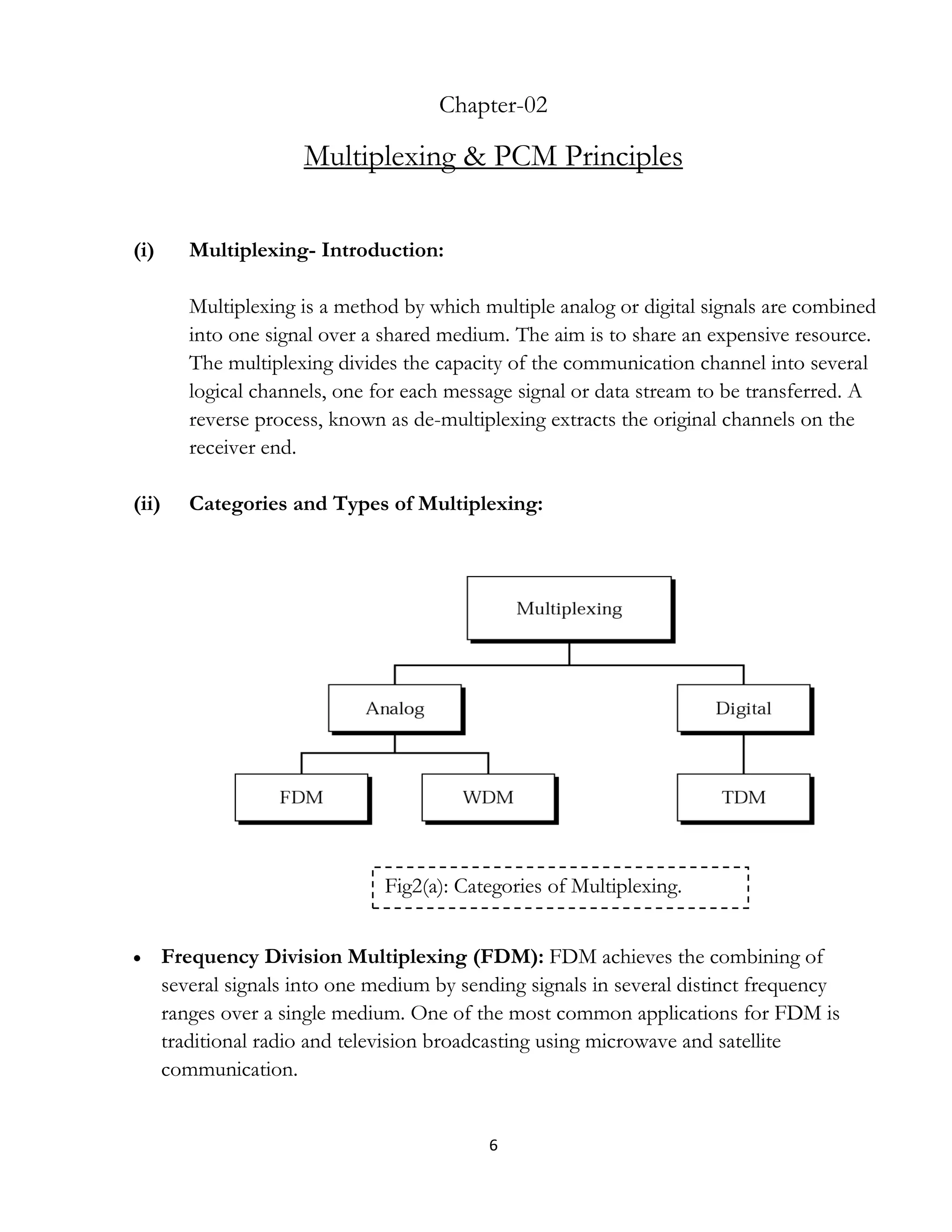
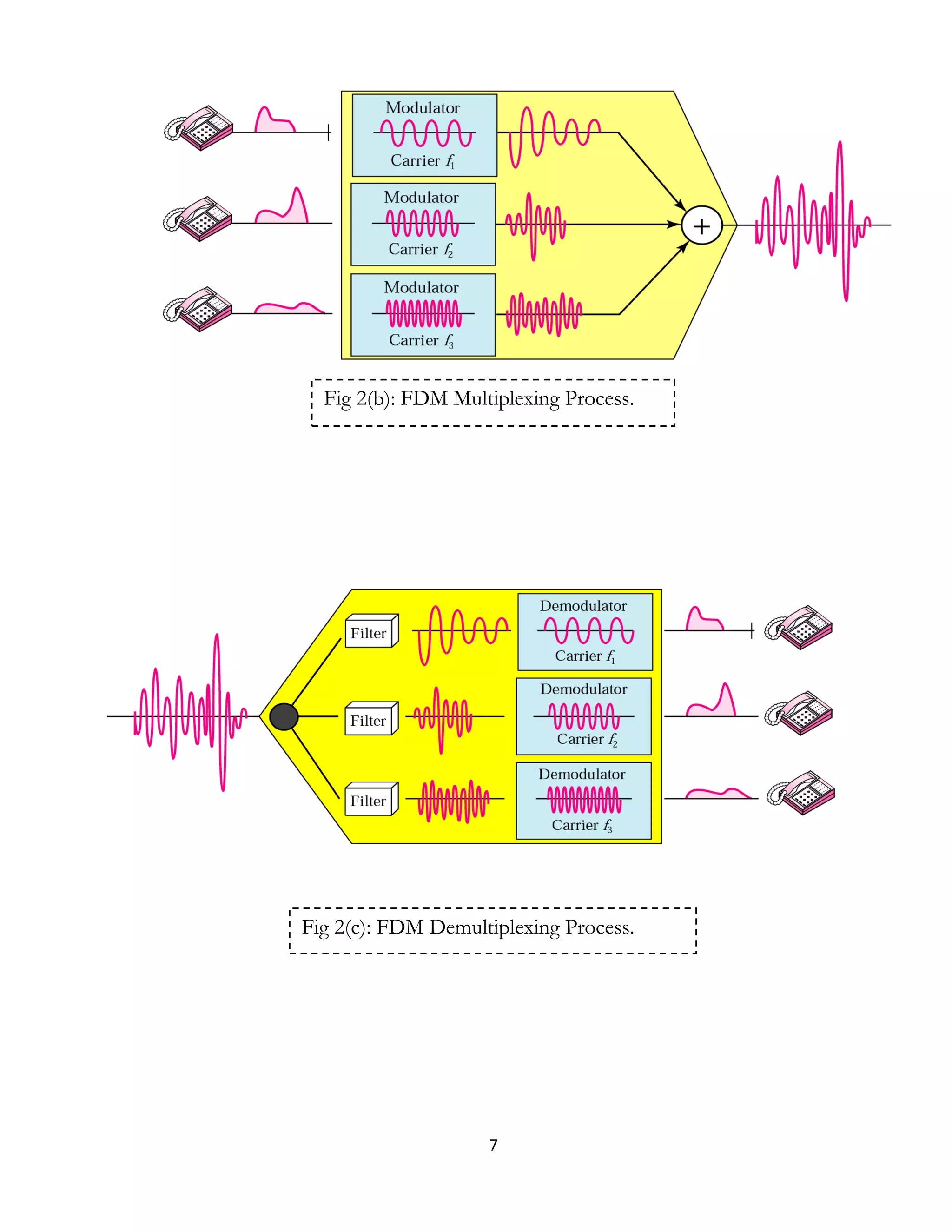
 Frequency Division Multiplexing (FDM): FDM achieves the combining of
several signals into one medium by sending signals in several distinct frequency
ranges over a single medium. One of the most common applications for FDM is
traditional radio and television broadcasting using microwave and satellite
communication.
Fig2(a): Categories of Multiplexing.
7
Fig 2(b): FDM Multiplexing Process.
Fig 2(c): FDM Demultiplexing Process.
8
 Wave Division Multiplexing (WDM): WDM is a method of combining multiple
signals on laser beams at various infrared wavelengths for transmission along fiber
optic media. It is designed to use the high data rate capability of fiber optic cable. It
is similar to FDM, except that FDM uses Radio Frequencies, while WDM uses
Infrared Frequencies. Each IR channel carries several RF signals combined by means
of FDM or TDM. There are two types of WDM namely,
(a) Coarse Wavelength Division Multiplexing (CWDM): It has usually 8 to 18
different IR channels.
(b) Dense Wavelength Division Multiplexing (CWDM): It has dozens of those IR
channels.
Since each IR channel carries its own set of multiplexed RF signals, it is theoretically
possible to transmit combined data on a single fiber at a total effective speed of
several hundred Gbps.
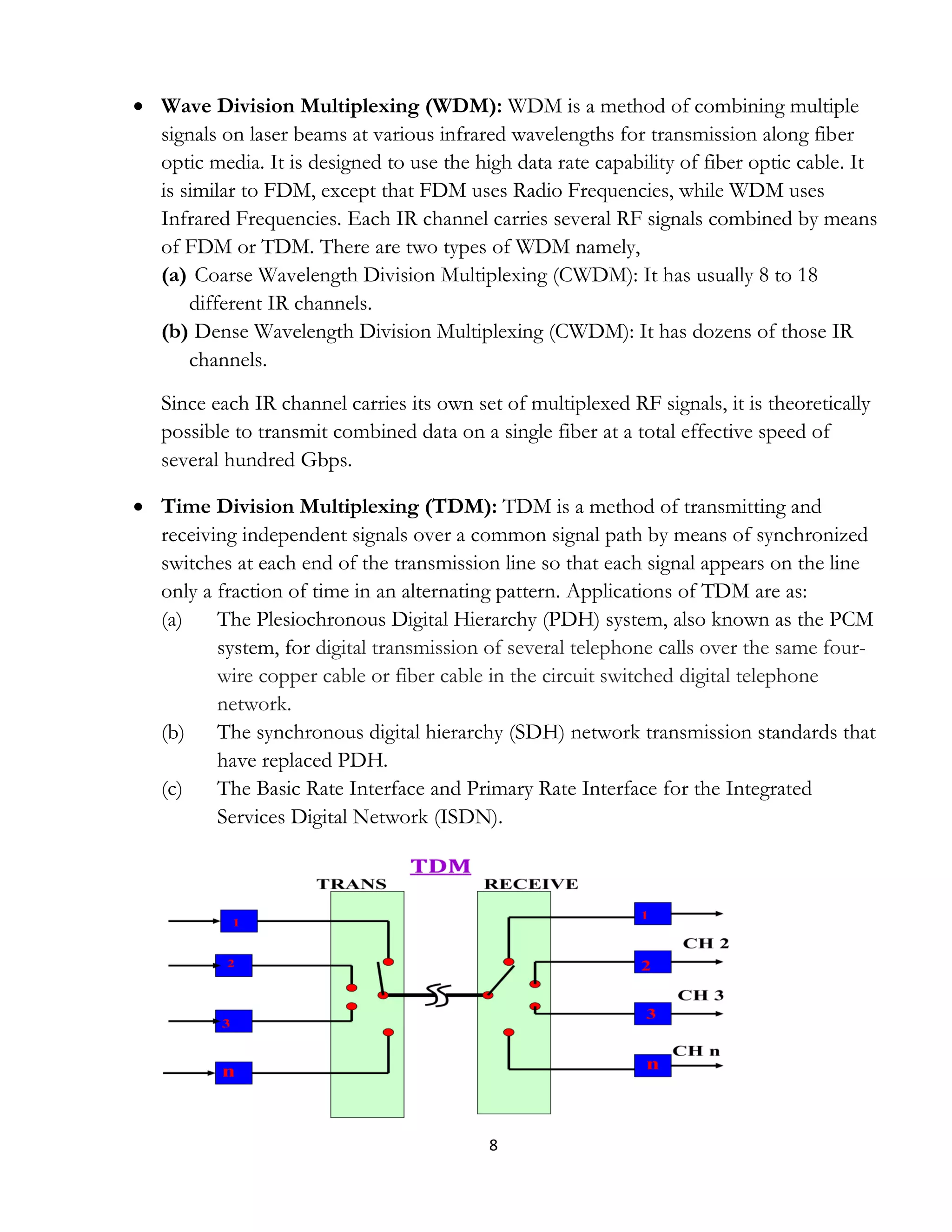
 Time Division Multiplexing (TDM): TDM is a method of transmitting and
receiving independent signals over a common signal path by means of synchronized
switches at each end of the transmission line so that each signal appears on the line
only a fraction of time in an alternating pattern. Applications of TDM are as:
(a) The Plesiochronous Digital Hierarchy (PDH) system, also known as the PCM
system, for digital transmission of several telephone calls over the same four-
wire copper cable or fiber cable in the circuit switched digital telephone
network.
(b) The synchronous digital hierarchy (SDH) network transmission standards that
have replaced PDH.
(c) The Basic Rate Interface and Primary Rate Interface for the Integrated
Services Digital Network (ISDN).
9
(iii) Pulse Code Modulation (PCM)- Introduction:
PCM is a method used to digitally represent sampled analog signals. In a PCM
stream, the amplitude of the analog signal is sampled regularly at uniform
intervals, and each sample is quantized to the nearest value within a range of
digital steps.
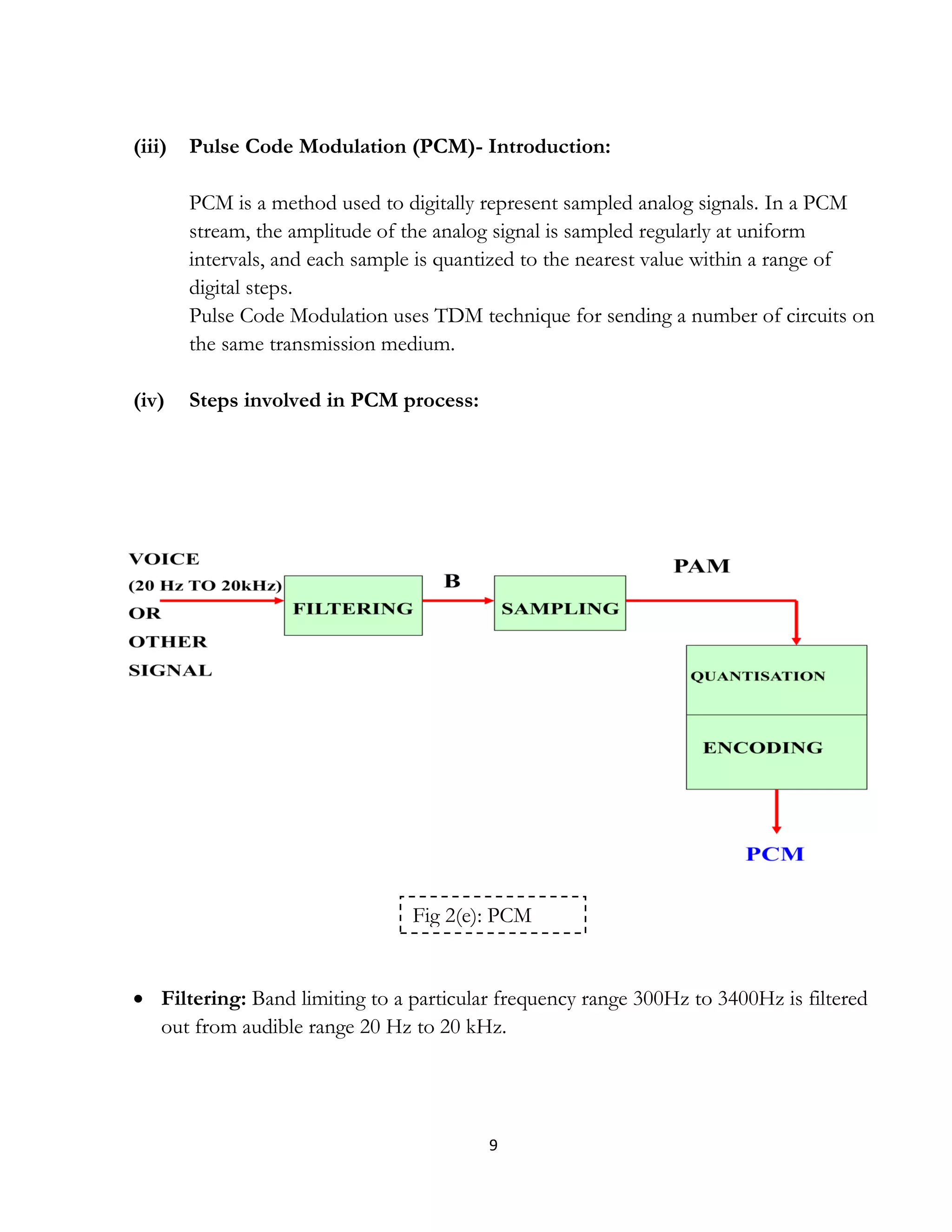
Pulse Code Modulation uses TDM technique for sending a number of circuits on
the same transmission medium.
(iv) Steps involved in PCM process:
 Filtering: Band limiting to a particular frequency range 300Hz to 3400Hz is filtered
out from audible range 20 Hz to 20 kHz.
Fig 2(e): PCM
10
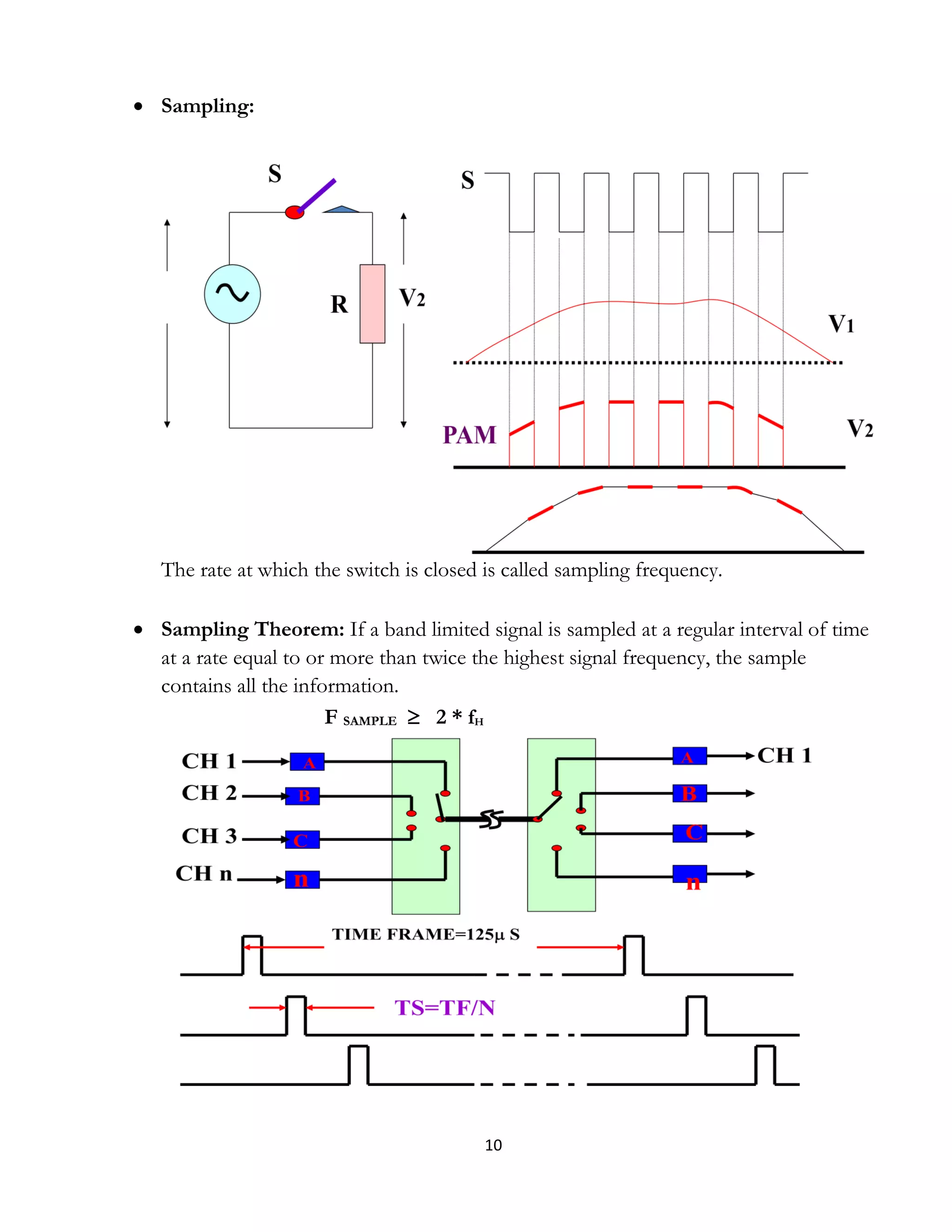
 Sampling:
The rate at which the switch is closed is called sampling frequency.
 Sampling Theorem: If a band limited signal is sampled at a regular interval of time
at a rate equal to or more than twice the highest signal frequency, the sample
contains all the information.
F SAMPLE  2 * fH
11
 Quantization: The output of Sampler is a PAM signal and it is then converted into
Digital form by Quantization. It is the process of measuring the numerical values of
the samples and allocating them the nearest decimal value.
Non uniform 11quantization is achieved by using segmented quantization
(companding).
 Encoding: It converts Discrete sample into Digital Code.
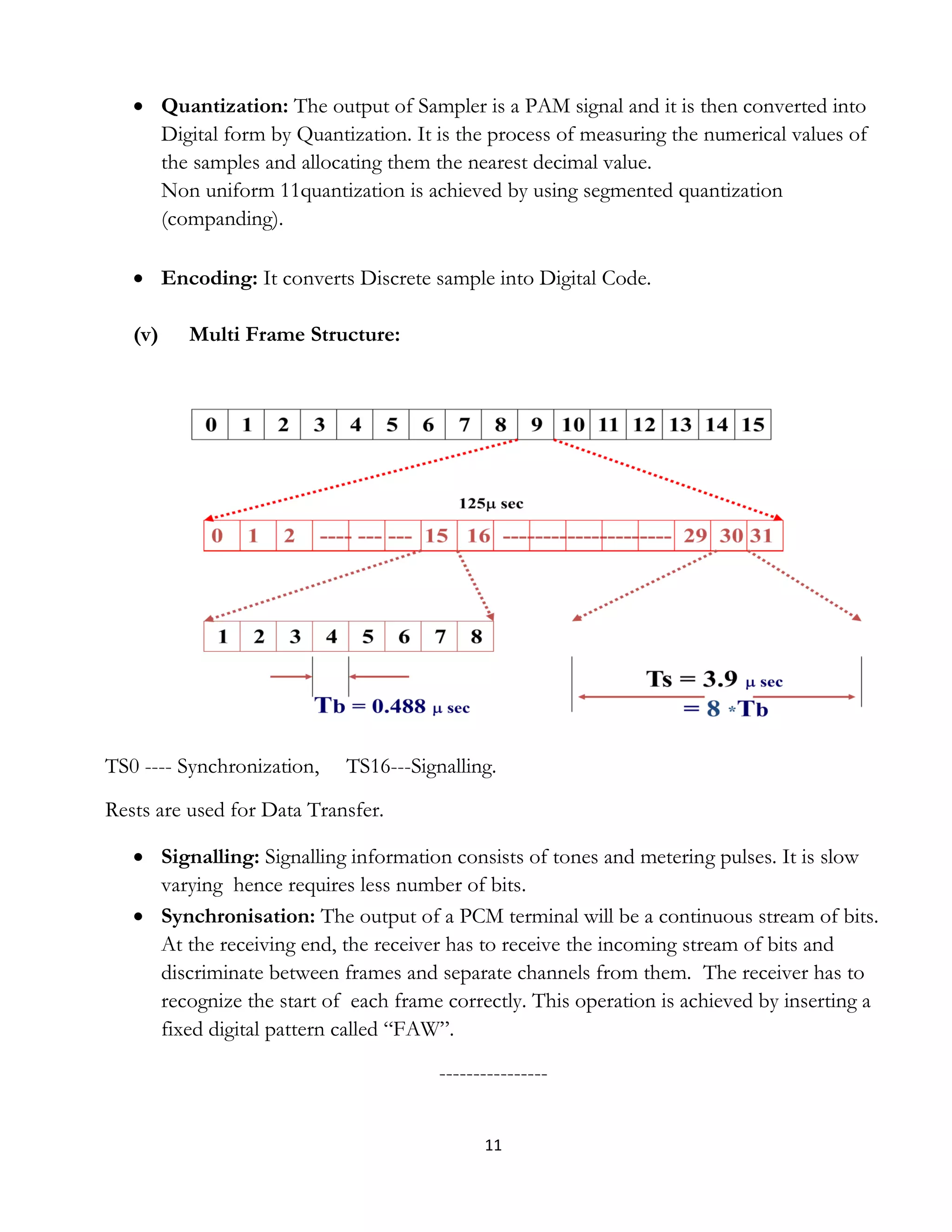
(v) Multi Frame Structure:
TS0 ---- Synchronization, TS16---Signalling.
Rests are used for Data Transfer.
 Signalling: Signalling information consists of tones and metering pulses. It is slow
varying hence requires less number of bits.
 Synchronisation: The output of a PCM terminal will be a continuous stream of bits.
At the receiving end, the receiver has to receive the incoming stream of bits and
discriminate between frames and separate channels from them. The receiver has to
recognize the start of each frame correctly. This operation is achieved by inserting a
fixed digital pattern called “FAW”.
----------------
12
Chapter-03
Digital Switching Principles & Signalling
(i) Digital Switch: Introduction:
A Digital Switching System is one in which signals are switched in digital form. These
signals may represent Speech or Data. The digital signals of several speech samples
are time multiplexed on a common media before being switched through the system.
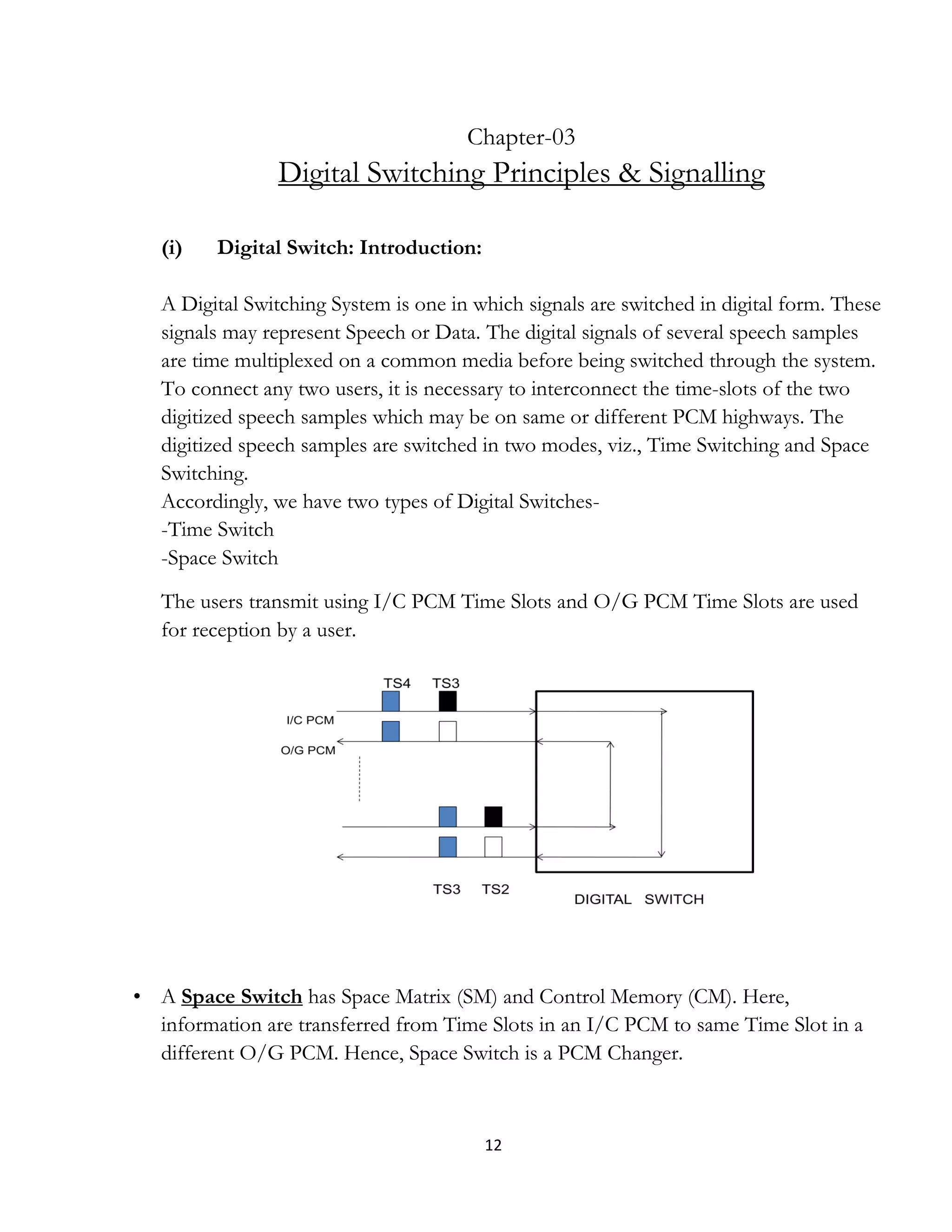
To connect any two users, it is necessary to interconnect the time-slots of the two
digitized speech samples which may be on same or different PCM highways. The
digitized speech samples are switched in two modes, viz., Time Switching and Space
Switching.
Accordingly, we have two types of Digital Switches-
-Time Switch
-Space Switch
The users transmit using I/C PCM Time Slots and O/G PCM Time Slots are used
for reception by a user.
• A Space Switch has Space Matrix (SM) and Control Memory (CM). Here,
information are transferred from Time Slots in an I/C PCM to same Time Slot in a
different O/G PCM. Hence, Space Switch is a PCM Changer.
13
• A Time Switch has Buffer Memory (BM) and Control Memory (CM). Information
are transferred from a Time Slot of an I/C PCM to different Time Slot of same O/G
PCM. In fact, Time Switch is a Time Slot Changer.
There are two types of Time Switches-
 I/P Associated Controlled Time Switch: Writing is controlled and reading
is sequential.
 O/P Associated Controlled time Switch: Writing is sequential and reading
is controlled.
• Time Switch Capacity: The capacity of a Time Switch is decided by the number of
PCM pairs it can handle. Time Switches are available in various capacities- 16 * 16,
32 * 32, 128 * 128, 256 * 256, 512 * 512 etc. We may combine a number of Time
switches to enhance the capacity.
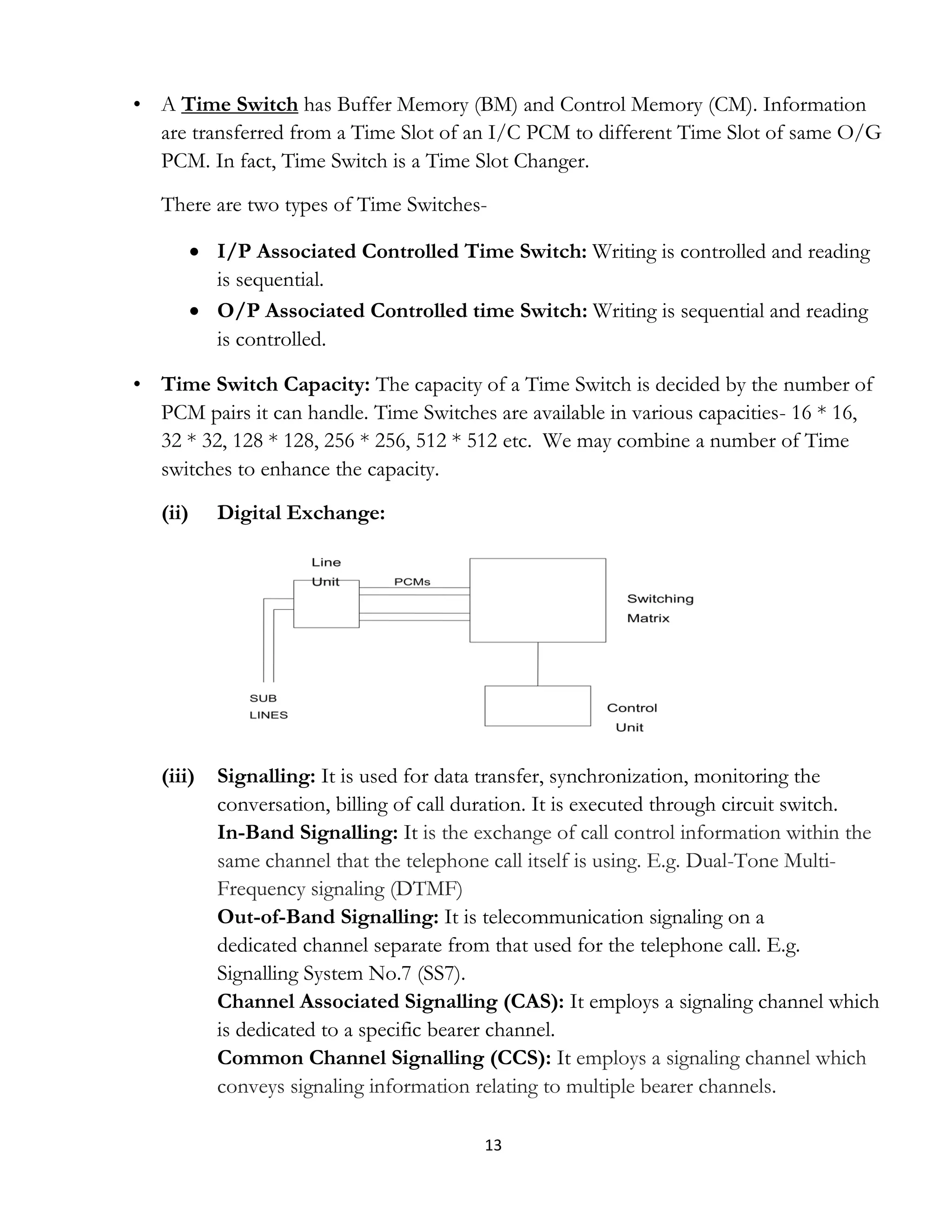
(ii) Digital Exchange:
(iii) Signalling: It is used for data transfer, synchronization, monitoring the
conversation, billing of call duration. It is executed through circuit switch.
In-Band Signalling: It is the exchange of call control information within the
same channel that the telephone call itself is using. E.g. Dual-Tone Multi-
Frequency signaling (DTMF)
Out-of-Band Signalling: It is telecommunication signaling on a
dedicated channel separate from that used for the telephone call. E.g.
Signalling System No.7 (SS7).
Channel Associated Signalling (CAS): It employs a signaling channel which
is dedicated to a specific bearer channel.
Common Channel Signalling (CCS): It employs a signaling channel which
conveys signaling information relating to multiple bearer channels.
14
Chapter-04
Optical Fibre System
(i) Optical Fibre: Introduction:
Optical Fibre is a new medium in which information (Voice, Data or Video) is
transmitted through a Glass or Plastic Fibre, in the form of light.
Advantages of Fibre Optics:
 Optical Fibres are non-conductive (dielectric)
 Electromagnetic Immunity
 Large Bandwidth ( >50 GHz for 1 Km)
 Low Loss (6 dB/km to < 0.25 dB/km)
 Small and light weight cables
 Available in long lengths (> 12 kms)
 Security
 Universal Medium
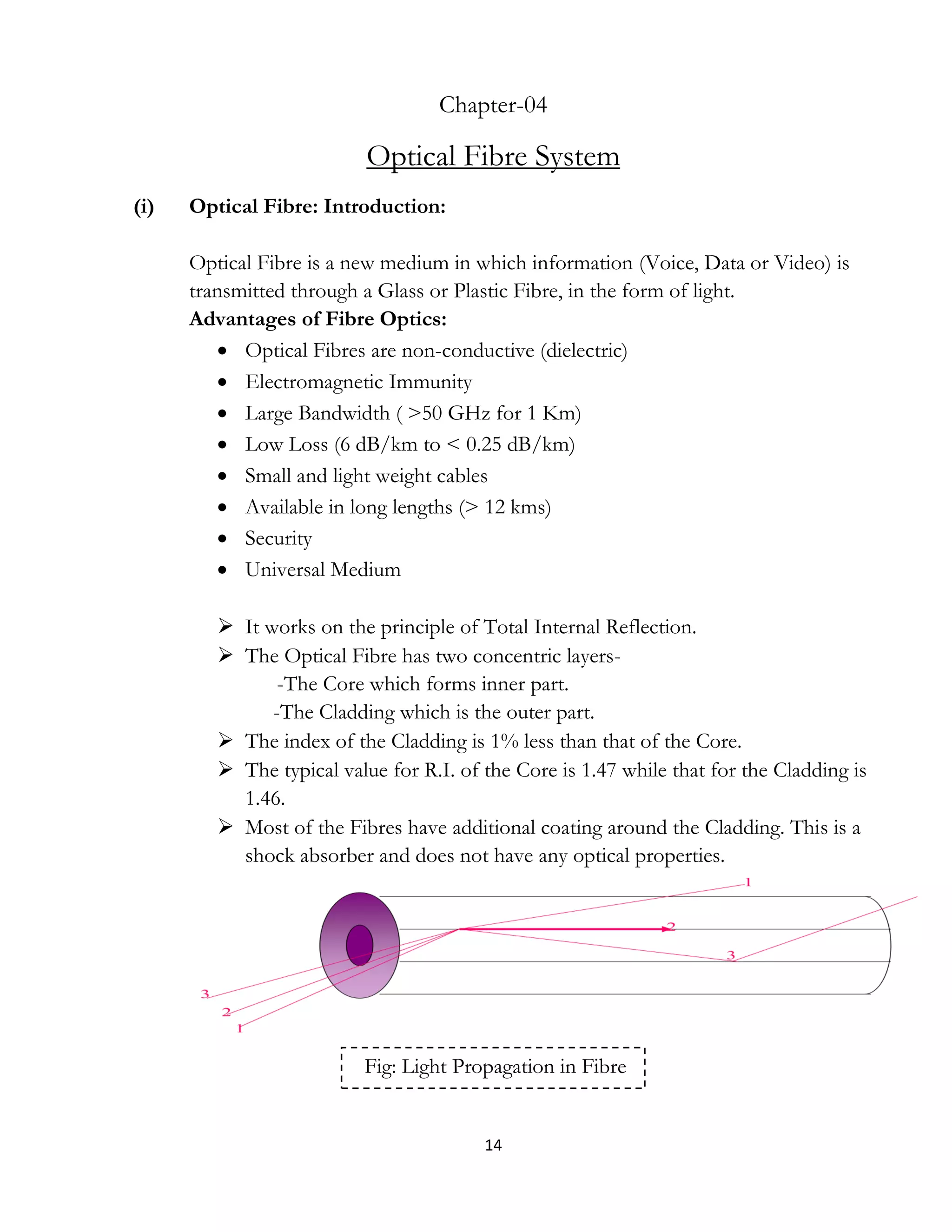
 It works on the principle of Total Internal Reflection.
 The Optical Fibre has two concentric layers-
-The Core which forms inner part.
-The Cladding which is the outer part.
 The index of the Cladding is 1% less than that of the Core.
 The typical value for R.I. of the Core is 1.47 while that for the Cladding is
1.46.
 Most of the Fibres have additional coating around the Cladding. This is a
shock absorber and does not have any optical properties.
Fig: Light Propagation in Fibre
15
(ii) Optical Transmission System:
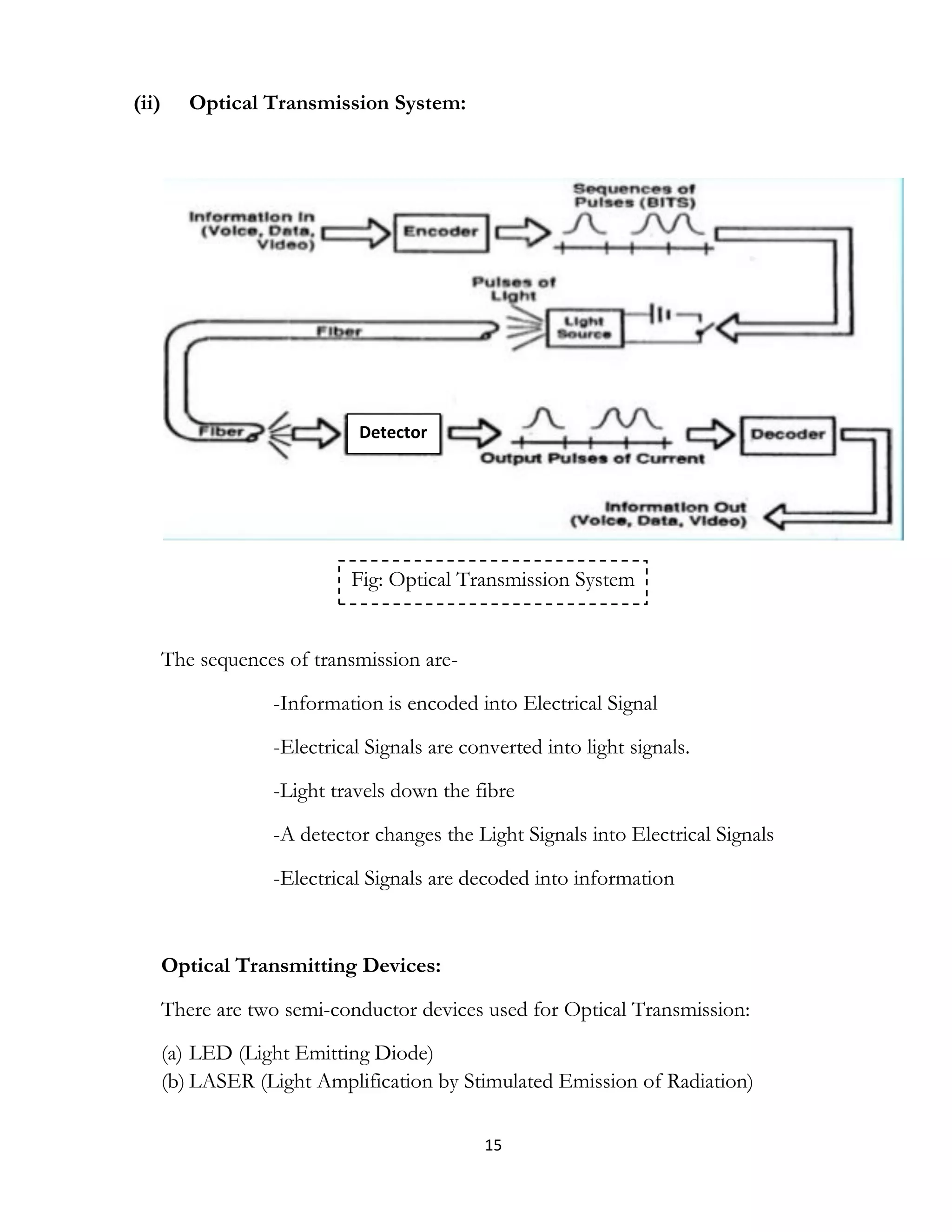
The sequences of transmission are-
-Information is encoded into Electrical Signal
-Electrical Signals are converted into light signals.
-Light travels down the fibre
-A detector changes the Light Signals into Electrical Signals
-Electrical Signals are decoded into information
Optical Transmitting Devices:
There are two semi-conductor devices used for Optical Transmission:
(a) LED (Light Emitting Diode)
(b) LASER (Light Amplification by Stimulated Emission of Radiation)
Fig: Optical Transmission System
Detector
16
 LEDs are composed of a P-N junction with doped semiconductor layers. Injected
electrons combine with ‘holes’ in the P-layer where this phenomenon results in
emission of Photons.
o There are two categories of LEDs:
 Surface Emitting LEDs radiate Photons in a pattern where power
diminishes away from a direction normal to the surface.
 Edge Emitting LEDs can concentrate radiation with improved
coupling efficiency
 In case of LASER Diodes, the emissions of Photons are spontaneous and are
stimulated by other Photons (by amplifying light) and we get large quantities of high
energy Photons emitted.
Optical Detector:
The Optical Detector converts Optical Energy into Electrical Energy. It is basically an
Opto-Electronic Transducer doing the opposite function of an Optical Source.
There are two distinct mechanisms for Photo detection:
• In External Photo-Electric Effect, the Electrons are freed from the surface of a
metal by the Energy absorbed from an incident stream of Photons. The Vacuum
Photodiode and the Photo Multiplier Tubes come under this category.
• In Internal Photo Electric Effect, Semi-conductor Devices allow generation of free
Charge carriers, Electrons and Holes by absorption of Incoming Photons. PIN
Photo Diode and APD come under this category.
Examples of two Optical Detectors: PIN Photodiode and Avalanche Photo
Diodes
 PIN Photodiode: PIN stands for Positive, Intrinsic, Negative. It has resistive
Intrinsic layer sand-witched in between P and N layers. The width of intrinsic layer is
sufficient and the depletion layer is spread over the intrinsic layer under the influence
of high field due to reverse bias. Under reverse bias condition, when a Photon enters
the depletion region, it is absorbed and a pair of Electron and Hole is generated. The
Electron and the Hole so generated move towards the opposite Electrodes. This
results in the flow of Current in the external field. The PIN Photo Diodes have lower
capacitance, high Quantum efficiency and high speed of operation.
17
 Avalanche Photo Diodes: The APD has a very wide Intrinsic Layer in between the
P and N Semiconductor materials. Provision of another P type material in between
the N type material and the intrinsic layer makes working much more efficient. As
the Photon enters the intrinsic layer, Electron-Hole pairs are formed. Movement of
the charge carriers towards the opposite terminals results in collision inside the
Diode with neutral atoms. As a result of such collision more numbers of Electron-
Hole pairs are generated. Consequently, we get large flow of current in the external
Circuit.
APDs are often influenced by various Noises.
General Features of Detectors:
 High efficiency
 Fast response
 Low Noise
 Small Size
 Light Weight
 Long Life
 Reliability
 Low Cost
 For Transmission, Single Mode Fibre is used.
 Window: It is defined as the range of wavelengths on which a fibre can
operate properly. Each window is centered at the typical operational
wavelength.
-----------------
18
Chapter-05
Mobile Communication- GSM Principle & Network
Architecture
(i) GSM:
GSM stands for Global System for Mobile Communication. It is a digital cellular
mobile communication system. Radio Channels are accessed using TDMA.
Two common Bands of Frequencies are allocated to GSM-
(i) 900 MHz band-
-890 to 915 MHz Up-link
-935 to 960 MHz Dn-link
(ii)1800 MHz Band-
-1710 to 1785 MHz Up-link
-1805 to 1880 MHz Dn-link
Strength of GSM:
• It provides wide ranges of services
• Open Standard
• User friendly System
• Widely accepted in major parts of the World
• Technical support is available easily
• Integration with other systems is not complex
• Cellular Systems: In a Cellular System, the Coverage area of an Operator is divided
into a number of sub-areas called Cells. The shape of a Cell is Hexagonal for design
purposes. The size of a Cell is determined by the Transmitter’s power. Cellular
Systems use low power transmitters.
• Cluster: The Cells are grouped for the purpose of frequency allocation. The Groups
are termed as Clusters. Every Cell of a Cluster gets a set of unique frequencies. The
Clusters are repeated to cover more and more areas with the restriction that no two
adjacent cells belonging to different clusters get the same set of frequencies.
19
• Sector: With Omni-directional Antenna, C/I ratio becomes lower than 18 dB when
a Customer goes closer to the boundary of a Cell. On the other hand, if each Cell of
the 4 Cell Cluster is divided into 3 Sectors and each Sector is provided with a
Directional Antenna, then C/I come to around 20 dB in the worst case. The RFs
allotted for each Cell is distributed among the Sectors of the Cell.
(ii) Architecture of GSM Network:
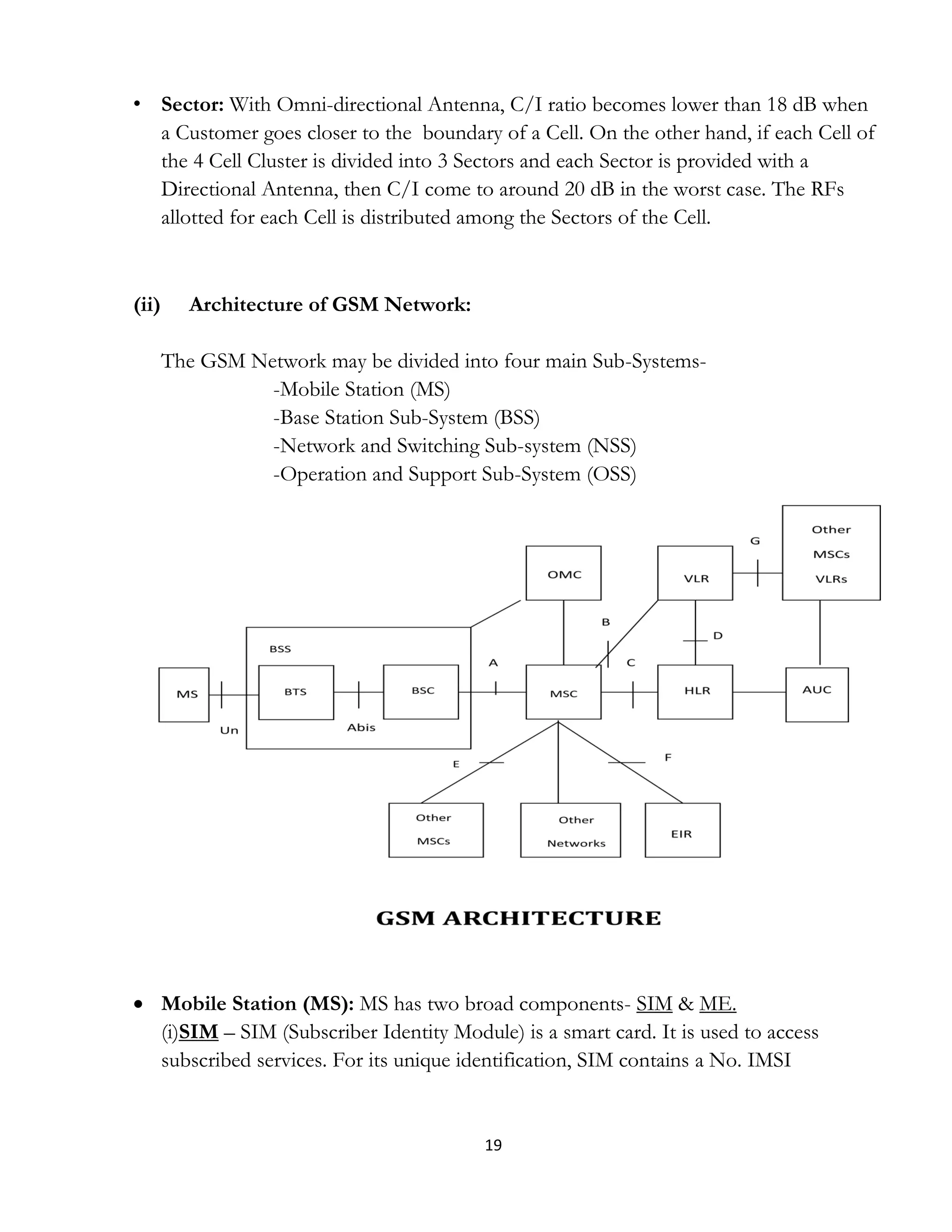
The GSM Network may be divided into four main Sub-Systems-
-Mobile Station (MS)
-Base Station Sub-System (BSS)
-Network and Switching Sub-system (NSS)
-Operation and Support Sub-System (OSS)
 Mobile Station (MS): MS has two broad components- SIM & ME.
(i)SIM – SIM (Subscriber Identity Module) is a smart card. It is used to access
subscribed services. For its unique identification, SIM contains a No. IMSI
20
(International Mobile Subscriber Identity). SIM also accommodates MSISDN
(Mobile Subscriber ISDN Number).
(ii)ME- ME (Mobile Equipment) is the part of MS minus SIM. It has a Unique
Identification No. IMEI (International Mobile Equipment Identity).
 Base Station Sub-System (BSS): BSS can be divided into two units- BTS (Base
Trans-receiver Station) & BSC (Base Station Controller).
 BTS: BTS provides wireless resources to MSs. BTS is usually placed in the
Centre of a Cell. BTS contains one or more TRXs (Transceiver or Radio
Units) to provide full duplex communication to MSs.
 BSC: Each BSC controls a group of BTSs. BSC is the Radio Resource
Manager.
-BSC is primarily responsible for-
-Handovers within its area of coverage
-Frequency Hopping
-Exchange Functions
-Radio Resource Power level control
 Network & Switching Sub-System (NSS): Its role is to manage communication
between mobile users and other users.
NSS consists of-
 MSC (Mobile Switching Centre): MSC performs Switching and signaling
functions. It interacts with PSTNs, other MSCs, HLR, VLR etc. Handling
location registration through VLR. It controls inter-BSC and Intra-MSC
handovers. It performs standard functions of a Digital Switch.
 HLR (Home Location Register): HLR contains most important Database
of its MSs. It also stores current sub location & service entitlements.HLR
contains IMSI, MSISDN Numbers of Subscribers. Subscription information
of various services.
 VLR (Visitor Location Register): VLR contains Sub parameters and
Location information of Mobile Subs currently lying in its coverage area.
When a new sub enters the coverage area of a VLR, it collects relevant
information of the sub.VLR contains IMSI, TMSI, MSISDN, MSRN of a Sub.
 AUC (Authentication Centre): AuC is a register used for security purposes.
It provides parameters needed for authentication and encryption functions. It
helps to verify user’s identity. AUC is an assistant to HLR.
21
 EIR (Equipment Identity Register): It is a register containing information
about the Mobile Equipments. EIR is accessed during IMEI verification
procedure. EIR contains IMEIs which may be in any of the three lists-
-White or Valid Lists
-Grey or Monitored Lists
-Black or Prohibited Lists
 Operation & Support Sub-System: OSS is connected with NSS and BSS to control
and monitor the GSM System. OSS also controls the traffic load of BSS.
OSS has only one sub-unit called OMC (Operation and Maintenance Centre).
OMC may have further segregation as-
- OMC-S for NSS part activity &
- OMC-R for BSS (RSS) part activity.
 Other Network Elements:
Billing Centre- Each MSC writes the Call Accounting Records to a local disk
memory. The Billing Centre periodically pulls the disk records of each MSC to collect
the Billing Data.
Service Centre- The Service Centre interfaces with the MSCs to provide special
services such as SMS.
Areas of GSM Network:
• A Cell is the Coverage Area of a BTS.
• A number of Cells grouped together constitute a LA (Location Area) identified by its
LAI (Location Area Identity).
• A number of Las are grouped to form an MSC/VLR Area served by one MSC/VLR.
• A number of MSC/VLR Areas served by one Network Operator form a PLMN
(Public Land Mobile Network).
---------------
22
Chapter-06
CDMA Technology
CDMA is a multiple access technique where large numbers of transmissions are
combined on the same RF channel at the same time but are separated by codes.
CDMA Band- 824-849 MHz & 869-894 MHz.
Salient Features of CDMA:
(a) It is an advanced communication technology.
(b) It uses spread spectrum technology.
(c) It has inbuilt anti-jam and security features.
(d) Large capacity as compared to other technologies like FDMA and TDMA.
(e) Less (optimum) power per cell.
(f) Seamless handoff.
(g) Variable data rate
Advantages:
(a) Fast network deployment.
(b) Reduced service interruptions.
(c) Low maintenance & operational cost.
(d) Better system coverage flexibility.
(e) Higher capacity.
(f) Frequency re-use (No freq. reuse pattern reqd.)
(g) Easy transition to mobile services
CDMA Technology based systems are deployed in BSNL to provide the following
services:
(a) WLL (Wireless in Local Loop)
(b) High Speed wireless Internet Services
The CDMA systems used in BSNL are:
(a) CDMA2000 1x
(b) 1x EVDO
23
CDMA2000 1x system consists of –
1] Radio Access Network (RAN)
2] Circuit Switched – Core Network (CS-CN)
3] Packet Switched – Core Network (PS-CN)
RAN: It consists of:-
(a)Base Transceiver Station (BTS): It modulates and demodulates baseband
signal. It performs channel processing function. It receives and transmits RF
signal.
(b) Base Station Controller (BSC): It allocates radio resources, call processing,
power controlling, handover processing, voice coding.
(c) Packet Control Function (PCF): They assign supplemental channels for
packet data sessions; maintain reachable state between PDSN and MS; buffer
packets during unavailability of radio resources; and relay packets between MS
and PSDN.
Fig: Structure of CDMA
Network
24
CS-CN: It consists of:-
(a)Mobile Switching Centre (MSC): They have overall control of the network;
controls and switches the voice service of the terminals in the local service
area; interfaces with different types of networks.
(b)Home Location Register (HLR): It stores and manages user profiles;
manages relevant service functions; and assists in completing user calls and
service operations.
(c)Visitor Location Register (VLR): It is responsible for storing and updating
user data of roaming MS. It stores information reqd. for call establishment
into the database for MSC to search.
(d)Authentication Register (AuC): It authenticates the mobile user; stores the
authentication information related to the MS; able to generate and transport
relevant authentication parameters according to the MSC/VLR request.
PS-CN: It consists of:-
(a) Packet Data Serving Node (PDSN): It establishes, maintains, and
terminates PPP sessions with the subscriber; supports simple and mobile IP
packet-services; initiates authentication, authorization and accounting for the
MS client to the AAA server; routes packets to and from the external packet-
data networks.
(b) Authentication Authorization Accounting (AAA): Authentication
associated with PPP and mobile IP connections; Authorization (service profile
and security key distribution and management); dynamically assigning IP
addresses for the simple and mobile IP; Accounting.
(c) Home Agent (HA): It supports seamless data roaming into other networks;
tracks the location of the mobile IP subscriber as it moves from one packet
zone to another; associates the MS IP address with MS forwarding address
and forwards any mobile bound traffic to the appropriate network for delivery
to handset.
(d) Foreign Agent (FA): It is a router through which the MS visits a network. It
provides the MS with IP forwarding address and IP routing services; For data
destined to a MS, FA picks up the IP data packets from HA tunnel and
forwards them to the MS.
25
Chapter-07
3G Overview & Architecture
Background:
Weakness of GSM:
• Accessing method is TDMA which is not very secure.
• RF Channel Bandwidth is less
• Data Speed supported is very less and present day customers demand higher speed
• It is not capable to provide multi-media
• Traffic handling capacity is limited.
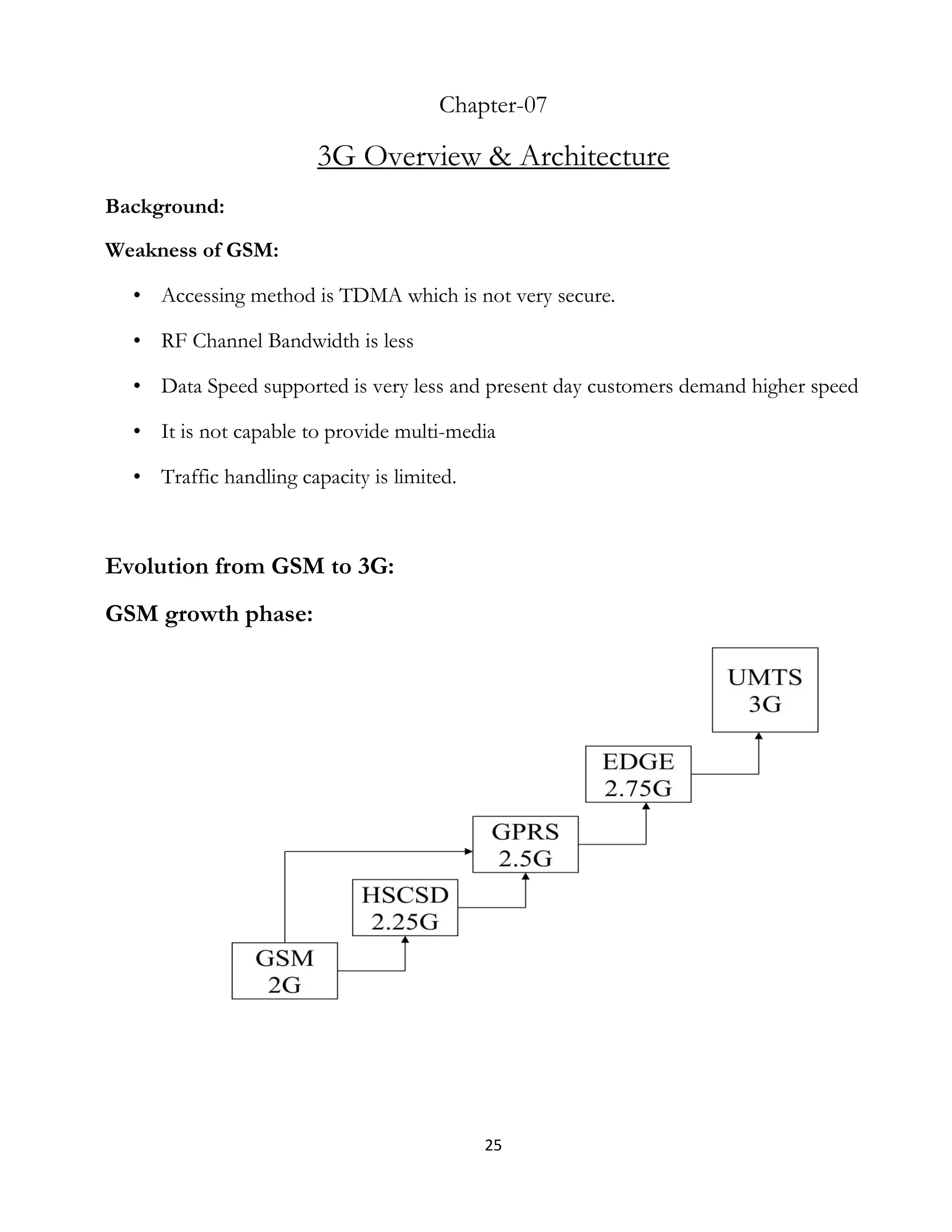
Evolution from GSM to 3G:
GSM growth phase:
26
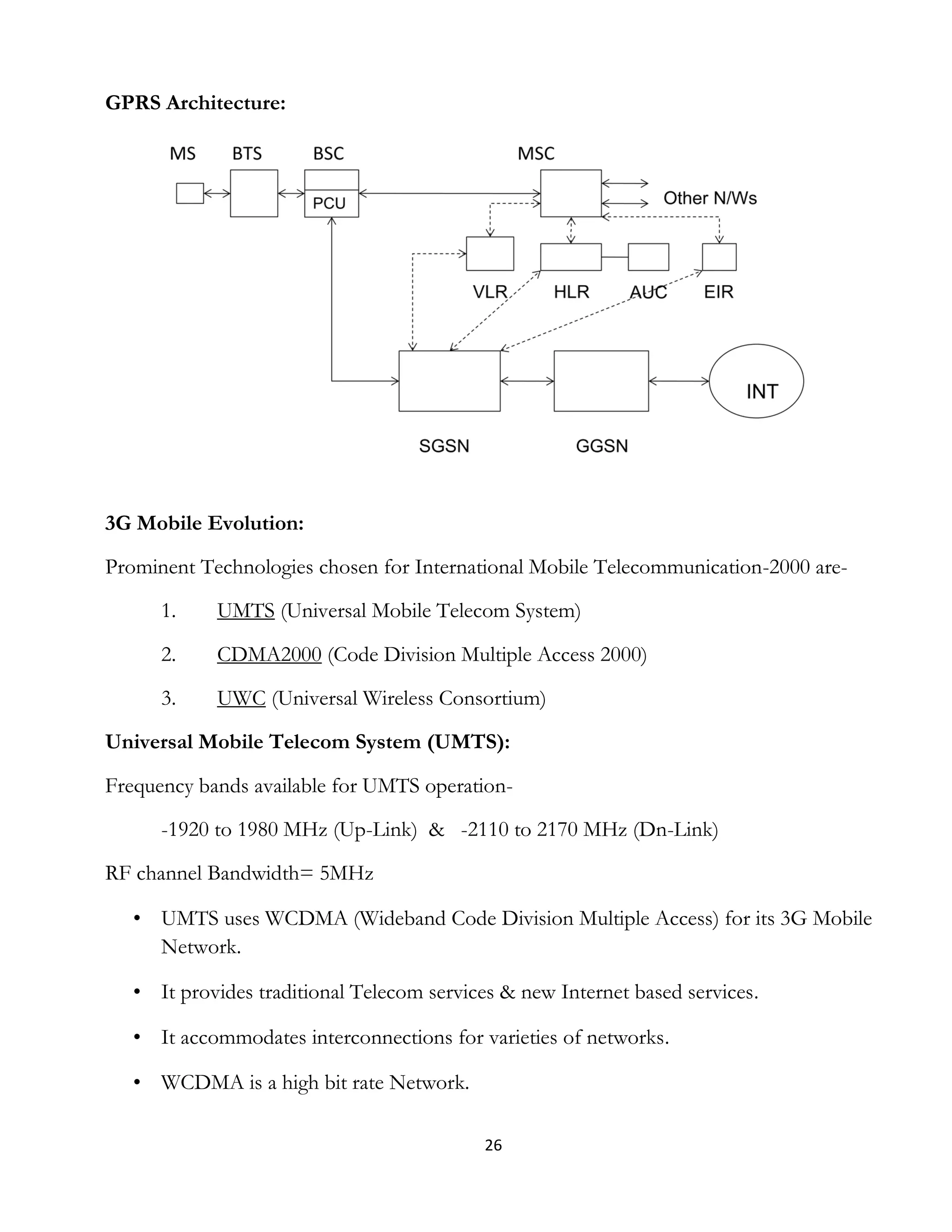
GPRS Architecture:
3G Mobile Evolution:
Prominent Technologies chosen for International Mobile Telecommunication-2000 are-
1. UMTS (Universal Mobile Telecom System)
2. CDMA2000 (Code Division Multiple Access 2000)
3. UWC (Universal Wireless Consortium)
Universal Mobile Telecom System (UMTS):
Frequency bands available for UMTS operation-
-1920 to 1980 MHz (Up-Link) & -2110 to 2170 MHz (Dn-Link)
RF channel Bandwidth= 5MHz
• UMTS uses WCDMA (Wideband Code Division Multiple Access) for its 3G Mobile
Network.
• It provides traditional Telecom services & new Internet based services.
• It accommodates interconnections for varieties of networks.
• WCDMA is a high bit rate Network.
27
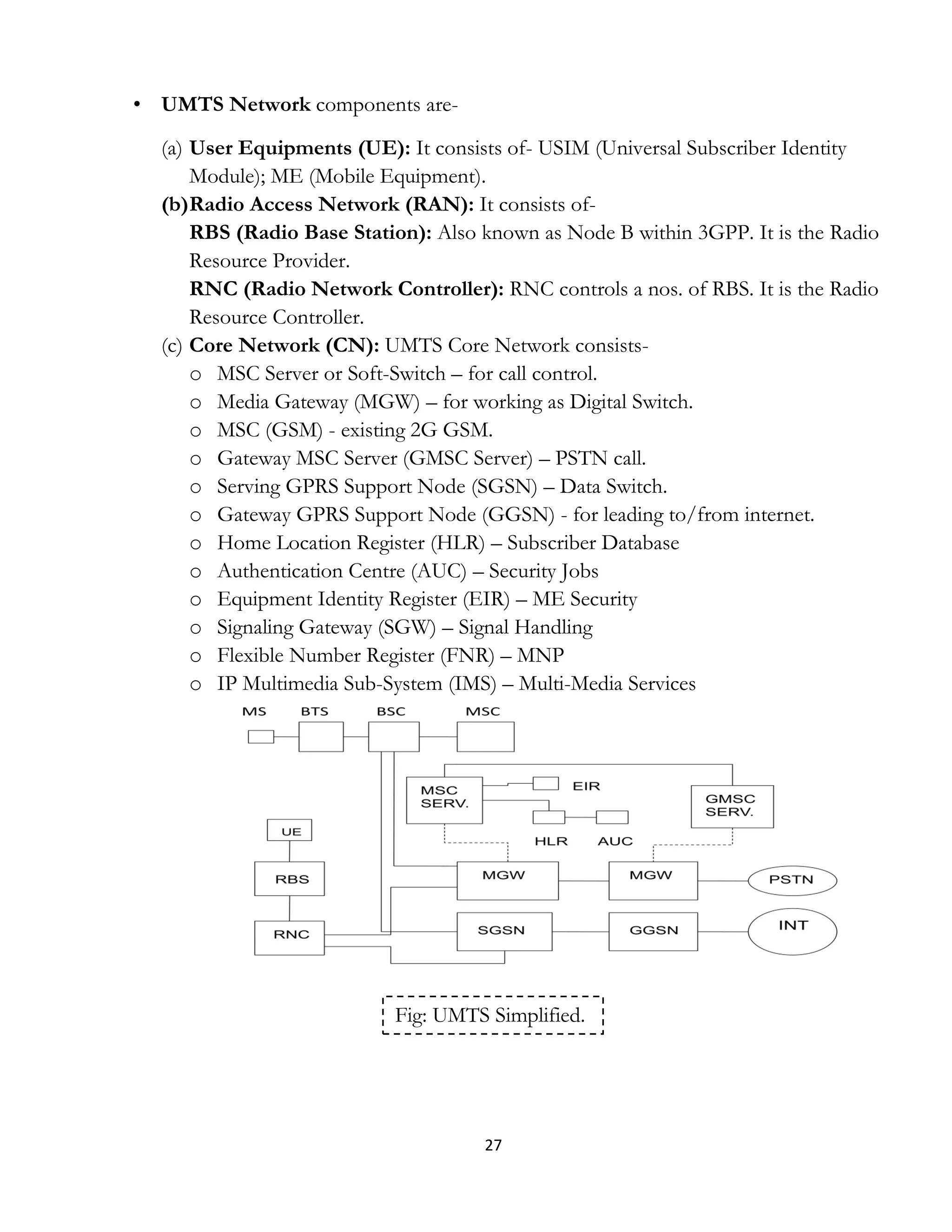
• UMTS Network components are-
(a) User Equipments (UE): It consists of- USIM (Universal Subscriber Identity
Module); ME (Mobile Equipment).
(b)Radio Access Network (RAN): It consists of-
RBS (Radio Base Station): Also known as Node B within 3GPP. It is the Radio
Resource Provider.
RNC (Radio Network Controller): RNC controls a nos. of RBS. It is the Radio
Resource Controller.
(c) Core Network (CN): UMTS Core Network consists-
o MSC Server or Soft-Switch – for call control.
o Media Gateway (MGW) – for working as Digital Switch.
o MSC (GSM) - existing 2G GSM.
o Gateway MSC Server (GMSC Server) – PSTN call.
o Serving GPRS Support Node (SGSN) – Data Switch.
o Gateway GPRS Support Node (GGSN) - for leading to/from internet.
o Home Location Register (HLR) – Subscriber Database
o Authentication Centre (AUC) – Security Jobs
o Equipment Identity Register (EIR) – ME Security
o Signaling Gateway (SGW) – Signal Handling
o Flexible Number Register (FNR) – MNP
o IP Multimedia Sub-System (IMS) – Multi-Media Services
Fig: UMTS Simplified.
28
Applications of 3G:
-Video Calling
-Mobile Broadband
-Movie Streaming
-Video Downloading
-Full Track Song Downloading
-Gaming
-Multi-Media Messaging
Advantages of 3G Mobile:
• Availability of new Radio spectrum.
• More Bandwidth, Security & Reliability.
• Interoperability between different service providers.
• Fixed and variable data rates.
• Backward compatibility of Services with existing Networks.
• Always ON connectivity.
• Rich Multi-Media Services.
Disadvantages of 3G Mobile:
• Up-gradation cost of Base Stations and Cellular infrastructure is likely to be higher.
• 3G requires different Handsets and the issue is complex.
• Roaming and making voice/data call not yet been fully and been seamlessly
operational.
• Higher power consumptions for handsets.
-------------
29
Chapter-08
Wi-Fi & Wi-MAX Overview
Background:
• Broadband wireless is a technology that promises high-speed connection over the air.
• It uses radio waves to transmit and receive data directly to and from the potential
users whenever they want it.
• Technologies such as 3G, Wi-Fi, WiMAX and UWB work together to meet unique
customer needs.
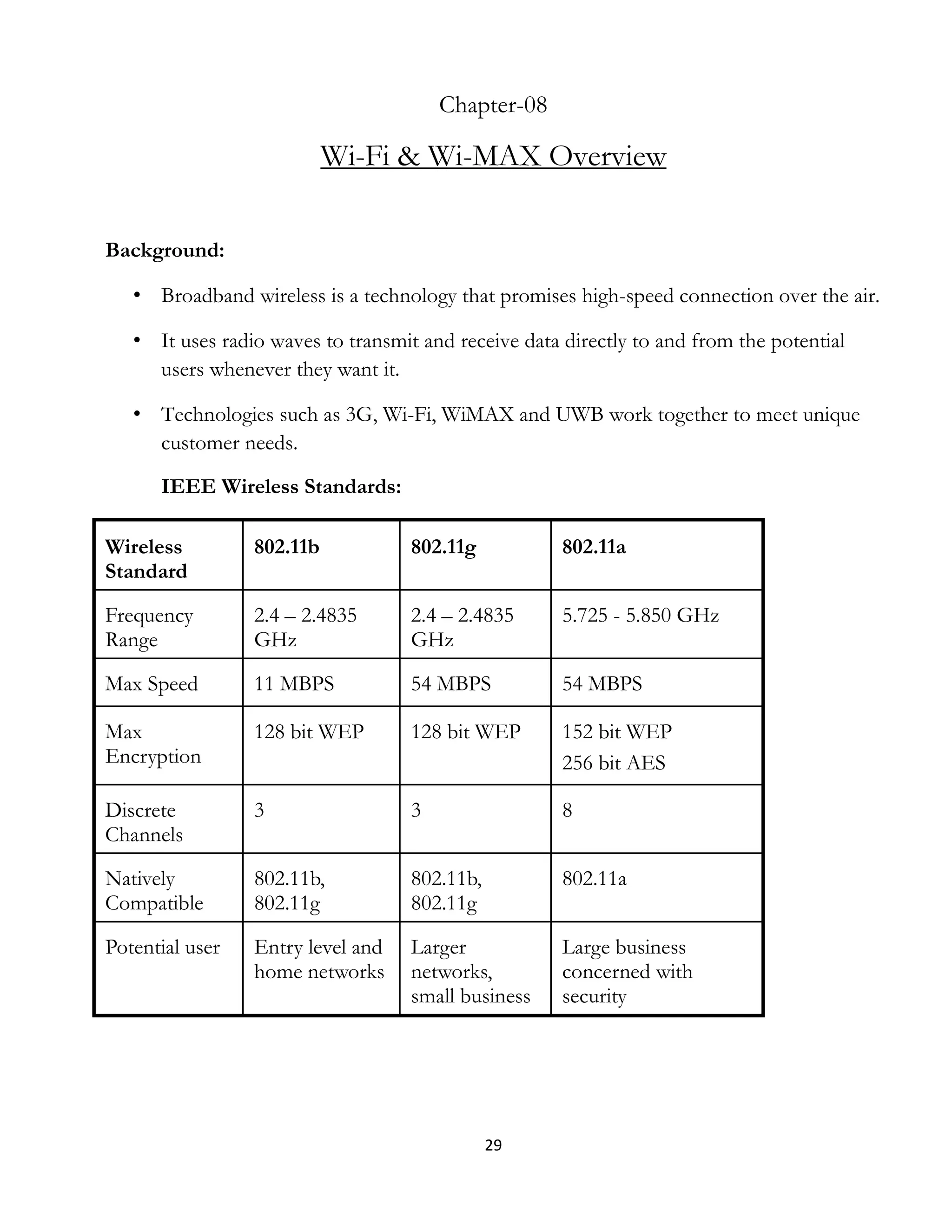
IEEE Wireless Standards:
Wireless
Standard
802.11b 802.11g 802.11a
Frequency
Range
2.4 – 2.4835
GHz
2.4 – 2.4835
GHz
5.725 - 5.850 GHz
Max Speed 11 MBPS 54 MBPS 54 MBPS
Max
Encryption
128 bit WEP 128 bit WEP 152 bit WEP
256 bit AES
Discrete
Channels
3 3 8
Natively
Compatible
802.11b,
802.11g
802.11b,
802.11g
802.11a
Potential user Entry level and
home networks
Larger
networks,
small business
Large business
concerned with
security
30
Wi-Fi:
It is short form for “Wireless-Fidelity”. Wi-Fi is based on the IEEE 802.11 family of
standards. It is primarily a Local Area Networking (LAN) technology designed to
provide in-building broadband coverage.
Benefits of Wi-Fi:
 Mobility:-Wi-Fi system can provide LAN users with access to real-time information
anywhere in their organisation.
 Installation Speed and Simplicity:-Installing a Wi-Fi- system can be fast and easy.
 Installation Flexibility:-Wireless technology allows the network to go where wire
cannot go.
 Reduced Cost-of-Ownership:-Initial investment required for Wi-Fi hardwire can
be higher than the cost of wired LAN hardware, overall installation expenses and
life-cycle costs can be significantly lower.
 Scalability:- Wi-Fi systems can be configured in a variety of topologies. It offers
much high speed up to 54 Mbps.
Components reqd. for Wi-Fi:
 A PC, laptop or PDA, running Windows 98 or above.
 A wireless PCMCIA card, or a wireless adapter.
 A Network Interface Card (optional) - Only if a LAN connection is required)
 An Access Point - essentially a compact radio transmitter with an antenna that
connects to a wired connection, such as an Ethernet, DSL, or Cable Network.
 A valid internet connection.
Hotspots:
 A HotSpot is a geographic area that has a readily accessible wireless network.
 HotSpots are equipped with a Broadband Internet connection, and one or more
Access Points that allow users to access the Internet wirelessly.
 HotSpots can be setup in any public location that can support an Internet
connection. All the locations discussed previously are examples of HotSpots.
31
Limitations of Wi-Fi Networks:
 Coverage
 Roaming
 Backhaul
 Interference
 Security
Wi-MAX:
Wi-Max provides Worldwide Interoperability for Microwave Access. It works on
MMDS Technology. It is Fully Packet based. It Operates in 3.3-3.4 GHz band.
Advantages:
(a) High speed of Broadband service upto 70Mbps.
(b) Less expensive
(c) Much easier to extend to suburban and rural areas.
(d) Broad coverage up to 50Kms.
Uses of Wi-MAX:
 Broadband connectivity
 Leased Line/MPLS-VPN,PRI Connectivity
 BTS backhaul
 Backhaul of Wi-Fi access points
Components required:
 Multiple Access Points - To provide overlapping coverage throughout a site.
Access points can be installed almost anywhere.
 Network switch - A device that joins multiple computers together. A set of
Access Points can be connected to a single network switch.
 Wireless LAN bridge (optional) – A wireless LAN workgroup bridge enables
connection between two different hotspot networks.
32
Wi-MAX Standards:
1) IEEE 802.16-2004
For (a) Fixed point –to-point and
(b) Fixed point-to-multipoint
It is also called first Non Line of Sight (NLOS), BWA standard.
2) IEEE 802.16e is for mobile wireless access from laptops and hand held. It is
analogous to a faster version of 3G telecom technology.
Working of Wi-MAX:
Wi-MAX operates similar to Wi-Fi but at higher speed, over greater distances and for
greater number of users. It consists of following two parts:-
i) A Wi-MAX tower.
ii) A Wi-MAX receiver and antenna.
Applications:
1. Fixed WiMAX , which are point to multipoint enabling Broadband access to
homes and offices.
2. Mobile WiMAX, which offers the full mobility of cellular network at true speed.
Wi-MAX Backhaul:
• WiMAX backhaul is the transport link between a Base station (BS) and the Wi-
MAX Access Service Network Gateway (ASN – GW).
• Efficient backhauling means aggregates existing 2G, 3G, HSPA (high Speed
Downlink Protocol Access) and Wi-Fi technologies with Wi-MAX and future
LTE (long term evolution) utilising one infrastructure.
33
• Wi-Max Spectrum: The DOT has allotted one slot of 20 MHz to BSNL and
MTNL for all the 22 Service Areas of the country in 2.5 GHz band with specific
frequency 2635 to 2655 MHz.
Connecting to Wi-MAX:
 BSNL offers large variety of Customer Premises Equipments (CPE) including
Outdoor, Indoor and USB dongles from which customers can choose as per their
application requirements.
 Indoor: Best suited for Home/Office users. Can be used in moving vehicle also
 Dongle: Small Dongle can be connected directly to PC / Laptop via USB port.
 Outdoor: Suitable for remote and rural areas. Can be used up to 15 Km distance
(Line of sight) from BTS site.
Reasons for preferability of BSNL Wi-MAX:
 Internet browsing at lightning speed.
 Data Download/Upload at very high speed upto 7Mbps.
 Superior Performance.
 World’s latest wireless broadband technology.
 Very low cost and low starting tariff.
 Wide range of User friendly plans.
-------------------
34
Conclusion
Engineering student will have to serve in the public and private sector industries and the
workshop based training and teaching in the classroom has its limitation. The lack of
exposure to the real life, material express and functioning of industrial organization is the
measure hindrance in the student employment.
In the open economy era of fast modernization and tough competition, technical industries
should procedure pass out as near to job function as possible.
Practical training is one of the major steps in this direction. The training program at RTTC
BSNL Guwahati was interesting and an all together a new learning experience. The training
helps me gaining knowledge of the working of telephone exchange, various technologies of
BSNL- GSM, GPRS, Wi-Fi, Wi-MAX and Optical Fibre Transmission.
I, therefore, hereby conclude that I have successfully completed my training program on the
above topics.
Thanking You.

Project Report (Basic Telecom) BSNL

  • 1.
    Submitted By: PANKAJ KRPURBEY B.Tech 2nd Yr National Institute of Technology, Durgapur
  • 2.
    1 Acknowledgement It is withprofound gratitude that I express my deep indebtedness to all the employees of R.T.T.C., B.S.N.L. Guwahati without whose support and guidance it would not have been possible for this training to have materialized and taken a concrete shape. I owe my personal thanks to my trainers in charge- Mr. D. Baishya, Mr. D.S. Sandhu, Mr. S. Bhaumik, Mr. B.deka, Mr. S.Basu who extended their full support and co-operation at every stage of the training period. I would also like to acknowledge the HOD and TPSW Representative of Electronics and Communication Engg. Dept. of our Institute for providing me the opportunity to undergo training at BSNL. PANKAJ KR PURBEY B.Tech 2nd yr NIT Durgapur
  • 3.
    2 Preface Engineers need toconcentrate more on the mechanism and the way in which things have been made. The need of training arises for doing things yourself, understanding its way. Practical exposure for doing things makes a person conversant to the technicalities involved in any job. In view of such benefits, imparting of vocational training has been made an integral part of any academic structure. In B.S.N.L., training is given to Engineering Students to secure future in the dynamic world of telecommunications. Today telecommunication industry is one of the very fast growing industries in the world. For this, I have taken 14 days vocational training in Basic Telecom at RTTC BSNL, Guwahati. In my report, I try to introduce the Overview of Telecommunication Networks, Different technologies used in telecom and the upcoming scope in this field.
  • 4.
    3 Table of Contents ChapterNo. Contents Page No. Acknowledgement 01 Preface 02 Table of Contents 03 01 BSNL Services and Telecommunication Networks 04-05 i. Introduction ii. Telecom Network and Architecture iii. BSNL Telecom Network 02 Multiplexing & PCM Principles 06-11 i. Multiplexing-Introduction ii. Categories and Types of Multiplexing iii. PCM-Introduction iv. Steps involved in PCM process v. Multi-Frame Structure 03 Digital Switching and Signalling 12-13 i. Digital Switch: Introduction ii. Digital Exchange iii. Signalling 04 Optical Fibre System 14-17 i. Optical Fibre: Introduction ii. Optical Fibre Transmission System 05 Mobile Communication- GSM Principle & Network Architecture 18-21 i. GSM ii Architecture of GSM Network 06 CDMA Technology 22-24 07 3G Overview & Architecture 25-28 i. Background ii. Evolution of 3G iii. Applications, Advantages, Disadvantages 08 Wi-Fi & Wi-MAX Overview 29-33 i. Background ii. Wi-Fi iii. Wi-MAX Conclusion 34
  • 5.
    4 Chapter-01 BSNL Services andTelecommunication Networks (i) Introduction: Bharat Sanchar Nigam Limited (BSNL) is an Indian state-owned telecommunications company which came into effect from 1st October 2000. Now, it is the largest provider of fixed telephony and broadband services with more than 60% market share and sixth largest mobile telephony provider in India. (ii) Telecom Network and Architecture: Telecom network is broadly an integration of—  User Equipment: It may be an ordinary Telephone, a Mobile Phone, A PC and similar other devices.  Access Network: It provides connectivity between user equipment with switching network primarily. It may be copper pairs, Wireless Link and Optical Fibre.  Switching Network: It has a role to interconnect different users. Prominent Switches are- CDOT, OCB, AT&T etc.  Transmission Network: It is the link between various Networks. It may be optical fibre, wireless network, satellite etc  Application Servers: These servers are connected to the switching networks through suitable Transmission links. Servers may contain websites, movies, game, videos and many others. (iii) BSNL Telecom Network: Prominent BSNL networks are—  BSNL Landline Network: Between Landline Telephone and a Landline/Mobile Telephone. Some of the Value Added Services based on landline Telephone Network are Broadband Services, Sancharnet Card, Webfone Service, ISDN services, IN Services, Audio Conferencing, Video Conferencing etc.
  • 6.
    5  BSNL MobileNetwork: It is also known as CMTS (Cellular Mobile Telephone Service). BSNL provides mobile services through GSM (Global System for Mobile Communication) Technology.  BSNL WLL Network: It stands for Wireless in Local Loop. BSNL provides WLL services for technically non-feasible Landline areas and also for rural mobile communications.WLL works on CDMA Technology.  BSNL Internet & Broadband: It is a service through which computer to computer communication is possible worldwide.  ISDN Services: ISDN is Integrated Services Digital Network. It is an integration of services like audio, video, images etc. There are two types of ISDN services—BRA (Basic Rate Access) with 128 kbps link, and PRA (Primary Rate Access) with 2 Mbps link.  Data Networks: (a) Leased lines. (b) Managed Leased Line Network (MLLN). (c) Wi-Fi (Wireless Fidelity). (d) Wi-MAX (Wireless Inter-operability for Microwave Access)  MPLS VPN: Virtual Private Network (VPN) & Multi Protocol Label Switching (MPLS). It provides Bandwidth on Demand, Video Conferencing, Voice over Internet and many other services.  Intelligent Network: IN provides a framework to create various services in a centralized place independent of the switch. Popular IN services are- Free Phone Service, Premium Rate Service, India Telephone Card, Virtual Private Network, Universal Access Number, Tele Voting, Account Calling Card etc.  Satellite Networks: It consists of Communication Satellite, User Equipment Known as VSAT & Radio Link. BSNL offers Satellite based Telecom Services supporting- Broadband internet access, VOIP, Video Conferencing, Local Area Network, Voice, Fax etc. -------------
  • 7.
    6 Chapter-02 Multiplexing & PCMPrinciples (i) Multiplexing- Introduction: Multiplexing is a method by which multiple analog or digital signals are combined into one signal over a shared medium. The aim is to share an expensive resource. The multiplexing divides the capacity of the communication channel into several logical channels, one for each message signal or data stream to be transferred. A reverse process, known as de-multiplexing extracts the original channels on the receiver end. (ii) Categories and Types of Multiplexing:  Frequency Division Multiplexing (FDM): FDM achieves the combining of several signals into one medium by sending signals in several distinct frequency ranges over a single medium. One of the most common applications for FDM is traditional radio and television broadcasting using microwave and satellite communication. Fig2(a): Categories of Multiplexing.
  • 8.
    7 Fig 2(b): FDMMultiplexing Process. Fig 2(c): FDM Demultiplexing Process.
  • 9.
    8  Wave DivisionMultiplexing (WDM): WDM is a method of combining multiple signals on laser beams at various infrared wavelengths for transmission along fiber optic media. It is designed to use the high data rate capability of fiber optic cable. It is similar to FDM, except that FDM uses Radio Frequencies, while WDM uses Infrared Frequencies. Each IR channel carries several RF signals combined by means of FDM or TDM. There are two types of WDM namely, (a) Coarse Wavelength Division Multiplexing (CWDM): It has usually 8 to 18 different IR channels. (b) Dense Wavelength Division Multiplexing (CWDM): It has dozens of those IR channels. Since each IR channel carries its own set of multiplexed RF signals, it is theoretically possible to transmit combined data on a single fiber at a total effective speed of several hundred Gbps.  Time Division Multiplexing (TDM): TDM is a method of transmitting and receiving independent signals over a common signal path by means of synchronized switches at each end of the transmission line so that each signal appears on the line only a fraction of time in an alternating pattern. Applications of TDM are as: (a) The Plesiochronous Digital Hierarchy (PDH) system, also known as the PCM system, for digital transmission of several telephone calls over the same four- wire copper cable or fiber cable in the circuit switched digital telephone network. (b) The synchronous digital hierarchy (SDH) network transmission standards that have replaced PDH. (c) The Basic Rate Interface and Primary Rate Interface for the Integrated Services Digital Network (ISDN).
  • 10.
    9 (iii) Pulse CodeModulation (PCM)- Introduction: PCM is a method used to digitally represent sampled analog signals. In a PCM stream, the amplitude of the analog signal is sampled regularly at uniform intervals, and each sample is quantized to the nearest value within a range of digital steps. Pulse Code Modulation uses TDM technique for sending a number of circuits on the same transmission medium. (iv) Steps involved in PCM process:  Filtering: Band limiting to a particular frequency range 300Hz to 3400Hz is filtered out from audible range 20 Hz to 20 kHz. Fig 2(e): PCM
  • 11.
    10  Sampling: The rateat which the switch is closed is called sampling frequency.  Sampling Theorem: If a band limited signal is sampled at a regular interval of time at a rate equal to or more than twice the highest signal frequency, the sample contains all the information. F SAMPLE  2 * fH
  • 12.
    11  Quantization: Theoutput of Sampler is a PAM signal and it is then converted into Digital form by Quantization. It is the process of measuring the numerical values of the samples and allocating them the nearest decimal value. Non uniform 11quantization is achieved by using segmented quantization (companding).  Encoding: It converts Discrete sample into Digital Code. (v) Multi Frame Structure: TS0 ---- Synchronization, TS16---Signalling. Rests are used for Data Transfer.  Signalling: Signalling information consists of tones and metering pulses. It is slow varying hence requires less number of bits.  Synchronisation: The output of a PCM terminal will be a continuous stream of bits. At the receiving end, the receiver has to receive the incoming stream of bits and discriminate between frames and separate channels from them. The receiver has to recognize the start of each frame correctly. This operation is achieved by inserting a fixed digital pattern called “FAW”. ----------------
  • 13.
    12 Chapter-03 Digital Switching Principles& Signalling (i) Digital Switch: Introduction: A Digital Switching System is one in which signals are switched in digital form. These signals may represent Speech or Data. The digital signals of several speech samples are time multiplexed on a common media before being switched through the system. To connect any two users, it is necessary to interconnect the time-slots of the two digitized speech samples which may be on same or different PCM highways. The digitized speech samples are switched in two modes, viz., Time Switching and Space Switching. Accordingly, we have two types of Digital Switches- -Time Switch -Space Switch The users transmit using I/C PCM Time Slots and O/G PCM Time Slots are used for reception by a user. • A Space Switch has Space Matrix (SM) and Control Memory (CM). Here, information are transferred from Time Slots in an I/C PCM to same Time Slot in a different O/G PCM. Hence, Space Switch is a PCM Changer.
  • 14.
    13 • A TimeSwitch has Buffer Memory (BM) and Control Memory (CM). Information are transferred from a Time Slot of an I/C PCM to different Time Slot of same O/G PCM. In fact, Time Switch is a Time Slot Changer. There are two types of Time Switches-  I/P Associated Controlled Time Switch: Writing is controlled and reading is sequential.  O/P Associated Controlled time Switch: Writing is sequential and reading is controlled. • Time Switch Capacity: The capacity of a Time Switch is decided by the number of PCM pairs it can handle. Time Switches are available in various capacities- 16 * 16, 32 * 32, 128 * 128, 256 * 256, 512 * 512 etc. We may combine a number of Time switches to enhance the capacity. (ii) Digital Exchange: (iii) Signalling: It is used for data transfer, synchronization, monitoring the conversation, billing of call duration. It is executed through circuit switch. In-Band Signalling: It is the exchange of call control information within the same channel that the telephone call itself is using. E.g. Dual-Tone Multi- Frequency signaling (DTMF) Out-of-Band Signalling: It is telecommunication signaling on a dedicated channel separate from that used for the telephone call. E.g. Signalling System No.7 (SS7). Channel Associated Signalling (CAS): It employs a signaling channel which is dedicated to a specific bearer channel. Common Channel Signalling (CCS): It employs a signaling channel which conveys signaling information relating to multiple bearer channels.
  • 15.
    14 Chapter-04 Optical Fibre System (i)Optical Fibre: Introduction: Optical Fibre is a new medium in which information (Voice, Data or Video) is transmitted through a Glass or Plastic Fibre, in the form of light. Advantages of Fibre Optics:  Optical Fibres are non-conductive (dielectric)  Electromagnetic Immunity  Large Bandwidth ( >50 GHz for 1 Km)  Low Loss (6 dB/km to < 0.25 dB/km)  Small and light weight cables  Available in long lengths (> 12 kms)  Security  Universal Medium  It works on the principle of Total Internal Reflection.  The Optical Fibre has two concentric layers- -The Core which forms inner part. -The Cladding which is the outer part.  The index of the Cladding is 1% less than that of the Core.  The typical value for R.I. of the Core is 1.47 while that for the Cladding is 1.46.  Most of the Fibres have additional coating around the Cladding. This is a shock absorber and does not have any optical properties. Fig: Light Propagation in Fibre
  • 16.
    15 (ii) Optical TransmissionSystem: The sequences of transmission are- -Information is encoded into Electrical Signal -Electrical Signals are converted into light signals. -Light travels down the fibre -A detector changes the Light Signals into Electrical Signals -Electrical Signals are decoded into information Optical Transmitting Devices: There are two semi-conductor devices used for Optical Transmission: (a) LED (Light Emitting Diode) (b) LASER (Light Amplification by Stimulated Emission of Radiation) Fig: Optical Transmission System Detector
  • 17.
    16  LEDs arecomposed of a P-N junction with doped semiconductor layers. Injected electrons combine with ‘holes’ in the P-layer where this phenomenon results in emission of Photons. o There are two categories of LEDs:  Surface Emitting LEDs radiate Photons in a pattern where power diminishes away from a direction normal to the surface.  Edge Emitting LEDs can concentrate radiation with improved coupling efficiency  In case of LASER Diodes, the emissions of Photons are spontaneous and are stimulated by other Photons (by amplifying light) and we get large quantities of high energy Photons emitted. Optical Detector: The Optical Detector converts Optical Energy into Electrical Energy. It is basically an Opto-Electronic Transducer doing the opposite function of an Optical Source. There are two distinct mechanisms for Photo detection: • In External Photo-Electric Effect, the Electrons are freed from the surface of a metal by the Energy absorbed from an incident stream of Photons. The Vacuum Photodiode and the Photo Multiplier Tubes come under this category. • In Internal Photo Electric Effect, Semi-conductor Devices allow generation of free Charge carriers, Electrons and Holes by absorption of Incoming Photons. PIN Photo Diode and APD come under this category. Examples of two Optical Detectors: PIN Photodiode and Avalanche Photo Diodes  PIN Photodiode: PIN stands for Positive, Intrinsic, Negative. It has resistive Intrinsic layer sand-witched in between P and N layers. The width of intrinsic layer is sufficient and the depletion layer is spread over the intrinsic layer under the influence of high field due to reverse bias. Under reverse bias condition, when a Photon enters the depletion region, it is absorbed and a pair of Electron and Hole is generated. The Electron and the Hole so generated move towards the opposite Electrodes. This results in the flow of Current in the external field. The PIN Photo Diodes have lower capacitance, high Quantum efficiency and high speed of operation.
  • 18.
    17  Avalanche PhotoDiodes: The APD has a very wide Intrinsic Layer in between the P and N Semiconductor materials. Provision of another P type material in between the N type material and the intrinsic layer makes working much more efficient. As the Photon enters the intrinsic layer, Electron-Hole pairs are formed. Movement of the charge carriers towards the opposite terminals results in collision inside the Diode with neutral atoms. As a result of such collision more numbers of Electron- Hole pairs are generated. Consequently, we get large flow of current in the external Circuit. APDs are often influenced by various Noises. General Features of Detectors:  High efficiency  Fast response  Low Noise  Small Size  Light Weight  Long Life  Reliability  Low Cost  For Transmission, Single Mode Fibre is used.  Window: It is defined as the range of wavelengths on which a fibre can operate properly. Each window is centered at the typical operational wavelength. -----------------
  • 19.
    18 Chapter-05 Mobile Communication- GSMPrinciple & Network Architecture (i) GSM: GSM stands for Global System for Mobile Communication. It is a digital cellular mobile communication system. Radio Channels are accessed using TDMA. Two common Bands of Frequencies are allocated to GSM- (i) 900 MHz band- -890 to 915 MHz Up-link -935 to 960 MHz Dn-link (ii)1800 MHz Band- -1710 to 1785 MHz Up-link -1805 to 1880 MHz Dn-link Strength of GSM: • It provides wide ranges of services • Open Standard • User friendly System • Widely accepted in major parts of the World • Technical support is available easily • Integration with other systems is not complex • Cellular Systems: In a Cellular System, the Coverage area of an Operator is divided into a number of sub-areas called Cells. The shape of a Cell is Hexagonal for design purposes. The size of a Cell is determined by the Transmitter’s power. Cellular Systems use low power transmitters. • Cluster: The Cells are grouped for the purpose of frequency allocation. The Groups are termed as Clusters. Every Cell of a Cluster gets a set of unique frequencies. The Clusters are repeated to cover more and more areas with the restriction that no two adjacent cells belonging to different clusters get the same set of frequencies.
  • 20.
    19 • Sector: WithOmni-directional Antenna, C/I ratio becomes lower than 18 dB when a Customer goes closer to the boundary of a Cell. On the other hand, if each Cell of the 4 Cell Cluster is divided into 3 Sectors and each Sector is provided with a Directional Antenna, then C/I come to around 20 dB in the worst case. The RFs allotted for each Cell is distributed among the Sectors of the Cell. (ii) Architecture of GSM Network: The GSM Network may be divided into four main Sub-Systems- -Mobile Station (MS) -Base Station Sub-System (BSS) -Network and Switching Sub-system (NSS) -Operation and Support Sub-System (OSS)  Mobile Station (MS): MS has two broad components- SIM & ME. (i)SIM – SIM (Subscriber Identity Module) is a smart card. It is used to access subscribed services. For its unique identification, SIM contains a No. IMSI
  • 21.
    20 (International Mobile SubscriberIdentity). SIM also accommodates MSISDN (Mobile Subscriber ISDN Number). (ii)ME- ME (Mobile Equipment) is the part of MS minus SIM. It has a Unique Identification No. IMEI (International Mobile Equipment Identity).  Base Station Sub-System (BSS): BSS can be divided into two units- BTS (Base Trans-receiver Station) & BSC (Base Station Controller).  BTS: BTS provides wireless resources to MSs. BTS is usually placed in the Centre of a Cell. BTS contains one or more TRXs (Transceiver or Radio Units) to provide full duplex communication to MSs.  BSC: Each BSC controls a group of BTSs. BSC is the Radio Resource Manager. -BSC is primarily responsible for- -Handovers within its area of coverage -Frequency Hopping -Exchange Functions -Radio Resource Power level control  Network & Switching Sub-System (NSS): Its role is to manage communication between mobile users and other users. NSS consists of-  MSC (Mobile Switching Centre): MSC performs Switching and signaling functions. It interacts with PSTNs, other MSCs, HLR, VLR etc. Handling location registration through VLR. It controls inter-BSC and Intra-MSC handovers. It performs standard functions of a Digital Switch.  HLR (Home Location Register): HLR contains most important Database of its MSs. It also stores current sub location & service entitlements.HLR contains IMSI, MSISDN Numbers of Subscribers. Subscription information of various services.  VLR (Visitor Location Register): VLR contains Sub parameters and Location information of Mobile Subs currently lying in its coverage area. When a new sub enters the coverage area of a VLR, it collects relevant information of the sub.VLR contains IMSI, TMSI, MSISDN, MSRN of a Sub.  AUC (Authentication Centre): AuC is a register used for security purposes. It provides parameters needed for authentication and encryption functions. It helps to verify user’s identity. AUC is an assistant to HLR.
  • 22.
    21  EIR (EquipmentIdentity Register): It is a register containing information about the Mobile Equipments. EIR is accessed during IMEI verification procedure. EIR contains IMEIs which may be in any of the three lists- -White or Valid Lists -Grey or Monitored Lists -Black or Prohibited Lists  Operation & Support Sub-System: OSS is connected with NSS and BSS to control and monitor the GSM System. OSS also controls the traffic load of BSS. OSS has only one sub-unit called OMC (Operation and Maintenance Centre). OMC may have further segregation as- - OMC-S for NSS part activity & - OMC-R for BSS (RSS) part activity.  Other Network Elements: Billing Centre- Each MSC writes the Call Accounting Records to a local disk memory. The Billing Centre periodically pulls the disk records of each MSC to collect the Billing Data. Service Centre- The Service Centre interfaces with the MSCs to provide special services such as SMS. Areas of GSM Network: • A Cell is the Coverage Area of a BTS. • A number of Cells grouped together constitute a LA (Location Area) identified by its LAI (Location Area Identity). • A number of Las are grouped to form an MSC/VLR Area served by one MSC/VLR. • A number of MSC/VLR Areas served by one Network Operator form a PLMN (Public Land Mobile Network). ---------------
  • 23.
    22 Chapter-06 CDMA Technology CDMA isa multiple access technique where large numbers of transmissions are combined on the same RF channel at the same time but are separated by codes. CDMA Band- 824-849 MHz & 869-894 MHz. Salient Features of CDMA: (a) It is an advanced communication technology. (b) It uses spread spectrum technology. (c) It has inbuilt anti-jam and security features. (d) Large capacity as compared to other technologies like FDMA and TDMA. (e) Less (optimum) power per cell. (f) Seamless handoff. (g) Variable data rate Advantages: (a) Fast network deployment. (b) Reduced service interruptions. (c) Low maintenance & operational cost. (d) Better system coverage flexibility. (e) Higher capacity. (f) Frequency re-use (No freq. reuse pattern reqd.) (g) Easy transition to mobile services CDMA Technology based systems are deployed in BSNL to provide the following services: (a) WLL (Wireless in Local Loop) (b) High Speed wireless Internet Services The CDMA systems used in BSNL are: (a) CDMA2000 1x (b) 1x EVDO
  • 24.
    23 CDMA2000 1x systemconsists of – 1] Radio Access Network (RAN) 2] Circuit Switched – Core Network (CS-CN) 3] Packet Switched – Core Network (PS-CN) RAN: It consists of:- (a)Base Transceiver Station (BTS): It modulates and demodulates baseband signal. It performs channel processing function. It receives and transmits RF signal. (b) Base Station Controller (BSC): It allocates radio resources, call processing, power controlling, handover processing, voice coding. (c) Packet Control Function (PCF): They assign supplemental channels for packet data sessions; maintain reachable state between PDSN and MS; buffer packets during unavailability of radio resources; and relay packets between MS and PSDN. Fig: Structure of CDMA Network
  • 25.
    24 CS-CN: It consistsof:- (a)Mobile Switching Centre (MSC): They have overall control of the network; controls and switches the voice service of the terminals in the local service area; interfaces with different types of networks. (b)Home Location Register (HLR): It stores and manages user profiles; manages relevant service functions; and assists in completing user calls and service operations. (c)Visitor Location Register (VLR): It is responsible for storing and updating user data of roaming MS. It stores information reqd. for call establishment into the database for MSC to search. (d)Authentication Register (AuC): It authenticates the mobile user; stores the authentication information related to the MS; able to generate and transport relevant authentication parameters according to the MSC/VLR request. PS-CN: It consists of:- (a) Packet Data Serving Node (PDSN): It establishes, maintains, and terminates PPP sessions with the subscriber; supports simple and mobile IP packet-services; initiates authentication, authorization and accounting for the MS client to the AAA server; routes packets to and from the external packet- data networks. (b) Authentication Authorization Accounting (AAA): Authentication associated with PPP and mobile IP connections; Authorization (service profile and security key distribution and management); dynamically assigning IP addresses for the simple and mobile IP; Accounting. (c) Home Agent (HA): It supports seamless data roaming into other networks; tracks the location of the mobile IP subscriber as it moves from one packet zone to another; associates the MS IP address with MS forwarding address and forwards any mobile bound traffic to the appropriate network for delivery to handset. (d) Foreign Agent (FA): It is a router through which the MS visits a network. It provides the MS with IP forwarding address and IP routing services; For data destined to a MS, FA picks up the IP data packets from HA tunnel and forwards them to the MS.
  • 26.
    25 Chapter-07 3G Overview &Architecture Background: Weakness of GSM: • Accessing method is TDMA which is not very secure. • RF Channel Bandwidth is less • Data Speed supported is very less and present day customers demand higher speed • It is not capable to provide multi-media • Traffic handling capacity is limited. Evolution from GSM to 3G: GSM growth phase:
  • 27.
    26 GPRS Architecture: 3G MobileEvolution: Prominent Technologies chosen for International Mobile Telecommunication-2000 are- 1. UMTS (Universal Mobile Telecom System) 2. CDMA2000 (Code Division Multiple Access 2000) 3. UWC (Universal Wireless Consortium) Universal Mobile Telecom System (UMTS): Frequency bands available for UMTS operation- -1920 to 1980 MHz (Up-Link) & -2110 to 2170 MHz (Dn-Link) RF channel Bandwidth= 5MHz • UMTS uses WCDMA (Wideband Code Division Multiple Access) for its 3G Mobile Network. • It provides traditional Telecom services & new Internet based services. • It accommodates interconnections for varieties of networks. • WCDMA is a high bit rate Network.
  • 28.
    27 • UMTS Networkcomponents are- (a) User Equipments (UE): It consists of- USIM (Universal Subscriber Identity Module); ME (Mobile Equipment). (b)Radio Access Network (RAN): It consists of- RBS (Radio Base Station): Also known as Node B within 3GPP. It is the Radio Resource Provider. RNC (Radio Network Controller): RNC controls a nos. of RBS. It is the Radio Resource Controller. (c) Core Network (CN): UMTS Core Network consists- o MSC Server or Soft-Switch – for call control. o Media Gateway (MGW) – for working as Digital Switch. o MSC (GSM) - existing 2G GSM. o Gateway MSC Server (GMSC Server) – PSTN call. o Serving GPRS Support Node (SGSN) – Data Switch. o Gateway GPRS Support Node (GGSN) - for leading to/from internet. o Home Location Register (HLR) – Subscriber Database o Authentication Centre (AUC) – Security Jobs o Equipment Identity Register (EIR) – ME Security o Signaling Gateway (SGW) – Signal Handling o Flexible Number Register (FNR) – MNP o IP Multimedia Sub-System (IMS) – Multi-Media Services Fig: UMTS Simplified.
  • 29.
    28 Applications of 3G: -VideoCalling -Mobile Broadband -Movie Streaming -Video Downloading -Full Track Song Downloading -Gaming -Multi-Media Messaging Advantages of 3G Mobile: • Availability of new Radio spectrum. • More Bandwidth, Security & Reliability. • Interoperability between different service providers. • Fixed and variable data rates. • Backward compatibility of Services with existing Networks. • Always ON connectivity. • Rich Multi-Media Services. Disadvantages of 3G Mobile: • Up-gradation cost of Base Stations and Cellular infrastructure is likely to be higher. • 3G requires different Handsets and the issue is complex. • Roaming and making voice/data call not yet been fully and been seamlessly operational. • Higher power consumptions for handsets. -------------
  • 30.
    29 Chapter-08 Wi-Fi & Wi-MAXOverview Background: • Broadband wireless is a technology that promises high-speed connection over the air. • It uses radio waves to transmit and receive data directly to and from the potential users whenever they want it. • Technologies such as 3G, Wi-Fi, WiMAX and UWB work together to meet unique customer needs. IEEE Wireless Standards: Wireless Standard 802.11b 802.11g 802.11a Frequency Range 2.4 – 2.4835 GHz 2.4 – 2.4835 GHz 5.725 - 5.850 GHz Max Speed 11 MBPS 54 MBPS 54 MBPS Max Encryption 128 bit WEP 128 bit WEP 152 bit WEP 256 bit AES Discrete Channels 3 3 8 Natively Compatible 802.11b, 802.11g 802.11b, 802.11g 802.11a Potential user Entry level and home networks Larger networks, small business Large business concerned with security
  • 31.
    30 Wi-Fi: It is shortform for “Wireless-Fidelity”. Wi-Fi is based on the IEEE 802.11 family of standards. It is primarily a Local Area Networking (LAN) technology designed to provide in-building broadband coverage. Benefits of Wi-Fi:  Mobility:-Wi-Fi system can provide LAN users with access to real-time information anywhere in their organisation.  Installation Speed and Simplicity:-Installing a Wi-Fi- system can be fast and easy.  Installation Flexibility:-Wireless technology allows the network to go where wire cannot go.  Reduced Cost-of-Ownership:-Initial investment required for Wi-Fi hardwire can be higher than the cost of wired LAN hardware, overall installation expenses and life-cycle costs can be significantly lower.  Scalability:- Wi-Fi systems can be configured in a variety of topologies. It offers much high speed up to 54 Mbps. Components reqd. for Wi-Fi:  A PC, laptop or PDA, running Windows 98 or above.  A wireless PCMCIA card, or a wireless adapter.  A Network Interface Card (optional) - Only if a LAN connection is required)  An Access Point - essentially a compact radio transmitter with an antenna that connects to a wired connection, such as an Ethernet, DSL, or Cable Network.  A valid internet connection. Hotspots:  A HotSpot is a geographic area that has a readily accessible wireless network.  HotSpots are equipped with a Broadband Internet connection, and one or more Access Points that allow users to access the Internet wirelessly.  HotSpots can be setup in any public location that can support an Internet connection. All the locations discussed previously are examples of HotSpots.
  • 32.
    31 Limitations of Wi-FiNetworks:  Coverage  Roaming  Backhaul  Interference  Security Wi-MAX: Wi-Max provides Worldwide Interoperability for Microwave Access. It works on MMDS Technology. It is Fully Packet based. It Operates in 3.3-3.4 GHz band. Advantages: (a) High speed of Broadband service upto 70Mbps. (b) Less expensive (c) Much easier to extend to suburban and rural areas. (d) Broad coverage up to 50Kms. Uses of Wi-MAX:  Broadband connectivity  Leased Line/MPLS-VPN,PRI Connectivity  BTS backhaul  Backhaul of Wi-Fi access points Components required:  Multiple Access Points - To provide overlapping coverage throughout a site. Access points can be installed almost anywhere.  Network switch - A device that joins multiple computers together. A set of Access Points can be connected to a single network switch.  Wireless LAN bridge (optional) – A wireless LAN workgroup bridge enables connection between two different hotspot networks.
  • 33.
    32 Wi-MAX Standards: 1) IEEE802.16-2004 For (a) Fixed point –to-point and (b) Fixed point-to-multipoint It is also called first Non Line of Sight (NLOS), BWA standard. 2) IEEE 802.16e is for mobile wireless access from laptops and hand held. It is analogous to a faster version of 3G telecom technology. Working of Wi-MAX: Wi-MAX operates similar to Wi-Fi but at higher speed, over greater distances and for greater number of users. It consists of following two parts:- i) A Wi-MAX tower. ii) A Wi-MAX receiver and antenna. Applications: 1. Fixed WiMAX , which are point to multipoint enabling Broadband access to homes and offices. 2. Mobile WiMAX, which offers the full mobility of cellular network at true speed. Wi-MAX Backhaul: • WiMAX backhaul is the transport link between a Base station (BS) and the Wi- MAX Access Service Network Gateway (ASN – GW). • Efficient backhauling means aggregates existing 2G, 3G, HSPA (high Speed Downlink Protocol Access) and Wi-Fi technologies with Wi-MAX and future LTE (long term evolution) utilising one infrastructure.
  • 34.
    33 • Wi-Max Spectrum:The DOT has allotted one slot of 20 MHz to BSNL and MTNL for all the 22 Service Areas of the country in 2.5 GHz band with specific frequency 2635 to 2655 MHz. Connecting to Wi-MAX:  BSNL offers large variety of Customer Premises Equipments (CPE) including Outdoor, Indoor and USB dongles from which customers can choose as per their application requirements.  Indoor: Best suited for Home/Office users. Can be used in moving vehicle also  Dongle: Small Dongle can be connected directly to PC / Laptop via USB port.  Outdoor: Suitable for remote and rural areas. Can be used up to 15 Km distance (Line of sight) from BTS site. Reasons for preferability of BSNL Wi-MAX:  Internet browsing at lightning speed.  Data Download/Upload at very high speed upto 7Mbps.  Superior Performance.  World’s latest wireless broadband technology.  Very low cost and low starting tariff.  Wide range of User friendly plans. -------------------
  • 35.
    34 Conclusion Engineering student willhave to serve in the public and private sector industries and the workshop based training and teaching in the classroom has its limitation. The lack of exposure to the real life, material express and functioning of industrial organization is the measure hindrance in the student employment. In the open economy era of fast modernization and tough competition, technical industries should procedure pass out as near to job function as possible. Practical training is one of the major steps in this direction. The training program at RTTC BSNL Guwahati was interesting and an all together a new learning experience. The training helps me gaining knowledge of the working of telephone exchange, various technologies of BSNL- GSM, GPRS, Wi-Fi, Wi-MAX and Optical Fibre Transmission. I, therefore, hereby conclude that I have successfully completed my training program on the above topics. Thanking You.