Geometry of Miami
   University
Dear Students,
  You have been learning about geometry in math class! In geometry, you learn
  about shapes, lines, curves, 3-D and 2-D objects and much more! This photo
  essay is going to give you practice with geometry. Each page has a picture and
  each picture has three questions that go with it. You will read each question
  and use the picture to answer the questions.
  The pictures were taken at Miami University in Ohio and it is where I went to
  college! This book is divided into three grades: first, second and third. Please
  make sure you are answering the questions found with the grade you are in.
  I hope that you enjoy this book! Remember to have fun with it because math
  should be fun!
                                   Your Teacher,
                                    Miss Collins
Directions
1. Press the space bar (the biggest button on your
   keyboard) until you get to your grade
2. You will answer three questions about five different
   pictures
3. To change pictures, press the space bar
4. Write your answers to the questions in your math
   notebook
5. Remember to ask your teacher for help if you do not
   understand a question or need help with a word
6. Turn in your notebook to the teacher when you are
   done
First Grade
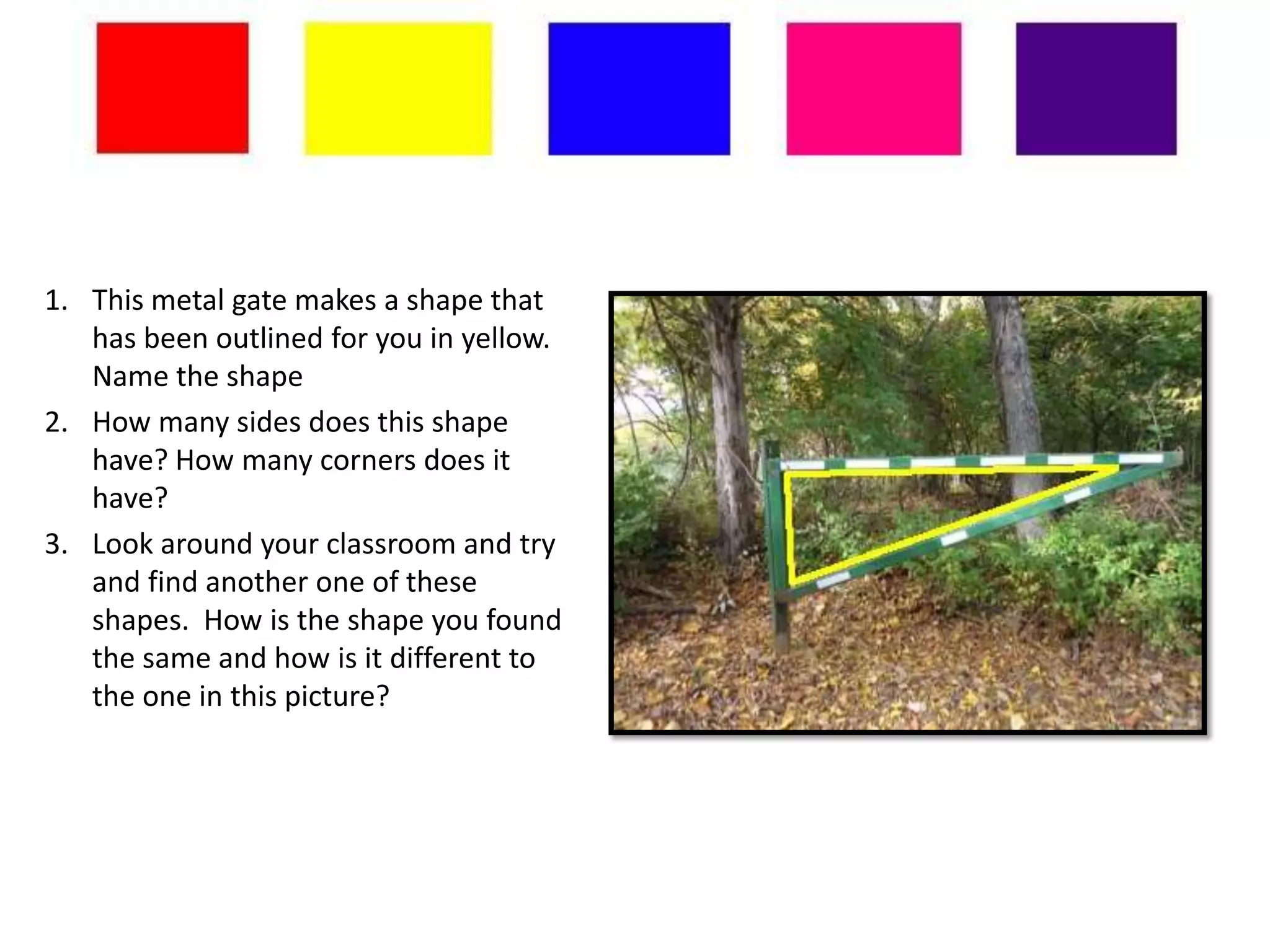
1. This metal gate makes a shape that
   has been outlined for you in yellow.
   Name the shape
2. How many sides does this shape
   have? How many corners does it
   have?
3. Look around your classroom and try
   and find another one of these
   shapes. How is the shape you found
   the same and how is it different to
   the one in this picture?
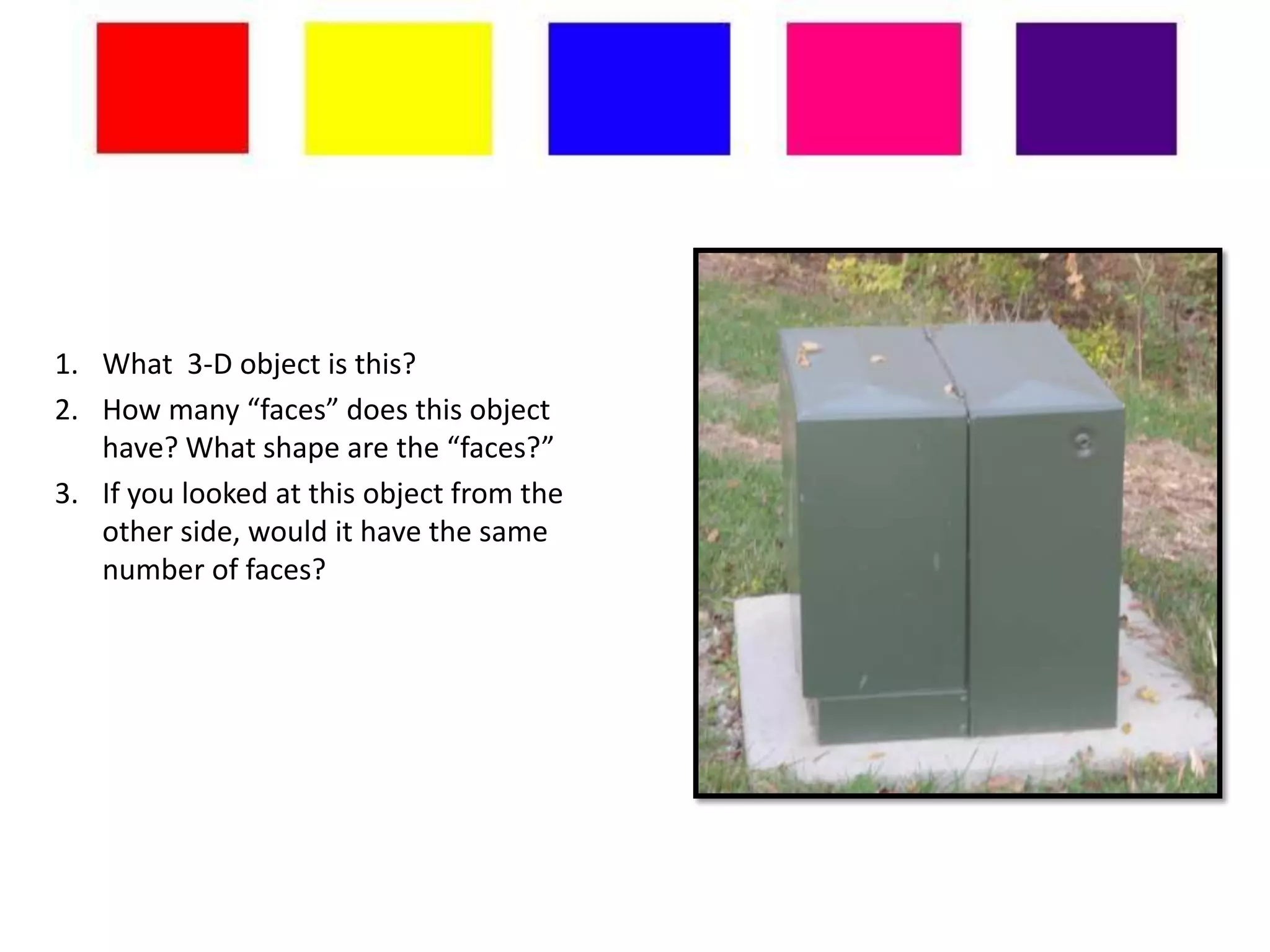
1. What 3-D object is this?
2. How many “faces” does this object
   have? What shape are the “faces?”
3. If you looked at this object from the
   other side, would it have the same
   number of faces?
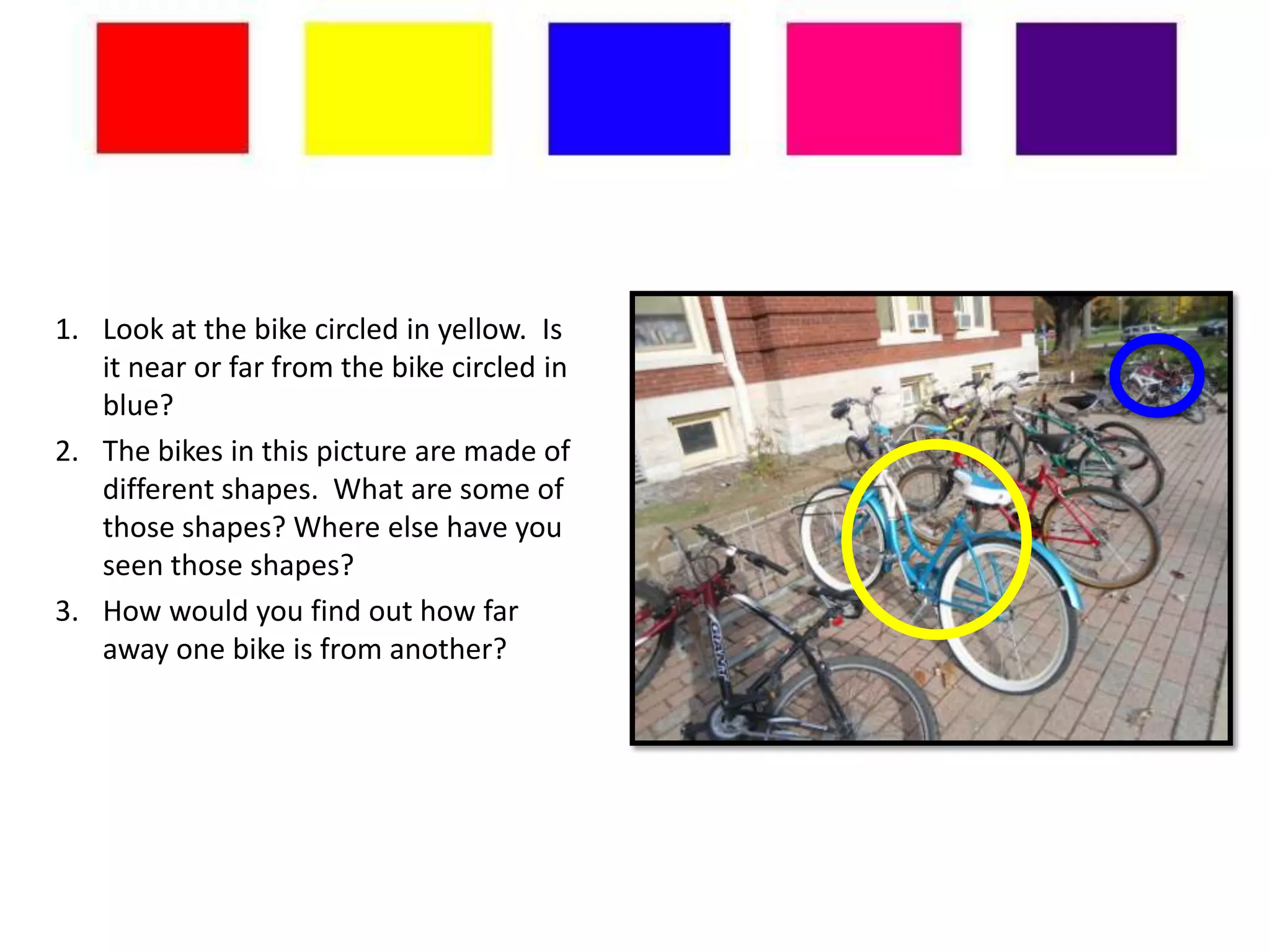
1. Look at the bike circled in yellow. Is
   it near or far from the bike circled in
   blue?
2. The bikes in this picture are made of
   different shapes. What are some of
   those shapes? Where else have you
   seen those shapes?
3. How would you find out how far
   away one bike is from another?
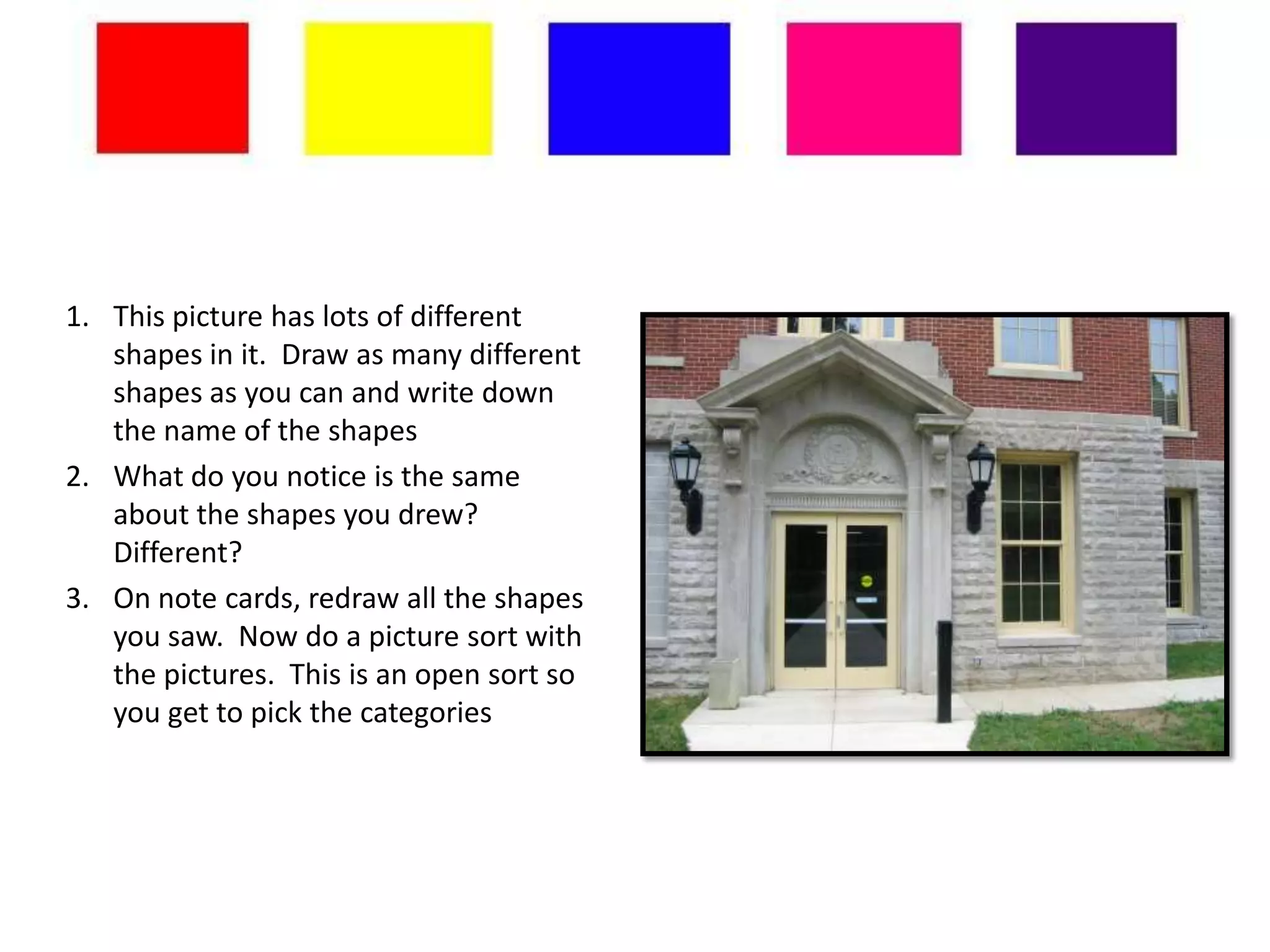
1. This picture has lots of different
   shapes in it. Draw as many different
   shapes as you can and write down
   the name of the shapes
2. What do you notice is the same
   about the shapes you drew?
   Different?
3. On note cards, redraw all the shapes
   you saw. Now do a picture sort with
   the pictures. This is an open sort so
   you get to pick the categories
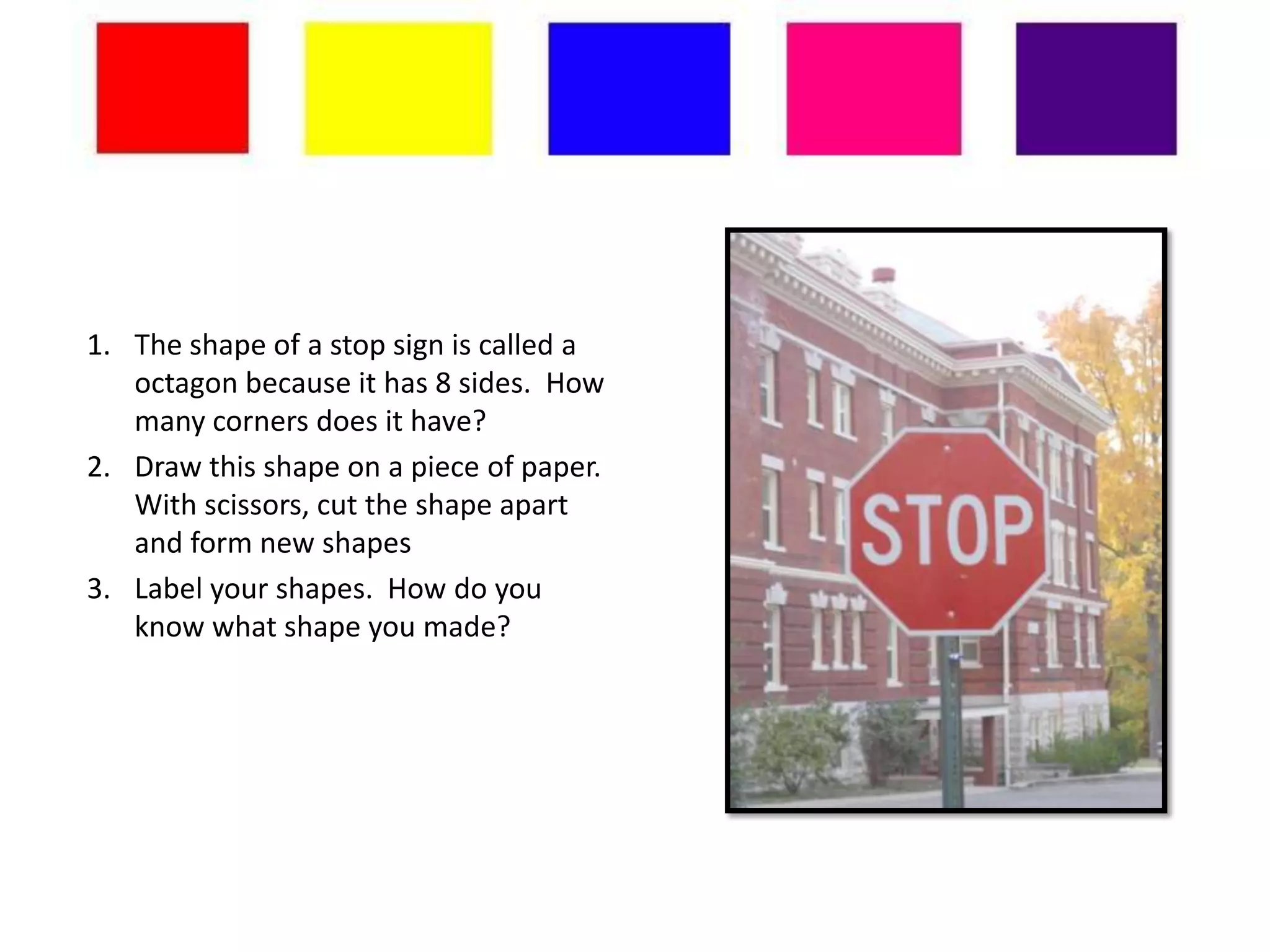
1. The shape of a stop sign is called a
   octagon because it has 8 sides. How
   many corners does it have?
2. Draw this shape on a piece of paper.
   With scissors, cut the shape apart
   and form new shapes
3. Label your shapes. How do you
   know what shape you made?
Second Grade
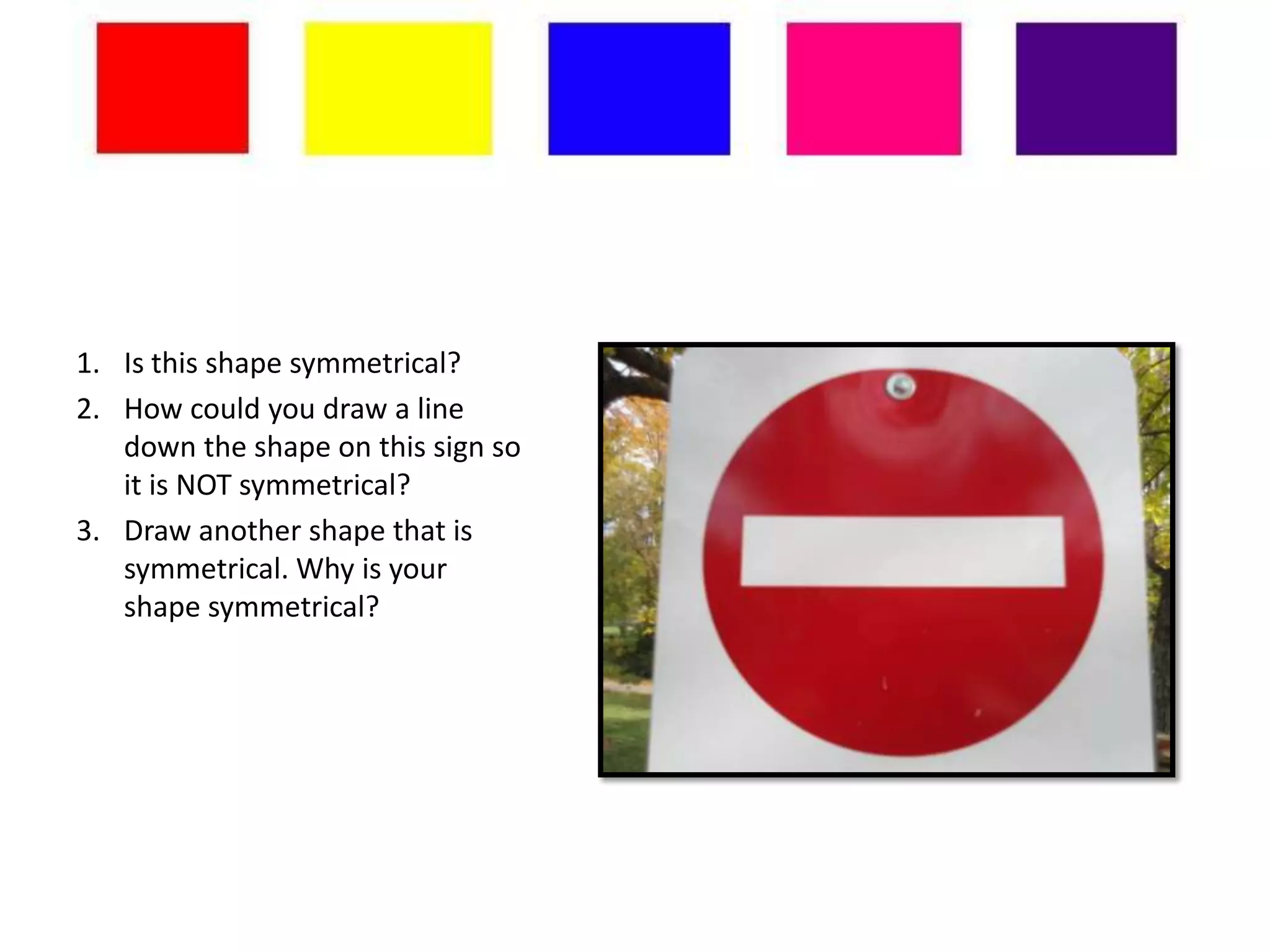
1. Is this shape symmetrical?
2. How could you draw a line
   down the shape on this sign so
   it is NOT symmetrical?
3. Draw another shape that is
   symmetrical. Why is your
   shape symmetrical?
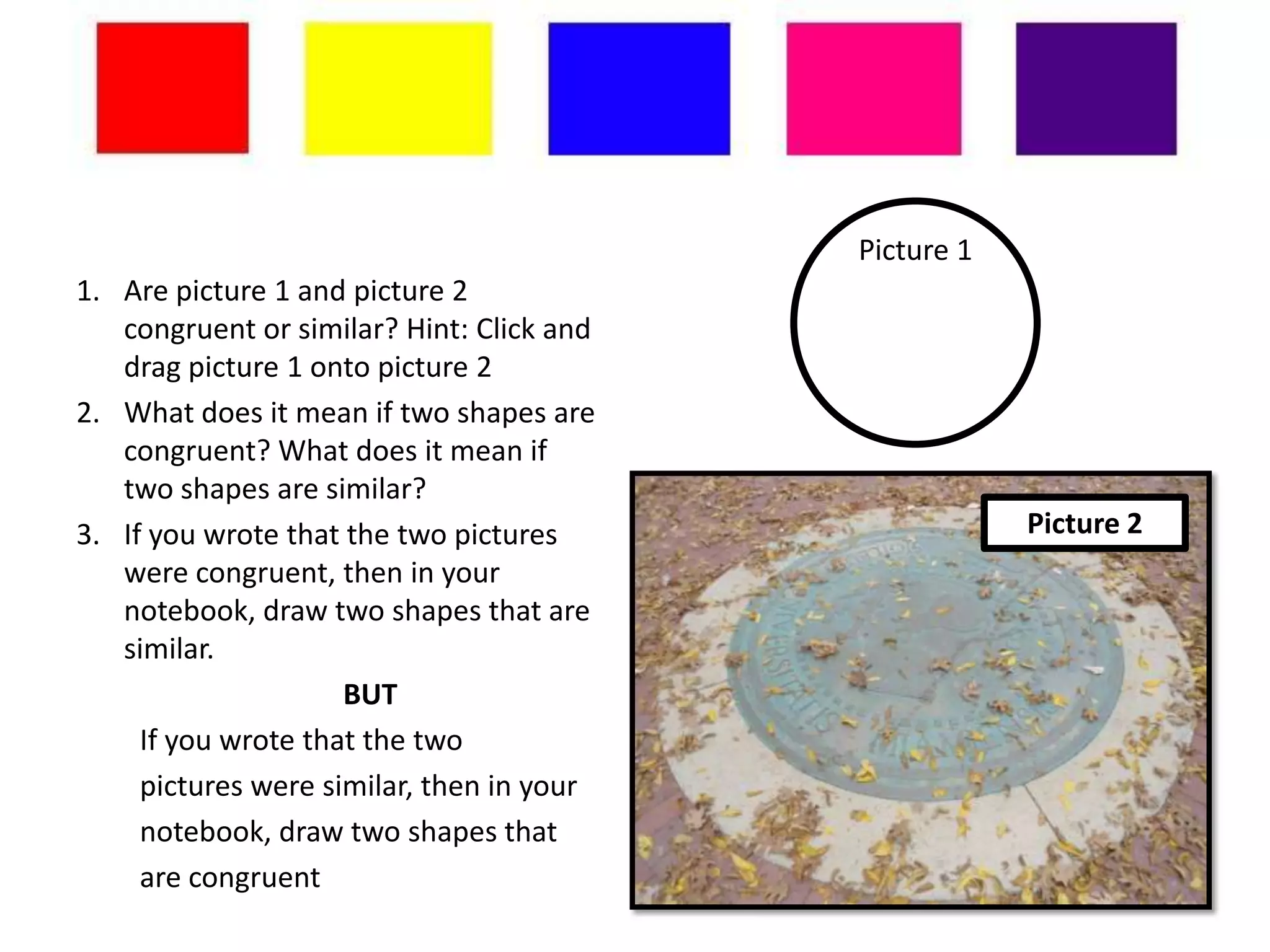
Picture 1
1. Are picture 1 and picture 2
   congruent or similar? Hint: Click and
   drag picture 1 onto picture 2
2. What does it mean if two shapes are
   congruent? What does it mean if
   two shapes are similar?
3. If you wrote that the two pictures                  Picture 2
   were congruent, then in your
   notebook, draw two shapes that are
   similar.
                     BUT
     If you wrote that the two
     pictures were similar, then in your
     notebook, draw two shapes that
     are congruent
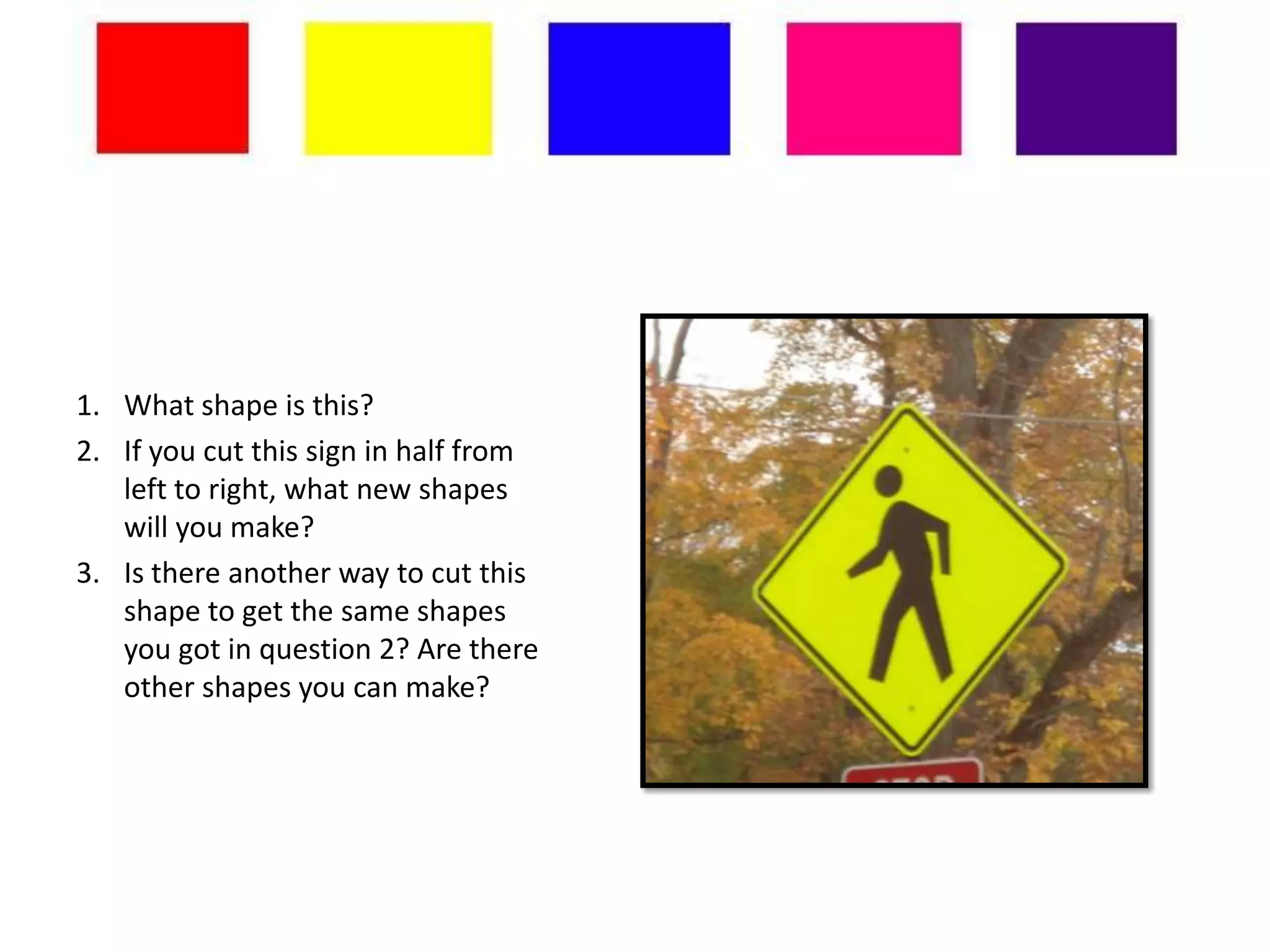
1. What shape is this?
2. If you cut this sign in half from
   left to right, what new shapes
   will you make?
3. Is there another way to cut this
   shape to get the same shapes
   you got in question 2? Are there
   other shapes you can make?
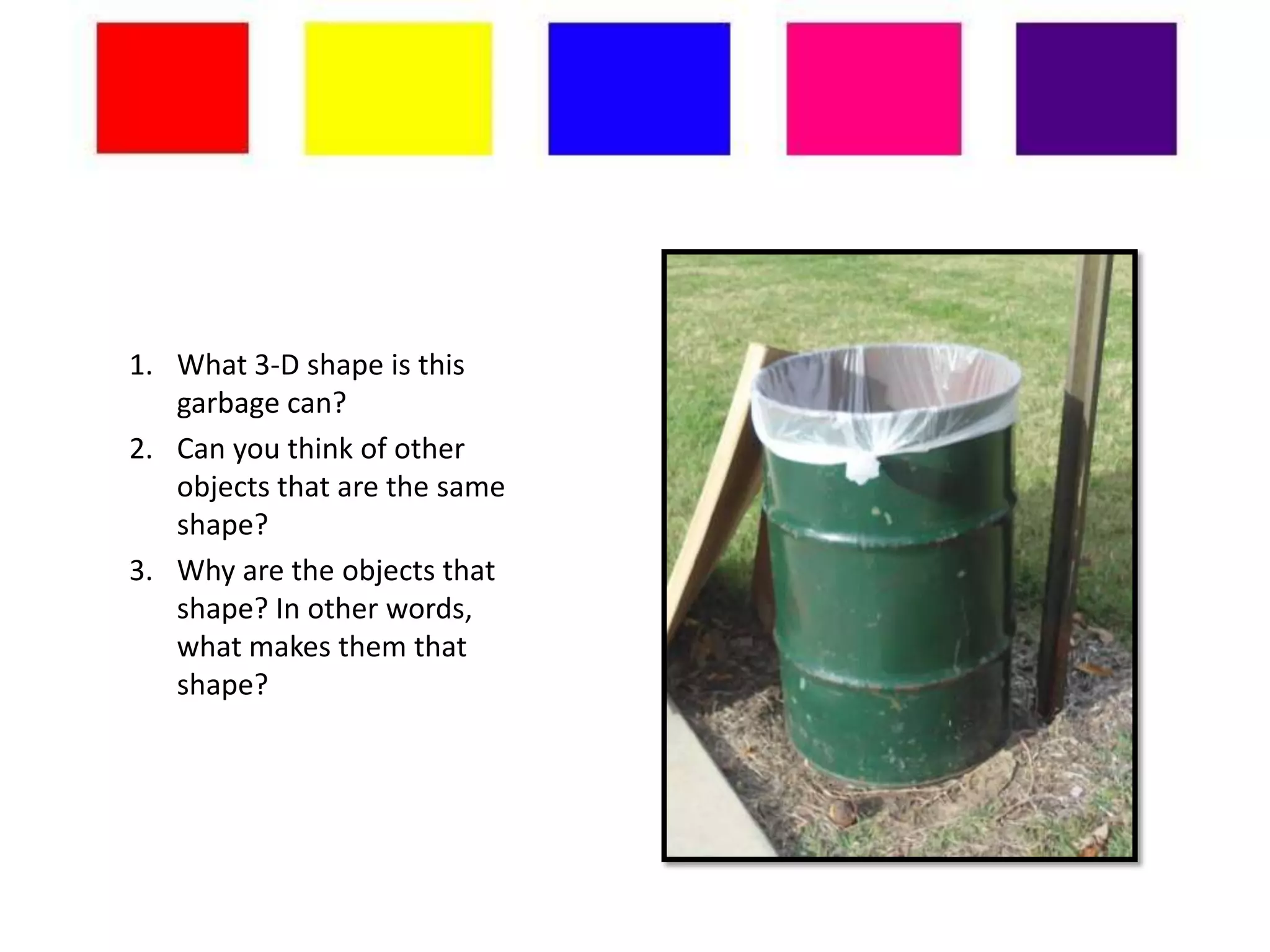
1. What 3-D shape is this
   garbage can?
2. Can you think of other
   objects that are the same
   shape?
3. Why are the objects that
   shape? In other words,
   what makes them that
   shape?
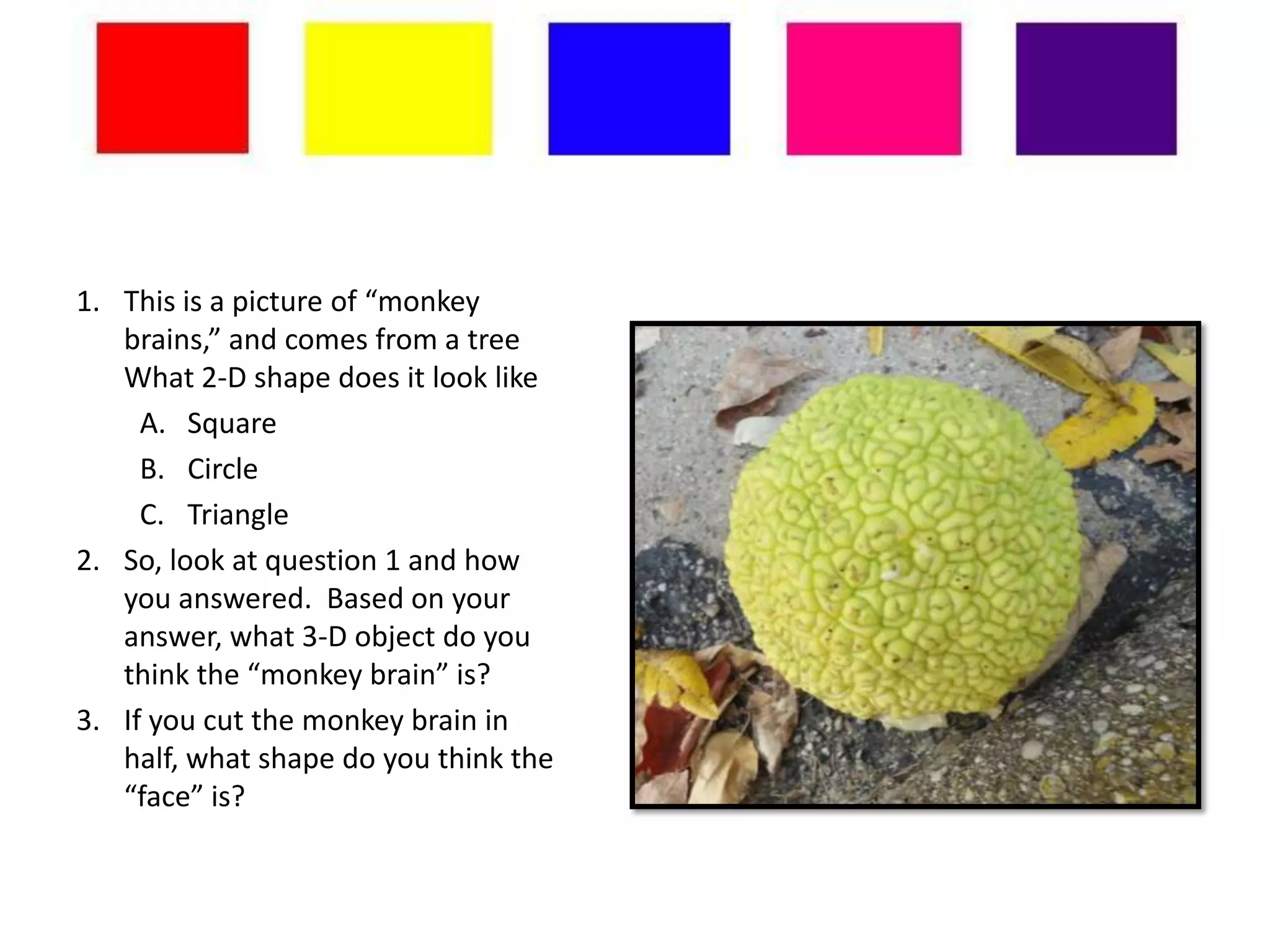
1. This is a picture of “monkey
   brains,” and comes from a tree
   What 2-D shape does it look like
     A. Square
     B. Circle
     C. Triangle
2. So, look at question 1 and how
   you answered. Based on your
   answer, what 3-D object do you
   think the “monkey brain” is?
3. If you cut the monkey brain in
   half, what shape do you think the
   “face” is?
Third Grade
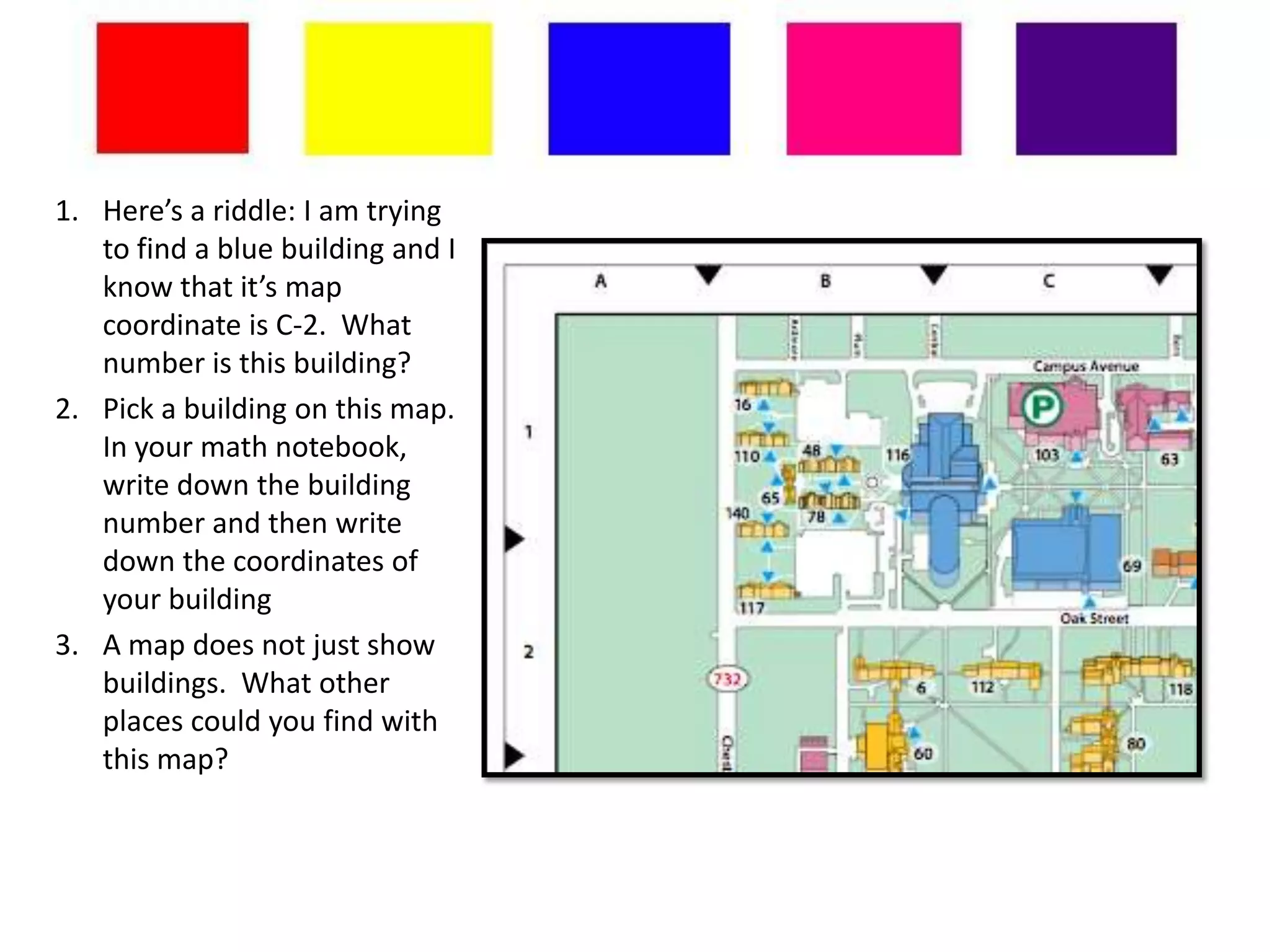
1. Here’s a riddle: I am trying
   to find a blue building and I
   know that it’s map
   coordinate is C-2. What
   number is this building?
2. Pick a building on this map.
   In your math notebook,
   write down the building
   number and then write
   down the coordinates of
   your building
3. A map does not just show
   buildings. What other
   places could you find with
   this map?
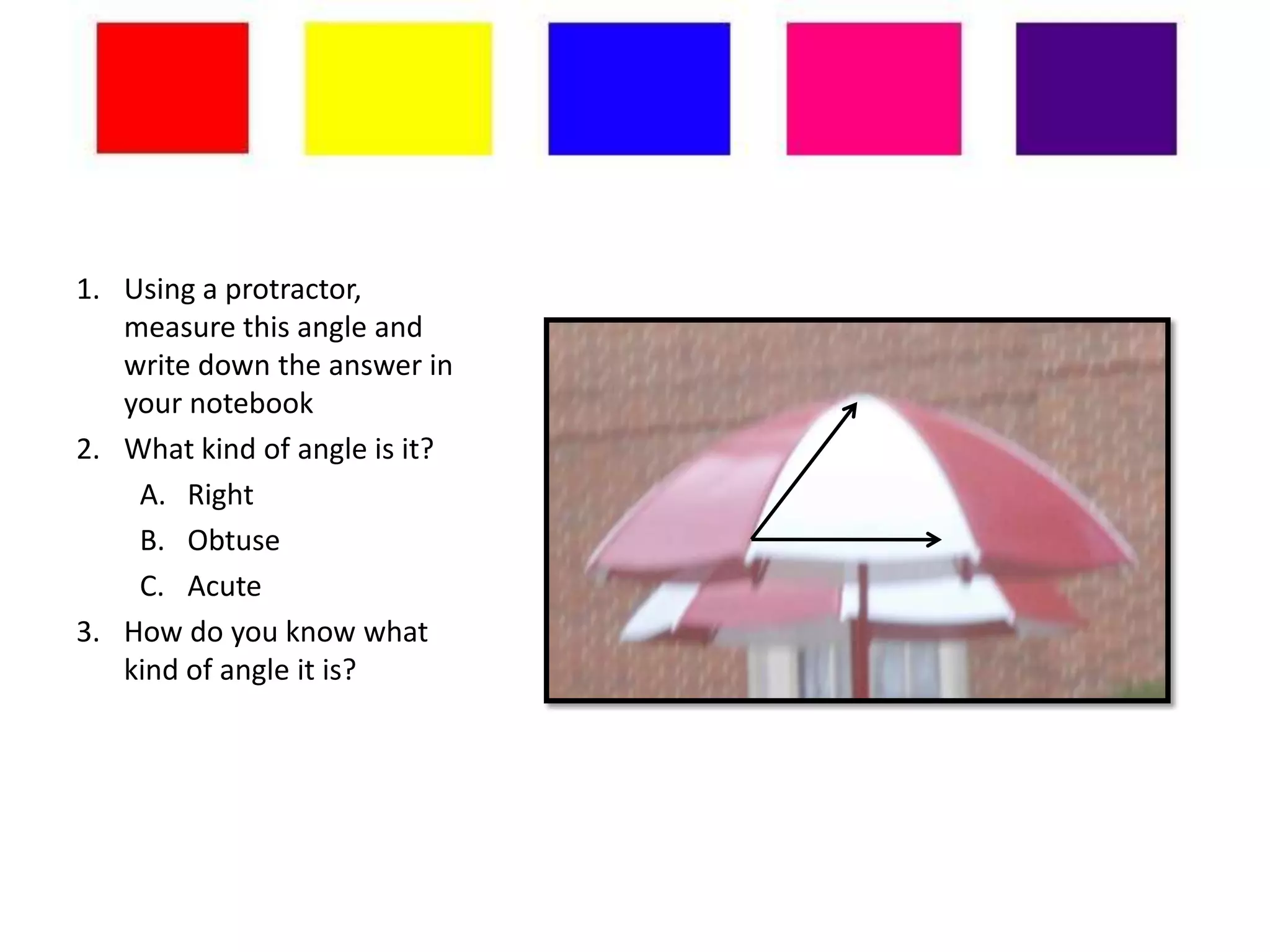
1. Using a protractor,
   measure this angle and
   write down the answer in
   your notebook
2. What kind of angle is it?
    A. Right
    B. Obtuse
    C. Acute
3. How do you know what
   kind of angle it is?
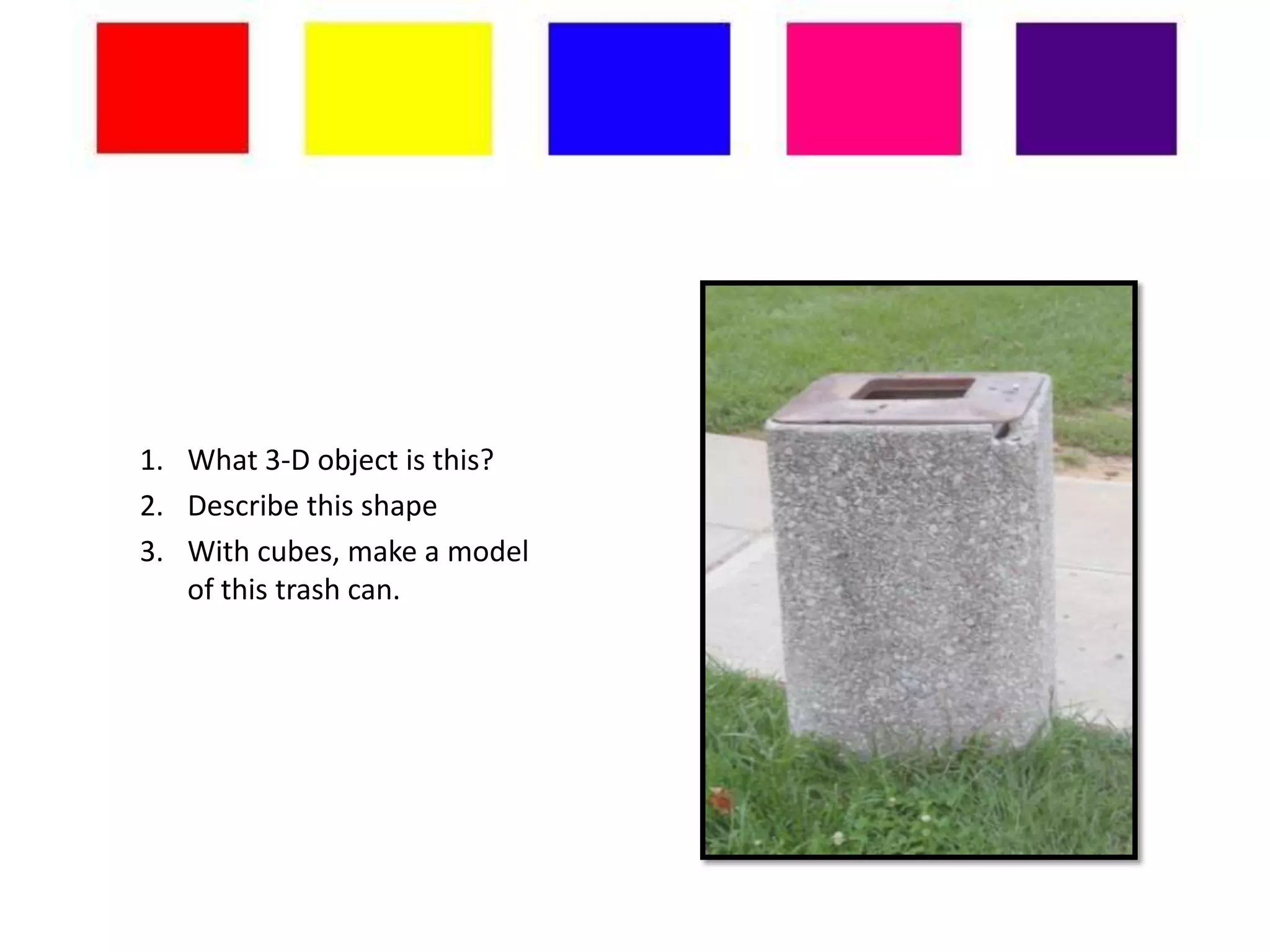
1. What 3-D object is this?
2. Describe this shape
3. With cubes, make a model
   of this trash can.
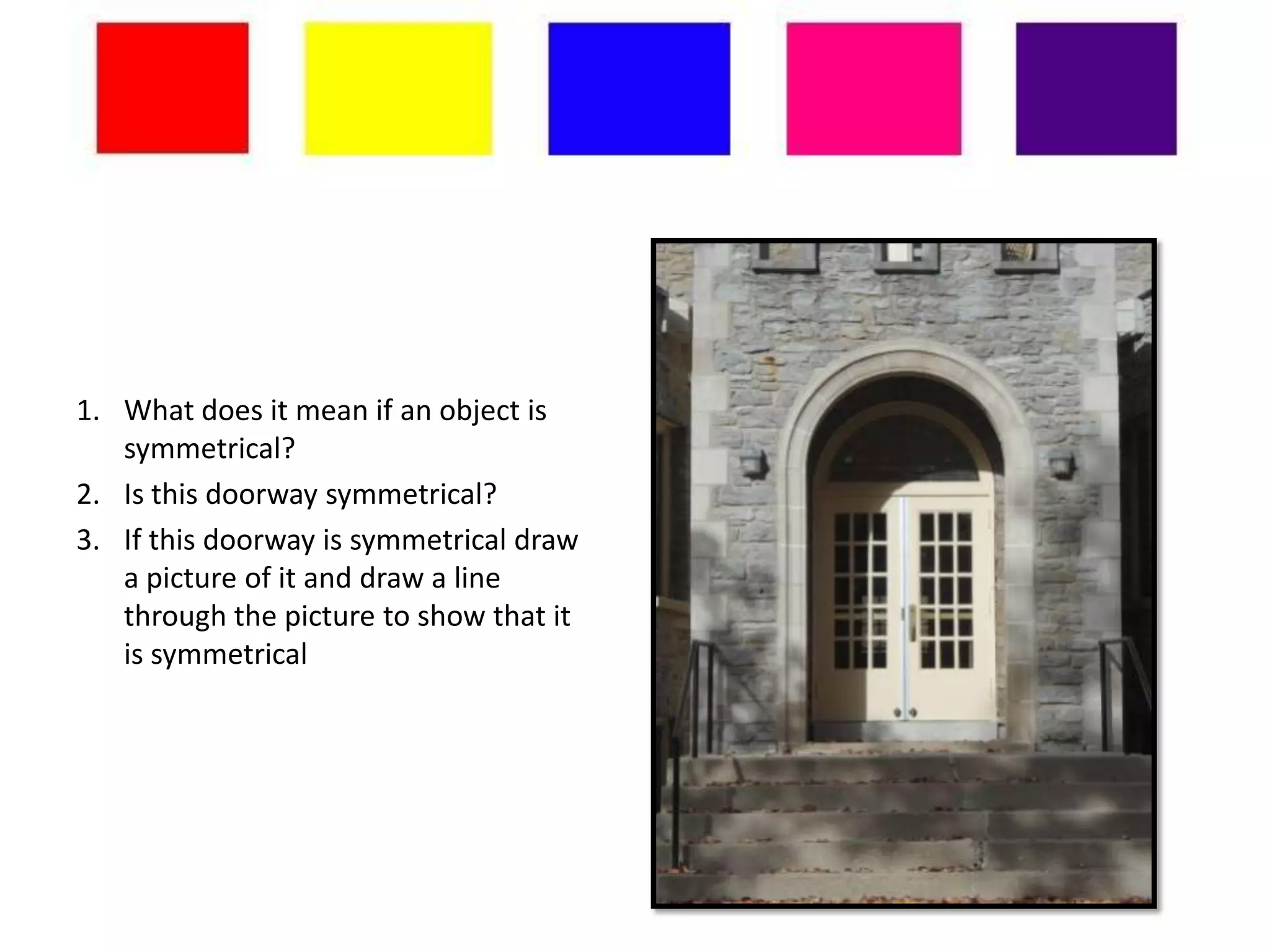
1. What does it mean if an object is
   symmetrical?
2. Is this doorway symmetrical?
3. If this doorway is symmetrical draw
   a picture of it and draw a line
   through the picture to show that it
   is symmetrical
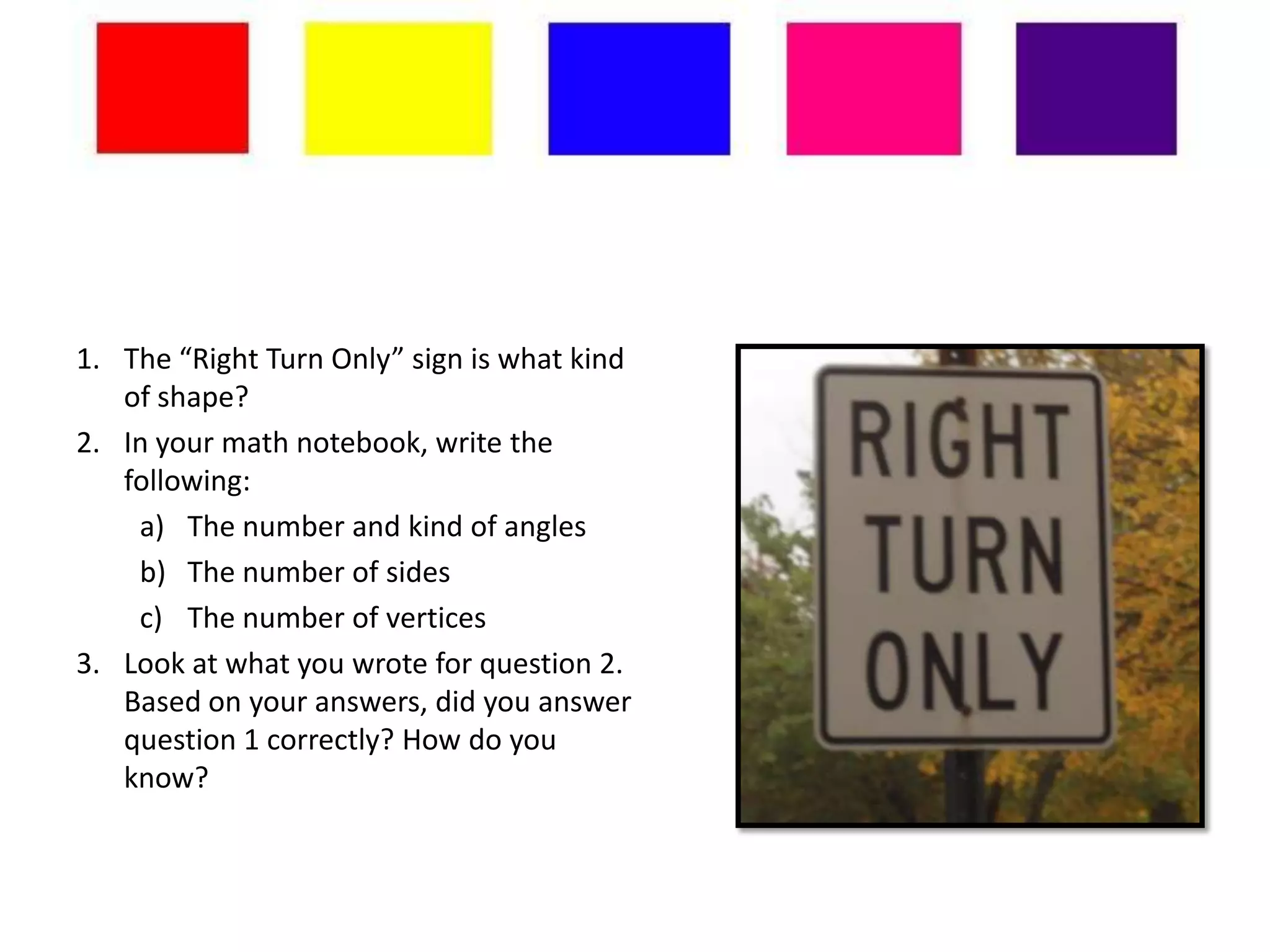
1. The “Right Turn Only” sign is what kind
   of shape?
2. In your math notebook, write the
   following:
    a) The number and kind of angles
    b) The number of sides
    c) The number of vertices
3. Look at what you wrote for question 2.
   Based on your answers, did you answer
   question 1 correctly? How do you
   know?
Summary
    This assignment asks you questions about geometry that a student in your
                                 grade needs to know.
•    First graders, all your questions were about different shapes and what
     makes them that shape and about “near” and “far.”
•    Second graders, all your questions were about different shapes, how
     shapes are the same or different and about what makes a 2-D or 3-D
     object
•    Third graders, all your questions were about symmetry, shape properties
     such as angles and faces, and finding places on a map
•    Make sure you answered all the questions for your grade. Then turn in
     your math notebook to your teacher.
                                     Good job!
Teacher
 Slides
First Grade Geometry
Picture 1
Benchmark C: Sort and compare 2-D figures and 3-D objects according to their characteristics and properties
Indicator 1: Identify, compare and sort 2-D shapes; i.e., square, circle, ellipse, triangle, rectangle, rhombus, trapezoid, parallelogram,
     pentagon and hexagon
Question 1: Knowledge
Question 2: Comprehension
Question 3: Evaluation

Picture 2
Benchmark B: Describe solid objects: cube, rectangular prism, sphere, cylinder, cone and pyramid, and identify them in the environment
Indicator 3: Identify the shapes of the faces of 3-D objects
Question 1: Knowledge
Question 2: Comprehension
Question 3: Analysis

Picture 3
Benchmark F Describe location using comparative (before, after), directional (above, below), and positional (first, last) words
Indicator 4: Extend the use of location words to include distance (near, far, close to) and directional (left, right)
Question 1: Knowledge
Question 2: Analysis
Question 3: Evaluation


 Picture 4
Benchmark A Describe and create plane figures: circle, rectangle, square, triangle, hexagon, trapezoid, parallelogram and rhombus, and
     identify them in the environment
Indicator 1: Identify, compare and sort 2-D shapes; i.e., square, circle, ellipse, triangle, rectangle, rhombus, trapezoid, parallelogram,
     pentagon and hexagon.
Question 1: Knowledge
Question 2: Evaluation
Picture 5
       Benchmark A: Describe and create plane figures: circle, rectangle, square, triangle, hexagon, trapezoid, parallelogram and rhombus, and
            identify them in the environment
       Indicator 2: Create new shapes by combining or cutting apart existing shapes
       Question 1: Knowledge
       Question 2: Application
       Question 3: Evaluation
                                                                Second Grade Geometry
      Picture 6
     Benchmark G: identify and draw figures with line symmetry
     Indicator 5: create and identify 2-d figures with line symmetry; e.g., what letter shapes, logos, polygons are symmetrical?
     Question 1: Knowledge
     Question 2: Evaluation
     Question 3: Synthesis

Picture 7
      Benchmark D: Identify, explain and model (superposition, copying) the concept of shapes being congruent and similar
      Indicator 4: Identify and determine whether 2-D shapes are congruent (same shape and size) or similar (same shape, different size) by
      copying or using superposition (lay one thing on top of another)
      Question 1: Knowledge
      Question 2: Comprehension
      Question 3: Synthesis

Picture 8
      Benchmark A: Describe and create plane figures: circle, rectangle, square, triangle, hexagon, trapezoid, parallelogram and rhombus, and
      identify them in the environment
      Indicator 2: Predict what new shapes will be formed by combining or cutting apart existing shapes
      Question 1: Knowledge
      Question 2: comprehension
      Question 3: Synthesis
Picture 9
      Benchmark C: Sort and compare 2-D figures and 3-D objects according to their characteristics and properties
      Indicator 1: Identify, describe, compare and sort 3-D objects (i.e., cubes, spheres
      prisms, cones, cylinders and pyramids) according to the shape of the faces or the number of faces, edges or vertices
      Question 1: Knowledge
      Question 2: Comprehension
      Question 3: Evaluation

Picture 10
      Benchmark C: Sort and compare 2-D figures and 3-D objects according to their characteristics and properties
      Indicator 1: Identify, describe, compare and sort 3-D objects (i.e., cubes, spheres, prisms, cones, cylinders and pyramids) according to the
      shape of the faces or the number of faces, edges or vertices
      Question 1: Knowledge
      Question 2: Comprehension
      Question 3: Evaluation
                                                              Third Grade Geometry
Picture 11
      Benchmark G: Find and name locations in coordinate systems
      Indicator 3: Find and name locations on a labeled grid or coordinate system; e.g., a map or graph
      Question 1: Comprehension
      Question 2: Application
      Question 3: Analysis

Picture 12
      Benchmark D: Identify and draw right, obtuse, acute and straight angles
      Indicator 2: Identify and describe the relative size of angles with respect to right angles as follows
      Identify, classify, and draw right, acute, obtuse and straight angles
      Question 1: Application
      Question 2: Knowledge
      Question 3: Analysis
Picture 13
Benchmark I: Describe, identify and model reflections, rotations and translations, using physical materials
Indicator 5: Build a 3-D model of objects composed of cubes; e.g., construct a model based on an illustration or actual object
Question 1: Knowledge
Question 2: Synthesis
Question 3: Application

Picture 14
Benchmark H: identify and describe line and rotational symmetry in 2-D shapes and designs
Indicator 4: Draw lines of symmetry to verify symmetrical 2-D shapes
Question 1: Synthesis
Question 2: Knowledge
Question 3: Application

Picture 15
Benchmark B: Describe and identify points, lines, and planes in the environment
Indicator 1: Analyze and describe properties of 2-D shapes and 3-D objects using terms such as vertex, edge, angle, side and face
Question 1: Knowledge
Question 2: Comprehension
Question 3: Evaluation

Math Photo Essay

  • 1.
  • 2.
    Dear Students, You have been learning about geometry in math class! In geometry, you learn about shapes, lines, curves, 3-D and 2-D objects and much more! This photo essay is going to give you practice with geometry. Each page has a picture and each picture has three questions that go with it. You will read each question and use the picture to answer the questions. The pictures were taken at Miami University in Ohio and it is where I went to college! This book is divided into three grades: first, second and third. Please make sure you are answering the questions found with the grade you are in. I hope that you enjoy this book! Remember to have fun with it because math should be fun! Your Teacher, Miss Collins
  • 3.
    Directions 1. Press thespace bar (the biggest button on your keyboard) until you get to your grade 2. You will answer three questions about five different pictures 3. To change pictures, press the space bar 4. Write your answers to the questions in your math notebook 5. Remember to ask your teacher for help if you do not understand a question or need help with a word 6. Turn in your notebook to the teacher when you are done
  • 4.
  • 5.
    1. This metalgate makes a shape that has been outlined for you in yellow. Name the shape 2. How many sides does this shape have? How many corners does it have? 3. Look around your classroom and try and find another one of these shapes. How is the shape you found the same and how is it different to the one in this picture?
  • 6.
    1. What 3-Dobject is this? 2. How many “faces” does this object have? What shape are the “faces?” 3. If you looked at this object from the other side, would it have the same number of faces?
  • 7.
    1. Look atthe bike circled in yellow. Is it near or far from the bike circled in blue? 2. The bikes in this picture are made of different shapes. What are some of those shapes? Where else have you seen those shapes? 3. How would you find out how far away one bike is from another?
  • 8.
    1. This picturehas lots of different shapes in it. Draw as many different shapes as you can and write down the name of the shapes 2. What do you notice is the same about the shapes you drew? Different? 3. On note cards, redraw all the shapes you saw. Now do a picture sort with the pictures. This is an open sort so you get to pick the categories
  • 9.
    1. The shapeof a stop sign is called a octagon because it has 8 sides. How many corners does it have? 2. Draw this shape on a piece of paper. With scissors, cut the shape apart and form new shapes 3. Label your shapes. How do you know what shape you made?
  • 10.
  • 11.
    1. Is thisshape symmetrical? 2. How could you draw a line down the shape on this sign so it is NOT symmetrical? 3. Draw another shape that is symmetrical. Why is your shape symmetrical?
  • 12.
    Picture 1 1. Arepicture 1 and picture 2 congruent or similar? Hint: Click and drag picture 1 onto picture 2 2. What does it mean if two shapes are congruent? What does it mean if two shapes are similar? 3. If you wrote that the two pictures Picture 2 were congruent, then in your notebook, draw two shapes that are similar. BUT If you wrote that the two pictures were similar, then in your notebook, draw two shapes that are congruent
  • 13.
    1. What shapeis this? 2. If you cut this sign in half from left to right, what new shapes will you make? 3. Is there another way to cut this shape to get the same shapes you got in question 2? Are there other shapes you can make?
  • 14.
    1. What 3-Dshape is this garbage can? 2. Can you think of other objects that are the same shape? 3. Why are the objects that shape? In other words, what makes them that shape?
  • 15.
    1. This isa picture of “monkey brains,” and comes from a tree What 2-D shape does it look like A. Square B. Circle C. Triangle 2. So, look at question 1 and how you answered. Based on your answer, what 3-D object do you think the “monkey brain” is? 3. If you cut the monkey brain in half, what shape do you think the “face” is?
  • 16.
  • 17.
    1. Here’s ariddle: I am trying to find a blue building and I know that it’s map coordinate is C-2. What number is this building? 2. Pick a building on this map. In your math notebook, write down the building number and then write down the coordinates of your building 3. A map does not just show buildings. What other places could you find with this map?
  • 18.
    1. Using aprotractor, measure this angle and write down the answer in your notebook 2. What kind of angle is it? A. Right B. Obtuse C. Acute 3. How do you know what kind of angle it is?
  • 19.
    1. What 3-Dobject is this? 2. Describe this shape 3. With cubes, make a model of this trash can.
  • 20.
    1. What doesit mean if an object is symmetrical? 2. Is this doorway symmetrical? 3. If this doorway is symmetrical draw a picture of it and draw a line through the picture to show that it is symmetrical
  • 21.
    1. The “RightTurn Only” sign is what kind of shape? 2. In your math notebook, write the following: a) The number and kind of angles b) The number of sides c) The number of vertices 3. Look at what you wrote for question 2. Based on your answers, did you answer question 1 correctly? How do you know?
  • 22.
    Summary This assignment asks you questions about geometry that a student in your grade needs to know. • First graders, all your questions were about different shapes and what makes them that shape and about “near” and “far.” • Second graders, all your questions were about different shapes, how shapes are the same or different and about what makes a 2-D or 3-D object • Third graders, all your questions were about symmetry, shape properties such as angles and faces, and finding places on a map • Make sure you answered all the questions for your grade. Then turn in your math notebook to your teacher. Good job!
  • 23.
  • 24.
    First Grade Geometry Picture1 Benchmark C: Sort and compare 2-D figures and 3-D objects according to their characteristics and properties Indicator 1: Identify, compare and sort 2-D shapes; i.e., square, circle, ellipse, triangle, rectangle, rhombus, trapezoid, parallelogram, pentagon and hexagon Question 1: Knowledge Question 2: Comprehension Question 3: Evaluation Picture 2 Benchmark B: Describe solid objects: cube, rectangular prism, sphere, cylinder, cone and pyramid, and identify them in the environment Indicator 3: Identify the shapes of the faces of 3-D objects Question 1: Knowledge Question 2: Comprehension Question 3: Analysis Picture 3 Benchmark F Describe location using comparative (before, after), directional (above, below), and positional (first, last) words Indicator 4: Extend the use of location words to include distance (near, far, close to) and directional (left, right) Question 1: Knowledge Question 2: Analysis Question 3: Evaluation Picture 4 Benchmark A Describe and create plane figures: circle, rectangle, square, triangle, hexagon, trapezoid, parallelogram and rhombus, and identify them in the environment Indicator 1: Identify, compare and sort 2-D shapes; i.e., square, circle, ellipse, triangle, rectangle, rhombus, trapezoid, parallelogram, pentagon and hexagon. Question 1: Knowledge Question 2: Evaluation
  • 25.
    Picture 5 Benchmark A: Describe and create plane figures: circle, rectangle, square, triangle, hexagon, trapezoid, parallelogram and rhombus, and identify them in the environment Indicator 2: Create new shapes by combining or cutting apart existing shapes Question 1: Knowledge Question 2: Application Question 3: Evaluation Second Grade Geometry Picture 6 Benchmark G: identify and draw figures with line symmetry Indicator 5: create and identify 2-d figures with line symmetry; e.g., what letter shapes, logos, polygons are symmetrical? Question 1: Knowledge Question 2: Evaluation Question 3: Synthesis Picture 7 Benchmark D: Identify, explain and model (superposition, copying) the concept of shapes being congruent and similar Indicator 4: Identify and determine whether 2-D shapes are congruent (same shape and size) or similar (same shape, different size) by copying or using superposition (lay one thing on top of another) Question 1: Knowledge Question 2: Comprehension Question 3: Synthesis Picture 8 Benchmark A: Describe and create plane figures: circle, rectangle, square, triangle, hexagon, trapezoid, parallelogram and rhombus, and identify them in the environment Indicator 2: Predict what new shapes will be formed by combining or cutting apart existing shapes Question 1: Knowledge Question 2: comprehension Question 3: Synthesis
  • 26.
    Picture 9 Benchmark C: Sort and compare 2-D figures and 3-D objects according to their characteristics and properties Indicator 1: Identify, describe, compare and sort 3-D objects (i.e., cubes, spheres prisms, cones, cylinders and pyramids) according to the shape of the faces or the number of faces, edges or vertices Question 1: Knowledge Question 2: Comprehension Question 3: Evaluation Picture 10 Benchmark C: Sort and compare 2-D figures and 3-D objects according to their characteristics and properties Indicator 1: Identify, describe, compare and sort 3-D objects (i.e., cubes, spheres, prisms, cones, cylinders and pyramids) according to the shape of the faces or the number of faces, edges or vertices Question 1: Knowledge Question 2: Comprehension Question 3: Evaluation Third Grade Geometry Picture 11 Benchmark G: Find and name locations in coordinate systems Indicator 3: Find and name locations on a labeled grid or coordinate system; e.g., a map or graph Question 1: Comprehension Question 2: Application Question 3: Analysis Picture 12 Benchmark D: Identify and draw right, obtuse, acute and straight angles Indicator 2: Identify and describe the relative size of angles with respect to right angles as follows Identify, classify, and draw right, acute, obtuse and straight angles Question 1: Application Question 2: Knowledge Question 3: Analysis
  • 27.
    Picture 13 Benchmark I:Describe, identify and model reflections, rotations and translations, using physical materials Indicator 5: Build a 3-D model of objects composed of cubes; e.g., construct a model based on an illustration or actual object Question 1: Knowledge Question 2: Synthesis Question 3: Application Picture 14 Benchmark H: identify and describe line and rotational symmetry in 2-D shapes and designs Indicator 4: Draw lines of symmetry to verify symmetrical 2-D shapes Question 1: Synthesis Question 2: Knowledge Question 3: Application Picture 15 Benchmark B: Describe and identify points, lines, and planes in the environment Indicator 1: Analyze and describe properties of 2-D shapes and 3-D objects using terms such as vertex, edge, angle, side and face Question 1: Knowledge Question 2: Comprehension Question 3: Evaluation