1
Project Appraisal & Financing
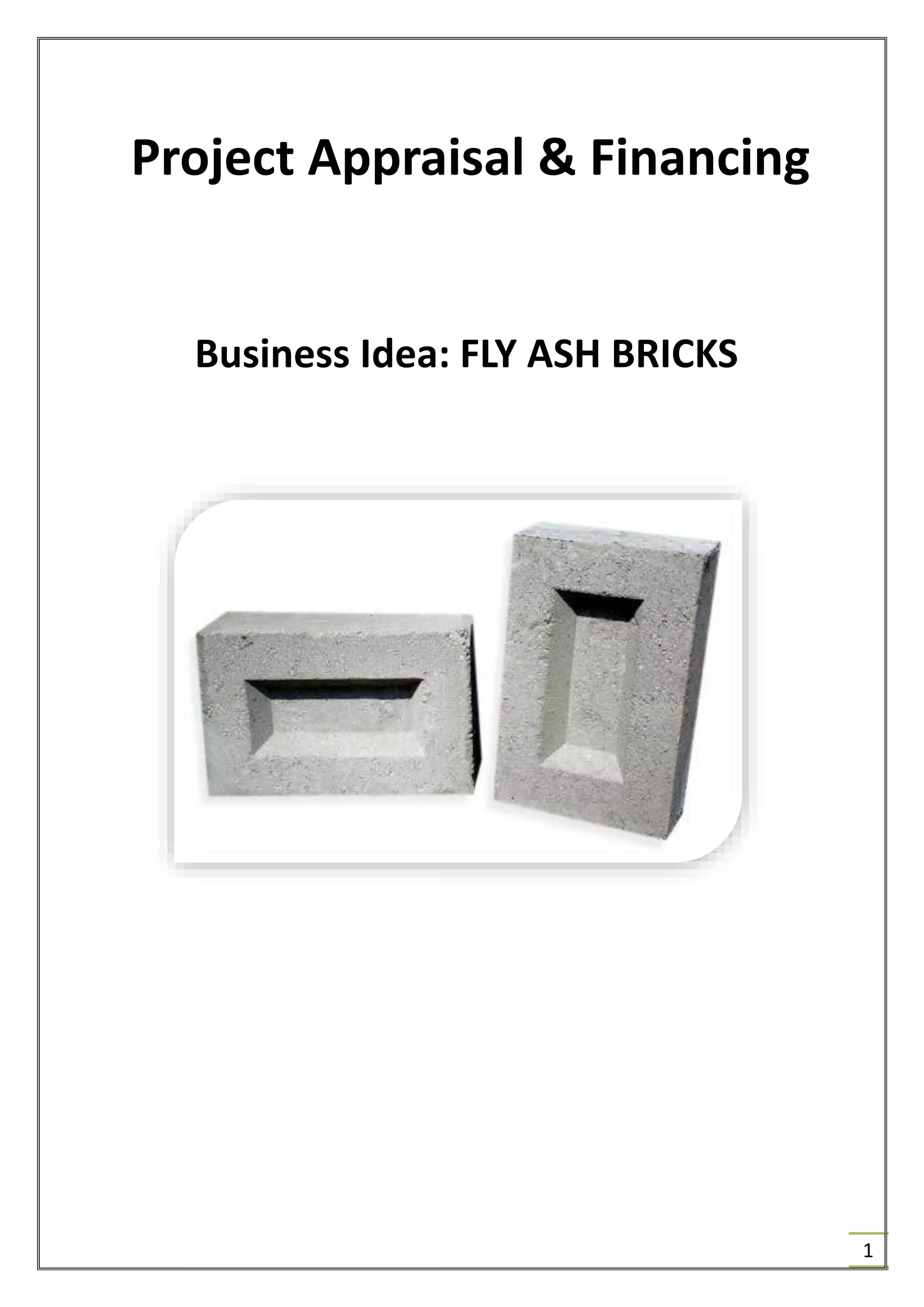
Business Idea: FLY ASH BRICKS
2
INTRODUCTION 3
MARKET DEMAND: .............................................................................................................................4
Why fly ash bricks? .............................................................................................................................4
Technical Specifications......................................................................................................................4
Demand potential estimate................................................................................................................5
Supply status:......................................................................................................................................5
Scope of the project:...........................................................................................................................5
Acquiring the raw materials:...............................................................................................................6
Economic concerns: ............................................................................................................................6
Product pricing....................................................................................................................................6
Promotional plans:..............................................................................................................................6
Marketing plans ..................................................................................................................................6
STP:......................................................................................................................................................6
Country Scenario.................................................................................................................................7
Steps involved.....................................................................................................................................8
Equipment Suppliers...........................................................................................................................8
Raw Materials & Utilities ....................................................................................................................8
Manpower Requirements...................................................................................................................8
Location & Infrastructure....................................................................................................................8
Implementation ..................................................................................................................................9
SOURCES: ................................................................................................................................................9
PAF FINAL RANK 1 IDEAS OF OUR TEAM ..............................................................................................10
Reasons for Selecting Fly Ash Bricks .................................................................................................10
Reasons for Not Selecting Others.....................................................................................................10
LIST OF ASSUMPTIONS..........................................................................................................................11
FEASIBILITY STUDY................................................................................................................................12
Estimation of Installed Capacity........................................................................................................12
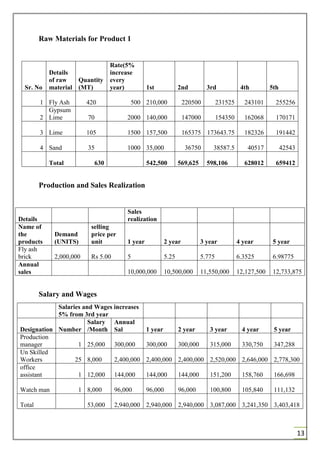
Raw Materials for Product 1 .............................................................................................................13
Production and Sales Realization......................................................................................................13
Salary and Wages..............................................................................................................................13
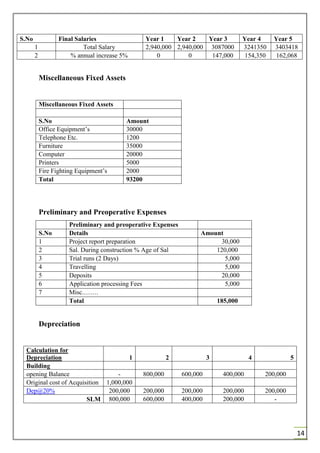
Miscellaneous Fixed Assets...............................................................................................................14
Preliminary and Preoperative Expenses ...........................................................................................14
Depreciation......................................................................................................................................14
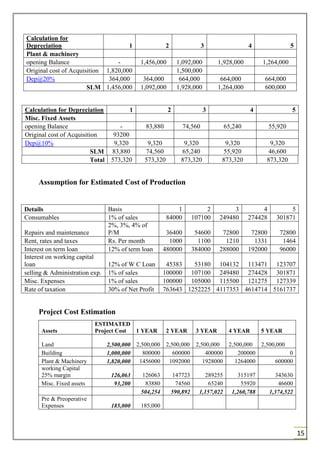
Assumption for Estimated Cost of Production .................................................................................15
Project Cost Estimation.....................................................................................................................15
3
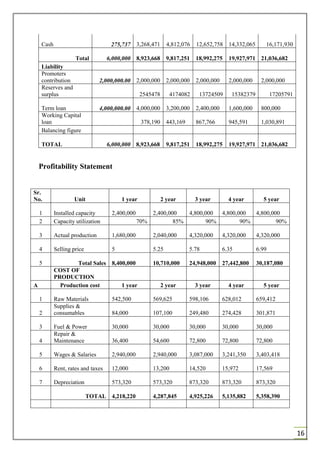
Profitability Statement......................................................................................................................16
Break Even Point...............................................................................................................................17
Working Capital Calculation..............................................................................................................18
Debt Service Coverage Ratio.............................................................................................................19
INTRODUCTION
Fly Ash bricks are made of fly ash, lime, gypsum and sand. These can be extensively
used in all building constructional activities similar to that of common burnt clay bricks. The
4
fly ash bricks are comparatively lighter in weight and stronger than common clay bricks.
Since fly ash is being accumulated as waste material in large quantity near thermal power
plants and creating serious environmental pollution problems, its utilization as main raw
material in the manufacture of bricks will not only create ample opportunities for its proper
and useful disposal but also help in environmental pollution control to a greater extent in the
surrounding areas of power plants. In view of superior quality and eco-friendly nature, and
government support the demand for Fly Ash Bricks has picked up.
MARKET DEMAND:
180 billion tons of common burnt clay bricks are consumed annually approximately
340 billion tons of clay- about 5000 acres of top layer of soil dug out for bricks manufacture,
soil erosion, emission from coal burning or fire woods which causes deforestation are the
serious problems posed by brick industry. The above problems can be reduced some extent
by using fly ash bricks in dwelling units. Demand for dwelling units likely to raise to 80
million units by year 2015 for lower middle and low income groups, involving an estimated
investment 0f $670 billion, according to the associated chamber of commerce and industry.
Demand for dwelling units will further grow to 90 million by 2020, which would require a
minimum investment of $890billion. The Indian housing sector at present faces a shortage of
20million dwelling units for its lower middle and low income groups which will witness a
spurt of about 22.5million dwelling units by the end of Tenth plan period. There is ample
scope for fly ash brick and block units... But good quality of bricks as well as required
quantity is not available moreover during the Rainey seasons supply of clay bricks are very
difficult. Therefore, in order to fulfill the required demand there will be a great chance to start
more units in the field of fly ash bricks. At present 20nos units are engaged and 40 lakhs no’s
of bricks per month are manufactured in our state. And there will be scope to start near about
100 units, which will be produced more than 2 cores no of bricks per month in future. Thus
marketing of these product are well shinning.
Why fly ash bricks?
Fly ash bricks are can be used as an alternative to burnt clay bricks. These are
environment friendly cost saving building products. These are 3 times stronger than
conventional bricks with consistent strength. These are ideally suited for internal, external,
load bearing and non-load bearing walls. These bricks with higher strength /weight ratio
(about 3 to 4 times that of burnt clay bricks) aid in designing stronger yet more economic
structures. Fly ash bricks are durable, have low water absorption, less consumption of mortar,
economical &ecofriendly, low energy consumption and no emission of greenhouse gases.
These bricks are not affected by environmental conditions and remain static thus ensuring
longer life of the building. Also the savings with regard to wastages in fly ash bricks are
considerable during unloading and construction due to true shape and size, consistency in
quality and the workability of the fly ash bricks unlike traditional clay bricks. These bricks
are very economical / cost effective.
Technical Specifications
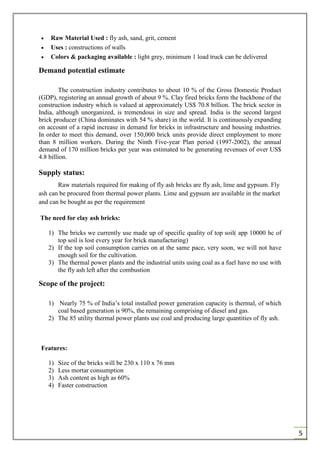
 Sizes available :230x110x70 mm
5
 Raw Material Used : fly ash, sand, grit, cement
 Uses : constructions of walls
 Colors & packaging available : light grey, minimum 1 load truck can be delivered
Demand potential estimate
The construction industry contributes to about 10 % of the Gross Domestic Product
(GDP), registering an annual growth of about 9 %. Clay fired bricks form the backbone of the
construction industry which is valued at approximately US$ 70.8 billion. The brick sector in
India, although unorganized, is tremendous in size and spread. India is the second largest
brick producer (China dominates with 54 % share) in the world. It is continuously expanding
on account of a rapid increase in demand for bricks in infrastructure and housing industries.
In order to meet this demand, over 150,000 brick units provide direct employment to more
than 8 million workers. During the Ninth Five-year Plan period (1997-2002), the annual
demand of 170 million bricks per year was estimated to be generating revenues of over US$
4.8 billion.
Supply status:
Raw materials required for making of fly ash bricks are fly ash, lime and gypsum. Fly
ash can be procured from thermal power plants. Lime and gypsum are available in the market
and can be bought as per the requirement
The need for clay ash bricks:
1) The bricks we currently use made up of specific quality of top soil( app 10000 hc of
top soil is lost every year for brick manufacturing)
2) If the top soil consumption carries on at the same pace, very soon, we will not have
enough soil for the cultivation.
3) The thermal power plants and the industrial units using coal as a fuel have no use with
the fly ash left after the combustion
Scope of the project:
1) Nearly 75 % of India’s total installed power generation capacity is thermal, of which
coal based generation is 90%, the remaining comprising of diesel and gas.
2) The 85 utility thermal power plants use coal and producing large quantities of fly ash.
Features:
1) Size of the bricks will be 230 x 110 x 76 mm
2) Less mortar consumption
3) Ash content as high as 60%
4) Faster construction
6
Acquiring the raw materials:
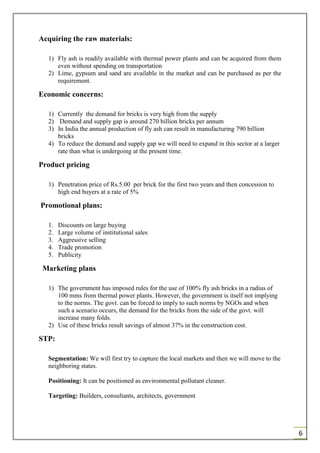
1) Fly ash is readily available with thermal power plants and can be acquired from them
even without spending on transportation
2) Lime, gypsum and sand are available in the market and can be purchased as per the
requirement.
Economic concerns:
1) Currently the demand for bricks is very high from the supply
2) Demand and supply gap is around 270 billion bricks per annum
3) In India the annual production of fly ash can result in manufacturing 790 billion
bricks
4) To reduce the demand and supply gap we will need to expand in this sector at a larger
rate than what is undergoing at the present time.
Product pricing
1) Penetration price of Rs.5.00 per brick for the first two years and then concession to
high end buyers at a rate of 5%
Promotional plans:
1. Discounts on large buying
2. Large volume of institutional sales
3. Aggressive selling
4. Trade promotion
5. Publicity
Marketing plans
1) The government has imposed rules for the use of 100% fly ash bricks in a radius of
100 mms from thermal power plants. However, the government is itself not implying
to the norms. The govt. can be forced to imply to such norms by NGOs and when
such a scenario occurs, the demand for the bricks from the side of the govt. will
increase many folds.
2) Use of these bricks result savings of almost 37% in the construction cost.
STP:
Segmentation: We will first try to capture the local markets and then we will move to the
neighboring states.
Positioning: It can be positioned as environmental pollutant cleaner.
Targeting: Builders, consultants, architects, government
7
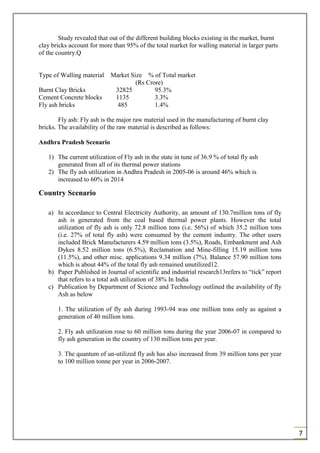
Study revealed that out of the different building blocks existing in the market, burnt
clay bricks account for more than 95% of the total market for walling material in larger parts
of the country.Q
Type of Walling material Market Size % of Total market
(Rs Crore)
Burnt Clay Bricks 32825 95.3%
Cement Concrete blocks 1135 3.3%
Fly ash bricks 485 1.4%
Fly ash: Fly ash is the major raw material used in the manufacturing of burnt clay
bricks. The availability of the raw material is described as follows:
Andhra Pradesh Scenario
1) The current utilization of Fly ash in the state in tune of 36.9 % of total fly ash
generated from all of its thermal power stations
2) The fly ash utilization in Andhra Pradesh in 2005-06 is around 46% which is
increased to 60% in 2014
Country Scenario
a) In accordance to Central Electricity Authority, an amount of 130.7million tons of fly
ash is generated from the coal based thermal power plants. However the total
utilization of fly ash is only 72.8 million tons (i.e. 56%) of which 35.2 million tons
(i.e. 27% of total fly ash) were consumed by the cement industry. The other users
included Brick Manufacturers 4.59 million tons (3.5%), Roads, Embankment and Ash
Dykes 8.52 million tons (6.5%), Reclamation and Mine-filling 15.19 million tons
(11.5%), and other misc. applications 9.34 million (7%). Balance 57.90 million tons
which is about 44% of the total fly ash remained unutilized12.
b) Paper Published in Journal of scientific and industrial research13refers to “tick” report
that refers to a total ash utilization of 38% In India
c) Publication by Department of Science and Technology outlined the availability of fly
Ash as below
1. The utilization of fly ash during 1993-94 was one million tons only as against a
generation of 40 million tons.
2. Fly ash utilization rose to 60 million tons during the year 2006-07 in compared to
fly ash generation in the country of 130 million tons per year.
3. The quantum of un-utilized fly ash has also increased from 39 million tons per year
to 100 million tonne per year in 2006-2007.
8
TECHNICAL REQUIREMENTS
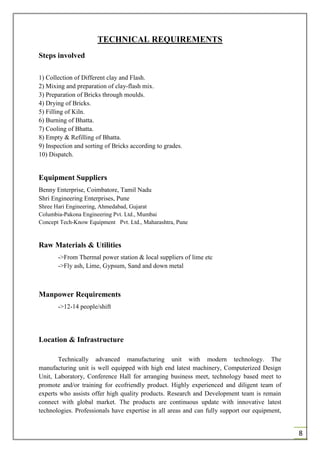
Steps involved
1) Collection of Different clay and Flash.
2) Mixing and preparation of clay-flash mix.
3) Preparation of Bricks through moulds.
4) Drying of Bricks.
5) Filling of Kiln.
6) Burning of Bhatta.
7) Cooling of Bhatta.
8) Empty & Refilling of Bhatta.
9) Inspection and sorting of Bricks according to grades.
10) Dispatch.
Equipment Suppliers
Benny Enterprise, Coimbatore, Tamil Nadu
Shri Engineering Enterprises, Pune
Shree Hari Engineering, Ahmedabad, Gujarat
Columbia-Pakona Engineering Pvt. Ltd., Mumbai
Concept Tech-Know Equipment Pvt. Ltd., Maharashtra, Pune
Raw Materials & Utilities
->From Thermal power station & local suppliers of lime etc
->Fly ash, Lime, Gypsum, Sand and down metal
Manpower Requirements
->12-14 people/shift
Location & Infrastructure
Technically advanced manufacturing unit with modern technology. The
manufacturing unit is well equipped with high end latest machinery, Computerized Design
Unit, Laboratory, Conference Hall for arranging business meet, technology based meet to
promote and/or training for ecofriendly product. Highly experienced and diligent team of
experts who assists offer high quality products. Research and Development team is remain
connect with global market. The products are continuous update with innovative latest
technologies. Professionals have expertise in all areas and can fully support our equipment,
9
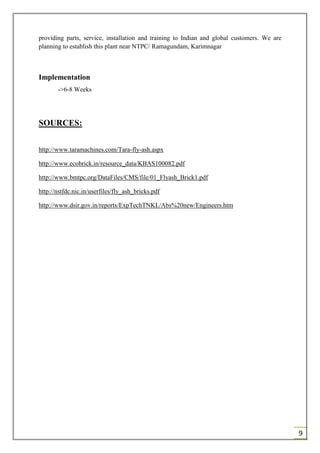
providing parts, service, installation and training to Indian and global customers. We are
planning to establish this plant near NTPC/ Ramagundam, Karimnagar
Implementation
->6-8 Weeks
SOURCES:
http://www.taramachines.com/Tara-fly-ash.aspx
http://www.ecobrick.in/resource_data/KBAS100082.pdf
http://www.bmtpc.org/DataFiles/CMS/file/01_Flyash_Brick1.pdf
http://nstfdc.nic.in/userfiles/fly_ash_bricks.pdf
http://www.dsir.gov.in/reports/ExpTechTNKL/Abs%20new/Engineers.htm
10
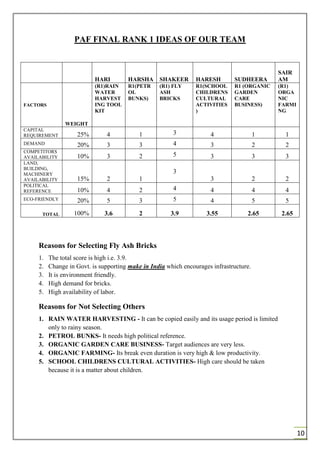
PAF FINAL RANK 1 IDEAS OF OUR TEAM
HARI HARSHA SHAKEER HARESH SUDHEERA
SAIR
AM
FACTORS
WEIGHT
(R1)RAIN
WATER
HARVEST
ING TOOL
KIT
R1(PETR
OL
BUNKS)
(R1) FLY
ASH
BRICKS
R1(SCHOOL
CHILDRENS
CULTURAL
ACTIVITIES
)
R1 (ORGANIC
GARDEN
CARE
BUSINESS)
(R1)
ORGA
NIC
FARMI
NG
CAPITAL
REQUIREMENT 25% 4 1 3 4 1 1
DEMAND 20% 3 3 4 3 2 2
COMPETITORS
AVAILABILITY 10% 3 2 5 3 3 3
LAND,
BUILDING,
MACHINERY
AVAILABILITY 15% 2 1
3
3 2 2
POLITICAL
REFERENCE 10% 4 2 4 4 4 4
ECO-FRIENDLY 20% 5 3 5 4 5 5
TOTAL 100% 3.6 2 3.9 3.55 2.65 2.65
Reasons for Selecting Fly Ash Bricks
1. The total score is high i.e. 3.9.
2. Change in Govt. is supporting make in India which encourages infrastructure.
3. It is environment friendly.
4. High demand for bricks.
5. High availability of labor.
Reasons for Not Selecting Others
1. RAIN WATER HARVESTING - It can be copied easily and its usage period is limited
only to rainy season.
2. PETROL BUNKS- It needs high political reference.
3. ORGANIC GARDEN CARE BUSINESS- Target audiences are very less.
4. ORGANIC FARMING- Its break even duration is very high & low productivity.
5. SCHOOL CHILDRENS CULTURAL ACTIVITIES- High care should be taken
because it is a matter about children.
11
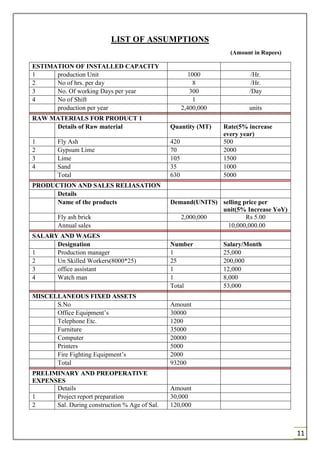
LIST OF ASSUMPTIONS
(Amount in Rupees)
ESTIMATION OF INSTALLED CAPACITY
1 production Unit 1000 /Hr.
2 No of hrs. per day 8 /Hr.
3 No. Of working Days per year 300 /Day
4 No of Shift 1
production per year 2,400,000 units
RAW MATERIALS FOR PRODUCT 1
Details of Raw material Quantity (MT) Rate(5% increase
every year)
1 Fly Ash 420 500
2 Gypsum Lime 70 2000
3 Lime 105 1500
4 Sand 35 1000
Total 630 5000
PRODUCTION AND SALES RELIASATION
Details
Name of the products Demand(UNITS) selling price per
unit(5% Increase YoY)
Fly ash brick 2,000,000 Rs 5.00
Annual sales 10,000,000.00
SALARY AND WAGES
Designation Number Salary/Month
1 Production manager 1 25,000
2 Un Skilled Workers(8000*25) 25 200,000
3 office assistant 1 12,000
4 Watch man 1 8,000
Total 53,000
MISCELLANEOUS FIXED ASSETS
S.No Amount
Office Equipment’s 30000
Telephone Etc. 1200
Furniture 35000
Computer 20000
Printers 5000
Fire Fighting Equipment’s 2000
Total 93200
PRELIMINARY AND PREOPERATIVE
EXPENSES
Details Amount
1 Project report preparation 30,000
2 Sal. During construction % Age of Sal. 120,000
12
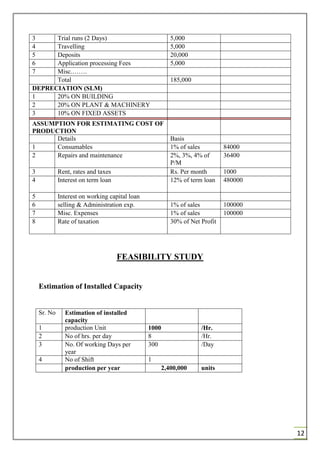
3 Trial runs (2 Days) 5,000
4 Travelling 5,000
5 Deposits 20,000
6 Application processing Fees 5,000
7 Misc.…….
Total 185,000
DEPRECIATION (SLM)
1 20% ON BUILDING
2 20% ON PLANT & MACHINERY
3 10% ON FIXED ASSETS
ASSUMPTION FOR ESTIMATING COST OF
PRODUCTION
Details Basis
1 Consumables 1% of sales 84000
2 Repairs and maintenance 2%, 3%, 4% of
P/M
36400
3 Rent, rates and taxes Rs. Per month 1000
4 Interest on term loan 12% of term loan 480000
5 Interest on working capital loan
6 selling & Administration exp. 1% of sales 100000
7 Misc. Expenses 1% of sales 100000
8 Rate of taxation 30% of Net Profit
FEASIBILITY STUDY
Estimation of Installed Capacity
Sr. No Estimation of installed
capacity
1 production Unit 1000 /Hr.
2 No of hrs. per day 8 /Hr.
3 No. Of working Days per
year
300 /Day
4 No of Shift 1
production per year 2,400,000 units
13
Raw Materials for Product 1
Sr. No
Details
of raw
material
Quantity
(MT)
Rate(5%
increase
every
year) 1st 2nd 3rd 4th 5th
1 Fly Ash 420 500 210,000 220500 231525 243101 255256
2
Gypsum
Lime 70 2000 140,000 147000 154350 162068 170171
3 Lime 105 1500 157,500 165375 173643.75 182326 191442
4 Sand 35 1000 35,000 36750 38587.5 40517 42543
Total 630 542,500 569,625 598,106 628012 659412
Production and Sales Realization
Details
Sales
realization
Name of
the
products
Demand
(UNITS)
selling
price per
unit 1 year 2 year 3 year 4 year 5 year
Fly ash
brick 2,000,000 Rs 5.00 5 5.25 5.775 6.3525 6.98775
Annual
sales 10,000,000 10,500,000 11,550,000 12,127,500 12,733,875
Salary and Wages
Salaries and Wages increases
5% from 3rd year
Designation Number
Salary
/Month
Annual
Sal 1 year 2 year 3 year 4 year 5 year
Production
manager 1 25,000 300,000 300,000 300,000 315,000 330,750 347,288
Un Skilled
Workers 25 8,000 2,400,000 2,400,000 2,400,000 2,520,000 2,646,000 2,778,300
office
assistant 1 12,000 144,000 144,000 144,000 151,200 158,760 166,698
Watch man 1 8,000 96,000 96,000 96,000 100,800 105,840 111,132
Total 53,000 2,940,000 2,940,000 2,940,000 3,087,000 3,241,350 3,403,418
14
S.No Final Salaries Year 1 Year 2 Year 3 Year 4 Year 5
1 Total Salary 2,940,000 2,940,000 3087000 3241350 3403418
2 % annual increase 5% 0 0 147,000 154,350 162,068
Miscellaneous Fixed Assets
S.No Amount
Office Equipment’s 30000
Telephone Etc. 1200
Furniture 35000
Computer 20000
Printers 5000
Fire Fighting Equipment’s 2000
Total 93200
Preliminary and Preoperative Expenses
Preliminary and preoperative Expenses
S.No Details Amount
1 Project report preparation 30,000
2 Sal. During construction % Age of Sal 120,000
3 Trial runs (2 Days) 5,000
4 Travelling 5,000
5 Deposits 20,000
6 Application processing Fees 5,000
7 Misc.…….
Total 185,000
Depreciation
Calculation for
Depreciation 1 2 3 4 5
Building
opening Balance - 800,000 600,000 400,000 200,000
Original cost of Acquisition 1,000,000
Dep@20% 200,000 200,000 200,000 200,000 200,000
SLM 800,000 600,000 400,000 200,000 -
15
Calculation for
Depreciation 1 2 3 4 5
Plant & machinery
opening Balance - 1,456,000 1,092,000 1,928,000 1,264,000
Original cost of Acquisition 1,820,000 1,500,000
Dep@20% 364,000 364,000 664,000 664,000 664,000
SLM 1,456,000 1,092,000 1,928,000 1,264,000 600,000
Calculation for Depreciation 1 2 3 4 5
Misc. Fixed Assets
opening Balance - 83,880 74,560 65,240 55,920
Original cost of Acquisition 93200
Dep@10% 9,320 9,320 9,320 9,320 9,320
SLM 83,880 74,560 65,240 55,920 46,600
Total 573,320 573,320 873,320 873,320 873,320
Assumption for Estimated Cost of Production
Details Basis 1 2 3 4 5
Consumables 1% of sales 84000 107100 249480 274428 301871
Repairs and maintenance
2%, 3%, 4% of
P/M 36400 54600 72800 72800 72800
Rent, rates and taxes Rs. Per month 1000 1100 1210 1331 1464
Interest on term loan 12% of term loan 480000 384000 288000 192000 96000
Interest on working capital
loan 12% of W C Loan 45383 53180 104132 113471 123707
selling & Administration exp. 1% of sales 100000 107100 249480 274428 301871
Misc. Expenses 1% of sales 100000 105000 115500 121275 127339
Rate of taxation 30% of Net Profit 763643 1252225 4117353 4614714 5161737
Project Cost Estimation
Assets
ESTIMATED
Project Cost 1 YEAR 2 YEAR 3 YEAR 4 YEAR 5 YEAR
Land 2,500,000 2,500,000 2,500,000 2,500,000 2,500,000 2,500,000
Building 1,000,000 800000 600000 400000 200000 0
Plant & Machinery 1,820,000 1456000 1092000 1928000 1264000 600000
working Capital
25% margin 126,063 126063 147723 289255 315197 343630
Misc. Fixed assets 93,200 83880 74560 65240 55920 46600
504,254 590,892 1,157,022 1,260,788 1,374,522
Pre & Preoperative
Expenses 185,000 185,000
16
Cash 275,737 3,268,471 4,812,076 12,652,758 14,332,065 16,171,930
Total 6,000,000 8,923,668 9,817,251 18,992,275 19,927,971 21,036,682
Liability
Promoters
contribution 2,000,000.00 2,000,000 2,000,000 2,000,000 2,000,000 2,000,000
Reserves and
surplus 2545478 4174082 13724509 15382379 17205791
Term loan 4,000,000.00 4,000,000 3,200,000 2,400,000 1,600,000 800,000
Working Capital
loan 378,190 443,169 867,766 945,591 1,030,891
Balancing figure
TOTAL 6,000,000 8,923,668 9,817,251 18,992,275 19,927,971 21,036,682
Profitability Statement
Sr.
No. Unit 1 year 2 year 3 year 4 year 5 year
1 Installed capacity 2,400,000 2,400,000 4,800,000 4,800,000 4,800,000
2 Capacity utilization 70% 85% 90% 90% 90%
3 Actual production 1,680,000 2,040,000 4,320,000 4,320,000 4,320,000
4 Selling price 5 5.25 5.78 6.35 6.99
5 Total Sales 8,400,000 10,710,000 24,948,000 27,442,800 30,187,080
COST OF
PRODUCTION
A Production cost 1 year 2 year 3 year 4 year 5 year
1 Raw Materials 542,500 569,625 598,106 628,012 659,412
2
Supplies &
consumables 84,000 107,100 249,480 274,428 301,871
3 Fuel & Power 30,000 30,000 30,000 30,000 30,000
4
Repair &
Maintenance 36,400 54,600 72,800 72,800 72,800
5 Wages & Salaries 2,940,000 2,940,000 3,087,000 3,241,350 3,403,418
6 Rent, rates and taxes 12,000 13,200 14,520 15,972 17,569
7 Depreciation 573,320 573,320 873,320 873,320 873,320
TOTAL 4,218,220 4,287,845 4,925,226 5,135,882 5,358,390
17
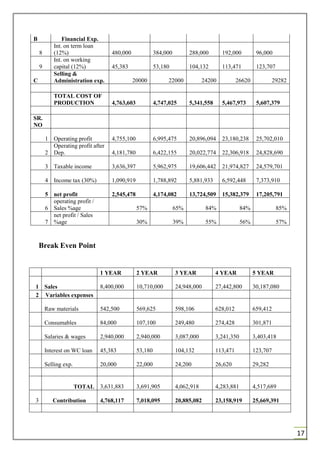
B Financial Exp.
8
Int. on term loan
(12%) 480,000 384,000 288,000 192,000 96,000
9
Int. on working
capital (12%) 45,383 53,180 104,132 113,471 123,707
C
Selling &
Administration exp. 20000 22000 24200 26620 29282
TOTAL COST OF
PRODUCTION 4,763,603 4,747,025 5,341,558 5,467,973 5,607,379
SR.
NO
1 Operating profit 4,755,100 6,995,475 20,896,094 23,180,238 25,702,010
2
Operating profit after
Dep. 4,181,780 6,422,155 20,022,774 22,306,918 24,828,690
3 Taxable income 3,636,397 5,962,975 19,606,442 21,974,827 24,579,701
4 Income tax (30%) 1,090,919 1,788,892 5,881,933 6,592,448 7,373,910
5 net profit 2,545,478 4,174,082 13,724,509 15,382,379 17,205,791
6
operating profit /
Sales %age 57% 65% 84% 84% 85%
7
net profit / Sales
%age 30% 39% 55% 56% 57%
Break Even Point
1 YEAR 2 YEAR 3 YEAR 4 YEAR 5 YEAR
1 Sales 8,400,000 10,710,000 24,948,000 27,442,800 30,187,080
2 Variables expenses
Raw materials 542,500 569,625 598,106 628,012 659,412
Consumables 84,000 107,100 249,480 274,428 301,871
Salaries & wages 2,940,000 2,940,000 3,087,000 3,241,350 3,403,418
Interest on WC loan 45,383 53,180 104,132 113,471 123,707
Selling exp. 20,000 22,000 24,200 26,620 29,282
TOTAL 3,631,883 3,691,905 4,062,918 4,283,881 4,517,689
3 Contribution 4,768,117 7,018,095 20,885,082 23,158,919 25,669,391
18
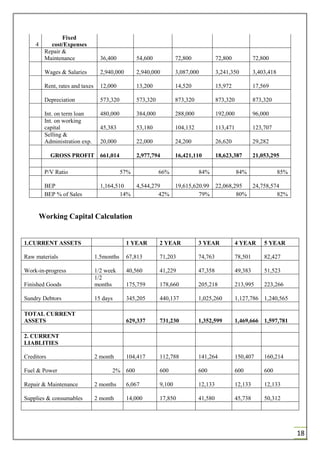
4
Fixed
cost/Expenses
Repair &
Maintenance 36,400 54,600 72,800 72,800 72,800
Wages & Salaries 2,940,000 2,940,000 3,087,000 3,241,350 3,403,418
Rent, rates and taxes 12,000 13,200 14,520 15,972 17,569
Depreciation 573,320 573,320 873,320 873,320 873,320
Int. on term loan 480,000 384,000 288,000 192,000 96,000
Int. on working
capital 45,383 53,180 104,132 113,471 123,707
Selling &
Administration exp. 20,000 22,000 24,200 26,620 29,282
GROSS PROFIT 661,014 2,977,794 16,421,110 18,623,387 21,053,295
P/V Ratio 57% 66% 84% 84% 85%
BEP 1,164,510 4,544,279 19,615,620.99 22,068,295 24,758,574
BEP % of Sales 14% 42% 79% 80% 82%
Working Capital Calculation
1.CURRENT ASSETS 1 YEAR 2 YEAR 3 YEAR 4 YEAR 5 YEAR
Raw materials 1.5months 67,813 71,203 74,763 78,501 82,427
Work-in-progress 1/2 week 40,560 41,229 47,358 49,383 51,523
Finished Goods
1/2
months 175,759 178,660 205,218 213,995 223,266
Sundry Debtors 15 days 345,205 440,137 1,025,260 1,127,786 1,240,565
TOTAL CURRENT
ASSETS 629,337 731,230 1,352,599 1,469,666 1,597,781
2. CURRENT
LIABLITIES
Creditors 2 month 104,417 112,788 141,264 150,407 160,214
Fuel & Power 2% 600 600 600 600 600
Repair & Maintenance 2 months 6,067 9,100 12,133 12,133 12,133
Supplies & consumables 2 month 14,000 17,850 41,580 45,738 50,312
19
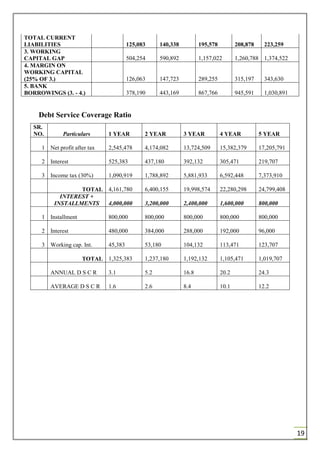
TOTAL CURRENT
LIABILITIES 125,083 140,338 195,578 208,878 223,259
3. WORKING
CAPITAL GAP 504,254 590,892 1,157,022 1,260,788 1,374,522
4. MARGIN ON
WORKING CAPITAL
(25% OF 3.) 126,063 147,723 289,255 315,197 343,630
5. BANK
BORROWINGS (3. - 4.) 378,190 443,169 867,766 945,591 1,030,891
Debt Service Coverage Ratio
SR.
NO. Particulars 1 YEAR 2 YEAR 3 YEAR 4 YEAR 5 YEAR
1 Net profit after tax 2,545,478 4,174,082 13,724,509 15,382,379 17,205,791
2 Interest 525,383 437,180 392,132 305,471 219,707
3 Income tax (30%) 1,090,919 1,788,892 5,881,933 6,592,448 7,373,910
TOTAL 4,161,780 6,400,155 19,998,574 22,280,298 24,799,408
INTEREST +
INSTALLMENTS 4,000,000 3,200,000 2,400,000 1,600,000 800,000
1 Installment 800,000 800,000 800,000 800,000 800,000
2 Interest 480,000 384,000 288,000 192,000 96,000
3 Working cap. Int. 45,383 53,180 104,132 113,471 123,707
TOTAL 1,325,383 1,237,180 1,192,132 1,105,471 1,019,707
ANNUAL D S C R 3.1 5.2 16.8 20.2 24.3
AVERAGE D S C R 1.6 2.6 8.4 10.1 12.2

Project Appraisal and Financing of a Business Idea in Fly ash Bricks

  • 1.
    1 Project Appraisal &Financing Business Idea: FLY ASH BRICKS
  • 2.
    2 INTRODUCTION 3 MARKET DEMAND:.............................................................................................................................4 Why fly ash bricks? .............................................................................................................................4 Technical Specifications......................................................................................................................4 Demand potential estimate................................................................................................................5 Supply status:......................................................................................................................................5 Scope of the project:...........................................................................................................................5 Acquiring the raw materials:...............................................................................................................6 Economic concerns: ............................................................................................................................6 Product pricing....................................................................................................................................6 Promotional plans:..............................................................................................................................6 Marketing plans ..................................................................................................................................6 STP:......................................................................................................................................................6 Country Scenario.................................................................................................................................7 Steps involved.....................................................................................................................................8 Equipment Suppliers...........................................................................................................................8 Raw Materials & Utilities ....................................................................................................................8 Manpower Requirements...................................................................................................................8 Location & Infrastructure....................................................................................................................8 Implementation ..................................................................................................................................9 SOURCES: ................................................................................................................................................9 PAF FINAL RANK 1 IDEAS OF OUR TEAM ..............................................................................................10 Reasons for Selecting Fly Ash Bricks .................................................................................................10 Reasons for Not Selecting Others.....................................................................................................10 LIST OF ASSUMPTIONS..........................................................................................................................11 FEASIBILITY STUDY................................................................................................................................12 Estimation of Installed Capacity........................................................................................................12 Raw Materials for Product 1 .............................................................................................................13 Production and Sales Realization......................................................................................................13 Salary and Wages..............................................................................................................................13 Miscellaneous Fixed Assets...............................................................................................................14 Preliminary and Preoperative Expenses ...........................................................................................14 Depreciation......................................................................................................................................14 Assumption for Estimated Cost of Production .................................................................................15 Project Cost Estimation.....................................................................................................................15
  • 3.
    3 Profitability Statement......................................................................................................................16 Break EvenPoint...............................................................................................................................17 Working Capital Calculation..............................................................................................................18 Debt Service Coverage Ratio.............................................................................................................19 INTRODUCTION Fly Ash bricks are made of fly ash, lime, gypsum and sand. These can be extensively used in all building constructional activities similar to that of common burnt clay bricks. The
  • 4.
    4 fly ash bricksare comparatively lighter in weight and stronger than common clay bricks. Since fly ash is being accumulated as waste material in large quantity near thermal power plants and creating serious environmental pollution problems, its utilization as main raw material in the manufacture of bricks will not only create ample opportunities for its proper and useful disposal but also help in environmental pollution control to a greater extent in the surrounding areas of power plants. In view of superior quality and eco-friendly nature, and government support the demand for Fly Ash Bricks has picked up. MARKET DEMAND: 180 billion tons of common burnt clay bricks are consumed annually approximately 340 billion tons of clay- about 5000 acres of top layer of soil dug out for bricks manufacture, soil erosion, emission from coal burning or fire woods which causes deforestation are the serious problems posed by brick industry. The above problems can be reduced some extent by using fly ash bricks in dwelling units. Demand for dwelling units likely to raise to 80 million units by year 2015 for lower middle and low income groups, involving an estimated investment 0f $670 billion, according to the associated chamber of commerce and industry. Demand for dwelling units will further grow to 90 million by 2020, which would require a minimum investment of $890billion. The Indian housing sector at present faces a shortage of 20million dwelling units for its lower middle and low income groups which will witness a spurt of about 22.5million dwelling units by the end of Tenth plan period. There is ample scope for fly ash brick and block units... But good quality of bricks as well as required quantity is not available moreover during the Rainey seasons supply of clay bricks are very difficult. Therefore, in order to fulfill the required demand there will be a great chance to start more units in the field of fly ash bricks. At present 20nos units are engaged and 40 lakhs no’s of bricks per month are manufactured in our state. And there will be scope to start near about 100 units, which will be produced more than 2 cores no of bricks per month in future. Thus marketing of these product are well shinning. Why fly ash bricks? Fly ash bricks are can be used as an alternative to burnt clay bricks. These are environment friendly cost saving building products. These are 3 times stronger than conventional bricks with consistent strength. These are ideally suited for internal, external, load bearing and non-load bearing walls. These bricks with higher strength /weight ratio (about 3 to 4 times that of burnt clay bricks) aid in designing stronger yet more economic structures. Fly ash bricks are durable, have low water absorption, less consumption of mortar, economical &ecofriendly, low energy consumption and no emission of greenhouse gases. These bricks are not affected by environmental conditions and remain static thus ensuring longer life of the building. Also the savings with regard to wastages in fly ash bricks are considerable during unloading and construction due to true shape and size, consistency in quality and the workability of the fly ash bricks unlike traditional clay bricks. These bricks are very economical / cost effective. Technical Specifications  Sizes available :230x110x70 mm
  • 5.
    5  Raw MaterialUsed : fly ash, sand, grit, cement  Uses : constructions of walls  Colors & packaging available : light grey, minimum 1 load truck can be delivered Demand potential estimate The construction industry contributes to about 10 % of the Gross Domestic Product (GDP), registering an annual growth of about 9 %. Clay fired bricks form the backbone of the construction industry which is valued at approximately US$ 70.8 billion. The brick sector in India, although unorganized, is tremendous in size and spread. India is the second largest brick producer (China dominates with 54 % share) in the world. It is continuously expanding on account of a rapid increase in demand for bricks in infrastructure and housing industries. In order to meet this demand, over 150,000 brick units provide direct employment to more than 8 million workers. During the Ninth Five-year Plan period (1997-2002), the annual demand of 170 million bricks per year was estimated to be generating revenues of over US$ 4.8 billion. Supply status: Raw materials required for making of fly ash bricks are fly ash, lime and gypsum. Fly ash can be procured from thermal power plants. Lime and gypsum are available in the market and can be bought as per the requirement The need for clay ash bricks: 1) The bricks we currently use made up of specific quality of top soil( app 10000 hc of top soil is lost every year for brick manufacturing) 2) If the top soil consumption carries on at the same pace, very soon, we will not have enough soil for the cultivation. 3) The thermal power plants and the industrial units using coal as a fuel have no use with the fly ash left after the combustion Scope of the project: 1) Nearly 75 % of India’s total installed power generation capacity is thermal, of which coal based generation is 90%, the remaining comprising of diesel and gas. 2) The 85 utility thermal power plants use coal and producing large quantities of fly ash. Features: 1) Size of the bricks will be 230 x 110 x 76 mm 2) Less mortar consumption 3) Ash content as high as 60% 4) Faster construction
  • 6.
    6 Acquiring the rawmaterials: 1) Fly ash is readily available with thermal power plants and can be acquired from them even without spending on transportation 2) Lime, gypsum and sand are available in the market and can be purchased as per the requirement. Economic concerns: 1) Currently the demand for bricks is very high from the supply 2) Demand and supply gap is around 270 billion bricks per annum 3) In India the annual production of fly ash can result in manufacturing 790 billion bricks 4) To reduce the demand and supply gap we will need to expand in this sector at a larger rate than what is undergoing at the present time. Product pricing 1) Penetration price of Rs.5.00 per brick for the first two years and then concession to high end buyers at a rate of 5% Promotional plans: 1. Discounts on large buying 2. Large volume of institutional sales 3. Aggressive selling 4. Trade promotion 5. Publicity Marketing plans 1) The government has imposed rules for the use of 100% fly ash bricks in a radius of 100 mms from thermal power plants. However, the government is itself not implying to the norms. The govt. can be forced to imply to such norms by NGOs and when such a scenario occurs, the demand for the bricks from the side of the govt. will increase many folds. 2) Use of these bricks result savings of almost 37% in the construction cost. STP: Segmentation: We will first try to capture the local markets and then we will move to the neighboring states. Positioning: It can be positioned as environmental pollutant cleaner. Targeting: Builders, consultants, architects, government
  • 7.
    7 Study revealed thatout of the different building blocks existing in the market, burnt clay bricks account for more than 95% of the total market for walling material in larger parts of the country.Q Type of Walling material Market Size % of Total market (Rs Crore) Burnt Clay Bricks 32825 95.3% Cement Concrete blocks 1135 3.3% Fly ash bricks 485 1.4% Fly ash: Fly ash is the major raw material used in the manufacturing of burnt clay bricks. The availability of the raw material is described as follows: Andhra Pradesh Scenario 1) The current utilization of Fly ash in the state in tune of 36.9 % of total fly ash generated from all of its thermal power stations 2) The fly ash utilization in Andhra Pradesh in 2005-06 is around 46% which is increased to 60% in 2014 Country Scenario a) In accordance to Central Electricity Authority, an amount of 130.7million tons of fly ash is generated from the coal based thermal power plants. However the total utilization of fly ash is only 72.8 million tons (i.e. 56%) of which 35.2 million tons (i.e. 27% of total fly ash) were consumed by the cement industry. The other users included Brick Manufacturers 4.59 million tons (3.5%), Roads, Embankment and Ash Dykes 8.52 million tons (6.5%), Reclamation and Mine-filling 15.19 million tons (11.5%), and other misc. applications 9.34 million (7%). Balance 57.90 million tons which is about 44% of the total fly ash remained unutilized12. b) Paper Published in Journal of scientific and industrial research13refers to “tick” report that refers to a total ash utilization of 38% In India c) Publication by Department of Science and Technology outlined the availability of fly Ash as below 1. The utilization of fly ash during 1993-94 was one million tons only as against a generation of 40 million tons. 2. Fly ash utilization rose to 60 million tons during the year 2006-07 in compared to fly ash generation in the country of 130 million tons per year. 3. The quantum of un-utilized fly ash has also increased from 39 million tons per year to 100 million tonne per year in 2006-2007.
  • 8.
    8 TECHNICAL REQUIREMENTS Steps involved 1)Collection of Different clay and Flash. 2) Mixing and preparation of clay-flash mix. 3) Preparation of Bricks through moulds. 4) Drying of Bricks. 5) Filling of Kiln. 6) Burning of Bhatta. 7) Cooling of Bhatta. 8) Empty & Refilling of Bhatta. 9) Inspection and sorting of Bricks according to grades. 10) Dispatch. Equipment Suppliers Benny Enterprise, Coimbatore, Tamil Nadu Shri Engineering Enterprises, Pune Shree Hari Engineering, Ahmedabad, Gujarat Columbia-Pakona Engineering Pvt. Ltd., Mumbai Concept Tech-Know Equipment Pvt. Ltd., Maharashtra, Pune Raw Materials & Utilities ->From Thermal power station & local suppliers of lime etc ->Fly ash, Lime, Gypsum, Sand and down metal Manpower Requirements ->12-14 people/shift Location & Infrastructure Technically advanced manufacturing unit with modern technology. The manufacturing unit is well equipped with high end latest machinery, Computerized Design Unit, Laboratory, Conference Hall for arranging business meet, technology based meet to promote and/or training for ecofriendly product. Highly experienced and diligent team of experts who assists offer high quality products. Research and Development team is remain connect with global market. The products are continuous update with innovative latest technologies. Professionals have expertise in all areas and can fully support our equipment,
  • 9.
    9 providing parts, service,installation and training to Indian and global customers. We are planning to establish this plant near NTPC/ Ramagundam, Karimnagar Implementation ->6-8 Weeks SOURCES: http://www.taramachines.com/Tara-fly-ash.aspx http://www.ecobrick.in/resource_data/KBAS100082.pdf http://www.bmtpc.org/DataFiles/CMS/file/01_Flyash_Brick1.pdf http://nstfdc.nic.in/userfiles/fly_ash_bricks.pdf http://www.dsir.gov.in/reports/ExpTechTNKL/Abs%20new/Engineers.htm
  • 10.
    10 PAF FINAL RANK1 IDEAS OF OUR TEAM HARI HARSHA SHAKEER HARESH SUDHEERA SAIR AM FACTORS WEIGHT (R1)RAIN WATER HARVEST ING TOOL KIT R1(PETR OL BUNKS) (R1) FLY ASH BRICKS R1(SCHOOL CHILDRENS CULTURAL ACTIVITIES ) R1 (ORGANIC GARDEN CARE BUSINESS) (R1) ORGA NIC FARMI NG CAPITAL REQUIREMENT 25% 4 1 3 4 1 1 DEMAND 20% 3 3 4 3 2 2 COMPETITORS AVAILABILITY 10% 3 2 5 3 3 3 LAND, BUILDING, MACHINERY AVAILABILITY 15% 2 1 3 3 2 2 POLITICAL REFERENCE 10% 4 2 4 4 4 4 ECO-FRIENDLY 20% 5 3 5 4 5 5 TOTAL 100% 3.6 2 3.9 3.55 2.65 2.65 Reasons for Selecting Fly Ash Bricks 1. The total score is high i.e. 3.9. 2. Change in Govt. is supporting make in India which encourages infrastructure. 3. It is environment friendly. 4. High demand for bricks. 5. High availability of labor. Reasons for Not Selecting Others 1. RAIN WATER HARVESTING - It can be copied easily and its usage period is limited only to rainy season. 2. PETROL BUNKS- It needs high political reference. 3. ORGANIC GARDEN CARE BUSINESS- Target audiences are very less. 4. ORGANIC FARMING- Its break even duration is very high & low productivity. 5. SCHOOL CHILDRENS CULTURAL ACTIVITIES- High care should be taken because it is a matter about children.
  • 11.
    11 LIST OF ASSUMPTIONS (Amountin Rupees) ESTIMATION OF INSTALLED CAPACITY 1 production Unit 1000 /Hr. 2 No of hrs. per day 8 /Hr. 3 No. Of working Days per year 300 /Day 4 No of Shift 1 production per year 2,400,000 units RAW MATERIALS FOR PRODUCT 1 Details of Raw material Quantity (MT) Rate(5% increase every year) 1 Fly Ash 420 500 2 Gypsum Lime 70 2000 3 Lime 105 1500 4 Sand 35 1000 Total 630 5000 PRODUCTION AND SALES RELIASATION Details Name of the products Demand(UNITS) selling price per unit(5% Increase YoY) Fly ash brick 2,000,000 Rs 5.00 Annual sales 10,000,000.00 SALARY AND WAGES Designation Number Salary/Month 1 Production manager 1 25,000 2 Un Skilled Workers(8000*25) 25 200,000 3 office assistant 1 12,000 4 Watch man 1 8,000 Total 53,000 MISCELLANEOUS FIXED ASSETS S.No Amount Office Equipment’s 30000 Telephone Etc. 1200 Furniture 35000 Computer 20000 Printers 5000 Fire Fighting Equipment’s 2000 Total 93200 PRELIMINARY AND PREOPERATIVE EXPENSES Details Amount 1 Project report preparation 30,000 2 Sal. During construction % Age of Sal. 120,000
  • 12.
    12 3 Trial runs(2 Days) 5,000 4 Travelling 5,000 5 Deposits 20,000 6 Application processing Fees 5,000 7 Misc.……. Total 185,000 DEPRECIATION (SLM) 1 20% ON BUILDING 2 20% ON PLANT & MACHINERY 3 10% ON FIXED ASSETS ASSUMPTION FOR ESTIMATING COST OF PRODUCTION Details Basis 1 Consumables 1% of sales 84000 2 Repairs and maintenance 2%, 3%, 4% of P/M 36400 3 Rent, rates and taxes Rs. Per month 1000 4 Interest on term loan 12% of term loan 480000 5 Interest on working capital loan 6 selling & Administration exp. 1% of sales 100000 7 Misc. Expenses 1% of sales 100000 8 Rate of taxation 30% of Net Profit FEASIBILITY STUDY Estimation of Installed Capacity Sr. No Estimation of installed capacity 1 production Unit 1000 /Hr. 2 No of hrs. per day 8 /Hr. 3 No. Of working Days per year 300 /Day 4 No of Shift 1 production per year 2,400,000 units
  • 13.
    13 Raw Materials forProduct 1 Sr. No Details of raw material Quantity (MT) Rate(5% increase every year) 1st 2nd 3rd 4th 5th 1 Fly Ash 420 500 210,000 220500 231525 243101 255256 2 Gypsum Lime 70 2000 140,000 147000 154350 162068 170171 3 Lime 105 1500 157,500 165375 173643.75 182326 191442 4 Sand 35 1000 35,000 36750 38587.5 40517 42543 Total 630 542,500 569,625 598,106 628012 659412 Production and Sales Realization Details Sales realization Name of the products Demand (UNITS) selling price per unit 1 year 2 year 3 year 4 year 5 year Fly ash brick 2,000,000 Rs 5.00 5 5.25 5.775 6.3525 6.98775 Annual sales 10,000,000 10,500,000 11,550,000 12,127,500 12,733,875 Salary and Wages Salaries and Wages increases 5% from 3rd year Designation Number Salary /Month Annual Sal 1 year 2 year 3 year 4 year 5 year Production manager 1 25,000 300,000 300,000 300,000 315,000 330,750 347,288 Un Skilled Workers 25 8,000 2,400,000 2,400,000 2,400,000 2,520,000 2,646,000 2,778,300 office assistant 1 12,000 144,000 144,000 144,000 151,200 158,760 166,698 Watch man 1 8,000 96,000 96,000 96,000 100,800 105,840 111,132 Total 53,000 2,940,000 2,940,000 2,940,000 3,087,000 3,241,350 3,403,418
  • 14.
    14 S.No Final SalariesYear 1 Year 2 Year 3 Year 4 Year 5 1 Total Salary 2,940,000 2,940,000 3087000 3241350 3403418 2 % annual increase 5% 0 0 147,000 154,350 162,068 Miscellaneous Fixed Assets Miscellaneous Fixed Assets S.No Amount Office Equipment’s 30000 Telephone Etc. 1200 Furniture 35000 Computer 20000 Printers 5000 Fire Fighting Equipment’s 2000 Total 93200 Preliminary and Preoperative Expenses Preliminary and preoperative Expenses S.No Details Amount 1 Project report preparation 30,000 2 Sal. During construction % Age of Sal 120,000 3 Trial runs (2 Days) 5,000 4 Travelling 5,000 5 Deposits 20,000 6 Application processing Fees 5,000 7 Misc.……. Total 185,000 Depreciation Calculation for Depreciation 1 2 3 4 5 Building opening Balance - 800,000 600,000 400,000 200,000 Original cost of Acquisition 1,000,000 Dep@20% 200,000 200,000 200,000 200,000 200,000 SLM 800,000 600,000 400,000 200,000 -
  • 15.
    15 Calculation for Depreciation 12 3 4 5 Plant & machinery opening Balance - 1,456,000 1,092,000 1,928,000 1,264,000 Original cost of Acquisition 1,820,000 1,500,000 Dep@20% 364,000 364,000 664,000 664,000 664,000 SLM 1,456,000 1,092,000 1,928,000 1,264,000 600,000 Calculation for Depreciation 1 2 3 4 5 Misc. Fixed Assets opening Balance - 83,880 74,560 65,240 55,920 Original cost of Acquisition 93200 Dep@10% 9,320 9,320 9,320 9,320 9,320 SLM 83,880 74,560 65,240 55,920 46,600 Total 573,320 573,320 873,320 873,320 873,320 Assumption for Estimated Cost of Production Details Basis 1 2 3 4 5 Consumables 1% of sales 84000 107100 249480 274428 301871 Repairs and maintenance 2%, 3%, 4% of P/M 36400 54600 72800 72800 72800 Rent, rates and taxes Rs. Per month 1000 1100 1210 1331 1464 Interest on term loan 12% of term loan 480000 384000 288000 192000 96000 Interest on working capital loan 12% of W C Loan 45383 53180 104132 113471 123707 selling & Administration exp. 1% of sales 100000 107100 249480 274428 301871 Misc. Expenses 1% of sales 100000 105000 115500 121275 127339 Rate of taxation 30% of Net Profit 763643 1252225 4117353 4614714 5161737 Project Cost Estimation Assets ESTIMATED Project Cost 1 YEAR 2 YEAR 3 YEAR 4 YEAR 5 YEAR Land 2,500,000 2,500,000 2,500,000 2,500,000 2,500,000 2,500,000 Building 1,000,000 800000 600000 400000 200000 0 Plant & Machinery 1,820,000 1456000 1092000 1928000 1264000 600000 working Capital 25% margin 126,063 126063 147723 289255 315197 343630 Misc. Fixed assets 93,200 83880 74560 65240 55920 46600 504,254 590,892 1,157,022 1,260,788 1,374,522 Pre & Preoperative Expenses 185,000 185,000
  • 16.
    16 Cash 275,737 3,268,4714,812,076 12,652,758 14,332,065 16,171,930 Total 6,000,000 8,923,668 9,817,251 18,992,275 19,927,971 21,036,682 Liability Promoters contribution 2,000,000.00 2,000,000 2,000,000 2,000,000 2,000,000 2,000,000 Reserves and surplus 2545478 4174082 13724509 15382379 17205791 Term loan 4,000,000.00 4,000,000 3,200,000 2,400,000 1,600,000 800,000 Working Capital loan 378,190 443,169 867,766 945,591 1,030,891 Balancing figure TOTAL 6,000,000 8,923,668 9,817,251 18,992,275 19,927,971 21,036,682 Profitability Statement Sr. No. Unit 1 year 2 year 3 year 4 year 5 year 1 Installed capacity 2,400,000 2,400,000 4,800,000 4,800,000 4,800,000 2 Capacity utilization 70% 85% 90% 90% 90% 3 Actual production 1,680,000 2,040,000 4,320,000 4,320,000 4,320,000 4 Selling price 5 5.25 5.78 6.35 6.99 5 Total Sales 8,400,000 10,710,000 24,948,000 27,442,800 30,187,080 COST OF PRODUCTION A Production cost 1 year 2 year 3 year 4 year 5 year 1 Raw Materials 542,500 569,625 598,106 628,012 659,412 2 Supplies & consumables 84,000 107,100 249,480 274,428 301,871 3 Fuel & Power 30,000 30,000 30,000 30,000 30,000 4 Repair & Maintenance 36,400 54,600 72,800 72,800 72,800 5 Wages & Salaries 2,940,000 2,940,000 3,087,000 3,241,350 3,403,418 6 Rent, rates and taxes 12,000 13,200 14,520 15,972 17,569 7 Depreciation 573,320 573,320 873,320 873,320 873,320 TOTAL 4,218,220 4,287,845 4,925,226 5,135,882 5,358,390
  • 17.
    17 B Financial Exp. 8 Int.on term loan (12%) 480,000 384,000 288,000 192,000 96,000 9 Int. on working capital (12%) 45,383 53,180 104,132 113,471 123,707 C Selling & Administration exp. 20000 22000 24200 26620 29282 TOTAL COST OF PRODUCTION 4,763,603 4,747,025 5,341,558 5,467,973 5,607,379 SR. NO 1 Operating profit 4,755,100 6,995,475 20,896,094 23,180,238 25,702,010 2 Operating profit after Dep. 4,181,780 6,422,155 20,022,774 22,306,918 24,828,690 3 Taxable income 3,636,397 5,962,975 19,606,442 21,974,827 24,579,701 4 Income tax (30%) 1,090,919 1,788,892 5,881,933 6,592,448 7,373,910 5 net profit 2,545,478 4,174,082 13,724,509 15,382,379 17,205,791 6 operating profit / Sales %age 57% 65% 84% 84% 85% 7 net profit / Sales %age 30% 39% 55% 56% 57% Break Even Point 1 YEAR 2 YEAR 3 YEAR 4 YEAR 5 YEAR 1 Sales 8,400,000 10,710,000 24,948,000 27,442,800 30,187,080 2 Variables expenses Raw materials 542,500 569,625 598,106 628,012 659,412 Consumables 84,000 107,100 249,480 274,428 301,871 Salaries & wages 2,940,000 2,940,000 3,087,000 3,241,350 3,403,418 Interest on WC loan 45,383 53,180 104,132 113,471 123,707 Selling exp. 20,000 22,000 24,200 26,620 29,282 TOTAL 3,631,883 3,691,905 4,062,918 4,283,881 4,517,689 3 Contribution 4,768,117 7,018,095 20,885,082 23,158,919 25,669,391
  • 18.
    18 4 Fixed cost/Expenses Repair & Maintenance 36,40054,600 72,800 72,800 72,800 Wages & Salaries 2,940,000 2,940,000 3,087,000 3,241,350 3,403,418 Rent, rates and taxes 12,000 13,200 14,520 15,972 17,569 Depreciation 573,320 573,320 873,320 873,320 873,320 Int. on term loan 480,000 384,000 288,000 192,000 96,000 Int. on working capital 45,383 53,180 104,132 113,471 123,707 Selling & Administration exp. 20,000 22,000 24,200 26,620 29,282 GROSS PROFIT 661,014 2,977,794 16,421,110 18,623,387 21,053,295 P/V Ratio 57% 66% 84% 84% 85% BEP 1,164,510 4,544,279 19,615,620.99 22,068,295 24,758,574 BEP % of Sales 14% 42% 79% 80% 82% Working Capital Calculation 1.CURRENT ASSETS 1 YEAR 2 YEAR 3 YEAR 4 YEAR 5 YEAR Raw materials 1.5months 67,813 71,203 74,763 78,501 82,427 Work-in-progress 1/2 week 40,560 41,229 47,358 49,383 51,523 Finished Goods 1/2 months 175,759 178,660 205,218 213,995 223,266 Sundry Debtors 15 days 345,205 440,137 1,025,260 1,127,786 1,240,565 TOTAL CURRENT ASSETS 629,337 731,230 1,352,599 1,469,666 1,597,781 2. CURRENT LIABLITIES Creditors 2 month 104,417 112,788 141,264 150,407 160,214 Fuel & Power 2% 600 600 600 600 600 Repair & Maintenance 2 months 6,067 9,100 12,133 12,133 12,133 Supplies & consumables 2 month 14,000 17,850 41,580 45,738 50,312
  • 19.
    19 TOTAL CURRENT LIABILITIES 125,083140,338 195,578 208,878 223,259 3. WORKING CAPITAL GAP 504,254 590,892 1,157,022 1,260,788 1,374,522 4. MARGIN ON WORKING CAPITAL (25% OF 3.) 126,063 147,723 289,255 315,197 343,630 5. BANK BORROWINGS (3. - 4.) 378,190 443,169 867,766 945,591 1,030,891 Debt Service Coverage Ratio SR. NO. Particulars 1 YEAR 2 YEAR 3 YEAR 4 YEAR 5 YEAR 1 Net profit after tax 2,545,478 4,174,082 13,724,509 15,382,379 17,205,791 2 Interest 525,383 437,180 392,132 305,471 219,707 3 Income tax (30%) 1,090,919 1,788,892 5,881,933 6,592,448 7,373,910 TOTAL 4,161,780 6,400,155 19,998,574 22,280,298 24,799,408 INTEREST + INSTALLMENTS 4,000,000 3,200,000 2,400,000 1,600,000 800,000 1 Installment 800,000 800,000 800,000 800,000 800,000 2 Interest 480,000 384,000 288,000 192,000 96,000 3 Working cap. Int. 45,383 53,180 104,132 113,471 123,707 TOTAL 1,325,383 1,237,180 1,192,132 1,105,471 1,019,707 ANNUAL D S C R 3.1 5.2 16.8 20.2 24.3 AVERAGE D S C R 1.6 2.6 8.4 10.1 12.2