1
Feasibility Study is an assessment of the
practicality of a proposed project or
system.
In feasibility analysis, the project idea is
examined from the point of view whether
to go in for making a detailed investment
proposal or not.
2
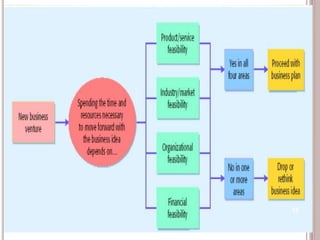
While making a feasibility analysis, there could
be only 3 alternatives which are the following:
1. When the project idea seems to be feasible, then we proceed with the idea.
2. When the project idea is not feasible, then we abandon the idea.
3. When we are unable to arrive at a conclusion, then we make efforts to collect
the required data and design the development.
3
 Techno - Economic feasibility refers to the estimation of
project demand potential and choice of optimal technology.
 Techno- Economic feasibility is an analysis on the existing
market and technology.
 The choice of technology itself will be based on the demand
potential in project design.
 Techno - Economic feasibility analyze the project on
individual criteria or different aspects and sets the stage for
detailed design development.
4
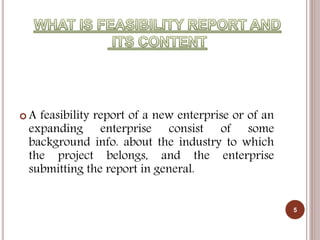
 A feasibility report of a new enterprise or of an
expanding enterprise consist of some
background info. about the industry to which
the project belongs, and the enterprise
submitting the report in general.
5
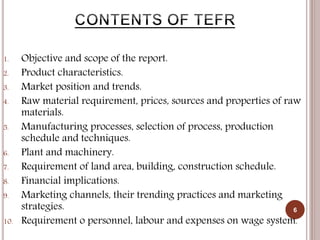
1. Objective and scope of the report.
2. Product characteristics.
3. Market position and trends.
4. Raw material requirement, prices, sources and properties of raw
materials.
5. Manufacturing processes, selection of process, production
schedule and techniques.
6. Plant and machinery.
7. Requirement of land area, building, construction schedule.
8. Financial implications.
9. Marketing channels, their trending practices and marketing
strategies.
10. Requirement o personnel, labour and expenses on wage system.
6
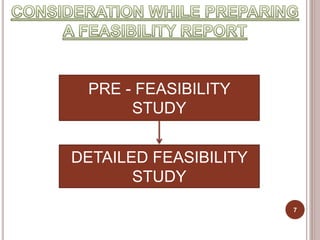
PRE - FEASIBILITY
STUDY
DETAILED FEASIBILITY
STUDY
7
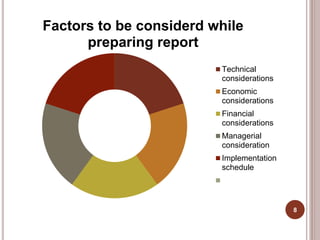
Factors to be considerd while
preparing report
Technical
considerations
Economic
considerations
Financial
considerations
Managerial
consideration
Implementation
schedule
8
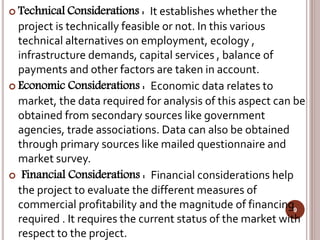
 Technical Considerations : It establishes whether the
project is technically feasible or not. In this various
technical alternatives on employment, ecology ,
infrastructure demands, capital services , balance of
payments and other factors are taken in account.
 Economic Considerations : Economic data relates to
market, the data required for analysis of this aspect can be
obtained from secondary sources like government
agencies, trade associations. Data can also be obtained
through primary sources like mailed questionnaire and
market survey.
 Financial Considerations : Financial considerations help
the project to evaluate the different measures of
commercial profitability and the magnitude of financing
required . It requires the current status of the market with
respect to the project.
9
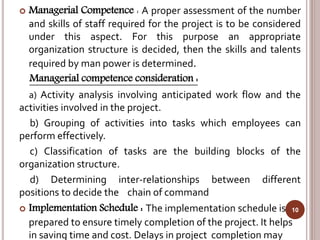
 Managerial Competence : A proper assessment of the number
and skills of staff required for the project is to be considered
under this aspect. For this purpose an appropriate
organization structure is decided, then the skills and talents
required by man power is determined.
Managerial competence consideration :
a) Activity analysis involving anticipated work flow and the
activities involved in the project.
b) Grouping of activities into tasks which employees can
perform effectively.
c) Classification of tasks are the building blocks of the
organization structure.
d) Determining inter-relationships between different
positions to decide the chain of command
 Implementation Schedule : The implementation schedule is
prepared to ensure timely completion of the project. It helps
in saving time and cost. Delays in project completion may
10
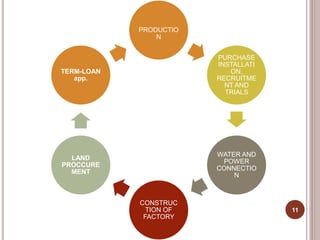
PRODUCTIO
N
PURCHASE
INSTALLATI
ON,
RECRUITME
NT AND
TRIALS
WATER AND
POWER
CONNECTIO
N
CONSTRUC
TION OF
FACTORY
LAND
PROCCURE
MENT
TERM-LOAN
app.
11
12
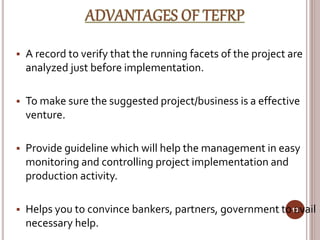
 A record to verify that the running facets of the project are
analyzed just before implementation.
 To make sure the suggested project/business is a effective
venture.
 Provide guideline which will help the management in easy
monitoring and controlling project implementation and
production activity.
 Helps you to convince bankers, partners, government to avail
necessary help.
13
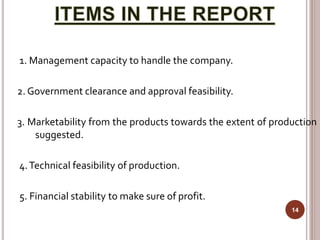
1. Management capacity to handle the company.
2. Government clearance and approval feasibility.
3. Marketability from the products towards the extent of production
suggested.
4.Technical feasibility of production.
5. Financial stability to make sure of profit.
14
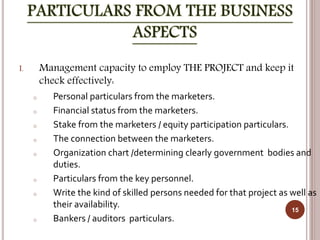
I. Management capacity to employ THE PROJECT and keep it
check effectively:
o Personal particulars from the marketers.
o Financial status from the marketers.
o Stake from the marketers / equity participation particulars.
o The connection between the marketers.
o Organization chart /determining clearly government bodies and
duties.
o Particulars from the key personnel.
o Write the kind of skilled persons needed for that project as well as
their availability.
o Bankers / auditors particulars.
15
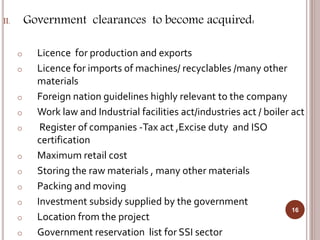
II. Government clearances to become acquired:
o Licence for production and exports
o Licence for imports of machines/ recyclables /many other
materials
o Foreign nation guidelines highly relevant to the company
o Work law and Industrial facilities act/industries act / boiler act
o Register of companies -Tax act ,Excise duty and ISO
certification
o Maximum retail cost
o Storing the raw materials , many other materials
o Packing and moving
o Investment subsidy supplied by the government
o Location from the project
o Government reservation list for SSI sector
16
III. Marketing aspects:
a) Creating the near future DEMAND /SUPPLY in quantity terms
 Projecting THE NEAR FUTURE DEMND
 Study yesteryear demand pattern
 Consumption , market size , exports , role of competition
 Starting at the present trend and future expected
demand thinking about above points
 Projecting THE NEAR FUTURE SUPPLY
 Study yesteryear supply pattern
 Production sector market , capital utilisation, imports and
quantity of models
 Starting at the present trend and future expected supply
thinking about above points
b) The scope of promoting the merchandise to at least one
 Consumer market
 Industrial market
 Export market
 Government and institutional market
17
c) The marketing mix ( product, cost, place promotion) of
competitors
Companies analyzed to reach a suitable means of organisation
d) Scope for ANCILLARY status unit to motor unit , marketing
correct arrangement , opening show rooms , acquiring job
work , captive consumption , ETC analyzed.
18
1. Quality parameters from the items suggested to
become created.
2. Product specifications.
3. Quantity to become created in every variety.
4. Suggested technology.
5. Highlights around the suggested technology.
6. Procedure for manufacture.
7. Production line balancing.
8. Listings of machines.
9. Supplier selections.
10. Raw material. (cost, quality etc.)
19
1. Price of land.
2. Price of building.
3. Price of machines.
4. Contingencies.
5. Preliminary and pre operative expenses.
6. Miscellaneous fixed assets.
7. Margin money for capital.
20
1. Promoter’s capital.
2. Term loan from bank.
3. Investment subsidy.
Term loan component is debt promoter’s capital and
investment subsidy components may be the equity.
21
22
1. Profit on sales.
2. Profit on investment with various investment
options.
3. Break even point.
4. DET service coverage ratio.
5. Sensitivity analysis.
6. Internal rate of return.
23
Entrepreneurship Development By S.Anil
kumar
Paper onTEFR of the industrial project
– Prof.V S RangarajAN
Entrepreneurship and Economic development
by-Wim Naude 24

Techno Economic Feasibility Report I Gaurav Singh Rajput

  • 1.
  • 2.
    Feasibility Study isan assessment of the practicality of a proposed project or system. In feasibility analysis, the project idea is examined from the point of view whether to go in for making a detailed investment proposal or not. 2
  • 3.
    While making afeasibility analysis, there could be only 3 alternatives which are the following: 1. When the project idea seems to be feasible, then we proceed with the idea. 2. When the project idea is not feasible, then we abandon the idea. 3. When we are unable to arrive at a conclusion, then we make efforts to collect the required data and design the development. 3
  • 4.
     Techno -Economic feasibility refers to the estimation of project demand potential and choice of optimal technology.  Techno- Economic feasibility is an analysis on the existing market and technology.  The choice of technology itself will be based on the demand potential in project design.  Techno - Economic feasibility analyze the project on individual criteria or different aspects and sets the stage for detailed design development. 4
  • 5.
     A feasibilityreport of a new enterprise or of an expanding enterprise consist of some background info. about the industry to which the project belongs, and the enterprise submitting the report in general. 5
  • 6.
    1. Objective andscope of the report. 2. Product characteristics. 3. Market position and trends. 4. Raw material requirement, prices, sources and properties of raw materials. 5. Manufacturing processes, selection of process, production schedule and techniques. 6. Plant and machinery. 7. Requirement of land area, building, construction schedule. 8. Financial implications. 9. Marketing channels, their trending practices and marketing strategies. 10. Requirement o personnel, labour and expenses on wage system. 6
  • 7.
  • 8.
    Factors to beconsiderd while preparing report Technical considerations Economic considerations Financial considerations Managerial consideration Implementation schedule 8
  • 9.
     Technical Considerations: It establishes whether the project is technically feasible or not. In this various technical alternatives on employment, ecology , infrastructure demands, capital services , balance of payments and other factors are taken in account.  Economic Considerations : Economic data relates to market, the data required for analysis of this aspect can be obtained from secondary sources like government agencies, trade associations. Data can also be obtained through primary sources like mailed questionnaire and market survey.  Financial Considerations : Financial considerations help the project to evaluate the different measures of commercial profitability and the magnitude of financing required . It requires the current status of the market with respect to the project. 9
  • 10.
     Managerial Competence: A proper assessment of the number and skills of staff required for the project is to be considered under this aspect. For this purpose an appropriate organization structure is decided, then the skills and talents required by man power is determined. Managerial competence consideration : a) Activity analysis involving anticipated work flow and the activities involved in the project. b) Grouping of activities into tasks which employees can perform effectively. c) Classification of tasks are the building blocks of the organization structure. d) Determining inter-relationships between different positions to decide the chain of command  Implementation Schedule : The implementation schedule is prepared to ensure timely completion of the project. It helps in saving time and cost. Delays in project completion may 10
  • 11.
  • 12.
  • 13.
     A recordto verify that the running facets of the project are analyzed just before implementation.  To make sure the suggested project/business is a effective venture.  Provide guideline which will help the management in easy monitoring and controlling project implementation and production activity.  Helps you to convince bankers, partners, government to avail necessary help. 13
  • 14.
    1. Management capacityto handle the company. 2. Government clearance and approval feasibility. 3. Marketability from the products towards the extent of production suggested. 4.Technical feasibility of production. 5. Financial stability to make sure of profit. 14
  • 15.
    I. Management capacityto employ THE PROJECT and keep it check effectively: o Personal particulars from the marketers. o Financial status from the marketers. o Stake from the marketers / equity participation particulars. o The connection between the marketers. o Organization chart /determining clearly government bodies and duties. o Particulars from the key personnel. o Write the kind of skilled persons needed for that project as well as their availability. o Bankers / auditors particulars. 15
  • 16.
    II. Government clearancesto become acquired: o Licence for production and exports o Licence for imports of machines/ recyclables /many other materials o Foreign nation guidelines highly relevant to the company o Work law and Industrial facilities act/industries act / boiler act o Register of companies -Tax act ,Excise duty and ISO certification o Maximum retail cost o Storing the raw materials , many other materials o Packing and moving o Investment subsidy supplied by the government o Location from the project o Government reservation list for SSI sector 16
  • 17.
    III. Marketing aspects: a)Creating the near future DEMAND /SUPPLY in quantity terms  Projecting THE NEAR FUTURE DEMND  Study yesteryear demand pattern  Consumption , market size , exports , role of competition  Starting at the present trend and future expected demand thinking about above points  Projecting THE NEAR FUTURE SUPPLY  Study yesteryear supply pattern  Production sector market , capital utilisation, imports and quantity of models  Starting at the present trend and future expected supply thinking about above points b) The scope of promoting the merchandise to at least one  Consumer market  Industrial market  Export market  Government and institutional market 17
  • 18.
    c) The marketingmix ( product, cost, place promotion) of competitors Companies analyzed to reach a suitable means of organisation d) Scope for ANCILLARY status unit to motor unit , marketing correct arrangement , opening show rooms , acquiring job work , captive consumption , ETC analyzed. 18
  • 19.
    1. Quality parametersfrom the items suggested to become created. 2. Product specifications. 3. Quantity to become created in every variety. 4. Suggested technology. 5. Highlights around the suggested technology. 6. Procedure for manufacture. 7. Production line balancing. 8. Listings of machines. 9. Supplier selections. 10. Raw material. (cost, quality etc.) 19
  • 20.
    1. Price ofland. 2. Price of building. 3. Price of machines. 4. Contingencies. 5. Preliminary and pre operative expenses. 6. Miscellaneous fixed assets. 7. Margin money for capital. 20
  • 21.
    1. Promoter’s capital. 2.Term loan from bank. 3. Investment subsidy. Term loan component is debt promoter’s capital and investment subsidy components may be the equity. 21
  • 22.
  • 23.
    1. Profit onsales. 2. Profit on investment with various investment options. 3. Break even point. 4. DET service coverage ratio. 5. Sensitivity analysis. 6. Internal rate of return. 23
  • 24.
    Entrepreneurship Development ByS.Anil kumar Paper onTEFR of the industrial project – Prof.V S RangarajAN Entrepreneurship and Economic development by-Wim Naude 24