ASV 
FLY ASH BRICKS Co. 
Business Plan 
On Fly Ash 
Ambrish 
Suvi 
Vinayak S. 
A GO GREEN PROJECT
PROMOTORS 
NAME QUALIFICATION 
 AMBARISH : B.com , M.B.A 
 SUVI SUGATHAN : B.E , M.B.A 
 VINAYAK : B.E , M.B.A
INTRODUCTION 
 We are introducing the business of manufacturing Fly Ash Bricks 
with a view point of eliminating Fly Ash as an Environment 
Pollutant which provides the huge benefit to organization as well 
as to environment. 
 What is fly ash brick? 
 It is a building material, specifically masonry units, 
containing class C fly ash and water. 
 Compressed at 28 MPa (272 atm) and cured for 24 hours in a66 
°C steam bath, then toughened with an air entrainment agent, 
the bricks last for more than 100 freeze-thaw cycles 
 Owing to the high concentration of calcium oxide in class C fly 
ash, the brick is described as "self-cementing“
INTRODUCTION 
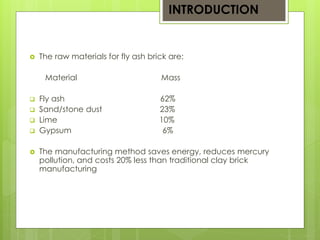
 The raw materials for fly ash brick are: 
Material Mass 
 Fly ash 62% 
 Sand/stone dust 23% 
 Lime 10% 
 Gypsum 6% 
 The manufacturing method saves energy, reduces mercury 
pollution, and costs 20% less than traditional clay brick 
manufacturing
MISSION & VISION: 
 “ To provide and promote business and services 
that strengthen the brick manufacturing sector for 
the ultimate benefit of its customers and society 
 To be in the forefront of creating awareness 
about environment, & to be the largest player in 
the field of fly-ash brick production.
LOCATION OF THE PLANT 
For setting up a fly ash brick industry these factors 
should be adhered:- 
 land requirement - at least 1.5 acre of land is 
required to set up a plant 
 factory location – fly ash generally is found near 
thermal power plant. Thus setting up a industry 
within 60 -70 km radius nearby a thermal power 
plant is an advantage. 
 Availability of water – ample amount of water is 
required for running these industry 
 Environmental issues – setting up a factory nearby 
an residential township or any other 
manufacturing industry is prohibited , as it 
generates huge dust and smoke and pollutes the 
air.
Thus keeping in mind all these factors , we did a lot of 
research and mapping intensively throughout India for a 
suitable location. 
At last we are setting our plant in the state of Karnataka , in 
Raichur district. 
About the location. 
 The plant is going to be set up at around 1.3acre of land 
within Malkapur village , which comes under raichur district. 
 These village is an abundant space of vast land with very 
few inhabitants. 
 Best thing is that it is just 14kms away from the Tungabhadra 
river 
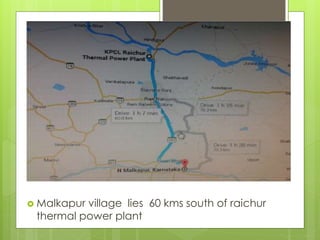
 Big advantage of these location is that it is just 59.9 kms 
away from the raichur thermal power plant. 
So by far these is the most relevant place for setting up a fly 
ash plant as these location meets all the essential criteria's.
 Malkapur village lies 60 kms south of raichur 
thermal power plant
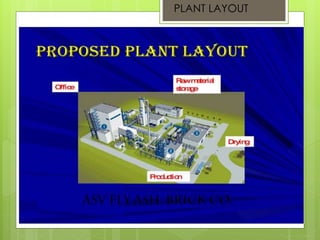
PLANT LAYOUT 
PROPOSED PLANT LAYOUT
 The bricks which currently most us aware is made up 
of the soil of specific quality, but due to which earth 
erosion takes place and we waste natural resources. 
 This job is too laborious and involves cost. Natural 
seasons affect the quality and cost. 
 This bricks creates environmental pollution. 
 Helps to reduce the pollution Demand consumption 
and increasing cost -We come up with FLY ASH 
BRICKS 
 The main raw material is fly ash which is available in 
abundant quantity and free of cost at the thermal 
power station. 
 Disposal of fly ash is headache , It is highly polluting 
material. 
OVERVIEW
 Nearly 73% of India’s total installed power generation 
capacity is thermal, of which coal-based generation 
is 90% – the remaining comprising diesel, wind, gas, 
and steam. 
 The 85 utility thermal power stations, besides the 
several captive power plants, use bituminous and 
sub-bituminous coal and produce large quantities of 
fly ash. 
 High ash content (30%–50%) contributes to these large 
volumes of fly ash. 
SCOPE OF PROJECT
PROBLEMS OF FLY ASH 
 It is a very difficult material to handle in dry state 
because it is very fine and readily airborne even in 
mild wind. 
 It disturbs the ecology of the region, being a source 
of soil air and water pollution. 
 Long inhalation of fly ash causes silicosis, fibrosis of 
lungs, bronchitis, pneumonitis etc. 
 Flying fine particles of ash create great nuisance for 
people living near power stations, corrode structural 
surfaces, and affect horticulture. 
 Eventual settlement of fly ash particles over many 
hectares of land in the vicinity of power station brings 
about perceptible degeneration in soil 
characteristics.
NEED FOR UTILIZING / 
DISPOSING FLY ASH 
With the rapid rise in thermal generation, 
environmental pollution as a result of massive fly 
ash generation, poses a new problem. 
 Fly ash is reported to cause ailments like allergic 
bronchitis, silicosis, and asthma. 
 Fly ash contaminates surface water and may also 
have an effect on underground water, affects the 
aquatic life, is harmful for plants, and corrodes 
exposed metallic structures in its vicinity.
CURRENT FLYASH DISPOSAL 
PRACTICES AND EFFECTS 
 At thermal power plants, fly ash is currently 
collected / disposed off by using wet or dry 
systems. 
 In cases, where fly ash collection systems are not 
very efficient, a portion of it escapes into the 
atmosphere causing environmental pollution. 
 In the wet system, fly ash is mixed with water and 
sluiced to settling ponds or dumping areas near 
the plant. 
 Being cheaper than any other manner of fly ash 
removal, it is the widely used method at present in 
India
 FLY ASH BLOCKS FEATURES: 
 Size of blocks is 290x185x125mm 
Faster construction 
 Less mortar consumption 
Most suitable for boundary walls 
Decorative, like stone masonry 
Ash content 26% 
PRODUCT DESCRIPTION
Ash can be collected in following categories: 
 DRY FLY ASH: 
 Dry ash is collected from different rows of electrostatic 
precipitators 
 It is available in two different grades of fineness in silos for use as 
resource material by different users 
 BOTTOM ASH: 
 Bottom ash is collected from the bottom of the boiler and 
transported to hydro bins and then ash mound for use in road 
embankment. 
 CONDITIONED FLY ASH: 
 Conditioned fly ash is also available in ash mound for use in land 
fills and ash building products. 
ASH COLLECTION
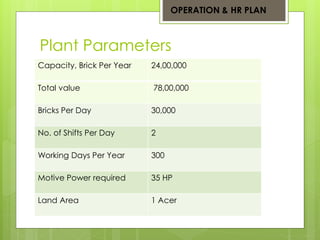
OPERATION & HR PLAN 
Plant Parameters 
Capacity, Brick Per Year 24,00,000 
Total value 78,00,000 
Bricks Per Day 30,000 
No. of Shifts Per Day 2 
Working Days Per Year 300 
Motive Power required 35 HP 
Land Area 1 Acer
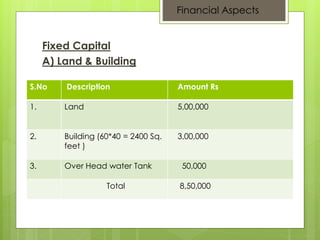
Financial Aspects 
Fixed Capital 
A) Land & Building 
S.No Description Amount Rs 
1. Building (60*40 = 2400 Sq. 
Land 5,00,000 
feet ) 
3,00,000 
2. Over Head water Tank 50,000 
Building (60*40 = 2400 Sq. 
feet ) 
3,00,000 
Total 3,50,000 
3. Over Head water Tank 50,000 
Total 8,50,000
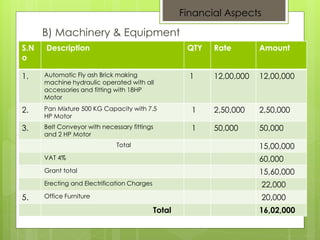
Financial Aspects 
B) Machinery & Equipment 
S.N 
o 
Description QTY Rate Amount 
1. Automatic Fly ash Brick making 
machine hydraulic operated with all 
accessories and fitting with 18HP 
Motor 
1 12,00,000 12,00,000 
2. Pan Mixture 500 KG Capacity with 7.5 
HP Motor 
1 2,50,000 2,50,000 
3. Belt Conveyor with necessary fittings 
and 2 HP Motor 
1 50,000 50,000 
Total 15,00,000 
VAT 4% 60,000 
Grant total 15,60,000 
Erecting and Electrification Charges 22,000 
5. Office Furniture 20,000 
Total 16,02,000
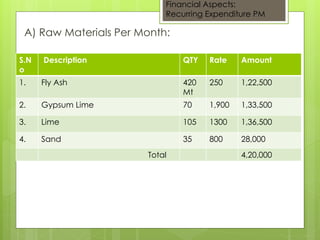
Financial Aspects: 
Recurring Expenditure PM 
A) Raw Materials Per Month: 
S.N 
o 
Description QTY Rate Amount 
1. Fly Ash 420 
Mt 
250 1,22,500 
2. Gypsum Lime 70 1,900 1,33,500 
3. Lime 105 1300 1,36,500 
4. Sand 35 800 28,000 
Total 4,20,000
Financial Aspects: Recurring 
Expenditure PM 
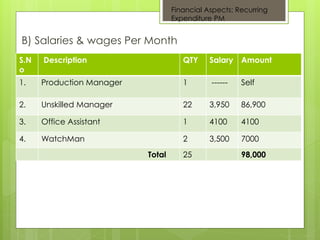
B) Salaries & wages Per Month 
S.N 
o 
Description QTY Salary Amount 
1. Production Manager 1 ------ Self 
2. Unskilled Manager 22 3,950 86,900 
3. Office Assistant 1 4100 4100 
4. WatchMan 2 3,500 7000 
Total 25 98,000
Financial Aspects: Recurring 
Expenditure PM 
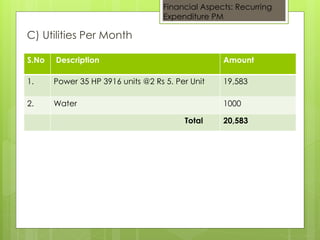
C) Utilities Per Month 
S.No Description Amount 
1. Power 35 HP 3916 units @2 Rs 5. Per Unit 19,583 
2. Water 1000 
Total 20,583
Financial Aspects: 
Recurring Expenditure PM 
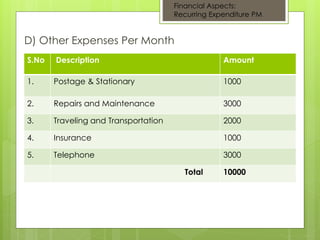
D) Other Expenses Per Month 
S.No Description Amount 
1. Postage & Stationary 1000 
2. Repairs and Maintenance 3000 
3. Traveling and Transportation 2000 
4. Insurance 1000 
5. Telephone 3000 
Total 10000
Financial Aspects: Recurring 
Expenditure PM 
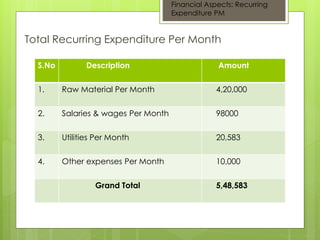
Total Recurring Expenditure Per Month 
S.No Description Amount 
1. Raw Material Per Month 4,20,000 
2. Salaries & wages Per Month 98000 
3. Utilities Per Month 20,583 
4. Other expenses Per Month 10,000 
Grand Total 5,48,583
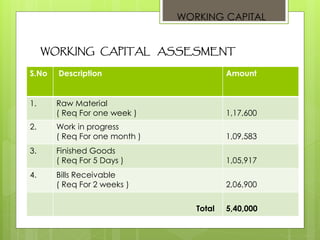
WORKING CAPITAL 
WORKING CAPITAL ASSESMENT 
S.No Description Amount 
1. Raw Material 
( Req For one week ) 1,17,600 
2. Work in progress 
( Req For one month ) 1,09,583 
3. Finished Goods 
( Req For 5 Days ) 1,05,917 
4. Bills Receivable 
( Req For 2 weeks ) 2,06,900 
Total 5,40,000
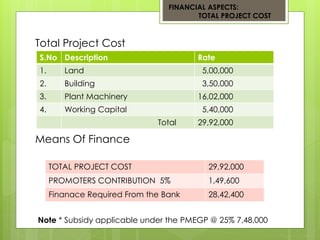
FINANCIAL ASPECTS: 
TOTAL PROJECT COST 
S.No Description Rate 
1. Land 5,00,000 
2. Building 3,50,000 
3. Plant Machinery 16,02,000 
Total 
Total Project Cost 
Means Of Finance 
5,00,000 
3,50,000 
4. Working Capital 5,40,000 
Total 29,92,000 
TOTAL PROJECT COST 29,92,000 
PROMOTERS CONTRIBUTION 5% 1,49,600 
Finanace Required From the Bank 28,42,400 
Note * Subsidy applicable under the PMEGP @ 25% 7,48,000
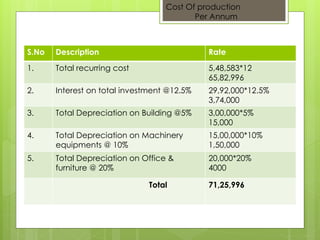
Cost Of production 
Per Annum 
S.No Description Rate 
1. Total recurring cost 5,48,583*12 
65,82,996 
2. Interest on total investment @12.5% 29,92,000*12.5% 
3,74,000 
3. Total Depreciation on Building @5% 3,00,000*5% 
15,000 
4. Total Depreciation on Machinery 
equipments @ 10% 
15,00,000*10% 
1,50,000 
5. Total Depreciation on Office & 
furniture @ 20% 
20,000*20% 
4000 
Total 71,25,996
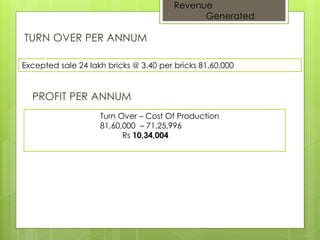
Revenue 
Generated 
TURN OVER PER ANNUM 
Excepted sale 24 lakh bricks @ 3.40 per bricks 81,60,000 
PROFIT PER ANNUM 
Turn Over – Cost Of Production 
81,60,000 – 71,25,996 
Rs 10,34,004
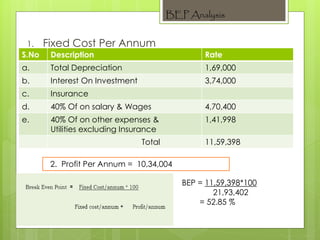
BEP Analysis 
1. Fixed Cost Per Annum 
S.No Description Rate 
a. Total Depreciation 1,69,000 
b. Interest On Investment 3,74,000 
c. Insurance 
d. 40% Of on salary & Wages 4,70,400 
e. 40% Of on other expenses & 
Utilities excluding Insurance 
1,41,998 
Total 11,59,398 
2. Profit Per Annum = 10,34,004 
BEP = 11,59,398*100 
21,93,402 
= 52.85 %
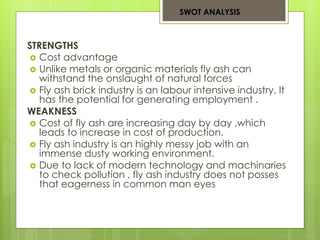
SWOT ANALYSIS 
STRENGTHS 
 Cost advantage 
 Unlike metals or organic materials fly ash can 
withstand the onslaught of natural forces 
 Fly ash brick industry is an labour intensive industry. It 
has the potential for generating employment . 
WEAKNESS 
 Cost of fly ash are increasing day by day ,which 
leads to increase in cost of production. 
 Fly ash industry is an highly messy job with an 
immense dusty working environment. 
 Due to lack of modern technology and machinaries 
to check pollution , fly ash industry does not posses 
that eagerness in common man eyes
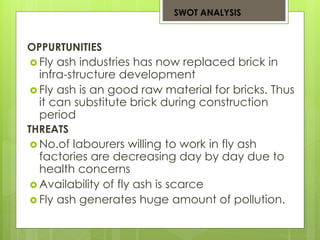
OPPURTUNITIES 
SWOT ANALYSIS 
 Fly ash industries has now replaced brick in 
infra-structure development 
 Fly ash is an good raw material for bricks. Thus 
it can substitute brick during construction 
period 
THREATS 
 No.of labourers willing to work in fly ash 
factories are decreasing day by day due to 
health concerns 
Availability of fly ash is scarce 
 Fly ash generates huge amount of pollution.
Production Plan

Business plan on fly ash (final)

  • 1.
    ASV FLY ASHBRICKS Co. Business Plan On Fly Ash Ambrish Suvi Vinayak S. A GO GREEN PROJECT
  • 2.
    PROMOTORS NAME QUALIFICATION  AMBARISH : B.com , M.B.A  SUVI SUGATHAN : B.E , M.B.A  VINAYAK : B.E , M.B.A
  • 3.
    INTRODUCTION  Weare introducing the business of manufacturing Fly Ash Bricks with a view point of eliminating Fly Ash as an Environment Pollutant which provides the huge benefit to organization as well as to environment.  What is fly ash brick?  It is a building material, specifically masonry units, containing class C fly ash and water.  Compressed at 28 MPa (272 atm) and cured for 24 hours in a66 °C steam bath, then toughened with an air entrainment agent, the bricks last for more than 100 freeze-thaw cycles  Owing to the high concentration of calcium oxide in class C fly ash, the brick is described as "self-cementing“
  • 4.
    INTRODUCTION  Theraw materials for fly ash brick are: Material Mass  Fly ash 62%  Sand/stone dust 23%  Lime 10%  Gypsum 6%  The manufacturing method saves energy, reduces mercury pollution, and costs 20% less than traditional clay brick manufacturing
  • 5.
    MISSION & VISION:  “ To provide and promote business and services that strengthen the brick manufacturing sector for the ultimate benefit of its customers and society  To be in the forefront of creating awareness about environment, & to be the largest player in the field of fly-ash brick production.
  • 6.
    LOCATION OF THEPLANT For setting up a fly ash brick industry these factors should be adhered:-  land requirement - at least 1.5 acre of land is required to set up a plant  factory location – fly ash generally is found near thermal power plant. Thus setting up a industry within 60 -70 km radius nearby a thermal power plant is an advantage.  Availability of water – ample amount of water is required for running these industry  Environmental issues – setting up a factory nearby an residential township or any other manufacturing industry is prohibited , as it generates huge dust and smoke and pollutes the air.
  • 7.
    Thus keeping inmind all these factors , we did a lot of research and mapping intensively throughout India for a suitable location. At last we are setting our plant in the state of Karnataka , in Raichur district. About the location.  The plant is going to be set up at around 1.3acre of land within Malkapur village , which comes under raichur district.  These village is an abundant space of vast land with very few inhabitants.  Best thing is that it is just 14kms away from the Tungabhadra river  Big advantage of these location is that it is just 59.9 kms away from the raichur thermal power plant. So by far these is the most relevant place for setting up a fly ash plant as these location meets all the essential criteria's.
  • 8.
     Malkapur villagelies 60 kms south of raichur thermal power plant
  • 9.
  • 10.
     The brickswhich currently most us aware is made up of the soil of specific quality, but due to which earth erosion takes place and we waste natural resources.  This job is too laborious and involves cost. Natural seasons affect the quality and cost.  This bricks creates environmental pollution.  Helps to reduce the pollution Demand consumption and increasing cost -We come up with FLY ASH BRICKS  The main raw material is fly ash which is available in abundant quantity and free of cost at the thermal power station.  Disposal of fly ash is headache , It is highly polluting material. OVERVIEW
  • 11.
     Nearly 73%of India’s total installed power generation capacity is thermal, of which coal-based generation is 90% – the remaining comprising diesel, wind, gas, and steam.  The 85 utility thermal power stations, besides the several captive power plants, use bituminous and sub-bituminous coal and produce large quantities of fly ash.  High ash content (30%–50%) contributes to these large volumes of fly ash. SCOPE OF PROJECT
  • 12.
    PROBLEMS OF FLYASH  It is a very difficult material to handle in dry state because it is very fine and readily airborne even in mild wind.  It disturbs the ecology of the region, being a source of soil air and water pollution.  Long inhalation of fly ash causes silicosis, fibrosis of lungs, bronchitis, pneumonitis etc.  Flying fine particles of ash create great nuisance for people living near power stations, corrode structural surfaces, and affect horticulture.  Eventual settlement of fly ash particles over many hectares of land in the vicinity of power station brings about perceptible degeneration in soil characteristics.
  • 13.
    NEED FOR UTILIZING/ DISPOSING FLY ASH With the rapid rise in thermal generation, environmental pollution as a result of massive fly ash generation, poses a new problem.  Fly ash is reported to cause ailments like allergic bronchitis, silicosis, and asthma.  Fly ash contaminates surface water and may also have an effect on underground water, affects the aquatic life, is harmful for plants, and corrodes exposed metallic structures in its vicinity.
  • 14.
    CURRENT FLYASH DISPOSAL PRACTICES AND EFFECTS  At thermal power plants, fly ash is currently collected / disposed off by using wet or dry systems.  In cases, where fly ash collection systems are not very efficient, a portion of it escapes into the atmosphere causing environmental pollution.  In the wet system, fly ash is mixed with water and sluiced to settling ponds or dumping areas near the plant.  Being cheaper than any other manner of fly ash removal, it is the widely used method at present in India
  • 15.
     FLY ASHBLOCKS FEATURES:  Size of blocks is 290x185x125mm Faster construction  Less mortar consumption Most suitable for boundary walls Decorative, like stone masonry Ash content 26% PRODUCT DESCRIPTION
  • 16.
    Ash can becollected in following categories:  DRY FLY ASH:  Dry ash is collected from different rows of electrostatic precipitators  It is available in two different grades of fineness in silos for use as resource material by different users  BOTTOM ASH:  Bottom ash is collected from the bottom of the boiler and transported to hydro bins and then ash mound for use in road embankment.  CONDITIONED FLY ASH:  Conditioned fly ash is also available in ash mound for use in land fills and ash building products. ASH COLLECTION
  • 17.
    OPERATION & HRPLAN Plant Parameters Capacity, Brick Per Year 24,00,000 Total value 78,00,000 Bricks Per Day 30,000 No. of Shifts Per Day 2 Working Days Per Year 300 Motive Power required 35 HP Land Area 1 Acer
  • 18.
    Financial Aspects FixedCapital A) Land & Building S.No Description Amount Rs 1. Building (60*40 = 2400 Sq. Land 5,00,000 feet ) 3,00,000 2. Over Head water Tank 50,000 Building (60*40 = 2400 Sq. feet ) 3,00,000 Total 3,50,000 3. Over Head water Tank 50,000 Total 8,50,000
  • 19.
    Financial Aspects B)Machinery & Equipment S.N o Description QTY Rate Amount 1. Automatic Fly ash Brick making machine hydraulic operated with all accessories and fitting with 18HP Motor 1 12,00,000 12,00,000 2. Pan Mixture 500 KG Capacity with 7.5 HP Motor 1 2,50,000 2,50,000 3. Belt Conveyor with necessary fittings and 2 HP Motor 1 50,000 50,000 Total 15,00,000 VAT 4% 60,000 Grant total 15,60,000 Erecting and Electrification Charges 22,000 5. Office Furniture 20,000 Total 16,02,000
  • 20.
    Financial Aspects: RecurringExpenditure PM A) Raw Materials Per Month: S.N o Description QTY Rate Amount 1. Fly Ash 420 Mt 250 1,22,500 2. Gypsum Lime 70 1,900 1,33,500 3. Lime 105 1300 1,36,500 4. Sand 35 800 28,000 Total 4,20,000
  • 21.
    Financial Aspects: Recurring Expenditure PM B) Salaries & wages Per Month S.N o Description QTY Salary Amount 1. Production Manager 1 ------ Self 2. Unskilled Manager 22 3,950 86,900 3. Office Assistant 1 4100 4100 4. WatchMan 2 3,500 7000 Total 25 98,000
  • 22.
    Financial Aspects: Recurring Expenditure PM C) Utilities Per Month S.No Description Amount 1. Power 35 HP 3916 units @2 Rs 5. Per Unit 19,583 2. Water 1000 Total 20,583
  • 23.
    Financial Aspects: RecurringExpenditure PM D) Other Expenses Per Month S.No Description Amount 1. Postage & Stationary 1000 2. Repairs and Maintenance 3000 3. Traveling and Transportation 2000 4. Insurance 1000 5. Telephone 3000 Total 10000
  • 24.
    Financial Aspects: Recurring Expenditure PM Total Recurring Expenditure Per Month S.No Description Amount 1. Raw Material Per Month 4,20,000 2. Salaries & wages Per Month 98000 3. Utilities Per Month 20,583 4. Other expenses Per Month 10,000 Grand Total 5,48,583
  • 25.
    WORKING CAPITAL WORKINGCAPITAL ASSESMENT S.No Description Amount 1. Raw Material ( Req For one week ) 1,17,600 2. Work in progress ( Req For one month ) 1,09,583 3. Finished Goods ( Req For 5 Days ) 1,05,917 4. Bills Receivable ( Req For 2 weeks ) 2,06,900 Total 5,40,000
  • 26.
    FINANCIAL ASPECTS: TOTALPROJECT COST S.No Description Rate 1. Land 5,00,000 2. Building 3,50,000 3. Plant Machinery 16,02,000 Total Total Project Cost Means Of Finance 5,00,000 3,50,000 4. Working Capital 5,40,000 Total 29,92,000 TOTAL PROJECT COST 29,92,000 PROMOTERS CONTRIBUTION 5% 1,49,600 Finanace Required From the Bank 28,42,400 Note * Subsidy applicable under the PMEGP @ 25% 7,48,000
  • 27.
    Cost Of production Per Annum S.No Description Rate 1. Total recurring cost 5,48,583*12 65,82,996 2. Interest on total investment @12.5% 29,92,000*12.5% 3,74,000 3. Total Depreciation on Building @5% 3,00,000*5% 15,000 4. Total Depreciation on Machinery equipments @ 10% 15,00,000*10% 1,50,000 5. Total Depreciation on Office & furniture @ 20% 20,000*20% 4000 Total 71,25,996
  • 28.
    Revenue Generated TURNOVER PER ANNUM Excepted sale 24 lakh bricks @ 3.40 per bricks 81,60,000 PROFIT PER ANNUM Turn Over – Cost Of Production 81,60,000 – 71,25,996 Rs 10,34,004
  • 29.
    BEP Analysis 1.Fixed Cost Per Annum S.No Description Rate a. Total Depreciation 1,69,000 b. Interest On Investment 3,74,000 c. Insurance d. 40% Of on salary & Wages 4,70,400 e. 40% Of on other expenses & Utilities excluding Insurance 1,41,998 Total 11,59,398 2. Profit Per Annum = 10,34,004 BEP = 11,59,398*100 21,93,402 = 52.85 %
  • 30.
    SWOT ANALYSIS STRENGTHS  Cost advantage  Unlike metals or organic materials fly ash can withstand the onslaught of natural forces  Fly ash brick industry is an labour intensive industry. It has the potential for generating employment . WEAKNESS  Cost of fly ash are increasing day by day ,which leads to increase in cost of production.  Fly ash industry is an highly messy job with an immense dusty working environment.  Due to lack of modern technology and machinaries to check pollution , fly ash industry does not posses that eagerness in common man eyes
  • 31.
    OPPURTUNITIES SWOT ANALYSIS  Fly ash industries has now replaced brick in infra-structure development  Fly ash is an good raw material for bricks. Thus it can substitute brick during construction period THREATS  No.of labourers willing to work in fly ash factories are decreasing day by day due to health concerns Availability of fly ash is scarce  Fly ash generates huge amount of pollution.
  • 32.