FLY ASH BRICKS
S.Deepak
K.Sandeep
CONTENTS
 INTRODUCTION TO FLY ASH
 USES OF FLY ASH
 FLY ASH BRICKS
 MANUFACTURING OF FLY ASH BRICKS
 COMPARISION OF FLY ASH BRICKS OVER CLAY BRICKS
 ADVANTAGES OF FLY ASH BRICKS
 DISADVANTAGES OF FLY ASH BRICKS
 ECONOMICAL BASIS
INTRODUCTION TO FLY ASH
 Fly Ash is a fine powder produced from industrial plants using pulverized coal
or lignite as a fuel.
 It is the most pozzolan siliceous or aluminosiliceous in nature in a finely
divided form.
 They are spherical shaped “ balls ” finer than cement particles .
USES OF FLY ASH
 CEMENT BLENDING
 READY MIX CONCRETE
 SOLID AND HOLLOW BLOCK
 FLY ASH BRICK
 MINE FILLING
 ROAD AND PAVEMENT CONSTRUCTION
 FLOOR AND WALL TILES
 PAINT INDUSTRY
 CONCRETE AND MORTAR
 LIGHT WEIGHT AGGREGATE
INTRODUCTION TO FLY ASH BRICKS
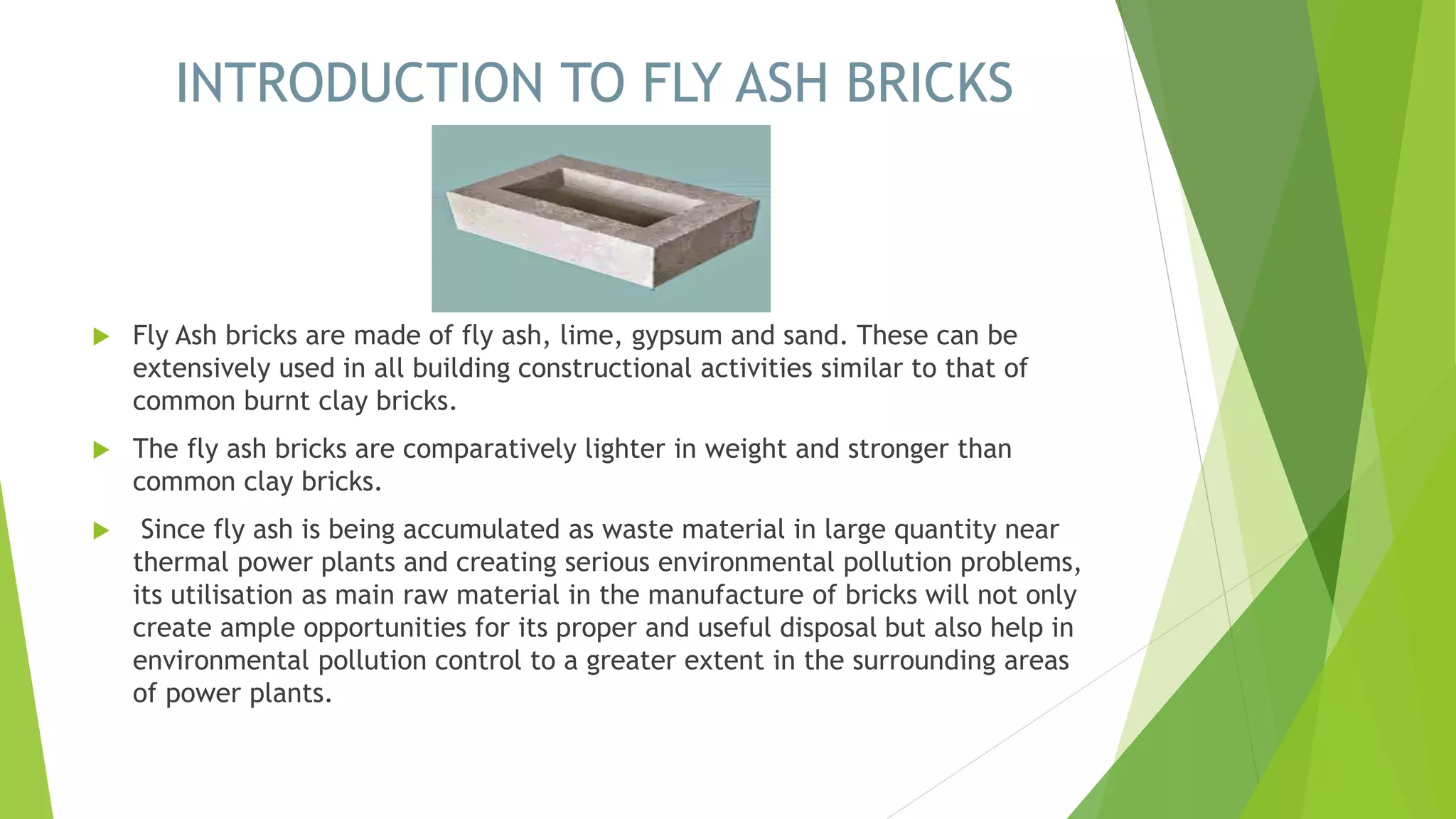
 Fly Ash bricks are made of fly ash, lime, gypsum and sand. These can be
extensively used in all building constructional activities similar to that of
common burnt clay bricks.
 The fly ash bricks are comparatively lighter in weight and stronger than
common clay bricks.
 Since fly ash is being accumulated as waste material in large quantity near
thermal power plants and creating serious environmental pollution problems,
its utilisation as main raw material in the manufacture of bricks will not only
create ample opportunities for its proper and useful disposal but also help in
environmental pollution control to a greater extent in the surrounding areas
of power plants.
FEATURES OF FLY ASH BRICKS
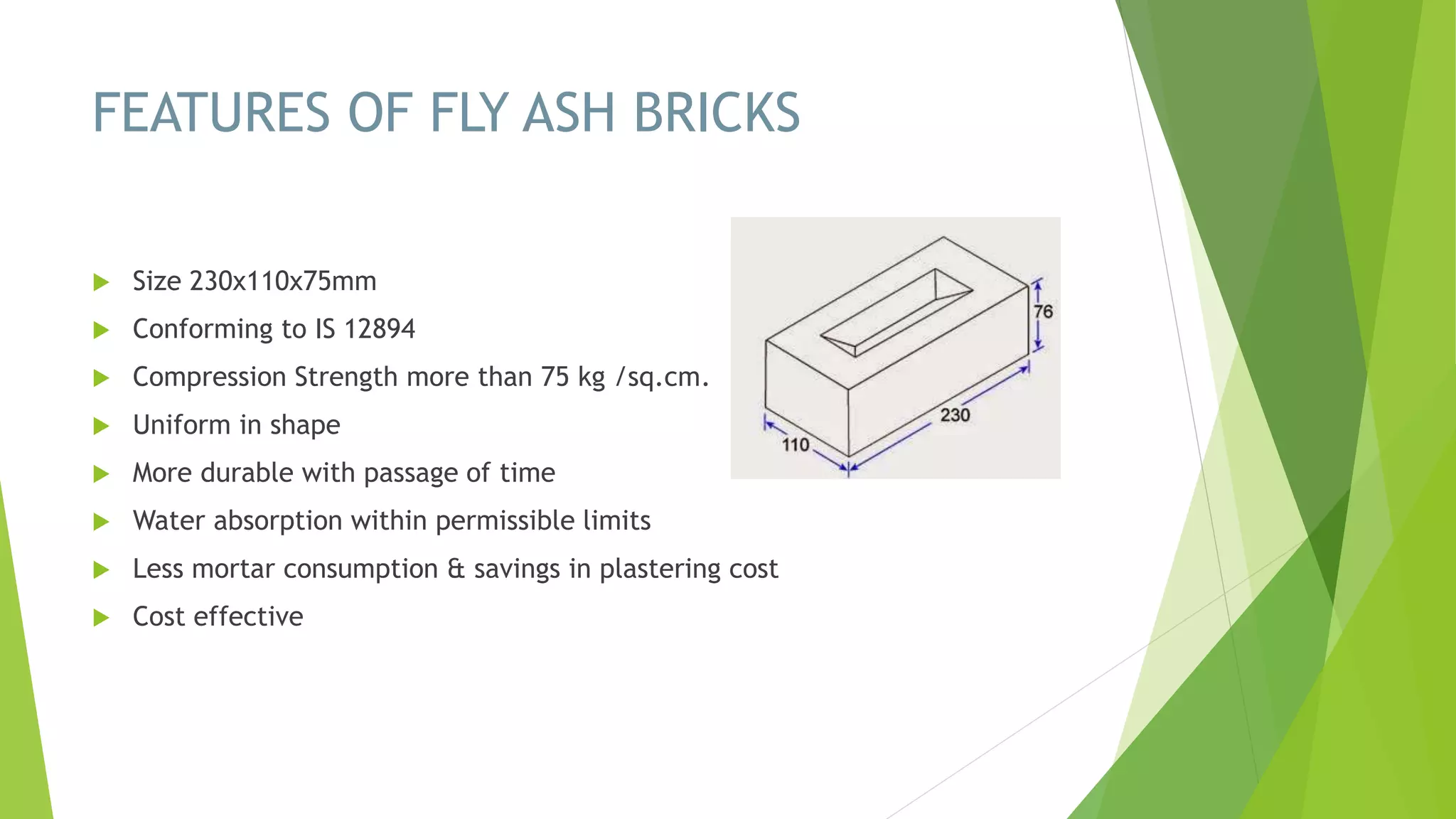
 Size 230x110x75mm
 Conforming to IS 12894
 Compression Strength more than 75 kg /sq.cm.
 Uniform in shape
 More durable with passage of time
 Water absorption within permissible limits
 Less mortar consumption & savings in plastering cost
 Cost effective
MANUFACTURING OF FLY ASH BRICK
1-Raw Material
2-Batching Plant
3- Conveyor belt
9-Pan Mixture
10-Conveyor Belt
11-Press Machine
12-Railing
13-Robot
14-Fly ash Brick
15-Loader
MANUFACTURING PROCESS IN BRICK
PLANT
 Fly ash (60%),
 Lime (10%),
 Gypsum (5%) and,
 Crusher Dust (15%) are manually feed into a pan mixer where water is added
to the required proportion for homogeneous mixing. The proportion of raw
material may vary depending upon quality of raw materials. After mixing, the
mixture are allowed to belt conveyor through feed in to automatic brick
making machine were the bricks are pressed automatically. Than the bricks
are placed on wooden pallets and kept as it is for two days there after
transported to open area where they are water cured for 10 -15 days. The
bricks are sorted and tested before dispatch.
COMPARISION OF FLY ASH BRICKS OVER
CLAY BRICKS
FLY ASH BRICKS
 It is environmental friendly .
 It is uniform in shape.
 The quality control is 100% .
 There is very negligible loss in
loading or handling bricks .
 It is not required .
CLAY BRICKS
 It is not environmental friendly .
 It has lot of variation in shape.
 The quality control is marginal .
 There is 10 % breakage in loading
or handling bricks .
 It requires lot of labour for water
treatment before use.
ADVANTAGES OF FLY ASH BRICKS
 Due to high strength, practically no breakage during transport & use.
 Due to uniform size of bricks mortar required for joints & plaster reduces
almost by 50%.
 Due to lower water penetration seepage of water through bricks is
considerably reduced.
 Plaster of Paris / Gypsum Plaster can be directly applied on these bricks
without a backing coat of plaster.
 These bricks do not require soaking in water for 24 hours. Only sprinkling of
water before use is enough.
 Can be manufactured at construction sites.
 Energy efficient , fire resistant , sound resistant , traditional , will not warp
or twist , 100% recyclable .
DISADVANTAGES OF FLY ASH BRICK
 The quality of fly ash to be utilized is very vital. Poor quality often has a
negative impact on the concrete.
 The poor quality can increase the permeability and thus damaging the
building.
 Some fly ash, those are produced in power plant is usually compatible with
concrete, while some other needs to be beneficiated, and few other types
cannot actually be improved for using in concrete. Thus, it is very much vital
to use only high quality fly ash to prevent negative effects on the structure of
the building.
ECONOMICAL BASIS
 Usage of clay bricks consumes more man power , plaster , cement , sand and
result poor efficiency .
 On usage of fly ash bricks it saves of 50% of money , man power , cement and
gives more efficiency .
 The life of wall will be more for less investment and is economical to
everyone by using fly ash bricks .
 Government has also made it has mandatory as it reduces the environmental
pollution and reduces global warming to some extent .
THANK YOU

Fly ash bricks.ppt

  • 1.
  • 2.
    CONTENTS  INTRODUCTION TOFLY ASH  USES OF FLY ASH  FLY ASH BRICKS  MANUFACTURING OF FLY ASH BRICKS  COMPARISION OF FLY ASH BRICKS OVER CLAY BRICKS  ADVANTAGES OF FLY ASH BRICKS  DISADVANTAGES OF FLY ASH BRICKS  ECONOMICAL BASIS
  • 3.
    INTRODUCTION TO FLYASH  Fly Ash is a fine powder produced from industrial plants using pulverized coal or lignite as a fuel.  It is the most pozzolan siliceous or aluminosiliceous in nature in a finely divided form.  They are spherical shaped “ balls ” finer than cement particles .
  • 4.
    USES OF FLYASH  CEMENT BLENDING  READY MIX CONCRETE  SOLID AND HOLLOW BLOCK  FLY ASH BRICK  MINE FILLING  ROAD AND PAVEMENT CONSTRUCTION  FLOOR AND WALL TILES  PAINT INDUSTRY  CONCRETE AND MORTAR  LIGHT WEIGHT AGGREGATE
  • 5.
    INTRODUCTION TO FLYASH BRICKS  Fly Ash bricks are made of fly ash, lime, gypsum and sand. These can be extensively used in all building constructional activities similar to that of common burnt clay bricks.  The fly ash bricks are comparatively lighter in weight and stronger than common clay bricks.  Since fly ash is being accumulated as waste material in large quantity near thermal power plants and creating serious environmental pollution problems, its utilisation as main raw material in the manufacture of bricks will not only create ample opportunities for its proper and useful disposal but also help in environmental pollution control to a greater extent in the surrounding areas of power plants.
  • 6.
    FEATURES OF FLYASH BRICKS  Size 230x110x75mm  Conforming to IS 12894  Compression Strength more than 75 kg /sq.cm.  Uniform in shape  More durable with passage of time  Water absorption within permissible limits  Less mortar consumption & savings in plastering cost  Cost effective
  • 7.
    MANUFACTURING OF FLYASH BRICK 1-Raw Material 2-Batching Plant 3- Conveyor belt 9-Pan Mixture 10-Conveyor Belt 11-Press Machine 12-Railing 13-Robot 14-Fly ash Brick 15-Loader
  • 8.
    MANUFACTURING PROCESS INBRICK PLANT  Fly ash (60%),  Lime (10%),  Gypsum (5%) and,  Crusher Dust (15%) are manually feed into a pan mixer where water is added to the required proportion for homogeneous mixing. The proportion of raw material may vary depending upon quality of raw materials. After mixing, the mixture are allowed to belt conveyor through feed in to automatic brick making machine were the bricks are pressed automatically. Than the bricks are placed on wooden pallets and kept as it is for two days there after transported to open area where they are water cured for 10 -15 days. The bricks are sorted and tested before dispatch.
  • 9.
    COMPARISION OF FLYASH BRICKS OVER CLAY BRICKS FLY ASH BRICKS  It is environmental friendly .  It is uniform in shape.  The quality control is 100% .  There is very negligible loss in loading or handling bricks .  It is not required . CLAY BRICKS  It is not environmental friendly .  It has lot of variation in shape.  The quality control is marginal .  There is 10 % breakage in loading or handling bricks .  It requires lot of labour for water treatment before use.
  • 10.
    ADVANTAGES OF FLYASH BRICKS  Due to high strength, practically no breakage during transport & use.  Due to uniform size of bricks mortar required for joints & plaster reduces almost by 50%.  Due to lower water penetration seepage of water through bricks is considerably reduced.  Plaster of Paris / Gypsum Plaster can be directly applied on these bricks without a backing coat of plaster.  These bricks do not require soaking in water for 24 hours. Only sprinkling of water before use is enough.  Can be manufactured at construction sites.  Energy efficient , fire resistant , sound resistant , traditional , will not warp or twist , 100% recyclable .
  • 11.
    DISADVANTAGES OF FLYASH BRICK  The quality of fly ash to be utilized is very vital. Poor quality often has a negative impact on the concrete.  The poor quality can increase the permeability and thus damaging the building.  Some fly ash, those are produced in power plant is usually compatible with concrete, while some other needs to be beneficiated, and few other types cannot actually be improved for using in concrete. Thus, it is very much vital to use only high quality fly ash to prevent negative effects on the structure of the building.
  • 12.
    ECONOMICAL BASIS  Usageof clay bricks consumes more man power , plaster , cement , sand and result poor efficiency .  On usage of fly ash bricks it saves of 50% of money , man power , cement and gives more efficiency .  The life of wall will be more for less investment and is economical to everyone by using fly ash bricks .  Government has also made it has mandatory as it reduces the environmental pollution and reduces global warming to some extent .
  • 13.