PRESENTATION 
ON 
T HARI KUMAR 
ROLL NO: 131449
 MERCHANT BANKING is defined as… 
“an institution which covers a wide range of activities such 
as management of customer services, portfolio 
management, credit syndication, acceptance credit, 
counselling, insurance etc.”
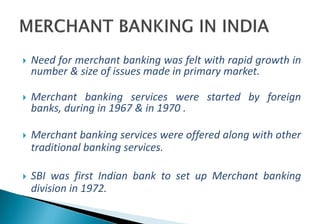
 Need for merchant banking was felt with rapid growth in 
number & size of issues made in primary market. 
 Merchant banking services were started by foreign 
banks, during in 1967 & in 1970 . 
 Merchant banking services were offered along with other 
traditional banking services. 
 SBI was first Indian bank to set up Merchant banking 
division in 1972.
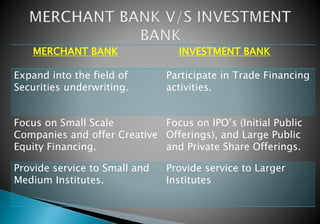
MERCHANT BANK INVESTMENT BANK 
Expand into the field of 
Securities underwriting. 
Participate in Trade Financing 
activities. 
Focus on Small Scale 
Companies and offer Creative 
Equity Financing. 
Focus on IPO’s (Initial Public 
Offerings), and Large Public 
and Private Share Offerings. 
Provide service to Small and 
Medium Institutes. 
Provide service to Larger 
Institutes
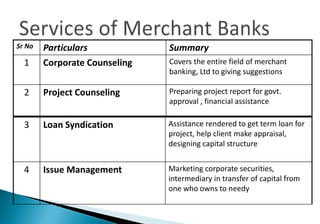
Sr No Particulars Summary 
1 Corporate Counseling Covers the entire field of merchant 
banking, Ltd to giving suggestions 
2 Project Counseling Preparing project report for govt. 
approval , financial assistance 
3 Loan Syndication Assistance rendered to get term loan for 
project, help client make appraisal, 
designing capital structure 
4 Issue Management Marketing corporate securities, 
intermediary in transfer of capital from 
one who owns to needy
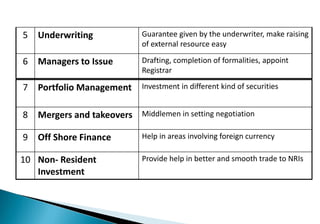
5 Underwriting Guarantee given by the underwriter, make raising 
of external resource easy 
6 Managers to Issue Drafting, completion of formalities, appoint 
Registrar 
7 Portfolio Management Investment in different kind of securities 
8 Mergers and takeovers Middlemen in setting negotiation 
9 Off Shore Finance Help in areas involving foreign currency 
10 Non- Resident 
Investment 
Provide help in better and smooth trade to NRIs
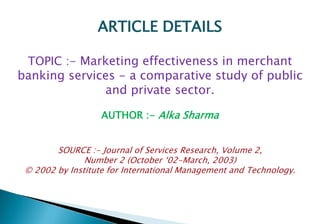
ARTICLE DETAILS 
TOPIC :- Marketing effectiveness in merchant 
banking services - a comparative study of public 
and private sector. 
AUTHOR :- Alka Sharma 
SOURCE :- Journal of Services Research, Volume 2, 
Number 2 (October ‘02-March, 2003) 
© 2002 by Institute for International Management and Technology.
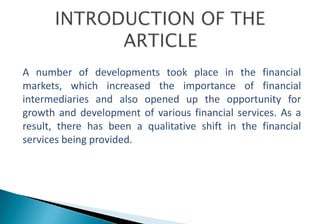
A number of developments took place in the financial 
markets, which increased the importance of financial 
intermediaries and also opened up the opportunity for 
growth and development of various financial services. As a 
result, there has been a qualitative shift in the financial 
services being provided.
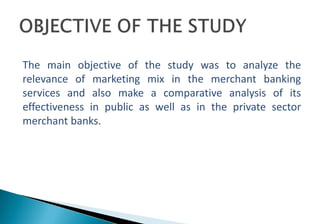
The main objective of the study was to analyze the 
relevance of marketing mix in the merchant banking 
services and also make a comparative analysis of its 
effectiveness in public as well as in the private sector 
merchant banks.
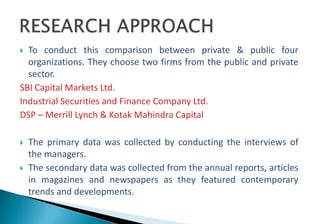
 To conduct this comparison between private & public four 
organizations. They choose two firms from the public and private 
sector. 
SBI Capital Markets Ltd. 
Industrial Securities and Finance Company Ltd. 
DSP – Merrill Lynch & Kotak Mahindra Capital 
 The primary data was collected by conducting the interviews of 
the managers. 
 The secondary data was collected from the annual reports, articles 
in magazines and newspapers as they featured contemporary 
trends and developments.
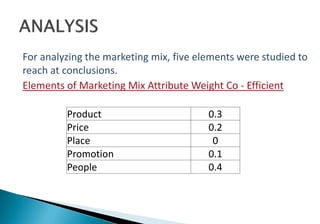
For analyzing the marketing mix, five elements were studied to 
reach at conclusions. 
Elements of Marketing Mix Attribute Weight Co - Efficient 
Product 0.3 
Price 0.2 
Place 0 
Promotion 0.1 
People 0.4
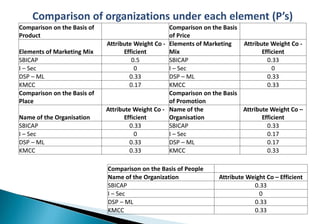
Comparison of organizations under each element (P’s) 
Comparison on the Basis of 
Product 
Comparison on the Basis 
of Price 
Elements of Marketing Mix 
Attribute Weight Co - 
Efficient 
Elements of Marketing 
Mix 
Attribute Weight Co - 
Efficient 
SBICAP 0.5 SBICAP 0.33 
I – Sec 0 I – Sec 0 
DSP – ML 0.33 DSP – ML 0.33 
KMCC 0.17 KMCC 0.33 
Comparison on the Basis of 
Comparison on the Basis 
Place 
of Promotion 
Name of the Organisation 
Attribute Weight Co - 
Efficient 
Name of the 
Organisation 
Attribute Weight Co – 
Efficient 
SBICAP 0.33 SBICAP 0.33 
I – Sec 0 I – Sec 0.17 
DSP – ML 0.33 DSP – ML 0.17 
KMCC 0.33 KMCC 0.33 
Comparison on the Basis of People 
Name of the Organization Attribute Weight Co – Efficient 
SBICAP 0.33 
I – Sec 0 
DSP – ML 0.33 
KMCC 0.33
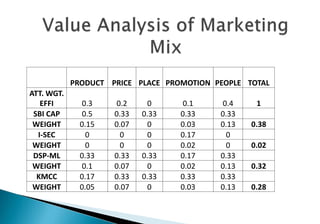
PRODUCT PRICE PLACE PROMOTION PEOPLE TOTAL 
ATT. WGT. 
EFFI 0.3 0.2 0 0.1 0.4 1 
SBI CAP 0.5 0.33 0.33 0.33 0.33 
WEIGHT 0.15 0.07 0 0.03 0.13 0.38 
I-SEC 0 0 0 0.17 0 
WEIGHT 0 0 0 0.02 0 0.02 
DSP-ML 0.33 0.33 0.33 0.17 0.33 
WEIGHT 0.1 0.07 0 0.02 0.13 0.32 
KMCC 0.17 0.33 0.33 0.33 0.33 
WEIGHT 0.05 0.07 0 0.03 0.13 0.28
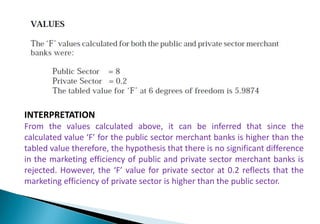
INTERPRETATION 
From the values calculated above, it can be inferred that since the 
calculated value ‘F’ for the public sector merchant banks is higher than the 
tabled value therefore, the hypothesis that there is no significant difference 
in the marketing efficiency of public and private sector merchant banks is 
rejected. However, the ‘F’ value for private sector at 0.2 reflects that the 
marketing efficiency of private sector is higher than the public sector.
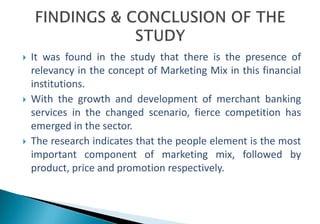
 It was found in the study that there is the presence of 
relevancy in the concept of Marketing Mix in this financial 
institutions. 
 With the growth and development of merchant banking 
services in the changed scenario, fierce competition has 
emerged in the sector. 
 The research indicates that the people element is the most 
important component of marketing mix, followed by 
product, price and promotion respectively.
Merchant banking & case study analysis

Merchant banking & case study analysis

  • 1.
    PRESENTATION ON THARI KUMAR ROLL NO: 131449
  • 2.
     MERCHANT BANKINGis defined as… “an institution which covers a wide range of activities such as management of customer services, portfolio management, credit syndication, acceptance credit, counselling, insurance etc.”
  • 3.
     Need formerchant banking was felt with rapid growth in number & size of issues made in primary market.  Merchant banking services were started by foreign banks, during in 1967 & in 1970 .  Merchant banking services were offered along with other traditional banking services.  SBI was first Indian bank to set up Merchant banking division in 1972.
  • 4.
    MERCHANT BANK INVESTMENTBANK Expand into the field of Securities underwriting. Participate in Trade Financing activities. Focus on Small Scale Companies and offer Creative Equity Financing. Focus on IPO’s (Initial Public Offerings), and Large Public and Private Share Offerings. Provide service to Small and Medium Institutes. Provide service to Larger Institutes
  • 5.
    Sr No ParticularsSummary 1 Corporate Counseling Covers the entire field of merchant banking, Ltd to giving suggestions 2 Project Counseling Preparing project report for govt. approval , financial assistance 3 Loan Syndication Assistance rendered to get term loan for project, help client make appraisal, designing capital structure 4 Issue Management Marketing corporate securities, intermediary in transfer of capital from one who owns to needy
  • 6.
    5 Underwriting Guaranteegiven by the underwriter, make raising of external resource easy 6 Managers to Issue Drafting, completion of formalities, appoint Registrar 7 Portfolio Management Investment in different kind of securities 8 Mergers and takeovers Middlemen in setting negotiation 9 Off Shore Finance Help in areas involving foreign currency 10 Non- Resident Investment Provide help in better and smooth trade to NRIs
  • 7.
    ARTICLE DETAILS TOPIC:- Marketing effectiveness in merchant banking services - a comparative study of public and private sector. AUTHOR :- Alka Sharma SOURCE :- Journal of Services Research, Volume 2, Number 2 (October ‘02-March, 2003) © 2002 by Institute for International Management and Technology.
  • 8.
    A number ofdevelopments took place in the financial markets, which increased the importance of financial intermediaries and also opened up the opportunity for growth and development of various financial services. As a result, there has been a qualitative shift in the financial services being provided.
  • 9.
    The main objectiveof the study was to analyze the relevance of marketing mix in the merchant banking services and also make a comparative analysis of its effectiveness in public as well as in the private sector merchant banks.
  • 10.
     To conductthis comparison between private & public four organizations. They choose two firms from the public and private sector. SBI Capital Markets Ltd. Industrial Securities and Finance Company Ltd. DSP – Merrill Lynch & Kotak Mahindra Capital  The primary data was collected by conducting the interviews of the managers.  The secondary data was collected from the annual reports, articles in magazines and newspapers as they featured contemporary trends and developments.
  • 11.
    For analyzing themarketing mix, five elements were studied to reach at conclusions. Elements of Marketing Mix Attribute Weight Co - Efficient Product 0.3 Price 0.2 Place 0 Promotion 0.1 People 0.4
  • 12.
    Comparison of organizationsunder each element (P’s) Comparison on the Basis of Product Comparison on the Basis of Price Elements of Marketing Mix Attribute Weight Co - Efficient Elements of Marketing Mix Attribute Weight Co - Efficient SBICAP 0.5 SBICAP 0.33 I – Sec 0 I – Sec 0 DSP – ML 0.33 DSP – ML 0.33 KMCC 0.17 KMCC 0.33 Comparison on the Basis of Comparison on the Basis Place of Promotion Name of the Organisation Attribute Weight Co - Efficient Name of the Organisation Attribute Weight Co – Efficient SBICAP 0.33 SBICAP 0.33 I – Sec 0 I – Sec 0.17 DSP – ML 0.33 DSP – ML 0.17 KMCC 0.33 KMCC 0.33 Comparison on the Basis of People Name of the Organization Attribute Weight Co – Efficient SBICAP 0.33 I – Sec 0 DSP – ML 0.33 KMCC 0.33
  • 13.
    PRODUCT PRICE PLACEPROMOTION PEOPLE TOTAL ATT. WGT. EFFI 0.3 0.2 0 0.1 0.4 1 SBI CAP 0.5 0.33 0.33 0.33 0.33 WEIGHT 0.15 0.07 0 0.03 0.13 0.38 I-SEC 0 0 0 0.17 0 WEIGHT 0 0 0 0.02 0 0.02 DSP-ML 0.33 0.33 0.33 0.17 0.33 WEIGHT 0.1 0.07 0 0.02 0.13 0.32 KMCC 0.17 0.33 0.33 0.33 0.33 WEIGHT 0.05 0.07 0 0.03 0.13 0.28
  • 14.
    INTERPRETATION From thevalues calculated above, it can be inferred that since the calculated value ‘F’ for the public sector merchant banks is higher than the tabled value therefore, the hypothesis that there is no significant difference in the marketing efficiency of public and private sector merchant banks is rejected. However, the ‘F’ value for private sector at 0.2 reflects that the marketing efficiency of private sector is higher than the public sector.
  • 15.
     It wasfound in the study that there is the presence of relevancy in the concept of Marketing Mix in this financial institutions.  With the growth and development of merchant banking services in the changed scenario, fierce competition has emerged in the sector.  The research indicates that the people element is the most important component of marketing mix, followed by product, price and promotion respectively.

Editor's Notes

  • #12 For this analysis, the technique of matrix – analysis has been used, which has been further validated by using ANOVA test. In matrix – analysis, various elements of the marketing mix were compared with each other and their weighted co-efficient was calculated.
  • #14 The table above clearly shows that on individual basis, it is the public sector merchant bank SBICAP, which has a most effective marketing mix, as it has the highest total score among the four organizations.