Submitted By:-
GOURAV AGARWAL
 It is one of the residues generated in combustion of
coal.
 Comprises of fine particles which rise with the flue
gases.
 One of the major pollutants which originate from
combustion.
 Due to recent mandate of using pollution control
equipments, these are now collected using
electrostatic precipitators and other particle filters.
 It is a heterogeneous material containing SiO2, Al2O3 and
Fe2O3 as major constituents with CaO occasionally being
the minor constituent.
 Exact composition varies according to the parent coal bed
makeup.
 Also has Arsenic, Beryllium, Cadmium, Chromium, Cobalt,
Mercury, Molybdenum, Selenium, Strontium, etc (in the
order of hundred ppm).
Component (%) Bituminous Sub-Bituminous Lignite
SiO2 20-60 40-60 15-45
Al2O3 5-35 20-30 20-25
Fe2O3 10-40 4-10 4-15
CaO 1-12 5-30 15-40
 Based upon differences in quantities of major
constituents, it is divided in two classes : Class C and
Class F.
 Class F: Produced by burning of anthracite and
bituminous coal. It is pozzolanic in nature and
contains less than 20% lime.
 Class C: Produced by burning young lignite or sub-
bituminous coal. It is both pozzolanic and self-
cementing in nature. Contains more than 20% lime.
 Admixture for Portland Cement
 Soil Stabilization
 Flyash Bricks
 Asphalt Concrete
 Embankments
 Geopolymers
 As a catalyst
 Waste Treatment
 Fly ash, being primarily pozzolanic, can actually
replace a percentage of the Portland cement, to
produce an even stronger, more durable and more
environment friendly concrete.
 The initial compressive strength is low but as days
pass, flyash concrete gains more strength and
eventually has a lot more strength as compared to
normal Portland cement.
 Significantly reduces the release of CO2 into the
atmosphere.
 Can be used for construction of structures on/under
water.
0
0.5
1
1.5
2
2.5
0 30 45 55
Ratio of 28/7 days
strength
Ratio of 90/7 days
strength
Ratio of 365/7 days
strength
0
10
20
30
40
50
60
3 7 28 56 90 180
Plain
Cement
Concrete
Flyash
Concrete
 Soil stabilization is the alteration of soil properties to
improve the engineering performance of soils.
 Modification of soil properties is the temporary
enhancement of sub-grade stability to speedup
construction.
 Stabilization can increase the shear strength of a soil
and/or control the shrink-swell properties of a soil,
thus improving the load-bearing capacity of a sub-
grade to support pavements and foundations.
 Stabilization can be used to treat a wide range of sub-
grade materials from expansive clays to granular
materials.
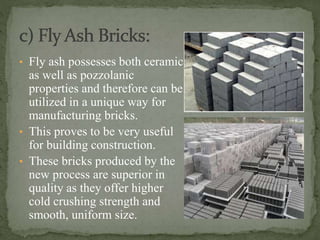
• Fly ash possesses both ceramic
as well as pozzolanic
properties and therefore can be
utilized in a unique way for
manufacturing bricks.
• This proves to be very useful
for building construction.
• These bricks produced by the
new process are superior in
quality as they offer higher
cold crushing strength and
smooth, uniform size.
S.NO FEATURES NORMAL CLAY
BRICKS
FLY ASH BRICKS
1 BINDING LIGHT DENSE
2 COLOUR VARY UNIFORM
3 SHAPE IRREGULAR UNIFORM
4 WEIGHT MORE LESS
5 COMPRESSIVE
STRENGTH
35 KGS/SQ.CM 100 KGS/SQ.CM
6 WATER
ABSORPTION
20-25% 6-12%
 Asphalt concrete is a composite material consisting of
an asphalt binder and mineral aggregate.
 Both Class F and Class C fly ash can typically be used
as a mineral filler to fill the voids.
 This application is used in conjunction with, or as a
replacement for, other binders (such as Portland
cement or hydrated lime).
 The hydrophobic nature of fly ash gives pavements
better resistance to deterioration caused by water.
 Fly ash has also been shown to increase the stiffness of
the asphalt matrix, improving rutting resistance and
increasing mix durability.
• Fly ash can be used for construction of road and
embankment. This utilization has many advantages
over conventional methods.
• Saves top soil which otherwise is conventionally used.
• Avoids creation of low lying areas (by excavation of
soil to be used for construction of embankments) .
• Avoids recurring expenditure on excavation of soil
from one place for construction and filling up of low
lying areas thus created
 Does not deprive the nation of the agricultural
produce that would be grown on the top soil which
otherwise would have been used for embankment
construction.
 Reduces the demand of land for disposal/deposition of
fly ash that otherwise would not have been used for
construction of embankment. Good Compaction .
 Free draining ( Less interruption due to raining ).
 Light in weight ( can be used in weak sub – grade )
 More recently, fly ash has been used as a component
in Geopolymers, where the reactivity of the fly ash
glasses generates a binder comparable to a
hydrated Portland Cement in appearance and
properties, but with possibly reduced CO2 emissions.
 Fly ash, mainly class C, may be used in the
stabilization/solidification process of hazardous wastes
and contaminated soils. For example, the Rhenipal process
uses fly ash as an admixture to stabilize sewage sludge and
other toxic sludge.
 Fly ash, in view of its alkalinity and water
absorption capacity, may be used in combination
with other alkaline materials to transform sewage
sludge into organic fertilizer or biofuel.
As seen above, there are a large number of sectors
where flyash can be put into use. There are many
reasons for the same like:
a) In terms of usability in Concrete and Cement:
 Higher Ultimate Strength
 Increased Durability
 Improved Workability
 Reduced Bleeding
 Increased Resistance to Sulfate Attack
 Reduced Shrinkage
 Almost zero emission of greenhouse gases.
b) In terms of usage as flyash bricks:
 Reduces excavation of clay.
 Low cost of brick as compared to clay brick of same
quality.
 Number of bricks required per unit volume of construction
is less as dimensional accuracy is maintained.
 Lesser consumption of mortar.
 Better resistance to water damage.
 Reduces soil erosion by replacing top soil as
ingredients for most construction mixes.
 Reduces pollution measure by re-use of wastes.
 Reduces the amount of greenhouse gases being added
to the atmosphere.
 Hydrophobic nature helps in proper draining off of
water from roads and structures.
 Production of crude oil from polyethylene.
 Also used in sewage treatment and generation of
biofuel as an alternate source of energy resource.
 Groundwater contamination due to runoffs carrying
ill-treated flyash.
 Cannot be used for structures requiring shorter setting
time, a demand which is expected by most of the
engineers and builders.
 Air content control plays a vital role and can prove
crucial for the quality of flyash concrete. Too much
reduction in air content can be disastrous.
 It is very difficult to use in winter season due to further
increase in already longer setting time.
 Difficult to control colour of cement containing flyash.
Hence, a bit problematic to use where cosmetic quality
plays a significant role.
Year Flyash produced in
million tonnes
Flyash used n million
tonnes
2006-07 116 24.8
2007-08 123 27.1
2008-09 130 29.7
2009-10 138 32.2
2010-11 145 34.7
2011-12 154 38.0
2012-13 163 42.5
Projected Flyash production Flyash utilisation
2013-14 173 48.0
0
5
10
15
20
25
30
2006-07
2007-08
2008-09
2009-10
2010-11
2011-12
2012-13
2013-14
% use of
flyash
 Flyash can be proclaimed as one of the most
advantageous waste material.
 Using it as a construction material will not only help in
its disposal but will also add strength and durablity of
structures.
 Since, the current usage of flyash in India is still
around 25% and below 45% even in the developed
countries like United States, there is a huge scope for
flyash in upcoming years.
 So let us harness a billion dollar resource that has been
wasted so far.
Fly Ash as a construction material

Fly Ash as a construction material

  • 1.
  • 2.
     It isone of the residues generated in combustion of coal.  Comprises of fine particles which rise with the flue gases.
  • 3.
     One ofthe major pollutants which originate from combustion.  Due to recent mandate of using pollution control equipments, these are now collected using electrostatic precipitators and other particle filters.
  • 4.
     It isa heterogeneous material containing SiO2, Al2O3 and Fe2O3 as major constituents with CaO occasionally being the minor constituent.  Exact composition varies according to the parent coal bed makeup.  Also has Arsenic, Beryllium, Cadmium, Chromium, Cobalt, Mercury, Molybdenum, Selenium, Strontium, etc (in the order of hundred ppm). Component (%) Bituminous Sub-Bituminous Lignite SiO2 20-60 40-60 15-45 Al2O3 5-35 20-30 20-25 Fe2O3 10-40 4-10 4-15 CaO 1-12 5-30 15-40
  • 5.
     Based upondifferences in quantities of major constituents, it is divided in two classes : Class C and Class F.  Class F: Produced by burning of anthracite and bituminous coal. It is pozzolanic in nature and contains less than 20% lime.  Class C: Produced by burning young lignite or sub- bituminous coal. It is both pozzolanic and self- cementing in nature. Contains more than 20% lime.
  • 7.
     Admixture forPortland Cement  Soil Stabilization  Flyash Bricks  Asphalt Concrete  Embankments  Geopolymers  As a catalyst  Waste Treatment
  • 9.
     Fly ash,being primarily pozzolanic, can actually replace a percentage of the Portland cement, to produce an even stronger, more durable and more environment friendly concrete.  The initial compressive strength is low but as days pass, flyash concrete gains more strength and eventually has a lot more strength as compared to normal Portland cement.  Significantly reduces the release of CO2 into the atmosphere.  Can be used for construction of structures on/under water.
  • 10.
    0 0.5 1 1.5 2 2.5 0 30 4555 Ratio of 28/7 days strength Ratio of 90/7 days strength Ratio of 365/7 days strength
  • 11.
    0 10 20 30 40 50 60 3 7 2856 90 180 Plain Cement Concrete Flyash Concrete
  • 12.
     Soil stabilizationis the alteration of soil properties to improve the engineering performance of soils.  Modification of soil properties is the temporary enhancement of sub-grade stability to speedup construction.  Stabilization can increase the shear strength of a soil and/or control the shrink-swell properties of a soil, thus improving the load-bearing capacity of a sub- grade to support pavements and foundations.  Stabilization can be used to treat a wide range of sub- grade materials from expansive clays to granular materials.
  • 14.
    • Fly ashpossesses both ceramic as well as pozzolanic properties and therefore can be utilized in a unique way for manufacturing bricks. • This proves to be very useful for building construction. • These bricks produced by the new process are superior in quality as they offer higher cold crushing strength and smooth, uniform size.
  • 15.
    S.NO FEATURES NORMALCLAY BRICKS FLY ASH BRICKS 1 BINDING LIGHT DENSE 2 COLOUR VARY UNIFORM 3 SHAPE IRREGULAR UNIFORM 4 WEIGHT MORE LESS 5 COMPRESSIVE STRENGTH 35 KGS/SQ.CM 100 KGS/SQ.CM 6 WATER ABSORPTION 20-25% 6-12%
  • 16.
     Asphalt concreteis a composite material consisting of an asphalt binder and mineral aggregate.  Both Class F and Class C fly ash can typically be used as a mineral filler to fill the voids.  This application is used in conjunction with, or as a replacement for, other binders (such as Portland cement or hydrated lime).  The hydrophobic nature of fly ash gives pavements better resistance to deterioration caused by water.  Fly ash has also been shown to increase the stiffness of the asphalt matrix, improving rutting resistance and increasing mix durability.
  • 17.
    • Fly ashcan be used for construction of road and embankment. This utilization has many advantages over conventional methods. • Saves top soil which otherwise is conventionally used. • Avoids creation of low lying areas (by excavation of soil to be used for construction of embankments) . • Avoids recurring expenditure on excavation of soil from one place for construction and filling up of low lying areas thus created
  • 18.
     Does notdeprive the nation of the agricultural produce that would be grown on the top soil which otherwise would have been used for embankment construction.  Reduces the demand of land for disposal/deposition of fly ash that otherwise would not have been used for construction of embankment. Good Compaction .  Free draining ( Less interruption due to raining ).  Light in weight ( can be used in weak sub – grade )
  • 19.
     More recently,fly ash has been used as a component in Geopolymers, where the reactivity of the fly ash glasses generates a binder comparable to a hydrated Portland Cement in appearance and properties, but with possibly reduced CO2 emissions.
  • 20.
     Fly ash,mainly class C, may be used in the stabilization/solidification process of hazardous wastes and contaminated soils. For example, the Rhenipal process uses fly ash as an admixture to stabilize sewage sludge and other toxic sludge.  Fly ash, in view of its alkalinity and water absorption capacity, may be used in combination with other alkaline materials to transform sewage sludge into organic fertilizer or biofuel.
  • 21.
    As seen above,there are a large number of sectors where flyash can be put into use. There are many reasons for the same like: a) In terms of usability in Concrete and Cement:  Higher Ultimate Strength  Increased Durability  Improved Workability  Reduced Bleeding  Increased Resistance to Sulfate Attack  Reduced Shrinkage  Almost zero emission of greenhouse gases.
  • 22.
    b) In termsof usage as flyash bricks:  Reduces excavation of clay.  Low cost of brick as compared to clay brick of same quality.  Number of bricks required per unit volume of construction is less as dimensional accuracy is maintained.  Lesser consumption of mortar.  Better resistance to water damage.
  • 23.
     Reduces soilerosion by replacing top soil as ingredients for most construction mixes.  Reduces pollution measure by re-use of wastes.  Reduces the amount of greenhouse gases being added to the atmosphere.  Hydrophobic nature helps in proper draining off of water from roads and structures.  Production of crude oil from polyethylene.  Also used in sewage treatment and generation of biofuel as an alternate source of energy resource.
  • 24.
     Groundwater contaminationdue to runoffs carrying ill-treated flyash.  Cannot be used for structures requiring shorter setting time, a demand which is expected by most of the engineers and builders.  Air content control plays a vital role and can prove crucial for the quality of flyash concrete. Too much reduction in air content can be disastrous.  It is very difficult to use in winter season due to further increase in already longer setting time.  Difficult to control colour of cement containing flyash. Hence, a bit problematic to use where cosmetic quality plays a significant role.
  • 25.
    Year Flyash producedin million tonnes Flyash used n million tonnes 2006-07 116 24.8 2007-08 123 27.1 2008-09 130 29.7 2009-10 138 32.2 2010-11 145 34.7 2011-12 154 38.0 2012-13 163 42.5 Projected Flyash production Flyash utilisation 2013-14 173 48.0
  • 26.
  • 27.
     Flyash canbe proclaimed as one of the most advantageous waste material.  Using it as a construction material will not only help in its disposal but will also add strength and durablity of structures.  Since, the current usage of flyash in India is still around 25% and below 45% even in the developed countries like United States, there is a huge scope for flyash in upcoming years.  So let us harness a billion dollar resource that has been wasted so far.