Rishabh Lala
Dual Degree
RGPV, Bhopal
CLAY FLY ASH BRICK
CONCEPT
CURRENT SCENARIO
BENEFITS
CODE SPECIFICATIONS
WAYS OF MAKING
DIMENSIONING
OUTLINE
 Fly ash brick + Local Soil - BURNT TOGETHER
 KEY POINTS 
 Manufacturing is similar to conventional Clay Bricks
Manufacturing
 Modifies the drying behavior of bricks
 MANUFACTURING 
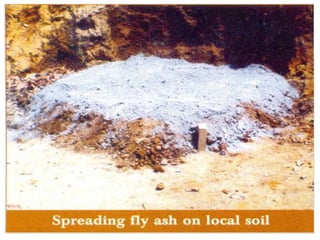
 I – Soil is layered
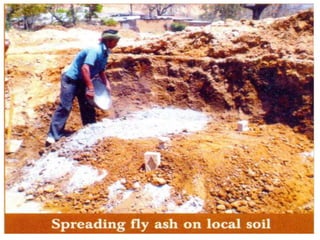
 II – Required Quantity of Fly ash is layed
 III –Manual Mixing in their dry form
 IV –Put them in wooden moulds
 V – Moulded Bricks are then air Dried
CONCEPT
 The bricks we currently use are made up of a specific quality
of Top Soil (Approximately 10,000 Hectares of Top Soil is lost
every year for Brick Manufacturing).
 If the top soil consumption carries on at the same pace, very
soon, we will not have enough soil for cultivation.
 Also, the thermal power plants and the industrial units using
coal as a fuel have no use with the Fly Ash left after the
combustion and they need to dump it some where.
CURRENT SCENARIO
 Nearly 73% of India’s total installed power generation
capacity is thermal, of which coal based generation is 90%,
the remaining comprising of diesel and gas.
 The 85 utility thermal power plants, besides the captive power
plants, use bituminous and sub- bituminous coal and produce
large quantities of Fly Ash.
 High ash content (30-50%) contributes to these large volumes
of fly ash
 a) REQUIRES LESS DRYING AREA;
 B) SAVING IN SPACE OF FLOOR AREA;
 C) ECONOMY IN COST OF BRICK MASONRY
 D) SAVING IN LABOUR COST;
 E) LESS LOSSES DURING HANDLING
 F) LESS CONSUMPTION OF MORTAR.:
BENEFITS
 Classes or Burnt Clay-Fly Ash Bricks IS 13757 (1993)
CODE SPECIFICATIONS
 Hand Moulded
 Hand-moulded bricks of 90 mm or 70 mm
 height shall be moulded with a frog 10 to 20 mm deep on one of
its flat sides;
 Machine Moulded
 Have smooth Surface and Sharp Corners
 The Fly Ash :
 Shall conform to grade 1 or grade 2 as per IS 3812 : 1981.
WAYS OF MAKING
DIMENSIONS
 STANDARD SIZES :
 WATER ABSORPTION :
IS 3495 ( Part 2 ) : 1992
In Cold water for 24 hours
Not more than 20% by weight of Brick
For Class higher than 12.5, maximum water
absorption is 15 % by weight of Brick
 Compressive Strength Test:
The 95% of the lot should satisfy the compressive
strength tests
TESTS

Clay Fly Ash Bricks

  • 1.
    Rishabh Lala Dual Degree RGPV,Bhopal CLAY FLY ASH BRICK
  • 2.
  • 3.
     Fly ashbrick + Local Soil - BURNT TOGETHER  KEY POINTS   Manufacturing is similar to conventional Clay Bricks Manufacturing  Modifies the drying behavior of bricks  MANUFACTURING   I – Soil is layered  II – Required Quantity of Fly ash is layed  III –Manual Mixing in their dry form  IV –Put them in wooden moulds  V – Moulded Bricks are then air Dried CONCEPT
  • 8.
     The brickswe currently use are made up of a specific quality of Top Soil (Approximately 10,000 Hectares of Top Soil is lost every year for Brick Manufacturing).  If the top soil consumption carries on at the same pace, very soon, we will not have enough soil for cultivation.  Also, the thermal power plants and the industrial units using coal as a fuel have no use with the Fly Ash left after the combustion and they need to dump it some where. CURRENT SCENARIO
  • 9.
     Nearly 73%of India’s total installed power generation capacity is thermal, of which coal based generation is 90%, the remaining comprising of diesel and gas.  The 85 utility thermal power plants, besides the captive power plants, use bituminous and sub- bituminous coal and produce large quantities of Fly Ash.  High ash content (30-50%) contributes to these large volumes of fly ash
  • 10.
     a) REQUIRESLESS DRYING AREA;  B) SAVING IN SPACE OF FLOOR AREA;  C) ECONOMY IN COST OF BRICK MASONRY  D) SAVING IN LABOUR COST;  E) LESS LOSSES DURING HANDLING  F) LESS CONSUMPTION OF MORTAR.: BENEFITS
  • 11.
     Classes orBurnt Clay-Fly Ash Bricks IS 13757 (1993) CODE SPECIFICATIONS
  • 12.
     Hand Moulded Hand-moulded bricks of 90 mm or 70 mm  height shall be moulded with a frog 10 to 20 mm deep on one of its flat sides;  Machine Moulded  Have smooth Surface and Sharp Corners  The Fly Ash :  Shall conform to grade 1 or grade 2 as per IS 3812 : 1981. WAYS OF MAKING
  • 13.
  • 14.
     WATER ABSORPTION: IS 3495 ( Part 2 ) : 1992 In Cold water for 24 hours Not more than 20% by weight of Brick For Class higher than 12.5, maximum water absorption is 15 % by weight of Brick  Compressive Strength Test: The 95% of the lot should satisfy the compressive strength tests TESTS