Eleyda Ruiz
Fabienne Joseph
Kayla Ross
Recent News

●

Oregon Group Uses Mushrooms for Bioremediation
Washington, DC--(ENEWSPF)--January 23, 2014. Putting ideas into
action, an Oregon-based restoration nonprofit group, Ocean Blue
Project, is harnessing the power of mushrooms to clean up
pesticides and other pollutants that plague Oregon and national
waterways. Yes, mushrooms.
What is Bioremediation?


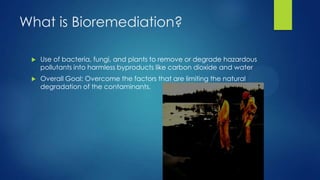
Use of bacteria, fungi, and plants to remove or degrade hazardous
pollutants into harmless byproducts like carbon dioxide and water



Overall Goal: Overcome the factors that are limiting the natural
degradation of the contaminants.
Causes of Bioremediation
Types of Bioremediation
In Situ


The treatment of the contamination
on site

Biostimulation
Simply by adding nutrients and oxygen
to enhance the capabilities of any
microorganisms already present at the
contamination site.
Bioaugmentation
Cleanup crews apply specifically
engineered microorganisms that are
specially designed to break down the
contaminants.

Ex Situ


The physical extraction of the
contaminated media to another
location for treatment.
Microbes Role
Aerobic


In aerobic conditions, microbes
need oxygen in order to perform
their duties. With enough oxygen,
they will be to transform the
contaminants in the soil into water
and carbon.

(Aerobic bioremediation usually is preferred because it degrades
pollutants 10 to 100 times faster than anaerobic bioremediation.)

Anaerobic


In anaerobic conditions, microbes
work without oxygen. The
chemical compounds that are in
the soil are decomposed by the
bacteria, which creates energy
that the
Let’s Get Specific!
 Pseudomonas

Putida

 Deinococcus

radiodurans

 Alcanivorax

borkumensis
Microorganisms at Work
Pseudomonas putida-“Superbug”


Gram-negative bacterium



Aerobic



Very versatile metabolism



Degrade an array of toxic
chemicals, including gasoline
components



Degrade toluene, a component of
paint thinner



Degrade Styrofoam™

The electron micrograph
Microorganisms at Work
Deinococcus radiodurans-”The
world’s toughest bacterium”


Gram-positive bacteria that
usually forms in spherical pairs or
tetrads



Aerobic



Genetically Engineered
Microorganism



Modified to consume and digest
toluene ionic mercury from highly
radioactive nuclear waste

An electron micrograph of Deinococcus radiodurans, an extremely
radiation resistant bacterium which produces potent antioxidant
manganese complexes.
Microorganisms at Work
Alcanivorax borkumensis


Gram-negative, rod-shaped
hydrocarbonoclastic (“oildegrading”) bacterium



Thrives in halophilic, aerobic
environments



Found in the upper layers of
freshwater or marine
environments: Mediterranean Sea,
Pacific Ocean and Arctic Sea



Involved in the bioremediation of
oil-contaminated aquatic
environments.
Microorganisms at work
Inside The News
More Than Just Microbes
Factors of Bioremediation


Type(s) of contamination



Extent of contamination



Toxicity of contaminants



Location and characteristics of the site



economic situation



microbes source of carbon and energy



electron acceptor availability.



temperature and other weather conditions



nutrients available to the microbes - this includes types of nutrients and amount of
nutrients



pH of contaminated site - must be between 5 and 10 work in general. Optimal
conditions are pH 6-8.



moisture content (for soil contamination)
Soil Sample Collection

Lab Testing of the Soil

The soil sample is taken to a lab where it is tested

Soil samples are collected from different depths
Bioremediation Can’t Win Them All


High Metal Concentrations - Metals that cannot be broken down
include arsenic, cadmium, mercury, copper, chromium and zinc.
Mercury is the most toxic of heavy metals.



Highly Chlorinated Organic Molecules - These are organic
molecules that have multiple chlorine atoms attached to them.



Inorganic salts - This includes substances such as sodium
thiosulfate, sulfur dioxide, sodium metabisulfite, trimethylamine
hydrochoride, and ferric chloride.

Final bioremediation

  • 1.
  • 2.
    Recent News  ● Oregon GroupUses Mushrooms for Bioremediation Washington, DC--(ENEWSPF)--January 23, 2014. Putting ideas into action, an Oregon-based restoration nonprofit group, Ocean Blue Project, is harnessing the power of mushrooms to clean up pesticides and other pollutants that plague Oregon and national waterways. Yes, mushrooms.
  • 3.
    What is Bioremediation?  Useof bacteria, fungi, and plants to remove or degrade hazardous pollutants into harmless byproducts like carbon dioxide and water  Overall Goal: Overcome the factors that are limiting the natural degradation of the contaminants.
  • 4.
  • 5.
    Types of Bioremediation InSitu  The treatment of the contamination on site Biostimulation Simply by adding nutrients and oxygen to enhance the capabilities of any microorganisms already present at the contamination site. Bioaugmentation Cleanup crews apply specifically engineered microorganisms that are specially designed to break down the contaminants. Ex Situ  The physical extraction of the contaminated media to another location for treatment.
  • 6.
    Microbes Role Aerobic  In aerobicconditions, microbes need oxygen in order to perform their duties. With enough oxygen, they will be to transform the contaminants in the soil into water and carbon. (Aerobic bioremediation usually is preferred because it degrades pollutants 10 to 100 times faster than anaerobic bioremediation.) Anaerobic  In anaerobic conditions, microbes work without oxygen. The chemical compounds that are in the soil are decomposed by the bacteria, which creates energy that the
  • 7.
    Let’s Get Specific! Pseudomonas Putida  Deinococcus radiodurans  Alcanivorax borkumensis
  • 8.
    Microorganisms at Work Pseudomonasputida-“Superbug”  Gram-negative bacterium  Aerobic  Very versatile metabolism  Degrade an array of toxic chemicals, including gasoline components  Degrade toluene, a component of paint thinner  Degrade Styrofoam™ The electron micrograph
  • 9.
    Microorganisms at Work Deinococcusradiodurans-”The world’s toughest bacterium”  Gram-positive bacteria that usually forms in spherical pairs or tetrads  Aerobic  Genetically Engineered Microorganism  Modified to consume and digest toluene ionic mercury from highly radioactive nuclear waste An electron micrograph of Deinococcus radiodurans, an extremely radiation resistant bacterium which produces potent antioxidant manganese complexes.
  • 10.
    Microorganisms at Work Alcanivoraxborkumensis  Gram-negative, rod-shaped hydrocarbonoclastic (“oildegrading”) bacterium  Thrives in halophilic, aerobic environments  Found in the upper layers of freshwater or marine environments: Mediterranean Sea, Pacific Ocean and Arctic Sea  Involved in the bioremediation of oil-contaminated aquatic environments.
  • 11.
  • 12.
  • 13.
    More Than JustMicrobes Factors of Bioremediation  Type(s) of contamination  Extent of contamination  Toxicity of contaminants  Location and characteristics of the site  economic situation  microbes source of carbon and energy  electron acceptor availability.  temperature and other weather conditions  nutrients available to the microbes - this includes types of nutrients and amount of nutrients  pH of contaminated site - must be between 5 and 10 work in general. Optimal conditions are pH 6-8.  moisture content (for soil contamination)
  • 14.
    Soil Sample Collection LabTesting of the Soil The soil sample is taken to a lab where it is tested Soil samples are collected from different depths
  • 15.
    Bioremediation Can’t WinThem All  High Metal Concentrations - Metals that cannot be broken down include arsenic, cadmium, mercury, copper, chromium and zinc. Mercury is the most toxic of heavy metals.  Highly Chlorinated Organic Molecules - These are organic molecules that have multiple chlorine atoms attached to them.  Inorganic salts - This includes substances such as sodium thiosulfate, sulfur dioxide, sodium metabisulfite, trimethylamine hydrochoride, and ferric chloride.

Editor's Notes

  • #6 However, this process is not very effective because it is hard to control the growth of microbes to get rid of the particular contaminant(Bioaugmentaton)This method is usually attempted to some degree at every site because it is the simplest approach.(biostimulation)
  • #7 Anaerobic:With enough oxygen, they will be to transform the contaminants in the soil into water and carbon.Aeorbic:
  • #11 In unpolluted water, A. borkumensis is found in low numbers. This is due to the limited availability of nutrients, namely phosphorus and nitrogen. However, in oil-contaminated water, the addition of phosphorus and nitrogen allows A. borkumensis populations to thrive