Soil
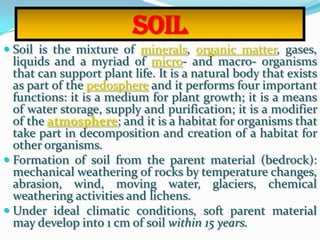
 Soil is the mixture of minerals, organic matter, gases,
liquids and a myriad of micro- and macro- organisms
that can support plant life. It is a natural body that exists
as part of the pedosphere and it performs four important
functions: it is a medium for plant growth; it is a means
of water storage, supply and purification; it is a modifier
of the atmosphere; and it is a habitat for organisms that
take part in decomposition and creation of a habitat for
other organisms.
 Formation of soil from the parent material (bedrock):
mechanical weathering of rocks by temperature changes,
abrasion, wind, moving water, glaciers, chemical
weathering activities and lichens.
 Under ideal climatic conditions, soft parent material
may develop into 1 cm of soil within 15 years.
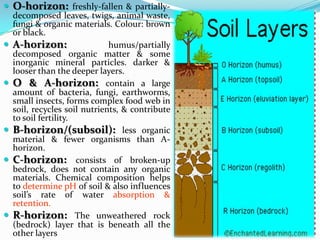
 O-horizon: freshly-fallen & partially-
decomposed leaves, twigs, animal waste,
fungi & organic materials. Colour: brown
or black.
 A-horizon: humus/partially
decomposed organic matter & some
inorganic mineral particles. darker &
looser than the deeper layers.
 O & A-horizon: contain a large
amount of bacteria, fungi, earthworms,
small insects, forms complex food web in
soil, recycles soil nutrients, & contribute
to soil fertility.
 B-horizon/(subsoil): less organic
material & fewer organisms than A-
horizon.
 C-horizon: consists of broken-up
bedrock, does not contain any organic
materials. Chemical composition helps
to determine pH of soil & also influences
soil’s rate of water absorption &
retention.
 R-horizon: The unweathered rock
(bedrock) layer that is beneath all the
other layers
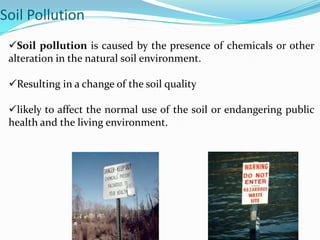
Soil Pollution
Soil pollution is caused by the presence of chemicals or other
alteration in the natural soil environment.
Resulting in a change of the soil quality
likely to affect the normal use of the soil or endangering public
health and the living environment.
CAUSES OF SOIL DEGRADATION
 Soil erosion/degradation is the loss of top soil erodes fertility
of soil & reduces its water-holding capacity.
 Excessive farming, construction, overgrazing, burning of grass
cover and deforestation
 Excess salts and water (Salinization)
 Excessive use of fertilizers & pesticides
 Solid waste
:
First effect of pollutants
 Washed away: might accumulates somewhere
 Evaporate: can be a source of air pollution
 Infiltrate through the unsaturated soil to the
groundwater
 DDT: fat soluble, stored in fatty tissues
 Interferes with calcium metabolism
 Results in thin egg shells in birds
 Agent orange: code name for one of the herbicides and
defoliants (results in leaf fall) used by the U.S. military
as part of its herbicidal warfare program, During the
Vietnam War, between 1962 and 1971, the United States military
sprayed 20,000,000 US gallons (80,000,000 L) of chemical herbicides
and defoliants in Vietnam
 anti fertility, skin problems, cancer
Control of soil pollution
 Use of pesticides and fertilizers should be minimized.
 Cropping techniques should be improved to prevent
growth of weeds.
 Special pits should be selected for dumping wastes.
 Controlled grazing and forest management.
 Wind breaks and wind shield in areas exposed to wind
erosion
 Afforestation and reforestation.
 3 Rs: reduce, reuse, recycle
6
Kind of material-organic or inorganic- is the material
biodegradable/ dangerous to animals & humans
 How much material was added to the soil, will it overload the
organisms in the soil
C:N ratio of the pollutant material
Nature of soil: will the soil be able to handle the material before
groundwater is contaminated
Growing conditions for the soil organisms: - is it too cold, too wet
etc.
How long the material has been on site: is there evidence of
environmental problems, is it undergoing decomposition.
Immediate danger to people & environment: Urgency of the
situation.
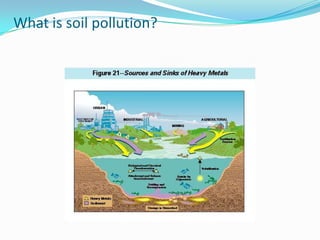
What is soil pollution?
Lecture 14
Soil Pollution:
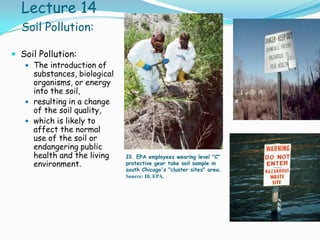
 Soil Pollution:
 The introduction of
substances, biological
organisms, or energy
into the soil,
 resulting in a change
of the soil quality,
 which is likely to
affect the normal
use of the soil or
endangering public
health and the living
environment.
Ill. EPA employees wearing level "C"
protective gear take soil sample in
south Chicago's "cluster sites" area.
Source: Ill. EPA.
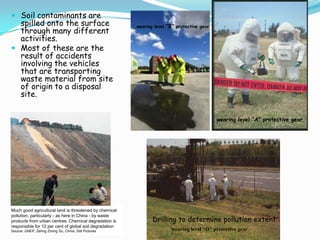
 Soil contaminants are
spilled onto the surface
through many different
activities.
 Most of these are the
result of accidents
involving the vehicles
that are transporting
waste material from site
of origin to a disposal
site.
Drilling to determine pollution extent
wearing level “A" protective gear
wearing level “B" protective gear
wearing level “D" protective gear
Much good agricultural land is threatened by chemical
pollution, particularly - as here in China - by waste
products from urban centres. Chemical degradation is
responsible for 12 per cent of global soil degradation
Source: UNEP, Zehng Zhong Su, China, Still Pictures
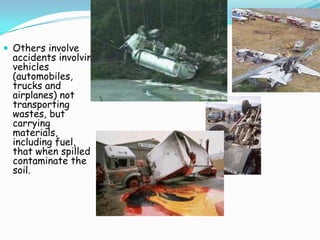
 Others involve
accidents involving
vehicles
(automobiles,
trucks and
airplanes) not
transporting
wastes, but
carrying
materials,
including fuel,
that when spilled
contaminate the
soil.
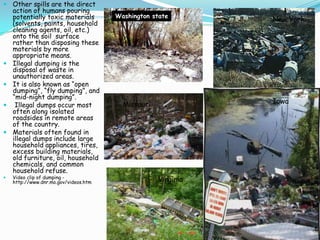
 Other spills are the direct
action of humans pouring
potentially toxic materials
(solvents, paints, household
cleaning agents, oil, etc.)
onto the soil surface
rather than disposing these
materials by more
appropriate means.
 Illegal dumping is the
disposal of waste in
unauthorized areas.
 It is also known as “open
dumping”, “fly dumping”, and
“mid-night dumping”.
 Illegal dumps occur most
often along isolated
roadsides in remote areas
of the country.
 Materials often found in
illegal dumps include large
household appliances, tires,
excess building materials,
old furniture, oil, household
chemicals, and common
household refuse.
 Video clip of dumping -
http://www.dnr.mo.gov/videos.htm
Washington state
Missouri
Virginia
New York
Iowa
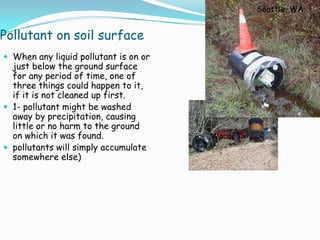
Pollutant on soil surface
 When any liquid pollutant is on or
just below the ground surface
for any period of time, one of
three things could happen to it,
if it is not cleaned up first.
 1- pollutant might be washed
away by precipitation, causing
little or no harm to the ground
on which it was found.
 pollutants will simply accumulate
somewhere else)
Seattle, WA
Waco, Tx
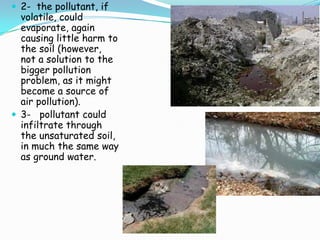
 2- the pollutant, if
volatile, could
evaporate, again
causing little harm to
the soil (however,
not a solution to the
bigger pollution
problem, as it might
become a source of
air pollution).
 3- pollutant could
infiltrate through
the unsaturated soil,
in much the same way
as ground water.
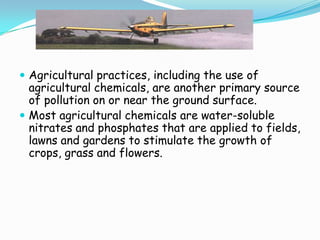
 Agricultural practices, including the use of
agricultural chemicals, are another primary source
of pollution on or near the ground surface.
 Most agricultural chemicals are water-soluble
nitrates and phosphates that are applied to fields,
lawns and gardens to stimulate the growth of
crops, grass and flowers.
Ag Chemicals
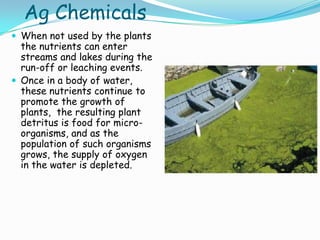
 When not used by the plants
the nutrients can enter
streams and lakes during the
run-off or leaching events.
 Once in a body of water,
these nutrients continue to
promote the growth of
plants, the resulting plant
detritus is food for micro-
organisms, and as the
population of such organisms
grows, the supply of oxygen
in the water is depleted.
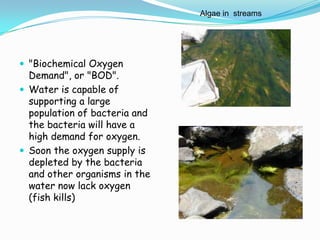
 "Biochemical Oxygen
Demand", or "BOD".
 Water is capable of
supporting a large
population of bacteria and
the bacteria will have a
high demand for oxygen.
 Soon the oxygen supply is
depleted by the bacteria
and other organisms in the
water now lack oxygen
(fish kills)
Algae in streams
Soil Pollution
Information needed to clean up materials added
to soil include:
1) Kind of material - organic or inorganic - is the
material biodegradable, is the material dangerous
to animals and humans,
2) how much material was added to the soil, will
it overload the organisms in the soil;
3) C:N ratio of the material, are additional
nutrients needed ( N & P)
Soil Pollution
4) Kind of Soil - will the soil be able to handle
the material before groundwater is contaminated,
5) Growing conditions for the soil organisms - is it
too cold, too wet etc.
6) How long has the material been on the site - is
there evidence of environmental problems, is it
undergoing decomposition.
7) Immediate danger to people and the
environment - Urgency of the situation.
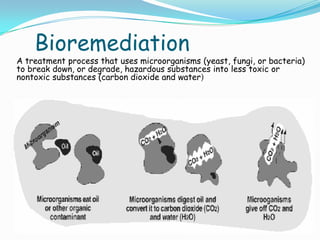
Bioremediation
A treatment process that uses microorganisms (yeast, fungi, or bacteria)
to break down, or degrade, hazardous substances into less toxic or
nontoxic substances (carbon dioxide and water)
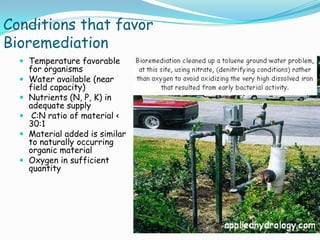
Conditions that favor
Bioremediation
 Temperature favorable
for organisms
 Water available (near
field capacity)
 Nutrients (N, P, K) in
adequate supply
 C:N ratio of material <
30:1
 Material added is similar
to naturally occurring
organic material
 Oxygen in sufficient
quantity
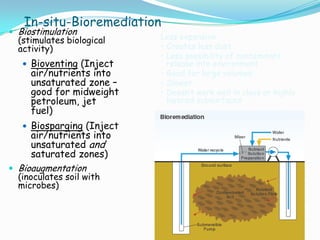
In-situ-Bioremediation
 Biostimulation
(stimulates biological
activity)
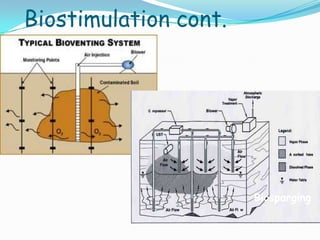
 Bioventing (Inject
air/nutrients into
unsaturated zone –
good for midweight
petroleum, jet
fuel)
 Biosparging (Inject
air/nutrients into
unsaturated and
saturated zones)
 Bioaugmentation
(inoculates soil with
microbes)
Less expensive
• Creates less dust
• Less possibility of contaminant
release into environment
• Good for large volumes
• Slower
• Doesn’t work well in clays or highly
layered subsurfaces
Biostimulation cont.
Biosparging
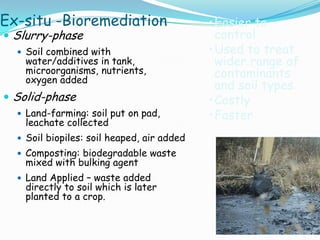
Ex-situ -Bioremediation
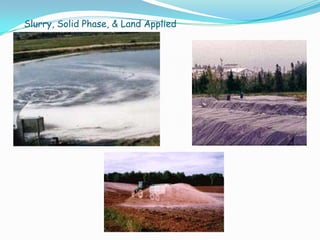
 Slurry-phase
 Soil combined with
water/additives in tank,
microorganisms, nutrients,
oxygen added
 Solid-phase
 Land-farming: soil put on pad,
leachate collected
 Soil biopiles: soil heaped, air added
 Composting: biodegradable waste
mixed with bulking agent
 Land Applied – waste added
directly to soil which is later
planted to a crop.
•Easier to
control
•Used to treat
wider range of
contaminants
and soil types
•Costly
•Faster
Advantages of Using Bioremediation Processes
Compared With Other Remediation Technologies
(1) biologically-based remediation detoxifies hazardous substances instead
of merely transferring contaminants from on environmental medium to
another;
(2) bioremediation is generally less disruptive to the environment than
excavation-based processes; and
(3) The cost of treating a hazardous waste site using bioremediation
technologies can be considerably lower than that for conventional
treatment methods: vacuuming, absorbing, burning, dispersing, or
moving the material .
Slurry, Solid Phase, & Land Applied
Using Plants for pollution cleanup
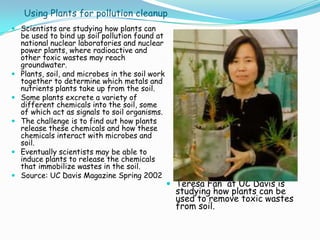
 Scientists are studying how plants can
be used to bind up soil pollution found at
national nuclear laboratories and nuclear
power plants, where radioactive and
other toxic wastes may reach
groundwater.
 Plants, soil, and microbes in the soil work
together to determine which metals and
nutrients plants take up from the soil.
 Some plants excrete a variety of
different chemicals into the soil, some
of which act as signals to soil organisms.
 The challenge is to find out how plants
release these chemicals and how these
chemicals interact with microbes and
soil.
 Eventually scientists may be able to
induce plants to release the chemicals
that immobilize wastes in the soil.
 Source: UC Davis Magazine Spring 2002
 Teresa Fan at UC Davis is
studying how plants can be
used to remove toxic wastes
from soil.
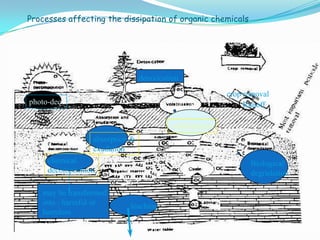
Processes affecting the dissipation of organic chemicals
photo-dec.
absorption &
exudation
volatilization
Biological
degradation
leaching
chemical
decomposition
Runoff
crop removal
detoxication
may be transformed
into - harmful or
harmless
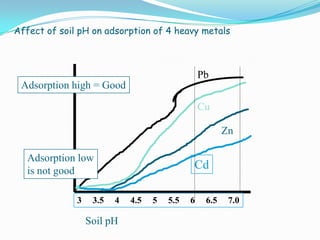
Affect of soil pH on adsorption of 4 heavy metals
Adsorption high = Good
Soil pH
3 3.5 4 4.5 5 5.5 6 6.5 7.0
Pb
Cu
Zn
Cd
Adsorption low
is not good
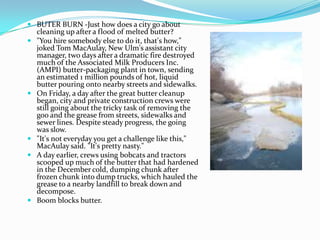
 BUTER BURN -Just how does a city go about
cleaning up after a flood of melted butter?
 "You hire somebody else to do it, that's how,"
joked Tom MacAulay, New Ulm's assistant city
manager, two days after a dramatic fire destroyed
much of the Associated Milk Producers Inc.
(AMPI) butter-packaging plant in town, sending
an estimated 1 million pounds of hot, liquid
butter pouring onto nearby streets and sidewalks.
 On Friday, a day after the great butter cleanup
began, city and private construction crews were
still going about the tricky task of removing the
goo and the grease from streets, sidewalks and
sewer lines. Despite steady progress, the going
was slow.
 "It's not everyday you get a challenge like this,"
MacAulay said. "It's pretty nasty."
 A day earlier, crews using bobcats and tractors
scooped up much of the butter that had hardened
in the December cold, dumping chunk after
frozen chunk into dump trucks, which hauled the
grease to a nearby landfill to break down and
decompose.
 Boom blocks butter.
All told, an estimated $6 million worth of butter -- about half of what was
stored at the plant the night of the fire -- spilled and was removed.
 Yet for all the progress, much work remained Friday.
 Butter that spilled into the city's storm sewer system stuck to the
lining of the pipes, which will need to be jet sprayed and cleaned. And
though First North Street -- where much of the butter pooled -- had
been stripped clean of the worst of it, a good quarter-inch of slime
remained on the pavement, even if it couldn't be seen.
 "You cannot scrape all that butterfat off the street," said Tom
Patterson, the city's street commissioner. "And it's even more
dangerous if you can't see it."
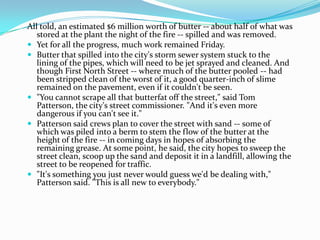
 Patterson said crews plan to cover the street with sand -- some of
which was piled into a berm to stem the flow of the butter at the
height of the fire -- in coming days in hopes of absorbing the
remaining grease. At some point, he said, the city hopes to sweep the
street clean, scoop up the sand and deposit it in a landfill, allowing the
street to be reopened for traffic.
 "It's something you just never would guess we'd be dealing with,"
Patterson said. "This is all new to everybody."
Dyad on Pollution
 1) A lot of the melted butter was soaked up with sand.
 2) What could be done with the polluted sand besides dumping it in a land fill. Do you think dumping the solid butter that was scrapped off the
roads in the landfill was a good idea?
Phyto-remediation
 Use of accumulator plant that capable to absorb
pollutant from soil & clean it , then harvested and
safely disposed.

L14

  • 1.
    Soil  Soil isthe mixture of minerals, organic matter, gases, liquids and a myriad of micro- and macro- organisms that can support plant life. It is a natural body that exists as part of the pedosphere and it performs four important functions: it is a medium for plant growth; it is a means of water storage, supply and purification; it is a modifier of the atmosphere; and it is a habitat for organisms that take part in decomposition and creation of a habitat for other organisms.  Formation of soil from the parent material (bedrock): mechanical weathering of rocks by temperature changes, abrasion, wind, moving water, glaciers, chemical weathering activities and lichens.  Under ideal climatic conditions, soft parent material may develop into 1 cm of soil within 15 years.
  • 2.
     O-horizon: freshly-fallen& partially- decomposed leaves, twigs, animal waste, fungi & organic materials. Colour: brown or black.  A-horizon: humus/partially decomposed organic matter & some inorganic mineral particles. darker & looser than the deeper layers.  O & A-horizon: contain a large amount of bacteria, fungi, earthworms, small insects, forms complex food web in soil, recycles soil nutrients, & contribute to soil fertility.  B-horizon/(subsoil): less organic material & fewer organisms than A- horizon.  C-horizon: consists of broken-up bedrock, does not contain any organic materials. Chemical composition helps to determine pH of soil & also influences soil’s rate of water absorption & retention.  R-horizon: The unweathered rock (bedrock) layer that is beneath all the other layers
  • 3.
    Soil Pollution Soil pollutionis caused by the presence of chemicals or other alteration in the natural soil environment. Resulting in a change of the soil quality likely to affect the normal use of the soil or endangering public health and the living environment.
  • 4.
    CAUSES OF SOILDEGRADATION  Soil erosion/degradation is the loss of top soil erodes fertility of soil & reduces its water-holding capacity.  Excessive farming, construction, overgrazing, burning of grass cover and deforestation  Excess salts and water (Salinization)  Excessive use of fertilizers & pesticides  Solid waste :
  • 5.
    First effect ofpollutants  Washed away: might accumulates somewhere  Evaporate: can be a source of air pollution  Infiltrate through the unsaturated soil to the groundwater  DDT: fat soluble, stored in fatty tissues  Interferes with calcium metabolism  Results in thin egg shells in birds  Agent orange: code name for one of the herbicides and defoliants (results in leaf fall) used by the U.S. military as part of its herbicidal warfare program, During the Vietnam War, between 1962 and 1971, the United States military sprayed 20,000,000 US gallons (80,000,000 L) of chemical herbicides and defoliants in Vietnam  anti fertility, skin problems, cancer
  • 6.
    Control of soilpollution  Use of pesticides and fertilizers should be minimized.  Cropping techniques should be improved to prevent growth of weeds.  Special pits should be selected for dumping wastes.  Controlled grazing and forest management.  Wind breaks and wind shield in areas exposed to wind erosion  Afforestation and reforestation.  3 Rs: reduce, reuse, recycle 6
  • 7.
    Kind of material-organicor inorganic- is the material biodegradable/ dangerous to animals & humans  How much material was added to the soil, will it overload the organisms in the soil C:N ratio of the pollutant material Nature of soil: will the soil be able to handle the material before groundwater is contaminated Growing conditions for the soil organisms: - is it too cold, too wet etc. How long the material has been on site: is there evidence of environmental problems, is it undergoing decomposition. Immediate danger to people & environment: Urgency of the situation.
  • 8.
    What is soilpollution?
  • 9.
    Lecture 14 Soil Pollution: Soil Pollution:  The introduction of substances, biological organisms, or energy into the soil,  resulting in a change of the soil quality,  which is likely to affect the normal use of the soil or endangering public health and the living environment. Ill. EPA employees wearing level "C" protective gear take soil sample in south Chicago's "cluster sites" area. Source: Ill. EPA.
  • 10.
     Soil contaminantsare spilled onto the surface through many different activities.  Most of these are the result of accidents involving the vehicles that are transporting waste material from site of origin to a disposal site. Drilling to determine pollution extent wearing level “A" protective gear wearing level “B" protective gear wearing level “D" protective gear Much good agricultural land is threatened by chemical pollution, particularly - as here in China - by waste products from urban centres. Chemical degradation is responsible for 12 per cent of global soil degradation Source: UNEP, Zehng Zhong Su, China, Still Pictures
  • 11.
     Others involve accidentsinvolving vehicles (automobiles, trucks and airplanes) not transporting wastes, but carrying materials, including fuel, that when spilled contaminate the soil.
  • 12.
     Other spillsare the direct action of humans pouring potentially toxic materials (solvents, paints, household cleaning agents, oil, etc.) onto the soil surface rather than disposing these materials by more appropriate means.  Illegal dumping is the disposal of waste in unauthorized areas.  It is also known as “open dumping”, “fly dumping”, and “mid-night dumping”.  Illegal dumps occur most often along isolated roadsides in remote areas of the country.  Materials often found in illegal dumps include large household appliances, tires, excess building materials, old furniture, oil, household chemicals, and common household refuse.  Video clip of dumping - http://www.dnr.mo.gov/videos.htm Washington state Missouri Virginia New York Iowa
  • 13.
    Pollutant on soilsurface  When any liquid pollutant is on or just below the ground surface for any period of time, one of three things could happen to it, if it is not cleaned up first.  1- pollutant might be washed away by precipitation, causing little or no harm to the ground on which it was found.  pollutants will simply accumulate somewhere else) Seattle, WA Waco, Tx
  • 14.
     2- thepollutant, if volatile, could evaporate, again causing little harm to the soil (however, not a solution to the bigger pollution problem, as it might become a source of air pollution).  3- pollutant could infiltrate through the unsaturated soil, in much the same way as ground water.
  • 15.
     Agricultural practices,including the use of agricultural chemicals, are another primary source of pollution on or near the ground surface.  Most agricultural chemicals are water-soluble nitrates and phosphates that are applied to fields, lawns and gardens to stimulate the growth of crops, grass and flowers.
  • 16.
    Ag Chemicals  Whennot used by the plants the nutrients can enter streams and lakes during the run-off or leaching events.  Once in a body of water, these nutrients continue to promote the growth of plants, the resulting plant detritus is food for micro- organisms, and as the population of such organisms grows, the supply of oxygen in the water is depleted.
  • 17.
     "Biochemical Oxygen Demand",or "BOD".  Water is capable of supporting a large population of bacteria and the bacteria will have a high demand for oxygen.  Soon the oxygen supply is depleted by the bacteria and other organisms in the water now lack oxygen (fish kills) Algae in streams
  • 18.
    Soil Pollution Information neededto clean up materials added to soil include: 1) Kind of material - organic or inorganic - is the material biodegradable, is the material dangerous to animals and humans, 2) how much material was added to the soil, will it overload the organisms in the soil; 3) C:N ratio of the material, are additional nutrients needed ( N & P)
  • 19.
    Soil Pollution 4) Kindof Soil - will the soil be able to handle the material before groundwater is contaminated, 5) Growing conditions for the soil organisms - is it too cold, too wet etc. 6) How long has the material been on the site - is there evidence of environmental problems, is it undergoing decomposition. 7) Immediate danger to people and the environment - Urgency of the situation.
  • 20.
    Bioremediation A treatment processthat uses microorganisms (yeast, fungi, or bacteria) to break down, or degrade, hazardous substances into less toxic or nontoxic substances (carbon dioxide and water)
  • 21.
    Conditions that favor Bioremediation Temperature favorable for organisms  Water available (near field capacity)  Nutrients (N, P, K) in adequate supply  C:N ratio of material < 30:1  Material added is similar to naturally occurring organic material  Oxygen in sufficient quantity
  • 22.
    In-situ-Bioremediation  Biostimulation (stimulates biological activity) Bioventing (Inject air/nutrients into unsaturated zone – good for midweight petroleum, jet fuel)  Biosparging (Inject air/nutrients into unsaturated and saturated zones)  Bioaugmentation (inoculates soil with microbes) Less expensive • Creates less dust • Less possibility of contaminant release into environment • Good for large volumes • Slower • Doesn’t work well in clays or highly layered subsurfaces
  • 23.
  • 24.
    Ex-situ -Bioremediation  Slurry-phase Soil combined with water/additives in tank, microorganisms, nutrients, oxygen added  Solid-phase  Land-farming: soil put on pad, leachate collected  Soil biopiles: soil heaped, air added  Composting: biodegradable waste mixed with bulking agent  Land Applied – waste added directly to soil which is later planted to a crop. •Easier to control •Used to treat wider range of contaminants and soil types •Costly •Faster
  • 25.
    Advantages of UsingBioremediation Processes Compared With Other Remediation Technologies (1) biologically-based remediation detoxifies hazardous substances instead of merely transferring contaminants from on environmental medium to another; (2) bioremediation is generally less disruptive to the environment than excavation-based processes; and (3) The cost of treating a hazardous waste site using bioremediation technologies can be considerably lower than that for conventional treatment methods: vacuuming, absorbing, burning, dispersing, or moving the material .
  • 26.
    Slurry, Solid Phase,& Land Applied
  • 27.
    Using Plants forpollution cleanup  Scientists are studying how plants can be used to bind up soil pollution found at national nuclear laboratories and nuclear power plants, where radioactive and other toxic wastes may reach groundwater.  Plants, soil, and microbes in the soil work together to determine which metals and nutrients plants take up from the soil.  Some plants excrete a variety of different chemicals into the soil, some of which act as signals to soil organisms.  The challenge is to find out how plants release these chemicals and how these chemicals interact with microbes and soil.  Eventually scientists may be able to induce plants to release the chemicals that immobilize wastes in the soil.  Source: UC Davis Magazine Spring 2002  Teresa Fan at UC Davis is studying how plants can be used to remove toxic wastes from soil.
  • 28.
    Processes affecting thedissipation of organic chemicals photo-dec. absorption & exudation volatilization Biological degradation leaching chemical decomposition Runoff crop removal detoxication may be transformed into - harmful or harmless
  • 29.
    Affect of soilpH on adsorption of 4 heavy metals Adsorption high = Good Soil pH 3 3.5 4 4.5 5 5.5 6 6.5 7.0 Pb Cu Zn Cd Adsorption low is not good
  • 30.
     BUTER BURN-Just how does a city go about cleaning up after a flood of melted butter?  "You hire somebody else to do it, that's how," joked Tom MacAulay, New Ulm's assistant city manager, two days after a dramatic fire destroyed much of the Associated Milk Producers Inc. (AMPI) butter-packaging plant in town, sending an estimated 1 million pounds of hot, liquid butter pouring onto nearby streets and sidewalks.  On Friday, a day after the great butter cleanup began, city and private construction crews were still going about the tricky task of removing the goo and the grease from streets, sidewalks and sewer lines. Despite steady progress, the going was slow.  "It's not everyday you get a challenge like this," MacAulay said. "It's pretty nasty."  A day earlier, crews using bobcats and tractors scooped up much of the butter that had hardened in the December cold, dumping chunk after frozen chunk into dump trucks, which hauled the grease to a nearby landfill to break down and decompose.  Boom blocks butter.
  • 31.
    All told, anestimated $6 million worth of butter -- about half of what was stored at the plant the night of the fire -- spilled and was removed.  Yet for all the progress, much work remained Friday.  Butter that spilled into the city's storm sewer system stuck to the lining of the pipes, which will need to be jet sprayed and cleaned. And though First North Street -- where much of the butter pooled -- had been stripped clean of the worst of it, a good quarter-inch of slime remained on the pavement, even if it couldn't be seen.  "You cannot scrape all that butterfat off the street," said Tom Patterson, the city's street commissioner. "And it's even more dangerous if you can't see it."  Patterson said crews plan to cover the street with sand -- some of which was piled into a berm to stem the flow of the butter at the height of the fire -- in coming days in hopes of absorbing the remaining grease. At some point, he said, the city hopes to sweep the street clean, scoop up the sand and deposit it in a landfill, allowing the street to be reopened for traffic.  "It's something you just never would guess we'd be dealing with," Patterson said. "This is all new to everybody."
  • 33.
    Dyad on Pollution 1) A lot of the melted butter was soaked up with sand.  2) What could be done with the polluted sand besides dumping it in a land fill. Do you think dumping the solid butter that was scrapped off the roads in the landfill was a good idea?
  • 34.
    Phyto-remediation  Use ofaccumulator plant that capable to absorb pollutant from soil & clean it , then harvested and safely disposed.