Tooth Color Restorations
(Composite)
2018-2019
‫بسم‬‫ﷲ‬‫الرحيم‬ ‫الرحمن‬
ْ‫ل‬ُ‫ل‬ْ‫اح‬ َ‫و‬‫م‬ ً‫ة‬َ‫د‬ْ‫ق‬ُ‫ع‬ِ‫ن‬َ‫س‬‫ل‬ ‫ن‬{27}
‫ل‬ ْ‫و‬َ‫ق‬ ‫وا‬ُ‫ه‬َ‫ق‬ْ‫ف‬َ‫ي‬{28}‫الﻌﻅيﻢ‬‫صدق‬‫ﷲ‬
Anterior Restorative Materials
• Silicate cements (Historical).
• Unfilled Resin (Historical).
• Filled Resin (Composite).
• Glass Ionomer.
• Glass ionomer cements (GIC).
• Resin modified.
• Compomers.
Those esthetic materials that are tooth colored.
Tooth Colerd Restorations
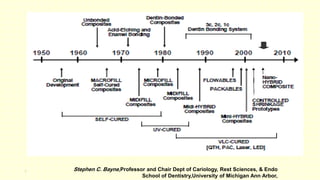
History:
 1871 – silicates
◦ alumina-silica glass &
phosphoric acid
◦ very soluble
◦ poor mechanical properties
 1948 - acrylic resins
◦ polymethylmethacrylate
◦ high polymerization shrinkage
 1962 – Bis-GMA
◦ stronger resin
 1969 – filled composite resin
◦ improved mechanical properties
◦ less shrinkage
◦ paste/paste system
 1970’s – acid etching and microfills
 1980’s – light curing and hybrids
 1990’s – flowables and packables
 2000’s – nanofills
6
Stephen C. Bayne,Professor and Chair Dept of Cariology, Rest Sciences, & Endo
School of Dentistry,University of Michigan Ann Arbor,
Ideal Requirements:
1. It should match the tooth in color, translucency and refractive index.
2. It should not stain or discolor by time.
3. It should not be irritant to the pulp or to the gingiva.
4. It should not dissolve in saliva or in fluids taken into the mouth.
5. It should have adequate mechanical properties to withstand the forces
of mastication:
A. It should have strength and modulus of elasticity similar to those of
enamel and dentin.
B. Good abrasion resistance to dentifrices and constituents of food.
1. It should have similar coefficient of thermal expansion to that of enamel
and dentin.
2. It should undergo minimal dimensional changes on setting.
3. It should take and retain a smooth surface finish.
4. It should be radiopaque to enable detection of secondary caries,
identification of overhanging ledges and detection of incompletely filled
cavities.
5. Ideally, adhesion between the filling material, enamel and dentin
should occur.
Ideal Requirements:
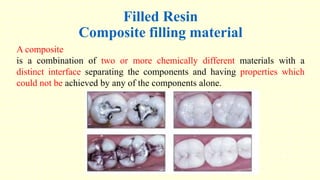
Filled Resin
Composite filling material
A composite
is a combination of two or more chemically different materials with a
distinct interface separating the components and having properties which
could not be achieved by any of the components alone.
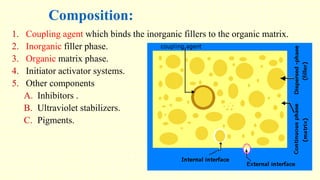
Composition:
1. Coupling agent which binds the inorganic fillers to the organic matrix.
2. Inorganic filler phase.
3. Organic matrix phase.
4. Initiator activator systems.
5. Other components
A. Inhibitors .
B. Ultraviolet stabilizers.
C. Pigments.
 Resin matrix
◦ monomer
◦ initiator
◦ inhibitors
◦ pigments
 Inorganic filler
◦ glass
◦ quartz
◦ colloidal silica
 Coupling Agent
OCH2CHCH2O-C-C=CH2CH2=C-C-O-CH2CH-CH2O -C-
CH3 CH3
CH3
CH3OH OH
O O
Monomers: Binds filler particles together Provides “workability”
1- Bis-GMA
 extremely viscous
 large benzene rings
2- Lowered by adding TEGDMA:
 freely movable, increases polymer conversion, increases crosslinking ,
increases shrinkage
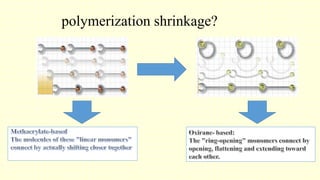
3-Ring-opening monomers:
were developed to reduce or overcome the polymerization
shrinkage of resin-based composites. Most recently, oxiranes and
siloranes (a combination of siloxanes and oxiranes) are being
discussed more and more, with a siloran-based product being
marketed at present.
13
Resin-based composites release residual monomers (and other
substances) because of a conversion rate of 35–77%. Released
compounds can directly cause biological reactions. Polymerization
shrinkage is a material property that may indirectly influence the
tissue compatibility .
This volume change may cause marginal gaps that may allow
penetration of bacteria with subsequent pulpitis. Shrinkage of modern
filling resins generally ranges between 2 vol.% and 3 vol.% .
14
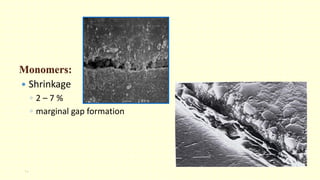
Monomers:
 Shrinkage
◦ 2 – 7 %
◦ marginal gap formation
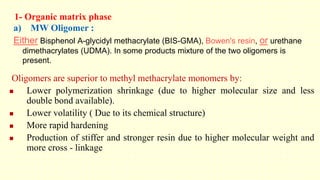
1- Organic matrix phase
a) MW Oligomer :
Either Bisphenol A-glycidyl methacrylate (BIS-GMA), Bowen's resin, or urethane
dimethacrylates (UDMA). In some products mixture of the two oligomers is
present.
Oligomers are superior to methyl methacrylate monomers by:
 Lower polymerization shrinkage (due to higher molecular size and less
double bond available).
 Lower volatility ( Due to its chemical structure)
 More rapid hardening
 Production of stiffer and stronger resin due to higher molecular weight and
more cross - linkage
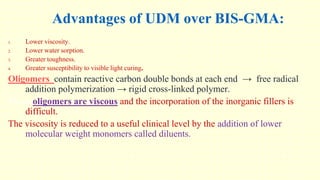
Advantages of UDM over BIS-GMA:
1. Lower viscosity.
2. Lower water sorption.
3. Greater toughness.
4. Greater susceptibility to visible light curing.
Oligomers contain reactive carbon double bonds at each end → free radical
addition polymerization → rigid cross-linked polymer.
These oligomers are viscous and the incorporation of the inorganic fillers is
difficult.
The viscosity is reduced to a useful clinical level by the addition of lower
molecular weight monomers called diluents.
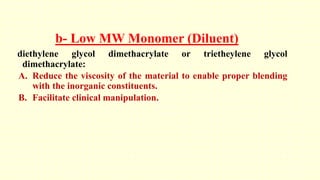
b- Low MW Monomer (Diluent)
diethylene glycol dimethacrylate or trietheylene glycol
dimethacrylate:
A. Reduce the viscosity of the material to enable proper blending
with the inorganic constituents.
B. Facilitate clinical manipulation.
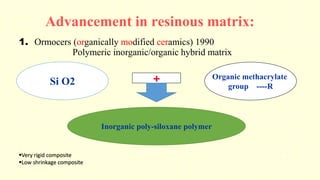
Advancement in resinous matrix:
1. Ormocers (organically modified ceramics) 1990
Polymeric inorganic/organic hybrid matrix
Si O2
Organic methacrylate
group ----R
+
Inorganic poly-siloxane polymer
Very rigid composite
Low shrinkage composite
polymerization shrinkage?
• Coupling agents:
what happens if bond between resin and filler is weak:
• The material would be weak and susceptible to creep and
fracture and
• The interface between filler and resin will be a source of
fracture, stress will not be distributed properly.
• Silane coupling agents:
has a hydrophobic end (methacrylate group) to bind the resin and a
hydrophilic end (OH- group) to bind glass fillers
20
• Silanes have disadvantages. They age quickly in a bottle and
become ineffective. Silanes are sensitive to water so the silane
filler bond breaks down with moisture.
• Water absorbed into composites results in hydrolysis of the silane
bond and eventual filler loss.
21
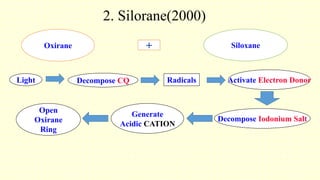
2. Silorane(2000)
Oxirane + Siloxane
Light Decompose CQ Radicals Activate Electron Donor
Decompose Iodonium Salt
Generate
Acidic CATION
Open
Oxirane
Ring
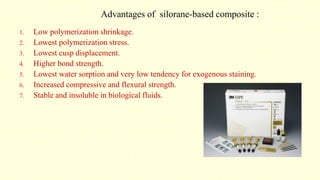
Advantages of silorane-based composite :
1. Low polymerization shrinkage.
2. Lowest polymerization stress.
3. Lowest cusp displacement.
4. Higher bond strength.
5. Lowest water sorption and very low tendency for exogenous staining.
6. Increased compressive and flexural strength.
7. Stable and insoluble in biological fluids.
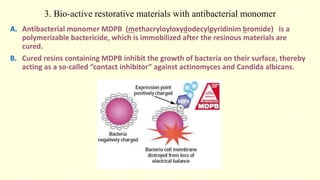
3. Bio-active restorative materials with antibacterial monomer
A. Antibacterial monomer MDPB (methacryloyloxydodecylpyridinim bromide) is a
polymerizable bactericide, which is immobilized after the resinous materials are
cured.
B. Cured resins containing MDPB inhibit the growth of bacteria on their surface, thereby
acting as a so-called “contact inhibitor” against actinomyces and Candida albicans.
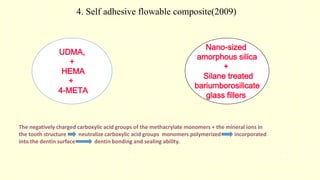
4. Self adhesive flowable composite(2009)
UDMA,
+
HEMA
+
4-META
Nano-sized
amorphous silica
+
Silane treated
bariumborosilicate
glass fillers.
The negatively charged carboxylic acid groups of the methacrylate monomers + the mineral ions in
the tooth structure neutralize carboxylic acid groups monomers polymerized incorporated
into the dentin surface dentin bonding and sealing ability.
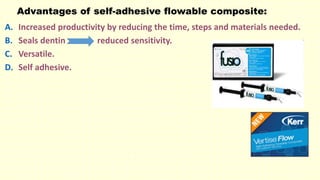
Advantages of self-adhesive flowable composite:
A. Increased productivity by reducing the time, steps and materials needed.
B. Seals dentin reduced sensitivity.
C. Versatile.
D. Self adhesive.
2- Inorganic (reinforcing) Fillers
1. Improvement in mechanical properties (must be in high concentration) to
achieve good mechanical properties.
2. Reduction in coefficient of thermal expansion.
3. Glass is able to reflect the color of the surrounding tooth material so the filler
contributes to the aesthetics. The refractive index should match that of the organic matrix to
secure translucency.
4. Reduction in the polymerization shrinkage.
5. Less heat evolved in polymerization.
6. The composite is radiopaque if barium or strontium glasses are used.
Filler particle size and properties:
Historically, (conventional large 20-30m).
The disadvantage of conventional composites are:
i. Discoloration and staining tendencies
ii. Difficulty in finishing and polishing such composites.
Current composites are:
1-Fine composites: with smaller filler particles (0.5-3m).
Good mechanical properties and can be finished and polished
2-Microfine composites: (0.04-0.2m).
i. Perfect surface quality → lustrous surfaces on finishing.
ii. But poor mechanical properties.
3-Blend (hybrid) composites:
Containing mixture of fine and microfine fillers.
i. High mechanical properties as fine composites and
ii. Perfect surface finish as microfine composites.
Nano filled composites: (60-70%)
Containing nano sized particles (20-75
i. High translucency, finish and polish.
ii. Lower polymerization shrinkage.
iii. Higher depth of curing.
iv. High mechanical properties as hybrid c.t
v. Excellent handling properties Excellent.
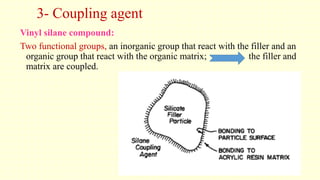
3- Coupling agent
Vinyl silane compound:
Two functional groups, an inorganic group that react with the filler and an
organic group that react with the organic matrix; the filler and
matrix are coupled.
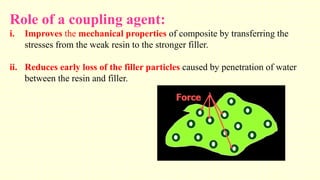
Role of a coupling agent:
i. Improves the mechanical properties of composite by transferring the
stresses from the weak resin to the stronger filler.
ii. Reduces early loss of the filler particles caused by penetration of water
between the resin and filler.
4- Initiator activator systems
Chemical or Light activation
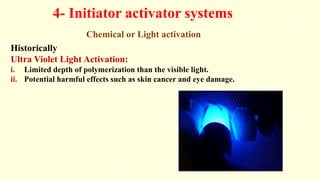
Historically
Ultra Violet Light Activation:
i. Limited depth of polymerization than the visible light.
ii. Potential harmful effects such as skin cancer and eye damage.
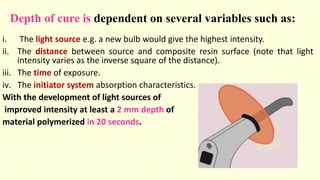
Depth of cure is dependent on several variables such as:
i. The light source e.g. a new bulb would give the highest intensity.
ii. The distance between source and composite resin surface (note that light
intensity varies as the inverse square of the distance).
iii. The time of exposure.
iv. The initiator system absorption characteristics.
With the development of light sources of
improved intensity at least a 2 mm depth of
material polymerized in 20 seconds.
Avoid unpolymerized material in the base of cavities or undercuts. Therefore,
directing the light from both sides of an anterior restoration or building up by
layers may be advisable.
Composite resin which is not fully polymerized will show:
i. Reduced mechanical properties.
ii. Poorer color stability and greater susceptibility to stain.
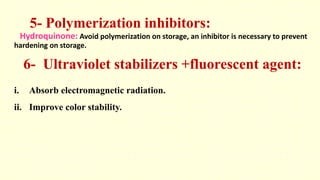
5- Polymerization inhibitors:
Hydroquinone: Avoid polymerization on storage, an inhibitor is necessary to prevent
hardening on storage.
6- Ultraviolet stabilizers +fluorescent agent:
i. Absorb electromagnetic radiation.
ii. Improve color stability.
36
A-Based on Curing type
1-Chimical Cure
2-Visible Light Cure
3-Duable Cure
Classification System
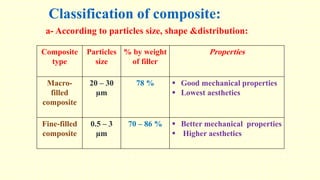
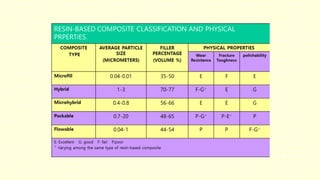
Classification of composite:
a- According to particles size, shape &distribution:
Properties% by weight
of filler
Particles
size
Composite
type
 Good mechanical properties
 Lowest aesthetics
78 %20 – 30
µm
Macro-
filled
composite
 Better mechanical properties
 Higher aesthetics
70 – 86 %0.5 – 3
µm
Fine-filled
composite
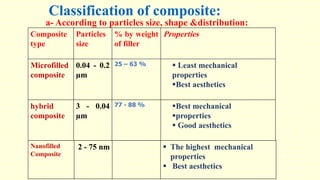
Properties% by weight
of filler
Particles
size
Composite
type
 Least mechanical
properties
Best aesthetics
25 – 63 %0.04 - 0.2
µm
Microfilled
composite
Best mechanical
properties
 Good aesthetics
77 - 88 %3 - 0.04
µm
hybrid
composite
a- According to particles size, shape &distribution:
Classification of composite:
 The highest mechanical
properties
 Best aesthetics
2 - 75 nmNanofilled
Composite
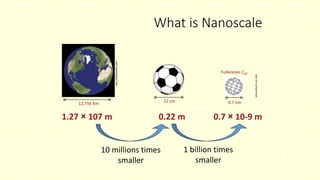
What is Nanoscale
1.27 × 10⁷ m ww.mathworks.com
0.22 m 0.7 × 10⁻⁹ m
Fullerenes C60
12,756 Km 22 cm 0.7 nm
10 millions times
smaller
1 billion times
smaller
www.physics.ucr.edu
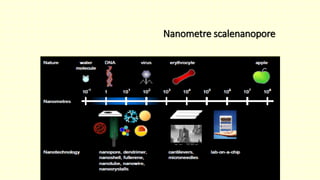
Nanometre scalenanopore
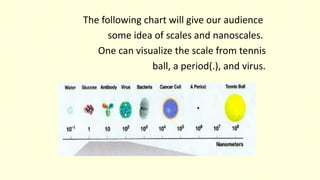
The following chart will give our audience
some idea of scales and nanoscales.
One can visualize the scale from tennis
ball, a period(.), and virus.
43
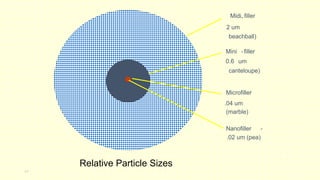
Midi- filler -
2 um
(beachball)
Mini -filler -
0.6 um
(canteloupe)
Nanofiller -
.02 um (pea)
Microfiller -
.04 um
(marble)
Relative Particle Sizes
b- According to methods of Activation:
• Chemically cured composite
• Light cured composite
• Dual cured composite
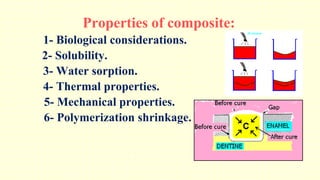
Properties of composite:
1- Biological considerations.
2- Solubility.
3- Water sorption.
4- Thermal properties.
5- Mechanical properties.
6- Polymerization shrinkage.
7- Esthetic and optical properties:
 Composite materials are translucent materials which can match the color
of teeth and have good aesthetics.
 The materials can be radiopaque by the addition of glasses having high
atomic numbers such as barium, strontium and zirconium. Radiopacity helps
in diagnosis.
 Abrasive wear may lead to surface roughness of the material, because the
polymer phase wears more rapidly than harder ceramic fillers. This may lead
to discoloration with time. However, micro fine and hybrid types can take
and retain smooth surface finish for long periods in the mouth.
 Stress cracks within the polymer matrix and partial debonding of the fillers
as a result of hydrolysis tend to change the color.
47
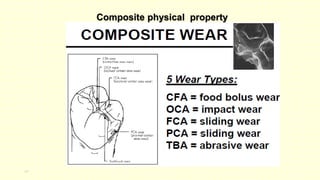
Composite physical property
48
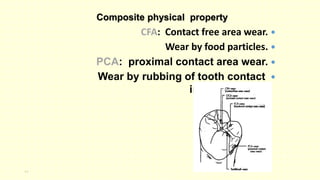
CFA: Contact free area wear.
Wear by food particles.
PCA: proximal contact area wear.
Wear by rubbing of tooth contact
interproximally.
Composite physical property
49
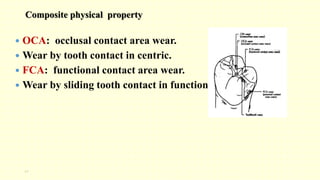
 OCA: occlusal contact area wear.
 Wear by tooth contact in centric.
 FCA: functional contact area wear.
 Wear by sliding tooth contact in function.
Composite physical property
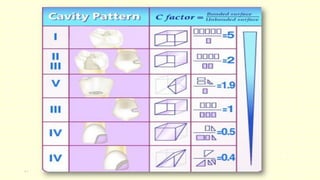
C-factor is…
• ratio between bonded and unbounded
surfaces
• an increase in this ratio results in increased
polymerization stress
-Three-dimensional cavity preparations (Class I) have the highest
(most unfavorable)
Composite physical property
51
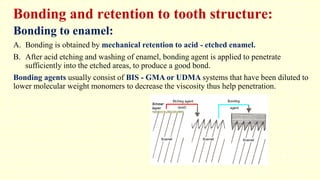
Bonding and retention to tooth structure:
Bonding to enamel:
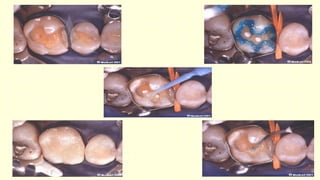
A. Bonding is obtained by mechanical retention to acid - etched enamel.
B. After acid etching and washing of enamel, bonding agent is applied to penetrate
sufficiently into the etched areas, to produce a good bond.
Bonding agents usually consist of BIS - GMA or UDMA systems that have been diluted to
lower molecular weight monomers to decrease the viscosity thus help penetration.
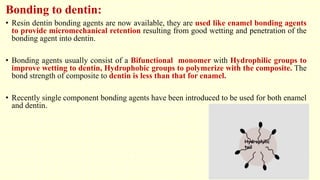
Bonding to dentin:
• Resin dentin bonding agents are now available, they are used like enamel bonding agents
to provide micromechanical retention resulting from good wetting and penetration of the
bonding agent into dentin.
• Bonding agents usually consist of a Bifunctional monomer with Hydrophilic groups to
improve wetting to dentin, Hydrophobic groups to polymerize with the composite. The
bond strength of composite to dentin is less than that for enamel.
• Recently single component bonding agents have been introduced to be used for both enamel
and dentin.
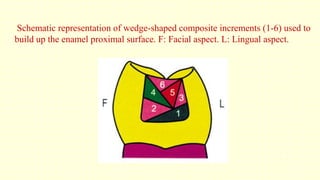
Schematic representation of wedge-shaped composite increments (1-6) used to
build up the enamel proximal surface. F: Facial aspect. L: Lingual aspect.
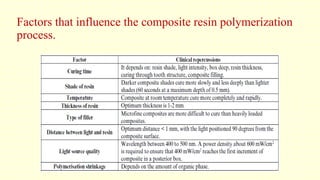
Factors that influence the composite resin polymerization
process.
57

Tooth Color Restorations (Composite) 2018-2019

  • 1.
  • 2.
    ‫بسم‬‫ﷲ‬‫الرحيم‬ ‫الرحمن‬ ْ‫ل‬ُ‫ل‬ْ‫اح‬ َ‫و‬‫م‬ً‫ة‬َ‫د‬ْ‫ق‬ُ‫ع‬ِ‫ن‬َ‫س‬‫ل‬ ‫ن‬{27} ‫ل‬ ْ‫و‬َ‫ق‬ ‫وا‬ُ‫ه‬َ‫ق‬ْ‫ف‬َ‫ي‬{28}‫الﻌﻅيﻢ‬‫صدق‬‫ﷲ‬
  • 3.
    Anterior Restorative Materials •Silicate cements (Historical). • Unfilled Resin (Historical). • Filled Resin (Composite). • Glass Ionomer. • Glass ionomer cements (GIC). • Resin modified. • Compomers. Those esthetic materials that are tooth colored. Tooth Colerd Restorations
  • 4.
    History:  1871 –silicates ◦ alumina-silica glass & phosphoric acid ◦ very soluble ◦ poor mechanical properties  1948 - acrylic resins ◦ polymethylmethacrylate ◦ high polymerization shrinkage
  • 5.
     1962 –Bis-GMA ◦ stronger resin  1969 – filled composite resin ◦ improved mechanical properties ◦ less shrinkage ◦ paste/paste system  1970’s – acid etching and microfills  1980’s – light curing and hybrids  1990’s – flowables and packables  2000’s – nanofills
  • 6.
    6 Stephen C. Bayne,Professorand Chair Dept of Cariology, Rest Sciences, & Endo School of Dentistry,University of Michigan Ann Arbor,
  • 7.
    Ideal Requirements: 1. Itshould match the tooth in color, translucency and refractive index. 2. It should not stain or discolor by time. 3. It should not be irritant to the pulp or to the gingiva. 4. It should not dissolve in saliva or in fluids taken into the mouth. 5. It should have adequate mechanical properties to withstand the forces of mastication: A. It should have strength and modulus of elasticity similar to those of enamel and dentin. B. Good abrasion resistance to dentifrices and constituents of food.
  • 8.
    1. It shouldhave similar coefficient of thermal expansion to that of enamel and dentin. 2. It should undergo minimal dimensional changes on setting. 3. It should take and retain a smooth surface finish. 4. It should be radiopaque to enable detection of secondary caries, identification of overhanging ledges and detection of incompletely filled cavities. 5. Ideally, adhesion between the filling material, enamel and dentin should occur. Ideal Requirements:
  • 9.
    Filled Resin Composite fillingmaterial A composite is a combination of two or more chemically different materials with a distinct interface separating the components and having properties which could not be achieved by any of the components alone.
  • 10.
    Composition: 1. Coupling agentwhich binds the inorganic fillers to the organic matrix. 2. Inorganic filler phase. 3. Organic matrix phase. 4. Initiator activator systems. 5. Other components A. Inhibitors . B. Ultraviolet stabilizers. C. Pigments.
  • 11.
     Resin matrix ◦monomer ◦ initiator ◦ inhibitors ◦ pigments  Inorganic filler ◦ glass ◦ quartz ◦ colloidal silica  Coupling Agent OCH2CHCH2O-C-C=CH2CH2=C-C-O-CH2CH-CH2O -C- CH3 CH3 CH3 CH3OH OH O O
  • 12.
    Monomers: Binds fillerparticles together Provides “workability” 1- Bis-GMA  extremely viscous  large benzene rings 2- Lowered by adding TEGDMA:  freely movable, increases polymer conversion, increases crosslinking , increases shrinkage 3-Ring-opening monomers: were developed to reduce or overcome the polymerization shrinkage of resin-based composites. Most recently, oxiranes and siloranes (a combination of siloxanes and oxiranes) are being discussed more and more, with a siloran-based product being marketed at present.
  • 13.
    13 Resin-based composites releaseresidual monomers (and other substances) because of a conversion rate of 35–77%. Released compounds can directly cause biological reactions. Polymerization shrinkage is a material property that may indirectly influence the tissue compatibility . This volume change may cause marginal gaps that may allow penetration of bacteria with subsequent pulpitis. Shrinkage of modern filling resins generally ranges between 2 vol.% and 3 vol.% .
  • 14.
    14 Monomers:  Shrinkage ◦ 2– 7 % ◦ marginal gap formation
  • 15.
    1- Organic matrixphase a) MW Oligomer : Either Bisphenol A-glycidyl methacrylate (BIS-GMA), Bowen's resin, or urethane dimethacrylates (UDMA). In some products mixture of the two oligomers is present. Oligomers are superior to methyl methacrylate monomers by:  Lower polymerization shrinkage (due to higher molecular size and less double bond available).  Lower volatility ( Due to its chemical structure)  More rapid hardening  Production of stiffer and stronger resin due to higher molecular weight and more cross - linkage
  • 16.
    Advantages of UDMover BIS-GMA: 1. Lower viscosity. 2. Lower water sorption. 3. Greater toughness. 4. Greater susceptibility to visible light curing. Oligomers contain reactive carbon double bonds at each end → free radical addition polymerization → rigid cross-linked polymer. These oligomers are viscous and the incorporation of the inorganic fillers is difficult. The viscosity is reduced to a useful clinical level by the addition of lower molecular weight monomers called diluents.
  • 17.
    b- Low MWMonomer (Diluent) diethylene glycol dimethacrylate or trietheylene glycol dimethacrylate: A. Reduce the viscosity of the material to enable proper blending with the inorganic constituents. B. Facilitate clinical manipulation.
  • 18.
    Advancement in resinousmatrix: 1. Ormocers (organically modified ceramics) 1990 Polymeric inorganic/organic hybrid matrix Si O2 Organic methacrylate group ----R + Inorganic poly-siloxane polymer Very rigid composite Low shrinkage composite
  • 19.
  • 20.
    • Coupling agents: whathappens if bond between resin and filler is weak: • The material would be weak and susceptible to creep and fracture and • The interface between filler and resin will be a source of fracture, stress will not be distributed properly. • Silane coupling agents: has a hydrophobic end (methacrylate group) to bind the resin and a hydrophilic end (OH- group) to bind glass fillers 20
  • 21.
    • Silanes havedisadvantages. They age quickly in a bottle and become ineffective. Silanes are sensitive to water so the silane filler bond breaks down with moisture. • Water absorbed into composites results in hydrolysis of the silane bond and eventual filler loss. 21
  • 22.
    2. Silorane(2000) Oxirane +Siloxane Light Decompose CQ Radicals Activate Electron Donor Decompose Iodonium Salt Generate Acidic CATION Open Oxirane Ring
  • 23.
    Advantages of silorane-basedcomposite : 1. Low polymerization shrinkage. 2. Lowest polymerization stress. 3. Lowest cusp displacement. 4. Higher bond strength. 5. Lowest water sorption and very low tendency for exogenous staining. 6. Increased compressive and flexural strength. 7. Stable and insoluble in biological fluids.
  • 24.
    3. Bio-active restorativematerials with antibacterial monomer A. Antibacterial monomer MDPB (methacryloyloxydodecylpyridinim bromide) is a polymerizable bactericide, which is immobilized after the resinous materials are cured. B. Cured resins containing MDPB inhibit the growth of bacteria on their surface, thereby acting as a so-called “contact inhibitor” against actinomyces and Candida albicans.
  • 25.
    4. Self adhesiveflowable composite(2009) UDMA, + HEMA + 4-META Nano-sized amorphous silica + Silane treated bariumborosilicate glass fillers. The negatively charged carboxylic acid groups of the methacrylate monomers + the mineral ions in the tooth structure neutralize carboxylic acid groups monomers polymerized incorporated into the dentin surface dentin bonding and sealing ability.
  • 26.
    Advantages of self-adhesiveflowable composite: A. Increased productivity by reducing the time, steps and materials needed. B. Seals dentin reduced sensitivity. C. Versatile. D. Self adhesive.
  • 27.
    2- Inorganic (reinforcing)Fillers 1. Improvement in mechanical properties (must be in high concentration) to achieve good mechanical properties. 2. Reduction in coefficient of thermal expansion. 3. Glass is able to reflect the color of the surrounding tooth material so the filler contributes to the aesthetics. The refractive index should match that of the organic matrix to secure translucency. 4. Reduction in the polymerization shrinkage. 5. Less heat evolved in polymerization. 6. The composite is radiopaque if barium or strontium glasses are used.
  • 28.
    Filler particle sizeand properties: Historically, (conventional large 20-30m). The disadvantage of conventional composites are: i. Discoloration and staining tendencies ii. Difficulty in finishing and polishing such composites. Current composites are: 1-Fine composites: with smaller filler particles (0.5-3m). Good mechanical properties and can be finished and polished 2-Microfine composites: (0.04-0.2m). i. Perfect surface quality → lustrous surfaces on finishing. ii. But poor mechanical properties. 3-Blend (hybrid) composites: Containing mixture of fine and microfine fillers. i. High mechanical properties as fine composites and ii. Perfect surface finish as microfine composites.
  • 29.
    Nano filled composites:(60-70%) Containing nano sized particles (20-75 i. High translucency, finish and polish. ii. Lower polymerization shrinkage. iii. Higher depth of curing. iv. High mechanical properties as hybrid c.t v. Excellent handling properties Excellent.
  • 30.
    3- Coupling agent Vinylsilane compound: Two functional groups, an inorganic group that react with the filler and an organic group that react with the organic matrix; the filler and matrix are coupled.
  • 31.
    Role of acoupling agent: i. Improves the mechanical properties of composite by transferring the stresses from the weak resin to the stronger filler. ii. Reduces early loss of the filler particles caused by penetration of water between the resin and filler.
  • 32.
    4- Initiator activatorsystems Chemical or Light activation Historically Ultra Violet Light Activation: i. Limited depth of polymerization than the visible light. ii. Potential harmful effects such as skin cancer and eye damage.
  • 33.
    Depth of cureis dependent on several variables such as: i. The light source e.g. a new bulb would give the highest intensity. ii. The distance between source and composite resin surface (note that light intensity varies as the inverse square of the distance). iii. The time of exposure. iv. The initiator system absorption characteristics. With the development of light sources of improved intensity at least a 2 mm depth of material polymerized in 20 seconds.
  • 34.
    Avoid unpolymerized materialin the base of cavities or undercuts. Therefore, directing the light from both sides of an anterior restoration or building up by layers may be advisable. Composite resin which is not fully polymerized will show: i. Reduced mechanical properties. ii. Poorer color stability and greater susceptibility to stain.
  • 35.
    5- Polymerization inhibitors: Hydroquinone:Avoid polymerization on storage, an inhibitor is necessary to prevent hardening on storage. 6- Ultraviolet stabilizers +fluorescent agent: i. Absorb electromagnetic radiation. ii. Improve color stability.
  • 36.
    36 A-Based on Curingtype 1-Chimical Cure 2-Visible Light Cure 3-Duable Cure Classification System
  • 37.
    Classification of composite: a-According to particles size, shape &distribution: Properties% by weight of filler Particles size Composite type  Good mechanical properties  Lowest aesthetics 78 %20 – 30 µm Macro- filled composite  Better mechanical properties  Higher aesthetics 70 – 86 %0.5 – 3 µm Fine-filled composite
  • 38.
    Properties% by weight offiller Particles size Composite type  Least mechanical properties Best aesthetics 25 – 63 %0.04 - 0.2 µm Microfilled composite Best mechanical properties  Good aesthetics 77 - 88 %3 - 0.04 µm hybrid composite a- According to particles size, shape &distribution: Classification of composite:  The highest mechanical properties  Best aesthetics 2 - 75 nmNanofilled Composite
  • 40.
    What is Nanoscale 1.27× 10⁷ m ww.mathworks.com 0.22 m 0.7 × 10⁻⁹ m Fullerenes C60 12,756 Km 22 cm 0.7 nm 10 millions times smaller 1 billion times smaller www.physics.ucr.edu
  • 41.
  • 42.
    The following chartwill give our audience some idea of scales and nanoscales. One can visualize the scale from tennis ball, a period(.), and virus.
  • 43.
    43 Midi- filler - 2um (beachball) Mini -filler - 0.6 um (canteloupe) Nanofiller - .02 um (pea) Microfiller - .04 um (marble) Relative Particle Sizes
  • 44.
    b- According tomethods of Activation: • Chemically cured composite • Light cured composite • Dual cured composite
  • 45.
    Properties of composite: 1-Biological considerations. 2- Solubility. 3- Water sorption. 4- Thermal properties. 5- Mechanical properties. 6- Polymerization shrinkage.
  • 46.
    7- Esthetic andoptical properties:  Composite materials are translucent materials which can match the color of teeth and have good aesthetics.  The materials can be radiopaque by the addition of glasses having high atomic numbers such as barium, strontium and zirconium. Radiopacity helps in diagnosis.  Abrasive wear may lead to surface roughness of the material, because the polymer phase wears more rapidly than harder ceramic fillers. This may lead to discoloration with time. However, micro fine and hybrid types can take and retain smooth surface finish for long periods in the mouth.  Stress cracks within the polymer matrix and partial debonding of the fillers as a result of hydrolysis tend to change the color.
  • 47.
  • 48.
    48 CFA: Contact freearea wear. Wear by food particles. PCA: proximal contact area wear. Wear by rubbing of tooth contact interproximally. Composite physical property
  • 49.
    49  OCA: occlusalcontact area wear.  Wear by tooth contact in centric.  FCA: functional contact area wear.  Wear by sliding tooth contact in function. Composite physical property
  • 50.
    C-factor is… • ratiobetween bonded and unbounded surfaces • an increase in this ratio results in increased polymerization stress -Three-dimensional cavity preparations (Class I) have the highest (most unfavorable) Composite physical property
  • 51.
  • 52.
    Bonding and retentionto tooth structure: Bonding to enamel: A. Bonding is obtained by mechanical retention to acid - etched enamel. B. After acid etching and washing of enamel, bonding agent is applied to penetrate sufficiently into the etched areas, to produce a good bond. Bonding agents usually consist of BIS - GMA or UDMA systems that have been diluted to lower molecular weight monomers to decrease the viscosity thus help penetration.
  • 53.
    Bonding to dentin: •Resin dentin bonding agents are now available, they are used like enamel bonding agents to provide micromechanical retention resulting from good wetting and penetration of the bonding agent into dentin. • Bonding agents usually consist of a Bifunctional monomer with Hydrophilic groups to improve wetting to dentin, Hydrophobic groups to polymerize with the composite. The bond strength of composite to dentin is less than that for enamel. • Recently single component bonding agents have been introduced to be used for both enamel and dentin.
  • 55.
    Schematic representation ofwedge-shaped composite increments (1-6) used to build up the enamel proximal surface. F: Facial aspect. L: Lingual aspect.
  • 56.
    Factors that influencethe composite resin polymerization process.
  • 57.