


FILE TRANSFER PROTOCOL(FTP)
BY: VARNIT
YADAV
B.Tech(C.S.)
U.I.E.T.
B.B.A.U.
WHAT IS FTP?
The File Transfer Protocol (FTP) is a standard network
protocol used for the transfer of computer files from a
server to a client using the Client–server model on
a computer network.
HISTORY OF FTP SERVER
• Initially written by Abhay Bhushan.
• Until 1980, FTP ran on NCP.
• The protocol was later replaced by a TCP/IP
version, RFC 765 and RFC 959.
Basic model of FTP
Components of client
• User interface
• Client control process
• Client data transfer process
Components of server
• Server control process
• Server data transfer
process
TWO CONNECTIONS
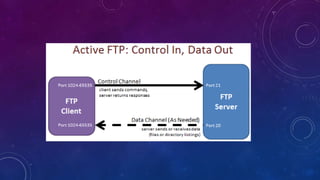
• Control Connection
• Data Connection
CONTROL CONNECTION
• Port 21 is used for the control connection.
• Uses the NVT ASCII character set as used by TELNET.
• Communication is achieved through commands and
responses.
SOME FTP COMMANDS
SOME RESPONSES IN FTP
DATA CONNECTION
• Port 20 at the server site is used for the data connection.
• The client issues a passive open using an ephemeral port.
• Using the PORT command the client sends this port
number to the server.
• The server receives the port number and issues an active
open using port 20.
COMMUNICATION OVER DATA CONNECTION
The heterogeneity problem is resolved by defining three
attributes of communication: file type, data structure, and
transmission mode.
FILE TYPE
• ASCII file
•EBCDIC file
•Image file
DATA STRUCTURE
• File structure
• Record structure
• Page Structure
TRANSMISSION MODE
• Stream mode
• Block mode
• Compressed mode
FILE TRANSFER
•Retrieving a file (server to client)
• Storing a file (client to server)
• Directory listing (server to client)
SECURITY FOR FTP
• FTP requires a password, it is sent in plaintext,
which means it can be intercepted and used by an
attacker.
• The data transfer is in plaintext, which is
insecure.
• To be secure one can add a Secure Socket
Layer(SSL) between the FTP application layer
THANK YOU

File Transfer Protocol(FTP)

  • 1.
    FILE TRANSFER PROTOCOL(FTP) BY:VARNIT YADAV B.Tech(C.S.) U.I.E.T. B.B.A.U.
  • 2.
    WHAT IS FTP? TheFile Transfer Protocol (FTP) is a standard network protocol used for the transfer of computer files from a server to a client using the Client–server model on a computer network.
  • 3.
    HISTORY OF FTPSERVER • Initially written by Abhay Bhushan. • Until 1980, FTP ran on NCP. • The protocol was later replaced by a TCP/IP version, RFC 765 and RFC 959.
  • 4.
  • 5.
    Components of client •User interface • Client control process • Client data transfer process Components of server • Server control process • Server data transfer process
  • 6.
    TWO CONNECTIONS • ControlConnection • Data Connection
  • 7.
    CONTROL CONNECTION • Port21 is used for the control connection. • Uses the NVT ASCII character set as used by TELNET. • Communication is achieved through commands and responses.
  • 8.
  • 9.
  • 11.
    DATA CONNECTION • Port20 at the server site is used for the data connection. • The client issues a passive open using an ephemeral port. • Using the PORT command the client sends this port number to the server. • The server receives the port number and issues an active open using port 20.
  • 13.
    COMMUNICATION OVER DATACONNECTION The heterogeneity problem is resolved by defining three attributes of communication: file type, data structure, and transmission mode.
  • 14.
    FILE TYPE • ASCIIfile •EBCDIC file •Image file
  • 15.
    DATA STRUCTURE • Filestructure • Record structure • Page Structure
  • 16.
    TRANSMISSION MODE • Streammode • Block mode • Compressed mode
  • 17.
    FILE TRANSFER •Retrieving afile (server to client) • Storing a file (client to server) • Directory listing (server to client)
  • 18.
    SECURITY FOR FTP •FTP requires a password, it is sent in plaintext, which means it can be intercepted and used by an attacker. • The data transfer is in plaintext, which is insecure. • To be secure one can add a Secure Socket Layer(SSL) between the FTP application layer
  • 19.