Understanding FTP (File Transfer
Protocol)
Presented by: Salman Yousafzai
Course: Computer Networks
What is FTP?
• FTP stands for File Transfer Protocol.
• Standard network protocol to transfer files over TCP/IP.
• Introduced in the early 1970s (RFC 959 – 1985).
• Works on client-server architecture.
History & Background
• Developed by Abhay Bhushan in 1971 (RFC 114).
• Used in ARPANET (early internet).
• RFC 959 (1985) is the current standard.
• Secure versions: FTPS and SFTP.
Why FTP is Used
• Upload/download files from remote servers.
• Website maintenance – web pages and media.
• Backup and large file transfer.
• Remote file sharing and collaboration.
How FTP Works – Basics
• Client-server model: client requests, server responds.
• Uses two ports:
• - Port 21: control connection (commands).
• - Port 20: data connection (file transfer).
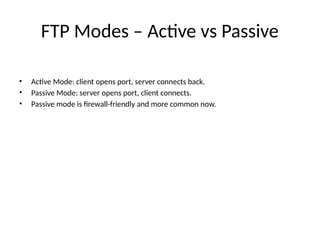
FTP Modes – Active vs Passive
• Active Mode: client opens port, server connects back.
• Passive Mode: server opens port, client connects.
• Passive mode is firewall-friendly and more common now.
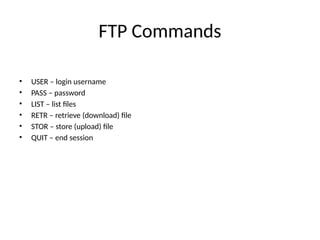
FTP Commands
• USER – login username
• PASS – password
• LIST – list files
• RETR – retrieve (download) file
• STOR – store (upload) file
• QUIT – end session
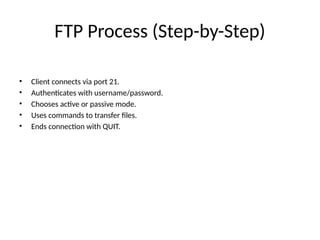
FTP Process (Step-by-Step)
• Client connects via port 21.
• Authenticates with username/password.
• Chooses active or passive mode.
• Uses commands to transfer files.
• Ends connection with QUIT.
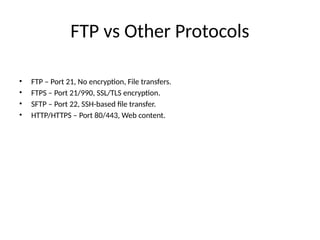
FTP vs Other Protocols
• FTP – Port 21, No encryption, File transfers.
• FTPS – Port 21/990, SSL/TLS encryption.
• SFTP – Port 22, SSH-based file transfer.
• HTTP/HTTPS – Port 80/443, Web content.
Pros and Cons of FTP
• Pros: Simple, good for large files, widely supported.
• Cons: No encryption, insecure, replaced by secure protocols.
Modern Usage & Security
• Still used in web hosting and legacy systems.
• For secure transfers, use FTPS or SFTP.
• Avoid plain FTP for sensitive data.
Real Life Example
• Open FileZilla client.
• Connect to hosting server with credentials.
• Upload files to /public_html/.
• Website updates instantly.
Tools that Use FTP
• FileZilla – popular FTP client.
• Other tools: WinSCP, Cyberduck, Transmit.
• cPanel and other web hosting panels use FTP.
Summary
• FTP = classic file transfer protocol.
• Uses ports 21 (control) and 20 (data).
• Basic but insecure – use FTPS/SFTP.
• Still used in web development.
Q&A
• Any questions?

FTP_Presentation_by_Salman_Yousafzai.pptx

  • 1.
    Understanding FTP (FileTransfer Protocol) Presented by: Salman Yousafzai Course: Computer Networks
  • 2.
    What is FTP? •FTP stands for File Transfer Protocol. • Standard network protocol to transfer files over TCP/IP. • Introduced in the early 1970s (RFC 959 – 1985). • Works on client-server architecture.
  • 3.
    History & Background •Developed by Abhay Bhushan in 1971 (RFC 114). • Used in ARPANET (early internet). • RFC 959 (1985) is the current standard. • Secure versions: FTPS and SFTP.
  • 4.
    Why FTP isUsed • Upload/download files from remote servers. • Website maintenance – web pages and media. • Backup and large file transfer. • Remote file sharing and collaboration.
  • 5.
    How FTP Works– Basics • Client-server model: client requests, server responds. • Uses two ports: • - Port 21: control connection (commands). • - Port 20: data connection (file transfer).
  • 6.
    FTP Modes –Active vs Passive • Active Mode: client opens port, server connects back. • Passive Mode: server opens port, client connects. • Passive mode is firewall-friendly and more common now.
  • 7.
    FTP Commands • USER– login username • PASS – password • LIST – list files • RETR – retrieve (download) file • STOR – store (upload) file • QUIT – end session
  • 8.
    FTP Process (Step-by-Step) •Client connects via port 21. • Authenticates with username/password. • Chooses active or passive mode. • Uses commands to transfer files. • Ends connection with QUIT.
  • 9.
    FTP vs OtherProtocols • FTP – Port 21, No encryption, File transfers. • FTPS – Port 21/990, SSL/TLS encryption. • SFTP – Port 22, SSH-based file transfer. • HTTP/HTTPS – Port 80/443, Web content.
  • 10.
    Pros and Consof FTP • Pros: Simple, good for large files, widely supported. • Cons: No encryption, insecure, replaced by secure protocols.
  • 11.
    Modern Usage &Security • Still used in web hosting and legacy systems. • For secure transfers, use FTPS or SFTP. • Avoid plain FTP for sensitive data.
  • 12.
    Real Life Example •Open FileZilla client. • Connect to hosting server with credentials. • Upload files to /public_html/. • Website updates instantly.
  • 13.
    Tools that UseFTP • FileZilla – popular FTP client. • Other tools: WinSCP, Cyberduck, Transmit. • cPanel and other web hosting panels use FTP.
  • 14.
    Summary • FTP =classic file transfer protocol. • Uses ports 21 (control) and 20 (data). • Basic but insecure – use FTPS/SFTP. • Still used in web development.
  • 15.