1Database Systems, 9th Edition
Database Systems:
Design, Implementation, and
Management
Ninth Edition
Chapter 2
Data Models
2
Objectives
In this chapter, you will learn:
• About data modeling and why data models
are important
• About the basic data-modeling building
blocks
• What business rules are and how they
influence database design
• How the major data models evolved
• How data models can be classified by level of
abstraction
Database Systems, 9th Edition
3
Introduction
• Designers, programmers, and end users see
data in different ways
• Different views of same data lead to designs
that do not reflect organization’s operation
• Data modeling reduces complexities of
database design
• Various degrees of data abstraction help
reconcile varying views of same data
Database Systems, 9th Edition
4
Data Modeling and Data Models
• Data models
– Relatively simple representations of complex
real-world data structures
• Often graphical
• Model: an abstraction of a real-world object or
event
– Useful in understanding complexities of the
real-world environment
• Data modeling is iterative and progressive
Database Systems, 9th Edition
5
The Importance of Data Models
• Facilitate interaction among the designer, the
applications programmer, and the end user
• End users have different views and needs for
data
• Data model organizes data for various users
• Data model is an abstraction
– Cannot draw required data out of the data
model
Database Systems, 9th Edition
6
Data Model Basic Building Blocks
• Entity: anything about which data are to be
collected and stored
• Attribute: a characteristic of an entity
• Relationship: describes an association
among entities
– One-to-many (1:M) relationship
– Many-to-many (M:N or M:M) relationship
– One-to-one (1:1) relationship
• Constraint: a restriction placed on the data
Database Systems, 9th Edition
7
Business Rules
• Descriptions of policies, procedures, or
principles within a specific organization
– Apply to any organization that stores and uses
data to generate information
• Description of operations to create/enforce
actions within an organization’s environment
– Must be in writing and kept up to date
– Must be easy to understand and widely
disseminated
• Describe characteristics of data as viewed by
the company
Database Systems, 9th Edition
8
Discovering Business Rules
• Sources of business rules:
– Company managers
– Policy makers
– Department managers
– Written documentation
• Procedures
• Standards
• Operations manuals
– Direct interviews with end users
Database Systems, 9th Edition
9
Discovering Business Rules (cont’d.)
• Standardize company’s view of data
• Communications tool between users and
designers
• Allow designer to understand the nature, role,
and scope of data
• Allow designer to understand business
processes
• Allow designer to develop appropriate
relationship participation rules and constraints
Database Systems, 9th Edition
10
Translating Business Rules into
Data Model Components
• Generally, nouns translate into entities
• Verbs translate into relationships among
entities
• Relationships are bidirectional
• Two questions to identify the relationship
type:
– How many instances of B are related to one
instance of A?
– How many instances of A are related to one
instance of B?
Database Systems, 9th Edition
11
Naming Conventions
• Naming occurs during translation of business
rules to data model components
• Names should make the object unique and
distinguishable from other objects
• Names should also be descriptive of objects
in the environment and be familiar to users
• Proper naming:
– Facilitates communication between parties
– Promotes self-documentation
Database Systems, 9th Edition
12
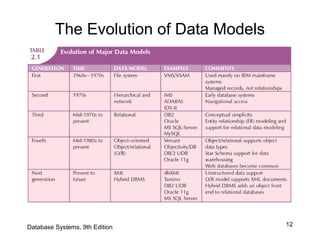
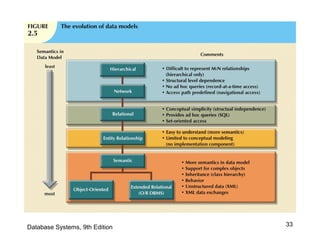
The Evolution of Data Models
Database Systems, 9th Edition
13
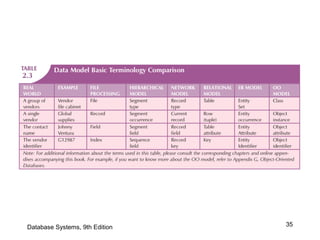
The Hierarchical Model
• The hierarchical model was developed in the
1960s to manage large amounts of data for
manufacturing projects
• Basic logical structure is represented by an
upside-down “tree”
• Hierarchical structure contains levels or
segments
– Segment analogous to a record type
– Set of one-to-many relationships between
segments
Database Systems, 9th Edition
14
The Network Model
• The network model was created to represent
complex data relationships more effectively
than the hierarchical model
– Improves database performance
– Imposes a database standard
• Resembles hierarchical model
– However, record may have more than one
parent
Database Systems, 9th Edition
15Database Systems, 9th Edition
The Network Model (cont’d.)
• Collection of records in 1:M relationships
• Set composed of two record types:
– Owner
• Equivalent to the hierarchical model’s parent
– Member
• Equivalent to the hierarchical model’s child
16
The Network Model (cont’d.)
• Concepts still used today:
– Schema
• Conceptual organization of entire database as
viewed by the database administrator
– Subschema
• Database portion “seen” by the application
programs
Database Systems, 9th Edition
17
The Network Model (cont’d.)
• Concepts still used today: (cont’d.)
– Data management language (DML)
• Defines the environment in which data can be
managed
– Data definition language (DDL)
• Enables the administrator to define the schema
components
Database Systems, 9th Edition
18
The Network Model (cont’d.)
• Disadvantages of the network model:
– Cumbersome
– Lack of ad hoc query capability placed burden
on programmers to generate code for reports
– Structural change in the database could
produce havoc in all application programs
Database Systems, 9th Edition
19
The Relational Model
• Developed by E.F. Codd (IBM) in 1970
• Table (relations)
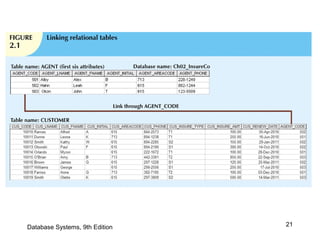
– Matrix consisting of row/column intersections
– Each row in a relation is called a tuple
• Relational models were considered
impractical in 1970
• Model was conceptually simple at expense of
computer overhead
Database Systems, 9th Edition
20
The Relational Model (cont’d.)
• Relational data management system
(RDBMS)
– Performs same functions provided by
hierarchical model
– Hides complexity from the user
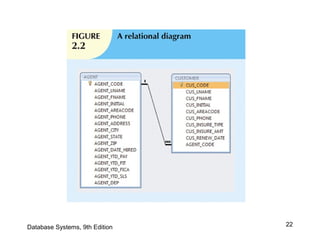
• Relational diagram
– Representation of entities, attributes, and
relationships
• Relational table stores collection of related
entities
Database Systems, 9th Edition
21Database Systems, 9th Edition
22Database Systems, 9th Edition
23Database Systems, 9th Edition
The Relational Model (cont’d.)
• SQL-based relational database application
involves three parts:
– User interface
• Allows end user to interact with the data
– Set of tables stored in the database
• Each table is independent from another
• Rows in different tables are related based on
common values in common attributes
– SQL “engine”
• Executes all queries
24
The Entity Relationship Model
• Widely accepted standard for data modeling
• Introduced by Chen in 1976
• Graphical representation of entities and their
relationships in a database structure
• Entity relationship diagram (ERD)
– Uses graphic representations to model
database components
– Entity is mapped to a relational table
Database Systems, 9th Edition
25
The Entity Relationship Model
(cont’d.)
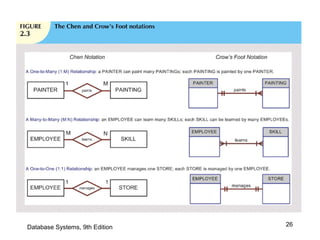
• Entity instance (or occurrence) is row in table
• Entity set is collection of like entities
• Connectivity labels types of relationships
• Relationships are expressed using Chen
notation
– Relationships are represented by a diamond
– Relationship name is written inside the
diamond
• Crow’s Foot notation used as design standard
in this book
Database Systems, 9th Edition
26Database Systems, 9th Edition
27
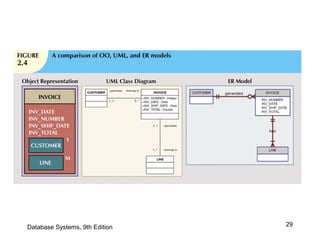
The Object-Oriented (OO) Model
• Data and relationships are contained in a
single structure known as an object
• OODM (object-oriented data model) is the
basis for OODBMS
– Semantic data model
• An object:
– Contains operations
– Are self-contained: a basic building-block for
autonomous structures
– Is an abstraction of a real-world entity
Database Systems, 9th Edition
28
The Object-Oriented (OO) Model
(cont’d.)
• Attributes describe the properties of an object
• Objects that share similar characteristics are
grouped in classes
• Classes are organized in a class hierarchy
• Inheritance: object inherits methods and
attributes of parent class
• UML based on OO concepts that describe
diagrams and symbols
– Used to graphically model a system
Database Systems, 9th Edition
29Database Systems, 9th Edition
30
Newer Data Models:
Object/Relational and XML
• Extended relational data model (ERDM)
– Semantic data model developed in response
to increasing complexity of applications
– Includes many of OO model’s best features
– Often described as an object/relational
database management system (O/RDBMS)
– Primarily geared to business applications
Database Systems, 9th Edition
31
Newer Data Models:
Object/Relational and XML (cont’d.)
• The Internet revolution created the potential
to exchange critical business information
• In this environment, Extensible Markup
Language (XML) emerged as the de facto
standard
• Current databases support XML
– XML: the standard protocol for data exchange
among systems and Internet services
Database Systems, 9th Edition
32
The Future of Data Models
• Hybrid DBMSs
– Retain advantages of relational model
– Provide object-oriented view of the underlying
data
• SQL data services
– Store data remotely without incurring
expensive hardware, software, and personnel
costs
– Companies operate on a “pay-as-you-go”
system
Database Systems, 9th Edition
33Database Systems, 9th Edition
34
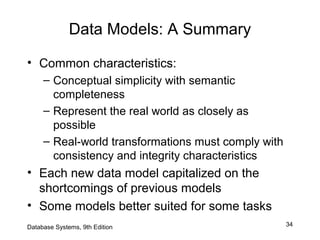
Data Models: A Summary
• Common characteristics:
– Conceptual simplicity with semantic
completeness
– Represent the real world as closely as
possible
– Real-world transformations must comply with
consistency and integrity characteristics
• Each new data model capitalized on the
shortcomings of previous models
• Some models better suited for some tasks
Database Systems, 9th Edition
35Database Systems, 9th Edition
36
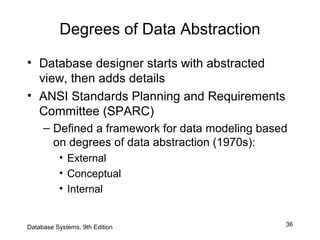
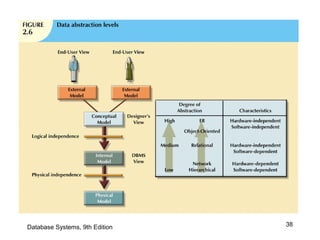
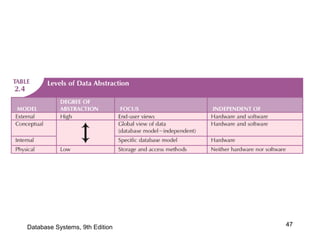
Degrees of Data Abstraction
• Database designer starts with abstracted
view, then adds details
• ANSI Standards Planning and Requirements
Committee (SPARC)
– Defined a framework for data modeling based
on degrees of data abstraction (1970s):
• External
• Conceptual
• Internal
Database Systems, 9th Edition
37
The External Model
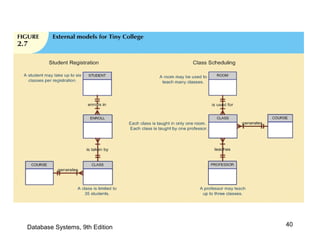
• End users’ view of the data environment
• ER diagrams represent external views
• External schema: specific representation of
an external view
– Entities
– Relationships
– Processes
– Constraints
Database Systems, 9th Edition
38Database Systems, 9th Edition
39
The External Model (cont’d.)
• Easy to identify specific data required to
support each business unit’s operations
• Facilitates designer’s job by providing
feedback about the model’s adequacy
• Ensures security constraints in database
design
• Simplifies application program development
Database Systems, 9th Edition
40Database Systems, 9th Edition
41
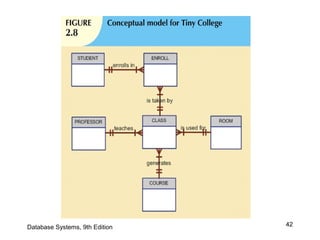
The Conceptual Model
• Represents global view of the entire database
• All external views integrated into single global
view: conceptual schema
• ER model most widely used
• ERD graphically represents the conceptual
schema
Database Systems, 9th Edition
42Database Systems, 9th Edition
43
The Conceptual Model (cont’d.)
• Provides a relatively easily understood macro
level view of data environment
• Independent of both software and hardware
– Does not depend on the DBMS software used
to implement the model
– Does not depend on the hardware used in the
implementation of the model
– Changes in hardware or software do not affect
database design at the conceptual level
Database Systems, 9th Edition
44
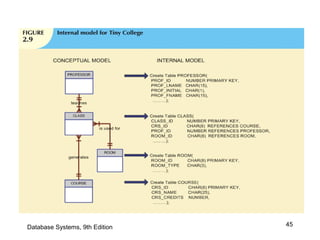
The Internal Model
• Representation of the database as “seen” by
the DBMS
– Maps the conceptual model to the DBMS
• Internal schema depicts a specific
representation of an internal model
• Depends on specific database software
– Change in DBMS software requires internal
model be changed
• Logical independence: change internal model
without affecting conceptual model
Database Systems, 9th Edition
45Database Systems, 9th Edition
46
The Physical Model
• Operates at lowest level of abstraction
– Describes the way data are saved on storage
media such as disks or tapes
• Requires the definition of physical storage
and data access methods
• Relational model aimed at logical level
– Does not require physical-level details
• Physical independence: changes in physical
model do not affect internal model
Database Systems, 9th Edition
47Database Systems, 9th Edition
48
Summary
• A data model is an abstraction of a complex
real-world data environment
• Basic data modeling components:
– Entities
– Attributes
– Relationships
– Constraints
• Business rules identify and define basic
modeling components
Database Systems, 9th Edition
49
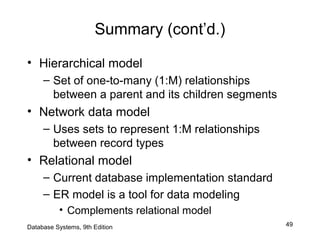
Summary (cont’d.)
• Hierarchical model
– Set of one-to-many (1:M) relationships
between a parent and its children segments
• Network data model
– Uses sets to represent 1:M relationships
between record types
• Relational model
– Current database implementation standard
– ER model is a tool for data modeling
• Complements relational model
Database Systems, 9th Edition
50
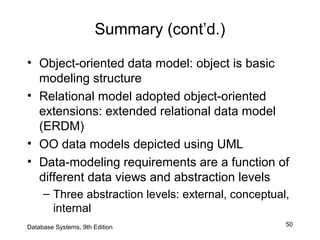
Summary (cont’d.)
• Object-oriented data model: object is basic
modeling structure
• Relational model adopted object-oriented
extensions: extended relational data model
(ERDM)
• OO data models depicted using UML
• Data-modeling requirements are a function of
different data views and abstraction levels
– Three abstraction levels: external, conceptual,
internal
Database Systems, 9th Edition

Fundamentals of Database ppt ch02

  • 1.
    1Database Systems, 9thEdition Database Systems: Design, Implementation, and Management Ninth Edition Chapter 2 Data Models
  • 2.
    2 Objectives In this chapter,you will learn: • About data modeling and why data models are important • About the basic data-modeling building blocks • What business rules are and how they influence database design • How the major data models evolved • How data models can be classified by level of abstraction Database Systems, 9th Edition
  • 3.
    3 Introduction • Designers, programmers,and end users see data in different ways • Different views of same data lead to designs that do not reflect organization’s operation • Data modeling reduces complexities of database design • Various degrees of data abstraction help reconcile varying views of same data Database Systems, 9th Edition
  • 4.
    4 Data Modeling andData Models • Data models – Relatively simple representations of complex real-world data structures • Often graphical • Model: an abstraction of a real-world object or event – Useful in understanding complexities of the real-world environment • Data modeling is iterative and progressive Database Systems, 9th Edition
  • 5.
    5 The Importance ofData Models • Facilitate interaction among the designer, the applications programmer, and the end user • End users have different views and needs for data • Data model organizes data for various users • Data model is an abstraction – Cannot draw required data out of the data model Database Systems, 9th Edition
  • 6.
    6 Data Model BasicBuilding Blocks • Entity: anything about which data are to be collected and stored • Attribute: a characteristic of an entity • Relationship: describes an association among entities – One-to-many (1:M) relationship – Many-to-many (M:N or M:M) relationship – One-to-one (1:1) relationship • Constraint: a restriction placed on the data Database Systems, 9th Edition
  • 7.
    7 Business Rules • Descriptionsof policies, procedures, or principles within a specific organization – Apply to any organization that stores and uses data to generate information • Description of operations to create/enforce actions within an organization’s environment – Must be in writing and kept up to date – Must be easy to understand and widely disseminated • Describe characteristics of data as viewed by the company Database Systems, 9th Edition
  • 8.
    8 Discovering Business Rules •Sources of business rules: – Company managers – Policy makers – Department managers – Written documentation • Procedures • Standards • Operations manuals – Direct interviews with end users Database Systems, 9th Edition
  • 9.
    9 Discovering Business Rules(cont’d.) • Standardize company’s view of data • Communications tool between users and designers • Allow designer to understand the nature, role, and scope of data • Allow designer to understand business processes • Allow designer to develop appropriate relationship participation rules and constraints Database Systems, 9th Edition
  • 10.
    10 Translating Business Rulesinto Data Model Components • Generally, nouns translate into entities • Verbs translate into relationships among entities • Relationships are bidirectional • Two questions to identify the relationship type: – How many instances of B are related to one instance of A? – How many instances of A are related to one instance of B? Database Systems, 9th Edition
  • 11.
    11 Naming Conventions • Namingoccurs during translation of business rules to data model components • Names should make the object unique and distinguishable from other objects • Names should also be descriptive of objects in the environment and be familiar to users • Proper naming: – Facilitates communication between parties – Promotes self-documentation Database Systems, 9th Edition
  • 12.
    12 The Evolution ofData Models Database Systems, 9th Edition
  • 13.
    13 The Hierarchical Model •The hierarchical model was developed in the 1960s to manage large amounts of data for manufacturing projects • Basic logical structure is represented by an upside-down “tree” • Hierarchical structure contains levels or segments – Segment analogous to a record type – Set of one-to-many relationships between segments Database Systems, 9th Edition
  • 14.
    14 The Network Model •The network model was created to represent complex data relationships more effectively than the hierarchical model – Improves database performance – Imposes a database standard • Resembles hierarchical model – However, record may have more than one parent Database Systems, 9th Edition
  • 15.
    15Database Systems, 9thEdition The Network Model (cont’d.) • Collection of records in 1:M relationships • Set composed of two record types: – Owner • Equivalent to the hierarchical model’s parent – Member • Equivalent to the hierarchical model’s child
  • 16.
    16 The Network Model(cont’d.) • Concepts still used today: – Schema • Conceptual organization of entire database as viewed by the database administrator – Subschema • Database portion “seen” by the application programs Database Systems, 9th Edition
  • 17.
    17 The Network Model(cont’d.) • Concepts still used today: (cont’d.) – Data management language (DML) • Defines the environment in which data can be managed – Data definition language (DDL) • Enables the administrator to define the schema components Database Systems, 9th Edition
  • 18.
    18 The Network Model(cont’d.) • Disadvantages of the network model: – Cumbersome – Lack of ad hoc query capability placed burden on programmers to generate code for reports – Structural change in the database could produce havoc in all application programs Database Systems, 9th Edition
  • 19.
    19 The Relational Model •Developed by E.F. Codd (IBM) in 1970 • Table (relations) – Matrix consisting of row/column intersections – Each row in a relation is called a tuple • Relational models were considered impractical in 1970 • Model was conceptually simple at expense of computer overhead Database Systems, 9th Edition
  • 20.
    20 The Relational Model(cont’d.) • Relational data management system (RDBMS) – Performs same functions provided by hierarchical model – Hides complexity from the user • Relational diagram – Representation of entities, attributes, and relationships • Relational table stores collection of related entities Database Systems, 9th Edition
  • 21.
  • 22.
  • 23.
    23Database Systems, 9thEdition The Relational Model (cont’d.) • SQL-based relational database application involves three parts: – User interface • Allows end user to interact with the data – Set of tables stored in the database • Each table is independent from another • Rows in different tables are related based on common values in common attributes – SQL “engine” • Executes all queries
  • 24.
    24 The Entity RelationshipModel • Widely accepted standard for data modeling • Introduced by Chen in 1976 • Graphical representation of entities and their relationships in a database structure • Entity relationship diagram (ERD) – Uses graphic representations to model database components – Entity is mapped to a relational table Database Systems, 9th Edition
  • 25.
    25 The Entity RelationshipModel (cont’d.) • Entity instance (or occurrence) is row in table • Entity set is collection of like entities • Connectivity labels types of relationships • Relationships are expressed using Chen notation – Relationships are represented by a diamond – Relationship name is written inside the diamond • Crow’s Foot notation used as design standard in this book Database Systems, 9th Edition
  • 26.
  • 27.
    27 The Object-Oriented (OO)Model • Data and relationships are contained in a single structure known as an object • OODM (object-oriented data model) is the basis for OODBMS – Semantic data model • An object: – Contains operations – Are self-contained: a basic building-block for autonomous structures – Is an abstraction of a real-world entity Database Systems, 9th Edition
  • 28.
    28 The Object-Oriented (OO)Model (cont’d.) • Attributes describe the properties of an object • Objects that share similar characteristics are grouped in classes • Classes are organized in a class hierarchy • Inheritance: object inherits methods and attributes of parent class • UML based on OO concepts that describe diagrams and symbols – Used to graphically model a system Database Systems, 9th Edition
  • 29.
  • 30.
    30 Newer Data Models: Object/Relationaland XML • Extended relational data model (ERDM) – Semantic data model developed in response to increasing complexity of applications – Includes many of OO model’s best features – Often described as an object/relational database management system (O/RDBMS) – Primarily geared to business applications Database Systems, 9th Edition
  • 31.
    31 Newer Data Models: Object/Relationaland XML (cont’d.) • The Internet revolution created the potential to exchange critical business information • In this environment, Extensible Markup Language (XML) emerged as the de facto standard • Current databases support XML – XML: the standard protocol for data exchange among systems and Internet services Database Systems, 9th Edition
  • 32.
    32 The Future ofData Models • Hybrid DBMSs – Retain advantages of relational model – Provide object-oriented view of the underlying data • SQL data services – Store data remotely without incurring expensive hardware, software, and personnel costs – Companies operate on a “pay-as-you-go” system Database Systems, 9th Edition
  • 33.
  • 34.
    34 Data Models: ASummary • Common characteristics: – Conceptual simplicity with semantic completeness – Represent the real world as closely as possible – Real-world transformations must comply with consistency and integrity characteristics • Each new data model capitalized on the shortcomings of previous models • Some models better suited for some tasks Database Systems, 9th Edition
  • 35.
  • 36.
    36 Degrees of DataAbstraction • Database designer starts with abstracted view, then adds details • ANSI Standards Planning and Requirements Committee (SPARC) – Defined a framework for data modeling based on degrees of data abstraction (1970s): • External • Conceptual • Internal Database Systems, 9th Edition
  • 37.
    37 The External Model •End users’ view of the data environment • ER diagrams represent external views • External schema: specific representation of an external view – Entities – Relationships – Processes – Constraints Database Systems, 9th Edition
  • 38.
  • 39.
    39 The External Model(cont’d.) • Easy to identify specific data required to support each business unit’s operations • Facilitates designer’s job by providing feedback about the model’s adequacy • Ensures security constraints in database design • Simplifies application program development Database Systems, 9th Edition
  • 40.
  • 41.
    41 The Conceptual Model •Represents global view of the entire database • All external views integrated into single global view: conceptual schema • ER model most widely used • ERD graphically represents the conceptual schema Database Systems, 9th Edition
  • 42.
  • 43.
    43 The Conceptual Model(cont’d.) • Provides a relatively easily understood macro level view of data environment • Independent of both software and hardware – Does not depend on the DBMS software used to implement the model – Does not depend on the hardware used in the implementation of the model – Changes in hardware or software do not affect database design at the conceptual level Database Systems, 9th Edition
  • 44.
    44 The Internal Model •Representation of the database as “seen” by the DBMS – Maps the conceptual model to the DBMS • Internal schema depicts a specific representation of an internal model • Depends on specific database software – Change in DBMS software requires internal model be changed • Logical independence: change internal model without affecting conceptual model Database Systems, 9th Edition
  • 45.
  • 46.
    46 The Physical Model •Operates at lowest level of abstraction – Describes the way data are saved on storage media such as disks or tapes • Requires the definition of physical storage and data access methods • Relational model aimed at logical level – Does not require physical-level details • Physical independence: changes in physical model do not affect internal model Database Systems, 9th Edition
  • 47.
  • 48.
    48 Summary • A datamodel is an abstraction of a complex real-world data environment • Basic data modeling components: – Entities – Attributes – Relationships – Constraints • Business rules identify and define basic modeling components Database Systems, 9th Edition
  • 49.
    49 Summary (cont’d.) • Hierarchicalmodel – Set of one-to-many (1:M) relationships between a parent and its children segments • Network data model – Uses sets to represent 1:M relationships between record types • Relational model – Current database implementation standard – ER model is a tool for data modeling • Complements relational model Database Systems, 9th Edition
  • 50.
    50 Summary (cont’d.) • Object-orienteddata model: object is basic modeling structure • Relational model adopted object-oriented extensions: extended relational data model (ERDM) • OO data models depicted using UML • Data-modeling requirements are a function of different data views and abstraction levels – Three abstraction levels: external, conceptual, internal Database Systems, 9th Edition