1
2
3
Unit I
4
Fibrous & Globular
proteins
Practical
Extracellular matrix fibrous proteins
Globular proteins: hemoglobin, myoglobin
Pathology of hemoglobin
5
3. 1. Fibrous proteins
(Quick Review)
6
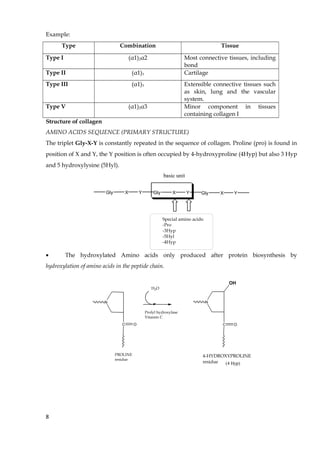
Practical class N 8
Subject: “Fibrous proteins”.
Theoretical questions:
1. Collagen. Structure. Cross-links. Biosyntehsis.
2. Disease due to collagen: Ehler- Danlos syndrome, osteogenesis imperfecta.
3. Elastin. Structure. Cross-links, Function, biosynthesis.
4. Morfan syndrome.
3. 1. 1. Summary of collagen
• There are 19 types of collagen identified in human tissues.
• Different genes coded the synthesis different type of collagen.
• The various types of collagen consist of different combination of α-chain.
7
Example:
Type Combination Tissue
Type I (α1)2α2 Most connective tissues, including
bond
Type II (α1)3 Cartilage
Type III (α1)3 Extensible connective tissues such
as skin, lung and the vascular
system.
Type V (α1)2α3 Minor component in tissues
containing collagen I
Structure of collagen
AMINO ACIDS SEQUENCE (PRIMARY STRUCTURE)
The triplet Gly-X-Y is constantly repeated in the sequence of collagen. Proline (pro) is found in
position of X and Y, the Y position is often occupied by 4-hydroxyproline (4Hyp) but also 3 Hyp
and 5 hydroxylysine (5Hyl).
Gly X Y Gly X Y Gly X Y
basic unit
Special amino acids:
-Pro
-3Hyp
-5Hyl
-4Hyp
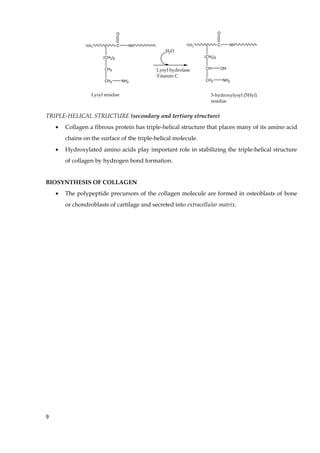
• The hydroxylated Amino acids only produced after protein biosynthesis by
hydroxylation of amino acids in the peptide chain.
N
C O
N
C O
OH
Prolyl hydroxylase
Vitamin C
H2O
PROLINE
residue
4-HYDROXYPROLINE
residue (4 Hyp)
8
NH2 C
(CH2)2
CH2
CH2 NH2
O
NH NH2 C
(CH2)2
CH
CH2 NH2
O
NH
OH
H2O
Lysyl hydrolase
Vitamin C
Lysyl residue 5-hydroxylysyl (5Hyl)
residue
TRIPLE-HELICAL STRUCTURE (secondary and tertiary structure)
• Collagen a fibrous protein has triple-helical structure that places many of its amino acid
chains on the surface of the triple-helical molecule.
• Hydroxylated amino acids play important role in stabilizing the triple-helical structure
of collagen by hydrogen bond formation.
BIOSYNTHESIS OF COLLAGEN
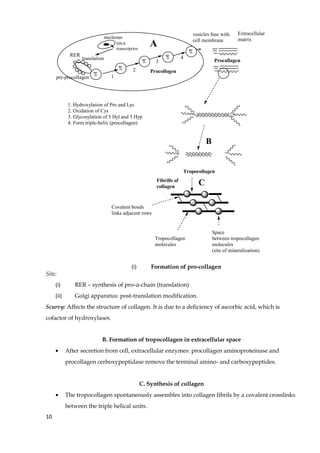
• The polypeptide precursors of the collagen molecule are formed in osteoblasts of bone
or chondroblasts of cartilage and secreted into extracellular matrix.
9
nucleous
Extracellular
matrix
RER
A
B
Procallagen
Procollogen
Tropocollagen
Fibrills of
collagen
Space
between tropocollagen
molecules
(site of mineralization)
C
Covalent bonds
links adjacent rows
Tropocollagen
molecules
DNA
transcription
translation
pre-procollagen 1
2
3
4
vesicles fuse with
cell membrane
1. Hydroxylation of Pro and Lys
2. Oxidation of Cys
3. Glycosylation of 5 Hyl and 5 Hyp
4. Form triple-helix (procollagen)
(i) Formation of pro-collagen
Site:
(i) RER – synthesis of pro-α-chain (translation)
(ii) Golgi apparatus: post-translation modification.
Scurvy: Affects the structure of collagen. It is due to a deficiency of ascorbic acid, which is
cofactor of hydroxylases.
B. Formation of tropocollagen in extracellular space
• After secretion from cell, extracellular enzymes: procollagen aminoproteinase and
procollagen cerboxypeptidase remove the terminal amino- and carboxypeptides.
C. Synthesis of collagen
• The tropocollagen spontaneously assembles into collagen fibrils by a covalent crosslinks
between the triple helical units.
10
CROSS-LINKS FORMATION:
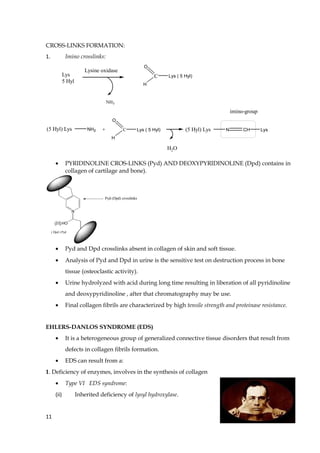
1. Imino crosslinks:
Lys
5 Hyl
Lysine oxidase
NH3
C
O
H
Lys ( 5 Hyl)
(5 Hyl) Lys NH2 + C
O
H
Lys ( 5 Hyl) (5 Hyl) Lys N CH Lys
H2O
imino-group
• PYRIDINOLINE CROS-LINKS (Pyd) AND DEOXYPYRIDINOLINE (Dpd) contains in
collagen of cartilage and bone).
N
HO
Pyd (Dpd) crosslinks
(H)
( Dpd ) Pyd
• Pyd and Dpd crosslinks absent in collagen of skin and soft tissue.
• Analysis of Pyd and Dpd in urine is the sensitive test on destruction process in bone
tissue (osteoclastic activity).
• Urine hydrolyzed with acid during long time resulting in liberation of all pyridinoline
and deoxypyridinoline , after that chromatography may be use.
• Final collagen fibrils are characterized by high tensile strength and proteinase resistance.
EHLERS-DANLOS SYNDROME (EDS)
• It is a heterogeneous group of generalized connective tissue disorders that result from
defects in collagen fibrils formation.
• EDS can result from a:
1. Deficiency of enzymes, involves in the synthesis of collagen
• Type VI EDS syndrome:
(ii) Inherited deficiency of lysyl hydroxylase.
11
(ii) This type is characterized severe scoliosis (abnormal vertebral column curvature) and
hyperextensivity of skin and joints.
• Type V EDS syndrome:
(i) Inherited deficiency of lysyl oxidase activity.
(ii) Small amount of cross-links
(iii) There is severe arteriovascular and skeletal change.
2. EDS can result from mutations in the amino acids sequence of collagen type I, III.
Collagen type II is an important component of arteries, potentially lethal vascular problem
occur.
OSTEOGENESIS IMPERFECTA (BRITTLE BONE SYNDROME)
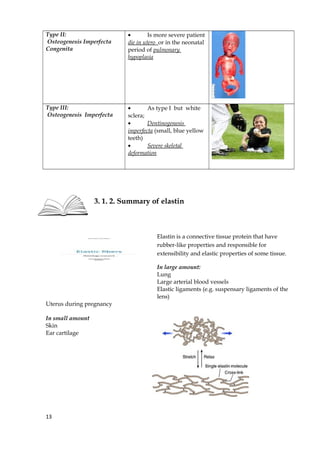
• It is a group of hereditary conditions characterized by abnormal development of type I
collagen, result in bone fragility.
• Osteogenesis imperfecta – mutations in the gene, coded pro-α1 or pro-α2 chains of type I
collagen.
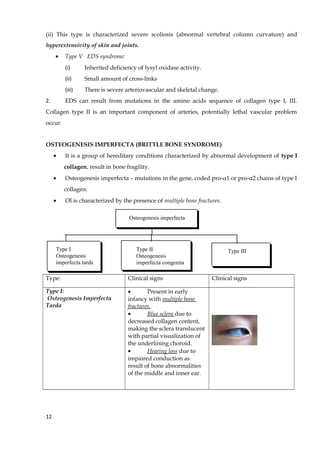
• OI is characterized by the presence of multiple bone fractures.
Osteogenesis imperfecta
Type IIIType II
Osteogenesis
imperfecta congenita
Type I
Osteogenesis
imperfecta tarda
Type: Clinical signs Clinical signs
Type I:
Osteogenesis Imperfecta
Tarda
• Present in early
infancy with multiple bone
fractures.
• Blue sclera due to
decreased collagen content,
making the sclera translucent
with partial visualization of
the underlining choroid.
• Hearing loss due to
impaired conduction as
result of bone abnormalities
of the middle and inner ear.
12
Type II:
Osteogenesis Imperfecta
Congenita
• Is more severe patient
die in utero or in the neonatal
period of pulmonary
hypoplasia
Type III:
Osteogenesis Imperfecta
• As type I but white
sclera;
• Dentinogenesis
imperfecta (small, blue yellow
teeth)
• Severe skeletal
deformation
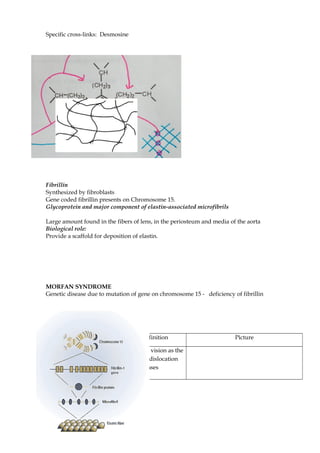
3. 1. 2. Summary of elastin
Elastin is a connective tissue protein that have
rubber-like properties and responsible for
extensibility and elastic properties of some tissue.
In large amount:
Lung
Large arterial blood vessels
Elastic ligaments (e.g. suspensary ligaments of the
lens)
Uterus during pregnancy
In small amount
Skin
Ear cartilage
13
Specific cross-links: Desmosine
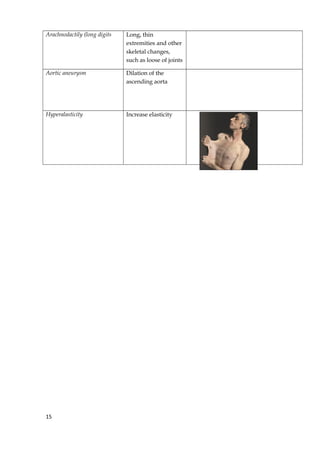
Fibrillin
Synthesized by fibroblasts
Gene coded fibrillin presents on Chromosome 15.
Glycoprotein and major component of elastin-associated microfibrils
Large amount found in the fibers of lens, in the periosteum and media of the aorta
Biological role:
Provide a scaffold for deposition of elastin.
MORFAN SYNDROME
Genetic disease due to mutation of gene on chromosome 15 - deficiency of fibrillin
Clinical signs Definition Picture
Ectopia lentis Reduced vision as the
result of dislocation
of the lenses
14
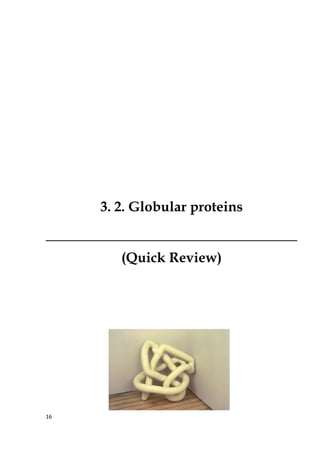
Arachnodactily (long digits Long, thin
extremities and other
skeletal changes,
such as loose of joints
Aortic aneurysm Dilation of the
ascending aorta
Hyperalasticity Increase elasticity
15
3. 2. Globular proteins
(Quick Review)
16
Practical class N 9
Subject: “Myoglobin and Hemoglobin”.
Theoretical questions:
1. Myoglobin. Structure. Functions.
2. Rhabdomyolysis and acute renal failure
3. Hemoglobin. Structure.
4. Types of hemoglobin. HbA, HbA2, HbF, HbA1C.
5. T-and R- forms of hemoglobin. Transport of gases. Hb buffer function.
6. Developmental biology of goblin chain synthesis. Gene families.
7. Nephrotoxic effect of myoglobinuria and hematuria on intrarenal vessels.
Laboratory work: Detection and Estimation of blood hemoglobin”.
3.2.1. Summary of Myoglobin
• Myoglobin (Mb) is a protein of cardiac and skeletal muscles (striated muscles).
• Red muscles which exhibit substantial activity are rich in myoglobin than white muscle.
• Adult man has about 40 mg of myoglobin.
Biological role:
• Myoglobin stores oxygen as a reserve against oxygen deprivation
Structure of myoglobin
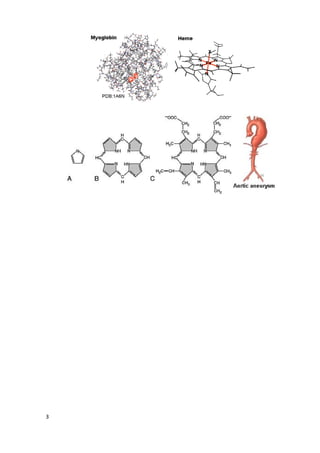
• It is globular conjugated protein (metalloprotein)
• It contains a single polypeptide chain of about 150 amino acids.
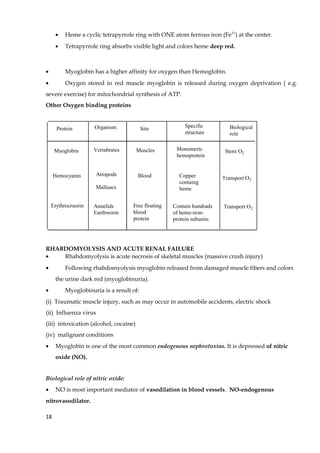
• Myoglobin contains heme as prosthetic group.
17
• Heme a cyclic tetrapyrrole ring with ONE atom ferrous iron (Fe2+
) at the center.
• Tetrapyrrole ring absorbs visible light and colors heme deep red.
• Myoglobin has a higher affinity for oxygen than Hemoglobin.
• Oxygen stored in red muscle myoglobin is released during oxygen deprivation ( e.g.
severe exercise) for mitochondrial synthesis of ATP.
Other Oxygen binding proteins
Myoglobin Vertabrates Muscles Monomeric
hemoprotein
Atropods
Malluscs
Blood Copper
containg
heme
Transport O2
Protein Organism Site Specific
structure
Biological
role
Hemocyanin
Erythrocruorin Annelids
Earthworm
Contain hundrads
of heme-iron-
protein subunits
Free floating
blood
protein
Transport O2
Store O2
RHABDOMYOLYSIS AND ACUTE RENAL FAILURE
• Rhabdomyolysis is acute necrosis of skeletal muscles (massive crush injury)
• Following rhabdomyolysis myoglobin released from damaged muscle fibers and colors
the urine dark red (myoglobinuria).
• Myoglobinuria is a result of:
(i) Traumatic muscle injury, such as may occur in automobile accidents, electric shock
(ii) Influenza virus
(iii) intoxication (alcohol, cocaine)
(iv) malignant conditions
• Myoglobin is one of the most common endogenous nephrotoxins. It is depressed of nitric
oxide (NO).
Biological role of nitric oxide:
• NO is most important mediator of vasodilation in blood vessels. NO-endogenous
nitrovasodilator.
18
• The vasodilatory actions of nitric oxide play a key role in renal control of extracellular fluid
homeostasis and is essential for the regulation of blood flow and blood pressure.
• NO also plays a role in erection of the penis.
• Myoglobinuria leads renal vasoconstriction; ischemia (acute renal failure); renal stone
formation (nephrolithiasis); immunoglobulin formation increase; inflammation.
3.2.2. Summary of Hemoglobin
What is Hemoglobin?
• Hemoglobin is metalloprotein that composed from
(i) Protein part: globin
(ii) Heme: non-protein part – N-containing cyclic compound
(iii) Metal ion: iron (II)
• A single RBC has 29 picogramm (10-12
) of hemoglobin
• Total Hemoglobin in blood of adult approximately 900 g.
• The normal concentration of hemoglobin
(i) Adult male ………..130-160 g/L
(ii) Adult female………120-140g/L
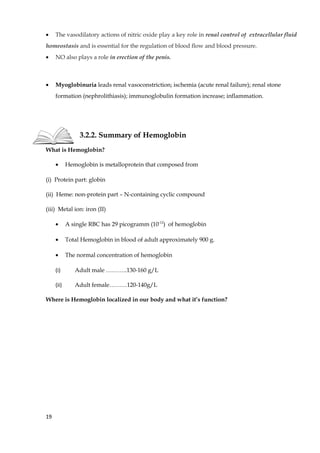
Where is Hemoglobin localized in our body and what it’s function?
19
10%
Other sites
Dopaminergic
neurons in the
substantia nigra
Macrophages
Oxygen-
carrying
function
Regulatory function of
iron metabolism
90%
RBCs
Component of
buffer system
of the blood
Alveolar
cells
What is the structure of Adult Hemoglobin (HbA1) ?
It is a heterotetramer consisting of two α-chains and two β-chains
(α2β2)
Primary structure:
- α-chain have 141 amino acids and similar for different types of
hemoglobin
- β-chain have 146 amino acids (has high content of histidine,
lysine). This type of chain in different isotypes may be γ, δ, ε and also have similar quantities of
amino acids but different sequence of amino acids in terminal regions.
E.g. β-chain: Val-His-Leu-----------------------------Lys- Tyr-His
γ-chain: Gly-His-Phe----------------------------His-Tyr-Arg
Secondary structure: 80% of the amino acid residues form α-helix.
Tertiary structure: Each chain in globular form with one domain. Each subunit carries a heme
group, with a central bivalent iron ion.
Quaternary structure: Heterotetramer.
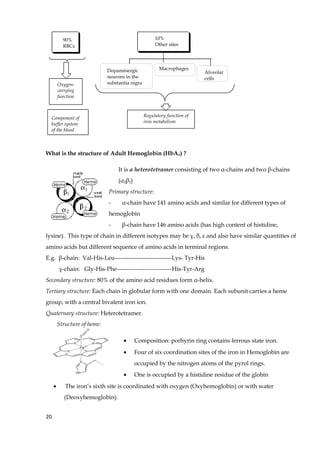
Structure of heme:
• Composition: porhyrin ring contains ferrous state iron.
• Four of six coordination sites of the iron in Hemoglobin are
occupied by the nitrogen atoms of the pyrol rings.
• One is occupied by a histidine residue of the globin
• The iron’s sixth site is coordinated with oxygen (Oxyhemoglobin) or with water
(Deoxyhemoglobin).
20
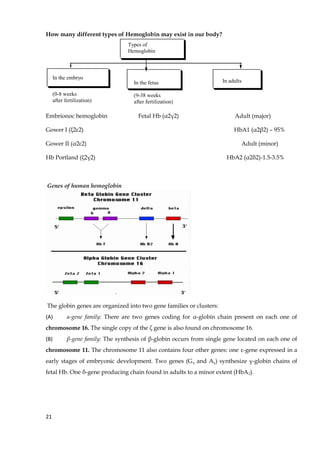
How many different types of Hemoglobin may exist in our body?
Types of
Hemoglobin
In the embryo
(0-8 weeks
after fertilization)
In the fetus
(9-38 weeks
after fertilization)
In adults
Embrionoc hemoglobin Fetal Hb (α2γ2) Adult (major)
Gower I (ξ2ε2) HbA1 (α2β2) – 95%
Gower II (α2ε2) Adult (minor)
Hb Portland (ξ2γ2) HbA2 (α2δ2)-1.5-3.5%
Genes of human hemoglobin
The globin genes are organized into two gene families or clusters:
(A) α-gene family: There are two genes coding for α-globin chain present on each one of
chromosome 16. The single copy of the ζ gene is also found on chromosome 16.
(B) β-gene family: The synthesis of β-globin occurs from single gene located on each one of
chromosome 11. The chromosome 11 also contains four other genes: one ε-gene expressed in a
early stages of embryonic development. Two genes (Gγ and Aγ) synthesize γ-globin chains of
fetal Hb. One δ-gene producing chain found in adults to a minor extent (HbA2).
21
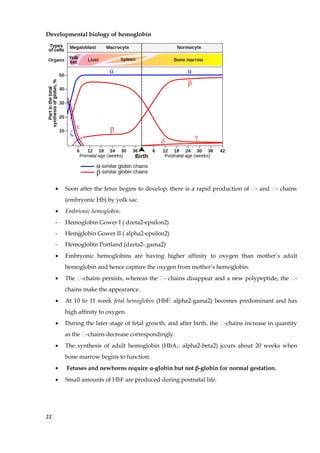
Developmental biology of hemoglobin
• Soon after the fetus begins to develop, there is a rapid production of - and - chains
(embryonic Hb) by yolk sac.
• Embrionic hemoglobin:
- Hemoglobin Gower I ( dzeta2-epsilon2)
- Hemjglobin Gower II ( alpha2-epsilon2)
- Hemoglobin Portland (dzeta2- gama2)
• Embryonic hemoglobins are having higher affinity to oxygen than mother’s adult
hemoglobin and hence capture the oxygen from mother’s hemoglobin.
• The -chains persists, whereas the - chains disappear and a new polypeptide, the -
chains make the appearance.
• At 10 to 11 week fetal hemoglobin (HbF: alpha2-gama2) becomes predominant and has
high affinity to oxygen.
• During the later stage of fetal growth, and after birth, the -chains increase in quantity
as the -chains decrease correspondingly.
• The synthesis of adult hemoglobin (HbA1: alpha2-beta2) jccurs about 20 weeks when
bone marrow begins to function.
• Fetuses and newborns require α-globin but not β-globin for normal gestation.
• Small amounts of HbF are produced during postnatal life.
22
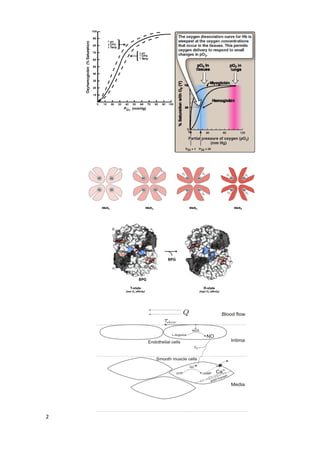
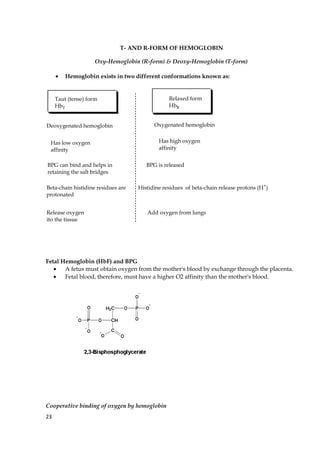
T- AND R-FORM OF HEMOGLOBIN
Oxy-Hemoglobin (R-form) & Deoxy-Hemoglobin (T-form)
• Hemoglobin exists in two different conformations known as:
Taut (tense) form
HbT
Relaxed form
HbR
Has high oxygen
affinity
Has low oxygen
affinity
Add oxygen from lungs
Deoxygenated hemoglobin Oxygenated hemoglobin
BPG can bind and helps in
retaining the salt bridges
Beta-chain histidine residues are
protonated
Release oxygen
ito the tissue
Histidine residues of beta-chain release protons (H+
)
BPG is released
Fetal Hemoglobin (HbF) and BPG
• A fetus must obtain oxygen from the mother's blood by exchange through the placenta.
• Fetal blood, therefore, must have a higher O2 affinity than the mother's blood.
Cooperative binding of oxygen by hemoglobin
23
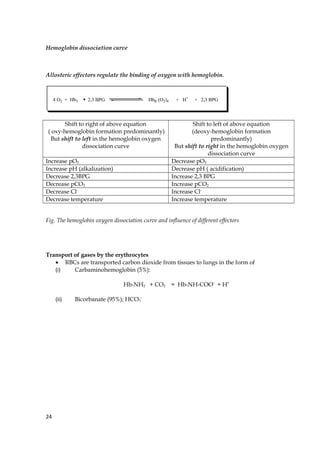
Hemoglobin dissociation curve
Allosteric effectors regulate the binding of oxygen with hemoglobin.
4 O2 + HbT 2,3 BPG HbR (O2)4 + H+
+ 2,3 BPG
Shift to right of above equation
( oxy-hemoglobin formation predominantly)
But shift to left in the hemoglobin oxygen
dissociation curve
Shift to left of above equation
(deoxy-hemoglobin formation
predominantly)
But shift to right in the hemoglobin oxygen
dissociation curve
Increase pO2 Decrease pO2
Increase pH (alkalization) Decrease pH ( acidification)
Decrease 2,3BPG Increase 2,3 BPG
Decrease pCO2 Increase pCO2
Decrease Cl-
Increase Cl-
Decrease temperature Increase temperature
Fig. The hemoglobin oxygen dissociation curve and influence of different effectors
Transport of gases by the erythrocytes
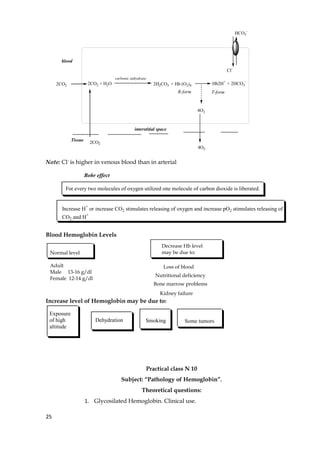
• RBCs are transported carbon dioxide from tissues to lungs in the form of
(i) Carbaminohemoglobin (5%):
Hb-NH2 + CO2 = Hb-NH-COO-
+ H+
(ii) Bicorbanate (95%); HCO3
-
24
2CO2 + H2O
carbonic anhydrase
2H2CO3 + Hb (O2)4 Hb2H+
+ 2HCO3
-
HCO3
-
Cl-
4O2
Tissue
R-form T-form
blood
2CO2
interstitial space
2CO2
4O2
Note: Cl-
is higher in venous blood than in arterial
Bohr effect
For every two molecules of oxygen utilized one molecule of carbon dioxide is liberated.
Increase H+
or increase CO2 stimulates releasing of oxygen and increase pO2 stimulates releasing of
CO2 and H+
Blood Hemoglobin Levels
Normal level
Adult
Male 13-16 g/dl
Female 12-14 g/dl
Decrease Hb level
may be due to:
Loss of blood
Nutritional deficiency
Bone marrow problems
Kidney failure
Increase level of Hemoglobin may be due to:
Exposure
of high
altitude
SmokingDehydration Some tumors
Practical class N 10
Subject: “Pathology of Hemoglobin”.
Theoretical questions:
1. Glycosilated Hemoglobin. Clinical use.
25
2. Structural hemogloglobinopathies: sickle cell anemia, biochemical
mechanism of pathology, clinical signs, laboratory investigation
3. Structural hemoglobinopathies: thalassemias syndrome. Classification.
Biochemical mechanism of pathology, Clinical signs.
4. Functional hemoglobinopathies: Methemoglobin, carboxyhemoglobin
3.2. 3. Pathology of Hemoglobin
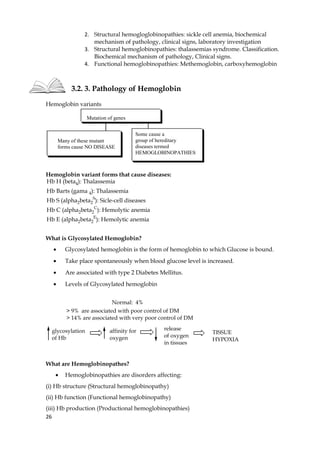
Hemoglobin variants
Mutation of genes
Some cause a
group of hereditary
diseases termed
HEMOGLOBINOPATHIES
Many of these mutant
forms cause NO DISEASE
Hemoglobin variant forms that cause diseases:
Hb H (beta4): Thalassemia
Hb Barts (gama 4): Thalassemia
Hb S (alpha2beta2
S
): Sicle-cell diseases
Hb C (alpha2beta2
C
): Hemolytic anemia
Hb E (alpha2beta2
E
): Hemolytic anemia
What is Glycosylated Hemoglobin?
• Glycosylated hemoglobin is the form of hemoglobin to which Glucose is bound.
• Take place spontaneously when blood glucose level is increased.
• Are associated with type 2 Diabetes Mellitus.
• Levels of Glycosylated hemoglobin
Normal: 4%
> 9% are associated with poor control of DM
> 14% are associated with very poor control of DM
glycosylation
of Hb
affinity for
oxygen
release
of oxygen
in tissues
TISSUE
HYPOXIA
What are Hemoglobinopathes?
• Hemoglobinopathies are disorders affecting:
(i) Hb structure (Structural hemoglobinopathy)
(ii) Hb function (Functional hemoglobinopathy)
(iii) Hb production (Productional hemoglobinopathies)
26
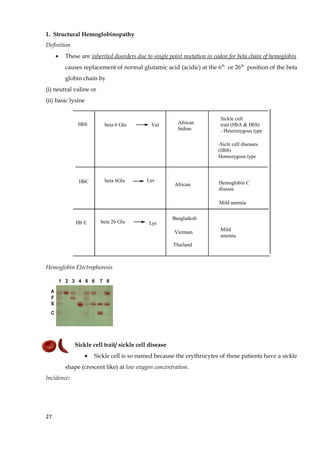
1. Structural Hemoglobinopathy
Definition
• These are inherited disorders due to single point mutation in codon for beta chain of hemoglobin
causes replacement of normal glutamic acid (acidic) at the 6th
or 26th
position of the beta
globin chain by
(i) neutral valine or
(ii) basic lysine
HbS beta 6 Glu Val African
Indian
Sickle cell
trait (HbA & HbS)
- Heterozygous type
-Sicle cell diseases
(HbS)
Homozygous type
HbC beta 6Glu Lys
African Hemoglobin C
disease
Mild anemia
Hb E beta 26 Glu Lys
Bangladesh
Vietnam
Thailand
Mild
anemia
Hemoglobin Electrophoresis
Sickle cell trait/ sickle cell disease
• Sickle cell is so named because the erythrocytes of these patients have a sickle
shape (crescent like) at low oxygen concentration.
Incidence:
27
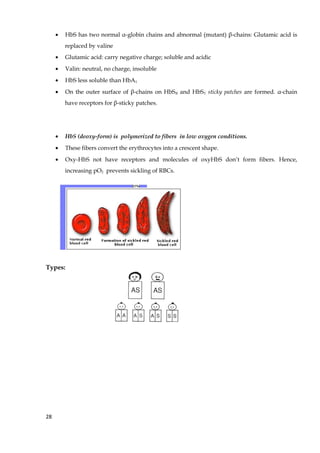
• HbS has two normal α-globin chains and abnormal (mutant) β-chains: Glutamic acid is
replaced by valine
• Glutamic acid: carry negative charge; soluble and acidic
• Valin: neutral, no charge, insoluble
• HbS less soluble than HbA1
• On the outer surface of β-chains on HbSR and HbST sticky patches are formed. α-chain
have receptors for β-sticky patches.
• HbS (deoxy-form) is polymerized to fibers in low oxygen conditions.
• These fibers convert the erythrocytes into a crescent shape.
• Oxy-HbS not have receptors and molecules of oxyHbS don’t form fibers. Hence,
increasing pO2 prevents sickling of RBCs.
Types:
28
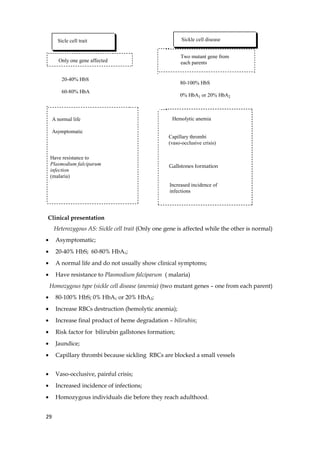
Sicle cell trait Sickle cell disease
Only one gene affected
Two mutant gene from
each parents
20-40% HbS
60-80% HbA
80-100% HbS
0% HbA1 or 20% HbA2
A normal life
Asymptomatic
Have resistance to
Plasmodium falciparum
infection
(malaria)
Hemolytic anemia
Capillary thrombi
(vaso-occlusive crisis)
Increased incidence of
infections
Gallstones formation
Clinical presentation
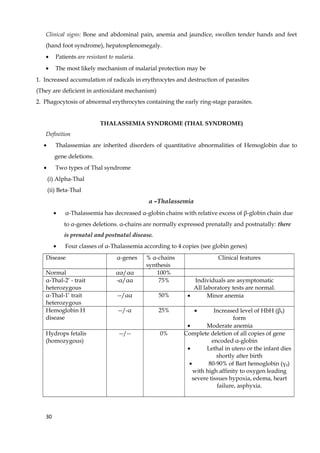
Heterozygous AS: Sickle cell trait (Only one gene is affected while the other is normal)
• Asymptomatic;
• 20-40% HbS; 60-80% HbA1;
• A normal life and do not usually show clinical symptoms;
• Have resistance to Plasmodium falciparum ( malaria)
Homozygous type (sickle cell disease (anemia) (two mutant genes – one from each parent)
• 80-100% HbS; 0% HbA1 or 20% HbA2;
• Increase RBCs destruction (hemolytic anemia);
• Increase final product of heme degradation – bilirubin;
• Risk factor for bilirubin gallstones formation;
• Jaundice;
• Capillary thrombi because sickling RBCs are blocked a small vessels
• Vaso-occlusive, painful crisis;
• Increased incidence of infections;
• Homozygous individuals die before they reach adulthood.
29
Clinical signs: Bone and abdominal pain, anemia and jaundice, swollen tender hands and feet
(hand foot syndrome), hepatosplenomegaly.
• Patients are resistant to malaria.
• The most likely mechanism of malarial protection may be
1. Increased accumulation of radicals in erythrocytes and destruction of parasites
(They are deficient in antioxidant mechanism)
2. Phagocytosis of abnormal erythrocytes containing the early ring-stage parasites.
THALASSEMIA SYNDROME (THAL SYNDROME)
Definition
• Thalassemias are inherited disorders of quantitative abnormalities of Hemoglobin due to
gene deletions.
• Two types of Thal syndrome
(i) Alpha-Thal
(ii) Beta-Thal
α –Thalassemia
• α-Thalassemia has decreased α-globin chains with relative excess of β-globin chain due
to α-genes deletions. α-chains are normally expressed prenatally and postnatally: there
is prenatal and postnatal disease.
• Four classes of α-Thalassemia according to 4 copies (see globin genes)
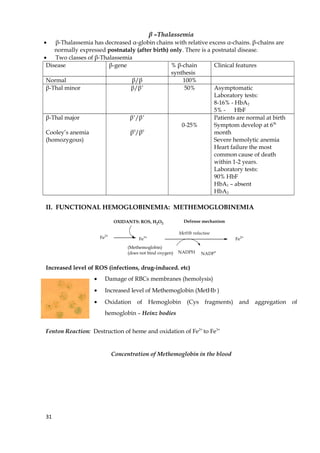
Disease α-genes % α-chains
synthesis
Clinical features
Normal αα/αα 100%
α-Thal-2’ - trait
heterozygous
-α/αα 75% Individuals are asymptomatic
All laboratory tests are normal.
α-Thal-1’ trait
heterozygous
--/αα 50% • Minor anemia
Hemoglobin H
disease
--/-α 25% • Increased level of HbH (β4)
form
• Moderate anemia
Hydrops fetalis
(homozygous)
--/-- 0% Complete deletion of all copies of gene
encoded α-globin
• Lethal in utero or the infant dies
shortly after birth
• 80-90% of Bart hemoglobin (γ4)
with high affinity to oxygen leading
severe tissues hypoxia, edema, heart
failure, asphyxia.
30
β –Thalassemia
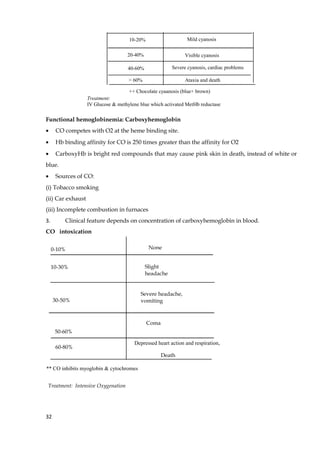
• β-Thalassemia has decreased α-globin chains with relative excess α-chains. β-chains are
normally expressed postnataly (after birth) only. There is a postnatal disease.
• Two classes of β-Thalassemia
Disease β-gene % β-chain
synthesis
Clinical features
Normal β/β 100%
β-Thal minor β/β+
50% Asymptomatic
Laboratory tests:
8-16% - HbA2
5% - HbF
β-Thal major
Cooley’s anemia
(homozygous)
β+
/β+
β0
/β0
0-25%
Patients are normal at birth
Symptom develop at 6th
month
Severe hemolytic anemia
Heart failure the most
common cause of death
within 1-2 years.
Laboratory tests:
90% HbF
HbA1 – absent
HbA2
II. FUNCTIONAL HEMOGLOBINEMIA: METHEMOGLOBINEMIA
Fe2+
Fe3+
OXIDANTS: ROS, H2O2 Defense mechanism
(Methemoglobin)
(does not bind oxygen)
Fe2+
NADPH NADP+
MetHb reductase
Increased level of ROS (infections, drug-induced. etc)
• Damage of RBCs membranes (hemolysis)
• Increased level of Methemoglobin (MetHb )
• Oxidation of Hemoglobin (Cys fragments) and aggregation of
hemoglobin – Heinz bodies
Fenton Reaction: Destruction of heme and oxidation of Fe2+
to Fe3+
Concentration of Methemoglobin in the blood
31
10-20% Mild cyanosis
20-40% Visible cyanosis
40-60% Severe cyanosis, cardiac problems
> 60% Ataxia and death
Treatment:
IV Glucose & methylene blue which activated MetHb reductase
++ Chocolate cyaanosis (blue+ brown)
Functional hemoglobinemia: Carboxyhemoglobin
• CO competes with O2 at the heme binding site.
• Hb binding affinity for CO is 250 times greater than the affinity for O2
• CarboxyHb is bright red compounds that may cause pink skin in death, instead of white or
blue.
• Sources of CO:
(i) Tobacco smoking
(ii) Car exhaust
(iii) Incomplete combustion in furnaces
3. Clinical feature depends on concentration of carboxyhemoglobin in blood.
CO intoxication
0-10% None
10-30% Slight
headache
30-50%
Severe headache,
vomiting
50-60%
Coma
60-80%
Death
Treatment: Intensive Oxygenation
** CO inhibits myoglobin & cytochromes
Depressed heart action and respiration,
32
3.3. Laboratory practice
3.3.1. DETECTION AND ESTIMATION OF BLOOD HEMOGLOBIN
Principle
The blood is diluted in Drabkin’s reagent, which hemolyses the red cells and
converts the hemoglobin into hemiglobincyanide. The solution obtained is
examined in a colorimeter. Its optical density is directly proportional to the amount of
hemoglobin in the blood.
Reagents and materials:
33
• Drabkin’s reagent (0.2 g potassium ferricyanide -K3[Fe(CN)6], 1.0g sodium carbonate, 0.5
ml of acetoncyanhydrine
CH3 C CH3
CN
OH
• Hemoglobin standard solution (140 g/L)
• Sample of patient’s serum
• Blood (Sahli) pipettes, 0.02 ml
• Test tubes
• Colorimeter
Procedure:
• Take three test tubes and mark them B (blank), R (reference) and P (patient)
respectively.
• Prepare solution according to the table:
Table Preparing of the working solution for determination of blood hemoglobin
№ Reagents B R P
1. Drabkin’s reagent 5.0 ml - 5.0 ml
2. Hemoglobin standard
solution
- 5.0 ml -
3. Serum - - 0.02 ml
Let the test tube stand
at room temperature
for 10 minutes
• Mix the contents of each test tube.
• Read the optical density (O.D.) of solutions from P and R test tubes against blank
solution at 490-540 nm transmissions (green filter) in a colorimeter using cuvette with
1.0 cm thickness of medium through light passes.
Calculation
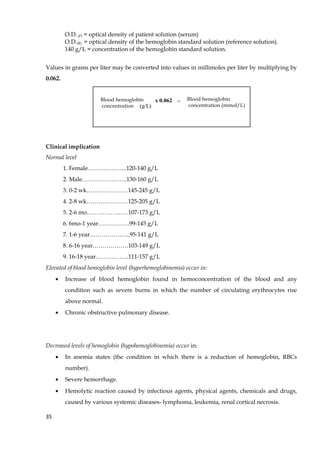
Calculate the concentration of blood hemoglobin using the following formula:
Blood hemoglobin
concentration =
(g/L)
O.D.(P)
O.D.(R)
140 g/L
Where,
34
O.D.(P) = optical density of patient solution (serum)
O.D.(R) = optical density of the hemoglobin standard solution (reference solution).
140 g/L = concentration of the hemoglobin standard solution.
Values in grams per liter may be converted into values in millimoles per liter by multiplying by
0.062.
Blood hemoglobin
concentration (g/L)
x 0.062 Blood hemoglobin
concentration (mmol/L)
=
Clinical implication
Normal level
1. Female………………..120-140 g/L
2. Male…………………..130-160 g/L
3. 0-2 wk…………………145-245 g/L
4. 2-8 wk…………………125-205 g/L
5. 2-6 mo…………………107-173 g/L
6. 6mo-1 year…………….99-145 g/L
7. 1-6 year………………...95-141 g/L
8. 6-16 year………………103-149 g/L
9. 16-18 year……………..111-157 g/L
Elevated of blood hemoglobin level (hyperhemoglobinemia) occur in:
• Increase of blood hemoglobin found in hemoconcentration of the blood and any
condition such as severe burns in which the number of circulating erythrocytes rise
above normal.
• Chronic obstructive pulmonary disease.
Decreased levels of hemoglobin (hypohemoglobinemia) occur in:
• In anemia states (the condition in which there is a reduction of hemoglobin, RBCs
number).
• Severe hemorrhage.
• Hemolytic reaction caused by infectious agents, physical agents, chemicals and drugs,
caused by various systemic diseases- lymphoma, leukemia, renal cortical necrosis.
35
Clinical alert
• The hemoglobin value is less than 50 g/L leads to heart failure and death.
• A value higher than 200 g/L leads to clogging of capillaries owing to hemoconcentration.
3.3.2. SLIDE TEST FOR SICKLE-CELL ANEMIA.
Background
Hemoglobin S is inherited abnormal hemoglobin. If inherited from both parents
it causes sickle-cell anemia, a serious disease. If inherited from only one pernt it causes sicle-
cell trait, which does not usually cause disease. Hemoglobin S occurs mainly in tropical Africa
but also in the Eastern Mediterranean region and among Americans of African origin. The
sickle-cell slide test does not distinguish between sickle cell anemia and sickle-cell trait.
Principle
One drop of blood is mixed with one drop of sodium metabisufite reagent on a slide. If the
erythrocytes contain hemoglobin S, they will become sickle-shaped or half-moon-shaped. The
reagent removes oxygen from the cells, allowing sickling to take place.
Reagents and materials:
• 2% of fresh sodium metabisulfite solution
• Capillary blood
• Microscope slides
• Microscope
• Coverslips
• Petri dish
• Two small wooden sticks
• Filter paper
36
Interfering factors
1. People leaving at high altitudes will have increased values, just as in
hematocrit values.
2. Excessive fluid intake will cause a decreased hemoglobin level.
3. Hemoglobin levels are normally decreased in pregnancy.
4. There are many drugs that may cause decreased levels of hemoglobin
(E.g. gentamicin and methyldopa).
• Dropping pipette
Procedure:
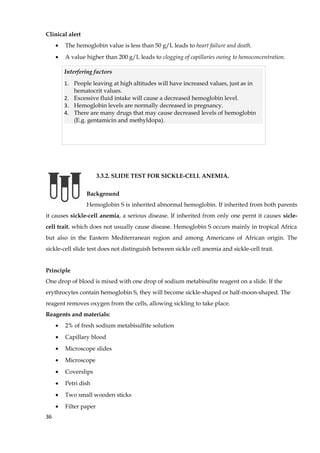
1. Place a small drop of capillary blood (about 4 mm
diameter) in the centre of a slide (see Fig.20.6).
2. Add an equal-sized drop of sodium metabisulfite
solution.
3. Mix carefully with the corner of slide (Fig.20.6).
4. 4. Cover with a coverslip, making sure that no air
bubbles form.
Fig.1. Mixing the blood and
Sodium metabisulfite solution
5. Place the slide in a Petri dish that has wet filter-
paper in the bottom. Support the slide on two
sticks (Fig.20.7.)
6. Wait 3- minutes before examination the slide.
Fig.2 Incubating the slide in
a Petri dish. Note: When using a reducing reagent such as sodium
metabisulfite it is not necessary to seal the
preparation.
7.Microscopic examination. Examine the slide under the microscope using the x
40 objective.
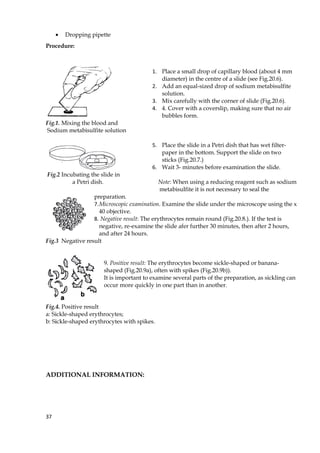
8. Negative result: The erythrocytes remain round (Fig.20.8.). If the test is
negative, re-examine the slide afer further 30 minutes, then after 2 hours,
and after 24 hours.
Fig.3 Negative result
9. Positive result: The erythrocytes become sickle-shaped or banana-
shaped (Fig.20.9a), often with spikes (Fig.20.9b)).
It is important to examine several parts of the preparation, as sickling can
occur more quickly in one part than in another.
Fig.4. Positive result
a: Sickle-shaped erythrocytes;
b: Sickle-shaped erythrocytes with spikes.
ADDITIONAL INFORMATION:
37
38

Fibrous protein & Globular protein

  • 1.
  • 2.
  • 3.
  • 4.
  • 5.
    Fibrous & Globular proteins Practical Extracellularmatrix fibrous proteins Globular proteins: hemoglobin, myoglobin Pathology of hemoglobin 5
  • 6.
    3. 1. Fibrousproteins (Quick Review) 6
  • 7.
    Practical class N8 Subject: “Fibrous proteins”. Theoretical questions: 1. Collagen. Structure. Cross-links. Biosyntehsis. 2. Disease due to collagen: Ehler- Danlos syndrome, osteogenesis imperfecta. 3. Elastin. Structure. Cross-links, Function, biosynthesis. 4. Morfan syndrome. 3. 1. 1. Summary of collagen • There are 19 types of collagen identified in human tissues. • Different genes coded the synthesis different type of collagen. • The various types of collagen consist of different combination of α-chain. 7
  • 8.
    Example: Type Combination Tissue TypeI (α1)2α2 Most connective tissues, including bond Type II (α1)3 Cartilage Type III (α1)3 Extensible connective tissues such as skin, lung and the vascular system. Type V (α1)2α3 Minor component in tissues containing collagen I Structure of collagen AMINO ACIDS SEQUENCE (PRIMARY STRUCTURE) The triplet Gly-X-Y is constantly repeated in the sequence of collagen. Proline (pro) is found in position of X and Y, the Y position is often occupied by 4-hydroxyproline (4Hyp) but also 3 Hyp and 5 hydroxylysine (5Hyl). Gly X Y Gly X Y Gly X Y basic unit Special amino acids: -Pro -3Hyp -5Hyl -4Hyp • The hydroxylated Amino acids only produced after protein biosynthesis by hydroxylation of amino acids in the peptide chain. N C O N C O OH Prolyl hydroxylase Vitamin C H2O PROLINE residue 4-HYDROXYPROLINE residue (4 Hyp) 8
  • 9.
    NH2 C (CH2)2 CH2 CH2 NH2 O NHNH2 C (CH2)2 CH CH2 NH2 O NH OH H2O Lysyl hydrolase Vitamin C Lysyl residue 5-hydroxylysyl (5Hyl) residue TRIPLE-HELICAL STRUCTURE (secondary and tertiary structure) • Collagen a fibrous protein has triple-helical structure that places many of its amino acid chains on the surface of the triple-helical molecule. • Hydroxylated amino acids play important role in stabilizing the triple-helical structure of collagen by hydrogen bond formation. BIOSYNTHESIS OF COLLAGEN • The polypeptide precursors of the collagen molecule are formed in osteoblasts of bone or chondroblasts of cartilage and secreted into extracellular matrix. 9
  • 10.
    nucleous Extracellular matrix RER A B Procallagen Procollogen Tropocollagen Fibrills of collagen Space between tropocollagen molecules (siteof mineralization) C Covalent bonds links adjacent rows Tropocollagen molecules DNA transcription translation pre-procollagen 1 2 3 4 vesicles fuse with cell membrane 1. Hydroxylation of Pro and Lys 2. Oxidation of Cys 3. Glycosylation of 5 Hyl and 5 Hyp 4. Form triple-helix (procollagen) (i) Formation of pro-collagen Site: (i) RER – synthesis of pro-α-chain (translation) (ii) Golgi apparatus: post-translation modification. Scurvy: Affects the structure of collagen. It is due to a deficiency of ascorbic acid, which is cofactor of hydroxylases. B. Formation of tropocollagen in extracellular space • After secretion from cell, extracellular enzymes: procollagen aminoproteinase and procollagen cerboxypeptidase remove the terminal amino- and carboxypeptides. C. Synthesis of collagen • The tropocollagen spontaneously assembles into collagen fibrils by a covalent crosslinks between the triple helical units. 10
  • 11.
    CROSS-LINKS FORMATION: 1. Iminocrosslinks: Lys 5 Hyl Lysine oxidase NH3 C O H Lys ( 5 Hyl) (5 Hyl) Lys NH2 + C O H Lys ( 5 Hyl) (5 Hyl) Lys N CH Lys H2O imino-group • PYRIDINOLINE CROS-LINKS (Pyd) AND DEOXYPYRIDINOLINE (Dpd) contains in collagen of cartilage and bone). N HO Pyd (Dpd) crosslinks (H) ( Dpd ) Pyd • Pyd and Dpd crosslinks absent in collagen of skin and soft tissue. • Analysis of Pyd and Dpd in urine is the sensitive test on destruction process in bone tissue (osteoclastic activity). • Urine hydrolyzed with acid during long time resulting in liberation of all pyridinoline and deoxypyridinoline , after that chromatography may be use. • Final collagen fibrils are characterized by high tensile strength and proteinase resistance. EHLERS-DANLOS SYNDROME (EDS) • It is a heterogeneous group of generalized connective tissue disorders that result from defects in collagen fibrils formation. • EDS can result from a: 1. Deficiency of enzymes, involves in the synthesis of collagen • Type VI EDS syndrome: (ii) Inherited deficiency of lysyl hydroxylase. 11
  • 12.
    (ii) This typeis characterized severe scoliosis (abnormal vertebral column curvature) and hyperextensivity of skin and joints. • Type V EDS syndrome: (i) Inherited deficiency of lysyl oxidase activity. (ii) Small amount of cross-links (iii) There is severe arteriovascular and skeletal change. 2. EDS can result from mutations in the amino acids sequence of collagen type I, III. Collagen type II is an important component of arteries, potentially lethal vascular problem occur. OSTEOGENESIS IMPERFECTA (BRITTLE BONE SYNDROME) • It is a group of hereditary conditions characterized by abnormal development of type I collagen, result in bone fragility. • Osteogenesis imperfecta – mutations in the gene, coded pro-α1 or pro-α2 chains of type I collagen. • OI is characterized by the presence of multiple bone fractures. Osteogenesis imperfecta Type IIIType II Osteogenesis imperfecta congenita Type I Osteogenesis imperfecta tarda Type: Clinical signs Clinical signs Type I: Osteogenesis Imperfecta Tarda • Present in early infancy with multiple bone fractures. • Blue sclera due to decreased collagen content, making the sclera translucent with partial visualization of the underlining choroid. • Hearing loss due to impaired conduction as result of bone abnormalities of the middle and inner ear. 12
  • 13.
    Type II: Osteogenesis Imperfecta Congenita •Is more severe patient die in utero or in the neonatal period of pulmonary hypoplasia Type III: Osteogenesis Imperfecta • As type I but white sclera; • Dentinogenesis imperfecta (small, blue yellow teeth) • Severe skeletal deformation 3. 1. 2. Summary of elastin Elastin is a connective tissue protein that have rubber-like properties and responsible for extensibility and elastic properties of some tissue. In large amount: Lung Large arterial blood vessels Elastic ligaments (e.g. suspensary ligaments of the lens) Uterus during pregnancy In small amount Skin Ear cartilage 13
  • 14.
    Specific cross-links: Desmosine Fibrillin Synthesizedby fibroblasts Gene coded fibrillin presents on Chromosome 15. Glycoprotein and major component of elastin-associated microfibrils Large amount found in the fibers of lens, in the periosteum and media of the aorta Biological role: Provide a scaffold for deposition of elastin. MORFAN SYNDROME Genetic disease due to mutation of gene on chromosome 15 - deficiency of fibrillin Clinical signs Definition Picture Ectopia lentis Reduced vision as the result of dislocation of the lenses 14
  • 15.
    Arachnodactily (long digitsLong, thin extremities and other skeletal changes, such as loose of joints Aortic aneurysm Dilation of the ascending aorta Hyperalasticity Increase elasticity 15
  • 16.
    3. 2. Globularproteins (Quick Review) 16
  • 17.
    Practical class N9 Subject: “Myoglobin and Hemoglobin”. Theoretical questions: 1. Myoglobin. Structure. Functions. 2. Rhabdomyolysis and acute renal failure 3. Hemoglobin. Structure. 4. Types of hemoglobin. HbA, HbA2, HbF, HbA1C. 5. T-and R- forms of hemoglobin. Transport of gases. Hb buffer function. 6. Developmental biology of goblin chain synthesis. Gene families. 7. Nephrotoxic effect of myoglobinuria and hematuria on intrarenal vessels. Laboratory work: Detection and Estimation of blood hemoglobin”. 3.2.1. Summary of Myoglobin • Myoglobin (Mb) is a protein of cardiac and skeletal muscles (striated muscles). • Red muscles which exhibit substantial activity are rich in myoglobin than white muscle. • Adult man has about 40 mg of myoglobin. Biological role: • Myoglobin stores oxygen as a reserve against oxygen deprivation Structure of myoglobin • It is globular conjugated protein (metalloprotein) • It contains a single polypeptide chain of about 150 amino acids. • Myoglobin contains heme as prosthetic group. 17
  • 18.
    • Heme acyclic tetrapyrrole ring with ONE atom ferrous iron (Fe2+ ) at the center. • Tetrapyrrole ring absorbs visible light and colors heme deep red. • Myoglobin has a higher affinity for oxygen than Hemoglobin. • Oxygen stored in red muscle myoglobin is released during oxygen deprivation ( e.g. severe exercise) for mitochondrial synthesis of ATP. Other Oxygen binding proteins Myoglobin Vertabrates Muscles Monomeric hemoprotein Atropods Malluscs Blood Copper containg heme Transport O2 Protein Organism Site Specific structure Biological role Hemocyanin Erythrocruorin Annelids Earthworm Contain hundrads of heme-iron- protein subunits Free floating blood protein Transport O2 Store O2 RHABDOMYOLYSIS AND ACUTE RENAL FAILURE • Rhabdomyolysis is acute necrosis of skeletal muscles (massive crush injury) • Following rhabdomyolysis myoglobin released from damaged muscle fibers and colors the urine dark red (myoglobinuria). • Myoglobinuria is a result of: (i) Traumatic muscle injury, such as may occur in automobile accidents, electric shock (ii) Influenza virus (iii) intoxication (alcohol, cocaine) (iv) malignant conditions • Myoglobin is one of the most common endogenous nephrotoxins. It is depressed of nitric oxide (NO). Biological role of nitric oxide: • NO is most important mediator of vasodilation in blood vessels. NO-endogenous nitrovasodilator. 18
  • 19.
    • The vasodilatoryactions of nitric oxide play a key role in renal control of extracellular fluid homeostasis and is essential for the regulation of blood flow and blood pressure. • NO also plays a role in erection of the penis. • Myoglobinuria leads renal vasoconstriction; ischemia (acute renal failure); renal stone formation (nephrolithiasis); immunoglobulin formation increase; inflammation. 3.2.2. Summary of Hemoglobin What is Hemoglobin? • Hemoglobin is metalloprotein that composed from (i) Protein part: globin (ii) Heme: non-protein part – N-containing cyclic compound (iii) Metal ion: iron (II) • A single RBC has 29 picogramm (10-12 ) of hemoglobin • Total Hemoglobin in blood of adult approximately 900 g. • The normal concentration of hemoglobin (i) Adult male ………..130-160 g/L (ii) Adult female………120-140g/L Where is Hemoglobin localized in our body and what it’s function? 19
  • 20.
    10% Other sites Dopaminergic neurons inthe substantia nigra Macrophages Oxygen- carrying function Regulatory function of iron metabolism 90% RBCs Component of buffer system of the blood Alveolar cells What is the structure of Adult Hemoglobin (HbA1) ? It is a heterotetramer consisting of two α-chains and two β-chains (α2β2) Primary structure: - α-chain have 141 amino acids and similar for different types of hemoglobin - β-chain have 146 amino acids (has high content of histidine, lysine). This type of chain in different isotypes may be γ, δ, ε and also have similar quantities of amino acids but different sequence of amino acids in terminal regions. E.g. β-chain: Val-His-Leu-----------------------------Lys- Tyr-His γ-chain: Gly-His-Phe----------------------------His-Tyr-Arg Secondary structure: 80% of the amino acid residues form α-helix. Tertiary structure: Each chain in globular form with one domain. Each subunit carries a heme group, with a central bivalent iron ion. Quaternary structure: Heterotetramer. Structure of heme: • Composition: porhyrin ring contains ferrous state iron. • Four of six coordination sites of the iron in Hemoglobin are occupied by the nitrogen atoms of the pyrol rings. • One is occupied by a histidine residue of the globin • The iron’s sixth site is coordinated with oxygen (Oxyhemoglobin) or with water (Deoxyhemoglobin). 20
  • 21.
    How many differenttypes of Hemoglobin may exist in our body? Types of Hemoglobin In the embryo (0-8 weeks after fertilization) In the fetus (9-38 weeks after fertilization) In adults Embrionoc hemoglobin Fetal Hb (α2γ2) Adult (major) Gower I (ξ2ε2) HbA1 (α2β2) – 95% Gower II (α2ε2) Adult (minor) Hb Portland (ξ2γ2) HbA2 (α2δ2)-1.5-3.5% Genes of human hemoglobin The globin genes are organized into two gene families or clusters: (A) α-gene family: There are two genes coding for α-globin chain present on each one of chromosome 16. The single copy of the ζ gene is also found on chromosome 16. (B) β-gene family: The synthesis of β-globin occurs from single gene located on each one of chromosome 11. The chromosome 11 also contains four other genes: one ε-gene expressed in a early stages of embryonic development. Two genes (Gγ and Aγ) synthesize γ-globin chains of fetal Hb. One δ-gene producing chain found in adults to a minor extent (HbA2). 21
  • 22.
    Developmental biology ofhemoglobin • Soon after the fetus begins to develop, there is a rapid production of - and - chains (embryonic Hb) by yolk sac. • Embrionic hemoglobin: - Hemoglobin Gower I ( dzeta2-epsilon2) - Hemjglobin Gower II ( alpha2-epsilon2) - Hemoglobin Portland (dzeta2- gama2) • Embryonic hemoglobins are having higher affinity to oxygen than mother’s adult hemoglobin and hence capture the oxygen from mother’s hemoglobin. • The -chains persists, whereas the - chains disappear and a new polypeptide, the - chains make the appearance. • At 10 to 11 week fetal hemoglobin (HbF: alpha2-gama2) becomes predominant and has high affinity to oxygen. • During the later stage of fetal growth, and after birth, the -chains increase in quantity as the -chains decrease correspondingly. • The synthesis of adult hemoglobin (HbA1: alpha2-beta2) jccurs about 20 weeks when bone marrow begins to function. • Fetuses and newborns require α-globin but not β-globin for normal gestation. • Small amounts of HbF are produced during postnatal life. 22
  • 23.
    T- AND R-FORMOF HEMOGLOBIN Oxy-Hemoglobin (R-form) & Deoxy-Hemoglobin (T-form) • Hemoglobin exists in two different conformations known as: Taut (tense) form HbT Relaxed form HbR Has high oxygen affinity Has low oxygen affinity Add oxygen from lungs Deoxygenated hemoglobin Oxygenated hemoglobin BPG can bind and helps in retaining the salt bridges Beta-chain histidine residues are protonated Release oxygen ito the tissue Histidine residues of beta-chain release protons (H+ ) BPG is released Fetal Hemoglobin (HbF) and BPG • A fetus must obtain oxygen from the mother's blood by exchange through the placenta. • Fetal blood, therefore, must have a higher O2 affinity than the mother's blood. Cooperative binding of oxygen by hemoglobin 23
  • 24.
    Hemoglobin dissociation curve Allostericeffectors regulate the binding of oxygen with hemoglobin. 4 O2 + HbT 2,3 BPG HbR (O2)4 + H+ + 2,3 BPG Shift to right of above equation ( oxy-hemoglobin formation predominantly) But shift to left in the hemoglobin oxygen dissociation curve Shift to left of above equation (deoxy-hemoglobin formation predominantly) But shift to right in the hemoglobin oxygen dissociation curve Increase pO2 Decrease pO2 Increase pH (alkalization) Decrease pH ( acidification) Decrease 2,3BPG Increase 2,3 BPG Decrease pCO2 Increase pCO2 Decrease Cl- Increase Cl- Decrease temperature Increase temperature Fig. The hemoglobin oxygen dissociation curve and influence of different effectors Transport of gases by the erythrocytes • RBCs are transported carbon dioxide from tissues to lungs in the form of (i) Carbaminohemoglobin (5%): Hb-NH2 + CO2 = Hb-NH-COO- + H+ (ii) Bicorbanate (95%); HCO3 - 24
  • 25.
    2CO2 + H2O carbonicanhydrase 2H2CO3 + Hb (O2)4 Hb2H+ + 2HCO3 - HCO3 - Cl- 4O2 Tissue R-form T-form blood 2CO2 interstitial space 2CO2 4O2 Note: Cl- is higher in venous blood than in arterial Bohr effect For every two molecules of oxygen utilized one molecule of carbon dioxide is liberated. Increase H+ or increase CO2 stimulates releasing of oxygen and increase pO2 stimulates releasing of CO2 and H+ Blood Hemoglobin Levels Normal level Adult Male 13-16 g/dl Female 12-14 g/dl Decrease Hb level may be due to: Loss of blood Nutritional deficiency Bone marrow problems Kidney failure Increase level of Hemoglobin may be due to: Exposure of high altitude SmokingDehydration Some tumors Practical class N 10 Subject: “Pathology of Hemoglobin”. Theoretical questions: 1. Glycosilated Hemoglobin. Clinical use. 25
  • 26.
    2. Structural hemogloglobinopathies:sickle cell anemia, biochemical mechanism of pathology, clinical signs, laboratory investigation 3. Structural hemoglobinopathies: thalassemias syndrome. Classification. Biochemical mechanism of pathology, Clinical signs. 4. Functional hemoglobinopathies: Methemoglobin, carboxyhemoglobin 3.2. 3. Pathology of Hemoglobin Hemoglobin variants Mutation of genes Some cause a group of hereditary diseases termed HEMOGLOBINOPATHIES Many of these mutant forms cause NO DISEASE Hemoglobin variant forms that cause diseases: Hb H (beta4): Thalassemia Hb Barts (gama 4): Thalassemia Hb S (alpha2beta2 S ): Sicle-cell diseases Hb C (alpha2beta2 C ): Hemolytic anemia Hb E (alpha2beta2 E ): Hemolytic anemia What is Glycosylated Hemoglobin? • Glycosylated hemoglobin is the form of hemoglobin to which Glucose is bound. • Take place spontaneously when blood glucose level is increased. • Are associated with type 2 Diabetes Mellitus. • Levels of Glycosylated hemoglobin Normal: 4% > 9% are associated with poor control of DM > 14% are associated with very poor control of DM glycosylation of Hb affinity for oxygen release of oxygen in tissues TISSUE HYPOXIA What are Hemoglobinopathes? • Hemoglobinopathies are disorders affecting: (i) Hb structure (Structural hemoglobinopathy) (ii) Hb function (Functional hemoglobinopathy) (iii) Hb production (Productional hemoglobinopathies) 26
  • 27.
    1. Structural Hemoglobinopathy Definition •These are inherited disorders due to single point mutation in codon for beta chain of hemoglobin causes replacement of normal glutamic acid (acidic) at the 6th or 26th position of the beta globin chain by (i) neutral valine or (ii) basic lysine HbS beta 6 Glu Val African Indian Sickle cell trait (HbA & HbS) - Heterozygous type -Sicle cell diseases (HbS) Homozygous type HbC beta 6Glu Lys African Hemoglobin C disease Mild anemia Hb E beta 26 Glu Lys Bangladesh Vietnam Thailand Mild anemia Hemoglobin Electrophoresis Sickle cell trait/ sickle cell disease • Sickle cell is so named because the erythrocytes of these patients have a sickle shape (crescent like) at low oxygen concentration. Incidence: 27
  • 28.
    • HbS hastwo normal α-globin chains and abnormal (mutant) β-chains: Glutamic acid is replaced by valine • Glutamic acid: carry negative charge; soluble and acidic • Valin: neutral, no charge, insoluble • HbS less soluble than HbA1 • On the outer surface of β-chains on HbSR and HbST sticky patches are formed. α-chain have receptors for β-sticky patches. • HbS (deoxy-form) is polymerized to fibers in low oxygen conditions. • These fibers convert the erythrocytes into a crescent shape. • Oxy-HbS not have receptors and molecules of oxyHbS don’t form fibers. Hence, increasing pO2 prevents sickling of RBCs. Types: 28
  • 29.
    Sicle cell traitSickle cell disease Only one gene affected Two mutant gene from each parents 20-40% HbS 60-80% HbA 80-100% HbS 0% HbA1 or 20% HbA2 A normal life Asymptomatic Have resistance to Plasmodium falciparum infection (malaria) Hemolytic anemia Capillary thrombi (vaso-occlusive crisis) Increased incidence of infections Gallstones formation Clinical presentation Heterozygous AS: Sickle cell trait (Only one gene is affected while the other is normal) • Asymptomatic; • 20-40% HbS; 60-80% HbA1; • A normal life and do not usually show clinical symptoms; • Have resistance to Plasmodium falciparum ( malaria) Homozygous type (sickle cell disease (anemia) (two mutant genes – one from each parent) • 80-100% HbS; 0% HbA1 or 20% HbA2; • Increase RBCs destruction (hemolytic anemia); • Increase final product of heme degradation – bilirubin; • Risk factor for bilirubin gallstones formation; • Jaundice; • Capillary thrombi because sickling RBCs are blocked a small vessels • Vaso-occlusive, painful crisis; • Increased incidence of infections; • Homozygous individuals die before they reach adulthood. 29
  • 30.
    Clinical signs: Boneand abdominal pain, anemia and jaundice, swollen tender hands and feet (hand foot syndrome), hepatosplenomegaly. • Patients are resistant to malaria. • The most likely mechanism of malarial protection may be 1. Increased accumulation of radicals in erythrocytes and destruction of parasites (They are deficient in antioxidant mechanism) 2. Phagocytosis of abnormal erythrocytes containing the early ring-stage parasites. THALASSEMIA SYNDROME (THAL SYNDROME) Definition • Thalassemias are inherited disorders of quantitative abnormalities of Hemoglobin due to gene deletions. • Two types of Thal syndrome (i) Alpha-Thal (ii) Beta-Thal α –Thalassemia • α-Thalassemia has decreased α-globin chains with relative excess of β-globin chain due to α-genes deletions. α-chains are normally expressed prenatally and postnatally: there is prenatal and postnatal disease. • Four classes of α-Thalassemia according to 4 copies (see globin genes) Disease α-genes % α-chains synthesis Clinical features Normal αα/αα 100% α-Thal-2’ - trait heterozygous -α/αα 75% Individuals are asymptomatic All laboratory tests are normal. α-Thal-1’ trait heterozygous --/αα 50% • Minor anemia Hemoglobin H disease --/-α 25% • Increased level of HbH (β4) form • Moderate anemia Hydrops fetalis (homozygous) --/-- 0% Complete deletion of all copies of gene encoded α-globin • Lethal in utero or the infant dies shortly after birth • 80-90% of Bart hemoglobin (γ4) with high affinity to oxygen leading severe tissues hypoxia, edema, heart failure, asphyxia. 30
  • 31.
    β –Thalassemia • β-Thalassemiahas decreased α-globin chains with relative excess α-chains. β-chains are normally expressed postnataly (after birth) only. There is a postnatal disease. • Two classes of β-Thalassemia Disease β-gene % β-chain synthesis Clinical features Normal β/β 100% β-Thal minor β/β+ 50% Asymptomatic Laboratory tests: 8-16% - HbA2 5% - HbF β-Thal major Cooley’s anemia (homozygous) β+ /β+ β0 /β0 0-25% Patients are normal at birth Symptom develop at 6th month Severe hemolytic anemia Heart failure the most common cause of death within 1-2 years. Laboratory tests: 90% HbF HbA1 – absent HbA2 II. FUNCTIONAL HEMOGLOBINEMIA: METHEMOGLOBINEMIA Fe2+ Fe3+ OXIDANTS: ROS, H2O2 Defense mechanism (Methemoglobin) (does not bind oxygen) Fe2+ NADPH NADP+ MetHb reductase Increased level of ROS (infections, drug-induced. etc) • Damage of RBCs membranes (hemolysis) • Increased level of Methemoglobin (MetHb ) • Oxidation of Hemoglobin (Cys fragments) and aggregation of hemoglobin – Heinz bodies Fenton Reaction: Destruction of heme and oxidation of Fe2+ to Fe3+ Concentration of Methemoglobin in the blood 31
  • 32.
    10-20% Mild cyanosis 20-40%Visible cyanosis 40-60% Severe cyanosis, cardiac problems > 60% Ataxia and death Treatment: IV Glucose & methylene blue which activated MetHb reductase ++ Chocolate cyaanosis (blue+ brown) Functional hemoglobinemia: Carboxyhemoglobin • CO competes with O2 at the heme binding site. • Hb binding affinity for CO is 250 times greater than the affinity for O2 • CarboxyHb is bright red compounds that may cause pink skin in death, instead of white or blue. • Sources of CO: (i) Tobacco smoking (ii) Car exhaust (iii) Incomplete combustion in furnaces 3. Clinical feature depends on concentration of carboxyhemoglobin in blood. CO intoxication 0-10% None 10-30% Slight headache 30-50% Severe headache, vomiting 50-60% Coma 60-80% Death Treatment: Intensive Oxygenation ** CO inhibits myoglobin & cytochromes Depressed heart action and respiration, 32
  • 33.
    3.3. Laboratory practice 3.3.1.DETECTION AND ESTIMATION OF BLOOD HEMOGLOBIN Principle The blood is diluted in Drabkin’s reagent, which hemolyses the red cells and converts the hemoglobin into hemiglobincyanide. The solution obtained is examined in a colorimeter. Its optical density is directly proportional to the amount of hemoglobin in the blood. Reagents and materials: 33
  • 34.
    • Drabkin’s reagent(0.2 g potassium ferricyanide -K3[Fe(CN)6], 1.0g sodium carbonate, 0.5 ml of acetoncyanhydrine CH3 C CH3 CN OH • Hemoglobin standard solution (140 g/L) • Sample of patient’s serum • Blood (Sahli) pipettes, 0.02 ml • Test tubes • Colorimeter Procedure: • Take three test tubes and mark them B (blank), R (reference) and P (patient) respectively. • Prepare solution according to the table: Table Preparing of the working solution for determination of blood hemoglobin № Reagents B R P 1. Drabkin’s reagent 5.0 ml - 5.0 ml 2. Hemoglobin standard solution - 5.0 ml - 3. Serum - - 0.02 ml Let the test tube stand at room temperature for 10 minutes • Mix the contents of each test tube. • Read the optical density (O.D.) of solutions from P and R test tubes against blank solution at 490-540 nm transmissions (green filter) in a colorimeter using cuvette with 1.0 cm thickness of medium through light passes. Calculation Calculate the concentration of blood hemoglobin using the following formula: Blood hemoglobin concentration = (g/L) O.D.(P) O.D.(R) 140 g/L Where, 34
  • 35.
    O.D.(P) = opticaldensity of patient solution (serum) O.D.(R) = optical density of the hemoglobin standard solution (reference solution). 140 g/L = concentration of the hemoglobin standard solution. Values in grams per liter may be converted into values in millimoles per liter by multiplying by 0.062. Blood hemoglobin concentration (g/L) x 0.062 Blood hemoglobin concentration (mmol/L) = Clinical implication Normal level 1. Female………………..120-140 g/L 2. Male…………………..130-160 g/L 3. 0-2 wk…………………145-245 g/L 4. 2-8 wk…………………125-205 g/L 5. 2-6 mo…………………107-173 g/L 6. 6mo-1 year…………….99-145 g/L 7. 1-6 year………………...95-141 g/L 8. 6-16 year………………103-149 g/L 9. 16-18 year……………..111-157 g/L Elevated of blood hemoglobin level (hyperhemoglobinemia) occur in: • Increase of blood hemoglobin found in hemoconcentration of the blood and any condition such as severe burns in which the number of circulating erythrocytes rise above normal. • Chronic obstructive pulmonary disease. Decreased levels of hemoglobin (hypohemoglobinemia) occur in: • In anemia states (the condition in which there is a reduction of hemoglobin, RBCs number). • Severe hemorrhage. • Hemolytic reaction caused by infectious agents, physical agents, chemicals and drugs, caused by various systemic diseases- lymphoma, leukemia, renal cortical necrosis. 35
  • 36.
    Clinical alert • Thehemoglobin value is less than 50 g/L leads to heart failure and death. • A value higher than 200 g/L leads to clogging of capillaries owing to hemoconcentration. 3.3.2. SLIDE TEST FOR SICKLE-CELL ANEMIA. Background Hemoglobin S is inherited abnormal hemoglobin. If inherited from both parents it causes sickle-cell anemia, a serious disease. If inherited from only one pernt it causes sicle- cell trait, which does not usually cause disease. Hemoglobin S occurs mainly in tropical Africa but also in the Eastern Mediterranean region and among Americans of African origin. The sickle-cell slide test does not distinguish between sickle cell anemia and sickle-cell trait. Principle One drop of blood is mixed with one drop of sodium metabisufite reagent on a slide. If the erythrocytes contain hemoglobin S, they will become sickle-shaped or half-moon-shaped. The reagent removes oxygen from the cells, allowing sickling to take place. Reagents and materials: • 2% of fresh sodium metabisulfite solution • Capillary blood • Microscope slides • Microscope • Coverslips • Petri dish • Two small wooden sticks • Filter paper 36 Interfering factors 1. People leaving at high altitudes will have increased values, just as in hematocrit values. 2. Excessive fluid intake will cause a decreased hemoglobin level. 3. Hemoglobin levels are normally decreased in pregnancy. 4. There are many drugs that may cause decreased levels of hemoglobin (E.g. gentamicin and methyldopa).
  • 37.
    • Dropping pipette Procedure: 1.Place a small drop of capillary blood (about 4 mm diameter) in the centre of a slide (see Fig.20.6). 2. Add an equal-sized drop of sodium metabisulfite solution. 3. Mix carefully with the corner of slide (Fig.20.6). 4. 4. Cover with a coverslip, making sure that no air bubbles form. Fig.1. Mixing the blood and Sodium metabisulfite solution 5. Place the slide in a Petri dish that has wet filter- paper in the bottom. Support the slide on two sticks (Fig.20.7.) 6. Wait 3- minutes before examination the slide. Fig.2 Incubating the slide in a Petri dish. Note: When using a reducing reagent such as sodium metabisulfite it is not necessary to seal the preparation. 7.Microscopic examination. Examine the slide under the microscope using the x 40 objective. 8. Negative result: The erythrocytes remain round (Fig.20.8.). If the test is negative, re-examine the slide afer further 30 minutes, then after 2 hours, and after 24 hours. Fig.3 Negative result 9. Positive result: The erythrocytes become sickle-shaped or banana- shaped (Fig.20.9a), often with spikes (Fig.20.9b)). It is important to examine several parts of the preparation, as sickling can occur more quickly in one part than in another. Fig.4. Positive result a: Sickle-shaped erythrocytes; b: Sickle-shaped erythrocytes with spikes. ADDITIONAL INFORMATION: 37
  • 38.