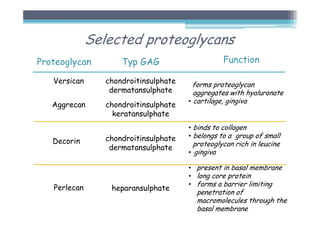
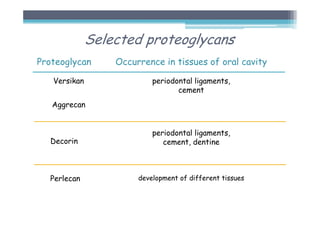
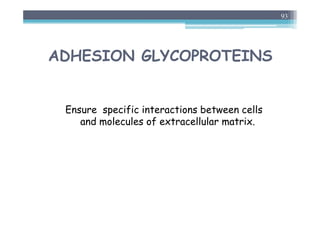
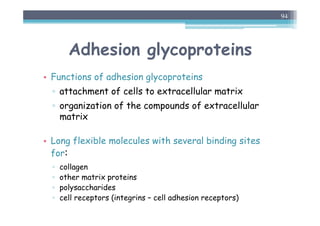
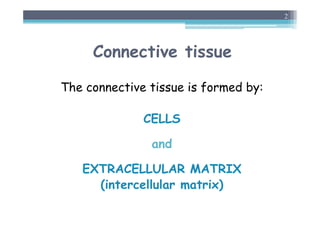
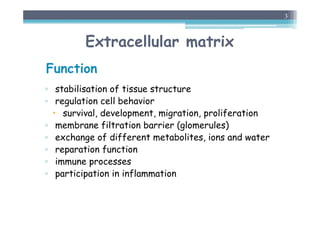
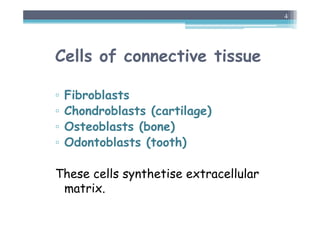
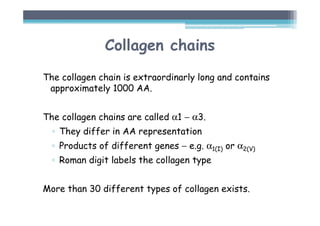
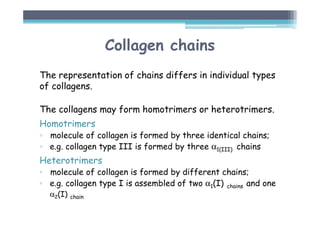
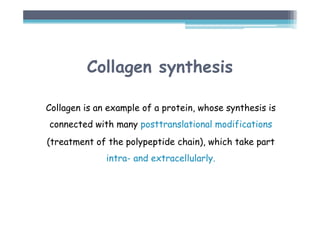
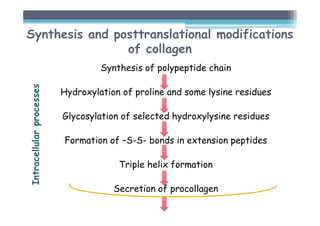
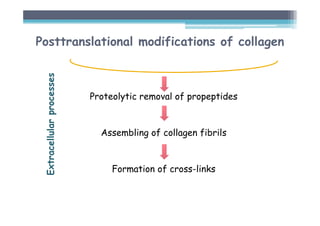
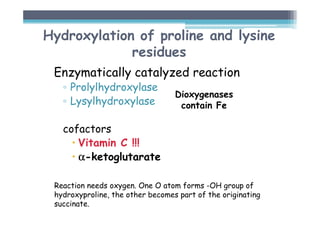
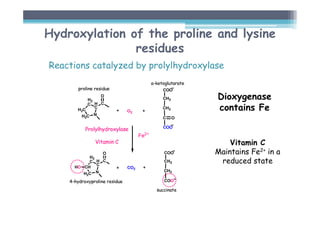
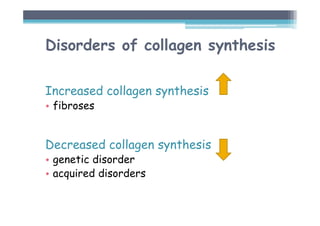
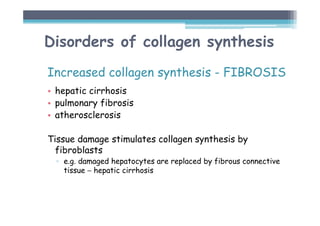
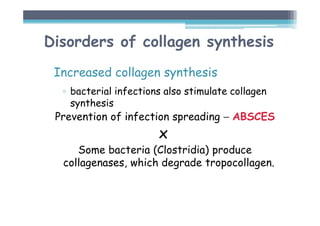
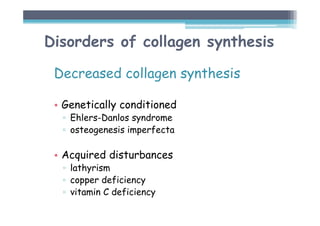
Connective tissue is formed by cells and an extracellular matrix. The extracellular matrix provides structure and regulates cell behavior through fibrillar proteins like collagen and elastin. Collagen is the most abundant protein in mammals and forms fibrils that give tissues strength and flexibility. Collagen synthesis involves extensive post-translational modifications within and outside cells, including hydroxylation, glycosylation, and cross-linking. These modifications are essential for collagen's signature triple helical structure and high tensile strength. Over 30 collagen types exist with diverse structures and tissue distributions that contribute to their unique functions.
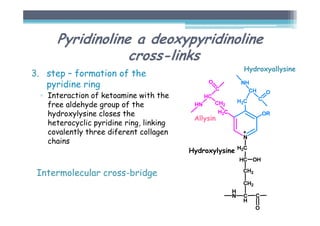
![Overview of collagens
Some fibrilar collagens
Type Molecular Occurrence
structure
I [α1(I)]2 [α2(I)] widely present, skin, vessels,
tendons, gingiva, bone, cement, dentin,
periodontal ligaments
II [α1(II)]3 cartilage, vitreous body
III [α1(III)]3 skin, vessels, lungs, gingiva, cement,
dentin, periodontal ligaments
V [α1(V)]3, [α1(V)2 α2(V)] skin, smooth muscle, bone,
cement, dentin](https://image.slidesharecdn.com/biochemistry-of-connective-tissue-dentistrykopptx-230324153535-fcd5d2bd/85/biochemistry-of-connective-tissue-dentistrykopptx-pdf-50-320.jpg)
![Types of collagen
Some collagens associated with fibrils
Type Molecular Occurrence
structure
VI [α1(VI) α2(VI) α3(VI)] laterally associated with
collagen type II, widely
present, bone, gingiva, cement,
periodontal ligaments
IX [α1(IX) α2(IX) α3(IX)] laterally associated with
collagen type II, cartilage,
vitreous body, periodontal ligaments
XII [α1(XII)]3 associated with collagen type I
in soft tissues,
periodontal ligaments](https://image.slidesharecdn.com/biochemistry-of-connective-tissue-dentistrykopptx-230324153535-fcd5d2bd/85/biochemistry-of-connective-tissue-dentistrykopptx-pdf-51-320.jpg)
![Oveview of collagens
Some net forming collagens
Type Molecular Occurrence
structure
IV [α1(IV)]2 [α2(IV)] basal membranes,
formation of two-dimensional net
gingiva, periodontal ligaments](https://image.slidesharecdn.com/biochemistry-of-connective-tissue-dentistrykopptx-230324153535-fcd5d2bd/85/biochemistry-of-connective-tissue-dentistrykopptx-pdf-52-320.jpg)
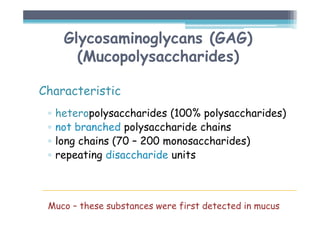
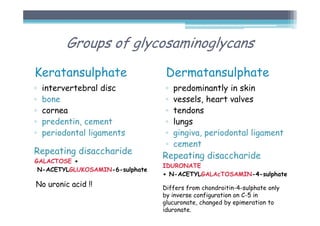
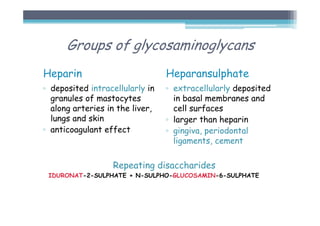
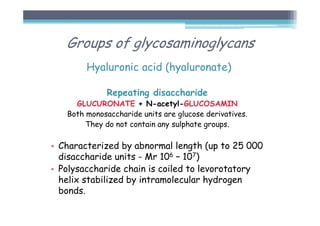
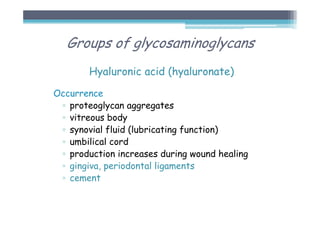
![Glycosaminoglycans
Polysaccharide chain of GAG is formed
by repeating disaccharide units.
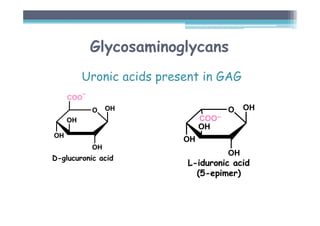
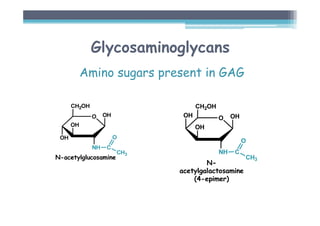
[URONIC ACID – AMINO SUGAR]n
OR
[MONOSACCHARIDE - SULFONATED AMINO SUGAR]n](https://image.slidesharecdn.com/biochemistry-of-connective-tissue-dentistrykopptx-230324153535-fcd5d2bd/85/biochemistry-of-connective-tissue-dentistrykopptx-pdf-70-320.jpg)