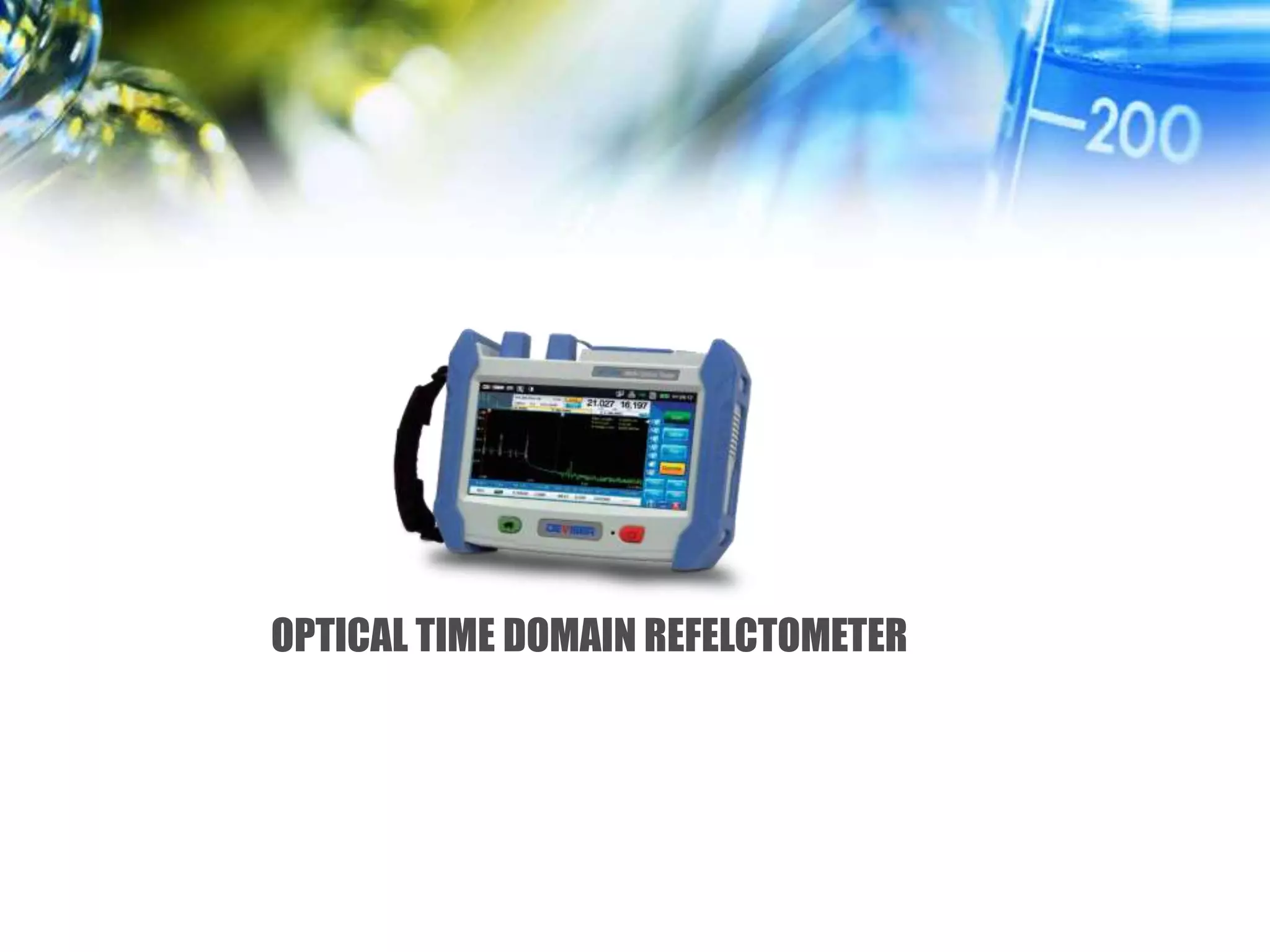
OPTICAL TIME DOMAIN REFELCTOMETER
Table of Contents
• Wavelength Basics
• Optical Fiber Communication System Basics
• OTDR Fundamentals
• Trace Analysis
• DEVISER AE Series OTDR
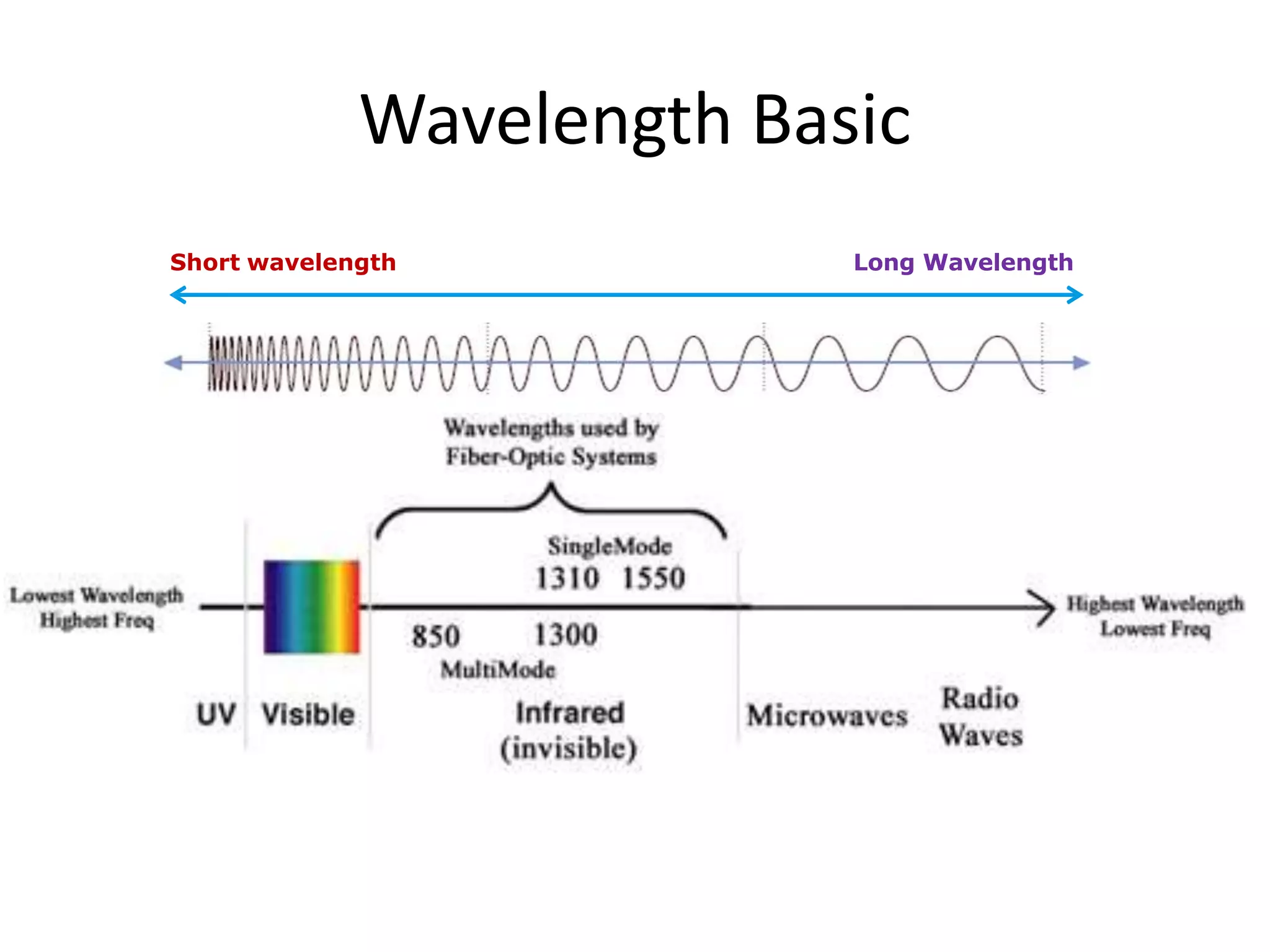
Wavelength Basic
Short wavelength Long Wavelength
WL Band Wavelength SMF MMF
B Band 850nm - ●
O Band
1300nm - ●
1310nm ● -
S Band 1490nm ● -
C Band 1550nm ● -
1c&3 wavelength Node T V
ONU P C
TV
DAT
A
FWDM FWDM
1550nm
1310nm
1490nm
Optical Fiber Communication System
Power budget and Transmission design
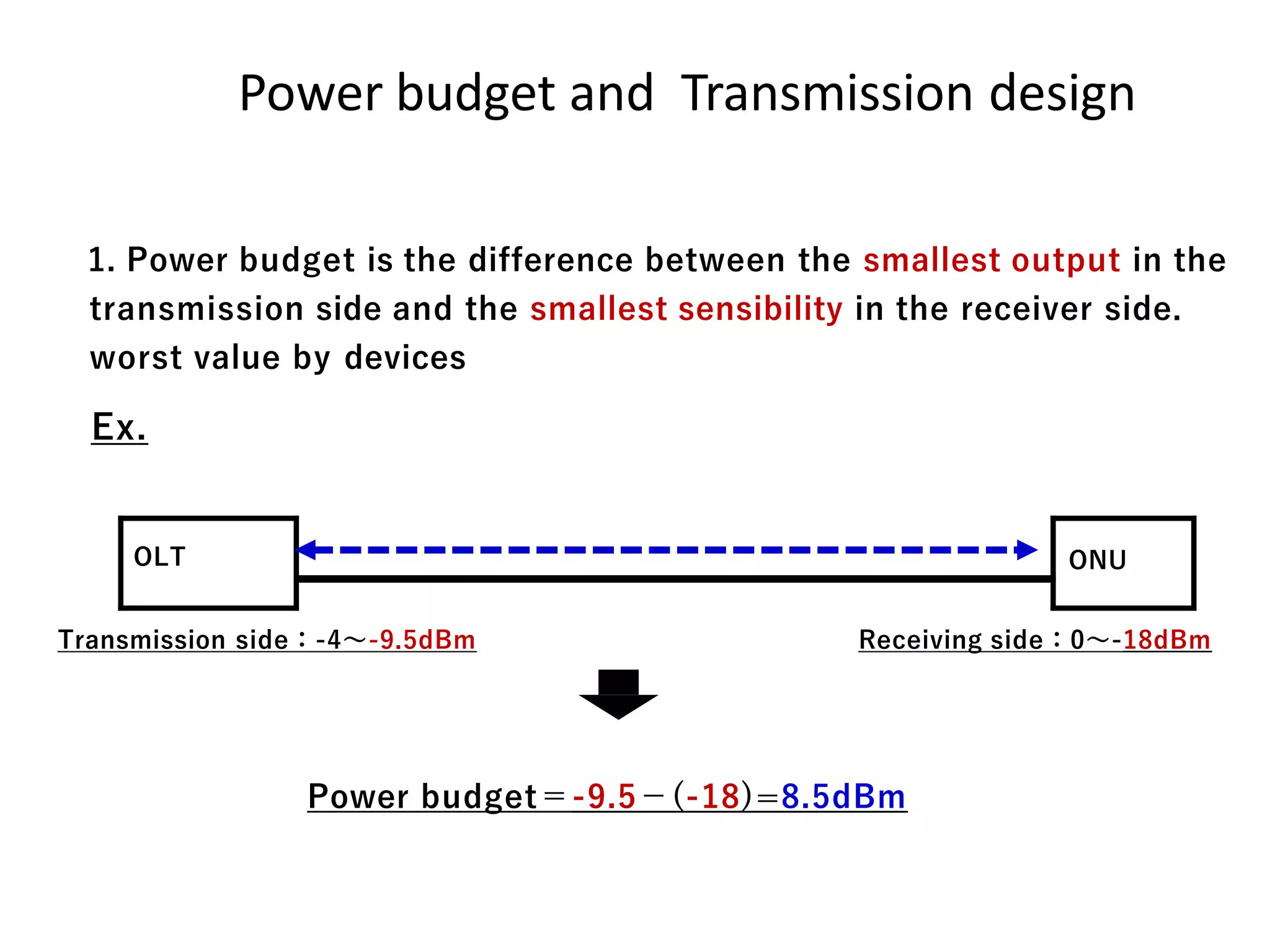
OLT ONU
Receiving side:0~-18dBmTransmission side:-4~-9.5dBm
1. Power budget is the difference between the smallest output in the
transmission side and the smallest sensibility in the receiver side.
worst value by devices
Ex.
Power budget=-9.5-(-18)=8.5dBm
②When confirming the power budget value, make the confirmation
for the transmission line design
Connector Fusion Splice Connector
OLT ONUTransmission Distant:2500m
Condition
① Connector loss:0.5dB/1point
② Splicing loss :0.2dB/1point
③ Fiber transmission loss:0.35dB/km(1310nm) ・ 0.20dB/km(1550nm)
Attenuation
① Connector :0.5dB×2 points=1.0dB
② Splicing loss : 0.2dB×1 point=0.2dB 2.075dB
③ Fiber transmission loss:2.5km×0.35dB=0.875dB
●For the value of Power budget「8.5dBm」, the attenuation of optical
transmission line is 「2.075dB」, no problem for this low value .
Power budget and Transmission design
Link Budget depends on the attenuation while transmitting the
signal in the optical fiber.
●The less optical attenuation is, the far transmission distance of
optical signal can.
The Factor of Loss
●Connection Loss
When fibers connecting, the light enter from (P1) to (P2) there some losses will
be occur whether it connected through splice or connector.
P1
P2
[d B]L=-10log
10
Entering Light Power
P1
Outgoing Light Power
P2
LOSS(dB) Transmittance(%)
0.01 0.998
0.05 0.989
0.10 0.977
0.20 0.955
0.30 0.933
0.40 0.912
0.50 0.891
1.00 0.794
→ Fusion Splicing(Avg.)
→ Connector Loss(Avg.)
→ Connector Loss(Max.)
●Return Loss
P3(Return Loss)
Entering Light Power
P1
Outgoing Light Power
P2
Connected
Face P1
L=-10log
P3
[d B]
Fresnel reflection is due to the light reflecting off a boundary
of two optical mediums, each having a different refractive
indexes (IOR).
Medium RI
Vacuum 1.0
Air 1.0003
Water 1.3
Silica(Fiber) 1.5
Diamond 2.4
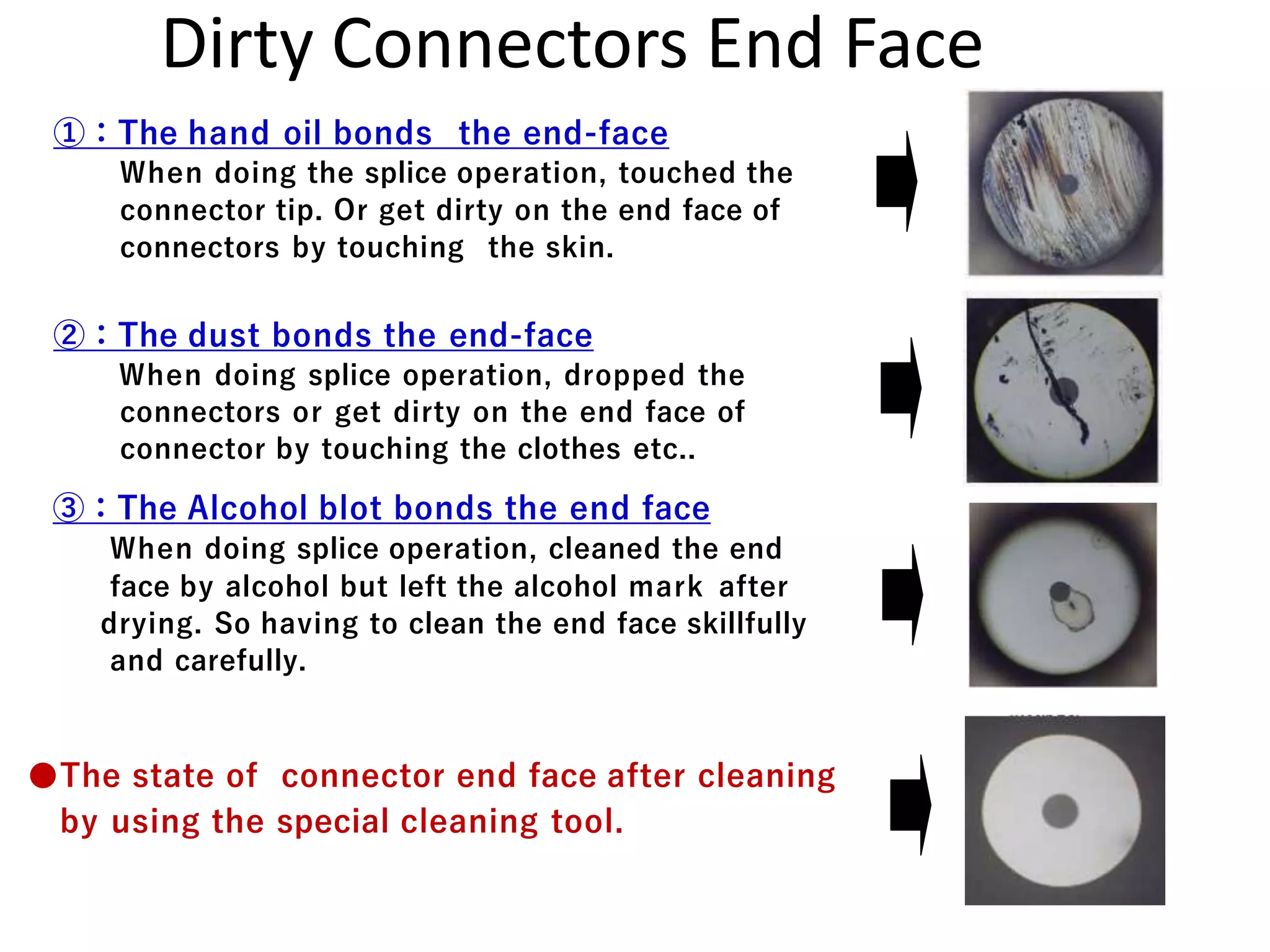
Dirty Connectors End Face
①:The hand oil bonds the end-face
When doing the splice operation, touched the
connector tip. Or get dirty on the end face of
connectors by touching the skin.
②:The dust bonds the end-face
When doing splice operation, dropped the
connectors or get dirty on the end face of
connector by touching the clothes etc..
③:The Alcohol blot bonds the end face
When doing splice operation, cleaned the end
face by alcohol but left the alcohol mark after
drying. So having to clean the end face skillfully
and carefully.
●The state of connector end face after cleaning
by using the special cleaning tool.
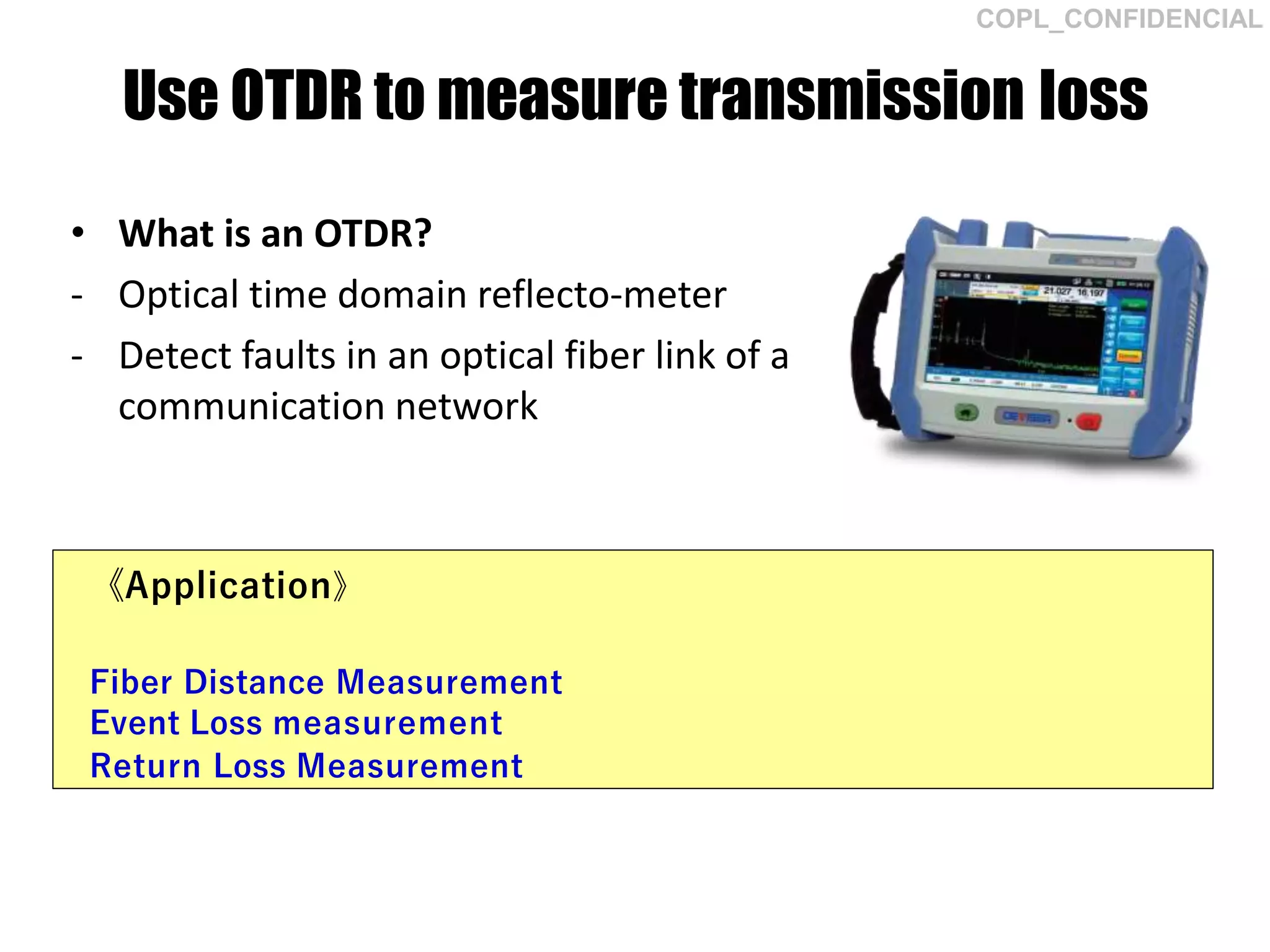
• What is an OTDR?
- Optical time domain reflecto-meter
- Detect faults in an optical fiber link of a
communication network
《Application》
Fiber Distance Measurement
Event Loss measurement
Return Loss Measurement
Use OTDR to measure transmission loss
COPL_CONFIDENCIAL
Flowing
OTDR Theory
Expression
Receiving
light
Electric
Signal
Ele
Sig
(APD)
Directive
CouplerOptical
Signal
LightSource
(LD)
ctric
nal
Pulse
Generator
Optical
Signal
Set Parameter
SELECTING MODE
Measuring
Save Data
POWER ON
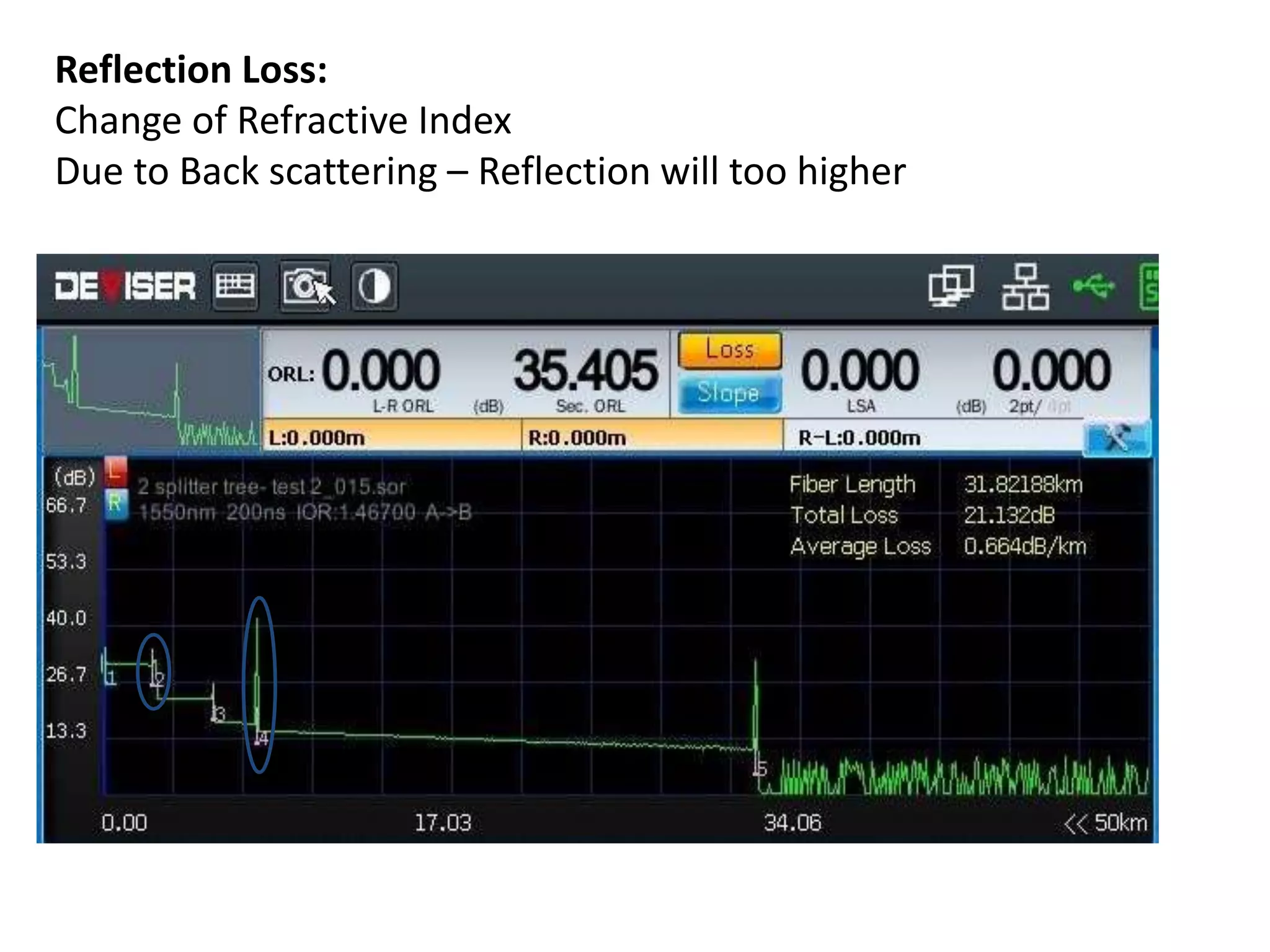
Reflection Loss:
Change of Refractive Index
Due to Back scattering – Reflection will too higher
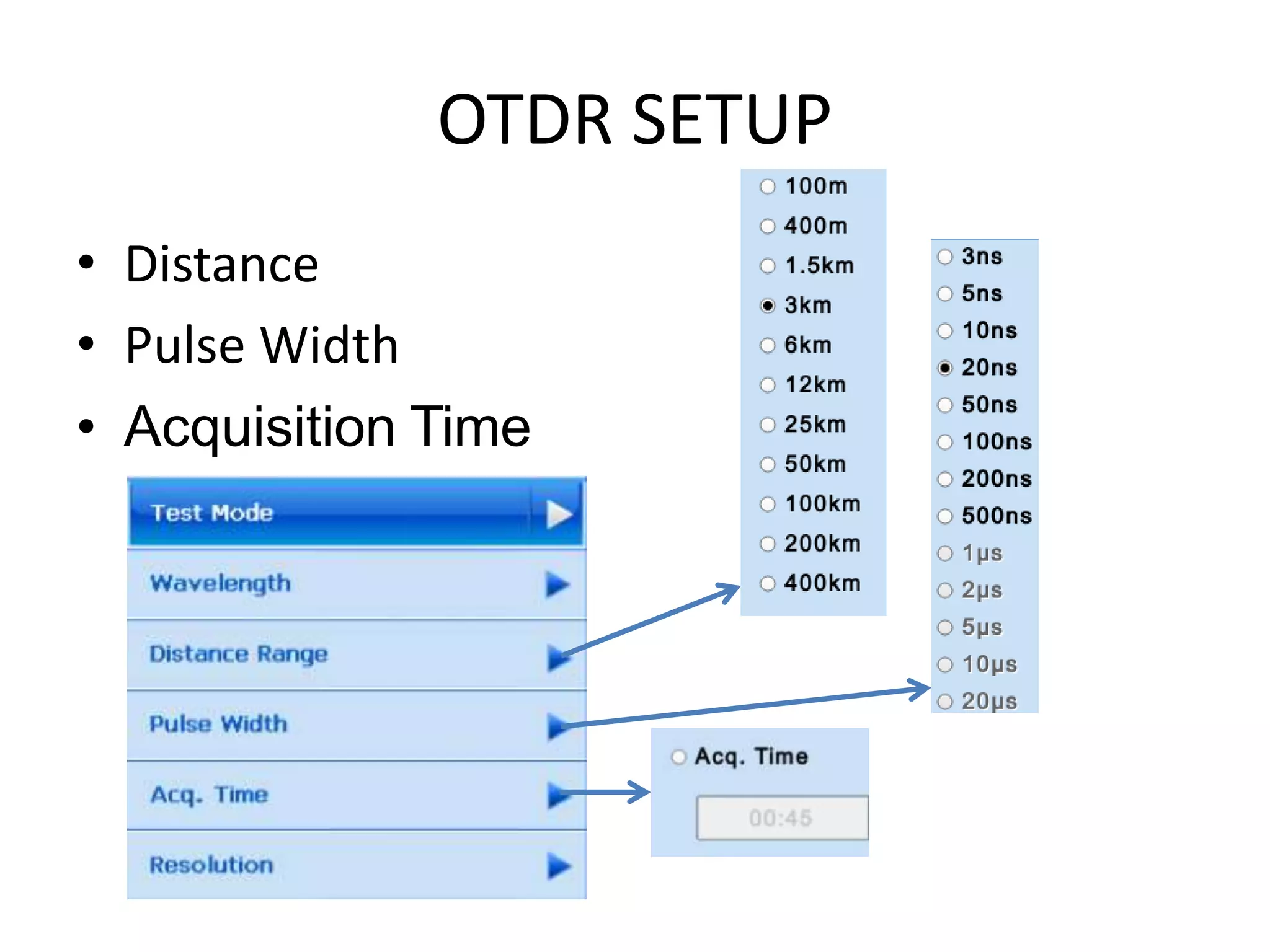
OTDR SETUP
• Distance
• Pulse Width
• Acquisition Time
Distance
• Scales the graph
• Set to at least 1.5x distance
Shorter Distance 1.5x Distance
Pulse Width
Noise
Widen the pulse width→The measurable distance will be gotten along,
but can not recognized the near connected point.
Narrow the pulse width→The OTDR Can recognize connected point, but the
measurable distance will be not gotten along.
Below graph shows the measured result for 40km fiber in 5µs and 100ns pulse width.
• If set the pulse without suitable width , the waveform will be out of shape and the
event will not detect.
• Also it can increase noise in the waveform
Trace with 5µs Pulse Width Trace with 100ns Pulse Width
Acquisition Time
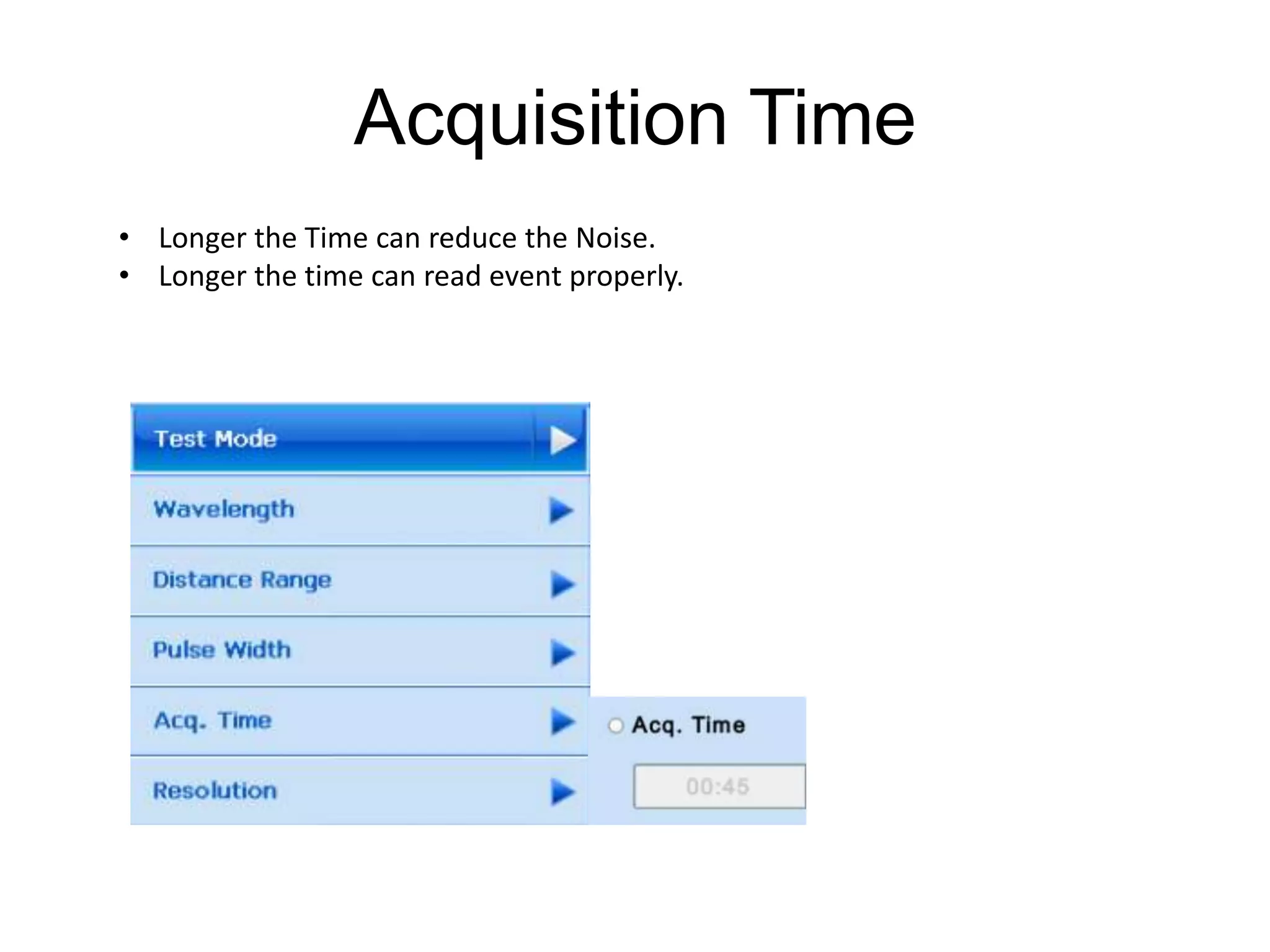
• Longer the Time can reduce the Noise.
• Longer the time can read event properly.
Recommended Setting
DISTANCE(km) PULSE WIDTH ACQ. TIME Launch CABLE
LENGTH(m)
<1.5 5/10ns 30/15s 150~300
1.5 ~ 5 10/30ns 30/15s 150~300
5~10 10/30ns 45/30s 150~300
10~20 30/100ns 45/30s 150~300
20~40 100/275ns 60/45s 150~300
40~80 275ns/1µs 90/60s 500
80~120 1µs/2.5µs 90/60s 500
120~160 2.5µs/10µs 120/90s 500 ~1k
160~200 10µs/20µs 120/90s 2.2k
200~260 20µs 120s 2.2k
NOTE: PULSE WIDTH may vary according to ratio of splitter used in Fiber Link
Auto Mode
• OTDRs have an “AUTO Mode” also.
• In Auto Mode OTDR Will automatically select Pulse Width &
Distance which is best suitable to reach end of the Fiber Link.
• In auto mode it may not provide the best result and on every trace it
may show the different result.
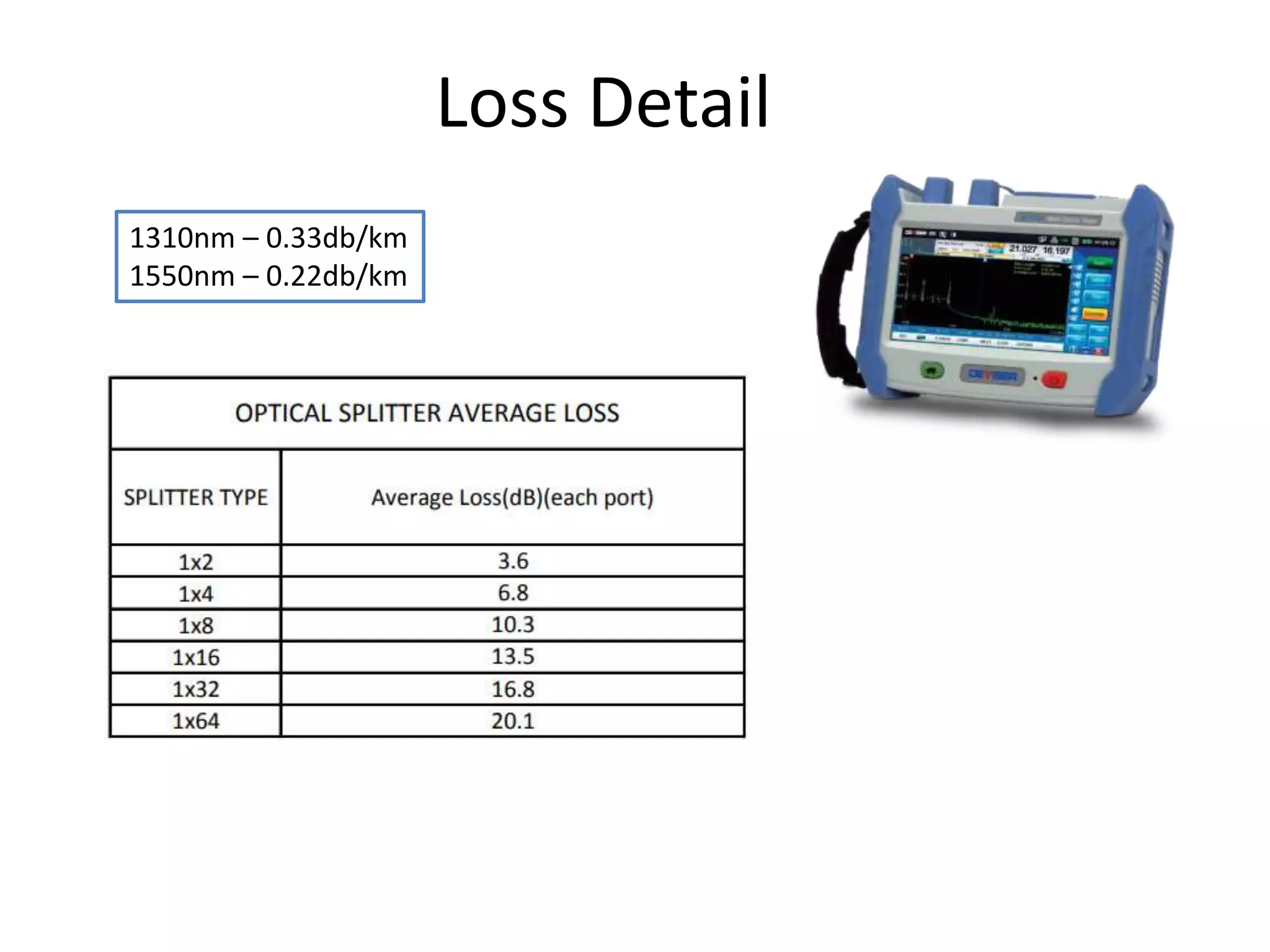
Loss Detail
1310nm – 0.33db/km
1550nm – 0.22db/km
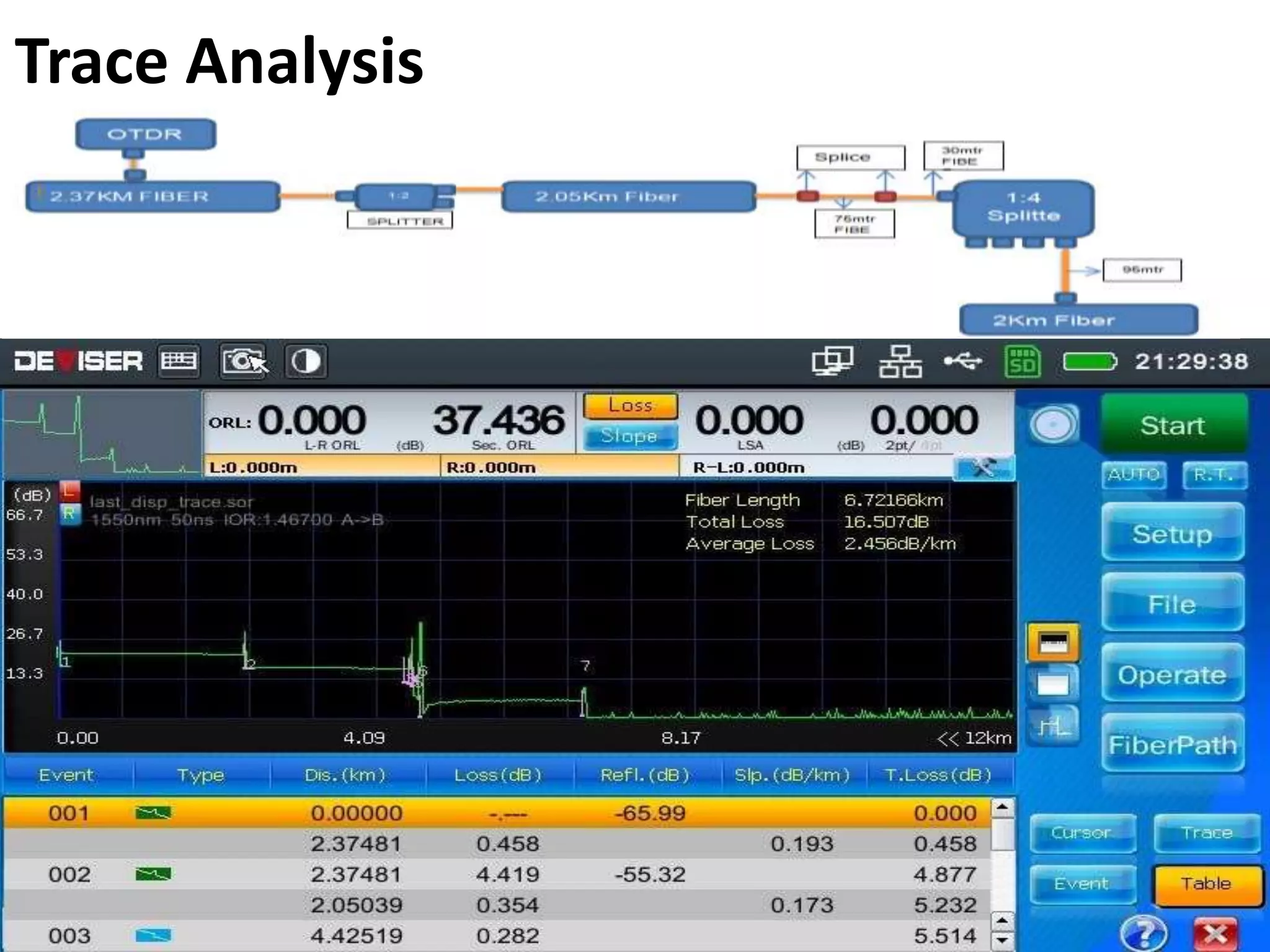
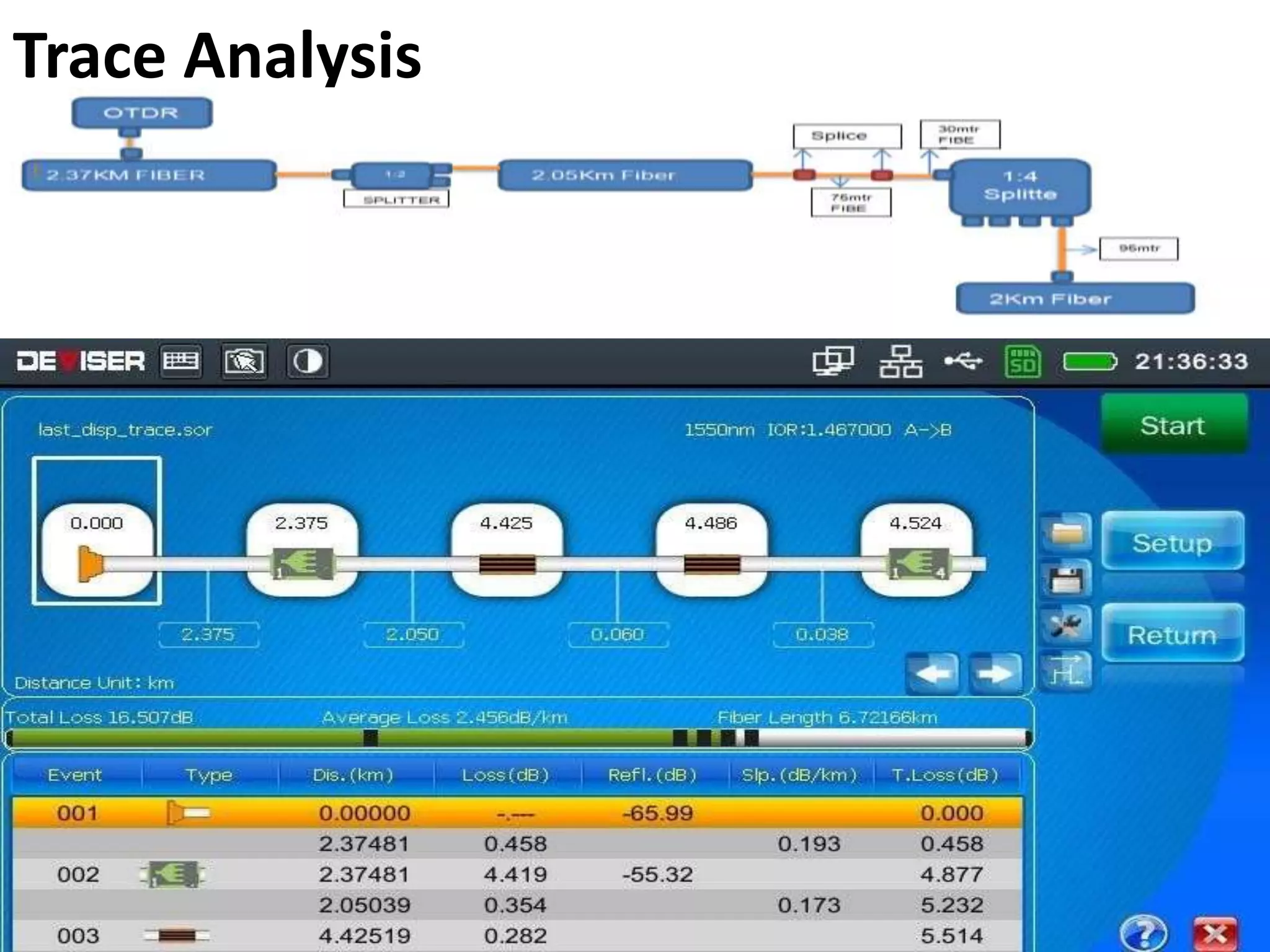
Trace Analysis
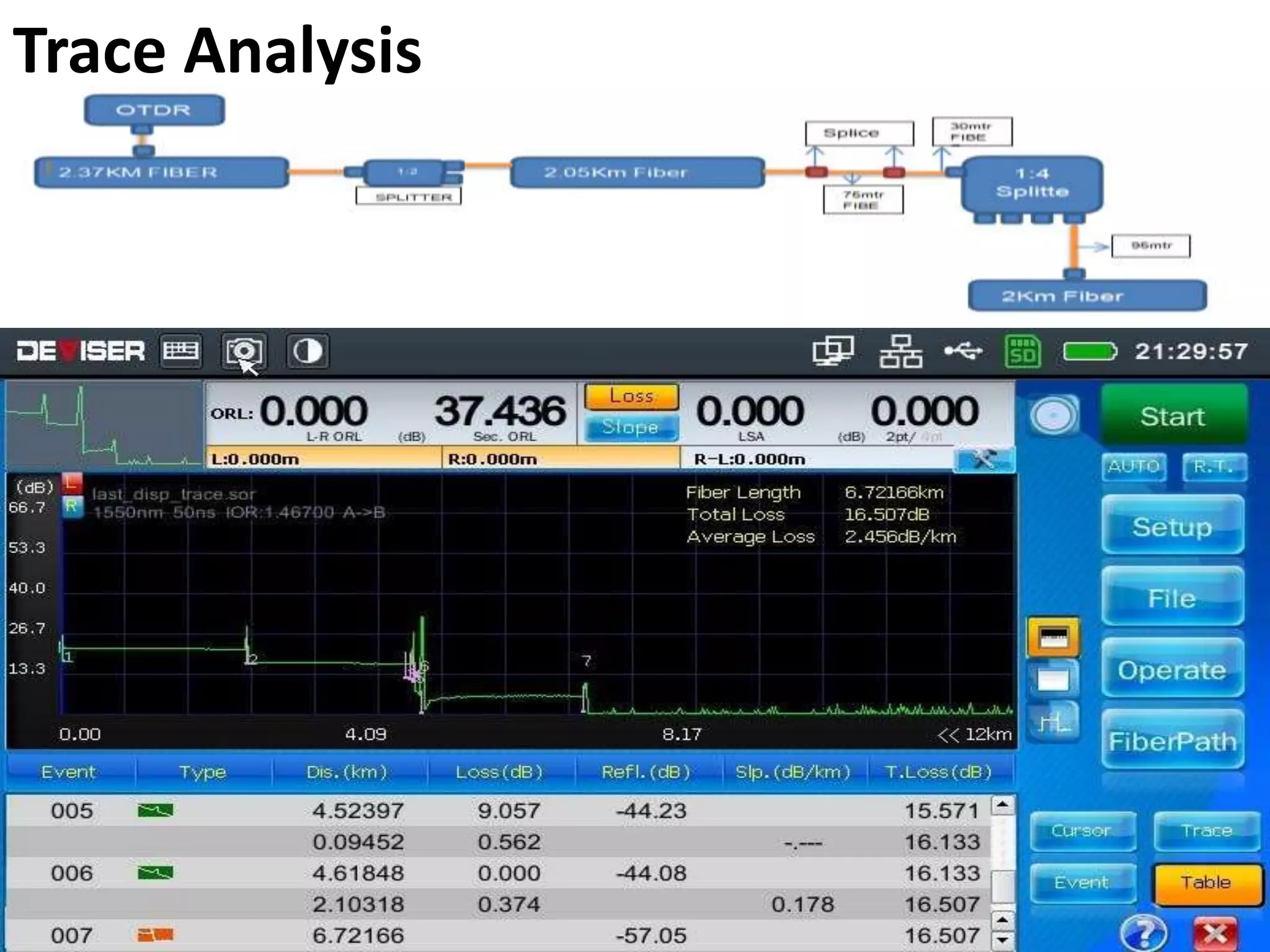
Trace Analysis
Trace Analysis
Trace Analysis
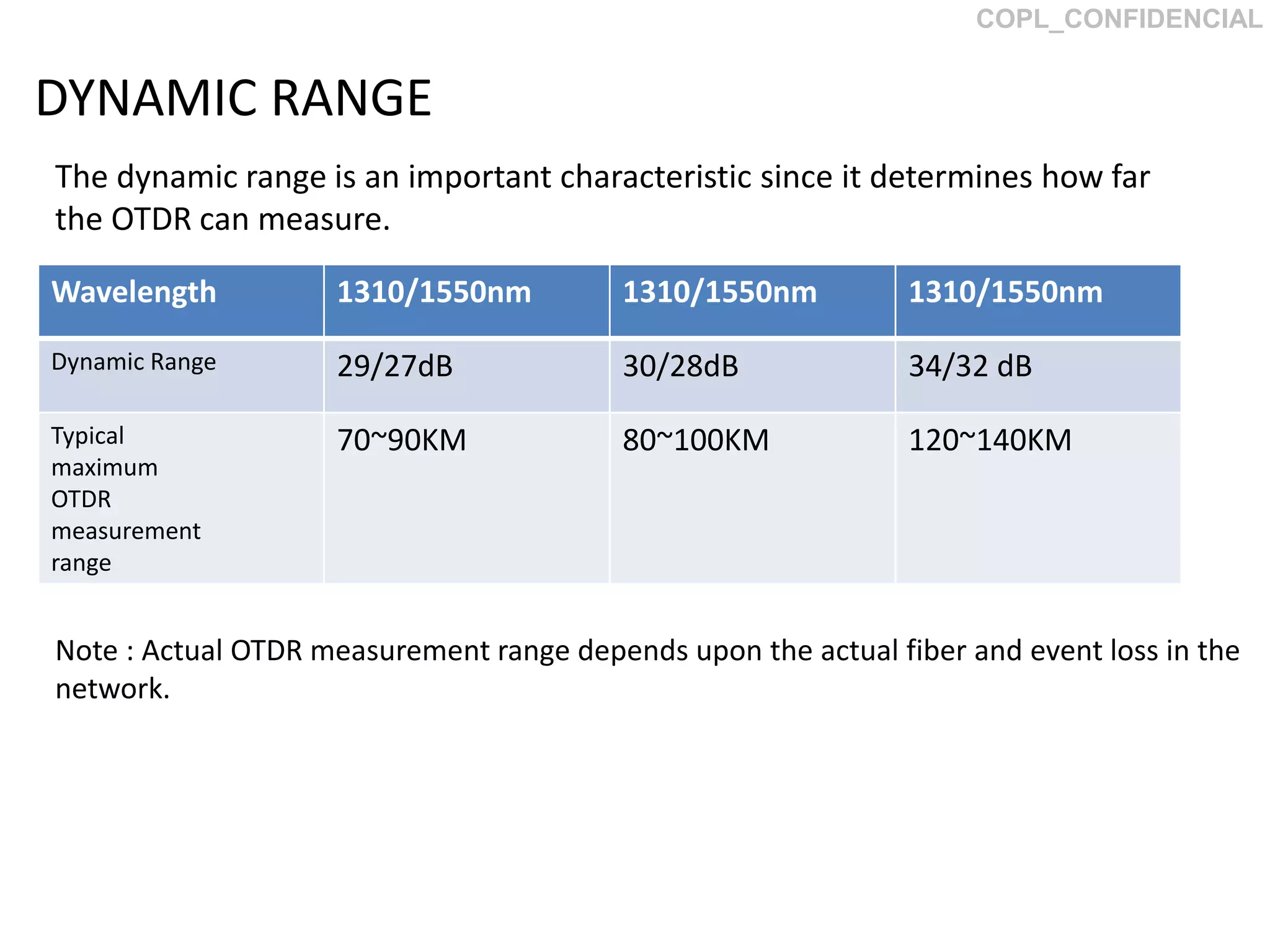
DYNAMIC RANGE
The dynamic range is an important characteristic since it determines how far
the OTDR can measure.
Wavelength 1310/1550nm 1310/1550nm 1310/1550nm
Dynamic Range 29/27dB 30/28dB 34/32 dB
Typical
maximum
OTDR
measurement
range
70~90KM 80~100KM 120~140KM
Note : Actual OTDR measurement range depends upon the actual fiber and event loss in the
network.
COPL_CONFIDENCIAL
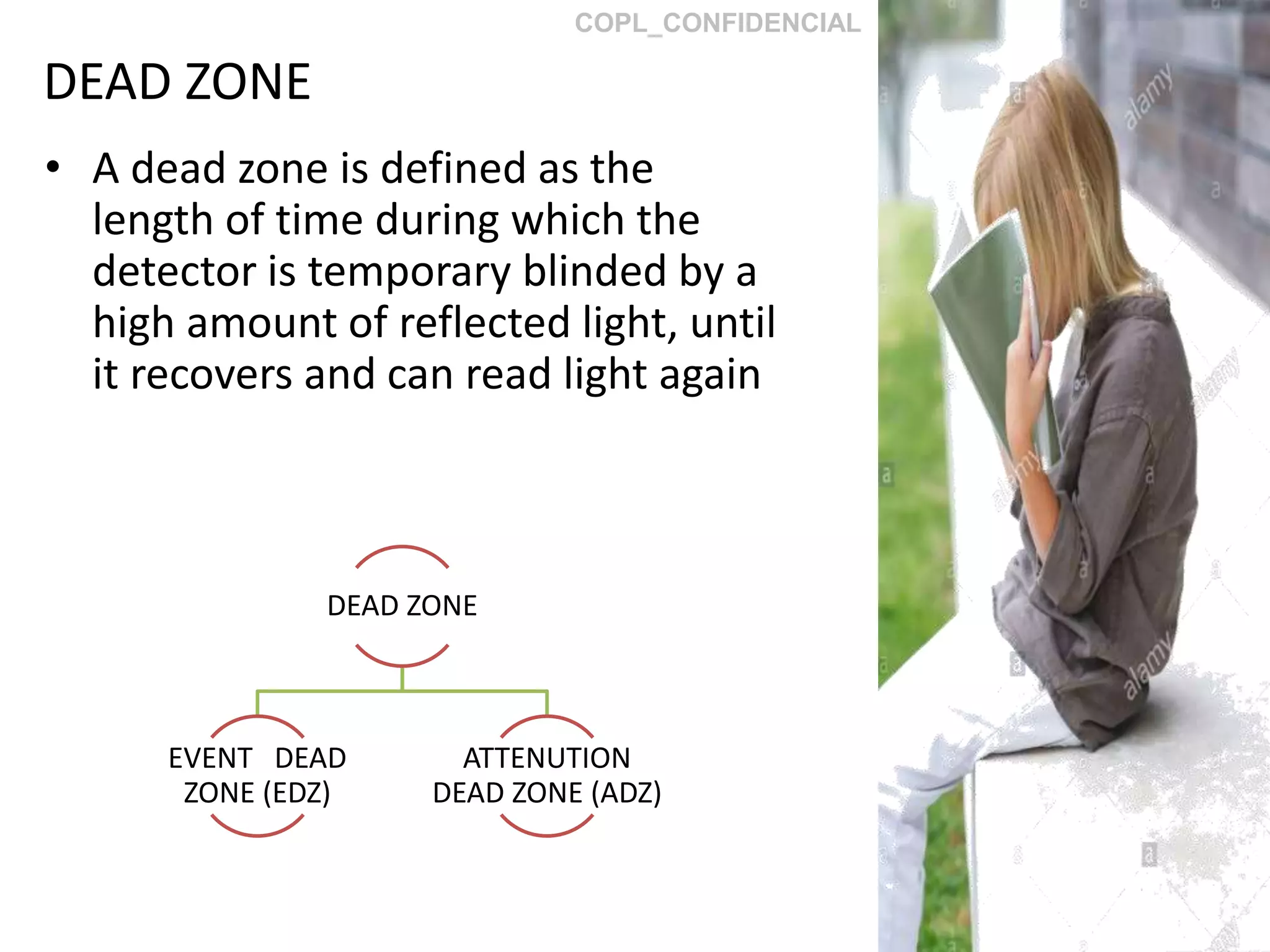
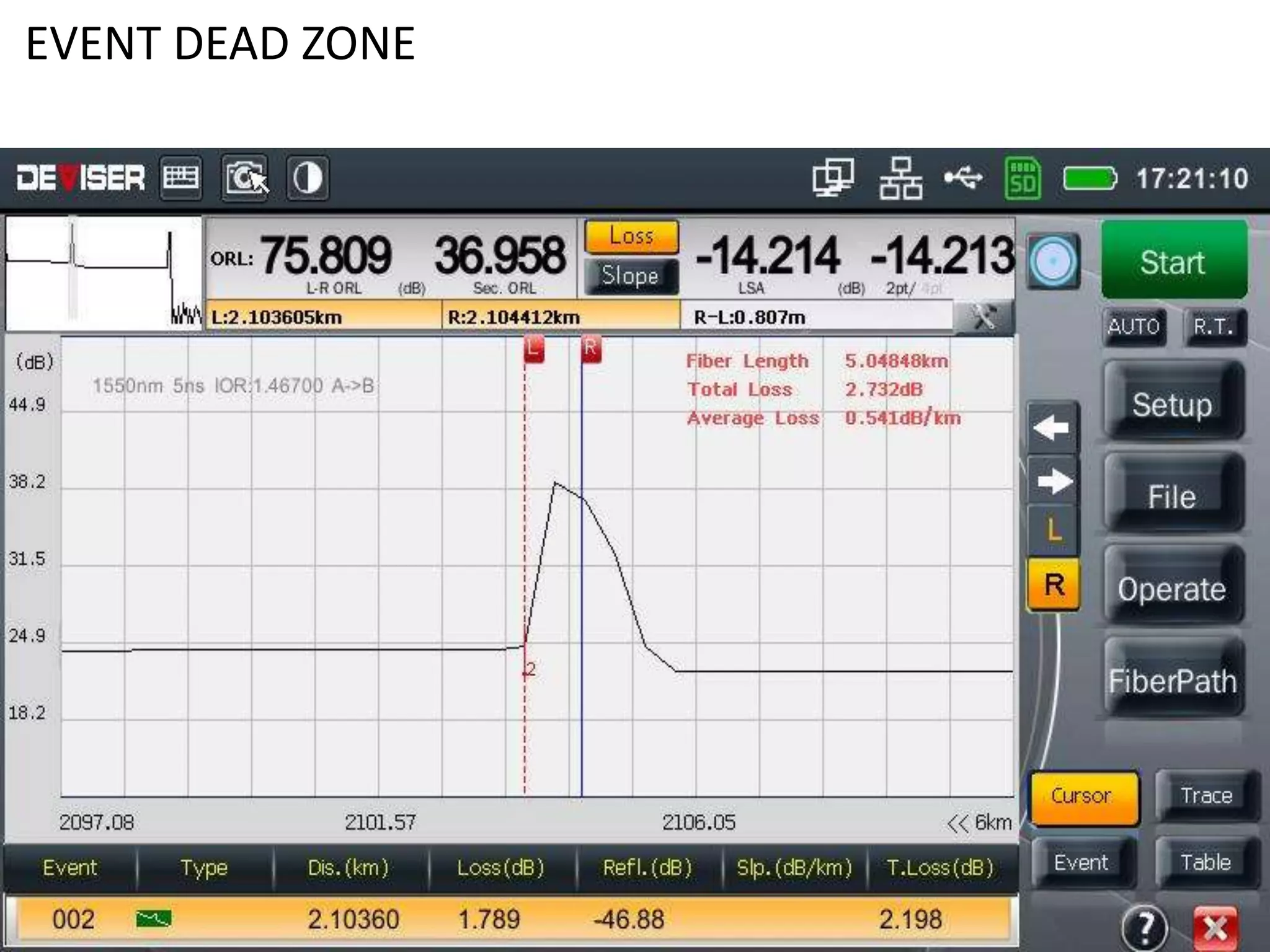
DEAD ZONE
• A dead zone is defined as the
length of time during which the
detector is temporary blinded by a
high amount of reflected light, until
it recovers and can read light again
DEAD ZONE
EVENT DEAD
ZONE (EDZ)
ATTENUTION
DEAD ZONE (ADZ)
COPL_CONFIDENCIAL
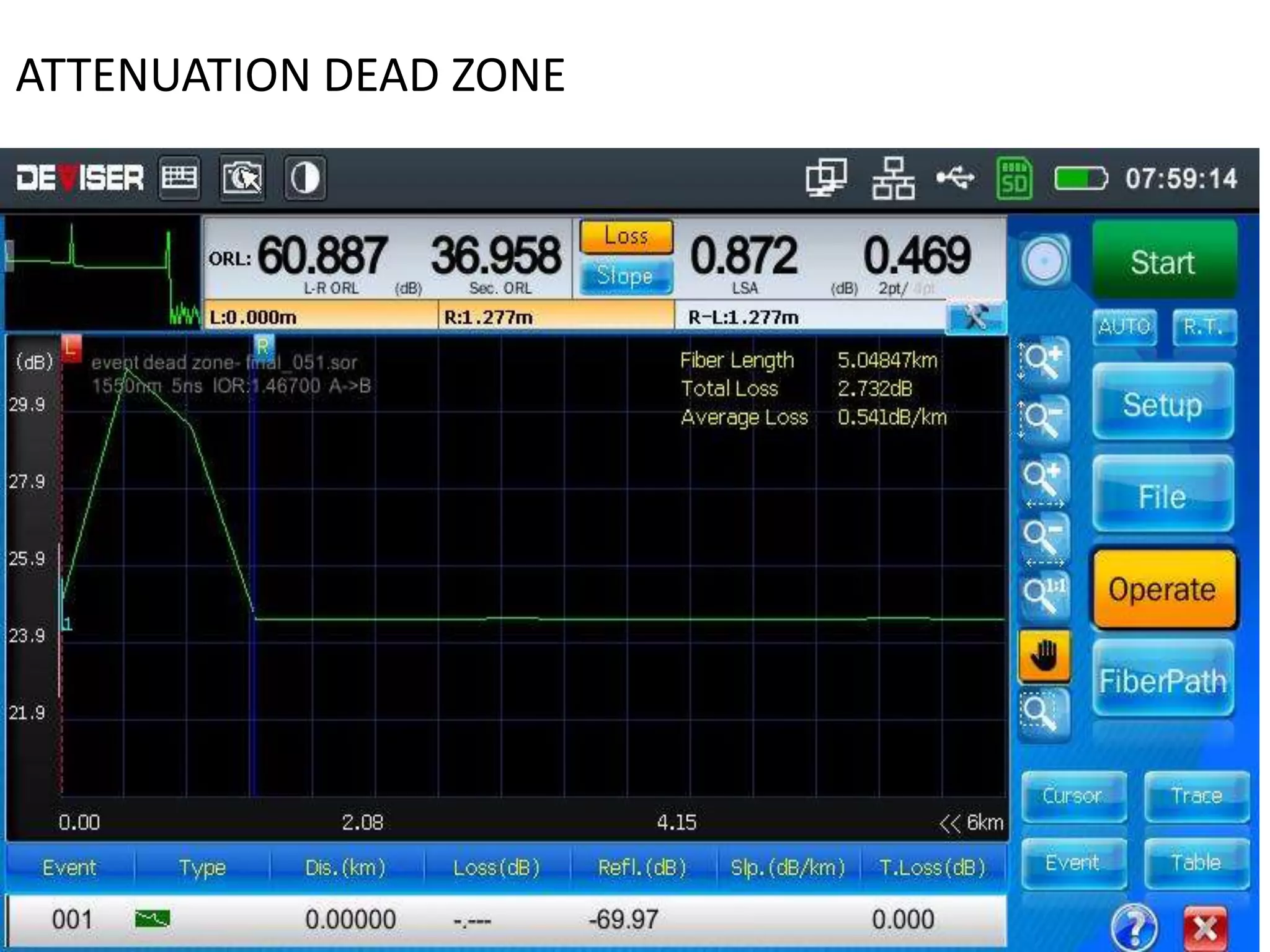
ATTENUATION DEAD ZONE
EVENT DEAD ZONE
Dead Zone according to Pulse Width
• Sampling Resolution – it is the distance between two consecutive
sampling point
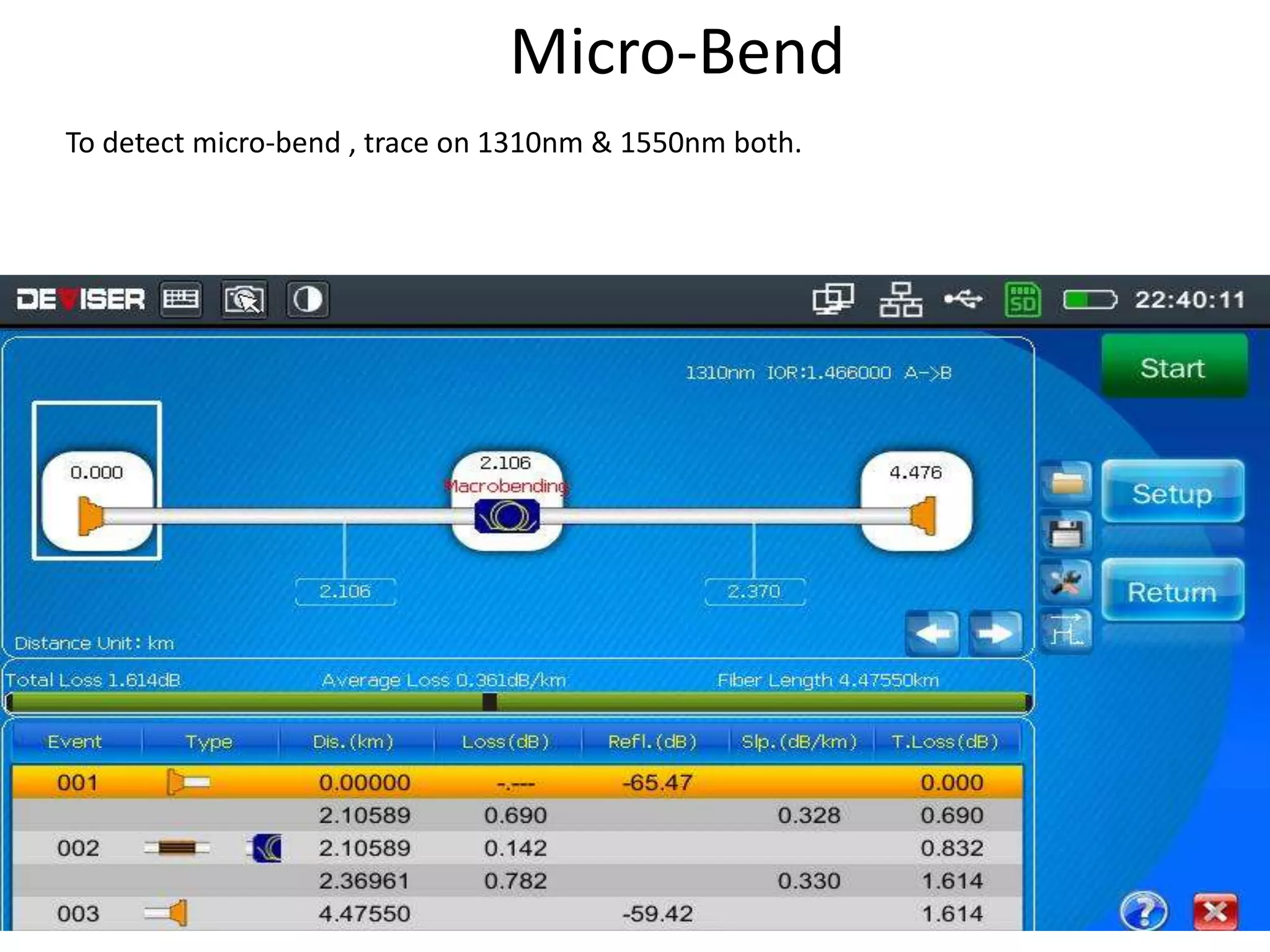
Micro-Bend
To detect micro-bend , trace on 1310nm & 1550nm both.
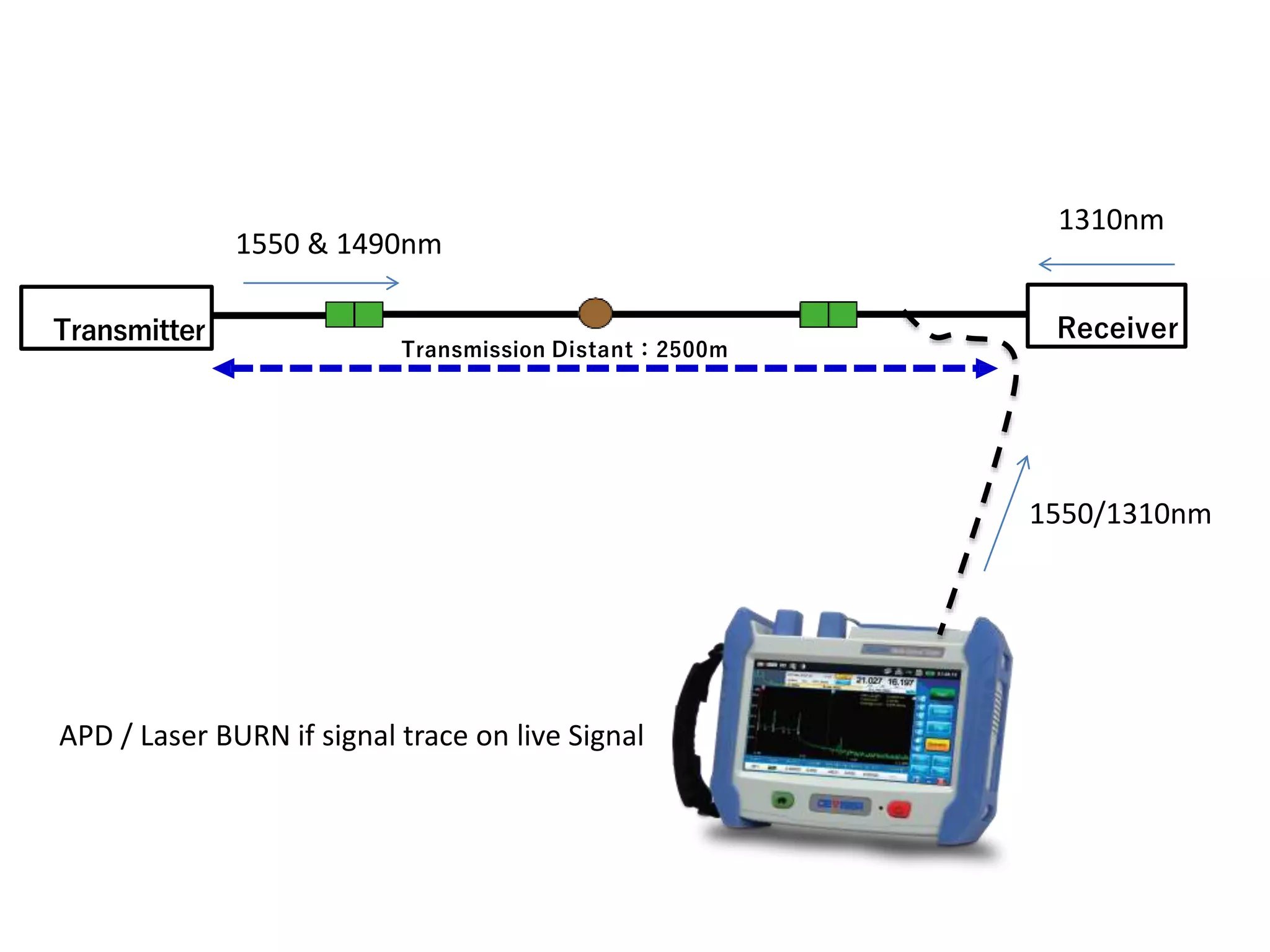
Transmitter Receiver
Transmission Distant:2500m
1550 & 1490nm
1310nm
1550/1310nm
APD / Laser BURN if signal trace on live Signal
Transmitter Receiver
Transmission Distant:2500m
1550 & 1490nm
1310nm
1625nm
Trace Over Live Signal
ADDITIONAL Features:
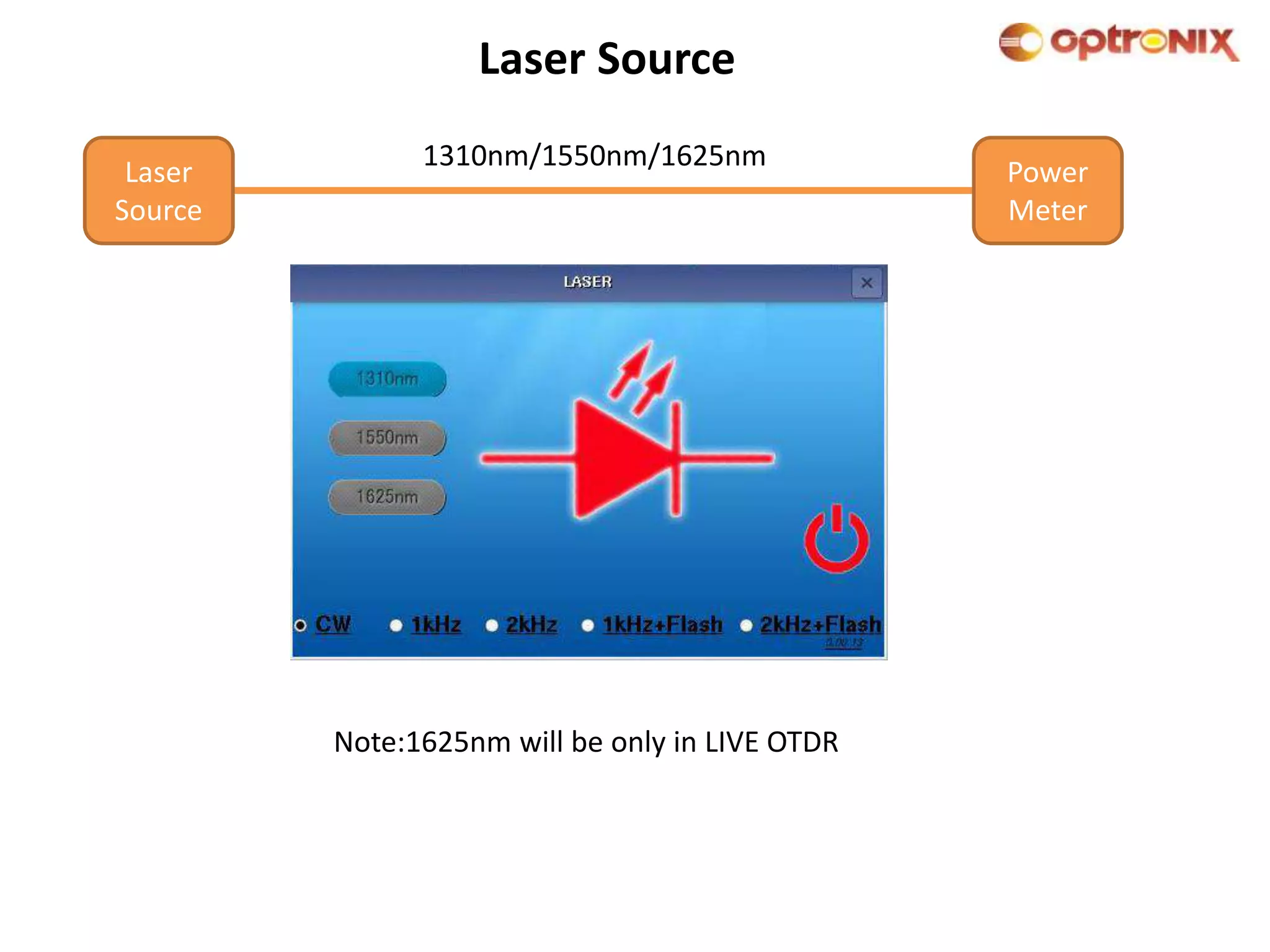
1. Laser Source
2. Optical Power Meter
3. Visual Fault Locator
4. QAM MODULE(Only in AE2100AQ Model)
5. Remote Access through Software
Laser Source
Laser
Source
Power
Meter
1310nm/1550nm/1625nm
Note:1625nm will be only in LIVE OTDR
Visual Fault Locator
A visual fault locator is a visible red laser designed to inject visible light energy into a
fiber sharp. Sharp bends, breaks , Faulty Connectors or other faults will leaks red light.
POWER METER
Measurement Range : +26 _-50dBm
ANALYSIS SOFTWARE - SYNCOR
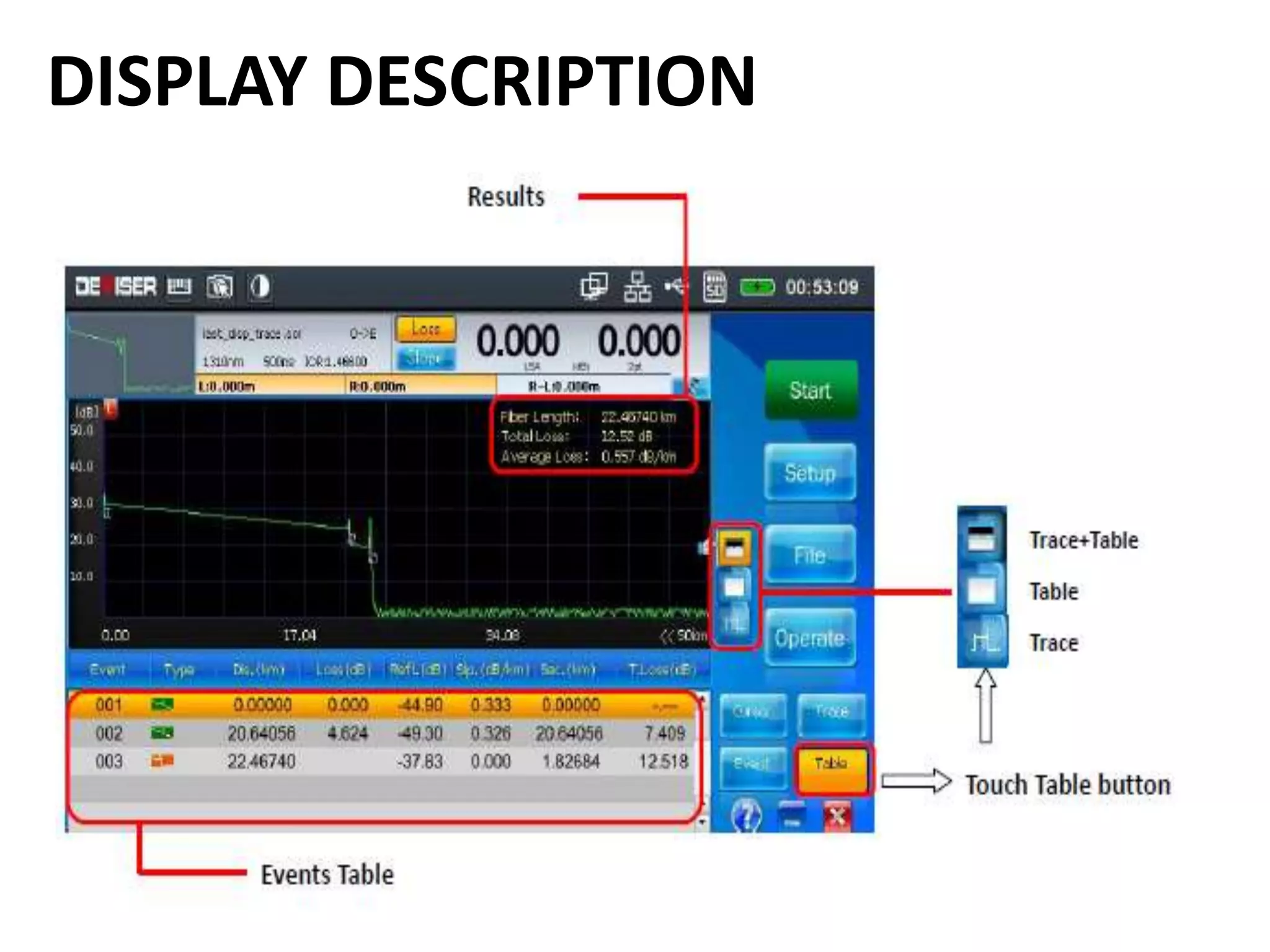
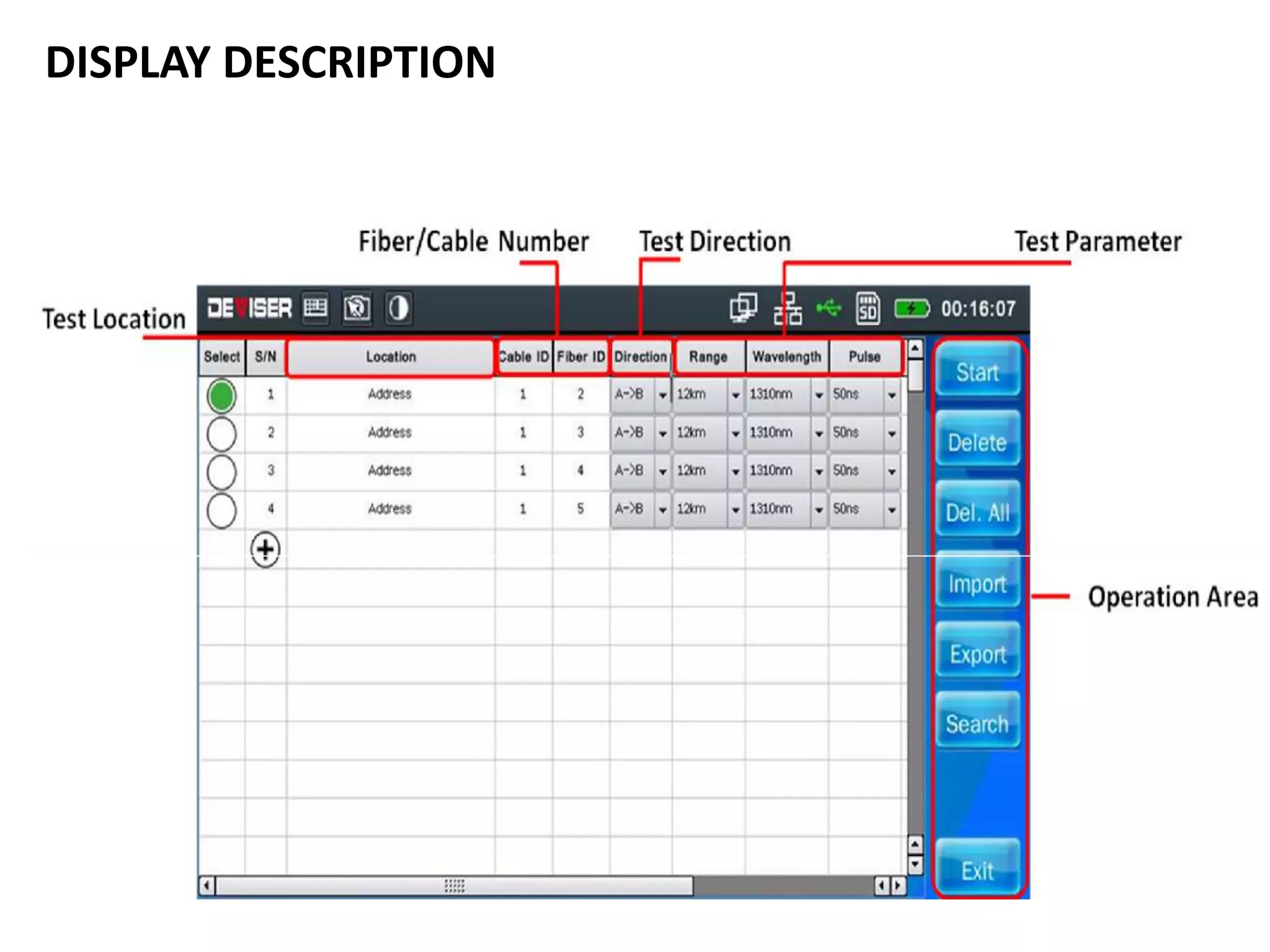
DISPLAY DESCRIPTION
Optional Features
Fiber path
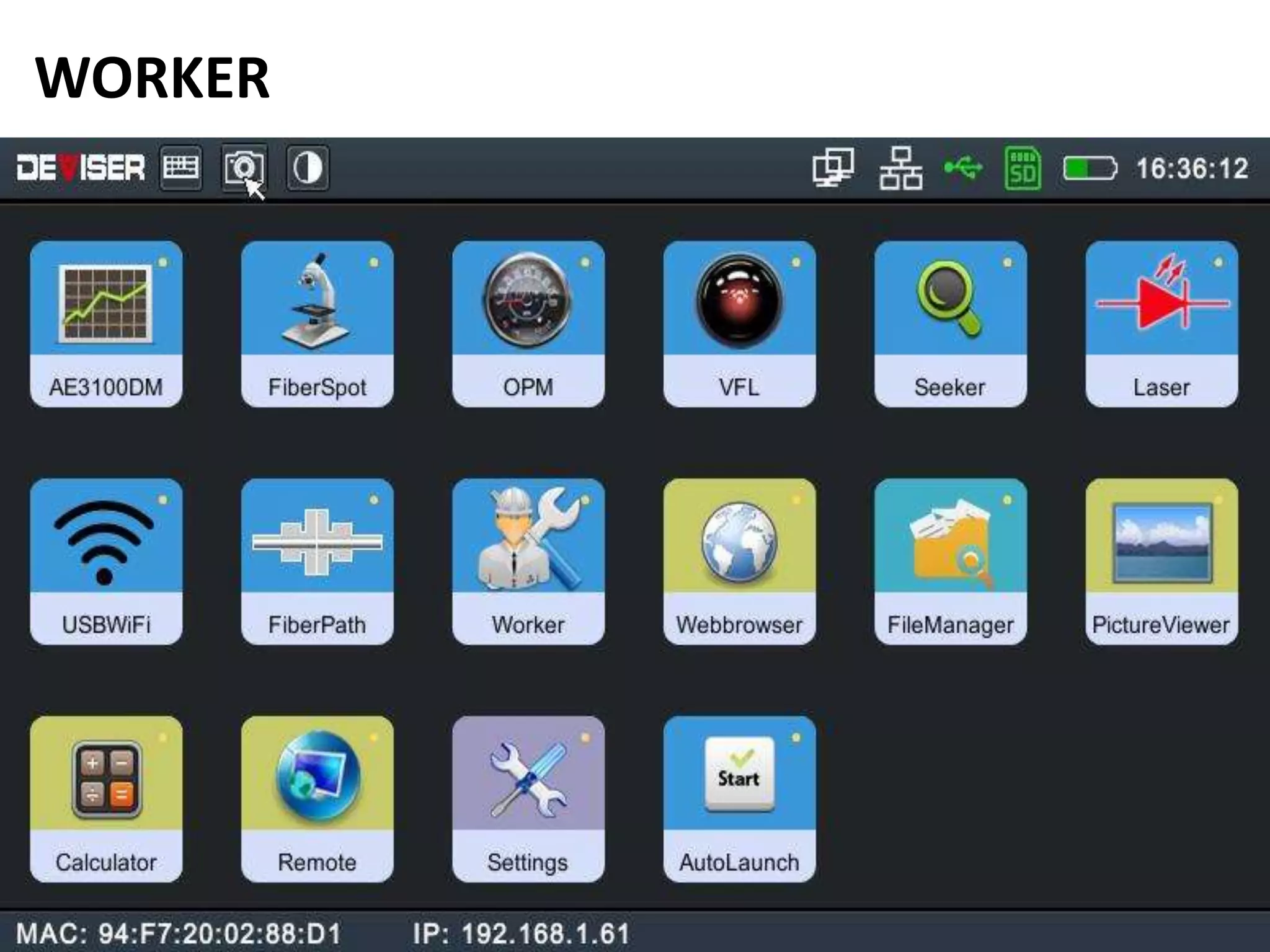
Worker
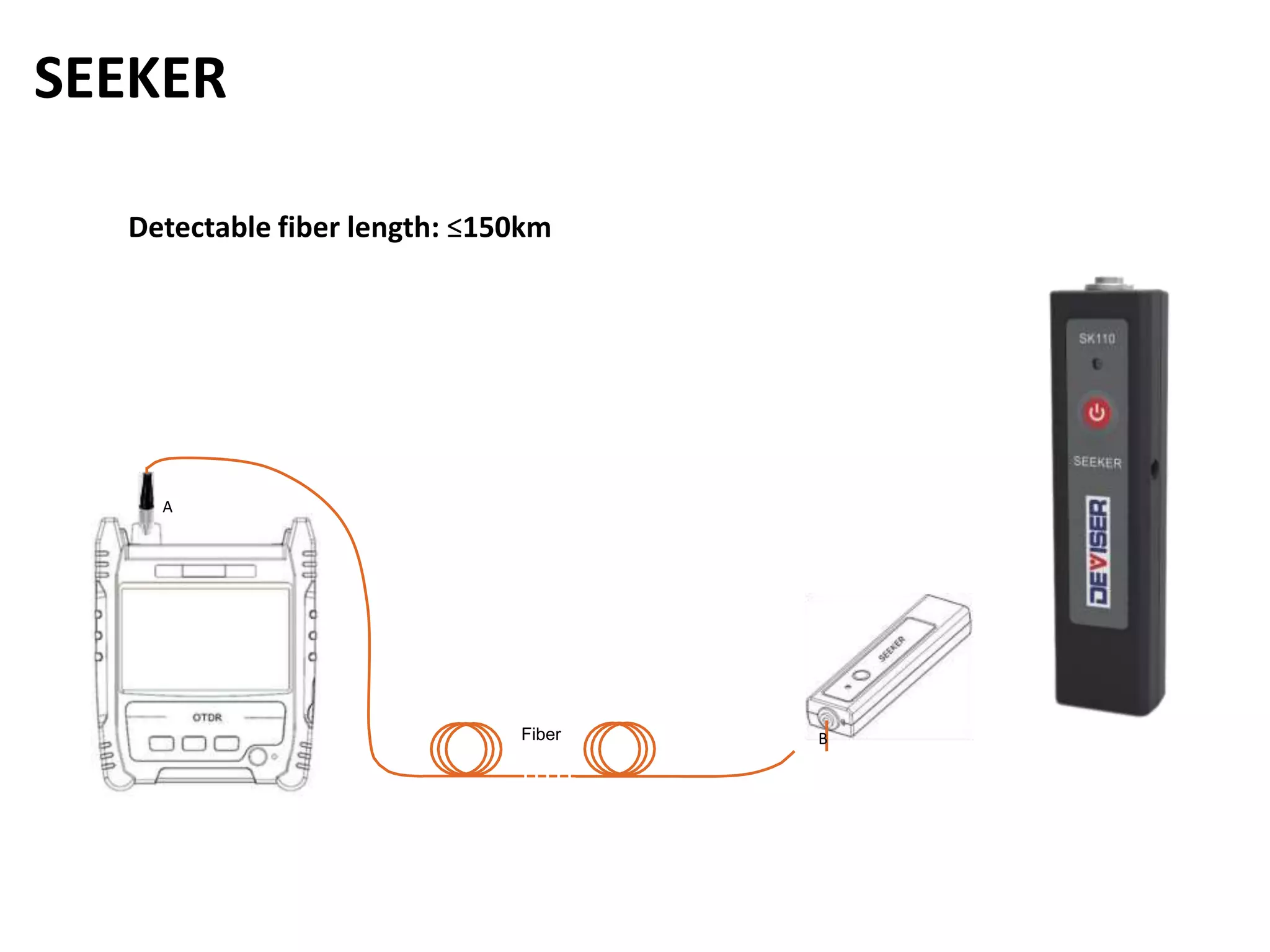
Seeker
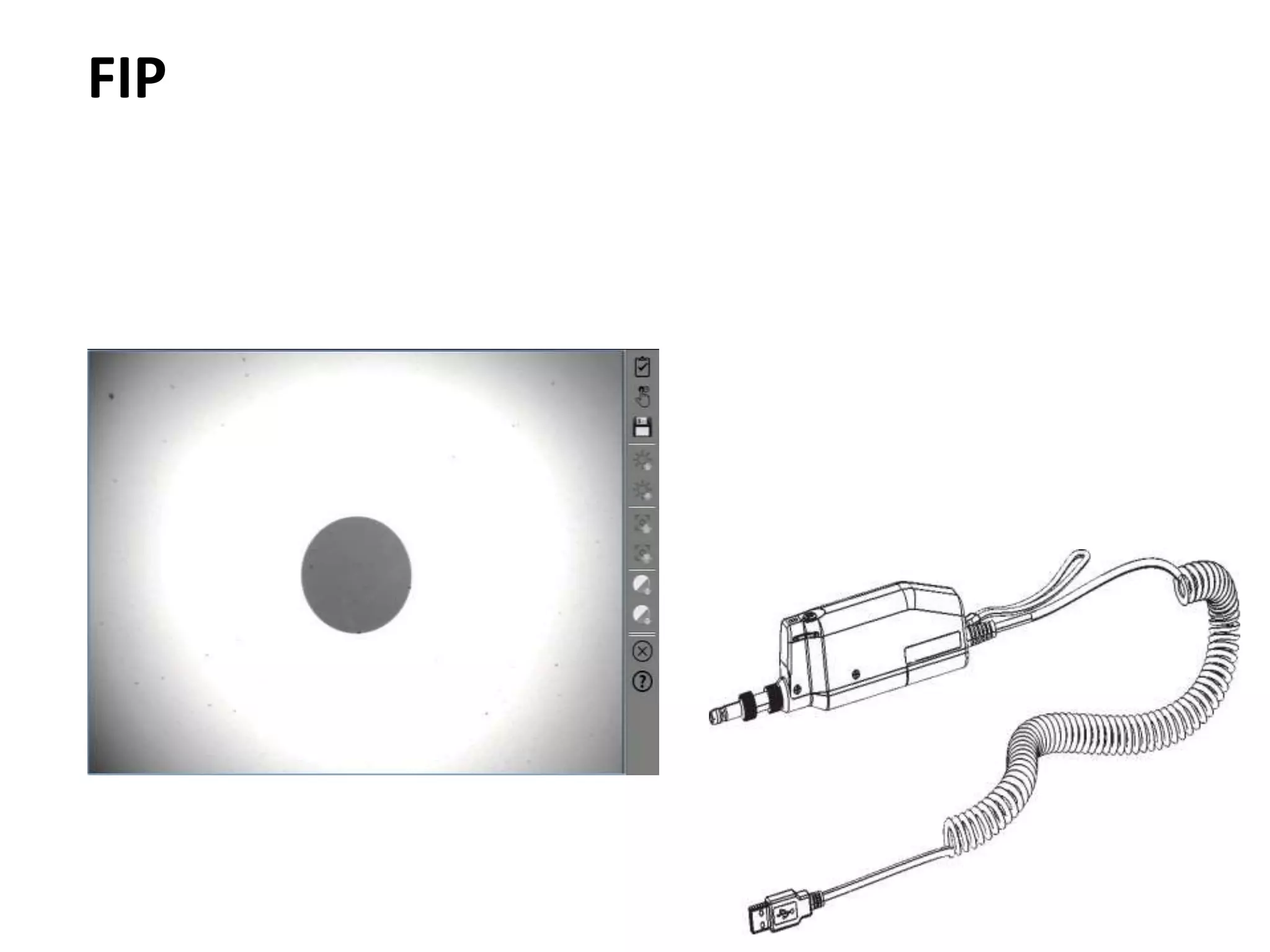
Fiber Inspection Probe
USB Wi-Fi Module
Beginning of trace event End of trace event
Connector/coupler event
Fusion splice event
Macro bend
Splitter
Fiber Path - Symbol
1:2 – 3~6dB
1:4 – 6~10dB
1:8 – 10~13dB
1:16 – 13~16.5dB
1:32 - >16.5
FIBERPATH
WORKER
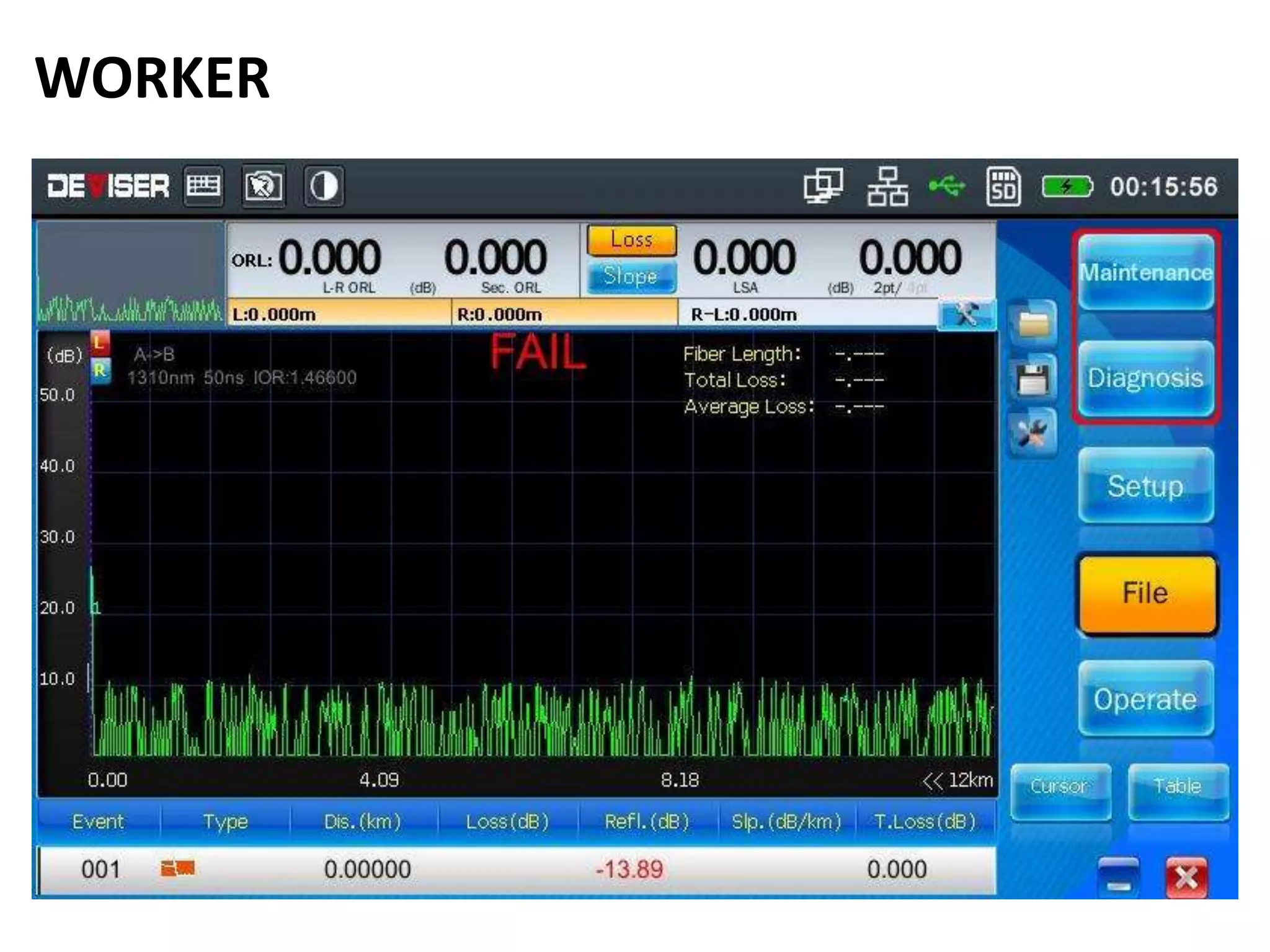
WORKER
Maintenance: The user
creates fiber links, sets
parameters, and conducts
measurements according to
the link's readings.
Diagnosis: Once you have
tested a fiber link and
accepted the results, you
can test the link again and
compare the new result to
the saved one
WORKER
DISPLAY DESCRIPTION
Detectable fiber length: ≤150km
A
Fiber B
SEEKER
FIP
THANK YOU

OTDR(OPTICAL TIME DOMAIN REFLECTOMETER)

  • 1.
    OPTICAL TIME DOMAINREFELCTOMETER
  • 2.
    Table of Contents •Wavelength Basics • Optical Fiber Communication System Basics • OTDR Fundamentals • Trace Analysis • DEVISER AE Series OTDR
  • 3.
  • 4.
    WL Band WavelengthSMF MMF B Band 850nm - ● O Band 1300nm - ● 1310nm ● - S Band 1490nm ● - C Band 1550nm ● - 1c&3 wavelength Node T V ONU P C TV DAT A FWDM FWDM 1550nm 1310nm 1490nm Optical Fiber Communication System
  • 5.
    Power budget andTransmission design OLT ONU Receiving side:0~-18dBmTransmission side:-4~-9.5dBm 1. Power budget is the difference between the smallest output in the transmission side and the smallest sensibility in the receiver side. worst value by devices Ex. Power budget=-9.5-(-18)=8.5dBm
  • 6.
    ②When confirming thepower budget value, make the confirmation for the transmission line design Connector Fusion Splice Connector OLT ONUTransmission Distant:2500m Condition ① Connector loss:0.5dB/1point ② Splicing loss :0.2dB/1point ③ Fiber transmission loss:0.35dB/km(1310nm) ・ 0.20dB/km(1550nm) Attenuation ① Connector :0.5dB×2 points=1.0dB ② Splicing loss : 0.2dB×1 point=0.2dB 2.075dB ③ Fiber transmission loss:2.5km×0.35dB=0.875dB ●For the value of Power budget「8.5dBm」, the attenuation of optical transmission line is 「2.075dB」, no problem for this low value . Power budget and Transmission design
  • 7.
    Link Budget dependson the attenuation while transmitting the signal in the optical fiber. ●The less optical attenuation is, the far transmission distance of optical signal can. The Factor of Loss
  • 8.
    ●Connection Loss When fibersconnecting, the light enter from (P1) to (P2) there some losses will be occur whether it connected through splice or connector. P1 P2 [d B]L=-10log 10 Entering Light Power P1 Outgoing Light Power P2 LOSS(dB) Transmittance(%) 0.01 0.998 0.05 0.989 0.10 0.977 0.20 0.955 0.30 0.933 0.40 0.912 0.50 0.891 1.00 0.794 → Fusion Splicing(Avg.) → Connector Loss(Avg.) → Connector Loss(Max.)
  • 9.
    ●Return Loss P3(Return Loss) EnteringLight Power P1 Outgoing Light Power P2 Connected Face P1 L=-10log P3 [d B] Fresnel reflection is due to the light reflecting off a boundary of two optical mediums, each having a different refractive indexes (IOR). Medium RI Vacuum 1.0 Air 1.0003 Water 1.3 Silica(Fiber) 1.5 Diamond 2.4
  • 10.
    Dirty Connectors EndFace ①:The hand oil bonds the end-face When doing the splice operation, touched the connector tip. Or get dirty on the end face of connectors by touching the skin. ②:The dust bonds the end-face When doing splice operation, dropped the connectors or get dirty on the end face of connector by touching the clothes etc.. ③:The Alcohol blot bonds the end face When doing splice operation, cleaned the end face by alcohol but left the alcohol mark after drying. So having to clean the end face skillfully and carefully. ●The state of connector end face after cleaning by using the special cleaning tool.
  • 11.
    • What isan OTDR? - Optical time domain reflecto-meter - Detect faults in an optical fiber link of a communication network 《Application》 Fiber Distance Measurement Event Loss measurement Return Loss Measurement Use OTDR to measure transmission loss COPL_CONFIDENCIAL
  • 12.
  • 13.
    Reflection Loss: Change ofRefractive Index Due to Back scattering – Reflection will too higher
  • 14.
    OTDR SETUP • Distance •Pulse Width • Acquisition Time
  • 15.
    Distance • Scales thegraph • Set to at least 1.5x distance Shorter Distance 1.5x Distance
  • 16.
    Pulse Width Noise Widen thepulse width→The measurable distance will be gotten along, but can not recognized the near connected point. Narrow the pulse width→The OTDR Can recognize connected point, but the measurable distance will be not gotten along. Below graph shows the measured result for 40km fiber in 5µs and 100ns pulse width. • If set the pulse without suitable width , the waveform will be out of shape and the event will not detect. • Also it can increase noise in the waveform Trace with 5µs Pulse Width Trace with 100ns Pulse Width
  • 17.
    Acquisition Time • Longerthe Time can reduce the Noise. • Longer the time can read event properly.
  • 18.
    Recommended Setting DISTANCE(km) PULSEWIDTH ACQ. TIME Launch CABLE LENGTH(m) <1.5 5/10ns 30/15s 150~300 1.5 ~ 5 10/30ns 30/15s 150~300 5~10 10/30ns 45/30s 150~300 10~20 30/100ns 45/30s 150~300 20~40 100/275ns 60/45s 150~300 40~80 275ns/1µs 90/60s 500 80~120 1µs/2.5µs 90/60s 500 120~160 2.5µs/10µs 120/90s 500 ~1k 160~200 10µs/20µs 120/90s 2.2k 200~260 20µs 120s 2.2k NOTE: PULSE WIDTH may vary according to ratio of splitter used in Fiber Link
  • 19.
    Auto Mode • OTDRshave an “AUTO Mode” also. • In Auto Mode OTDR Will automatically select Pulse Width & Distance which is best suitable to reach end of the Fiber Link. • In auto mode it may not provide the best result and on every trace it may show the different result.
  • 20.
    Loss Detail 1310nm –0.33db/km 1550nm – 0.22db/km
  • 21.
  • 22.
  • 23.
  • 24.
  • 25.
    DYNAMIC RANGE The dynamicrange is an important characteristic since it determines how far the OTDR can measure. Wavelength 1310/1550nm 1310/1550nm 1310/1550nm Dynamic Range 29/27dB 30/28dB 34/32 dB Typical maximum OTDR measurement range 70~90KM 80~100KM 120~140KM Note : Actual OTDR measurement range depends upon the actual fiber and event loss in the network. COPL_CONFIDENCIAL
  • 26.
    DEAD ZONE • Adead zone is defined as the length of time during which the detector is temporary blinded by a high amount of reflected light, until it recovers and can read light again DEAD ZONE EVENT DEAD ZONE (EDZ) ATTENUTION DEAD ZONE (ADZ) COPL_CONFIDENCIAL
  • 27.
  • 28.
  • 29.
    Dead Zone accordingto Pulse Width
  • 30.
    • Sampling Resolution– it is the distance between two consecutive sampling point
  • 31.
    Micro-Bend To detect micro-bend, trace on 1310nm & 1550nm both.
  • 32.
    Transmitter Receiver Transmission Distant:2500m 1550& 1490nm 1310nm 1550/1310nm APD / Laser BURN if signal trace on live Signal
  • 33.
    Transmitter Receiver Transmission Distant:2500m 1550& 1490nm 1310nm 1625nm Trace Over Live Signal
  • 34.
    ADDITIONAL Features: 1. LaserSource 2. Optical Power Meter 3. Visual Fault Locator 4. QAM MODULE(Only in AE2100AQ Model) 5. Remote Access through Software
  • 35.
  • 36.
    Visual Fault Locator Avisual fault locator is a visible red laser designed to inject visible light energy into a fiber sharp. Sharp bends, breaks , Faulty Connectors or other faults will leaks red light.
  • 37.
  • 38.
  • 39.
  • 40.
  • 41.
    Optional Features Fiber path Worker Seeker FiberInspection Probe USB Wi-Fi Module
  • 42.
    Beginning of traceevent End of trace event Connector/coupler event Fusion splice event Macro bend Splitter Fiber Path - Symbol 1:2 – 3~6dB 1:4 – 6~10dB 1:8 – 10~13dB 1:16 – 13~16.5dB 1:32 - >16.5
  • 43.
  • 44.
  • 45.
  • 46.
    Maintenance: The user createsfiber links, sets parameters, and conducts measurements according to the link's readings. Diagnosis: Once you have tested a fiber link and accepted the results, you can test the link again and compare the new result to the saved one WORKER
  • 47.
  • 49.
    Detectable fiber length:≤150km A Fiber B SEEKER
  • 50.
  • 51.