
Mechanical Splice
What is Fiber Optic Splicing
• Knowledge of fiber optic splicing methods is vital to any company or fiber
optic technician involved in Telecommunications or LAN and networking
projects.
• Fiber optic splicing is an important method of joining two fiber
optic cables together.
• It is a preferred solution when an available fiber optic cable is not
sufficiently long for the required run.
• In this case it is possible to splice together two cables to make a permanent
connection.
Types of splicing
Mechanical Splicing:
Mechanical splices are simply alignment devices, designed to hold the two fiber
ends in a precisely aligned position thus enabling light to pass from one fiber
into the other. (Typical loss: 0.3 dB)
Fusion Splicing:
In fusion splicing a machine is used to precisely align the two fiber ends then
the glass ends are "fused" or "welded" together using some type of heat or
electric arc. This produces a continuous connection between the fibers enabling
very low loss light transmission. (Typical loss: 0.1 dB)
Mechanical Splicing Method
Mechanical splicing is an optical junction where the fibers are precisely
aligned and held in place by a self-contained assembly, not a permanent
bond.
This method aligns the two fiber ends to a common centerline,
aligning their cores so the light can pass from one fiber to another.
Four steps to performing a mechanical splice
Step 1:
Preparing the fiber - Strip the protective coatings, jackets, tubes, strength members,
etc. leaving only the bare fiber showing. The main concern here is cleanliness.
Step 2:
Cleave the fiber - The process is identical to the cleaving for fusion splicing but the
cleave precision is not as critical.
Step 3:
Mechanically join the fibers - There is no heat used in this method. Simply position the
fiber ends together inside the mechanical splice unit. The index matching gel inside the
mechanical splice apparatus will help couple the light from one fiber end to the other.
Older apparatus will have an epoxy rather than the index matching gel holding the cores
together.
Step 4:
Protect the fiber - the completed mechanical splice provides its own protection for the
splice.
Techniques for tube splicing of optical fibers:
(a) Snug Tube Splice
(b) Loose Tube Splice; Square Cross section Capillary.
(c) V-groove splice.
Mechanical Splicing in Tube:
Uses accurately produced rigid alignment tubes into which the
prepared fiber ends are permanently bonded.
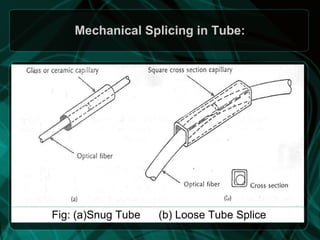
Snug Tube Splice :
-Bonding two fibers together in an alignment structure.
-Transparent adhesive – e. g, epoxy resin.
Loose Tube Splice:
-It’s a technique which avoids the critical tolerance requirement of the snug
tube splice is shown in above figure (b).
-This loose tube splice use an oversized square-section metal tube which
easily accepts the prepared fiber ends.
.
Mechanical Splicing in Tube:
Fig: (a)Snug Tube (b) Loose Tube Splice
Mechanical Splicing in Tube:
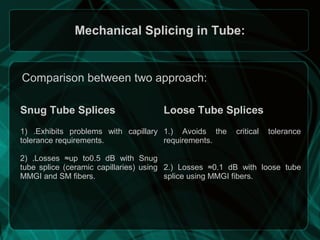
Snug Tube Splices Loose Tube Splices
1) .Exhibits problems with capillary
tolerance requirements.
2) .Losses ≈up to0.5 dB with Snug
tube splice (ceramic capillaries) using
MMGI and SM fibers.
1.) Avoids the critical tolerance
requirements.
2.) Losses ≈0.1 dB with loose tube
splice using MMGI fibers.
Comparison between two approach:
V-groove splice
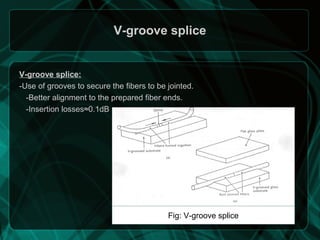
V-groove splice:
-Use of grooves to secure the fibers to be jointed.
-Better alignment to the prepared fiber ends.
-Insertion losses≈0.1dB
Fig: V-groove splice
Mechanical splice technique
Advantages:
-Semi permanent
-Lower loss than connector
-Low equipment cost.
-they require no tooling.
-They are easily implemented in the field.
Disadvantages:
-Higher loss than fusion splice
-Higher cost per splice.
-precision is require.
- Size is not small as fusion splice.
Thanks you

Mechanical splicing techniques for optical fiber

  • 1.
  • 2.
    What is FiberOptic Splicing • Knowledge of fiber optic splicing methods is vital to any company or fiber optic technician involved in Telecommunications or LAN and networking projects. • Fiber optic splicing is an important method of joining two fiber optic cables together. • It is a preferred solution when an available fiber optic cable is not sufficiently long for the required run. • In this case it is possible to splice together two cables to make a permanent connection.
  • 3.
    Types of splicing MechanicalSplicing: Mechanical splices are simply alignment devices, designed to hold the two fiber ends in a precisely aligned position thus enabling light to pass from one fiber into the other. (Typical loss: 0.3 dB) Fusion Splicing: In fusion splicing a machine is used to precisely align the two fiber ends then the glass ends are "fused" or "welded" together using some type of heat or electric arc. This produces a continuous connection between the fibers enabling very low loss light transmission. (Typical loss: 0.1 dB)
  • 4.
    Mechanical Splicing Method Mechanicalsplicing is an optical junction where the fibers are precisely aligned and held in place by a self-contained assembly, not a permanent bond. This method aligns the two fiber ends to a common centerline, aligning their cores so the light can pass from one fiber to another.
  • 5.
    Four steps toperforming a mechanical splice Step 1: Preparing the fiber - Strip the protective coatings, jackets, tubes, strength members, etc. leaving only the bare fiber showing. The main concern here is cleanliness. Step 2: Cleave the fiber - The process is identical to the cleaving for fusion splicing but the cleave precision is not as critical. Step 3: Mechanically join the fibers - There is no heat used in this method. Simply position the fiber ends together inside the mechanical splice unit. The index matching gel inside the mechanical splice apparatus will help couple the light from one fiber end to the other. Older apparatus will have an epoxy rather than the index matching gel holding the cores together. Step 4: Protect the fiber - the completed mechanical splice provides its own protection for the splice.
  • 6.
    Techniques for tubesplicing of optical fibers: (a) Snug Tube Splice (b) Loose Tube Splice; Square Cross section Capillary. (c) V-groove splice.
  • 7.
    Mechanical Splicing inTube: Uses accurately produced rigid alignment tubes into which the prepared fiber ends are permanently bonded. Snug Tube Splice : -Bonding two fibers together in an alignment structure. -Transparent adhesive – e. g, epoxy resin. Loose Tube Splice: -It’s a technique which avoids the critical tolerance requirement of the snug tube splice is shown in above figure (b). -This loose tube splice use an oversized square-section metal tube which easily accepts the prepared fiber ends. .
  • 8.
    Mechanical Splicing inTube: Fig: (a)Snug Tube (b) Loose Tube Splice
  • 9.
    Mechanical Splicing inTube: Snug Tube Splices Loose Tube Splices 1) .Exhibits problems with capillary tolerance requirements. 2) .Losses ≈up to0.5 dB with Snug tube splice (ceramic capillaries) using MMGI and SM fibers. 1.) Avoids the critical tolerance requirements. 2.) Losses ≈0.1 dB with loose tube splice using MMGI fibers. Comparison between two approach:
  • 10.
    V-groove splice V-groove splice: -Useof grooves to secure the fibers to be jointed. -Better alignment to the prepared fiber ends. -Insertion losses≈0.1dB Fig: V-groove splice
  • 11.
    Mechanical splice technique Advantages: -Semipermanent -Lower loss than connector -Low equipment cost. -they require no tooling. -They are easily implemented in the field. Disadvantages: -Higher loss than fusion splice -Higher cost per splice. -precision is require. - Size is not small as fusion splice.
  • 12.