FIBRE REINFORCED
CONCRETE
BY-
RAJAT NAINWAL
FIBRE-REINFORCED
CONCRETE
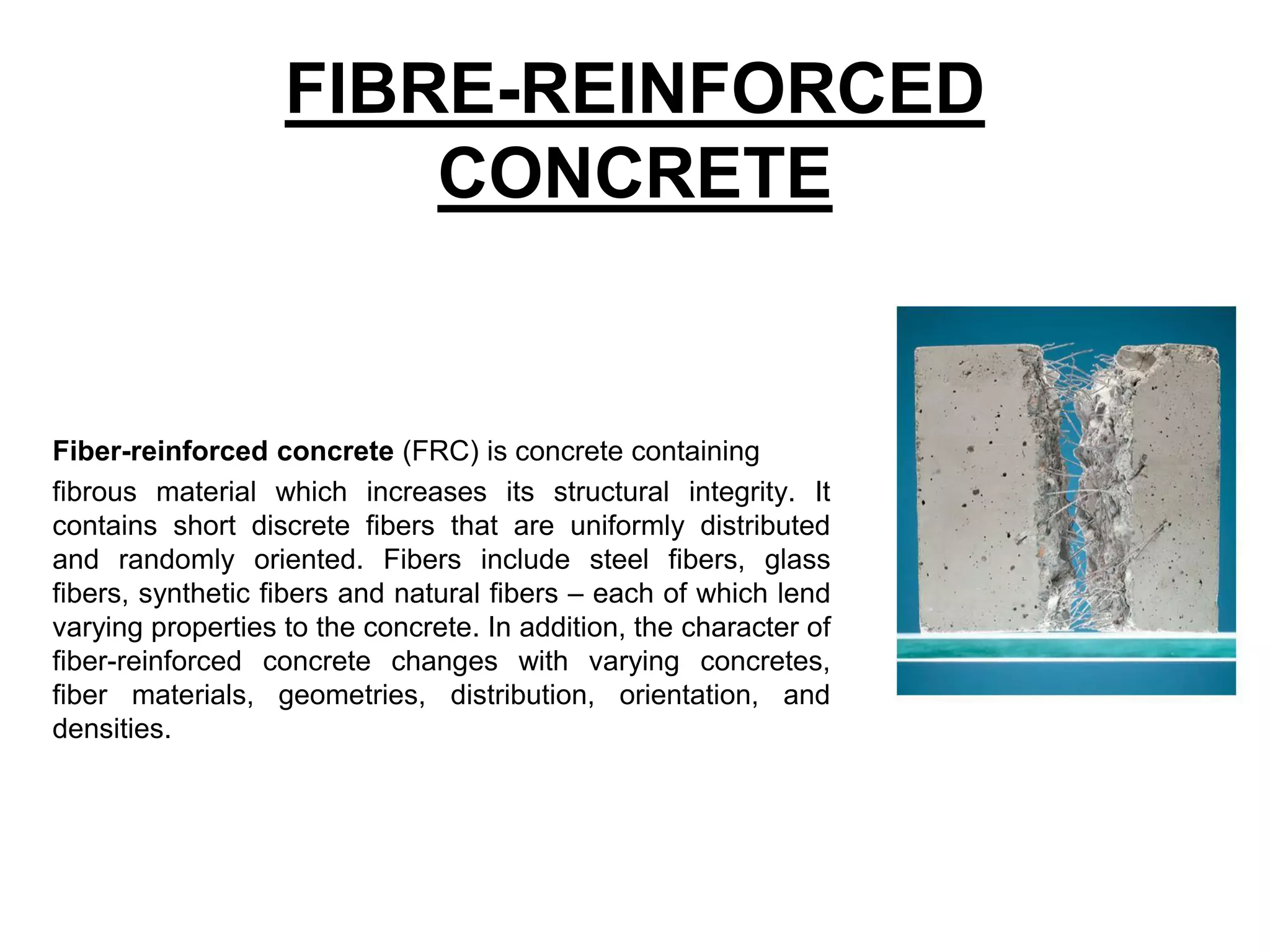
Fiber-reinforced concrete (FRC) is concrete containing
fibrous material which increases its structural integrity. It
contains short discrete fibers that are uniformly distributed
and randomly oriented. Fibers include steel fibers, glass
fibers, synthetic fibers and natural fibers – each of which lend
varying properties to the concrete. In addition, the character of
fiber-reinforced concrete changes with varying concretes,
fiber materials, geometries, distribution, orientation, and
densities.
EFFECT OF FIBERS IN CONCRETE
- Fibers are usually used in concrete to control cracking due to plastic shrinkage and to
drying shrinkage.
- They also reduce the permeability of concrete and thus reduce bleeding of water.
- Some types of fibers produce greater impact–, abrasion–, and shatter–resistance in
concrete. Generally fibers do not increase the flexural strength of concrete, and so
cannot replace moment–resisting or structural steel reinforcement.
-The amount of fibers added to a concrete mix is expressed as a percentage of the total
volume of the composite (concrete and fibers), termed "volume fraction" (Vf). Vf typically
ranges from 0.1 to 3%. The aspect ratio (l/d) is calculated by dividing fiber length (l) by its
diameter (d).
- Fibers with a non-circular cross section use an equivalent diameter for the calculation of
aspect ratio. If the fiber's modulus of elasticity is higher than the matrix, they help to carry
the load by increasing the tensile strength of the material. Increasing the aspect ratio of
the fiber usually segments the flexural strength and toughness of the matrix. However,
fibers that are too long tend to "ball" in the mix and create workability problems.
FRC COMPOSITION
230 kg/m3
710 kg/m3
210 kg/m3
40 - 160 kg/m3
13 kg/m3
140 kg/m3
1020 kg/m3
Cement
Silica Fume
Crushed
Quartz
Sand
Fibres
Plasticiser
Total Water
- No coarse aggregate
ADVANTAGES
• Very high compressive and tensile strength.
• High elasticity modulus and durability.
• Improve structural strength.
• Reduce steel reinforcement requirement.
• Reduce crack widths and control the crack widths tightly, thus improving durability.
• Improve impact– and abrasion–resistance.
• Improve resistance to explosive spalling in case of a severe fire.
• Increase resistance to plastic shrinkage during curing.
• Sherbrooke footbridge, 1997
• Seonyu footbridge, Korea, 2001-2002
• Papatoetoe Railway Station, New Zealand, 2005
• Cattenom Power Station beams, 1997-98
• Shepherds Gully Creek Bridge, Australia, 2003-2004
• Chabotte Bridge, France
• Millau Viaduct Toll Gate, France
• Shawnessy Light Rail Train Station, Canada
•The Folly, Netherlands
• Martel tree, 1998
• Monaco station panels, 1999
REFERENCES OF FRC
SHERBROOKE FOOTBRIDGE, CANADA
3000
3300
150
320
380
3000 mm
3 cm thick slab with ribs
FRC confined in stainless steel pipes
60 .0m4x7T13
2x4T132x4T13 2X7T13 2x4T13
3.0m
60m span prestressed structure without passive reinforcement
SHERBROOKE FOOTBRIDGE, CANADA
SEONYU FOOTBRIDGE, KOREA
PAPATOETOE RAILWAY STATION, NEW ZEALAND
• Use of FRC allows reduction
of the structure self weight by a
factor of 3
• Durability properties of Ductal
allow reduction of maintenance
costs
CATTENOM POWER STATION BEAMS, FRANCE
15100
Elevation
Precast pretensioned
FRC beams
Reinforced concrete slab
Driven steel piles Precast concrete walls
SHEPHERDS GULLY CREEK BRIDGE, AUSTRALIA
CHABOTTE BRIDGE, FRANCE
(Portée entre appuis : 47m40)
CHABOTTE BRIDGE, FRANCE
MILLAU VIADUCT TOLL GATE, FRANCE
24 FRC white, ultra-thin (only 20 mm)
curved shell-shaped canopies
SHAWNESSY LIGHT RAIL TRAIN STATION, CANADA
THE FOLLY, NETHERLANDS
MARTEL TREE, FRANCE
MONACO RAILWAY STATION PANELS
THANK YOU

Fibre reinforced concrete

  • 1.
  • 2.
    FIBRE-REINFORCED CONCRETE Fiber-reinforced concrete (FRC)is concrete containing fibrous material which increases its structural integrity. It contains short discrete fibers that are uniformly distributed and randomly oriented. Fibers include steel fibers, glass fibers, synthetic fibers and natural fibers – each of which lend varying properties to the concrete. In addition, the character of fiber-reinforced concrete changes with varying concretes, fiber materials, geometries, distribution, orientation, and densities.
  • 3.
    EFFECT OF FIBERSIN CONCRETE - Fibers are usually used in concrete to control cracking due to plastic shrinkage and to drying shrinkage. - They also reduce the permeability of concrete and thus reduce bleeding of water. - Some types of fibers produce greater impact–, abrasion–, and shatter–resistance in concrete. Generally fibers do not increase the flexural strength of concrete, and so cannot replace moment–resisting or structural steel reinforcement. -The amount of fibers added to a concrete mix is expressed as a percentage of the total volume of the composite (concrete and fibers), termed "volume fraction" (Vf). Vf typically ranges from 0.1 to 3%. The aspect ratio (l/d) is calculated by dividing fiber length (l) by its diameter (d). - Fibers with a non-circular cross section use an equivalent diameter for the calculation of aspect ratio. If the fiber's modulus of elasticity is higher than the matrix, they help to carry the load by increasing the tensile strength of the material. Increasing the aspect ratio of the fiber usually segments the flexural strength and toughness of the matrix. However, fibers that are too long tend to "ball" in the mix and create workability problems.
  • 4.
    FRC COMPOSITION 230 kg/m3 710kg/m3 210 kg/m3 40 - 160 kg/m3 13 kg/m3 140 kg/m3 1020 kg/m3 Cement Silica Fume Crushed Quartz Sand Fibres Plasticiser Total Water - No coarse aggregate
  • 5.
    ADVANTAGES • Very highcompressive and tensile strength. • High elasticity modulus and durability. • Improve structural strength. • Reduce steel reinforcement requirement. • Reduce crack widths and control the crack widths tightly, thus improving durability. • Improve impact– and abrasion–resistance. • Improve resistance to explosive spalling in case of a severe fire. • Increase resistance to plastic shrinkage during curing.
  • 6.
    • Sherbrooke footbridge,1997 • Seonyu footbridge, Korea, 2001-2002 • Papatoetoe Railway Station, New Zealand, 2005 • Cattenom Power Station beams, 1997-98 • Shepherds Gully Creek Bridge, Australia, 2003-2004 • Chabotte Bridge, France • Millau Viaduct Toll Gate, France • Shawnessy Light Rail Train Station, Canada •The Folly, Netherlands • Martel tree, 1998 • Monaco station panels, 1999 REFERENCES OF FRC
  • 7.
  • 8.
    3000 3300 150 320 380 3000 mm 3 cmthick slab with ribs FRC confined in stainless steel pipes 60 .0m4x7T13 2x4T132x4T13 2X7T13 2x4T13 3.0m 60m span prestressed structure without passive reinforcement SHERBROOKE FOOTBRIDGE, CANADA
  • 9.
  • 10.
  • 11.
    • Use ofFRC allows reduction of the structure self weight by a factor of 3 • Durability properties of Ductal allow reduction of maintenance costs CATTENOM POWER STATION BEAMS, FRANCE
  • 12.
    15100 Elevation Precast pretensioned FRC beams Reinforcedconcrete slab Driven steel piles Precast concrete walls SHEPHERDS GULLY CREEK BRIDGE, AUSTRALIA
  • 13.
    SHEPHERDS GULLY CREEKBRIDGE, AUSTRALIA
  • 14.
  • 15.
    (Portée entre appuis: 47m40) CHABOTTE BRIDGE, FRANCE
  • 16.
    MILLAU VIADUCT TOLLGATE, FRANCE
  • 17.
    MILLAU VIADUCT TOLLGATE, FRANCE
  • 18.
    24 FRC white,ultra-thin (only 20 mm) curved shell-shaped canopies SHAWNESSY LIGHT RAIL TRAIN STATION, CANADA
  • 19.
  • 20.
  • 21.