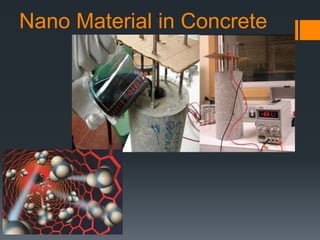
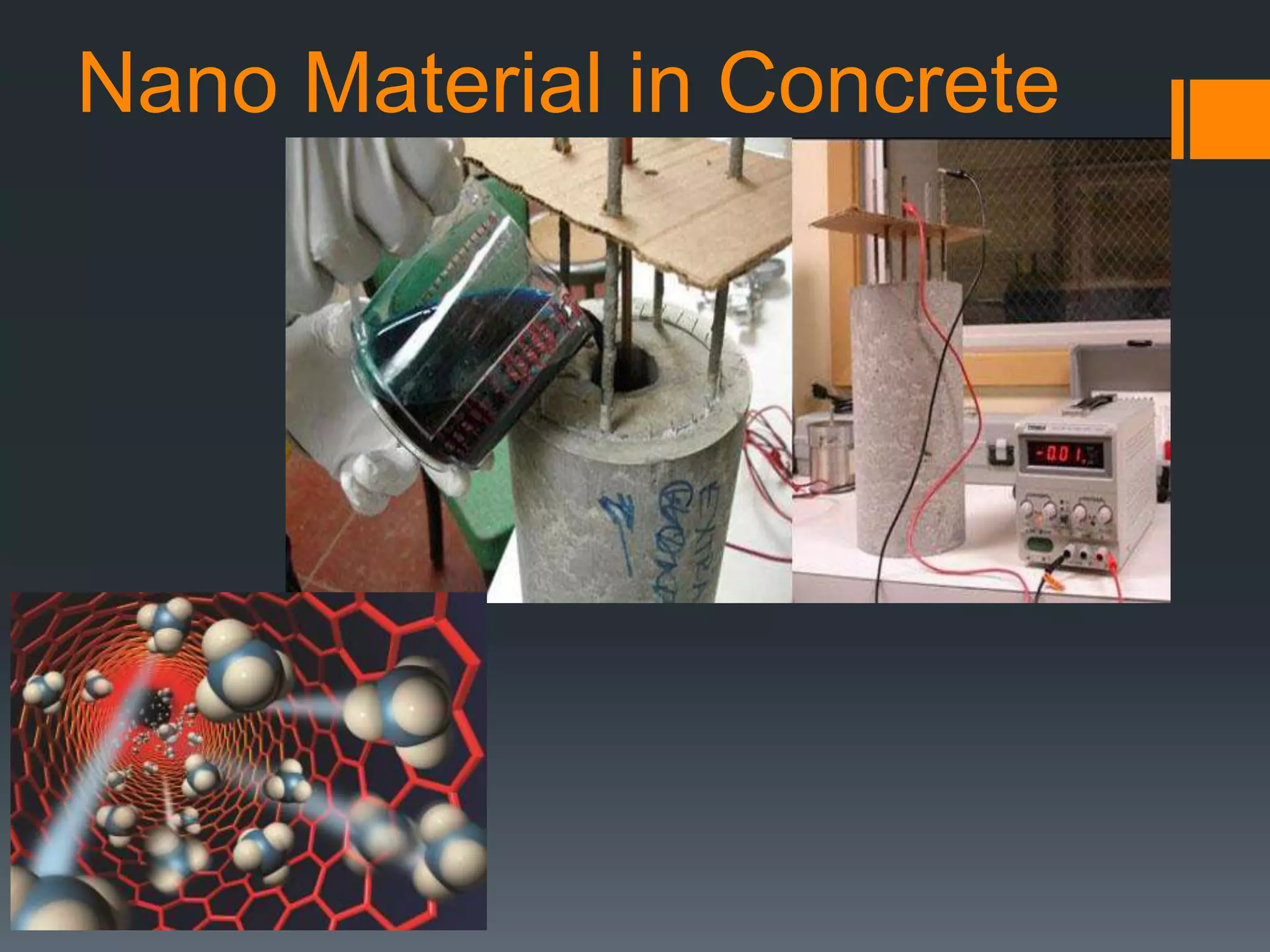
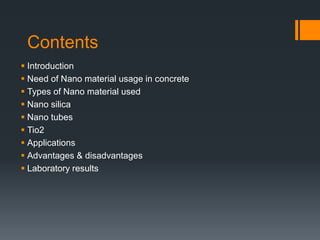
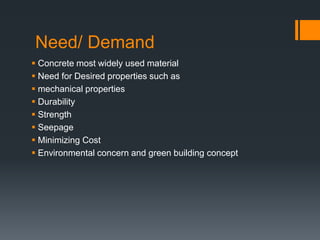
Nano Material in Concrete
Contents 
 Introduction 
 Need of Nano material usage in concrete 
 Types of Nano material used 
 Nano silica 
 Nano tubes 
 Tio2 
 Applications 
 Advantages & disadvantages 
 Laboratory results
Introduction 
 Nano= 10-9 m about one billionth of a meter 
 A strand of DNA is 2 nm wide 
 A human hair is about 100,000 nm 
 A sheet of paper is 100,000 nm 
What is Nano concrete ? 
Concrete made with Portland cement particle sizes that are less than 500 nm as cementing 
agent 
 When matter is controlled at the Nano scale, the 
following fundamental properties can change 
 mechanical 
 thermal 
 electrical 
 magnetic 
 chemical reactivity
Need/ Demand 
 Concrete most widely used material 
 Need for Desired properties such as 
 mechanical properties 
 Durability 
 Strength 
 Seepage 
 Minimizing Cost 
 Environmental concern and green building concept
Types of Nano material Used in 
concrete 
 Most known and research material used so far 
 Nano Silica 
 Carbon Nano tubes 
 Titanium oxide Ti02
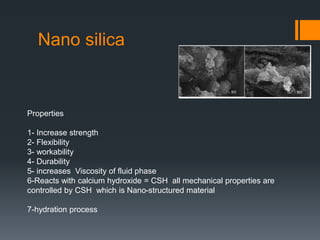
Nano silica 
Properties 
1- Increase strength 
2- Flexibility 
3- workability 
4- Durability 
5- increases Viscosity of fluid phase 
6-Reacts with calcium hydroxide = CSH all mechanical properties are 
controlled by CSH which is Nano-structured material 
7-hydration process
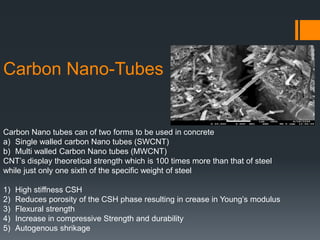
Carbon Nano-Tubes 
Carbon Nano tubes can of two forms to be used in concrete 
a) Single walled carbon Nano tubes (SWCNT) 
b) Multi walled Carbon Nano tubes (MWCNT) 
CNT’s display theoretical strength which is 100 times more than that of steel 
while just only one sixth of the specific weight of steel 
1) High stiffness CSH 
2) Reduces porosity of the CSH phase resulting in crease in Young’s modulus 
3) Flexural strength 
4) Increase in compressive Strength and durability 
5) Autogenous shrikage
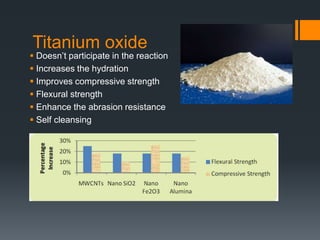
Titanium oxide 
 Doesn’t participate in the reaction 
 Increases the hydration 
 Improves compressive strength 
 Flexural strength 
 Enhance the abrasion resistance 
 Self cleansing
Case study 
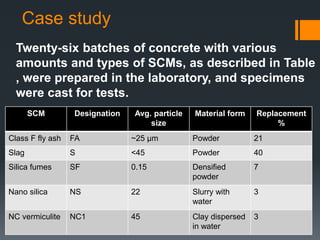
Twenty-six batches of concrete with various 
amounts and types of SCMs, as described in Table 
, were prepared in the laboratory, and specimens 
were cast for tests. 
SCM Designation Avg. particle 
size 
Material form Replacement 
% 
Class F fly ash FA ~25 μm Powder 21 
Slag S <45 Powder 40 
Silica fumes SF 0.15 Densified 
powder 
7 
Nano silica NS 22 Slurry with 
water 
3 
NC vermiculite NC1 45 Clay dispersed 
in water 
3
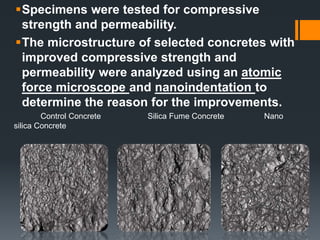
Specimens were tested for compressive 
strength and permeability. 
The microstructure of selected concretes with 
improved compressive strength and 
permeability were analyzed using an atomic 
force microscope and nanoindentation to 
determine the reason for the improvements. 
Control Concrete Silica Fume Concrete Nano 
silica Concrete
Results 
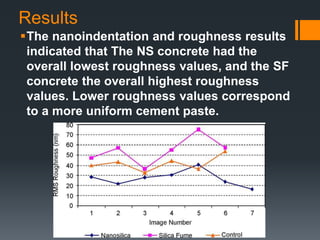
The nanoindentation and roughness results 
indicated that The NS concrete had the 
overall lowest roughness values, and the SF 
concrete the overall highest roughness 
values. Lower roughness values correspond 
to a more uniform cement paste.
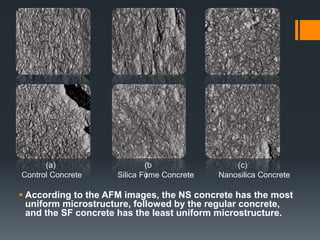
(a) (b 
) 
(c) 
Control Concrete Silica Fume Concrete Nanosilica Concrete 
 According to the AFM images, the NS concrete has the most 
uniform microstructure, followed by the regular concrete, 
and the SF concrete has the least uniform microstructure.
Advantages 
• Low maintenance 
• Reduces the thermal transfer rate 
• Increasing the sound absorption of 
acoustic absorber 
• Increasing the reflectivity of glass 
• improve segregation resistance 
• fix micro cracking 
• corrosion-resistance 
• Low life-cycle cost
Disadvantages 
 Require a lot of energy 
 Price 
 nanotubes might cause a lung problem 
 The research is in it´s early stage yet
Applications 
 Bridges 
 pipe joining materials and techniques 
 Lighter and stronger structural composites 
 Reservoirs 
 Waste water management 
 Roads 
 Nano-sensors
What is the world’s strongest 
material ?
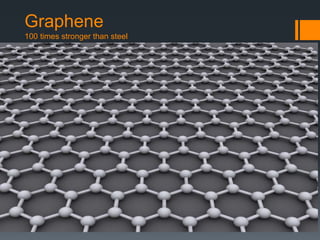
Graphene 
100 times stronger than steel
Thank You

Nano materials in concrete

  • 1.
  • 2.
    Contents  Introduction  Need of Nano material usage in concrete  Types of Nano material used  Nano silica  Nano tubes  Tio2  Applications  Advantages & disadvantages  Laboratory results
  • 3.
    Introduction  Nano=10-9 m about one billionth of a meter  A strand of DNA is 2 nm wide  A human hair is about 100,000 nm  A sheet of paper is 100,000 nm What is Nano concrete ? Concrete made with Portland cement particle sizes that are less than 500 nm as cementing agent  When matter is controlled at the Nano scale, the following fundamental properties can change  mechanical  thermal  electrical  magnetic  chemical reactivity
  • 4.
    Need/ Demand Concrete most widely used material  Need for Desired properties such as  mechanical properties  Durability  Strength  Seepage  Minimizing Cost  Environmental concern and green building concept
  • 5.
    Types of Nanomaterial Used in concrete  Most known and research material used so far  Nano Silica  Carbon Nano tubes  Titanium oxide Ti02
  • 6.
    Nano silica Properties 1- Increase strength 2- Flexibility 3- workability 4- Durability 5- increases Viscosity of fluid phase 6-Reacts with calcium hydroxide = CSH all mechanical properties are controlled by CSH which is Nano-structured material 7-hydration process
  • 7.
    Carbon Nano-Tubes CarbonNano tubes can of two forms to be used in concrete a) Single walled carbon Nano tubes (SWCNT) b) Multi walled Carbon Nano tubes (MWCNT) CNT’s display theoretical strength which is 100 times more than that of steel while just only one sixth of the specific weight of steel 1) High stiffness CSH 2) Reduces porosity of the CSH phase resulting in crease in Young’s modulus 3) Flexural strength 4) Increase in compressive Strength and durability 5) Autogenous shrikage
  • 8.
    Titanium oxide Doesn’t participate in the reaction  Increases the hydration  Improves compressive strength  Flexural strength  Enhance the abrasion resistance  Self cleansing
  • 9.
    Case study Twenty-sixbatches of concrete with various amounts and types of SCMs, as described in Table , were prepared in the laboratory, and specimens were cast for tests. SCM Designation Avg. particle size Material form Replacement % Class F fly ash FA ~25 μm Powder 21 Slag S <45 Powder 40 Silica fumes SF 0.15 Densified powder 7 Nano silica NS 22 Slurry with water 3 NC vermiculite NC1 45 Clay dispersed in water 3
  • 10.
    Specimens were testedfor compressive strength and permeability. The microstructure of selected concretes with improved compressive strength and permeability were analyzed using an atomic force microscope and nanoindentation to determine the reason for the improvements. Control Concrete Silica Fume Concrete Nano silica Concrete
  • 11.
    Results The nanoindentationand roughness results indicated that The NS concrete had the overall lowest roughness values, and the SF concrete the overall highest roughness values. Lower roughness values correspond to a more uniform cement paste.
  • 12.
    (a) (b ) (c) Control Concrete Silica Fume Concrete Nanosilica Concrete  According to the AFM images, the NS concrete has the most uniform microstructure, followed by the regular concrete, and the SF concrete has the least uniform microstructure.
  • 13.
    Advantages • Lowmaintenance • Reduces the thermal transfer rate • Increasing the sound absorption of acoustic absorber • Increasing the reflectivity of glass • improve segregation resistance • fix micro cracking • corrosion-resistance • Low life-cycle cost
  • 14.
    Disadvantages  Requirea lot of energy  Price  nanotubes might cause a lung problem  The research is in it´s early stage yet
  • 15.
    Applications  Bridges  pipe joining materials and techniques  Lighter and stronger structural composites  Reservoirs  Waste water management  Roads  Nano-sensors
  • 16.
    What is theworld’s strongest material ?
  • 17.
    Graphene 100 timesstronger than steel
  • 18.