NAME- IMRAN ALI (110107076)
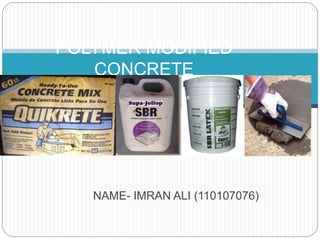
POLYMER MODIFIED
CONCRETE
Introduction
 The concept of polymer modification for cement
mortar and concrete is not so new, as in 1923 the first
patent of the concept had already been issued to
Cresson
 (1)This patent refers to paving materials with natural
rubber latexes, and cement was used as a filler. The
first patent with the present concept of polymer
modification was published by Lefebure
 (2)In 1924. Since then, considerable research and
development of polymer modification for cement,
mortar and concrete have been conducted in various
countries for 70 years or more. As a result, many
effective polymer modification systems for cement
mortar and concrete have been developed, and
currently are used in various applications in the
construction industry.
Polymer modification of concrete
 To produce polymer-modified mortar and
concrete, mostly polymers in dispersion (latex or
emulsion) form are added to ordinary cement
mortar and concrete during mixing. Polymer-
modified mortar and concrete have considerable
attraction because their process technology is
very similar to that of ordinary cement mortar and
concrete.
 The polymer dispersions widely used are styrene-
butadiene rubber (SBR)latex, ethylene-vinyl
acetate (EVA), and polyacrylic ester (PAE)
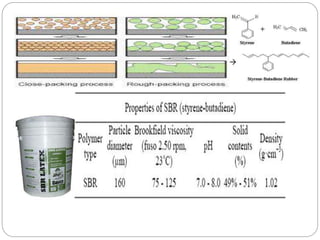
SBR Modified Concrete
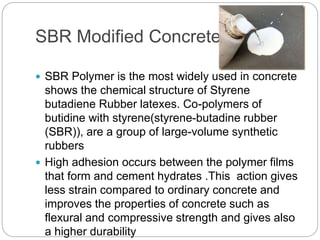
 SBR Polymer is the most widely used in concrete
shows the chemical structure of Styrene
butadiene Rubber latexes. Co-polymers of
butidine with styrene(styrene-butadine rubber
(SBR)), are a group of large-volume synthetic
rubbers
 High adhesion occurs between the polymer films
that form and cement hydrates .This action gives
less strain compared to ordinary concrete and
improves the properties of concrete such as
flexural and compressive strength and gives also
a higher durability
cost
 Various ingredients with their cost to produce 1
Kg of polymer have been ,It can be , that the total
cost to produce 1 Kg of polymer combination of
ratio 4:4:1 came to be rs 10/Kg whereas the cost
of cheapest polymer available in the market
varies from rs 40 to 100/Kg. Thus substantial cost
saving can be achieved by using the said polymer
combinations developed during the
Tensile and compressive strength of
PMC
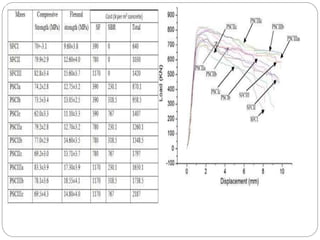
Tensile and compressive strengths of ordinary
concrete and polymer modified concrete using
varying proportions of PVA emulsion and subsidiary
Chemical that the polymer alteration resulted in an
increase in the flexural tensile and compressive
strength of the ordinary concrete. Highest tensile
strength i.e., 1,200 Psi with corresponding highest
compressive strength 12,400 Psi was achieved in
polymer-modified concrete with the ratio of 4:4:1 by
weight of PVA, AG and SBR, respectively
ADVANTAGES OF PMC
 High performance ,low cost , great convenience ,
and excellent durability.
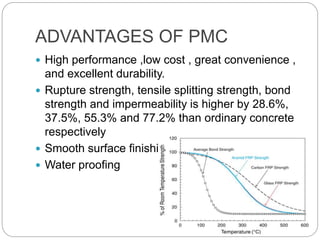
 Rupture strength, tensile splitting strength, bond
strength and impermeability is higher by 28.6%,
37.5%, 55.3% and 77.2% than ordinary concrete
respectively
 Smooth surface finishing.
 Water proofing
Applications of PMC
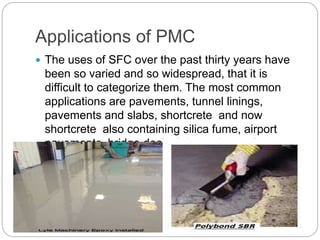
 The uses of SFC over the past thirty years have
been so varied and so widespread, that it is
difficult to categorize them. The most common
applications are pavements, tunnel linings,
pavements and slabs, shortcrete and now
shortcrete also containing silica fume, airport
pavements, bridge deck slab repairs, and so on.
Conclusion
 1. SBR Addition of steel to a concrete will improve both its
flexural and compressive strength. The strengths increase
significantly with fiber content.
 2. The flexural strength increases greatly when containing 3-
10 wt.% SBR. The optimal use of SBR is 5 wt.%, which
achieves the highest flexural strength. However, the
compressive strength may decrease with the addition arrives
10 wt.%, a 16% reduction is observed.
 3.Polymer films are observed in concretes when incorporating
5 or 10 wt.% SBR, and act as bridges across pores and
cracks. Moreover, the polymer films in concrete incorporating
10 wt.% SBR are thicker and more coherent.
 4. The pore size distribution curves of specimens exhibit at
least two peaks, which locate in the ranges of 5-20 nm and
50-1000 nm, respectively. Higher addition of SBR leads to a
larger peak magnitude in the range of 50-1000 nm.

Polymer modified concrete

  • 1.
    NAME- IMRAN ALI(110107076) POLYMER MODIFIED CONCRETE
  • 2.
    Introduction  The conceptof polymer modification for cement mortar and concrete is not so new, as in 1923 the first patent of the concept had already been issued to Cresson  (1)This patent refers to paving materials with natural rubber latexes, and cement was used as a filler. The first patent with the present concept of polymer modification was published by Lefebure  (2)In 1924. Since then, considerable research and development of polymer modification for cement, mortar and concrete have been conducted in various countries for 70 years or more. As a result, many effective polymer modification systems for cement mortar and concrete have been developed, and currently are used in various applications in the construction industry.
  • 3.
    Polymer modification ofconcrete  To produce polymer-modified mortar and concrete, mostly polymers in dispersion (latex or emulsion) form are added to ordinary cement mortar and concrete during mixing. Polymer- modified mortar and concrete have considerable attraction because their process technology is very similar to that of ordinary cement mortar and concrete.  The polymer dispersions widely used are styrene- butadiene rubber (SBR)latex, ethylene-vinyl acetate (EVA), and polyacrylic ester (PAE)
  • 4.
    SBR Modified Concrete SBR Polymer is the most widely used in concrete shows the chemical structure of Styrene butadiene Rubber latexes. Co-polymers of butidine with styrene(styrene-butadine rubber (SBR)), are a group of large-volume synthetic rubbers  High adhesion occurs between the polymer films that form and cement hydrates .This action gives less strain compared to ordinary concrete and improves the properties of concrete such as flexural and compressive strength and gives also a higher durability
  • 6.
    cost  Various ingredientswith their cost to produce 1 Kg of polymer have been ,It can be , that the total cost to produce 1 Kg of polymer combination of ratio 4:4:1 came to be rs 10/Kg whereas the cost of cheapest polymer available in the market varies from rs 40 to 100/Kg. Thus substantial cost saving can be achieved by using the said polymer combinations developed during the
  • 7.
    Tensile and compressivestrength of PMC Tensile and compressive strengths of ordinary concrete and polymer modified concrete using varying proportions of PVA emulsion and subsidiary Chemical that the polymer alteration resulted in an increase in the flexural tensile and compressive strength of the ordinary concrete. Highest tensile strength i.e., 1,200 Psi with corresponding highest compressive strength 12,400 Psi was achieved in polymer-modified concrete with the ratio of 4:4:1 by weight of PVA, AG and SBR, respectively
  • 9.
    ADVANTAGES OF PMC High performance ,low cost , great convenience , and excellent durability.  Rupture strength, tensile splitting strength, bond strength and impermeability is higher by 28.6%, 37.5%, 55.3% and 77.2% than ordinary concrete respectively  Smooth surface finishing.  Water proofing
  • 10.
    Applications of PMC The uses of SFC over the past thirty years have been so varied and so widespread, that it is difficult to categorize them. The most common applications are pavements, tunnel linings, pavements and slabs, shortcrete and now shortcrete also containing silica fume, airport pavements, bridge deck slab repairs, and so on.
  • 11.
    Conclusion  1. SBRAddition of steel to a concrete will improve both its flexural and compressive strength. The strengths increase significantly with fiber content.  2. The flexural strength increases greatly when containing 3- 10 wt.% SBR. The optimal use of SBR is 5 wt.%, which achieves the highest flexural strength. However, the compressive strength may decrease with the addition arrives 10 wt.%, a 16% reduction is observed.  3.Polymer films are observed in concretes when incorporating 5 or 10 wt.% SBR, and act as bridges across pores and cracks. Moreover, the polymer films in concrete incorporating 10 wt.% SBR are thicker and more coherent.  4. The pore size distribution curves of specimens exhibit at least two peaks, which locate in the ranges of 5-20 nm and 50-1000 nm, respectively. Higher addition of SBR leads to a larger peak magnitude in the range of 50-1000 nm.