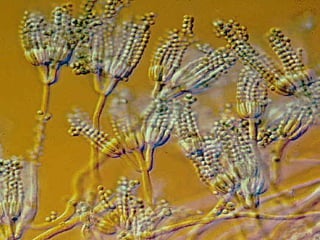
Deuteromycota The Imperfect Fungi
Deuteromycota means “ second fungi .” Deuteromycota was a formal phylum of kingdom Fungi. But, scientists have not yet observed Deuteromycota’s sexual reproductive cycle, one of the basis of the taxonomy of kingdom Fungi. Now, the term is only used informally to denote the species of fungi that reproduce asexually of the fungal phyla Ascomycota and Basidiomycota. Deuteromycota
They are characterized by  the production of septate mycelium and a sexual life cycle that is either unknown or absent. They reproduce asexually by means of  conidia  (sing. = conidium). A conidium is an asexual spore that is not produced in a sporangium Deuteromycota
Deuteromycota Deuteromycota There are four orders in phylum Deuteromycota: Moniliales Sphaeropsidales Melanconiales Mycelia Sterlia Deuteromycota
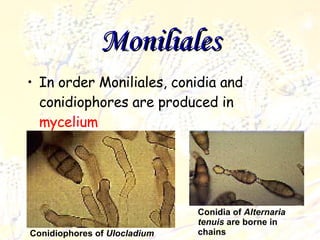
Moniliales Conidiophores of  Ulocladium Deuteromycota In order Moniliales, conidia and conidiophores are produced in  mycelium Moniliales Conidia of  Alternaria tenuis  are borne in chains
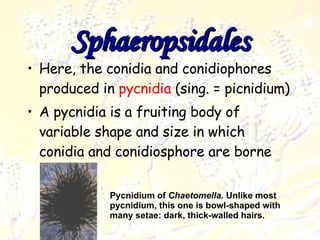
Sphaeropsidales Deuteromycota Here, the conidia and conidiophores produced in  pycnidia  (sing. = picnidium) A pycnidia is a fruiting body of variable shape and size in which conidia and conidiosphore are borne Sphaeropsidales Pycnidium of  Chaetomella.  Unlike most pycnidium, this one is bowl-shaped with many setae: dark, thick-walled hairs.
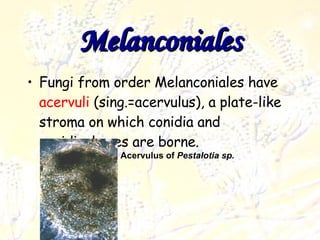
Melanconiales Deuteromycota Fungi from order Melanconiales have  acervuli  (sing.=acervulus), a plate-like stroma on which conidia and conidiophores are borne. Melanconiales Acervulus of  Pestalotia sp.
Mycelia Sterlia Deuteromycota Mycelium is sterile, conidia not produced. They have  sclerotia  (sing.= sclerotium). A sclerotium is a rounded structure composed of mass of hyphae, which is normally sterile. The sclerotia serves as a "resistant" stage which may give rise to mycelium, fruitbodies or stromata.  Mycelia Sterlia
Parasexual cycle Deuteromycota “ Parang sexual ” A process in which plasmogamy, karyogamy, and haploidization takes place, but not in a particular place in the thallus nor at any specific period during its life cycle. It was first discovered by  Pontecarvo  and  Roper (1952) in  Aspergillus nidulans . Parasexual Cycle
Parasexual cycle Deuteromycota Formation of  heterokaryotic   mycelium   Heterokaryon formation refers to the condition by which genetically different nuclei are associated in a common cytoplasm. Parasexual Cycle
Parasexual cycle Deuteromycota Occasional  karyogamy   Following initial fusion of hyphal cells, to form a genetically different cell, mitotic division perpetuates the cell and mycelium that is made up of genetically, different nuclei is formed. Parasexual Cycle
Parasexual cycle Deuteromycota Haploidization This haploidization is NOT meiosis. It is in fact, a series of errors in mitosis. A sequential loss of chromosomes will eventually give rise to a haploid nucleus. Parasexual Cycle
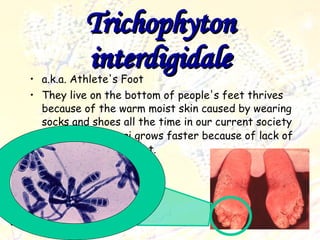
Trichophyton interdigidale a.k.a. Athlete's Foot They live on the bottom of people's feet thrives because of the warm moist skin caused by wearing socks and shoes all the time in our current society This type of fungi grows faster because of lack of ventilation to the feet.
Trichophyton interdigidale It causes Athlete's Foot along with many other organisms including Epidermophyton floccosum, Microsporum, and the human disease (ugly toenail fungus)‏ Can be extremely resistant to many treatments depending on the form of the Athlete's foot
Trichophyton interdigidale How It Adapts It can easily infect a human foot It is possible that everyone will, at some point, get Athlete's foot It is learning to resist many treatments and is slowly becoming immune to known treatments.
Trichophyton interdigidale Economic/ Ecological Significance It is painful and irritating There is a need to find new and more effective treatment against Athlete's Foot Affect footwear design Affect foot care industry
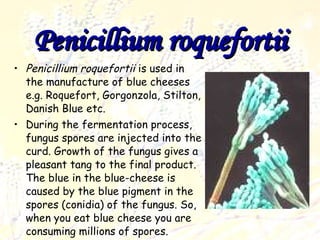
Penicillium roquefortii Penicillium roquefortii  is used in the manufacture of blue cheeses e.g. Roquefort, Gorgonzola, Stilton, Danish Blue etc. During the fermentation process, fungus spores are injected into the curd. Growth of the fungus gives a pleasant tang to the final product. The blue in the blue-cheese is caused by the blue pigment in the spores (conidia) of the fungus. So, when you eat blue cheese you are consuming millions of spores. Yumm…
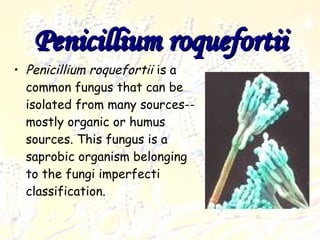
Penicillium roquefortii Penicillium roquefortii  is  a common fungus that can be isolated from many sources--mostly organic or humus sources. This fungus is a saprobic organism belonging to the fungi imperfecti classification.
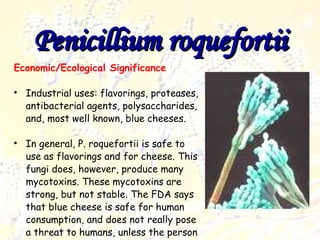
Penicillium roquefortii Economic/Ecological Significance Industrial uses: flavorings, proteases, antibacterial agents, polysaccharides, and, most well known, blue cheeses.  In general, P. roquefortii is safe to use as flavorings and for cheese. This fungi does, however, produce many mycotoxins. These mycotoxins are strong, but not stable. The FDA says that blue cheese is safe for human consumption, and does not really pose a threat to humans, unless the person has an allergy to the mycotoxins.
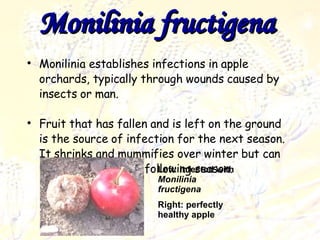
Monilinia fructigena   Monilinia establishes infections in apple orchards, typically through wounds caused by insects or man.  Fruit that has fallen and is left on the ground is the source of infection for the next season. It shrinks and mummifies over winter but can produce spores the following season.  Left: infected with  Monilinia fructigena Right: perfectly healthy apple
Monilinia fructigena   Characteristics The fungi causes the apple and fruits to rot when it invades the apple tissues and kills them by releasing enzymes.  The principal enzymes involved in this are pectic enzymes - those that break down the gel-like pectic compounds that cement the apple cells (or other plant cells) together.  There are several forms of these enzymes, but the major one is polygalacturonase  (PG), which splits the long pectin chains into smaller units of galacturonic acid.
Monilinia fructigena   Maturing plant tissues generate ethylene, and ethylene is a ripening agent. [In fact, bananas are shipped while green, to preserve them in good condition, and then are treated with ethylene to induce ripening before they are sold.]  A single rotten fruit can lead to a chain reaction. The damage caused by fruit-rotting fungi in even a single fruit in a package leads to the generation of ethylene and thus to the premature ripening of the other fruit.  Discovery in the control of this fungi could help reduce cost in the export or import of apple and other fruits
Many Thanks to… http://www.botany.hawaii.edu/faculty/wong/Bot201/Deuteromycota/Deuteromycota.htm   http://science.jrank.org/pages/2895/Fungi-Deuteromycota-imperfect-fungi.html   http://www.thefreedictionary.com/ dit.dru.ac.th www.lip-sas.fr  Nematophagous Fungi: Guide by Philip Jacobs, BRIC-Version (http://www.biological-research.com/philip-jacobs%20BRIC/ar-dact.htm) http://www.mycolog.com/CHAP4a.htm
And Thanks to… http://www.biology.ed.ac.uk/research/groups/jdeacon/microbes/applerot.htm http://bugs.bio.usyd.edu.au/Mycology/UsesOf_Fungi/industrialProduction/foodProcessing.shtml http://www.virtualmuseum.ca/~mushroom/English/Species/penicilliumroquefortii.html http://www.cals.ncsu.edu/course/pp318/profiles/deuteromycetes/deutero.htm http://www.cababstractsplus.org/google/abstract.asp?AcNo=20056401109 http://web.umr.edu/~microbio/BIO221_1998/P_roquefortii.html http://www.cs.cuc.edu/~tfutcher/Deuteromycota.html Tom Volk's Fungus of the Month for February 1998, http://botit.botany.wisc.edu/toms_fungi/feb98.html http://lynx6663.tripod.com/deuteromycota.html
Presented by Group 10 Ernest Nathan L. Nogales Jess Ramirez Lennart Panton Group 5 Athena Aherrera Mai Dealino Rocelle Mendoza
 

Deuteromycota

  • 1.
  • 2.
    Deuteromycota means “second fungi .” Deuteromycota was a formal phylum of kingdom Fungi. But, scientists have not yet observed Deuteromycota’s sexual reproductive cycle, one of the basis of the taxonomy of kingdom Fungi. Now, the term is only used informally to denote the species of fungi that reproduce asexually of the fungal phyla Ascomycota and Basidiomycota. Deuteromycota
  • 3.
    They are characterizedby the production of septate mycelium and a sexual life cycle that is either unknown or absent. They reproduce asexually by means of conidia (sing. = conidium). A conidium is an asexual spore that is not produced in a sporangium Deuteromycota
  • 4.
    Deuteromycota Deuteromycota Thereare four orders in phylum Deuteromycota: Moniliales Sphaeropsidales Melanconiales Mycelia Sterlia Deuteromycota
  • 5.
    Moniliales Conidiophores of Ulocladium Deuteromycota In order Moniliales, conidia and conidiophores are produced in mycelium Moniliales Conidia of Alternaria tenuis are borne in chains
  • 6.
    Sphaeropsidales Deuteromycota Here,the conidia and conidiophores produced in pycnidia (sing. = picnidium) A pycnidia is a fruiting body of variable shape and size in which conidia and conidiosphore are borne Sphaeropsidales Pycnidium of Chaetomella. Unlike most pycnidium, this one is bowl-shaped with many setae: dark, thick-walled hairs.
  • 7.
    Melanconiales Deuteromycota Fungifrom order Melanconiales have acervuli (sing.=acervulus), a plate-like stroma on which conidia and conidiophores are borne. Melanconiales Acervulus of Pestalotia sp.
  • 8.
    Mycelia Sterlia DeuteromycotaMycelium is sterile, conidia not produced. They have sclerotia (sing.= sclerotium). A sclerotium is a rounded structure composed of mass of hyphae, which is normally sterile. The sclerotia serves as a "resistant" stage which may give rise to mycelium, fruitbodies or stromata. Mycelia Sterlia
  • 9.
    Parasexual cycle Deuteromycota“ Parang sexual ” A process in which plasmogamy, karyogamy, and haploidization takes place, but not in a particular place in the thallus nor at any specific period during its life cycle. It was first discovered by Pontecarvo and Roper (1952) in Aspergillus nidulans . Parasexual Cycle
  • 10.
    Parasexual cycle DeuteromycotaFormation of heterokaryotic mycelium Heterokaryon formation refers to the condition by which genetically different nuclei are associated in a common cytoplasm. Parasexual Cycle
  • 11.
    Parasexual cycle DeuteromycotaOccasional karyogamy Following initial fusion of hyphal cells, to form a genetically different cell, mitotic division perpetuates the cell and mycelium that is made up of genetically, different nuclei is formed. Parasexual Cycle
  • 12.
    Parasexual cycle DeuteromycotaHaploidization This haploidization is NOT meiosis. It is in fact, a series of errors in mitosis. A sequential loss of chromosomes will eventually give rise to a haploid nucleus. Parasexual Cycle
  • 13.
    Trichophyton interdigidale a.k.a.Athlete's Foot They live on the bottom of people's feet thrives because of the warm moist skin caused by wearing socks and shoes all the time in our current society This type of fungi grows faster because of lack of ventilation to the feet.
  • 14.
    Trichophyton interdigidale Itcauses Athlete's Foot along with many other organisms including Epidermophyton floccosum, Microsporum, and the human disease (ugly toenail fungus)‏ Can be extremely resistant to many treatments depending on the form of the Athlete's foot
  • 15.
    Trichophyton interdigidale HowIt Adapts It can easily infect a human foot It is possible that everyone will, at some point, get Athlete's foot It is learning to resist many treatments and is slowly becoming immune to known treatments.
  • 16.
    Trichophyton interdigidale Economic/Ecological Significance It is painful and irritating There is a need to find new and more effective treatment against Athlete's Foot Affect footwear design Affect foot care industry
  • 17.
    Penicillium roquefortii Penicilliumroquefortii is used in the manufacture of blue cheeses e.g. Roquefort, Gorgonzola, Stilton, Danish Blue etc. During the fermentation process, fungus spores are injected into the curd. Growth of the fungus gives a pleasant tang to the final product. The blue in the blue-cheese is caused by the blue pigment in the spores (conidia) of the fungus. So, when you eat blue cheese you are consuming millions of spores. Yumm…
  • 18.
    Penicillium roquefortii Penicilliumroquefortii is a common fungus that can be isolated from many sources--mostly organic or humus sources. This fungus is a saprobic organism belonging to the fungi imperfecti classification.
  • 19.
    Penicillium roquefortii Economic/EcologicalSignificance Industrial uses: flavorings, proteases, antibacterial agents, polysaccharides, and, most well known, blue cheeses. In general, P. roquefortii is safe to use as flavorings and for cheese. This fungi does, however, produce many mycotoxins. These mycotoxins are strong, but not stable. The FDA says that blue cheese is safe for human consumption, and does not really pose a threat to humans, unless the person has an allergy to the mycotoxins.
  • 20.
    Monilinia fructigena Monilinia establishes infections in apple orchards, typically through wounds caused by insects or man. Fruit that has fallen and is left on the ground is the source of infection for the next season. It shrinks and mummifies over winter but can produce spores the following season. Left: infected with Monilinia fructigena Right: perfectly healthy apple
  • 21.
    Monilinia fructigena Characteristics The fungi causes the apple and fruits to rot when it invades the apple tissues and kills them by releasing enzymes. The principal enzymes involved in this are pectic enzymes - those that break down the gel-like pectic compounds that cement the apple cells (or other plant cells) together. There are several forms of these enzymes, but the major one is polygalacturonase (PG), which splits the long pectin chains into smaller units of galacturonic acid.
  • 22.
    Monilinia fructigena Maturing plant tissues generate ethylene, and ethylene is a ripening agent. [In fact, bananas are shipped while green, to preserve them in good condition, and then are treated with ethylene to induce ripening before they are sold.] A single rotten fruit can lead to a chain reaction. The damage caused by fruit-rotting fungi in even a single fruit in a package leads to the generation of ethylene and thus to the premature ripening of the other fruit. Discovery in the control of this fungi could help reduce cost in the export or import of apple and other fruits
  • 23.
    Many Thanks to…http://www.botany.hawaii.edu/faculty/wong/Bot201/Deuteromycota/Deuteromycota.htm http://science.jrank.org/pages/2895/Fungi-Deuteromycota-imperfect-fungi.html http://www.thefreedictionary.com/ dit.dru.ac.th www.lip-sas.fr Nematophagous Fungi: Guide by Philip Jacobs, BRIC-Version (http://www.biological-research.com/philip-jacobs%20BRIC/ar-dact.htm) http://www.mycolog.com/CHAP4a.htm
  • 24.
    And Thanks to…http://www.biology.ed.ac.uk/research/groups/jdeacon/microbes/applerot.htm http://bugs.bio.usyd.edu.au/Mycology/UsesOf_Fungi/industrialProduction/foodProcessing.shtml http://www.virtualmuseum.ca/~mushroom/English/Species/penicilliumroquefortii.html http://www.cals.ncsu.edu/course/pp318/profiles/deuteromycetes/deutero.htm http://www.cababstractsplus.org/google/abstract.asp?AcNo=20056401109 http://web.umr.edu/~microbio/BIO221_1998/P_roquefortii.html http://www.cs.cuc.edu/~tfutcher/Deuteromycota.html Tom Volk's Fungus of the Month for February 1998, http://botit.botany.wisc.edu/toms_fungi/feb98.html http://lynx6663.tripod.com/deuteromycota.html
  • 25.
    Presented by Group10 Ernest Nathan L. Nogales Jess Ramirez Lennart Panton Group 5 Athena Aherrera Mai Dealino Rocelle Mendoza
  • 26.