Heat Conduction

    Group A-2
Heat Conduction - Introduction

• Three types of heat transfer:
  – Radiation
  – Convection
  – Conduction
• Heat always transfers from a hot object to a
  colder one.
Heat Conduction – Theory

• Introduction
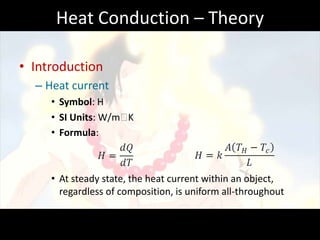
  – Heat current
     • Symbol: H
     • SI Units: W/mK
     • Formula:


     • At steady state, the heat current within an object,
       regardless of composition, is uniform all-throughout
Heat Conduction – Theory


Source: [1]
Heat Conduction - Experiment

• Objectives
  – Understand the concept of thermal conductivity
  – Determine the thermal conductivity of brass
Heat Conduction - Experiment

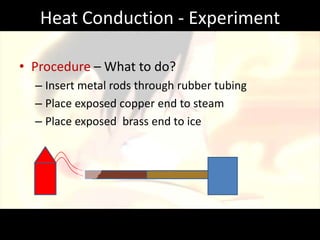
• Procedure – What to do?
  – Insert metal rods through rubber tubing
  – Place exposed copper end to steam
  – Place exposed brass end to ice
Heat Conduction - Experiment

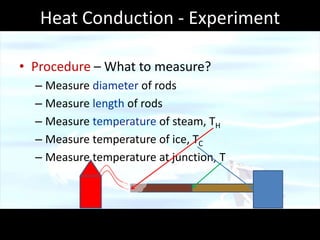
• Procedure – What to measure?
  – Measure diameter of rods
  – Measure length of rods
  – Measure temperature of steam, TH
  – Measure temperature of ice, TC
  – Measure temperature at junction, T
Heat Conduction - Experiment

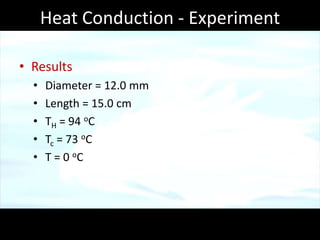
• Results
  •   Diameter = 12.0 mm
  •   Length = 15.0 cm
  •   TH = 94 oC
  •   Tc = 73 oC
  •   T = 0 oC
Heat Conduction - Worksheet

  • Results
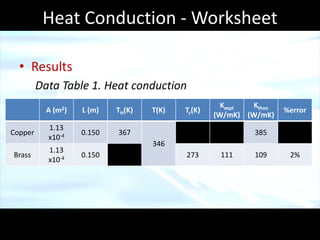
         Data Table 1. Heat conduction
                                                     Kexpt Ktheo
           A (m2)   L (m)   TH(K)   T(K)   Tc(K)                   %error
                                                   (W/mK) (W/mK)
           1.13
Copper              0.150   367                            385
           x10-4
                                    346
           1.13
Brass               0.150                  273      111    109      2%
           x10-4
Heat Conduction - Worksheet

• Calculations
  –


  –
Heat Conduction - Worksheet

• Answers to Questions
  1. Based on your calculations, which metal has the
     greater temperature drop? What does this result
     say about the ability of the metal to conduct
     heat?
  2. Is your result in question 1 consistent with the
     theoretical values of thermal conductivity of
     copper and brass? Why or why not?
Heat Conduction - Worksheet

• Answers to Questions
  3. What are the possible sources of error in the
     experiment? In which direction do they affect
     the measured values of thermal conductivity?
Heat Conduction

• Conclusion
  – The thermal conductivity of an object is
    dependent on its composition and dimensions
    (Cross-sectional area and length).
  – For two connected objects of the same dimension
    connected to hot and cold reservoirs, the higher
    the temperature drop, the lower the thermal
    conductivity
Heat Conduction

• Conclusion
  – Brass was experimentally found to have a thermal
    conductivity of 111 W/mK
  – Brass is less conductive thermally than copper.
Heat Conduction

• References
  –   [1]
        Hugh D. Young, Roger A. Freedman, contributing
    author A. Lewis Ford. "Figure 17.23 Steady-state heat
    flow due to conduction in a uniform rod." Hugh D.
    Young, Roger A. Freedman. Sears and Zemansky's
    University Physics with Modern Physics. San Francisco:
    Pearson Addison-Wesley, 1898-1975. 592.
  – [2] Nagi91860. “Ace vs Aokiji – One Piece Episode 481”
    Eiichiro Oda. One Piece. 1997.
    http://www.youtube.com/watch?v=uvYWRpN2rz4
Heat Conduction

Heat conduction

  • 1.
  • 2.
    Heat Conduction -Introduction • Three types of heat transfer: – Radiation – Convection – Conduction • Heat always transfers from a hot object to a colder one.
  • 3.
    Heat Conduction –Theory • Introduction – Heat current • Symbol: H • SI Units: W/mK • Formula: • At steady state, the heat current within an object, regardless of composition, is uniform all-throughout
  • 4.
    Heat Conduction –Theory Source: [1]
  • 5.
    Heat Conduction -Experiment • Objectives – Understand the concept of thermal conductivity – Determine the thermal conductivity of brass
  • 6.
    Heat Conduction -Experiment • Procedure – What to do? – Insert metal rods through rubber tubing – Place exposed copper end to steam – Place exposed brass end to ice
  • 7.
    Heat Conduction -Experiment • Procedure – What to measure? – Measure diameter of rods – Measure length of rods – Measure temperature of steam, TH – Measure temperature of ice, TC – Measure temperature at junction, T
  • 8.
    Heat Conduction -Experiment • Results • Diameter = 12.0 mm • Length = 15.0 cm • TH = 94 oC • Tc = 73 oC • T = 0 oC
  • 9.
    Heat Conduction -Worksheet • Results Data Table 1. Heat conduction Kexpt Ktheo A (m2) L (m) TH(K) T(K) Tc(K) %error (W/mK) (W/mK) 1.13 Copper 0.150 367 385 x10-4 346 1.13 Brass 0.150 273 111 109 2% x10-4
  • 10.
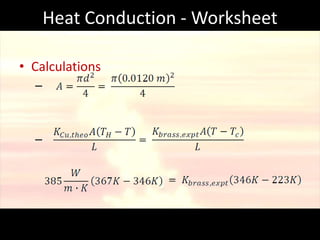
    Heat Conduction -Worksheet • Calculations – –
  • 11.
    Heat Conduction -Worksheet • Answers to Questions 1. Based on your calculations, which metal has the greater temperature drop? What does this result say about the ability of the metal to conduct heat? 2. Is your result in question 1 consistent with the theoretical values of thermal conductivity of copper and brass? Why or why not?
  • 12.
    Heat Conduction -Worksheet • Answers to Questions 3. What are the possible sources of error in the experiment? In which direction do they affect the measured values of thermal conductivity?
  • 13.
    Heat Conduction • Conclusion – The thermal conductivity of an object is dependent on its composition and dimensions (Cross-sectional area and length). – For two connected objects of the same dimension connected to hot and cold reservoirs, the higher the temperature drop, the lower the thermal conductivity
  • 14.
    Heat Conduction • Conclusion – Brass was experimentally found to have a thermal conductivity of 111 W/mK – Brass is less conductive thermally than copper.
  • 15.
    Heat Conduction • References – [1] Hugh D. Young, Roger A. Freedman, contributing author A. Lewis Ford. "Figure 17.23 Steady-state heat flow due to conduction in a uniform rod." Hugh D. Young, Roger A. Freedman. Sears and Zemansky's University Physics with Modern Physics. San Francisco: Pearson Addison-Wesley, 1898-1975. 592. – [2] Nagi91860. “Ace vs Aokiji – One Piece Episode 481” Eiichiro Oda. One Piece. 1997. http://www.youtube.com/watch?v=uvYWRpN2rz4
  • 16.

Editor's Notes

  • #3 The question is, how fast?
  • #4 If the heat current was not uniform, heat will accumulate causing some areas to be hotter than others.
  • #12 1. i) Brass ii) Lower thermal conductivity [deltaT is inversely proportional to K.]2. Yes. Kcu = 385.0Kbrass = 109.0Kcu > Kbrass Also, show 2% error
  • #13 3. i) Incomplete Junction  Lower T measured  Higher Kbrass,expt (not steady state) [show this in equation in slide 10] ii) Steam not in consistent contact  Lower Th and lower T measured  Higher Kbrass,expt iii) Ice not in consistent contact  Higher Tc and higher T measured  Lower Kbrass, expt[According to experience, T measured changes much more than Th or Tc