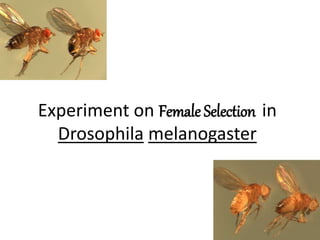
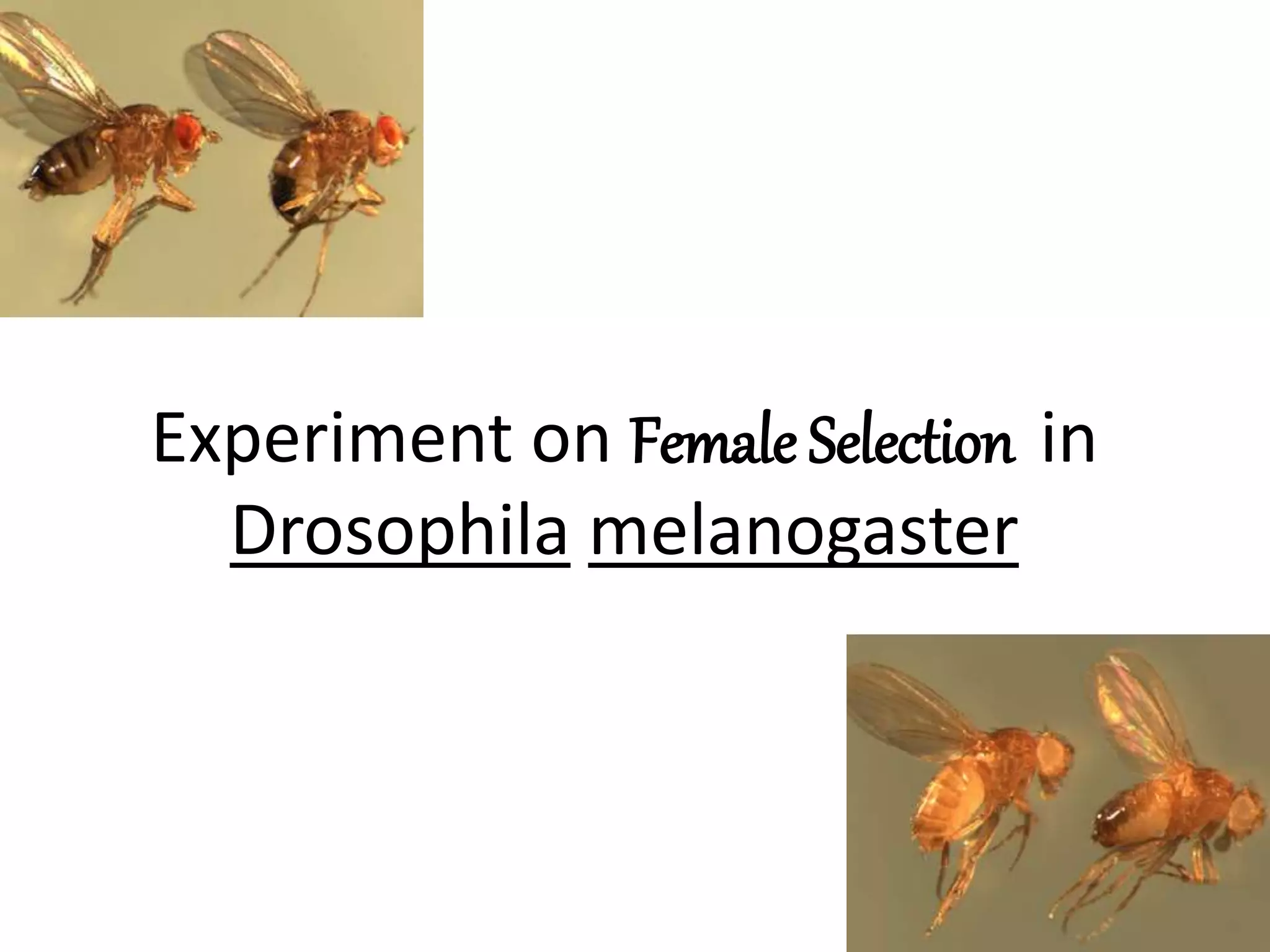


Experiment on Female Selection in 
Drosophila melanogaster
AIM 
To determine the effect of female selection 
on gene frequency.
INTRODUCTION 
FEMALE SELECTION 
• Usually female chooses his or her mate 
according the desired or attractive characteristics 
the selector wants to be represented in his or her 
offspring (P. Brennan, 2012). 
• Just like in humans, Drosophila melanogaster 
fruit flies have preference for those with whom 
they wish to mate. 
• This force, known as sexual selection, is one of 
the main factors that determine the course of 
evolution in any particular species.
INTRODUCTION 
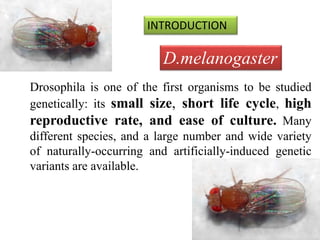
D.melanogaster 
Drosophila is one of the first organisms to be studied 
genetically: its small size, short life cycle, high 
reproductive rate, and ease of culture. Many 
different species, and a large number and wide variety 
of naturally-occurring and artificially-induced genetic 
variants are available.
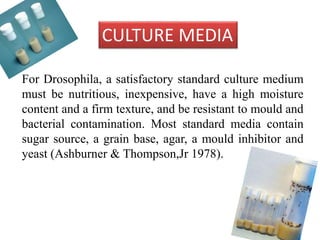
CULTURE MEDIA 
For Drosophila, a satisfactory standard culture medium 
must be nutritious, inexpensive, have a high moisture 
content and a firm texture, and be resistant to mould and 
bacterial contamination. Most standard media contain 
sugar source, a grain base, agar, a mould inhibitor and 
yeast (Ashburner & Thompson,Jr 1978).
PROCEDURE 
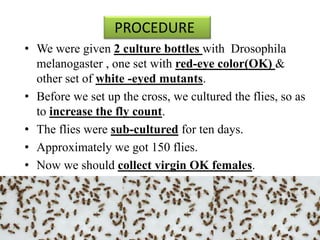
• We were given 2 culture bottles with Drosophila 
melanogaster , one set with red-eye color(OK) & 
other set of white -eyed mutants. 
• Before we set up the cross, we cultured the flies, so as 
to increase the fly count. 
• The flies were sub-cultured for ten days. 
• Approximately we got 150 flies. 
• Now we should collect virgin OK females.
IMPORTANCE OF VIRGIN FEMALES 
All female flies used in controlled genetic crosses must 
be “virgins”. Female flies are capable of mating as early 
as possible after emerging from the pupae stage and 
are polyandrous(capable of mating with several males). 
Once mated Females can retain viable sperm for 
several days and this will confuse the results of a 
subsequent controlled mating. To prevent this, all OK 
female pupas are removed from the culture bottle 
prior, so that all newly hatched flies will remain virgin.
•After collecting the virgins we have to keep for aging. 
•Aging is done to know whether the collected virgins are 
contaminated or not. 
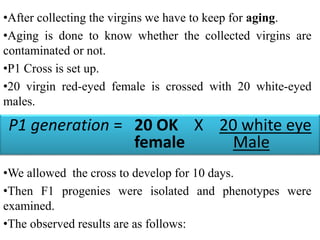
•P1 Cross is set up. 
•20 virgin red-eyed female is crossed with 20 white-eyed 
males. 
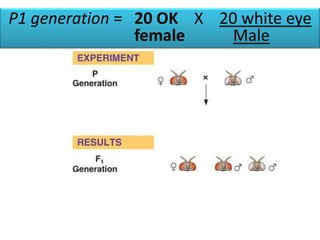
P1 generation = 20 OK X 20 white eye 
female Male 
•We allowed the cross to develop for 10 days. 
•Then F1 progenies were isolated and phenotypes were 
examined. 
•The observed results are as follows:
P1 generation = 20 OK X 20 white eye 
female Male
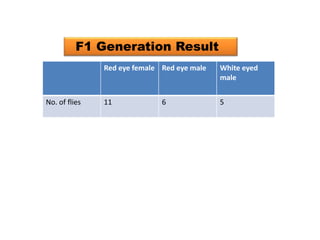
F1 Generation Result 
Red eye female Red eye male White eyed 
male 
No. of flies 11 6 5
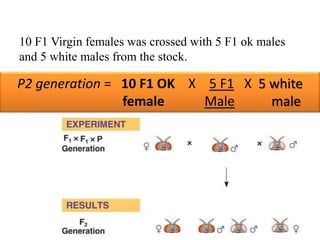
10 F1 Virgin females was crossed with 5 F1 ok males 
and 5 white males from the stock. 
P2 generation = 10 F1 OK X 5 F1 X 5 white 
female Male male
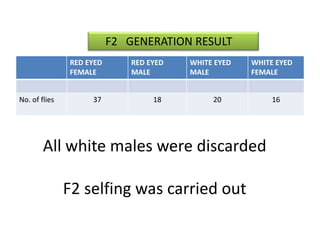
RED EYED 
FEMALE 
F2 GENERATION RESULT 
RED EYED 
MALE 
WHITE EYED 
MALE 
All white males were discarded 
F2 selfing was carried out 
WHITE EYED 
FEMALE 
No. of flies 37 18 20 16
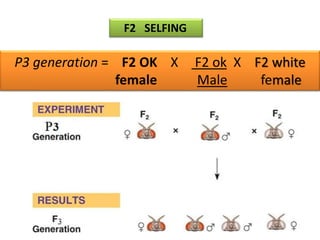
F2 SELFING 
P3 generation = F2 OK X F2 ok X F2 white 
female Male female
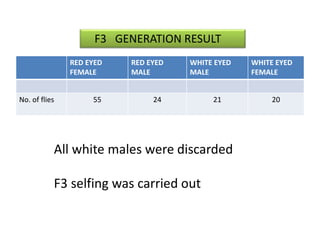
F3 GENERATION RESULT 
RED EYED 
FEMALE 
RED EYED 
MALE 
WHITE EYED 
MALE 
WHITE EYED 
FEMALE 
No. of flies 55 24 21 20 
All white males were discarded 
F3 selfing was carried out
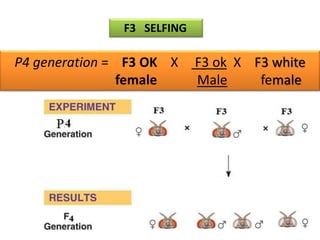
F3 SELFING 
P4 generation = F3 OK X F3 ok X F3 white 
female Male female
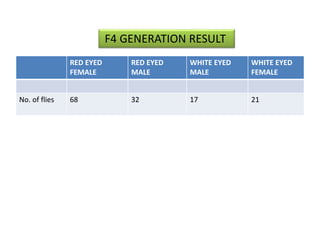
RED EYED 
FEMALE 
F4 GENERATION RESULT 
RED EYED 
MALE 
WHITE EYED 
MALE 
WHITE EYED 
FEMALE 
No. of flies 68 32 17 21
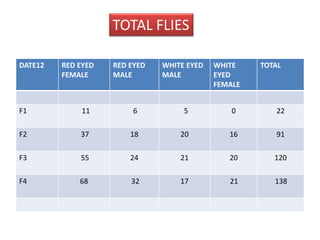
DATE12 RED EYED 
FEMALE 
TOTAL FLIES 
RED EYED 
MALE 
WHITE EYED 
MALE 
WHITE 
EYED 
FEMALE 
TOTAL 
F1 11 6 5 0 22 
F2 37 18 20 16 91 
F3 55 24 21 20 120 
F4 68 32 17 21 138
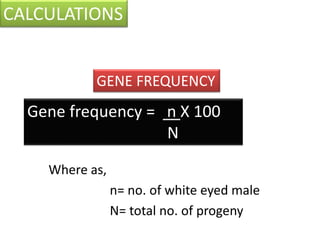
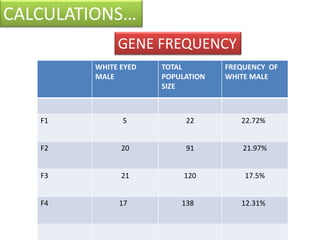
CALCULATIONS 
GENE FREQUENCY 
Gene frequency = n X 100 
Where as, 
N 
n= no. of white eyed male 
N= total no. of progeny
CALCULATIONS… 
GENE FREQUENCY 
WHITE EYED 
MALE 
TOTAL 
POPULATION 
SIZE 
FREQUENCY OF 
WHITE MALE 
F1 5 22 22.72% 
F2 20 91 21.97% 
F3 21 120 17.5% 
F4 17 138 12.31%
25.00% 
20.00% 
15.00% 
10.00% 
5.00% 
0.00% 
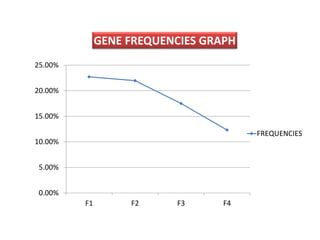
GENE FREQUENCIES GRAPH 
F1 F2 F3 F4 
FREQUENCIES
25.00% 
20.00% 
15.00% 
10.00% 
5.00% 
0.00% 
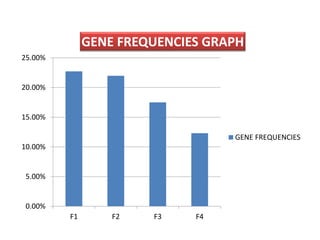
GENE FREQUENCIES GRAPH 
F1 F2 F3 F4 
GENE FREQUENCIES
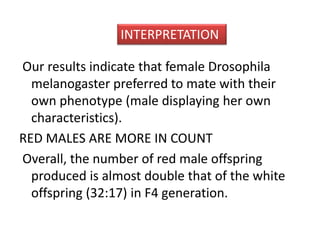
INTERPRETATION 
Our results indicate that female Drosophila 
melanogaster preferred to mate with their 
own phenotype (male displaying her own 
characteristics). 
RED MALES ARE MORE IN COUNT 
Overall, the number of red male offspring 
produced is almost double that of the white 
offspring (32:17) in F4 generation.
INTERPRETATION … 
• A positive effect of Female selection is that it 
increases variation within a population. 
• Although our results showed that the females 
mated more with males of the same 
phenotype, they also mated with males that 
showed different traits. 
• This contributes to increased genetic variation 
and prevents complete speciation.
INTERPRETATION … 
• Conversely, if female D. melanogaster only chose to 
mate with males of similar phenotypes, they could 
potentially develop into two separate species. 
• This is known as disruptive selection, which occurs 
when the average of a particular trait in a population 
is selected against (i.e. the two extremes are 
selected) and causes an entire population to diverge 
into two separate populations. 
• Thus, the preferences of female D. melanogaster 
may cause males to develop useful or detrimental 
traits, or may ultimately lead to the development of a 
new species.
REFERENCE 
• https://bu.digication.com/nahomiv/Sexual_Selection 
_and_Mating_Preferences_of_Female_ 
• http://www.ou.edu/journals/dis/DIS60/Ramachandr 
a%20171.pdf 
• www.googleimages.com
THANK YOU

Female selection in Drosophila

  • 1.
    Experiment on FemaleSelection in Drosophila melanogaster
  • 2.
    AIM To determinethe effect of female selection on gene frequency.
  • 3.
    INTRODUCTION FEMALE SELECTION • Usually female chooses his or her mate according the desired or attractive characteristics the selector wants to be represented in his or her offspring (P. Brennan, 2012). • Just like in humans, Drosophila melanogaster fruit flies have preference for those with whom they wish to mate. • This force, known as sexual selection, is one of the main factors that determine the course of evolution in any particular species.
  • 4.
    INTRODUCTION D.melanogaster Drosophilais one of the first organisms to be studied genetically: its small size, short life cycle, high reproductive rate, and ease of culture. Many different species, and a large number and wide variety of naturally-occurring and artificially-induced genetic variants are available.
  • 5.
    CULTURE MEDIA ForDrosophila, a satisfactory standard culture medium must be nutritious, inexpensive, have a high moisture content and a firm texture, and be resistant to mould and bacterial contamination. Most standard media contain sugar source, a grain base, agar, a mould inhibitor and yeast (Ashburner & Thompson,Jr 1978).
  • 6.
    PROCEDURE • Wewere given 2 culture bottles with Drosophila melanogaster , one set with red-eye color(OK) & other set of white -eyed mutants. • Before we set up the cross, we cultured the flies, so as to increase the fly count. • The flies were sub-cultured for ten days. • Approximately we got 150 flies. • Now we should collect virgin OK females.
  • 8.
    IMPORTANCE OF VIRGINFEMALES All female flies used in controlled genetic crosses must be “virgins”. Female flies are capable of mating as early as possible after emerging from the pupae stage and are polyandrous(capable of mating with several males). Once mated Females can retain viable sperm for several days and this will confuse the results of a subsequent controlled mating. To prevent this, all OK female pupas are removed from the culture bottle prior, so that all newly hatched flies will remain virgin.
  • 9.
    •After collecting thevirgins we have to keep for aging. •Aging is done to know whether the collected virgins are contaminated or not. •P1 Cross is set up. •20 virgin red-eyed female is crossed with 20 white-eyed males. P1 generation = 20 OK X 20 white eye female Male •We allowed the cross to develop for 10 days. •Then F1 progenies were isolated and phenotypes were examined. •The observed results are as follows:
  • 10.
    P1 generation =20 OK X 20 white eye female Male
  • 11.
    F1 Generation Result Red eye female Red eye male White eyed male No. of flies 11 6 5
  • 12.
    10 F1 Virginfemales was crossed with 5 F1 ok males and 5 white males from the stock. P2 generation = 10 F1 OK X 5 F1 X 5 white female Male male
  • 13.
    RED EYED FEMALE F2 GENERATION RESULT RED EYED MALE WHITE EYED MALE All white males were discarded F2 selfing was carried out WHITE EYED FEMALE No. of flies 37 18 20 16
  • 14.
    F2 SELFING P3generation = F2 OK X F2 ok X F2 white female Male female
  • 15.
    F3 GENERATION RESULT RED EYED FEMALE RED EYED MALE WHITE EYED MALE WHITE EYED FEMALE No. of flies 55 24 21 20 All white males were discarded F3 selfing was carried out
  • 16.
    F3 SELFING P4generation = F3 OK X F3 ok X F3 white female Male female
  • 17.
    RED EYED FEMALE F4 GENERATION RESULT RED EYED MALE WHITE EYED MALE WHITE EYED FEMALE No. of flies 68 32 17 21
  • 18.
    DATE12 RED EYED FEMALE TOTAL FLIES RED EYED MALE WHITE EYED MALE WHITE EYED FEMALE TOTAL F1 11 6 5 0 22 F2 37 18 20 16 91 F3 55 24 21 20 120 F4 68 32 17 21 138
  • 19.
    CALCULATIONS GENE FREQUENCY Gene frequency = n X 100 Where as, N n= no. of white eyed male N= total no. of progeny
  • 20.
    CALCULATIONS… GENE FREQUENCY WHITE EYED MALE TOTAL POPULATION SIZE FREQUENCY OF WHITE MALE F1 5 22 22.72% F2 20 91 21.97% F3 21 120 17.5% F4 17 138 12.31%
  • 21.
    25.00% 20.00% 15.00% 10.00% 5.00% 0.00% GENE FREQUENCIES GRAPH F1 F2 F3 F4 FREQUENCIES
  • 22.
    25.00% 20.00% 15.00% 10.00% 5.00% 0.00% GENE FREQUENCIES GRAPH F1 F2 F3 F4 GENE FREQUENCIES
  • 23.
    INTERPRETATION Our resultsindicate that female Drosophila melanogaster preferred to mate with their own phenotype (male displaying her own characteristics). RED MALES ARE MORE IN COUNT Overall, the number of red male offspring produced is almost double that of the white offspring (32:17) in F4 generation.
  • 24.
    INTERPRETATION … •A positive effect of Female selection is that it increases variation within a population. • Although our results showed that the females mated more with males of the same phenotype, they also mated with males that showed different traits. • This contributes to increased genetic variation and prevents complete speciation.
  • 25.
    INTERPRETATION … •Conversely, if female D. melanogaster only chose to mate with males of similar phenotypes, they could potentially develop into two separate species. • This is known as disruptive selection, which occurs when the average of a particular trait in a population is selected against (i.e. the two extremes are selected) and causes an entire population to diverge into two separate populations. • Thus, the preferences of female D. melanogaster may cause males to develop useful or detrimental traits, or may ultimately lead to the development of a new species.
  • 27.
    REFERENCE • https://bu.digication.com/nahomiv/Sexual_Selection _and_Mating_Preferences_of_Female_ • http://www.ou.edu/journals/dis/DIS60/Ramachandr a%20171.pdf • www.googleimages.com
  • 28.