30-04-2022 © R R INSTITUTIONS , BANGALORE 1
MODIFIED DRUG DELIVERY SYSTEM
MECHANISM OF PERMEATION OF DRUG IN BUCCAL
DRUG DELIVERY SYSTEM
RR COLLAGE OF PHARMACY
Submitted by;
SUPRITH D
1ST SEM M pharm
Dept. of Pharmaceutics
Submitted to;
Dr. A Geetha Lakshmi
HOD Dept. of Pharmaceutics
CONTENTS
• Introduction to bioadhesion
• Mechanism of bioadhesion
• Factors affecting bioadhesion
• Theories of bioadhesion
• Types of pathway for permeation
30-04-2022 © R R INSTITUTIONS , BANGALORE 2
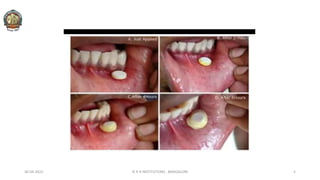
BIOADHESION/MUCOADHESION
Bioadhesion may be defined as the state in which two materials, at least one of which is
biological in nature, are held together for longer periods of time by interfacial forces. When the
adhesive attachment is to mucus or a mucous membrane, the phenomenon is referred to as
mucoadhesion .
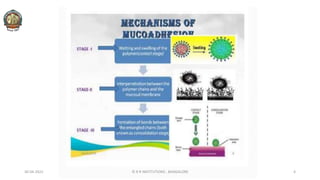
Mechanism of bioadhesion:
For bioadhesion to occur , three stages are involved
1. An intimate contact between a bioadhesive and a membrane either from a good wetting of the
bioadhesive and a membrane or from the swelling of bioadhesive .
2. Penetration of the bioadhesive into the tissue takes place.
3. Inter penetration of the chains of the bioadhesive with mucous takes place low chemical bonds
can then settle
30-04-2022 © R R INSTITUTIONS , BANGALORE 3
30-04-2022 © R R INSTITUTIONS , BANGALORE 4
30-04-2022 © R R INSTITUTIONS , BANGALORE 5
30-04-2022 © R R INSTITUTIONS , BANGALORE 6
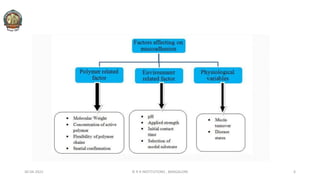
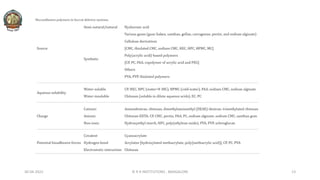
POLYMER RELATED FACTOR
• Molecular weight of polymer;
• The interpenetration of polymer molecules is favored by low molecular weight polymers,
whereas entanglements are favored at higher molecular weights.
• The optimum molecular weight for maximum mucoadhesive depend on type of polymer.
• Crosslinking and swelling of polymer:
•Cross-link density is inversely proportional to the degree of swelling. •The lower the cross-link
density ,the higher the flexibility and hydration rate; the larger the surface area of the polymer,
better the mucoadhesion
•High moisture and swelling results in a slippy mucilage leads to easy removal from substrate.
30-04-2022 © R R INSTITUTIONS , BANGALORE 7
Concentration of mucoadhesive polymer:
•Optimum concentration of polymer is required to get best mucoadhesion.
•In highly concentration coiled molecules of polymer become solvent poor and chains available for
bioadhesion are less.
•In low concentration bioadhesion of polymer also decrease
Spatial conformation:
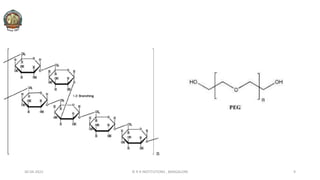
spatial configuration of a molecule is also an important factor for bioadhesion . Despite their high
molecular weight ,dextran(195000 Dalton) have similar bioadhesive strength to that of PEG , with
molecular weight of 200000 Dalton .this is because helical structure of dextrans may shield many
adhesively active groups, responsible for adhesion ,unlike PEG molecules which have a linear
configuration.
30-04-2022 © R R INSTITUTIONS , BANGALORE 8
30-04-2022 © R R INSTITUTIONS , BANGALORE 9
ENVIRONMENTAL FACTORS
PH:
• Adhesion of bioadhesives possessing ionizable groups affected by pH at interface.
•If the local PH is above the pk of the polymer , it will be largely ionized.
•If the ph is below the pk of the polymer , it will largely unionized.
ex :The maximum adhesive strength of the poly acrylic acid is found at Ph 4-5 and
decreases above Ph 6
Initial contact time:
• Greater the initial contact time between bioadhesive and substrate ,the greater the
swelling and interpenetration of polymer chains.
30-04-2022 © R R INSTITUTIONS , BANGALORE 10
PHYSIOLOGICAL VARIABLES
• Mucin turnover :
• The natural turnover of mucin molecules is important for two reason
• It is expected to limit the residence time of mucoadhesive on the mucus layer. No
matter how high the mucoadhesive strength, mucoadhesive are detached from the
surface due to mucin turnover.
• Secondly, mucin turnover results in substantial amounts of soluble mucin
molecules. The molecules interact with mucoadhesive before they have a chance to
interact with mucus layer. Surface fouling is unfavorable for mucoadhesion to the
tissue surface .
30-04-2022 © R R INSTITUTIONS , BANGALORE 11
Disease state:
• Physiochemical properties of the mucus are known to change during
disease conditions such as common cold, bacterial and fungal infection
etc. the exact structural changes taking place in mucus under these
condition is poorly understood
30-04-2022 © R R INSTITUTIONS , BANGALORE 12
30-04-2022 © R R INSTITUTIONS , BANGALORE 13
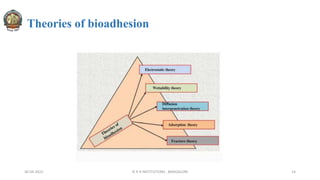
Theories of bioadhesion
30-04-2022 © R R INSTITUTIONS , BANGALORE 14
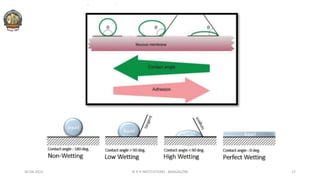
Wetting Theory
• The wetting theory applies to liquid or low viscosity bio adhesives.
• Adhesive agents penetrate into the surface irregularity of substrate and ultimately harden
and producing many adhesive anchors.
• This affinity can be found by using measuring techniques such as the contact angle .
• Lower the contact angle then the greater the affinity.
• The contact angle should be equal or close to zero to provides adequate spreadability.
30-04-2022 © R R INSTITUTIONS , BANGALORE 15
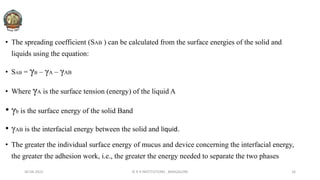
• The spreading coefficient (SAB ) can be calculated from the surface energies of the solid and
liquids using the equation:
• SAB = γB – γA – γAB
• Where γA is the surface tension (energy) of the liquid A
• γb is the surface energy of the solid Band
• γAB is the interfacial energy between the solid and liquid.
• The greater the individual surface energy of mucus and device concerning the interfacial energy,
the greater the adhesion work, i.e., the greater the energy needed to separate the two phases
30-04-2022 © R R INSTITUTIONS , BANGALORE 16
30-04-2022 © R R INSTITUTIONS , BANGALORE 17
Diffusion Theory:
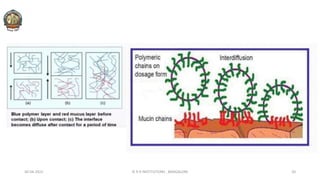
• According to this theory, the polymer chains and the mucus mix to a sufficient depth to create a
semi-permanent adhesive bond.
• Mucus chain present on the mucus membrane Ex: Glycoprotein
• Polymeric chains having ability to build bonds with mucus chain Ex: hydrogen bonding group
(-OH) ,(-COOH)
• The exact depth to which the polymer chains penetrate the mucus depends on the diffusion
coefficient and the time of contact.
• This diffusion coefficient, in turn, depends on the value of molecular weight between cross links
and decreases significantly as the cross linking density decreases
30-04-2022 © R R INSTITUTIONS , BANGALORE 18
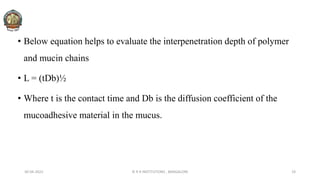
• Below equation helps to evaluate the interpenetration depth of polymer
and mucin chains
• L = (tDb)½
• Where t is the contact time and Db is the diffusion coefficient of the
mucoadhesive material in the mucus.
30-04-2022 © R R INSTITUTIONS , BANGALORE 19
30-04-2022 © R R INSTITUTIONS , BANGALORE 20
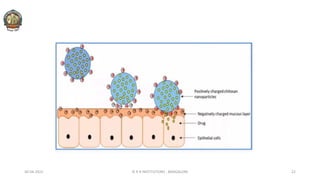
Electronic Theory
• It is based on the premise that both mucoadhesive and biological material poses
opposingg electrical charges.
• Mucus membrane have negative charge because of presence of sialic acid and
sulphate residue
• Thus, when both the materials come in contact with each other transfer of
electron takes place leading to the building of double electronic layer at the
interface , where the attractive forces with in the double layer determines the
mucoadhesive strength .
30-04-2022 © R R INSTITUTIONS , BANGALORE 21
30-04-2022 © R R INSTITUTIONS , BANGALORE 22
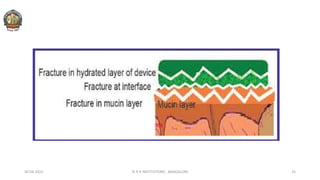
Fracture Theory
• Most used theory in studies on the mechanical measurement of
mucoadhesion
• It analyses the force required to separate two surfaces after adhesion is
established
• It is concerned only with the force required to separate parts
• It does not take in to the account of inter-penetration or diffusion of
polymeric chains
30-04-2022 © R R INSTITUTIONS , BANGALORE 23
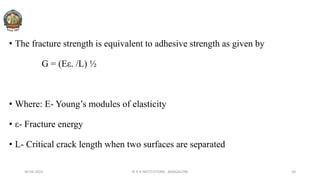
• The fracture strength is equivalent to adhesive strength as given by
G = (Eε. /L) ½
• Where: E- Young’s modules of elasticity
• ε- Fracture energy
• L- Critical crack length when two surfaces are separated
30-04-2022 © R R INSTITUTIONS , BANGALORE 24
30-04-2022 © R R INSTITUTIONS , BANGALORE 25
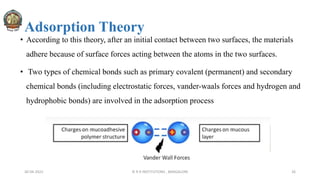
Adsorption Theory
• According to this theory, after an initial contact between two surfaces, the materials
adhere because of surface forces acting between the atoms in the two surfaces.
• Two types of chemical bonds such as primary covalent (permanent) and secondary
chemical bonds (including electrostatic forces, vander-waals forces and hydrogen and
hydrophobic bonds) are involved in the adsorption process
30-04-2022 © R R INSTITUTIONS , BANGALORE 26
30-04-2022 © R R INSTITUTIONS , BANGALORE
27
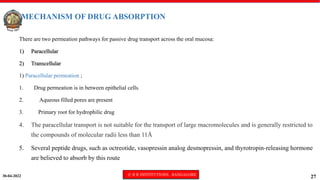
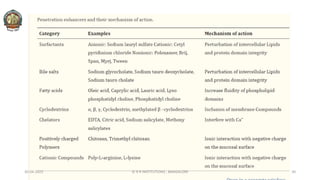
MECHANISM OF DRUG ABSORPTION
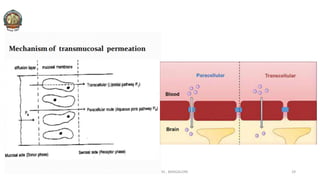
There are two permeation pathways for passive drug transport across the oral mucosa:
1) Paracellular
2) Transcellular
1) Paracellular permeation ;
1. Drug permeation is in between epithelial cells.
2. Aqueous filled pores are present
3. Primary root for hydrophilic drug
4. The paracellular transport is not suitable for the transport of large macromolecules and is generally restricted to
the compounds of molecular radii less than 11Å
5. Several peptide drugs, such as octreotide, vasopressin analog desmopressin, and thyrotropin-releasing hormone
are believed to absorb by this route
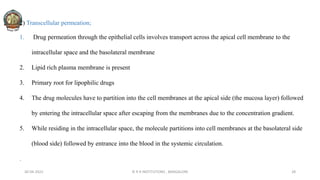
2) Transcellular permeation;
1. Drug permeation through the epithelial cells involves transport across the apical cell membrane to the
intracellular space and the basolateral membrane
2. Lipid rich plasma membrane is present
3. Primary root for lipophilic drugs
4. The drug molecules have to partition into the cell membranes at the apical side (the mucosa layer) followed
by entering the intracellular space after escaping from the membranes due to the concentration gradient.
5. While residing in the intracellular space, the molecule partitions into cell membranes at the basolateral side
(blood side) followed by entrance into the blood in the systemic circulation.
.
30-04-2022 © R R INSTITUTIONS , BANGALORE 28
30-04-2022 © R R INSTITUTIONS , BANGALORE 29
30-04-2022 © R R INSTITUTIONS , BANGALORE 30
REFRENCES
• N.K Jain Controlled and Novel Drug Delivery System
• S.P.Vyas and R.K.Khar , Controlled Drug Delivery System
• Encyclopaedia of Controlled Drug Delivery System
30-04-2022 © R R INSTITUTIONS , BANGALORE 31
30-04-2022 © R R INSTITUTIONS , BANGALORE 32