FEEDBACK RELATED DRUG
DELIVERY SYSTEM
PRESENTING BY :
L SAISUBRAMAINAN.
M.PHARM.PHARMACEUTICS
INTRODUCTION :
• Feed back mechanisms comes under controlled release drug delivery system.
• It is well understood that drug release can be generated by combining positive
and negative feedback.
• Positive feedback amplifies a stimulus and start drug release.
• Negative feedback suppresses drug release. Negative feedback slow relative
to the positive feedback.
• Release of drug is activated by triggering agent, such as biochemical
substance in the body and also regulated by its concentration.
• Rate of drug release is controlled by concentration of triggering agent.
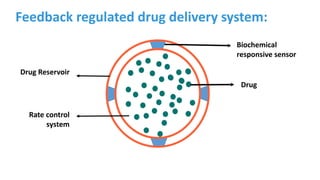
Feedback regulated drug delivery system:
Biochemical
responsive sensor
Drug
Drug Reservoir
Rate control
system
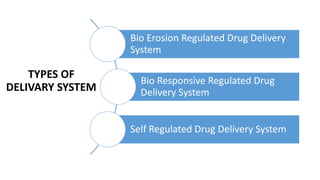
TYPES OF
DELIVARY SYSTEM
Bio Erosion Regulated Drug Delivery
System
Bio Responsive Regulated Drug
Delivery System
Self Regulated Drug Delivery System
Bio Erosion Regulated Drug Delivery System
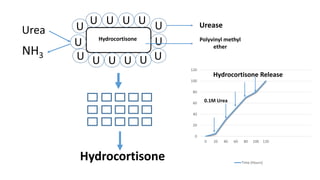
• This system consist of drug dispersed bio erodible matrix which is coated
with immobilized enzyme. When enzyme react with substrate drug is
released by substrate tends to release drug from matrix.
• Example: Release of Hydrocortisone.
Drug is dispersed in poly vinyl methyl ether is used are rate controlling
matrix. Which is coated with urease enzyme were urease convert urea to
ammonia so alter in PH happens and drug release by erosion of matrix. The
alter to alkaline PH tends to release drug faster comparing to neutral PH.
Hydrocortisone
U
U
U
U
U
U
U
U
U U U U U U
Urease
Polyvinyl methyl
ether
Urea
NH3
0
20
40
60
80
100
120
0 20 40 60 80 100 120
Hydrocortisone Release
Time (Hours)
0.1M Urea
Hydrocortisone
Bio Responsive Regulated Drug Delivery System
• Drug reservoir system is enclosed with bio responsive polymeric membrane.
Where drug release is controlled by biochemical agent in body react with bio
responsive polymeric membrane.
• Example : Insulin drug delivery system
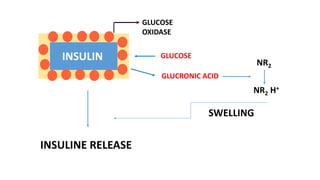
• Here Insulin is incorporated in hydrogel which contain –NR2 is enclosed with
glucose oxidase in bio responsive polymeric membrane.
• Glucose invade to membrane and convert to glucronic acid. glucronic acid
protonate –NR2 TO –NR2H+ swell hydrogel and will release Insulin at alkaine
condition
• Amount of insulin released is by concentration of glucose present.
INSULIN
GLUCOSE
OXIDASE
GLUCOSE
GLUCRONIC ACID
NR2
NR2 H+
INSULINE RELEASE
SWELLING
Self regulated drug delivery system
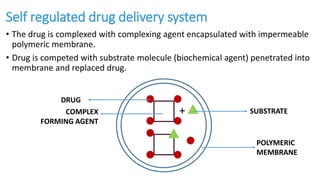
• The drug is complexed with complexing agent encapsulated with impermeable
polymeric membrane.
• Drug is competed with substrate molecule (biochemical agent) penetrated into
membrane and replaced drug.
+ SUBSTRATE
POLYMERIC
MEMBRANE
DRUG
COMPLEX
FORMING AGENT
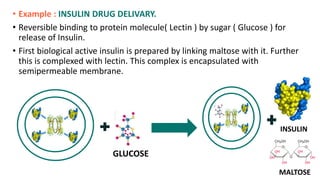
• Example : INSULIN DRUG DELIVARY.
• Reversible binding to protein molecule( Lectin ) by sugar ( Glucose ) for
release of Insulin.
• First biological active insulin is prepared by linking maltose with it. Further
this is complexed with lectin. This complex is encapsulated with
semipermeable membrane.
MALTOSE
INSULIN
GLUCOSE
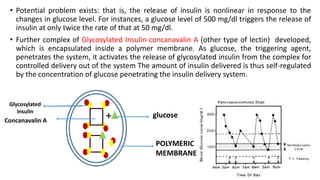
• Potential problem exists: that is, the release of insulin is nonlinear in response to the
changes in glucose level. For instances, a glucose level of 500 mg/dl triggers the release of
insulin at only twice the rate of that at 50 mg/dl.
• Further complex of Glycosylated Insulin-concanavalin A (other type of lectin) developed,
which is encapsulated inside a polymer membrane. As glucose, the triggering agent,
penetrates the system, it activates the release of glycosylated insulin from the complex for
controlled delivery out of the system The amount of insulin delivered is thus self-regulated
by the concentration of glucose penetrating the insulin delivery system.
+
POLYMERIC
MEMBRANE
Concanavalin A
+ glucose
Glycosylated
Insulin
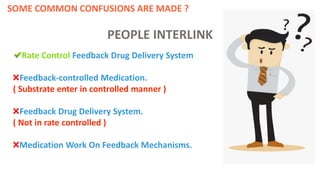
SOME COMMON CONFUSIONS ARE MADE ?
PEOPLE INTERLINK
Rate Control Feedback Drug Delivery System
Feedback-controlled Medication.
( Substrate enter in controlled manner )
Feedback Drug Delivery System.
( Not in rate controlled )
Medication Work On Feedback Mechanisms.
Reactive oxygen therapy
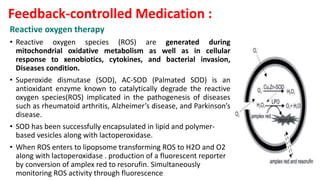
• Reactive oxygen species (ROS) are generated during
mitochondrial oxidative metabolism as well as in cellular
response to xenobiotics, cytokines, and bacterial invasion,
Diseases condition.
• Superoxide dismutase (SOD), AC-SOD (Palmated SOD) is an
antioxidant enzyme known to catalytically degrade the reactive
oxygen species(ROS) implicated in the pathogenesis of diseases
such as rheumatoid arthritis, Alzheimer’s disease, and Parkinson’s
disease.
• SOD has been successfully encapsulated in lipid and polymer-
based vesicles along with lactoperoxidase.
• When ROS enters to lipopsome transforming ROS to H2O and O2
along with lactoperoxidase . production of a fluorescent reporter
by conversion of amplex red to resorufin. Simultaneously
monitoring ROS activity through fluorescence
Feedback-controlled Medication :
Enzyme Replacement Therapy
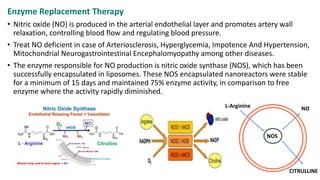
• Nitric oxide (NO) is produced in the arterial endothelial layer and promotes artery wall
relaxation, controlling blood flow and regulating blood pressure.
• Treat NO deficient in case of Arteriosclerosis, Hyperglycemia, Impotence And Hypertension,
Mitochondrial Neurogastrointestinal Encephalomyopathy among other diseases.
• The enzyme responsible for NO production is nitric oxide synthase (NOS), which has been
successfully encapsulated in liposomes. These NOS encapsulated nanoreactors were stable
for a minimum of 15 days and maintained 75% enzyme activity, in comparison to free
enzyme where the activity rapidly diminished.
L -
NOS
L-Arginine NO
CITRULLINE
Prodrug Activation
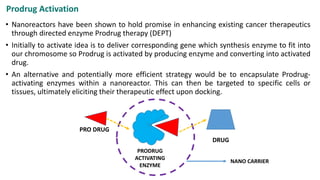
• Nanoreactors have been shown to hold promise in enhancing existing cancer therapeutics
through directed enzyme Prodrug therapy (DEPT)
• Initially to activate idea is to deliver corresponding gene which synthesis enzyme to fit into
our chromosome so Prodrug is activated by producing enzyme and converting into activated
drug.
• An alternative and potentially more efficient strategy would be to encapsulate Prodrug-
activating enzymes within a nanoreactor. This can then be targeted to specific cells or
tissues, ultimately eliciting their therapeutic effect upon docking.
PRODRUG
ACTIVATING
ENZYME
PRO DRUG
DRUG
NANO CARRIER
Reference :
Stephen J. Jones , Annette F. Taylor and Paul A Beales. Towards feedback-
controlled nanomedicines for smart, adaptive delivery. SAGE journal. September
11, 2018.
M.M. Gaspar, M.B. Martins, M.L. Corvo, M.E.M. Cruz. Design and characterization
of enzymosomes with surface-exposedsuperoxide dismutase. Biochimica et
Biophysica Acta. Elsevier. 16 December 2002.
Chien.w.yie. Novel drug delivery system ( drug and pharmaceutical science ).
Informa healthcare. New York. London. Second Edition. Pg. 32-38.

FEEDBACK REGULATED DRUG DELIVERY SYSTEM.pptx

  • 1.
    FEEDBACK RELATED DRUG DELIVERYSYSTEM PRESENTING BY : L SAISUBRAMAINAN. M.PHARM.PHARMACEUTICS
  • 2.
    INTRODUCTION : • Feedback mechanisms comes under controlled release drug delivery system. • It is well understood that drug release can be generated by combining positive and negative feedback. • Positive feedback amplifies a stimulus and start drug release. • Negative feedback suppresses drug release. Negative feedback slow relative to the positive feedback. • Release of drug is activated by triggering agent, such as biochemical substance in the body and also regulated by its concentration. • Rate of drug release is controlled by concentration of triggering agent.
  • 3.
    Feedback regulated drugdelivery system: Biochemical responsive sensor Drug Drug Reservoir Rate control system
  • 4.
    TYPES OF DELIVARY SYSTEM BioErosion Regulated Drug Delivery System Bio Responsive Regulated Drug Delivery System Self Regulated Drug Delivery System
  • 5.
    Bio Erosion RegulatedDrug Delivery System • This system consist of drug dispersed bio erodible matrix which is coated with immobilized enzyme. When enzyme react with substrate drug is released by substrate tends to release drug from matrix. • Example: Release of Hydrocortisone. Drug is dispersed in poly vinyl methyl ether is used are rate controlling matrix. Which is coated with urease enzyme were urease convert urea to ammonia so alter in PH happens and drug release by erosion of matrix. The alter to alkaline PH tends to release drug faster comparing to neutral PH.
  • 6.
    Hydrocortisone U U U U U U U U U U UU U U Urease Polyvinyl methyl ether Urea NH3 0 20 40 60 80 100 120 0 20 40 60 80 100 120 Hydrocortisone Release Time (Hours) 0.1M Urea Hydrocortisone
  • 7.
    Bio Responsive RegulatedDrug Delivery System • Drug reservoir system is enclosed with bio responsive polymeric membrane. Where drug release is controlled by biochemical agent in body react with bio responsive polymeric membrane. • Example : Insulin drug delivery system • Here Insulin is incorporated in hydrogel which contain –NR2 is enclosed with glucose oxidase in bio responsive polymeric membrane. • Glucose invade to membrane and convert to glucronic acid. glucronic acid protonate –NR2 TO –NR2H+ swell hydrogel and will release Insulin at alkaine condition • Amount of insulin released is by concentration of glucose present.
  • 8.
  • 9.
    Self regulated drugdelivery system • The drug is complexed with complexing agent encapsulated with impermeable polymeric membrane. • Drug is competed with substrate molecule (biochemical agent) penetrated into membrane and replaced drug. + SUBSTRATE POLYMERIC MEMBRANE DRUG COMPLEX FORMING AGENT
  • 10.
    • Example :INSULIN DRUG DELIVARY. • Reversible binding to protein molecule( Lectin ) by sugar ( Glucose ) for release of Insulin. • First biological active insulin is prepared by linking maltose with it. Further this is complexed with lectin. This complex is encapsulated with semipermeable membrane. MALTOSE INSULIN GLUCOSE
  • 11.
    • Potential problemexists: that is, the release of insulin is nonlinear in response to the changes in glucose level. For instances, a glucose level of 500 mg/dl triggers the release of insulin at only twice the rate of that at 50 mg/dl. • Further complex of Glycosylated Insulin-concanavalin A (other type of lectin) developed, which is encapsulated inside a polymer membrane. As glucose, the triggering agent, penetrates the system, it activates the release of glycosylated insulin from the complex for controlled delivery out of the system The amount of insulin delivered is thus self-regulated by the concentration of glucose penetrating the insulin delivery system. + POLYMERIC MEMBRANE Concanavalin A + glucose Glycosylated Insulin
  • 12.
    SOME COMMON CONFUSIONSARE MADE ? PEOPLE INTERLINK Rate Control Feedback Drug Delivery System Feedback-controlled Medication. ( Substrate enter in controlled manner ) Feedback Drug Delivery System. ( Not in rate controlled ) Medication Work On Feedback Mechanisms.
  • 13.
    Reactive oxygen therapy •Reactive oxygen species (ROS) are generated during mitochondrial oxidative metabolism as well as in cellular response to xenobiotics, cytokines, and bacterial invasion, Diseases condition. • Superoxide dismutase (SOD), AC-SOD (Palmated SOD) is an antioxidant enzyme known to catalytically degrade the reactive oxygen species(ROS) implicated in the pathogenesis of diseases such as rheumatoid arthritis, Alzheimer’s disease, and Parkinson’s disease. • SOD has been successfully encapsulated in lipid and polymer- based vesicles along with lactoperoxidase. • When ROS enters to lipopsome transforming ROS to H2O and O2 along with lactoperoxidase . production of a fluorescent reporter by conversion of amplex red to resorufin. Simultaneously monitoring ROS activity through fluorescence Feedback-controlled Medication :
  • 14.
    Enzyme Replacement Therapy •Nitric oxide (NO) is produced in the arterial endothelial layer and promotes artery wall relaxation, controlling blood flow and regulating blood pressure. • Treat NO deficient in case of Arteriosclerosis, Hyperglycemia, Impotence And Hypertension, Mitochondrial Neurogastrointestinal Encephalomyopathy among other diseases. • The enzyme responsible for NO production is nitric oxide synthase (NOS), which has been successfully encapsulated in liposomes. These NOS encapsulated nanoreactors were stable for a minimum of 15 days and maintained 75% enzyme activity, in comparison to free enzyme where the activity rapidly diminished. L - NOS L-Arginine NO CITRULLINE
  • 15.
    Prodrug Activation • Nanoreactorshave been shown to hold promise in enhancing existing cancer therapeutics through directed enzyme Prodrug therapy (DEPT) • Initially to activate idea is to deliver corresponding gene which synthesis enzyme to fit into our chromosome so Prodrug is activated by producing enzyme and converting into activated drug. • An alternative and potentially more efficient strategy would be to encapsulate Prodrug- activating enzymes within a nanoreactor. This can then be targeted to specific cells or tissues, ultimately eliciting their therapeutic effect upon docking. PRODRUG ACTIVATING ENZYME PRO DRUG DRUG NANO CARRIER
  • 16.
    Reference : Stephen J.Jones , Annette F. Taylor and Paul A Beales. Towards feedback- controlled nanomedicines for smart, adaptive delivery. SAGE journal. September 11, 2018. M.M. Gaspar, M.B. Martins, M.L. Corvo, M.E.M. Cruz. Design and characterization of enzymosomes with surface-exposedsuperoxide dismutase. Biochimica et Biophysica Acta. Elsevier. 16 December 2002. Chien.w.yie. Novel drug delivery system ( drug and pharmaceutical science ). Informa healthcare. New York. London. Second Edition. Pg. 32-38.