RATE CONTROLLED
DRUG DELIVERY
SYSTEM:
Principle
Fundamentals
Types
BY
NAKUL DHORE
“CONTENTS
❑ Principle_
Definition
Objectives
❑ Fundamentals_
Polymer solubility
Solution solubility
Partition coefficient
Diffusivity
Surface area
❑ Classification_
Rate preprogrammed DDS
Feedback regulated DDS
Activation modulated DDS
Site targeting DDS
PRINCIPLES_
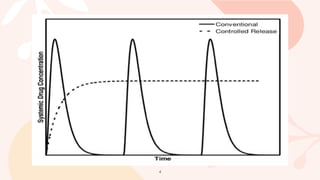
Definition_ The controlled release drug delivery system refers to the system of
modern medicine in which the release of drug is governed in a pre-determined
rate with an aim of constant drug release and better therapeutic achievement.
The term "Controlled release" has become associated with those systems from
which therapeutic agents may be automatically delivered at predefined rates
over a long period of time after the administration of single dose.
Objectives_ Maintenance of drug levels with desired range.
Need for fewer administration.
Optimal use and increased patient compliance.
Ease of convenience.
Reduced frequency of administration.
3
4
FUNDAMENTALS_
For the analysis of RCDDS various assumptions must be study serving the basis of
the drug delivery system.
1. Polymer solubility
2. Solution solubility
3. Partition coefficient
4. Diffusivity
5. Surface area
1. Polymer solubility_
Drug particles remain enclosed inside outermost surface layer of the
polymer particles. As soon as the polymer particles undergoes dissolution drug
particles dissociates in surrounding medium.
2. Solution solubility_
The maintenance of drug release in controlled manner is achieved by
making solution solubility much greater than the bulk concentration (Cs>>Cb).
Poor soluble drugs are made effectively soluble by multiple co-solvent systems.
3. Partition coefficient_
Partition coefficient is defined as ratio of drug solubility in solution
against its solubility in polymer composition. It signifies how and what extent
the drug will dissociate and then cross the cellular barrier to achieve absorption
(logP)
4. Diffusivity_
Diffusivity of polymer is determined by its specifications like-
cross-linking
crystallinity
filler content
Diffusivity of solution is dependent on the basis of molecular volume. It
differs for the different compounds:
alkanes> alcohols> amides> acids> amino acids> dicarboxylic acid.
5. Surface Area_
The In-vivo & In- vitro rates of drug release are observed to be dependent
upon the surface area of drug delivery sites.
Greater is the SA higher is the release rate and vice-versa.
TYPES_
8
Based on the technical specifications_
➢ Rate preprogrammed drug delivery system
➢ Feedback- regulated drug delivery system
➢ Activation- modulated drug delivery system
➢ Site targeting drug delivery system
The release of drug molecule from the system has been preprogrammed at
specific rate profile.
The system controls the molecular diffusion of drug particles across the barrier
medium with the surrounding delivery system.
Classification_
a. Polymer membrane permeation-controlled drug delivery system.
b. Polymer matrix diffusion-controlled drug delivery system.
c. Micro-reservior partition-controlled drug delivery system.
9
Rate pre-programmed drug delivery system
1. Polymer membrane permeation-controlled drug delivery system.
In this type, drug is totally or partially encapsulated within drug reservoir.
Its drug release surface is covered by a rate- controlling polymeric membrane
having a specific permeability.
Drug reservoir may exist in solid, suspension or solution form.
Release of drug molecules is controlled by_
▪ Partition coefficient of the drug molecule.
▪ Diffusivity of the drug molecule.
▪ The thickness of the rate controlling membrane
10
2. Polymer matrix diffusion-controlled drug delivery system.
In this type, drug reservoir is prepared by homogeneously dispersing drug
particle in rate controlling polymer matrix from either a lipophilic or a
hydrophilic polymer.
Release of drug molecule is controlled by_
▪ Loading dose
▪ Polymer solubility of drug
▪ Drug diffusivity in polymer matrix.
11
3. Micro reservoir partition-controlled drug delivery system_
In this type, drug reservoir is fabricated by micro dispersion of an aqueous
suspension of drug in biocompatible polymer to form homogeneous dispersion.
Depending upon the physicochemical properties of drugs & desired rate of drug
release, the device can be further coated with a layer of biocompatible polymer
to modify the mechanism & the rate of drug release.
Release of drug molecule is controlled by_
Partition coefficient
Diffusivity of drug
Solubility of drug
13
Activation modulated drug delivery system
14
AMDDS is activated by:-
Physical process
Chemical process
Biochemical process.
And facilitated by the energy supplied externally.
The rate of drug release is then controlled, based on the nature of the process
applied or the type of energy used.
15
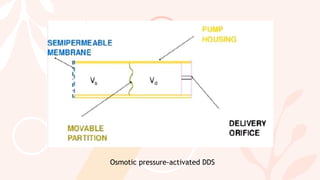
1. Osmotic pressure-activated DDS:
This system depends on osmotic pressure to activate the release of drug.
To release in solution form at a constant stem.
The drug reservoir maybe _
▪ A solution
▪ A solid formulation
Reservoir Contained within a semipermeable housing with a controlled
water permeability.
The drug in solution form, released through a special laser delivery orifice.
Constant rate of drug release is under controlled gradient of osmotic
pressure.
Example_ “Alzet osmotic pump (IMPLANTABLE)”
Osmotic pressure-activated DDS
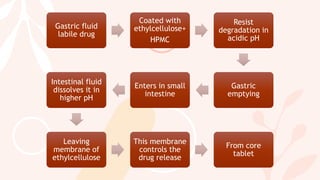
2. pH- activated DDS:
The delivery of drug is facilitated only in the region of selected pH range.
It is achieved by coating the core drug with pH sensitive polymer.
The membrane permeability is modified by, adjustment of ratio of
‘intestinal fluid soluble polymer’ to the ‘intestinal fluid insoluble polymer’
To Note here,,
Gastric pH= <3
Intestinal pH= >7.5
Gastric fluid
labile drug
Coated with
ethylcellulose+
HPMC
Resist
degradation in
acidic pH
Gastric
emptying
Enters in small
intestine
Intestinal fluid
dissolves it in
higher pH
Leaving
membrane of
ethylcellulose
This membrane
controls the
drug release
From core
tablet
19
3. Enzyme activated DDS:
This type of biochemical system depends on the enzymatic process to activate
the release of drug.
Drug reservoir-
▪ Physically entrapped in microsphere or,
▪ Chemically bound to polymer chains from biopolymers (albumins or
polypeptides)
The drug release is activated by enzymatic hydrolysis of biopolymers by specific
enzyme in target tissue.
Example: Albumin microspheres release 5-fluorouracil in a controlled manner by
protease- activated biodegradation.
20
Feedback regulated drug delivery system
The drug release from the system is activated by a triggering agent, such as a
biochemical substance in the body and also regulated by its concentration via
some feedback mechanism.
Rate of drug release is controlled by the concentration of triggering agent
detected by a sensor in the feedback regulated mechanisms.
Concept was applied to_
1. Bio-erosion-regulated DDS
2. Bio-responsive DDS
3. Self-regulated DDS
1. Bio-erosion-regulated DDS_
Drug mfg with polyvinyl methyl ester & coated with layer of immobilized
urease. In solution with close to neutral pH the polymer erodes very slowly. The
cause of change of pH inc the rapid degradation of polymer to release drug.
2. Bio-responsive DDS_
The drug reservoir is enclosed in the bio responsive polymeric membrane
& drug permeability is controlled by biochemical agents in tissue.
Example- Glucose triggered insulin delivery system.
3. Self-regulated DDS_
In this, drug reservoir encapsulated within a polymeric semipermeable
membrane. Drug release is triggered by the biochemical agent of tissue.
Example- In (insulin-sugar-lecithin) encapsulated system, when blood glucose
diffuses in it, it binds with lecithin molecules & activates release of insulin sugar
from binding site. Its concentration depends on the concentration of glucose.
22
Site targeting drug delivery system
Delivery of drugs to the targeted site is complex process & the drug release is
uncontrolled. To get rid of this drug delivery should be site targeting specific.
Classified as_
First order targeting_
Carrier facilitates drug release at the organ or tissue site.
Second order targeting_
Carrier facilitates drug release at the tumor cells but not normal cells.
Third order targeting_
Carrier releases the drug to the intracellular site of targeted cells.
THANK
YOU!
23
Dt. 05/02/2025