FEEDBACK-REGULATED DRUG DELIVERYSYSTEMS (FRDDS)
PRESENTED BY :
Elahe Tolideh
1st M.PHARM
Dept of Pharmaceutics
Al Ameen college of pharmacy
Bangalore
SUBMITTED TO :
Dr. Preeti Karwa
HOD Dept of Pharmaceutics
Al Ameen college of pharmacy
Bangalore
1
2.
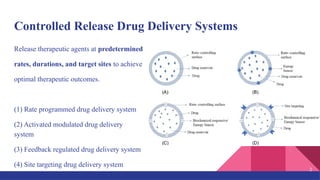
Controlled Release DrugDelivery Systems
Release therapeutic agents at predetermined
rates, durations, and target sites to achieve
optimal therapeutic outcomes.
(1) Rate programmed drug delivery system
(2) Activated modulated drug delivery
system
(3) Feedback regulated drug delivery system
(4) Site targeting drug delivery system
2
3.
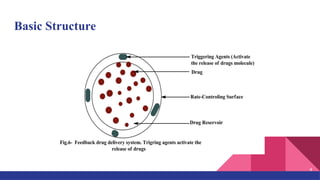
Feedback Regulated DrugDelivery System
➢ Release of drug molecules from the delivery
systems is activated by a triggering agent, such as
a biochemical substance, in the body in real time
and also regulated by its concentration via some
feedback mechanisms.
➢ The rate of drug release is then controlled by the
concentration of triggering agent detected by a sensor
in the feedback-regulated mechanism.
3
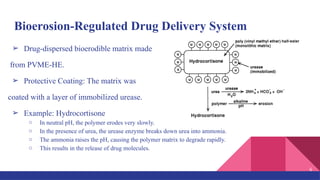
Bioerosion-Regulated Drug DeliverySystem
➢ Drug-dispersed bioerodible matrix made
from PVME-HE.
➢ Protective Coating: The matrix was
coated with a layer of immobilized urease.
➢ Example: Hydrocortisone
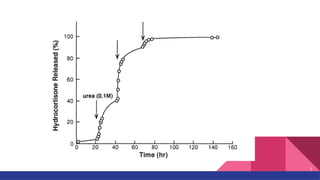
○ In neutral pH, the polymer erodes very slowly.
○ In the presence of urea, the urease enzyme breaks down urea into ammonia.
○ The ammonia raises the pH, causing the polymer matrix to degrade rapidly.
○ This results in the release of drug molecules.
6
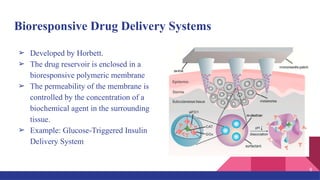
Bioresponsive Drug DeliverySystems
➢ Developed by Horbett.
➢ The drug reservoir is enclosed in a
bioresponsive polymeric membrane
➢ The permeability of the membrane is
controlled by the concentration of a
biochemical agent in the surrounding
tissue.
➢ Example: Glucose-Triggered Insulin
Delivery System
8
9.
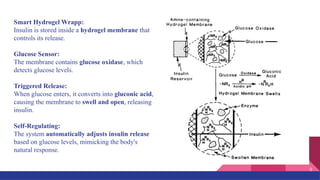
Smart Hydrogel Wrapp:
Insulinis stored inside a hydrogel membrane that
controls its release.
Glucose Sensor:
The membrane contains glucose oxidase, which
detects glucose levels.
Triggered Release:
When glucose enters, it converts into gluconic acid,
causing the membrane to swell and open, releasing
insulin.
Self-Regulating:
The system automatically adjusts insulin release
based on glucose levels, mimicking the body's
natural response.
9
Self-Regulating Drug DeliverySystems
➢ Works based on a reversible and competitive binding process to control drug release.
➢ The drug is stored inside a semipermeable polymeric membrane as a drug complex.
➢ A biochemical agent (e.g., glucose) from the body
triggers drug release by diffusing into the membrane.
➢ Example: Insulin delivery system
using a lectin-based
11
12.
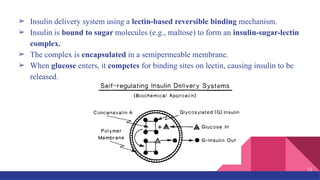
➢ Insulin deliverysystem using a lectin-based reversible binding mechanism.
➢ Insulin is bound to sugar molecules (e.g., maltose) to form an insulin-sugar-lectin
complex.
➢ The complex is encapsulated in a semipermeable membrane.
➢ When glucose enters, it competes for binding sites on lectin, causing insulin to be
released.
12
Disadvantage:
➢ Non-linear insulinrelease: The system does not proportionally adjust insulin release
to glucose levels.
Example: A glucose level of 500 mg/dl triggers insulin release at only twice the rate
of that at 50 mg/dl, instead of a significantly higher rate.
➢ Complex formulation: The development process relies on glycosylated insulin-
Concanavalin A complex, which is encapsulated inside a polymer membrane, making
the system more intricate.
14
15.
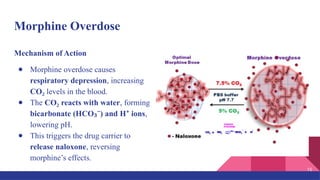
Morphine Overdose
Mechanism ofAction
● Morphine overdose causes
respiratory depression, increasing
CO₂ levels in the blood.
● The CO reacts with water
₂ , forming
bicarbonate (HCO ) and H ions
₃⁻ ⁺ ,
lowering pH.
● This triggers the drug carrier to
release naloxone, reversing
morphine’s effects.
15
16.
Polyurethane
Polymeric material composedof organic units drug delivery systems, due to its biocompatibility,
flexibility, and durability.
Roles in FRDDS:
➢ pH-Responsive Release – PU hydrogels alter swelling behavior based on pH, useful for targeted
drug delivery in the GI tract and tumor therapy.
➢ Enzyme-Triggered Release – PU degrades in the presence of specific enzymes, allowing
localized and self-regulated drug release in diseased tissues.
➢ Temperature-Sensitive PU – Releases drugs at specific body temperatures, beneficial for fever-
triggered therapies.
➢ PU Nanoparticles – Enables controlled and sustained drug release, modifiable for external
stimuli like magnetic fields or ultrasound.
16
17.
Recent advances inglucose-responsive insulin delivery systems: novel hydrogels and future applications
➢ Glucose-Responsive Insulin Delivery Systems (GRIDS): These systems aim to mimic the body's
natural insulin regulation by releasing insulin in response to elevated blood glucose levels, thereby
reducing the need for frequent blood sugar monitoring and manual insulin injections.
17
#6 Polyvinyl methyl ether half-ester (PVME-HE) is a synthetic polymer that has both hydrophilic (water-attracting) and hydrophobic (water-repelling) properties. It is derived from polyvinyl methyl ether (PVME) and modified to include half-ester functional groups, which make it responsive to changes in environmental conditions such as pH.
More urea = faster melting = more medicine released
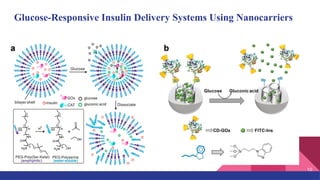
#10 This image illustrates glucose-responsive insulin delivery systems using nanocarriers for controlled insulin release.
Panel (a): Polymeric Nanocarrier System
Structure: The left side shows a self-assembled bilayer nanocarrier encapsulating insulin (red dots), glucose oxidase (GOx, pink), and catalase (CAT, blue).
Mechanism:
When glucose enters, GOx catalyzes its conversion to gluconic acid, reducing pH.
The drop in pH triggers the breakdown of the polymer bilayer, causing nanocarrier dissociation and insulin release.
Inset: The bottom-left structure shows a pH-sensitive polymer (PEG-Poly(Ser-Ketal)), which hydrolyzes in acidic conditions into water-soluble PEG-Polyserine—making the system biodegradable.
Panel (b): Enzyme-Driven Mesoporous Carrier
Structure: The right side depicts an alternative mesoporous silica-based system functionalized with cyclodextrin-modified glucose oxidase (CD-GOx).
Mechanism:
Glucose enters the system and is oxidized into gluconic acid, lowering the pH.
The acidic environment triggers the release of insulin (FITC-Ins, green dots) from the mesoporous structure.
The system mimics the natural glucose-responsive behavior of pancreatic beta cells.
Conclusion:
Both approaches present smart insulin delivery systems that respond to blood glucose levels, ensuring precise, self-regulated insulin release, which is crucial for diabetes management.
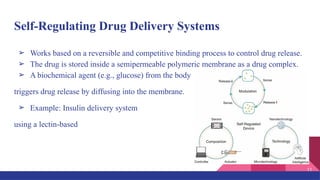
#11 The goal is to automatically sense the body's needs and modulate drug release accordingly, without external intervention.
. Modulation Cycle (Top Section)
The system works in a closed-loop feedback mechanism:
It senses biological signals (e.g., glucose levels in diabetics).
Based on the signal, it adjusts the release of the drug.
When the need decreases, the release slows down (🔽), and when the need increases, the release is enhanced (🔼).
This ensures that the patient receives only the necessary drug dose, reducing side effects and improving effectiveness.
Self-regulated drug delivery devices enhance patient care by ensuring optimal medication dosing, reducing manual intervention, and improving overall health outcomes.
These technologies are paving the way for smarter, more efficient drug therapies in conditions like diabetes, cancer, and hormonal disorders.
🔹 "With self-regulated drug delivery, we move one step closer to truly personalized medicine!"
#12 More glucose = More insulin released, creating a self-regulating system.
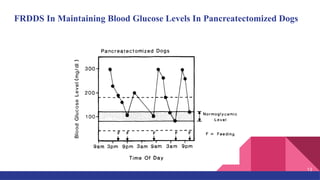
#13 (dogs without a pancreas, meaning they cannot produce insulin naturally).
#17 Diabetes Prevalence: The number of adults aged 20–79 with diabetes is projected to rise from approximately 537 million in 2021 to 783 million by 2045.
Traditional Management: Diabetes treatment requires frequent blood sugar checks and multiple daily insulin injections, which can be challenging for patients.
Glucose-Responsive Insulin Delivery Systems: These systems aim to release insulin in response to elevated blood glucose levels, mimicking the body's natural insulin regulation and reducing the need for constant monitoring.
Hydrogel-Based Approaches: Recent research focuses on hydrogels—water-absorbing polymer networks—that can respond to glucose levels. These hydrogels can swell or shrink in the presence of glucose, controlling insulin release accordingly.





![CTEV [ clubfoot] DR ARUN LAL ,DR MOHAMED ASHRAF travancore medical college k...](https://cdn.slidesharecdn.com/ss_thumbnails/ctevclubfootdrarunlaldrmohamedashraftravancoremedicalcollegekollamkeralaindia-260208063247-18fc466c-thumbnail.jpg?width=640&height=640&fit=bounds)


