FEEDBACK REGULATED
DRUG DELIVERY SYSTEM
MITALI PARYANI
18MPH107
CONTENT
1. Introduction of rate controlled drug delivery system
2. Rate controlled drug delivery system classification
3. What is feedback regulated drug delivery system & its types.
(3.1)Bioerosion & example
(3.2)Bioresponsive & example
(3.3)Self regulating & example
4. References
2
1. INTRODUCTION TO RATE CONTROLLED
DRUG DELIVERY SYSTEM
In conventional drug delivery system, there are many problems in maintaining
the dose in therapeutic window due to fluctuation in drug dose level.
 To overcome such, researchers devolped a system called as controlled drug
delivery system .
Control release is one where drug release of drug is at predetermined rate to
maintain constant drug concentration for specific period of time.
3
2.RATE CONTROLLED DRUG DELIVERY SYSTEM
CLASSIFICATION
A. RATE PREPROGRAMMED DRUG DELIVERY
SYSTEM.
B. ACTIVATION MODULATED DRUG DELIVERY
SYSTEM
C. FEEDBACK REGULATED DRUG DELIVERY
SYSTEM
D. SITE TARGETTING DRUG DELIVERY STEM
4
3.FEEDBACK REGULATED DRUG DELIVERY
SYSTEM
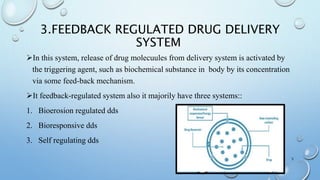
In this system, release of drug molecuules from delivery system is activated by
the triggering agent, such as biochemical substance in body by its concentration
via some feed-back mechanism.
It feedback-regulated system also it majorily have three systems::
1. Bioerosion regulated dds
2. Bioresponsive dds
3. Self regulating dds
5
(3.1) BIOEROSION-REGULATED DRUG
DELIVERY SYSTEM
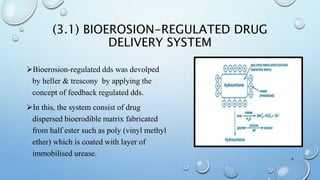
Bioerosion-regulated dds was devolped
by heller & trescony by applying the
concept of feedback regulated dds.
In this, the system consist of drug
dispersed bioerodible matrix fabricated
from half ester such as poly (vinyl methyl
ether) which is coated with layer of
immobilised urease.
6
(3.1) BIOEROSION-REGULATED DRUG
DELIVERY SYSTEM
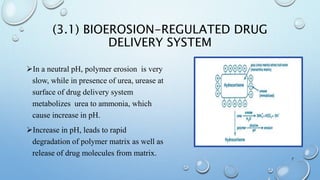
In a neutral pH, polymer erosion is very
slow, while in presence of urea, urease at
surface of drug delivery system
metabolizes urea to ammonia, which
cause increase in pH.
Increase in pH, leads to rapid
degradation of polymer matrix as well as
release of drug molecules from matrix.
7
(3.2) BIORESPONSIVE DRUG DELIVERY SYSTEM
Bioresponsive dds was devolped by horbett as a applied feedback
regulated dds.
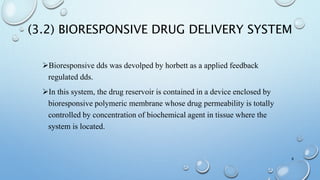
In this system, the drug reservoir is contained in a device enclosed by
bioresponsive polymeric membrane whose drug permeability is totally
controlled by concentration of biochemical agent in tissue where the
system is located.
8
(3.2) BIORESPONSIVE DRUG DELIVERY SYSTEM
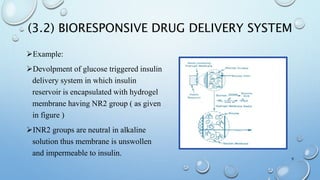
Example:
Devolpment of glucose triggered insulin
delivery system in which insulin
reservoir is encapsulated with hydrogel
membrane having NR2 group ( as given
in figure )
INR2 groups are neutral in alkaline
solution thus membrane is unswollen
and impermeable to insulin.
9
(3.2) BIORESPONSIVE DRUG DELIVERY SYSTEM
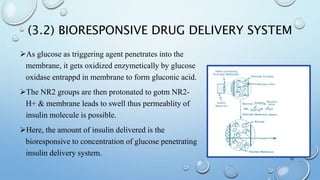
As glucose as triggering agent penetrates into the
membrane, it gets oxidized enzymetically by glucose
oxidase entrappd in membrane to form gluconic acid.
The NR2 groups are then protonated to gotm NR2-
H+ & membrane leads to swell thus permeablity of
insulin molecule is possible.
Here, the amount of insulin delivered is the
bioresponsive to concentration of glucose penetrating
insulin delivery system.
10
(3.3) SELF REGULATING DRUG DELIVERY
SYSTEM
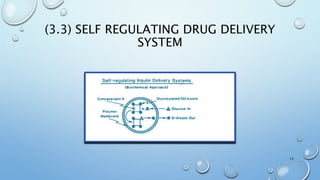
This system totally depends on reversible & competitve binding mechanism to
activate as well as release of drug.
Here, within a semipermeable membrane, drug reservoir is present, which gets
activated by membrane permeation of biochemical agent from thissue in which it
is located.
Kim was first to apply mechanism of reversible binding of sugar molecule by
lectin into design of self regulating drug delivery system.
11
(3.3) SELF REGULATING DRUG DELIVERY
SYSTEM
Example:
It first involve preparation of biologically active insulin derivatives in which
insulin is coupled with sugar component & this into insulin-sugar-lectin complex,
which is then encapsulated in semepermeable membrane.
As blood glucose diffuse into device & bind at sugar binding sites in lectin
molecules, it activate release of insulin-sugar dvts .
This dvts then diffuse out of device, and the whole amount of release is depend
on glucose oncentration. Thus self regulating drug delivery is achieved.
12
(3.3) SELF REGULATING DRUG DELIVERY
SYSTEM
13
1.SELF-REGULATED GLYCOSYLATED INSULIN
DELIVERY
A self-regulating insulin delivery system, based on the concept of competitive
binding between synthetic glycosylated insulin (g-insulin) and glucose to
concanavalin A (con A) ligand substrate, has been designed. The competitive
binding of the two ligands for the substrate regulates G- insulin release in relation
to the outside glucose concentration, while a polymeric membrane, serving as a
peritoneal implant pouch containing g-insulin and con A, is used to control the
permeability of glucose influx and g-insulin efflux. Mono-, di- and tri-sugar
substituted insulins have been characterized.
14
EXAMPLES FROM
ARTICLES
2.FEEDBACK REGULATED DRUG DELIVERY
VEHICLE: CARBONDIOXIDE RESPONSIVE
HYDROGEL FOR ANTIDOTE
A possible approach to handling the harmful side effects of an analgesic
overdose, without losing its therapeutic potential, involves feedback regulated
delivery of an antidote. For example, overdose of morphine causes
hypoventilation, an inadequate ventilation to perform gas exchanges in lungs
leading to increased CO2 concentration in the blood. Taking advantage of CO2
as a toxicity marker, a hydrogel-based delivery vehicle containing dimethylamino
groups [poly(n,n-dimethylaminoethyl methacrylate) cross-linked by
trimethylolpropane tri- methacrylate] was designed. 15
Stimulus controlled swelling of these hydrogels in naloxone delivery is done. A
remarkable control over naloxone release was achieved against the concentration
of the biomarker.
 The overall stimuli response of the gel could be enhanced further by
encapsulating carbonic anhydrase, a metalloenzyme known to catalyze the
reversible hydration of CO2. Thus, a feedback regulated drug delivery vehicle
based on toxicity biomarker strategy was modeled successfully, which has the
potential to mitigate risks associated with drug overdose.
16
4. REFERENCES
Yie W. Chien “Novel Drug Delivery Systems”feedback-regulated Drug
Delivery System, PG NO.2, 33-37, 43, 44
Sung Wan Kim, Chaul Min Pai, Kimiko Makino, Leah A. Seminoff, David L.
Holmberg, Jeremy M. Gleeson, Dana E. Wilson And Eric J. Mack “Self-
regulated Glycosylated Insulin Delivery” Journal Of Controlled Release, 11
(1990) PGNO.193-201
Sunita S. Satav, Shreedhar Bhat, And S. Thayumanavan, “Feedback Regulated
Drug Delivery Vehicles: Carbon Dioxide Responsive Cationic Hydrogels For
Antidote Release” , Biomacromolecules ,11 (2010) PG NO.1735–1740
17
THANKYOU
18

Feedback regulated drug delivery systems

  • 1.
    FEEDBACK REGULATED DRUG DELIVERYSYSTEM MITALI PARYANI 18MPH107
  • 2.
    CONTENT 1. Introduction ofrate controlled drug delivery system 2. Rate controlled drug delivery system classification 3. What is feedback regulated drug delivery system & its types. (3.1)Bioerosion & example (3.2)Bioresponsive & example (3.3)Self regulating & example 4. References 2
  • 3.
    1. INTRODUCTION TORATE CONTROLLED DRUG DELIVERY SYSTEM In conventional drug delivery system, there are many problems in maintaining the dose in therapeutic window due to fluctuation in drug dose level.  To overcome such, researchers devolped a system called as controlled drug delivery system . Control release is one where drug release of drug is at predetermined rate to maintain constant drug concentration for specific period of time. 3
  • 4.
    2.RATE CONTROLLED DRUGDELIVERY SYSTEM CLASSIFICATION A. RATE PREPROGRAMMED DRUG DELIVERY SYSTEM. B. ACTIVATION MODULATED DRUG DELIVERY SYSTEM C. FEEDBACK REGULATED DRUG DELIVERY SYSTEM D. SITE TARGETTING DRUG DELIVERY STEM 4
  • 5.
    3.FEEDBACK REGULATED DRUGDELIVERY SYSTEM In this system, release of drug molecuules from delivery system is activated by the triggering agent, such as biochemical substance in body by its concentration via some feed-back mechanism. It feedback-regulated system also it majorily have three systems:: 1. Bioerosion regulated dds 2. Bioresponsive dds 3. Self regulating dds 5
  • 6.
    (3.1) BIOEROSION-REGULATED DRUG DELIVERYSYSTEM Bioerosion-regulated dds was devolped by heller & trescony by applying the concept of feedback regulated dds. In this, the system consist of drug dispersed bioerodible matrix fabricated from half ester such as poly (vinyl methyl ether) which is coated with layer of immobilised urease. 6
  • 7.
    (3.1) BIOEROSION-REGULATED DRUG DELIVERYSYSTEM In a neutral pH, polymer erosion is very slow, while in presence of urea, urease at surface of drug delivery system metabolizes urea to ammonia, which cause increase in pH. Increase in pH, leads to rapid degradation of polymer matrix as well as release of drug molecules from matrix. 7
  • 8.
    (3.2) BIORESPONSIVE DRUGDELIVERY SYSTEM Bioresponsive dds was devolped by horbett as a applied feedback regulated dds. In this system, the drug reservoir is contained in a device enclosed by bioresponsive polymeric membrane whose drug permeability is totally controlled by concentration of biochemical agent in tissue where the system is located. 8
  • 9.
    (3.2) BIORESPONSIVE DRUGDELIVERY SYSTEM Example: Devolpment of glucose triggered insulin delivery system in which insulin reservoir is encapsulated with hydrogel membrane having NR2 group ( as given in figure ) INR2 groups are neutral in alkaline solution thus membrane is unswollen and impermeable to insulin. 9
  • 10.
    (3.2) BIORESPONSIVE DRUGDELIVERY SYSTEM As glucose as triggering agent penetrates into the membrane, it gets oxidized enzymetically by glucose oxidase entrappd in membrane to form gluconic acid. The NR2 groups are then protonated to gotm NR2- H+ & membrane leads to swell thus permeablity of insulin molecule is possible. Here, the amount of insulin delivered is the bioresponsive to concentration of glucose penetrating insulin delivery system. 10
  • 11.
    (3.3) SELF REGULATINGDRUG DELIVERY SYSTEM This system totally depends on reversible & competitve binding mechanism to activate as well as release of drug. Here, within a semipermeable membrane, drug reservoir is present, which gets activated by membrane permeation of biochemical agent from thissue in which it is located. Kim was first to apply mechanism of reversible binding of sugar molecule by lectin into design of self regulating drug delivery system. 11
  • 12.
    (3.3) SELF REGULATINGDRUG DELIVERY SYSTEM Example: It first involve preparation of biologically active insulin derivatives in which insulin is coupled with sugar component & this into insulin-sugar-lectin complex, which is then encapsulated in semepermeable membrane. As blood glucose diffuse into device & bind at sugar binding sites in lectin molecules, it activate release of insulin-sugar dvts . This dvts then diffuse out of device, and the whole amount of release is depend on glucose oncentration. Thus self regulating drug delivery is achieved. 12
  • 13.
    (3.3) SELF REGULATINGDRUG DELIVERY SYSTEM 13
  • 14.
    1.SELF-REGULATED GLYCOSYLATED INSULIN DELIVERY Aself-regulating insulin delivery system, based on the concept of competitive binding between synthetic glycosylated insulin (g-insulin) and glucose to concanavalin A (con A) ligand substrate, has been designed. The competitive binding of the two ligands for the substrate regulates G- insulin release in relation to the outside glucose concentration, while a polymeric membrane, serving as a peritoneal implant pouch containing g-insulin and con A, is used to control the permeability of glucose influx and g-insulin efflux. Mono-, di- and tri-sugar substituted insulins have been characterized. 14 EXAMPLES FROM ARTICLES
  • 15.
    2.FEEDBACK REGULATED DRUGDELIVERY VEHICLE: CARBONDIOXIDE RESPONSIVE HYDROGEL FOR ANTIDOTE A possible approach to handling the harmful side effects of an analgesic overdose, without losing its therapeutic potential, involves feedback regulated delivery of an antidote. For example, overdose of morphine causes hypoventilation, an inadequate ventilation to perform gas exchanges in lungs leading to increased CO2 concentration in the blood. Taking advantage of CO2 as a toxicity marker, a hydrogel-based delivery vehicle containing dimethylamino groups [poly(n,n-dimethylaminoethyl methacrylate) cross-linked by trimethylolpropane tri- methacrylate] was designed. 15
  • 16.
    Stimulus controlled swellingof these hydrogels in naloxone delivery is done. A remarkable control over naloxone release was achieved against the concentration of the biomarker.  The overall stimuli response of the gel could be enhanced further by encapsulating carbonic anhydrase, a metalloenzyme known to catalyze the reversible hydration of CO2. Thus, a feedback regulated drug delivery vehicle based on toxicity biomarker strategy was modeled successfully, which has the potential to mitigate risks associated with drug overdose. 16
  • 17.
    4. REFERENCES Yie W.Chien “Novel Drug Delivery Systems”feedback-regulated Drug Delivery System, PG NO.2, 33-37, 43, 44 Sung Wan Kim, Chaul Min Pai, Kimiko Makino, Leah A. Seminoff, David L. Holmberg, Jeremy M. Gleeson, Dana E. Wilson And Eric J. Mack “Self- regulated Glycosylated Insulin Delivery” Journal Of Controlled Release, 11 (1990) PGNO.193-201 Sunita S. Satav, Shreedhar Bhat, And S. Thayumanavan, “Feedback Regulated Drug Delivery Vehicles: Carbon Dioxide Responsive Cationic Hydrogels For Antidote Release” , Biomacromolecules ,11 (2010) PG NO.1735–1740 17
  • 18.