Culture
Every human interaction forms culture
Why is Eric talking about culture?
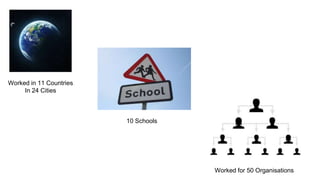
10 Schools
Worked in 11 Countries
In 24 Cities
Worked for 50 Organisations
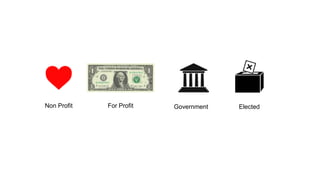
Non Profit For Profit ElectedGovernment
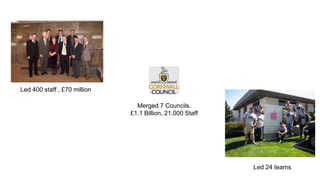
Merged 7 Councils,
£1.1 Billion, 21,000 Staff
Led 400 staff , £70 million
Led 24 teams
Where can you make a difference?
Be Kind
Being right is not enough
You are accountable
for how the other person feels
Feedback is hard to hear
Permission
Ask them to explain
Understand before you judge
What if they think I am dumb?
The killer of radical innovation
And effective risk management
What about the quiet people?
How people respond to failure
Reflection is the most powerful
way to learn
Permission
Control vs Influence
They
Aggressive learning
Science and Experience
Onboard with an eye towards friendship
Empower your team to find mutual
passions
Abolish They
The lonelier an employee
The poor the performance
Every idea starts fragile
The value of diversity of thought
SUN vs RAIN
People are classed as friend or foe,
quickly, with foe as the default in the
absence of positive cues
You can discover more about a person
in an hour of play
than in a year of conversation
Plato
..a culture of honest, constructive and
engaged feedback..
Ego impedes learning.. With success, it
can blind us to our faults.. In failure it
magnifies each blow..
The safer and more valued people feel,
the more resilient they are in the face of
high demand and uncertainty
True failure is when you failed
to ask for help
Reward Collaboration
In Conclusion
“We are all pebbles. We can grow to be rocks,
through our actions and behaviours.
Each of us when thrown into a pond create ripples.
The stronger the ripples the stronger the impact.
Too much and we destroy. Too little and we have
no effect.”
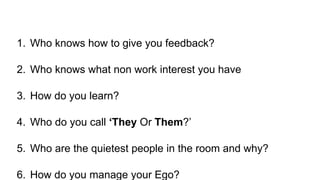
1. Who knows how to give you feedback?
2. Who knows what non work interest you have
3. How do you learn?
4. Who do you call ‘They Or Them?’
5. Who are the quietest people in the room and why?
6. How do you manage your Ego?
Everyone one of you are responsible for
the culture that you exist in
There are no innocent bystanders
ebrooke@enova.com
Linkedin https://www.linkedin.com/in/ericbrooke
Goodereads https://www.goodreads.com/ericbrooke
WordPress ericbrooke.wordpress.com
Twitter @ericbrooke

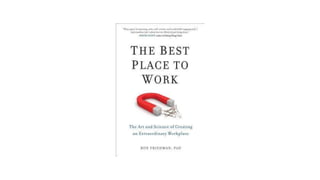
A great place to work

Editor's Notes

  • #2 Every human interaction forms culture You live multiple cultures - family, friends, sub groups of friends Everything counts, you ignore someone has walk along the corridor, you deciding to smile or not
  • #3 Eric Brooke I am a Software Engineer Manager here at Enova and I am currently working on Mobile Products https://www.linkedin.com/in/ericbrooke
  • #4 High exposure to a lot different cultures
  • #5 Have worked for nearly every sector
  • #6 Have a lot of leadership experience
  • #7 This lead me to create a Startup and for two years I studied LInguistics, psychology and organisation Development Finding the perfect people to work with Journey of my Startup and what I learned
  • #8 All of you are accountable for the culture that you work in Here are some ways you can evolve it
  • #9 Cultural difference between a Brit and a Canadian
  • #10 The link is my deck on Feedback Feedback is hard to hear even if it is good
  • #11 The Killer of most innovation or and effective risk management Impacts on people with more empathy A Barrier to juniors, introverts and sometimes woman
  • #12 How are you involving them in your conversations? You all are responsible for hearing people out But all people are accountable for shutting up when you have made your point
  • #13 Emotional response, the opportunity Was is it an experiment, what was learned? Startup Philosophy Election Campaigns Charity Campaigns Compromise, did you ask for too much
  • #14 We are often smarter when out of context Emotion can make us dumb Annual review of myself One to ones every week Monthly performance reviews
  • #15 If people do not feel they have permission to do they right thing, why not? At least a third of my work is about how I make it better around here? Its part part of my job description. At the same time I am completely transparent with my Boss and have a shared Doc with everything I am working on
  • #16 Early management style, fighting over people and territory The better negotiators are those that influence, not control
  • #17 Substitute this for any department name The filter that leads to prejudice, racism and other bad things Creates a barrier, its the bad people wear masks in movies Research shows we tend to mostly place people into categories of gender, race, and age. This task is so pervasive that scientists have deemed it our “primitive” categorization. http://sites.bu.edu/ombs/2013/10/16/why-are-people-sexist-racist-and-judgmental-behind-cognitive-bias-and-prejudice/ It’s your Primate brain at work, sometimes reinforced by your cultures
  • #18 How do you learn new things? What is your learning style Honey and Mumford Learning Style Inventory, you can find free ones online
  • #22 2011 Study california State and Wharton Business School
  • #26 Do you look at people when walking down the corridor and smile?
  • #27 Why? You see how people strategize You see how people lose
  • #28 I own 200 boardgames
  • #29 Amazing book if you want to take the next step in your evolution https://www.ted.com/talks/brene_brown_listening_to_shame https://www.ted.com/talks/brene_brown_on_vulnerability
  • #31 Arrogance
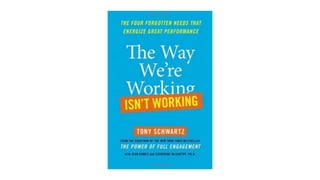
  • #33 https://www.goodreads.com/book/show/7679810-the-way-we-re-working-isn-t-working?ac=1&from_search=true
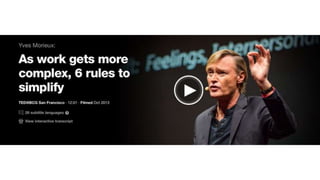
  • #35 https://www.ted.com/talks/yves_morieux_as_work_gets_more_complex_6_rules_to_simplify
  • #37 Who helped to achieve your goal? Who gave you the right idea to pursue? Who helped get the time? How does your department reward collaboration?
  • #40 Challenges for you to consider