MARTYN JONES
Managing Consultant
Sustainable success through seriously good
Customer Service
BUILDING YOUR BUSINESS THROUGH
OUTSTANDING CUSTOMER SERVICE
How to survive and prosper whilst others fail and go
under
AGENDA
 Why is service important?
 Who are your customers?
 What does excellent service look like?
 Ten Golden Rules
 Turning complaints into opportunities
 Measuring Customer Service
 Why bother?
 Challenges
 Action Planning
WHY IS SERVICE IMPORTANT?
 Exercise
 Write down 5 reasons why your customers should
spend their money with you.
 Exercise
 Write down 5 things that determine where you spend
your money.
CURRENT OPINION
“Ultimately, service is the only differentiator”
Jo Causon, CEO, Institute of Customer Service
“Companies should treat people in a special way and
make them feel special”
Brian Millar, Director of Strategy, Sense Worldwide
“While the average firms of today compete primarily
on quality or price, the leaders unsurprisingly
already prioritise customer service as their
competitive differentiator, far ahead of cost.”
Monica Woodley, Economist Intelligence Unit
CURRENT OPINION (2)
“Far too many businesses don’t prioritise good service as
part of their offer, meaning that as a nation we’ve come to
expect no better. This is where the smaller operator can
step in and break the mould. It’s amazing how the
smallest service gestures really make a difference: from
connecting with and really knowing and caring for your
customers, to having an in-depth knowledge that guides
and advises them; serving is quite simply the new
selling”.
Mary Portas
WHO ARE YOUR CUSTOMERS?
 Exercise
 Write down a list of who you think your customers are.
Who do you provide a service to?
 External customers e.g. Paying customers/clients,
providers/suppliers
 Internal customers e.g. boss, colleagues, other
departments, other offices etc.
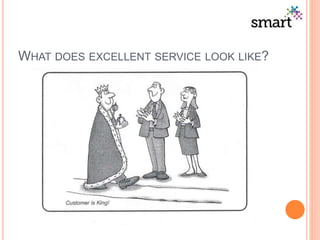
WHAT DOES EXCELLENT SERVICE LOOK LIKE?
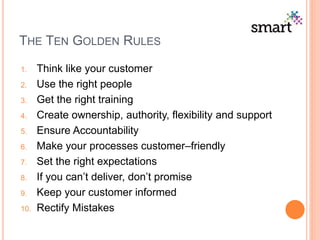
THE TEN GOLDEN RULES
1. Think like your customer
2. Use the right people
3. Get the right training
4. Create ownership, authority, flexibility and support
5. Ensure Accountability
6. Make your processes customer–friendly
7. Set the right expectations
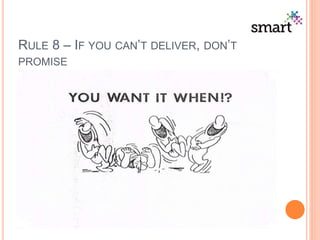
8. If you can’t deliver, don’t promise
9. Keep your customer informed
10. Rectify Mistakes
RULE 1 – THINK LIKE YOUR CUSTOMER
 Exercise
 Write a list of what you would want from you.
RULE 2 – USE THE RIGHT PEOPLE
 Exercise
 What will you improve to create the right first
impression?
RULE 3 – GET THE RIGHT TRAINING
 Exercise
 What additional training do you (or your staff) need in
order to enhance your service to your customers?
RULE 4 – CREATE OWNERSHIP,AUTHORITY,
FLEXIBILITY & SUPPORT
 Exercise
 What changes can you implement to create flexibility or
to give staff greater decision making authority and
support?
RULE 5 – ENSURE ACCOUNTABILITY
 Exercise
 What measures can I put in place in my business to
show how I am (or individual staff are) influencing
customer service?
RULE 6 – MAKE YOUR PROCESSES
CUSTOMER-FRIENDLY
 Exercise
 What can I change that will make the way I do business
more customer-friendly?
RULE 7 – SET THE RIGHT EXPECTATIONS
 Exercise
 What expectations should you be setting for your
customers?
RULE 8 – IF YOU CAN’T DELIVER, DON’T
PROMISE
RULE 9 – KEEP YOUR CUSTOMER INFORMED
 Exercise
 How can you improve ongoing communications with
your customers?
 Tip: What would you want to be told, how and
when?
RULE 10 – RECTIFY MISTAKES
As appropriate.
One size does NOT fit all!
CURRENT OPINION (3)
“Three quarters of leading companies have
empowered their staff to make decisions when
resolving customer issues, compared with less
than half among average firms. And while
weaker firms are investing more heavily in
standardised service processes, leading firms
are prioritising staff training and development,
and also working harder to define service
standards and goals.”
Monica Woodley, Economist Intelligence Unit
TURNING COMPLAINTS INTO OPPORTUNITIES
What is a complaint?
A complaint is free and genuine feedback about
something that you can improve to delight your
customers.
HANDLING A COMPLAINT
 Handle complaints promptly.
 Identify yourself and take responsibility.
 Ask for facts; don’t jump to conclusions.
 Find out how the customer wants the complaint
resolved.
 Resolve it.
 Identify why it happened.
 Make sure it only happens once.
TURNING COMPLAINTS INTO OPPORTUNITIES
“Your most unhappy customers are your greatest
source of learning”
Bill Gates
TURNING COMPLAINTS INTO OPPORTUNITIES
(CONTINUED)
 When have you complained?
 How was it handled?
 What did you want to happen?
 How did you feel?
 Exercise
 What can you learn from your own experiences that you
can implement for your business?
MEASURING CUSTOMER SATISFACTION
 Exercise
 What can you put in place that will measure what your
customers think of you or expect from you?
WHY BOTHER?
(WHAT’S IN IT FOR ME?)
 Business gains
 Sustainable competitive advantage
 Cost efficiency
 Profitability
 Good reputation
 Lifetime value of a customer
 Individual gains
 Increased job satisfaction
 More control of workload
 More efficient
 More proactive
WHAT’S IN IT FOR ME? (2)
Research has shown that:
 Over 20% customers are lost due to poor
service.
 Opposite is true. >20% increase in business
can be gained just by getting it right. Couple
of recent reports suggesting gain of over
30%.
 Delighted customers are 70% more likely to
return, repeat and recommend.
WHAT ELSE IS IN IT FOR ME?
 A Future
“There is only one boss. The customer. And he can fire
everybody in the company from the Chairman on down,
simply by spending his money somewhere else”
Sam Walton, Founder of Wal-Mart
CHALLENGES
 Communicating clearly
 Not missing the obvious signs
 Developing a Service culture
ACTION PLANNING
 Final Exercise
 Write down and sign up to three things that you will do to
improve customer service in your business.
Tips:
 Use the previous exercises for ideas.
 Include how you will implement them and assign realistic timescales.
 Include how you will measure success.
OBJECTIVES
Anything outstanding?
SUMMARY
 Why is service important?
 Who are your customers?
 What does excellent service look like?
 Ten Golden Rules
 Turning complaints into opportunities
 Measuring Customer Service
 Why bother?
 Challenges
 Action Planning
FINAL THOUGHTS
“Satisfying customers is not enough to earn
their loyalty. Instead, they must experience
exceptional service that is worthy of their
repeat business and referral to others. Make
your customers feel special and you will
succeed” Richard Branson
“ Customers who don’t feel valued become
someone else’s customers”
Martyn Jones
FINAL THOUGHTS
“A customer is not dependent on us. We are
dependent on him.
He is not an interruption or inconvenience in our
work. He is the purpose of it.
He is not an outsider in our business. He is part
of it.
We are not doing him a favour by serving him.
He is doing us a favour by giving us an
opportunity to do so.”
Mahatma Ghandi
Thank you for your input.
Good Luck implementing your Action Plan.

Exceptional Customer Service Training Course in Lancashire

  • 1.
    MARTYN JONES Managing Consultant Sustainablesuccess through seriously good Customer Service
  • 2.
    BUILDING YOUR BUSINESSTHROUGH OUTSTANDING CUSTOMER SERVICE How to survive and prosper whilst others fail and go under
  • 3.
    AGENDA  Why isservice important?  Who are your customers?  What does excellent service look like?  Ten Golden Rules  Turning complaints into opportunities  Measuring Customer Service  Why bother?  Challenges  Action Planning
  • 4.
    WHY IS SERVICEIMPORTANT?  Exercise  Write down 5 reasons why your customers should spend their money with you.  Exercise  Write down 5 things that determine where you spend your money.
  • 5.
    CURRENT OPINION “Ultimately, serviceis the only differentiator” Jo Causon, CEO, Institute of Customer Service “Companies should treat people in a special way and make them feel special” Brian Millar, Director of Strategy, Sense Worldwide “While the average firms of today compete primarily on quality or price, the leaders unsurprisingly already prioritise customer service as their competitive differentiator, far ahead of cost.” Monica Woodley, Economist Intelligence Unit
  • 6.
    CURRENT OPINION (2) “Fartoo many businesses don’t prioritise good service as part of their offer, meaning that as a nation we’ve come to expect no better. This is where the smaller operator can step in and break the mould. It’s amazing how the smallest service gestures really make a difference: from connecting with and really knowing and caring for your customers, to having an in-depth knowledge that guides and advises them; serving is quite simply the new selling”. Mary Portas
  • 7.
    WHO ARE YOURCUSTOMERS?  Exercise  Write down a list of who you think your customers are. Who do you provide a service to?  External customers e.g. Paying customers/clients, providers/suppliers  Internal customers e.g. boss, colleagues, other departments, other offices etc.
  • 8.
    WHAT DOES EXCELLENTSERVICE LOOK LIKE?
  • 9.
    THE TEN GOLDENRULES 1. Think like your customer 2. Use the right people 3. Get the right training 4. Create ownership, authority, flexibility and support 5. Ensure Accountability 6. Make your processes customer–friendly 7. Set the right expectations 8. If you can’t deliver, don’t promise 9. Keep your customer informed 10. Rectify Mistakes
  • 10.
    RULE 1 –THINK LIKE YOUR CUSTOMER  Exercise  Write a list of what you would want from you.
  • 11.
    RULE 2 –USE THE RIGHT PEOPLE  Exercise  What will you improve to create the right first impression?
  • 12.
    RULE 3 –GET THE RIGHT TRAINING  Exercise  What additional training do you (or your staff) need in order to enhance your service to your customers?
  • 13.
    RULE 4 –CREATE OWNERSHIP,AUTHORITY, FLEXIBILITY & SUPPORT  Exercise  What changes can you implement to create flexibility or to give staff greater decision making authority and support?
  • 14.
    RULE 5 –ENSURE ACCOUNTABILITY  Exercise  What measures can I put in place in my business to show how I am (or individual staff are) influencing customer service?
  • 15.
    RULE 6 –MAKE YOUR PROCESSES CUSTOMER-FRIENDLY  Exercise  What can I change that will make the way I do business more customer-friendly?
  • 16.
    RULE 7 –SET THE RIGHT EXPECTATIONS  Exercise  What expectations should you be setting for your customers?
  • 17.
    RULE 8 –IF YOU CAN’T DELIVER, DON’T PROMISE
  • 18.
    RULE 9 –KEEP YOUR CUSTOMER INFORMED  Exercise  How can you improve ongoing communications with your customers?  Tip: What would you want to be told, how and when?
  • 19.
    RULE 10 –RECTIFY MISTAKES As appropriate. One size does NOT fit all!
  • 20.
    CURRENT OPINION (3) “Threequarters of leading companies have empowered their staff to make decisions when resolving customer issues, compared with less than half among average firms. And while weaker firms are investing more heavily in standardised service processes, leading firms are prioritising staff training and development, and also working harder to define service standards and goals.” Monica Woodley, Economist Intelligence Unit
  • 21.
    TURNING COMPLAINTS INTOOPPORTUNITIES What is a complaint? A complaint is free and genuine feedback about something that you can improve to delight your customers.
  • 22.
    HANDLING A COMPLAINT Handle complaints promptly.  Identify yourself and take responsibility.  Ask for facts; don’t jump to conclusions.  Find out how the customer wants the complaint resolved.  Resolve it.  Identify why it happened.  Make sure it only happens once.
  • 23.
    TURNING COMPLAINTS INTOOPPORTUNITIES “Your most unhappy customers are your greatest source of learning” Bill Gates
  • 24.
    TURNING COMPLAINTS INTOOPPORTUNITIES (CONTINUED)  When have you complained?  How was it handled?  What did you want to happen?  How did you feel?  Exercise  What can you learn from your own experiences that you can implement for your business?
  • 25.
    MEASURING CUSTOMER SATISFACTION Exercise  What can you put in place that will measure what your customers think of you or expect from you?
  • 26.
    WHY BOTHER? (WHAT’S INIT FOR ME?)  Business gains  Sustainable competitive advantage  Cost efficiency  Profitability  Good reputation  Lifetime value of a customer  Individual gains  Increased job satisfaction  More control of workload  More efficient  More proactive
  • 27.
    WHAT’S IN ITFOR ME? (2) Research has shown that:  Over 20% customers are lost due to poor service.  Opposite is true. >20% increase in business can be gained just by getting it right. Couple of recent reports suggesting gain of over 30%.  Delighted customers are 70% more likely to return, repeat and recommend.
  • 28.
    WHAT ELSE ISIN IT FOR ME?  A Future “There is only one boss. The customer. And he can fire everybody in the company from the Chairman on down, simply by spending his money somewhere else” Sam Walton, Founder of Wal-Mart
  • 29.
    CHALLENGES  Communicating clearly Not missing the obvious signs  Developing a Service culture
  • 30.
    ACTION PLANNING  FinalExercise  Write down and sign up to three things that you will do to improve customer service in your business. Tips:  Use the previous exercises for ideas.  Include how you will implement them and assign realistic timescales.  Include how you will measure success.
  • 31.
  • 32.
    SUMMARY  Why isservice important?  Who are your customers?  What does excellent service look like?  Ten Golden Rules  Turning complaints into opportunities  Measuring Customer Service  Why bother?  Challenges  Action Planning
  • 33.
    FINAL THOUGHTS “Satisfying customersis not enough to earn their loyalty. Instead, they must experience exceptional service that is worthy of their repeat business and referral to others. Make your customers feel special and you will succeed” Richard Branson “ Customers who don’t feel valued become someone else’s customers” Martyn Jones
  • 34.
    FINAL THOUGHTS “A customeris not dependent on us. We are dependent on him. He is not an interruption or inconvenience in our work. He is the purpose of it. He is not an outsider in our business. He is part of it. We are not doing him a favour by serving him. He is doing us a favour by giving us an opportunity to do so.” Mahatma Ghandi
  • 35.
    Thank you foryour input. Good Luck implementing your Action Plan.