Service Desk Maturity Models & Frameworks Robert S. Last, M.A., S.C.A., S.C.M. February 14, 2008
Agenda What’s a model & what’s a framework? The most common models and frameworks Choosing a model or framework How they work--in brief  Lessons learned Resources Questions
What’s a Model & Framework? Model -A standard or example for imitation  or comparison. Framework -Guidance that is not prescriptive in nature. A framework tells you  who, what, where  and  when to do something, but  not   how to do it.
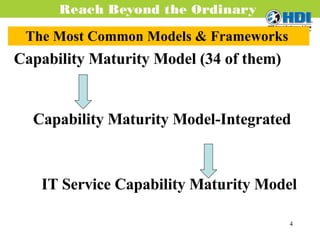
The Most Common Models & Frameworks  Capability Maturity Model (34 of them)   Capability Maturity Model-Integrated IT Service Capability Maturity Model
We Also Have… HDI Support Center  Maturity Model ISO/IEC 20000- Standard  (model) from our  British cousins & ISO ITIL- Framework  from our British cousins CoBIT- Model  for control of the IT environment
How They Work—In Brief… The good news first-the maturity models all work essentially the same way The frameworks and standards all have assessment tools of different types The documentation on all of these frameworks, models, standards, etc. is voluminous
How They Work… The bad news is that they have these characteristics: A lot of reading, study and paperwork have to be expended to understand them; The writing for these programs is DRY—Sinai Desert dry; Most support center managers have a tendency to pick and choose what parts they use
CMM CMM began in 1987; created by the Software Engineering Institute (SEI) at Carnegie-Mellon University; began from a charter issued by the DOD; released in 1990.
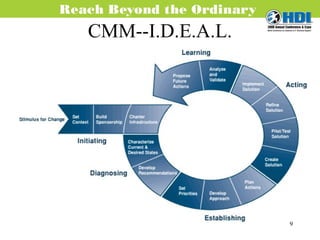
CMM--I.D.E.A.L.
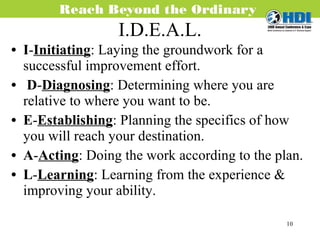
I.D.E.A.L. I - Initiating : Laying the groundwork for a successful improvement effort. D - Diagnosing : Determining where you are relative to where you want to be. E - Establishing : Planning the specifics of how you will reach your destination.  A - Acting : Doing the work according to the plan. L - Learning : Learning from the experience & improving your ability.
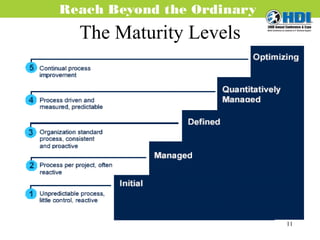
The Maturity Levels
What is a Maturity Model? Organizational  maturity   refers to an organizations’ ability to perform. A maturity  model  is a descriptive model that defines five stages of  evolutionary  growth. At each maturity level organizational competence increases.
Advantages to Maturity Model Practices are  identified  & can be  repeated. Best practices  can be  rapidly   transferred  across groups. Variations  in performing best practices are  reduced. Practices are  continuously improved  to enhance capability (optimizing). Provides a  common  framework & language.
Advantages of a Model &  Framework Allows you to concentrate on  improving  more than  creating . Generally is  supported  by training, consulting & ancillary literature. Repeatable practices  become the norm U.S Navy goes nuclear-safely & the airline pilots checklist Apollo 13—the movie Fewer and fewer “individual acts of heroism.”
CMMI Capability Maturity Model Integration(CMMI) was released in 2002 and combined disparate models of CMM into a single integrated model. CMMI describes the characteristics of  effective processes. CMMI is a  framework   for business process improvement.
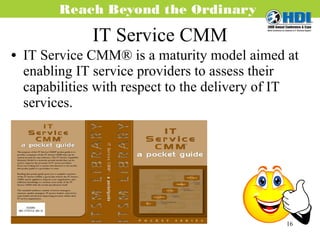
IT Service CMM IT Service CMM® is a maturity model aimed at enabling IT service providers to assess their capabilities with respect to the delivery of IT services.
Maturity Model Assessments-I Maturity model assessments measure the degree to which an organization uses its people, processes, tools, products, and management. Assessments show how the organization compares to other organizations. Assessments show opportunities to improve, identify required standards, processes, procedures and facilitate continuous improvements.
Choosing a Model or Framework Process Maturity Framework  (PMF)  or Governance Maturity Model  (GMM)? Are you subject to IT  governance audits ? Can anyone say CoBIT & SOX? HIPPA?
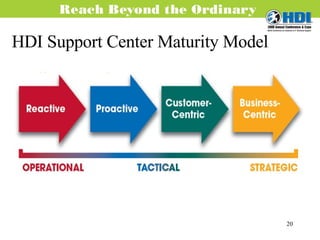
HDI Support Center Maturity Model Developed in 2003, updated in 2007. Based on input from the HDI Strategic Advisory Board. Reflects changes in business needs, advances in technology & growth in process maturity models.
HDI Support Center Maturity Model
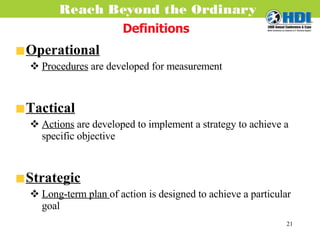
Definitions Operational Procedures  are developed for measurement Tactical Actions  are developed to implement a strategy to achieve a specific objective Strategic Long-term plan  of action is designed to achieve a particular goal
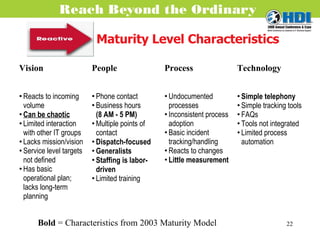
Maturity Level Characteristics Bold  = Characteristics from 2003 Maturity Model Vision People Process Technology Reacts to incoming volume Can be chaotic Limited interaction with other IT groups Lacks mission/vision Service level targets not defined Has basic operational plan; lacks long-term planning Phone contact Business hours  (8 AM - 5 PM) Multiple points of contact Dispatch-focused Generalists Staffing is labor-driven Limited training Undocumented processes Inconsistent process adoption Basic incident tracking/handling Reacts to changes Little measurement Simple telephony Simple tracking tools FAQs Tools not integrated Limited process automation
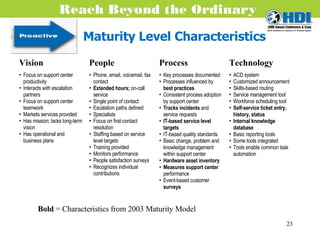
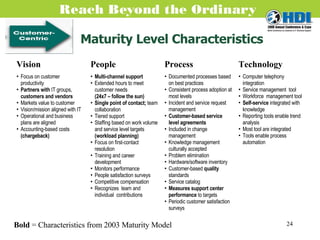
Maturity Level Characteristics Bold  = Characteristics from 2003 Maturity Model Vision People Process Technology Focus on support center productivity Interacts with escalation partners Focus on support center teamwork Markets services provided Has mission; lacks long-term vision Has operational and business plans Phone, email, voicemail, fax contact Extended hours;  on-call service Single point of contact Escalation paths defined Specialists Focus on first-contact resolution Staffing based on service level targets Training provided Monitors performance People satisfaction surveys Recognizes individual contributions Key processes documented Processes influenced by  best practices Consistent process adoption by support center Tracks incidents  and service requests IT-based service level targets IT-based quality standards Basic change, problem and knowledge management within support center Hardware asset inventory Measures support center  performance Event-based customer  surveys ACD system Customized announcement Skills-based routing Service management tool Workforce scheduling tool Self-service ticket entry, history, status Internal knowledge  database Basic reporting tools Some tools integrated Tools enable common task automation
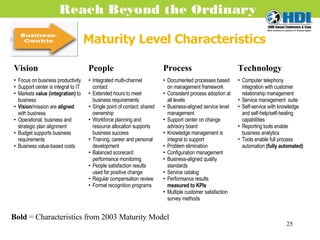
Maturity Level Characteristics Bold  = Characteristics from 2003 Maturity Model Vision People Process Technology Focus on customer productivity Partners with  IT groups,  customers and vendors Markets value to customer Vision/mission aligned with IT Operational and business plans are aligned Accounting-based costs  (chargeback) Multi-channel support Extended hours to meet customer needs (24x7 – follow the sun) Single point of contact;  team collaboration Tiered support Staffing based on work volume and service level targets  (workload planning) Focus on first-contact resolution Training and career development Monitors performance People satisfaction surveys Competitive compensation Recognizes  team and individual  contributions Documented processes based on best practices Consistent process adoption at most levels Incident and service request management Customer-based service level agreements Included in change management Knowledge management culturally accepted Problem elimination Hardware/software inventory Customer-based  quality  standards Service catalog Measures support center performance  to targets Periodic customer satisfaction surveys Computer telephony integration Service management  tool Workforce  management tool Self-service  integrated with knowledge Reporting tools enable trend analysis Most tool are integrated Tools enable process automation
Maturity Level Characteristics Bold  = Characteristics from 2003 Maturity Model Vision People Process Technology Focus on business productivity Support center is integral to IT Markets  value (integration)  to business Vision /mission are  aligned  with business Operational, business and strategic plan alignment Budget supports business requirements Business value-based costs Integrated multi-channel contact Extended hours to meet business requirements Single point of contact; shared ownership Workforce planning and resource allocation supports business success Training, career and personal development Balanced scorecard performance monitoring People satisfaction results used for positive change Regular compensation review Formal recognition programs Documented processes based on management framework Consistent process adoption at all levels Business-aligned service level management Support center on change advisory board Knowledge management is integral to support Problem elimination Configuration management Business-aligned quality standards Service catalog Performance results  measured to KPIs Multiple customer satisfaction survey methods Computer telephony integration with customer relationship management Service management  suite Self-service with knowledge and self-help/self-healing capabilities Reporting tools enable business analytics Tools enable full process automation  (fully automated)
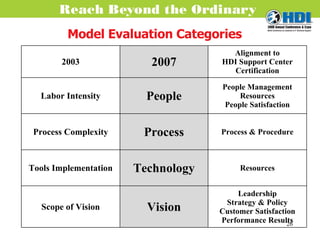
Model Evaluation Categories 2003 2007 Alignment to HDI Support Center Certification Labor Intensity People People Management Resources People Satisfaction Process Complexity Process Process & Procedure Tools Implementation Technology Resources Scope of Vision Vision Leadership Strategy & Policy Customer Satisfaction Performance Results
What do I do with this? The HDI Support Center Assessment Program: (Working on the tool now) http://www.thinkhdi.com/ ......
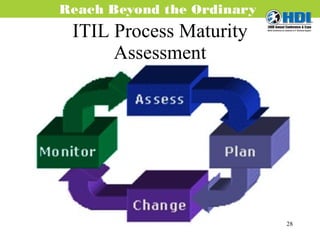
ITIL Process Maturity Assessment
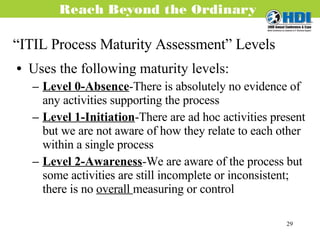
“ ITIL Process Maturity Assessment” Levels Uses the following maturity levels: Level 0-Absence -There is absolutely no evidence of any activities supporting the process Level 1-Initiation -There are ad hoc activities present but we are not aware of how they relate to each other within a single process Level 2-Awareness -We are aware of the process but some activities are still incomplete or inconsistent; there is no  overall  measuring or control
ITIL Process Maturity Assessment-Levels-continued Level 3-Control -The process is well defined, understood and implemented Level 4-Integration -Inputs from this process come other well controlled processes; outputs from this process go to other well controlled processes
ITIL Process Maturity Assessment-Levels Level 5-Optimization -This processes drives quality improvements & new business opportunities beyond the process itself.
Tools for You… IT Service Capability Maturity Model : http://www.itgovernance.co.uk/files/IT%20Service%20CMM.pdf http://www.itservicecmm.org/ http://www.itservicecmm.org/doc/quest-0.1.pdf http://www.serc.nl/people/niessink/publications/TR99.Niessink.pdf (This is one of the best explanations available-All 78 pages)
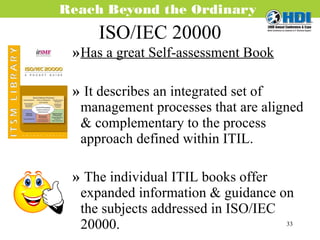
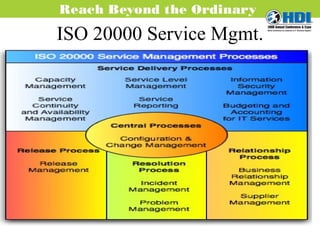
ISO/IEC 20000 Has a great Self-assessment Book It describes an integrated set of management processes that are aligned & complementary to the process approach defined within ITIL. The individual ITIL books offer expanded information & guidance on the subjects addressed in ISO/IEC 20000.
ISO 20000 Service Mgmt.
Does ITIL Have Assessments? Oh Yeah!  They’re very good too! IT Service Management:  Service Support  Self-assessment Questionnaire http://www.contentedits.com/img.asp?id=4183 http://www.itsm.info/downloads.htm www. itsm.info / Service _Desk  service _ support _assessment.xls IT Service Management :  Service Delivery  Self-assessment Questionnaire  http://www.itsm.info/downloads.htm http://www.itsm.info/
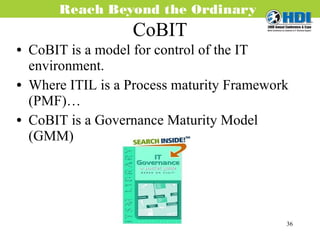
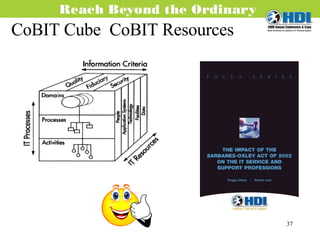
CoBIT CoBIT is a model for control of the IT environment. Where ITIL is a Process maturity Framework (PMF)… CoBIT is a Governance Maturity Model (GMM)
CoBIT Cube  CoBIT Resources
Lessons from Veteran Users Do your  homework  first Identify what  could  go wrong, not what  might  go wrong.  Never Assume—remember FEMA? Do not “implement by incantation” Remember, “Murphy’s Law-Whatever can go wrong, will go wrong, at the worst possible time-” was optimistic
Measuring & Defining Success Measuring: Identify what’s important for implementation Identify what’s important for daily management Identify what’s important for strategic management Define Success: You should do this in the beginning of the project, during the planning stage
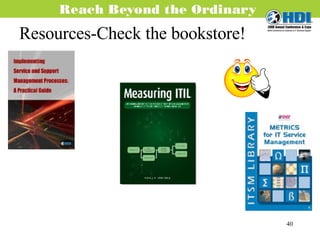
Resources-Check the bookstore!
Ask a question—I Dare You!
Any Questions? [email_address]
Thank you for attending this session. Please fill out an evaluation form.

Feb2008 Service Desk Maturity Models & Fram

  • 1.
    Service Desk MaturityModels & Frameworks Robert S. Last, M.A., S.C.A., S.C.M. February 14, 2008
  • 2.
    Agenda What’s amodel & what’s a framework? The most common models and frameworks Choosing a model or framework How they work--in brief Lessons learned Resources Questions
  • 3.
    What’s a Model& Framework? Model -A standard or example for imitation or comparison. Framework -Guidance that is not prescriptive in nature. A framework tells you who, what, where and when to do something, but not how to do it.
  • 4.
    The Most CommonModels & Frameworks Capability Maturity Model (34 of them) Capability Maturity Model-Integrated IT Service Capability Maturity Model
  • 5.
    We Also Have…HDI Support Center Maturity Model ISO/IEC 20000- Standard (model) from our British cousins & ISO ITIL- Framework from our British cousins CoBIT- Model for control of the IT environment
  • 6.
    How They Work—InBrief… The good news first-the maturity models all work essentially the same way The frameworks and standards all have assessment tools of different types The documentation on all of these frameworks, models, standards, etc. is voluminous
  • 7.
    How They Work…The bad news is that they have these characteristics: A lot of reading, study and paperwork have to be expended to understand them; The writing for these programs is DRY—Sinai Desert dry; Most support center managers have a tendency to pick and choose what parts they use
  • 8.
    CMM CMM beganin 1987; created by the Software Engineering Institute (SEI) at Carnegie-Mellon University; began from a charter issued by the DOD; released in 1990.
  • 9.
  • 10.
    I.D.E.A.L. I -Initiating : Laying the groundwork for a successful improvement effort. D - Diagnosing : Determining where you are relative to where you want to be. E - Establishing : Planning the specifics of how you will reach your destination. A - Acting : Doing the work according to the plan. L - Learning : Learning from the experience & improving your ability.
  • 11.
  • 12.
    What is aMaturity Model? Organizational maturity refers to an organizations’ ability to perform. A maturity model is a descriptive model that defines five stages of evolutionary growth. At each maturity level organizational competence increases.
  • 13.
    Advantages to MaturityModel Practices are identified & can be repeated. Best practices can be rapidly transferred across groups. Variations in performing best practices are reduced. Practices are continuously improved to enhance capability (optimizing). Provides a common framework & language.
  • 14.
    Advantages of aModel & Framework Allows you to concentrate on improving more than creating . Generally is supported by training, consulting & ancillary literature. Repeatable practices become the norm U.S Navy goes nuclear-safely & the airline pilots checklist Apollo 13—the movie Fewer and fewer “individual acts of heroism.”
  • 15.
    CMMI Capability MaturityModel Integration(CMMI) was released in 2002 and combined disparate models of CMM into a single integrated model. CMMI describes the characteristics of effective processes. CMMI is a framework for business process improvement.
  • 16.
    IT Service CMMIT Service CMM® is a maturity model aimed at enabling IT service providers to assess their capabilities with respect to the delivery of IT services.
  • 17.
    Maturity Model Assessments-IMaturity model assessments measure the degree to which an organization uses its people, processes, tools, products, and management. Assessments show how the organization compares to other organizations. Assessments show opportunities to improve, identify required standards, processes, procedures and facilitate continuous improvements.
  • 18.
    Choosing a Modelor Framework Process Maturity Framework (PMF) or Governance Maturity Model (GMM)? Are you subject to IT governance audits ? Can anyone say CoBIT & SOX? HIPPA?
  • 19.
    HDI Support CenterMaturity Model Developed in 2003, updated in 2007. Based on input from the HDI Strategic Advisory Board. Reflects changes in business needs, advances in technology & growth in process maturity models.
  • 20.
    HDI Support CenterMaturity Model
  • 21.
    Definitions Operational Procedures are developed for measurement Tactical Actions are developed to implement a strategy to achieve a specific objective Strategic Long-term plan of action is designed to achieve a particular goal
  • 22.
    Maturity Level CharacteristicsBold = Characteristics from 2003 Maturity Model Vision People Process Technology Reacts to incoming volume Can be chaotic Limited interaction with other IT groups Lacks mission/vision Service level targets not defined Has basic operational plan; lacks long-term planning Phone contact Business hours (8 AM - 5 PM) Multiple points of contact Dispatch-focused Generalists Staffing is labor-driven Limited training Undocumented processes Inconsistent process adoption Basic incident tracking/handling Reacts to changes Little measurement Simple telephony Simple tracking tools FAQs Tools not integrated Limited process automation
  • 23.
    Maturity Level CharacteristicsBold = Characteristics from 2003 Maturity Model Vision People Process Technology Focus on support center productivity Interacts with escalation partners Focus on support center teamwork Markets services provided Has mission; lacks long-term vision Has operational and business plans Phone, email, voicemail, fax contact Extended hours; on-call service Single point of contact Escalation paths defined Specialists Focus on first-contact resolution Staffing based on service level targets Training provided Monitors performance People satisfaction surveys Recognizes individual contributions Key processes documented Processes influenced by best practices Consistent process adoption by support center Tracks incidents and service requests IT-based service level targets IT-based quality standards Basic change, problem and knowledge management within support center Hardware asset inventory Measures support center performance Event-based customer surveys ACD system Customized announcement Skills-based routing Service management tool Workforce scheduling tool Self-service ticket entry, history, status Internal knowledge database Basic reporting tools Some tools integrated Tools enable common task automation
  • 24.
    Maturity Level CharacteristicsBold = Characteristics from 2003 Maturity Model Vision People Process Technology Focus on customer productivity Partners with IT groups, customers and vendors Markets value to customer Vision/mission aligned with IT Operational and business plans are aligned Accounting-based costs (chargeback) Multi-channel support Extended hours to meet customer needs (24x7 – follow the sun) Single point of contact; team collaboration Tiered support Staffing based on work volume and service level targets (workload planning) Focus on first-contact resolution Training and career development Monitors performance People satisfaction surveys Competitive compensation Recognizes team and individual contributions Documented processes based on best practices Consistent process adoption at most levels Incident and service request management Customer-based service level agreements Included in change management Knowledge management culturally accepted Problem elimination Hardware/software inventory Customer-based quality standards Service catalog Measures support center performance to targets Periodic customer satisfaction surveys Computer telephony integration Service management tool Workforce management tool Self-service integrated with knowledge Reporting tools enable trend analysis Most tool are integrated Tools enable process automation
  • 25.
    Maturity Level CharacteristicsBold = Characteristics from 2003 Maturity Model Vision People Process Technology Focus on business productivity Support center is integral to IT Markets value (integration) to business Vision /mission are aligned with business Operational, business and strategic plan alignment Budget supports business requirements Business value-based costs Integrated multi-channel contact Extended hours to meet business requirements Single point of contact; shared ownership Workforce planning and resource allocation supports business success Training, career and personal development Balanced scorecard performance monitoring People satisfaction results used for positive change Regular compensation review Formal recognition programs Documented processes based on management framework Consistent process adoption at all levels Business-aligned service level management Support center on change advisory board Knowledge management is integral to support Problem elimination Configuration management Business-aligned quality standards Service catalog Performance results measured to KPIs Multiple customer satisfaction survey methods Computer telephony integration with customer relationship management Service management suite Self-service with knowledge and self-help/self-healing capabilities Reporting tools enable business analytics Tools enable full process automation (fully automated)
  • 26.
    Model Evaluation Categories2003 2007 Alignment to HDI Support Center Certification Labor Intensity People People Management Resources People Satisfaction Process Complexity Process Process & Procedure Tools Implementation Technology Resources Scope of Vision Vision Leadership Strategy & Policy Customer Satisfaction Performance Results
  • 27.
    What do Ido with this? The HDI Support Center Assessment Program: (Working on the tool now) http://www.thinkhdi.com/ ......
  • 28.
  • 29.
    “ ITIL ProcessMaturity Assessment” Levels Uses the following maturity levels: Level 0-Absence -There is absolutely no evidence of any activities supporting the process Level 1-Initiation -There are ad hoc activities present but we are not aware of how they relate to each other within a single process Level 2-Awareness -We are aware of the process but some activities are still incomplete or inconsistent; there is no overall measuring or control
  • 30.
    ITIL Process MaturityAssessment-Levels-continued Level 3-Control -The process is well defined, understood and implemented Level 4-Integration -Inputs from this process come other well controlled processes; outputs from this process go to other well controlled processes
  • 31.
    ITIL Process MaturityAssessment-Levels Level 5-Optimization -This processes drives quality improvements & new business opportunities beyond the process itself.
  • 32.
    Tools for You…IT Service Capability Maturity Model : http://www.itgovernance.co.uk/files/IT%20Service%20CMM.pdf http://www.itservicecmm.org/ http://www.itservicecmm.org/doc/quest-0.1.pdf http://www.serc.nl/people/niessink/publications/TR99.Niessink.pdf (This is one of the best explanations available-All 78 pages)
  • 33.
    ISO/IEC 20000 Hasa great Self-assessment Book It describes an integrated set of management processes that are aligned & complementary to the process approach defined within ITIL. The individual ITIL books offer expanded information & guidance on the subjects addressed in ISO/IEC 20000.
  • 34.
  • 35.
    Does ITIL HaveAssessments? Oh Yeah! They’re very good too! IT Service Management: Service Support Self-assessment Questionnaire http://www.contentedits.com/img.asp?id=4183 http://www.itsm.info/downloads.htm www. itsm.info / Service _Desk service _ support _assessment.xls IT Service Management : Service Delivery Self-assessment Questionnaire http://www.itsm.info/downloads.htm http://www.itsm.info/
  • 36.
    CoBIT CoBIT isa model for control of the IT environment. Where ITIL is a Process maturity Framework (PMF)… CoBIT is a Governance Maturity Model (GMM)
  • 37.
    CoBIT Cube CoBIT Resources
  • 38.
    Lessons from VeteranUsers Do your homework first Identify what could go wrong, not what might go wrong. Never Assume—remember FEMA? Do not “implement by incantation” Remember, “Murphy’s Law-Whatever can go wrong, will go wrong, at the worst possible time-” was optimistic
  • 39.
    Measuring & DefiningSuccess Measuring: Identify what’s important for implementation Identify what’s important for daily management Identify what’s important for strategic management Define Success: You should do this in the beginning of the project, during the planning stage
  • 40.
  • 41.
  • 42.
  • 43.
    Thank you forattending this session. Please fill out an evaluation form.