Quality Standards
Lecture Objectives
•Sarbanes - Oxley
• ISO9000
• Capability Maturity Model (CMM)
• Maturity Levels
• People CMM
• CMMI
• Malcolm Baldrige National Quality Award
3.
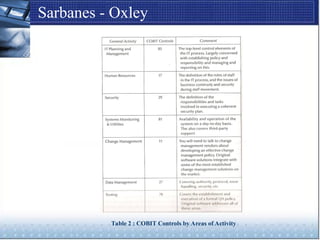
Sarbanes - Oxley
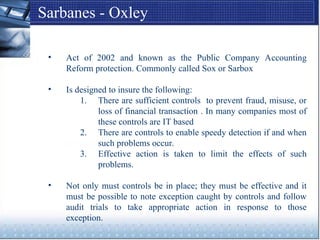
•Act of 2002 and known as the Public Company Accounting
Reform protection. Commonly called Sox or Sarbox
• Is designed to insure the following:
1. There are sufficient controls to prevent fraud, misuse, or
loss of financial transaction . In many companies most of
these controls are IT based
2. There are controls to enable speedy detection if and when
such problems occur.
3. Effective action is taken to limit the effects of such
problems.
• Not only must controls be in place; they must be effective and it
must be possible to note exception caught by controls and follow
audit trials to take appropriate action in response to those
exception.
ISO9000
• Is aquality series and comprises a set of five documents developed
in 1987 by the International Standard Organization (ISO).
• Becoming more and more important through Europe and United
State for manufacture and hardware.
• ISO9000 is a definitive set of quality standards, but is represents
quality as a part of Total Quality Management (TQM).
• It consists of ISO9001, ISO9002, or ISO9003 and it provides the
guidelines for selecting and implementing a quality assurance
standard.
7.
ISO9000
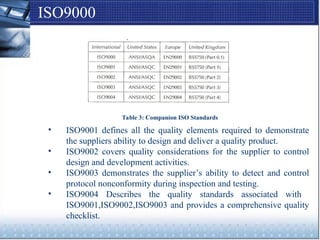
• ISO9001 definesall the quality elements required to demonstrate
the suppliers ability to design and deliver a quality product.
• ISO9002 covers quality considerations for the supplier to control
design and development activities.
• ISO9003 demonstrates the supplier’s ability to detect and control
protocol nonconformity during inspection and testing.
• ISO9004 Describes the quality standards associated with
ISO9001,ISO9002,ISO9003 and provides a comprehensive quality
checklist.
Table 3: Companion ISO Standards
8.
Capability Maturity Model(CMM)
• The Software engineering Institute – Capability Model (SEI-
CMM) is a model for judging the following:
Judging the maturity of the software processes of an
organization.
Identifying the key practices that are required to increase
the maturity of these processes.
Describes the principles and practices underlying software
process maturity and is intended to help software
organization improve the maturity of their software
processes in terms of an evolutionary path from ad hoc
chaotic processes to mature software process
9.
Capability Maturity Model(CMM)
The CMM is organized into five maturity levels
Level 1 : Initial
• The software process is characterized as ad hoc, few processes are
defined and success depends on individual efforts.
• This period is chaotic without any procedure and process
established for software development and testing.
Level 2 : Repreatable
• Track cost, schedule, and functionality .
• During this phase, measures and metrics will be reviewed to
include percentage compliance with various processes, percentage
of allocated requirements delivered, number of changes to
requirements, number of changes to project plan, variance between
estimated and actual size of deliverables.
10.
Capability Maturity Model(CMM)
The CMM is organized unto five maturity levels
• The following are the key process activities during Level 2:
Software configuration management
Software quality assurance
Software subcontract management
Software project tracking and oversight
Software project planning
Requirement management
Level 3: Defiened
• The software process for management and engineering activities is
documented, standardized and integrated into a standard software
process for the organization.
• All projects use an approved version of the organization standard
software process for developing and maintaining software.
11.
Capability Maturity Model(CMM)
The CMM is organized unto five maturity levels
• In this phase measures and metrics will be reviewed to include
percentage of total project time spent on test activities, test
efficiency, inspection rate for deliverable, inspection efficiency,
variance between actual attendance and planned attendance for
training programs.
• The following are the key process activities during Level 3:
Examine reviews
Intergroup coordination
Software program engineering
Integrated software management
Training Program
Organization process definition
Organization process focus
12.
Capability Maturity Model(CMM)
The CMM is organized unto five maturity levels
Level 4: Managed
• Detailed measures of the software process and product quality are
collected and both are understood and controlled.
• This phase denotes that the processes are well defined and
proficiently managed.
• The quality standard are on an upswing.
• With sound quality process in place the organization is better
equipped to meet customer expectations of high quality/ high
performance software at reasonable cost and commitment
deliveries .
13.
Capability Maturity Model(CMM)
The CMM is organized unto five maturity levels
Level 5: Optimizing
• Continues process improvement is enabled by quantitative
feedback from the process and from piloting new idea and
technologies.
• Continuous emphasis on process improvement and defect
reduction avoid process stagnancy and ensure continual
improvement translating into improved productivity, tracing
requirements across each development phase improves the
completeness of software, reduce rework, and simplify
maintenance. Verification and validation activities are planned
and executed to reduce defect leakage. Customers have access to
the project plane, receive regular status reports and their feedback
is sought and used for process tuning.
14.
Capability Maturity Model(CMM)
People CMM
• Is a framework that helps organization successfully address their
critical people issues such as human resources, knowledge
management, and organizational development.
• The people CMM guides organization in improving their processes
for managing and developing their workforces.
• People CMM helps organization characterize the maturity of their
workforce practice.
• Establish program of continuous workforce development (set
priority) .
15.
Capability Maturity Model(CMM)
CMMI
• The CMMI product suite provides the latest best practices for
product and services development and maintenance.
• The models extend the best practices of the of the Capability
Maturity Model Software (SW – CMM) , the Systems Engineering
Capability Model (SECM) and the Integrated Product
Development Capability Maturity Model (IPD – CMM).
• Organization reported that CMMI is adequate for guiding their
process suitable for their needs, although there are specific
opportunities for improvement.
16.
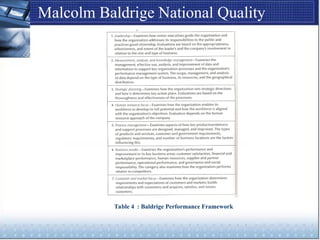
Malcolm Baldrige NationalQuality
Award
• Public law 100-107, signed into law on August20, 1987 created
Malcolm Baldrige National Quality Award. The Award program
led to the creation of a new public – private partnership.
The System for scoring examination items is based on these
evaluation dimintions
1. Approach: Indicates the method that the company uses the
achieve the purpose. Is the approach systematic/ used tools/is
the system integrated.
2. Deployment: It evaluate whether the approach is implemented
in all product and services
3. Result: This refers the outcome of the approach. The quality
levels demonstrated, rate of the quality improvement, and
significance.