Introduction to the SEI Capability
Maturity Model (SEI/CMM )
Jeff Jacobs
Jeffrey Jacobs & Associates
phone: 650.571.7092
email: jmjacobs@jeffreyjacobs.com
http://www.jeffreyjacobs.com
Jeffrey Jacobs & Associates 2
Survey
 Does your organization have a well defined software
development methodology/process?
 Does your organization use RUP?
 Does your organization have a software engineering
process group?
Jeffrey Jacobs & Associates 3
Agenda
 What is SEI/CMM?
 History
 Overview and characteristics of the 5 levels
 Structure
 Examples focus on Level 2
 Level 2 is the hardest to attain, as it involves fundamental
cultural changes
 A sample spreadsheet/questionnaire
 Caveats and clarifications
 Questions
Jeffrey Jacobs & Associates 4
What is the SEI/CMM?
 Well defined process and framework for assessing or
evaluating the maturity level of an organization
 Organizations may receive a formal assessment from
SEI licensed assessors
 DoD and other organizations may require a formal
assessment rating for contractors and partners
 Organizations may use the SEI/CMM materials to
perform internal evaluations and as a basis for
improvement
 Describes an evolutionary improvement path to
migrate an organization from an ad-hoc, immature
organization to mature, disciplined organization
Jeffrey Jacobs & Associates 5
Descriptive, not Prescriptive
 Describes what processes and practices should be in
place to achieve a maturity level, but not how they
should be performed
 “Software Configuration Management” should be performed,
but no guidelines on how to do it
Jeffrey Jacobs & Associates 6
History
 The SEI (Software Engineering Institute) is a
Federally Funded Research and Development Center
(FFRDC) established in 1984 at Carnegie Mellon
University by US Department of Defense
 To solve the problem of why software projects were
always late, over budget and full of bugs
 November 1986, SEI, in conjunction with MITRE
Corporation, began developing a process maturity
framework that would help organizations improve
their software process
 http://www.sei.cmu.edu
Jeffrey Jacobs & Associates 7
More History
 CMM conceived by Watts Humphrey
 SEI maturity questionnaire — 1987
 Humphrey, W.S. (1989), Managing the Software Process,
Addison-Wesley, Reading, MA.
 Paulk, M.C., Weber, C., Chrissis, M.B., Garcia, S., & Bush,
M. (1992), Key Practices of the Capability Maturity Model:
Version 1.1, Software Engineering Institute, Carnegie
Mellon University, Pittsburgh, PA.
 http://www.sei.cmu.edu
Jeffrey Jacobs & Associates 8
Why Should You Care?
 Does this sound familiar?
 Success is dependant on heroic efforts, long hours and
death marches
 People complain about workload and stress
 Processes are improvised and reinvented for every project
 Constant fire fighting
 People are rewarded for solving problems, not preventing
them
 There is no time to do it right, but there is always time to do
it over
Jeffrey Jacobs & Associates 9
Higher Level Organizations are More
Effective
 Fewer defects/higher quality
 Reduced schedule misses
 Fewer/lower cost overruns
 Lower personnel turnover
 Better predictability
 Numerous study results can be found at
http://www.sei.cmu.edu
Jeffrey Jacobs & Associates 10
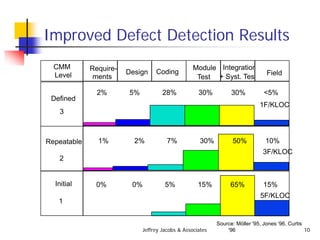
Improved Defect Detection Results
Defined
3
Repeatable
2
Initial
1
0% 0% 5% 15% 65% 15%
5F/KLOC
1% 2% 7% 30% 50% 10%
3F/KLOC
Design
Require-
ments
CMM
Level Coding
Module
Test
Integration
+ Syst. Test
Field
1F/KLOC
2% 5% 28% 30% 30% <5%
Source: Möller '95, Jones ‘96, Curtis
'96
Jeffrey Jacobs & Associates 11
Characteristics of a Mature
Organization
 Possesses an organization-wide ability to manage
software development and maintenance processes
 The processes are documented and communicated to
existing staff and new employees
 Work activities are carried out according to
documented procedures and process
 The defined processes are fit for use and consistent
with the way work actually gets done
 The defined processes are updated when necessary;
improvements are developed through controlled pilot
test or cost/benefit analysis
Jeffrey Jacobs & Associates 12
More Maturity...
 Roles and responsibilities are clear throughout
projects and across the entire organization
 Managers monitor the quality of the software
products and customer satisfaction
 There is an objective, quantitative basis for judging
product quality and for analyzing problems with the
product or process
 Schedules and budgets are based on historical
performance and are realistic
 The expected results for cost, schedule, functionality
and quality of the product are usually achieved
Jeffrey Jacobs & Associates 13
More Maturity...
 A disciplined process is followed because everyone
understands the benefits of doing so and the
infrastructure is in place to support it
Jeffrey Jacobs & Associates 14
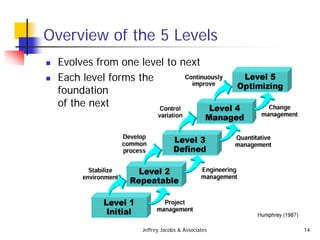
Overview of the 5 Levels
 Evolves from one level to next
 Each level forms the
foundation
of the next
Jeffrey Jacobs & Associates 15
Characteristics of Level 1 - Initial
 Ad hoc, chaotic work environment
 Success depends on heroic effort, overtime
 Few processes defined
 Even fewer processes and procedures are documented
 Processes often ignored under schedule pressure
 Missed deadlines, poor quality
 Most organizations are Level 1
Jeffrey Jacobs & Associates 16
Characteristics of Level 2 -
Repeatable
 Ability to repeat earlier success based on prior
experience
 Basic project management processes are established
 Project planning
 Project tracking
 Subcontractor management
 Basic software development processes are in place
 Requirements management
 Software quality assurance
 Software configuration management
 Processes are project oriented
Jeffrey Jacobs & Associates 17
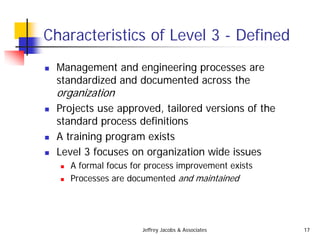
Characteristics of Level 3 - Defined
 Management and engineering processes are
standardized and documented across the
organization
 Projects use approved, tailored versions of the
standard process definitions
 A training program exists
 Level 3 focuses on organization wide issues
 A formal focus for process improvement exists
 Processes are documented and maintained
Jeffrey Jacobs & Associates 18
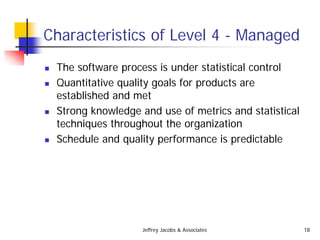
Characteristics of Level 4 - Managed
 The software process is under statistical control
 Quantitative quality goals for products are
established and met
 Strong knowledge and use of metrics and statistical
techniques throughout the organization
 Schedule and quality performance is predictable
Jeffrey Jacobs & Associates 19
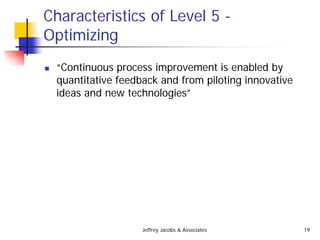
Characteristics of Level 5 -
Optimizing
 “Continuous process improvement is enabled by
quantitative feedback and from piloting innovative
ideas and new technologies”
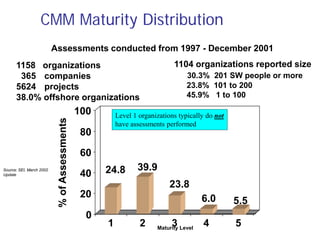
CMM Maturity Distribution
1158 organizations
365 companies
5624 projects
38.0% offshore organizations
24.8 39.9
23.8
6.0 5.5
0
20
40
60
80
100
%
of
Assessments
1 2 3 4 5
Maturity Level
Source: SEI, March 2002
Update
1104 organizations reported size
30.3% 201 SW people or more
23.8% 101 to 200
45.9% 1 to 100
Assessments conducted from 1997 - December 2001
Level 1 organizations typically do not
have assessments performed
Jeffrey Jacobs & Associates 21
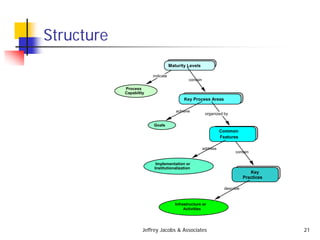
Structure
Maturity Levels
Key
Practices
contain
contain
Key Process Areas
Process
Capability
Goals
achieve
indicate
organized by
Common
Features
Implementation or
Institutionalization
address
describe
Infrastructure or
Activities
Jeffrey Jacobs & Associates 22
Key Process Areas (KPA)
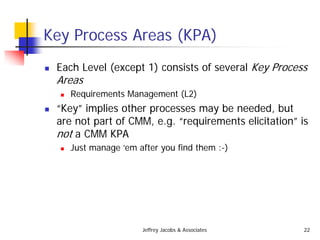
 Each Level (except 1) consists of several Key Process
Areas
 Requirements Management (L2)
 “Key” implies other processes may be needed, but
are not part of CMM, e.g. “requirements elicitation” is
not a CMM KPA
 Just manage ‘em after you find them :-)
Jeffrey Jacobs & Associates 23
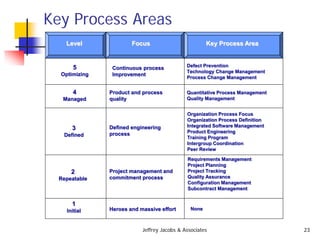
Key Process Areas
5
Optimizing
4
Managed
3
Defined
2
Repeatable
1
Initial
Continuous process
Improvement
Product and process
quality
Defined engineering
process
Requirements Management
Project Planning
Project Tracking
Quality Assurance
Configuration Management
Subcontract Management
Heroes and massive effort
Defect Prevention
Technology Change Management
Process Change Management
Quantitative Process Management
Quality Management
Organization Process Focus
Organization Process Definition
Integrated Software Management
Product Engineering
Training Program
Intergroup Coordination
Peer Review
Project management and
commitment process
None
Level Focus Key Process Area
Jeffrey Jacobs & Associates 24
Goals
 Each KPA has associated goals
 The degree of achievement of each Level’s KPA’s
Goals measure the level of maturity
 Goals are achieved by satisfactorily implementing the
activities
Jeffrey Jacobs & Associates 25
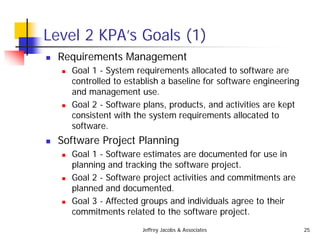
Level 2 KPA’s Goals (1)
 Requirements Management
 Goal 1 - System requirements allocated to software are
controlled to establish a baseline for software engineering
and management use.
 Goal 2 - Software plans, products, and activities are kept
consistent with the system requirements allocated to
software.
 Software Project Planning
 Goal 1 - Software estimates are documented for use in
planning and tracking the software project.
 Goal 2 - Software project activities and commitments are
planned and documented.
 Goal 3 - Affected groups and individuals agree to their
commitments related to the software project.
Jeffrey Jacobs & Associates 26
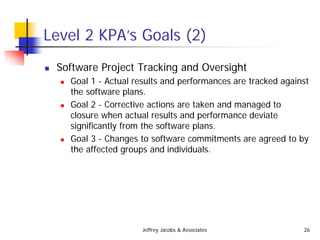
Level 2 KPA’s Goals (2)
 Software Project Tracking and Oversight
 Goal 1 - Actual results and performances are tracked against
the software plans.
 Goal 2 - Corrective actions are taken and managed to
closure when actual results and performance deviate
significantly from the software plans.
 Goal 3 - Changes to software commitments are agreed to by
the affected groups and individuals.
Jeffrey Jacobs & Associates 27
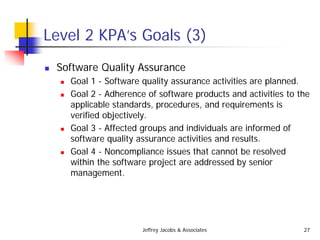
Level 2 KPA’s Goals (3)
 Software Quality Assurance
 Goal 1 - Software quality assurance activities are planned.
 Goal 2 - Adherence of software products and activities to the
applicable standards, procedures, and requirements is
verified objectively.
 Goal 3 - Affected groups and individuals are informed of
software quality assurance activities and results.
 Goal 4 - Noncompliance issues that cannot be resolved
within the software project are addressed by senior
management.
Jeffrey Jacobs & Associates 28
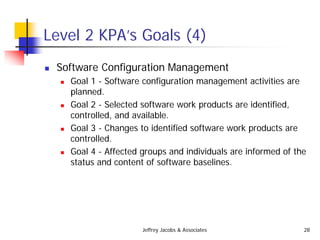
Level 2 KPA’s Goals (4)
 Software Configuration Management
 Goal 1 - Software configuration management activities are
planned.
 Goal 2 - Selected software work products are identified,
controlled, and available.
 Goal 3 - Changes to identified software work products are
controlled.
 Goal 4 - Affected groups and individuals are informed of the
status and content of software baselines.
Jeffrey Jacobs & Associates 29
Level 2 KPA’s Goals (5)
 Software Subcontract Management
 Goal 1 - The prime contractor selects qualified software
subcontractors. (CMM/SEI certified :-)
 Goal 2 - The prime contractor and the software
subcontractor agree to their commitments to each other.
 Goal 3 - The prime contractor and the software
subcontractor maintain ongoing communications.
 Goal 4 - The prime contractor tracks the software
subcontractor's actual results and performance against its
commitments.
Jeffrey Jacobs & Associates 30
Common Features
 Common Features are attributes that indicate
whether the implementation and institutionalization
of a KPA is effective, repeatable, and lasting
 There are 5 features common to all KPAs
 Commitment to Perform
 Ability to Perform
 Activities to Perform
 Measurement and Analysis
 Verifying Implementation
Jeffrey Jacobs & Associates 31
Common Feature #1 - Commitment
to Perform
 Commitment to Perform describes actions the
organization must take to ensure that the process is
established and will endure.
 This involves establishing organizational policies and
senior management sponsorship.
 Policy Statements
 Refers to a written organizational policy for the practices of that
key process area
 May refer to the project or to the organization (level 3)
 Leadership
 Assign a leadership role (e.g., project manager) or describes
sponsorship activities necessary for the key process area to be
successfully institutionalized
Jeffrey Jacobs & Associates 32
Common Feature #2 - Ability to
Perform
 Ability to Perform describes preconditions that must
exist in the project or organization to implement the
software process competently
 Resources and funding for the activities covered by
the key process area
 Training, formal and informal, for practioners
 Orientation
 Indicates less depth of skill or knowledge than would be
expected via training, e.g. overview or introduction to a
topic for those overseeing or interfacing with the
practitioners
Jeffrey Jacobs & Associates 33
Ability to Perform (2)
 Prerequisite Items
 Either outputs from another KPA or from outside the project
 Software development plan is a prerequisite for
Project Tracking and Oversight KPA
 CMM cites only those that are critical to implementing
the KPA; there are many other issues that may be
necessary for success
Jeffrey Jacobs & Associates 34
Common Feature #3 - Activities
Performed
 Activities Performed describes the roles and
procedures necessary to implement a key process
area.
 This typically involves:
 establishing plans and procedures
 performing the work
 tracking it
 taking corrective actions as necessary.
Jeffrey Jacobs & Associates 35
Common Feature #4 - Measurement
and Analysis
 Measurement and Analysis describes the need to
measure the process and analyze the measurements.
This typically includes examples of the measurements
that could be taken to determine the status and
effectiveness of the Activities Performed.
Jeffrey Jacobs & Associates 36
Common Feature #5 - Verifying
Implementation (1)
 Verifying Implementation describes the steps to
ensure that the activities are performed in
compliance with the process that has been
established. This typically encompasses reviews and
audits by management and software quality
assurance.
 Project management oversight on both a periodic and
event-driven basis
 Periodic - maintain an ongoing awareness of the status of
the effort and be informed when significant events (e.g.,
design review) on the project occur
Jeffrey Jacobs & Associates 37
Verifying Implementation (2)
 Senior management oversight on a periodic basis
 Provide awareness of and insight into software process
activities
 Adequate mechanisms for exception reporting
 Covers different topics or similar topics at a higher level of
abstraction than project management oversight reviews
 Software Quality Assurance activities
 Particular activities considered appropriate for review and/or
audit by the SQA group are described as a key practice
Jeffrey Jacobs & Associates 38
Activities
 Each KPA in each level has a list of activities
Jeffrey Jacobs & Associates 39
Level 2, Requirements Management
Activities
 System requirements allocated to software are
controlled to establish a baseline for software
engineering and management use.
 Software plans, products, and activities are kept
consistent with the system requirements allocated to
software.
 The project follows a written, organizational policy for
managing the system requirements allocated to
software.
Jeffrey Jacobs & Associates 40
More Activities
 For each project, responsibility is established for
analyzing the system requirements and allocating
them to hardware, software, and other system
components.
 The requirements are documented.
 Adequate resources and funding are provided for
managing the requirements.
 Members of the software engineering group and
other software-related groups are trained to perform
their requirements management activities.
Jeffrey Jacobs & Associates 41
Still More
 The software engineering group reviews the
requirements before they are incorporated into the
software project.
 The software engineering group uses the requirements
as the basis for software plans, work products, and
activities.
 Changes to the requirements are reviewed and
incorporated into the software project.
 Measurements are made and used to determine the
status of the activities for managing the requirements.
 The activities for managing the requirements are
reviewed with senior management on a periodic basis.
Jeffrey Jacobs & Associates 42
Finally
 The activities for managing the requirements are
reviewed with the project manager on both a periodic
and event-driven basis.
 The software quality assurance group reviews and/or
audits the activities and work products for managing
the allocated requirements and reports the results.
Jeffrey Jacobs & Associates 43
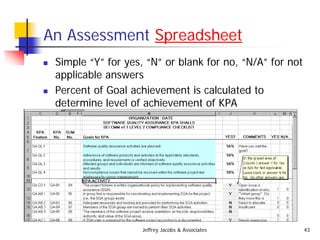
An Assessment Spreadsheet
 Simple “Y” for yes, “N” or blank for no, “N/A” for not
applicable answers
 Percent of Goal achievement is calculated to
determine level of achievement of KPA
Jeffrey Jacobs & Associates 44
Caveats and Clarifications
 Maturity assessment is not a guarantee of quality
 Activities belonging to a higher level’s KPA are often
needed and implemented by a lower level
organization
 Peer Review is a Level 3 KPA, but is a highly effective
technique often used by organizations that would be rated
Level 2
 Achievement of maturity takes time
 Estimate of 2 years to fully transition from Level 1 to Level 2
 Benefits accrue long before next level is reached
 Not a silver bullet
Jeffrey Jacobs & Associates 45
Summary
 SEI/CMM provides a well defined framework for
assessing and evaluating a software development
organization’s maturity
 Formal assessment is not required
 SEI/CMM provides a well defined framework for
understanding what a mature software development
organization should look like
 SEI/CMM is descriptive, not prescriptive
 SEI/CMM is comprehensive, but not complete
Jeffrey Jacobs & Associates 46
Questions?

Intro to CMM.pdf

  • 1.
    Introduction to theSEI Capability Maturity Model (SEI/CMM ) Jeff Jacobs Jeffrey Jacobs & Associates phone: 650.571.7092 email: jmjacobs@jeffreyjacobs.com http://www.jeffreyjacobs.com
  • 2.
    Jeffrey Jacobs &Associates 2 Survey  Does your organization have a well defined software development methodology/process?  Does your organization use RUP?  Does your organization have a software engineering process group?
  • 3.
    Jeffrey Jacobs &Associates 3 Agenda  What is SEI/CMM?  History  Overview and characteristics of the 5 levels  Structure  Examples focus on Level 2  Level 2 is the hardest to attain, as it involves fundamental cultural changes  A sample spreadsheet/questionnaire  Caveats and clarifications  Questions
  • 4.
    Jeffrey Jacobs &Associates 4 What is the SEI/CMM?  Well defined process and framework for assessing or evaluating the maturity level of an organization  Organizations may receive a formal assessment from SEI licensed assessors  DoD and other organizations may require a formal assessment rating for contractors and partners  Organizations may use the SEI/CMM materials to perform internal evaluations and as a basis for improvement  Describes an evolutionary improvement path to migrate an organization from an ad-hoc, immature organization to mature, disciplined organization
  • 5.
    Jeffrey Jacobs &Associates 5 Descriptive, not Prescriptive  Describes what processes and practices should be in place to achieve a maturity level, but not how they should be performed  “Software Configuration Management” should be performed, but no guidelines on how to do it
  • 6.
    Jeffrey Jacobs &Associates 6 History  The SEI (Software Engineering Institute) is a Federally Funded Research and Development Center (FFRDC) established in 1984 at Carnegie Mellon University by US Department of Defense  To solve the problem of why software projects were always late, over budget and full of bugs  November 1986, SEI, in conjunction with MITRE Corporation, began developing a process maturity framework that would help organizations improve their software process  http://www.sei.cmu.edu
  • 7.
    Jeffrey Jacobs &Associates 7 More History  CMM conceived by Watts Humphrey  SEI maturity questionnaire — 1987  Humphrey, W.S. (1989), Managing the Software Process, Addison-Wesley, Reading, MA.  Paulk, M.C., Weber, C., Chrissis, M.B., Garcia, S., & Bush, M. (1992), Key Practices of the Capability Maturity Model: Version 1.1, Software Engineering Institute, Carnegie Mellon University, Pittsburgh, PA.  http://www.sei.cmu.edu
  • 8.
    Jeffrey Jacobs &Associates 8 Why Should You Care?  Does this sound familiar?  Success is dependant on heroic efforts, long hours and death marches  People complain about workload and stress  Processes are improvised and reinvented for every project  Constant fire fighting  People are rewarded for solving problems, not preventing them  There is no time to do it right, but there is always time to do it over
  • 9.
    Jeffrey Jacobs &Associates 9 Higher Level Organizations are More Effective  Fewer defects/higher quality  Reduced schedule misses  Fewer/lower cost overruns  Lower personnel turnover  Better predictability  Numerous study results can be found at http://www.sei.cmu.edu
  • 10.
    Jeffrey Jacobs &Associates 10 Improved Defect Detection Results Defined 3 Repeatable 2 Initial 1 0% 0% 5% 15% 65% 15% 5F/KLOC 1% 2% 7% 30% 50% 10% 3F/KLOC Design Require- ments CMM Level Coding Module Test Integration + Syst. Test Field 1F/KLOC 2% 5% 28% 30% 30% <5% Source: Möller '95, Jones ‘96, Curtis '96
  • 11.
    Jeffrey Jacobs &Associates 11 Characteristics of a Mature Organization  Possesses an organization-wide ability to manage software development and maintenance processes  The processes are documented and communicated to existing staff and new employees  Work activities are carried out according to documented procedures and process  The defined processes are fit for use and consistent with the way work actually gets done  The defined processes are updated when necessary; improvements are developed through controlled pilot test or cost/benefit analysis
  • 12.
    Jeffrey Jacobs &Associates 12 More Maturity...  Roles and responsibilities are clear throughout projects and across the entire organization  Managers monitor the quality of the software products and customer satisfaction  There is an objective, quantitative basis for judging product quality and for analyzing problems with the product or process  Schedules and budgets are based on historical performance and are realistic  The expected results for cost, schedule, functionality and quality of the product are usually achieved
  • 13.
    Jeffrey Jacobs &Associates 13 More Maturity...  A disciplined process is followed because everyone understands the benefits of doing so and the infrastructure is in place to support it
  • 14.
    Jeffrey Jacobs &Associates 14 Overview of the 5 Levels  Evolves from one level to next  Each level forms the foundation of the next
  • 15.
    Jeffrey Jacobs &Associates 15 Characteristics of Level 1 - Initial  Ad hoc, chaotic work environment  Success depends on heroic effort, overtime  Few processes defined  Even fewer processes and procedures are documented  Processes often ignored under schedule pressure  Missed deadlines, poor quality  Most organizations are Level 1
  • 16.
    Jeffrey Jacobs &Associates 16 Characteristics of Level 2 - Repeatable  Ability to repeat earlier success based on prior experience  Basic project management processes are established  Project planning  Project tracking  Subcontractor management  Basic software development processes are in place  Requirements management  Software quality assurance  Software configuration management  Processes are project oriented
  • 17.
    Jeffrey Jacobs &Associates 17 Characteristics of Level 3 - Defined  Management and engineering processes are standardized and documented across the organization  Projects use approved, tailored versions of the standard process definitions  A training program exists  Level 3 focuses on organization wide issues  A formal focus for process improvement exists  Processes are documented and maintained
  • 18.
    Jeffrey Jacobs &Associates 18 Characteristics of Level 4 - Managed  The software process is under statistical control  Quantitative quality goals for products are established and met  Strong knowledge and use of metrics and statistical techniques throughout the organization  Schedule and quality performance is predictable
  • 19.
    Jeffrey Jacobs &Associates 19 Characteristics of Level 5 - Optimizing  “Continuous process improvement is enabled by quantitative feedback and from piloting innovative ideas and new technologies”
  • 20.
    CMM Maturity Distribution 1158organizations 365 companies 5624 projects 38.0% offshore organizations 24.8 39.9 23.8 6.0 5.5 0 20 40 60 80 100 % of Assessments 1 2 3 4 5 Maturity Level Source: SEI, March 2002 Update 1104 organizations reported size 30.3% 201 SW people or more 23.8% 101 to 200 45.9% 1 to 100 Assessments conducted from 1997 - December 2001 Level 1 organizations typically do not have assessments performed
  • 21.
    Jeffrey Jacobs &Associates 21 Structure Maturity Levels Key Practices contain contain Key Process Areas Process Capability Goals achieve indicate organized by Common Features Implementation or Institutionalization address describe Infrastructure or Activities
  • 22.
    Jeffrey Jacobs &Associates 22 Key Process Areas (KPA)  Each Level (except 1) consists of several Key Process Areas  Requirements Management (L2)  “Key” implies other processes may be needed, but are not part of CMM, e.g. “requirements elicitation” is not a CMM KPA  Just manage ‘em after you find them :-)
  • 23.
    Jeffrey Jacobs &Associates 23 Key Process Areas 5 Optimizing 4 Managed 3 Defined 2 Repeatable 1 Initial Continuous process Improvement Product and process quality Defined engineering process Requirements Management Project Planning Project Tracking Quality Assurance Configuration Management Subcontract Management Heroes and massive effort Defect Prevention Technology Change Management Process Change Management Quantitative Process Management Quality Management Organization Process Focus Organization Process Definition Integrated Software Management Product Engineering Training Program Intergroup Coordination Peer Review Project management and commitment process None Level Focus Key Process Area
  • 24.
    Jeffrey Jacobs &Associates 24 Goals  Each KPA has associated goals  The degree of achievement of each Level’s KPA’s Goals measure the level of maturity  Goals are achieved by satisfactorily implementing the activities
  • 25.
    Jeffrey Jacobs &Associates 25 Level 2 KPA’s Goals (1)  Requirements Management  Goal 1 - System requirements allocated to software are controlled to establish a baseline for software engineering and management use.  Goal 2 - Software plans, products, and activities are kept consistent with the system requirements allocated to software.  Software Project Planning  Goal 1 - Software estimates are documented for use in planning and tracking the software project.  Goal 2 - Software project activities and commitments are planned and documented.  Goal 3 - Affected groups and individuals agree to their commitments related to the software project.
  • 26.
    Jeffrey Jacobs &Associates 26 Level 2 KPA’s Goals (2)  Software Project Tracking and Oversight  Goal 1 - Actual results and performances are tracked against the software plans.  Goal 2 - Corrective actions are taken and managed to closure when actual results and performance deviate significantly from the software plans.  Goal 3 - Changes to software commitments are agreed to by the affected groups and individuals.
  • 27.
    Jeffrey Jacobs &Associates 27 Level 2 KPA’s Goals (3)  Software Quality Assurance  Goal 1 - Software quality assurance activities are planned.  Goal 2 - Adherence of software products and activities to the applicable standards, procedures, and requirements is verified objectively.  Goal 3 - Affected groups and individuals are informed of software quality assurance activities and results.  Goal 4 - Noncompliance issues that cannot be resolved within the software project are addressed by senior management.
  • 28.
    Jeffrey Jacobs &Associates 28 Level 2 KPA’s Goals (4)  Software Configuration Management  Goal 1 - Software configuration management activities are planned.  Goal 2 - Selected software work products are identified, controlled, and available.  Goal 3 - Changes to identified software work products are controlled.  Goal 4 - Affected groups and individuals are informed of the status and content of software baselines.
  • 29.
    Jeffrey Jacobs &Associates 29 Level 2 KPA’s Goals (5)  Software Subcontract Management  Goal 1 - The prime contractor selects qualified software subcontractors. (CMM/SEI certified :-)  Goal 2 - The prime contractor and the software subcontractor agree to their commitments to each other.  Goal 3 - The prime contractor and the software subcontractor maintain ongoing communications.  Goal 4 - The prime contractor tracks the software subcontractor's actual results and performance against its commitments.
  • 30.
    Jeffrey Jacobs &Associates 30 Common Features  Common Features are attributes that indicate whether the implementation and institutionalization of a KPA is effective, repeatable, and lasting  There are 5 features common to all KPAs  Commitment to Perform  Ability to Perform  Activities to Perform  Measurement and Analysis  Verifying Implementation
  • 31.
    Jeffrey Jacobs &Associates 31 Common Feature #1 - Commitment to Perform  Commitment to Perform describes actions the organization must take to ensure that the process is established and will endure.  This involves establishing organizational policies and senior management sponsorship.  Policy Statements  Refers to a written organizational policy for the practices of that key process area  May refer to the project or to the organization (level 3)  Leadership  Assign a leadership role (e.g., project manager) or describes sponsorship activities necessary for the key process area to be successfully institutionalized
  • 32.
    Jeffrey Jacobs &Associates 32 Common Feature #2 - Ability to Perform  Ability to Perform describes preconditions that must exist in the project or organization to implement the software process competently  Resources and funding for the activities covered by the key process area  Training, formal and informal, for practioners  Orientation  Indicates less depth of skill or knowledge than would be expected via training, e.g. overview or introduction to a topic for those overseeing or interfacing with the practitioners
  • 33.
    Jeffrey Jacobs &Associates 33 Ability to Perform (2)  Prerequisite Items  Either outputs from another KPA or from outside the project  Software development plan is a prerequisite for Project Tracking and Oversight KPA  CMM cites only those that are critical to implementing the KPA; there are many other issues that may be necessary for success
  • 34.
    Jeffrey Jacobs &Associates 34 Common Feature #3 - Activities Performed  Activities Performed describes the roles and procedures necessary to implement a key process area.  This typically involves:  establishing plans and procedures  performing the work  tracking it  taking corrective actions as necessary.
  • 35.
    Jeffrey Jacobs &Associates 35 Common Feature #4 - Measurement and Analysis  Measurement and Analysis describes the need to measure the process and analyze the measurements. This typically includes examples of the measurements that could be taken to determine the status and effectiveness of the Activities Performed.
  • 36.
    Jeffrey Jacobs &Associates 36 Common Feature #5 - Verifying Implementation (1)  Verifying Implementation describes the steps to ensure that the activities are performed in compliance with the process that has been established. This typically encompasses reviews and audits by management and software quality assurance.  Project management oversight on both a periodic and event-driven basis  Periodic - maintain an ongoing awareness of the status of the effort and be informed when significant events (e.g., design review) on the project occur
  • 37.
    Jeffrey Jacobs &Associates 37 Verifying Implementation (2)  Senior management oversight on a periodic basis  Provide awareness of and insight into software process activities  Adequate mechanisms for exception reporting  Covers different topics or similar topics at a higher level of abstraction than project management oversight reviews  Software Quality Assurance activities  Particular activities considered appropriate for review and/or audit by the SQA group are described as a key practice
  • 38.
    Jeffrey Jacobs &Associates 38 Activities  Each KPA in each level has a list of activities
  • 39.
    Jeffrey Jacobs &Associates 39 Level 2, Requirements Management Activities  System requirements allocated to software are controlled to establish a baseline for software engineering and management use.  Software plans, products, and activities are kept consistent with the system requirements allocated to software.  The project follows a written, organizational policy for managing the system requirements allocated to software.
  • 40.
    Jeffrey Jacobs &Associates 40 More Activities  For each project, responsibility is established for analyzing the system requirements and allocating them to hardware, software, and other system components.  The requirements are documented.  Adequate resources and funding are provided for managing the requirements.  Members of the software engineering group and other software-related groups are trained to perform their requirements management activities.
  • 41.
    Jeffrey Jacobs &Associates 41 Still More  The software engineering group reviews the requirements before they are incorporated into the software project.  The software engineering group uses the requirements as the basis for software plans, work products, and activities.  Changes to the requirements are reviewed and incorporated into the software project.  Measurements are made and used to determine the status of the activities for managing the requirements.  The activities for managing the requirements are reviewed with senior management on a periodic basis.
  • 42.
    Jeffrey Jacobs &Associates 42 Finally  The activities for managing the requirements are reviewed with the project manager on both a periodic and event-driven basis.  The software quality assurance group reviews and/or audits the activities and work products for managing the allocated requirements and reports the results.
  • 43.
    Jeffrey Jacobs &Associates 43 An Assessment Spreadsheet  Simple “Y” for yes, “N” or blank for no, “N/A” for not applicable answers  Percent of Goal achievement is calculated to determine level of achievement of KPA
  • 44.
    Jeffrey Jacobs &Associates 44 Caveats and Clarifications  Maturity assessment is not a guarantee of quality  Activities belonging to a higher level’s KPA are often needed and implemented by a lower level organization  Peer Review is a Level 3 KPA, but is a highly effective technique often used by organizations that would be rated Level 2  Achievement of maturity takes time  Estimate of 2 years to fully transition from Level 1 to Level 2  Benefits accrue long before next level is reached  Not a silver bullet
  • 45.
    Jeffrey Jacobs &Associates 45 Summary  SEI/CMM provides a well defined framework for assessing and evaluating a software development organization’s maturity  Formal assessment is not required  SEI/CMM provides a well defined framework for understanding what a mature software development organization should look like  SEI/CMM is descriptive, not prescriptive  SEI/CMM is comprehensive, but not complete
  • 46.
    Jeffrey Jacobs &Associates 46 Questions?