PRAYER BEFORE CLASS
Sample
Footer
Text
Tuesday, April 07, 2021 2
TEMPERATURE
CHECK
Sample
Footer
Text
Monday, February 1, 20XX 3
LEARNING
COMPETENCY:
Tuesday, apriL07,2021 4
Using models or
illustrations, explains how
movements along faults
generate earthquakes
(S8ES-IIa-14)
LESSON OBJECTIVES:
1. explain what a fault
is and how it is formed.
2. make a model of the
formation of fault; and
3.show tips about
precautionary measures
when you are living in
areas near faults by
giving an example
through a role playing.
(GAME)
CRASH THE ALIENS
I N S T R U C T I O N :
Reveal the hidden terms
through crashing the
aliens. The aliens are
letter X, Y and Z. The
terms that will be
revealed will be the
terms that will be
encountered in the new
lesson.
Monday, February 1, 20XX
5
ELICIT
REVIEWING PREVIOUS LESSON OR
PRESENTING NEW LESSON
XYFXXAYUZLZT
C R A S H T H E A L I E N N O . 1
Sample
Footer
Text
Monday, February 1, 20XX 6
Xyfxxayuzlzt
C R A S H T H E A L I E N N O . 2
Sample
Footer
Text
Monday, February 1, 20XX 7
Fyozzcxyuysz
C R A S H T H E A L I E N N O . 3
Sample
Footer
Text
Monday, February 1, 20XX 8
Xxeypxyicexynxtxerzxy
C R A S H T H E A L I E N N O . 4
Sample
Footer
Text
Monday, February 1, 20XX 9
Xxezayrtxyzhyqzuzzake
C R A S H T H E A L I E N N O . 5
Sample
Footer
Text
Monday, February 1, 20XX 10
Xyfxxayuzlzzt zlyiznxe
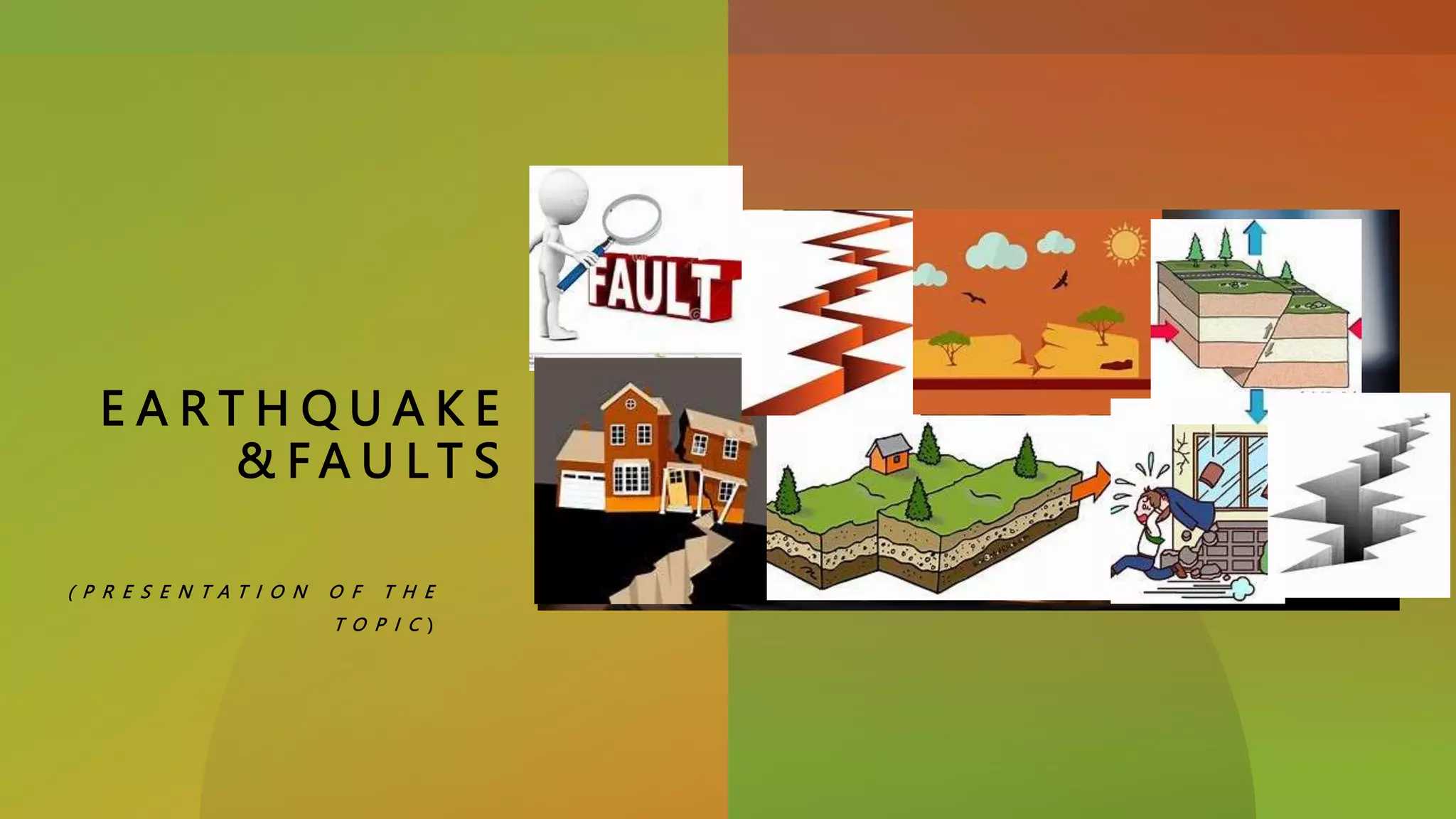
E A R T H Q U A K E
& F A U L T S
( P R E S E N T A T I O N O F T H E
T O P I C )
ACTIVITY 1:
A FAULT-Y-SET-UP
ENGAGE
(Establishing purpose for the lesson,or
present examples or instance of the
lesson)
Sample Footer Text
Monday, February 1, 20XX 12
Activity Objectives:
After performing this
activity, you will be able
to:
1. Describe the
appearance of fault; and
2. Explain how a fault
forms
PRESENTATION OF THE
SHORT ACTIVITY
Sample Footer Text
Monday, February 1, 20XX 13
a. As you move the sheets, what is
formed in the sand?
b. What happened to the lines?
GUIDE
QUESTIONS:
As you performed the activity what
happen when you move the sheets?
What is formed in the sand?
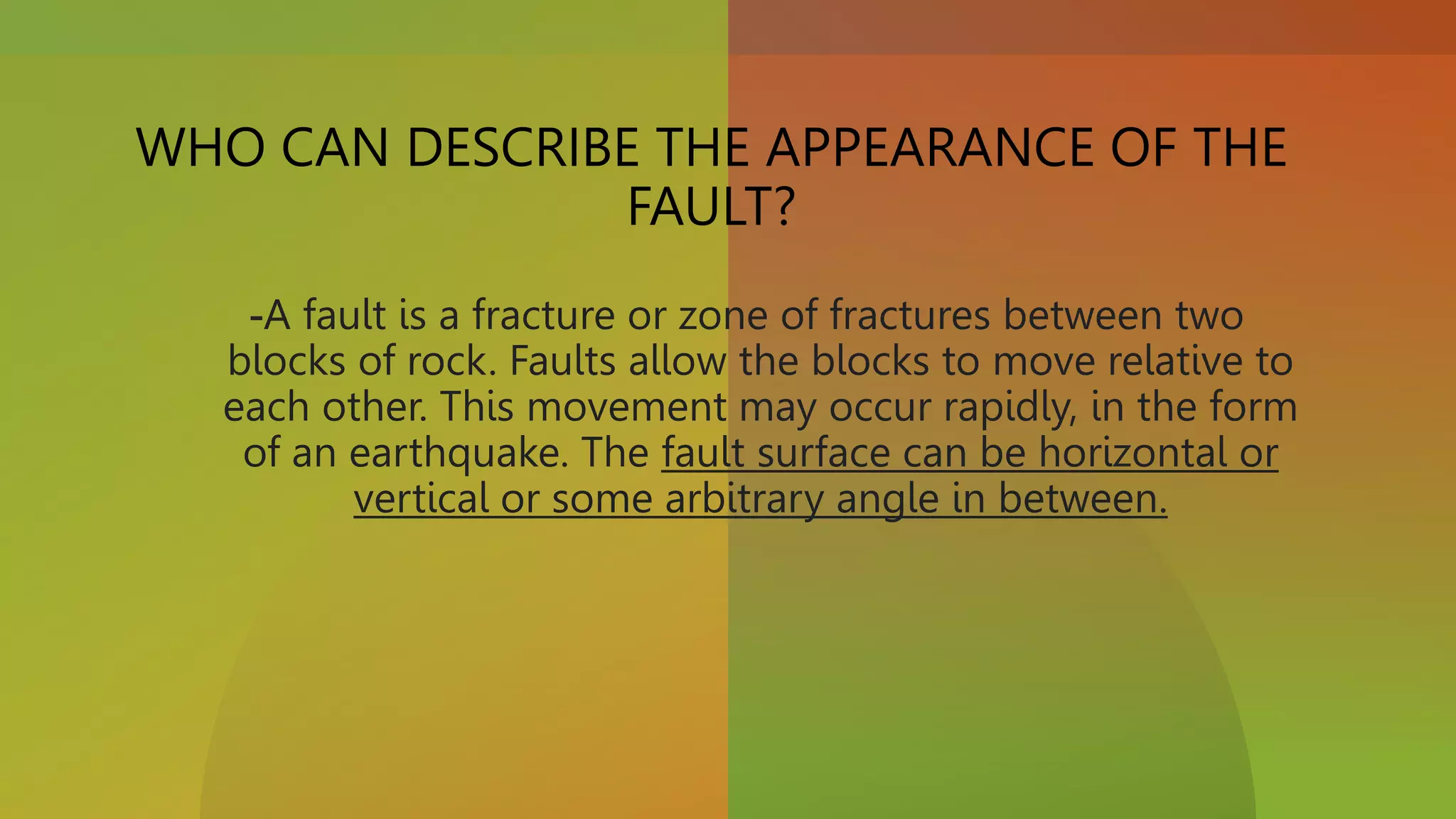
WHO CAN DESCRIBE THE APPEARANCE OF THE
FAULT?
-A fault is a fracture or zone of fractures between two
blocks of rock. Faults allow the blocks to move relative to
each other. This movement may occur rapidly, in the form
of an earthquake. The fault surface can be horizontal or
vertical or some arbitrary angle in between.
EXPLAIN HOW A FAULT IS FORMED
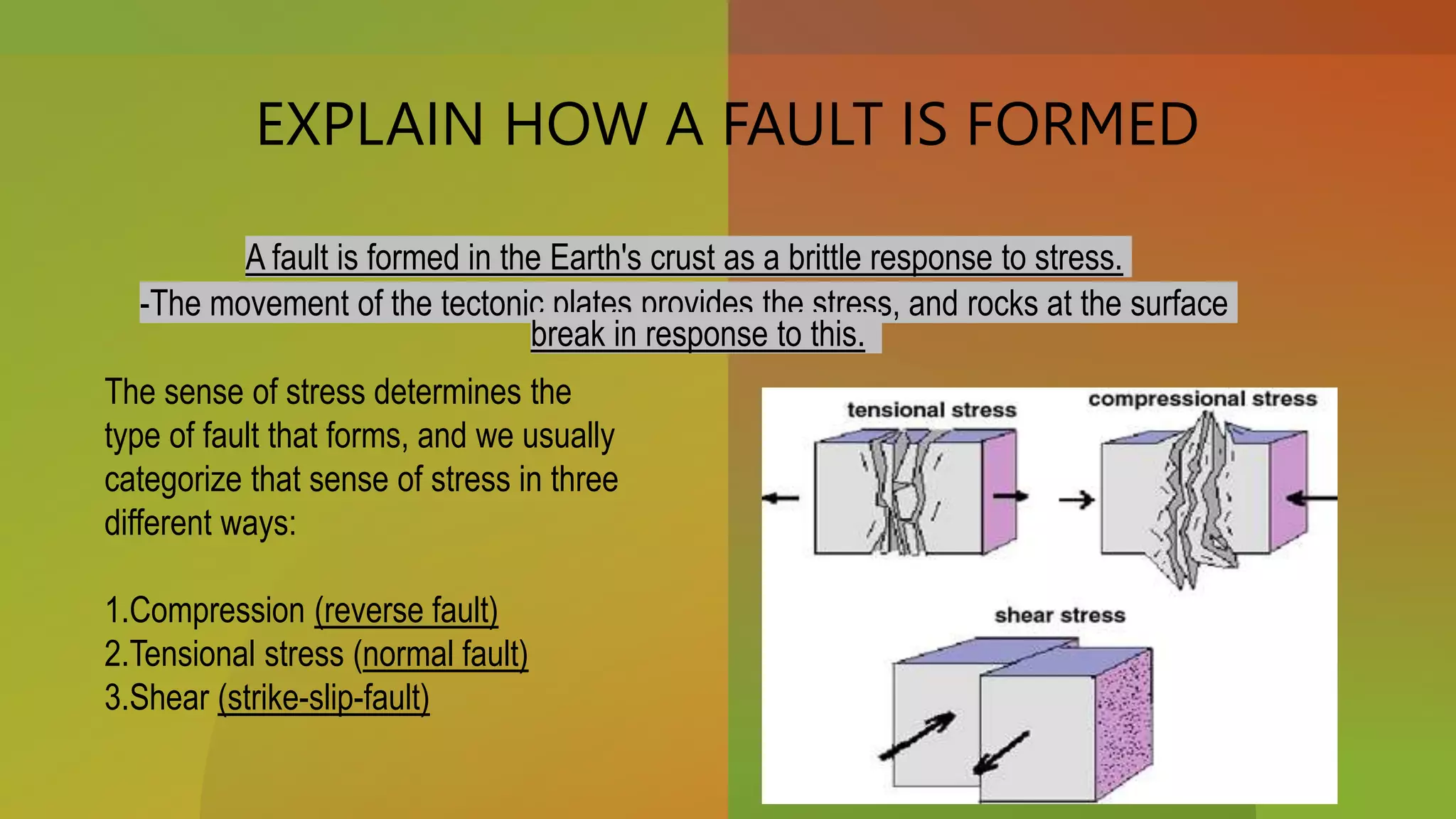
A fault is formed in the Earth's crust as a brittle response to stress.
-The movement of the tectonic plates provides the stress, and rocks at the surface
break in response to this.
The sense of stress determines the
type of fault that forms, and we usually
categorize that sense of stress in three
different ways:
1.Compression (reverse fault)
2.Tensional stress (normal fault)
3.Shear (strike-slip-fault)
ACTIVITY 2:
STICK-”N”-SLIP
EXPLORE
(Discussing new concepts and
practicing new skills)
Sample Footer Text
Monday, February 1, 20XX 18
Objectives:
After performing the activity, you
should be able to:
1. Explain how faults generates
earthquakes; and
2. Explain why not all movements
along faults produce earthquakes.
Guide Questions:
a. What happened to the rubber band?
b. What happened to the “house”?
c. Keep on pulling on the rubber band.
What happened to the box attached to
the rubber band?
d. Which is the “fault” in this set up?
PRESENTATION OF THE GROUP ACTIVITY
Sample Footer Text
GROUP 1 GROUP 2 GROUP 3 GROUP 4
Monday, February 1, 20XX
19
ACTIVITY RUBRICS
Process Skills--- ------------------------4pts
Time Management----------------------2pts
Cooperation and Teamwork-----------2 pts
Neatness and Orderliness--------------2pts
Total:--------------------------------------10pts
W H AT H A P P E N E D
TO T H E R U B B E R
B A N D ?
Q U E S T I O N 1 :
ANSWER:
THE RUBBER BAND STRETCHES.
W H A T
H A P P E N E D
T O T H E
“ H O U S E ” ?
Q U E S T I O N 2 :
ANSWER:
THE HOUSE FALLS OVER.
W H E N Y O U
K E E P O N
P U L L I N G T O
T H E R U B B E R
B A N D . W H A T
H A P P E N E D T O
T H E B O X
A T T A C H E D T O
T H E R U B B E R
B A N D ?
Q U E S T I O N 3 :
ANSWER:
THE BOX MOVE FORWARD.
W H I C H I S
T H E
“ F A U L T ” I N
T H I S S E T
U P ?
Q U E S T I O N 4 :
ANSWER:
THE FAULT IS THE BOUNDARY BETWEEN THE TWO BOXES.
FAULTS
Sample
Footer
Text
Monday, February 1, 20XX 25
EXPLAIN
(Developing mastery leads to
Formative Assessment)
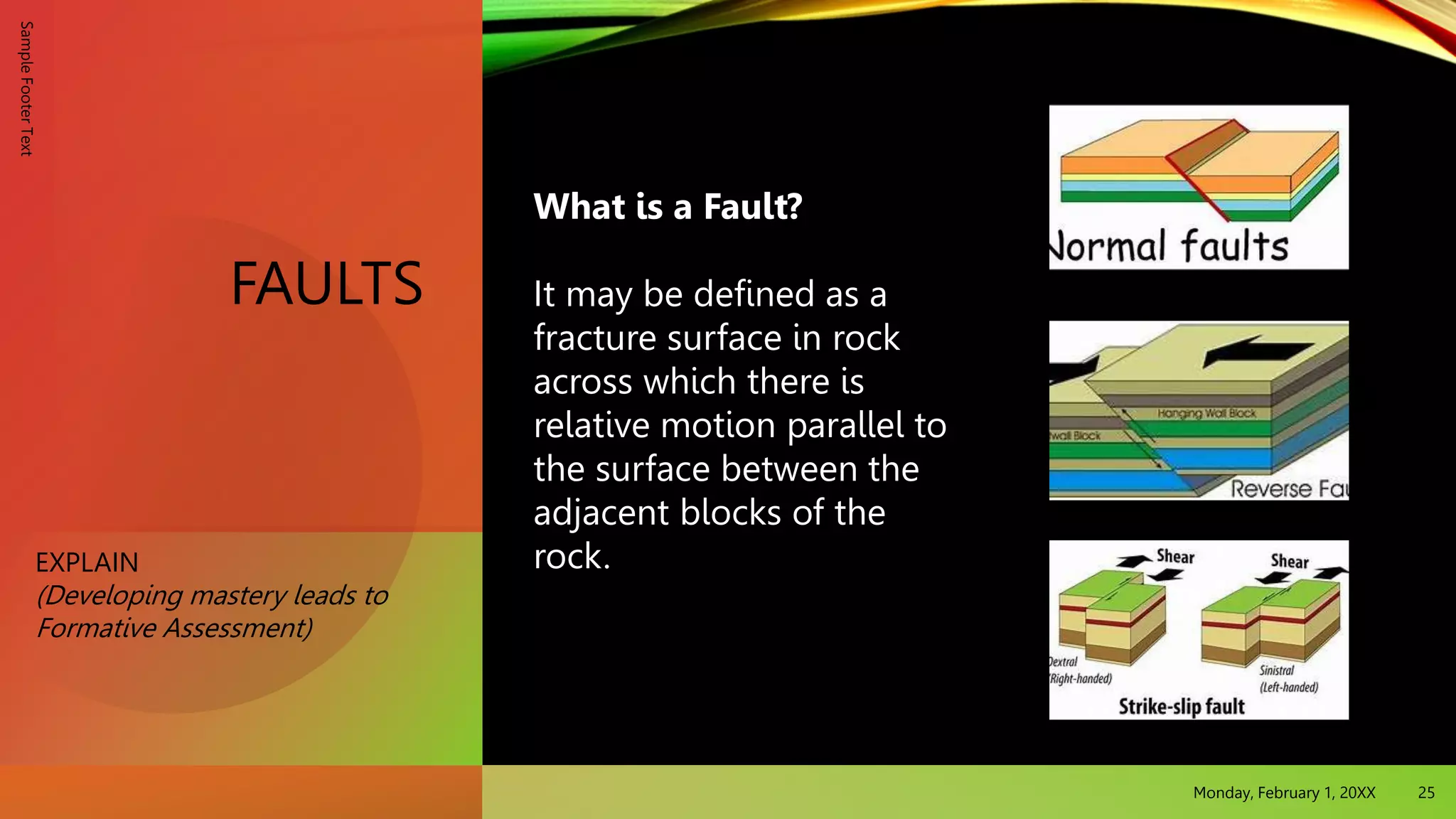
What is a Fault?
It may be defined as a
fracture surface in rock
across which there is
relative motion parallel to
the surface between the
adjacent blocks of the
rock.
HOW DO FAULTS
PRODUCE
EARTHQUAKES?
Energy from inside the earth make the
ground move. There is no movement right
away because of the Friction. Friction held
the rocks together. Once the friction is
overcome, the ground will move and
earthquake will occur.
Sample Footer Text
Monday, February 1, 20XX 26
Evertime a FAULT
slips or moves, the
EARTH QUAKE.
EARTHQUAKE
-The shaking or trembling
caused by the sudden release
of energy.
-it occur when rocks along
fault suddenly move.
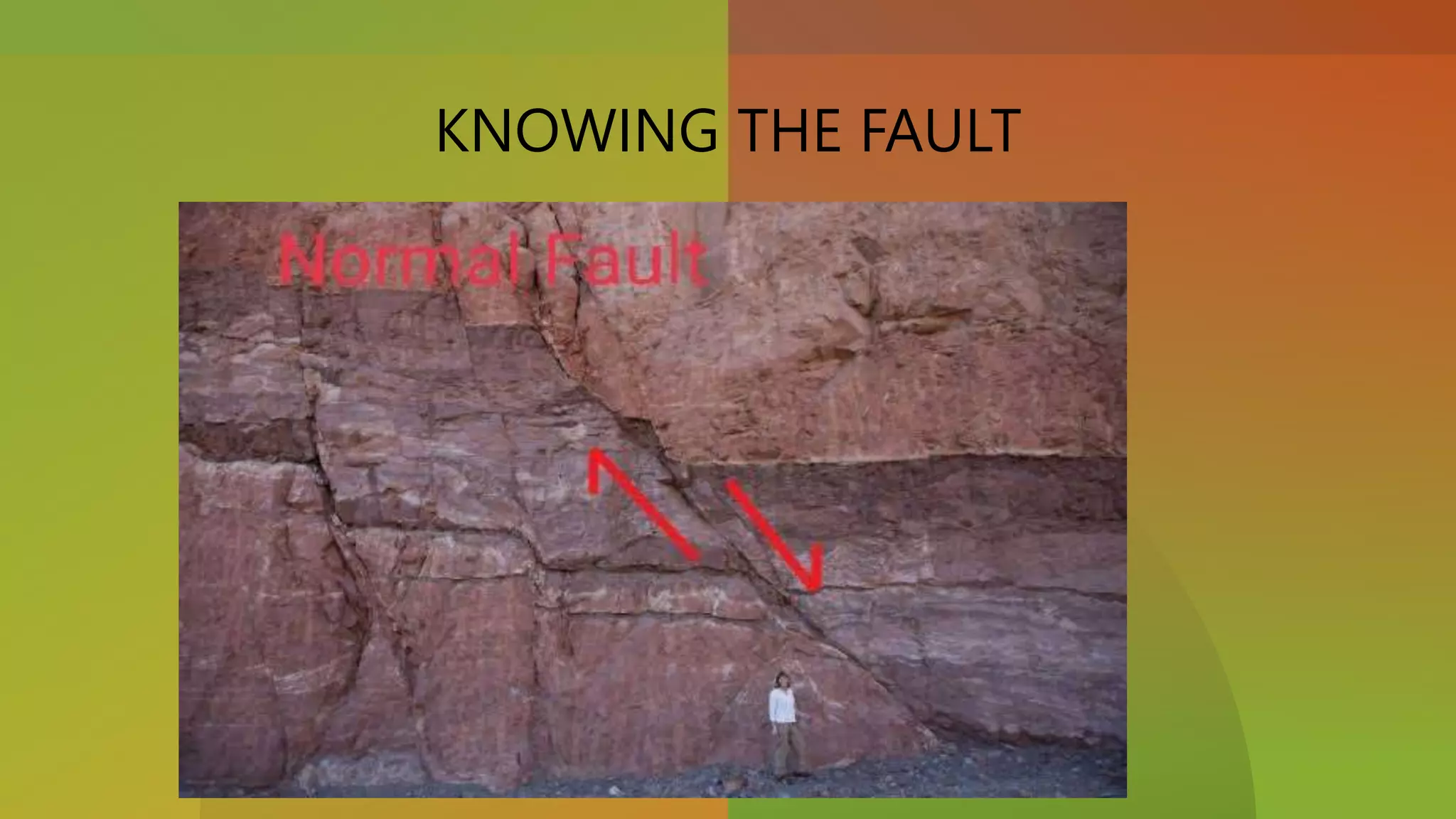
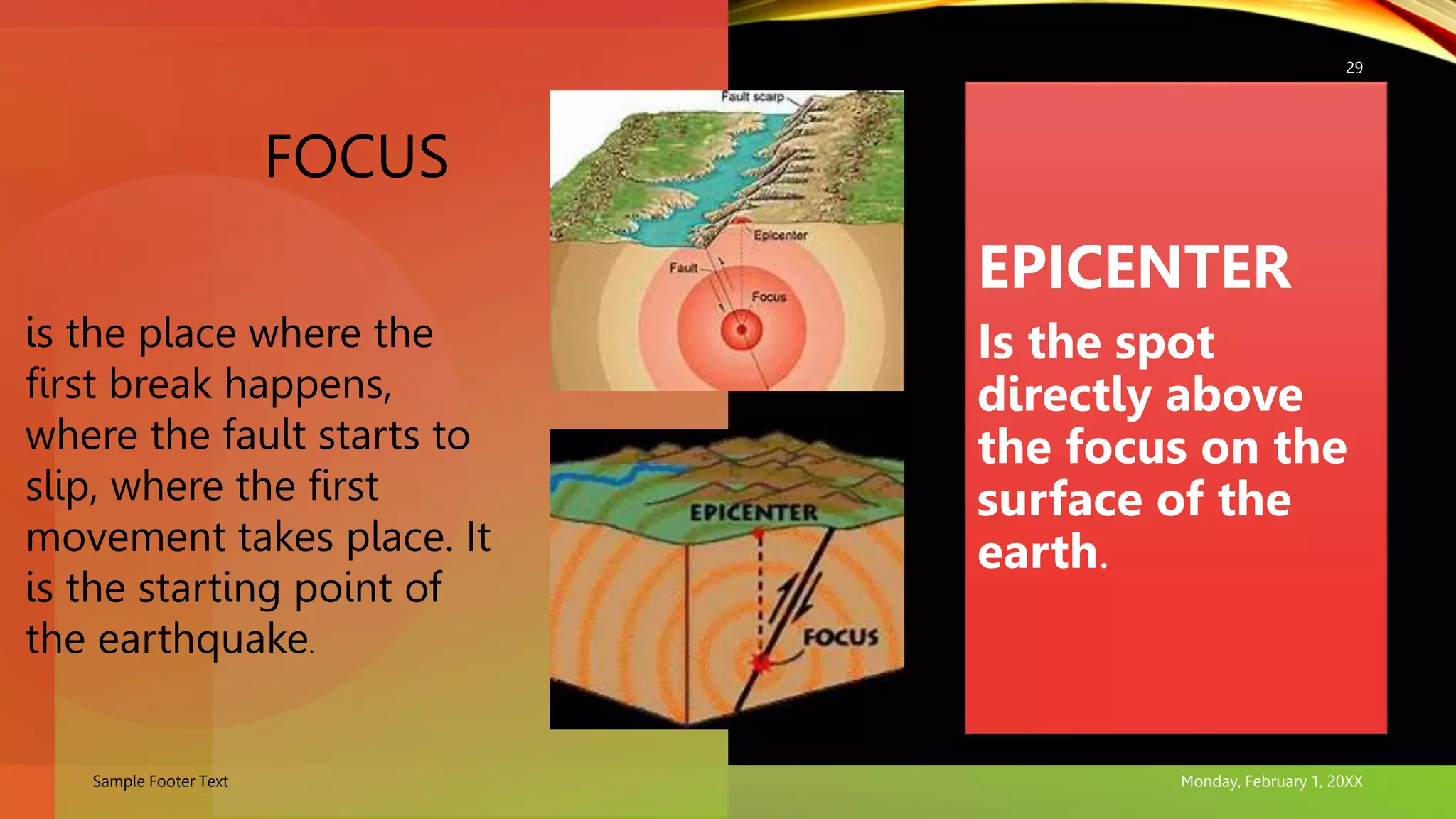
KNOWING THE FAULT
FOCUS
Sample Footer Text
EPICENTER
Is the spot
directly above
the focus on the
surface of the
earth.
Monday, February 1, 20XX
29
is the place where the
first break happens,
where the fault starts to
slip, where the first
movement takes place. It
is the starting point of
the earthquake.
A S H O R T V I D E O
P R E S E N T A T I O N
E L A B O R A T E
(FINDING PRACTICAL APPLICATIONS OF
CONCEPTS AND SKILLS IN DAILY LIVING.)
W H A T I S
Y O U R
I N S I G H T
A B O U T T H E
V I D E O ?
W H AT A R E Y O U
G O I N G T O D O
I F Y O U A R E O N
T H AT
S I T U AT I O N ?
( M A K I N G G E N E R A L I Z A T I O N
A N D A B S T R A C T I O N O F T H E
L E S S O N )
EVALUATION
DIRECTION:
Write the Letter of the
correct answer.
1. Earthquakes happen along a fault line.
Which of the following is NOT true
about faults?
a. It can be found on land
b. It can be found under the sea
c. It is where cyclone starts
d. It is a break in the Earth’s Crust
2. Energy from inside the Earth makes the
ground move. Which of the following is the
reason why there is no movement right
away?
a. There is no movement right away because
of the vibration of the rocks.
b. There is no movement right away
because of the bending of the rocks.
c. The rapid release of energy causes the
delay of the movement of the ground.
d. Friction causes the delay on the
movement of the ground.
3. Earthquakes are common occurrence
in Japan, Indonesia and Philippines.
Why is that so?
a. Japan, Indonesia and Philippines are
surrounded by seas.
b. Japan, Indonesia and Philippines are
located near the equator.
c. Japan, Indonesia and Philippines are
considered archipelagic countries.
d. Japan, Indonesia and Philippines are
found within the Pacific Ring of Fire.
4. Which of the following refers to the
place where the earthquakes start?
a. Fault
b. Focus
c. Epicenter
d. Fault line
5. What do you call the spot above the
focus on the surface of the Earth?
a. Fault c. Focus
b. b. Crust d. Epicenter
6. Which factor keeps the rocks from
slipping past each other?
a. The depth of the rocks
b. The bending of the rocks
c. The arrangement of the rocks
d. The roughness of the rocks
7. What Philippine Agency is concerned
in monitoring fault movement?
a. Department of Labor and Employment
b. Department of Environmental and
Natural Resources
c. Philippine Institute of Volcanology and
Seismology(PHIVOLCS)os
d. Philippine Atmospheric , Geophysical
and Astronomical Services
Administration (PAGASA)
8. What will most likely happen every time a fault slips?
a. The rock will be stuck together.
b. There will be no movement at all.
c. There will be movement right away
d. The rocks will suddenly slip and will generate an earthquake.
9. Which of the following refers to the vibrations produced by an earthquake?
a. Tidal waves
b. Seismic waves
c. Pressure waves
d. Sea-surface waves
10. The seismic waves travel through the Earth and carry information from the interior to
the surface.
All of the following statement is true, EXCEPT
a. The seismic wave are reflected
b. The seismic wave bounced back
c. The seismic waves are refracted or bent
d. The seismic waves are stocked on the rocks
ANSWER TO EVALUATION
Monday, February 1, 20XX
Sample Footer Text
37
1. c
2. D
3. D
4. B
5. D
6. D
7. C
8. D
9. B
10.D
EXTEND
Sample Footer Text
Direction:
Through a role
playing, show tips
about precautionary
measures when you
are living in areas
near faults. You will
be given 5 minutes
to prepare a 3-
minute role play
Monday, February 1, 20XX
38
CRITERIA:
Content – 8pts
Relevance- 7pts
Teamwork- 5pts
Total- 20pts
THE WAY TO GET STARTED IS TO QUIT TALKING
AND BEGIN DOING.
Walt Disney
Sample Footer Text Monday, February 1, 20XX
39
THANK YOU
Sample Footer Text
Presenter Name:
Jevie G. Rosel, LPT
Email Address:
jevie.gonzales@deped.
gov.ph
Monday, February 1, 20XX
40

EARTHQUAKE AND FAULTS.pptx

  • 1.
  • 2.
  • 3.
  • 4.
    LEARNING COMPETENCY: Tuesday, apriL07,2021 4 Usingmodels or illustrations, explains how movements along faults generate earthquakes (S8ES-IIa-14) LESSON OBJECTIVES: 1. explain what a fault is and how it is formed. 2. make a model of the formation of fault; and 3.show tips about precautionary measures when you are living in areas near faults by giving an example through a role playing.
  • 5.
    (GAME) CRASH THE ALIENS IN S T R U C T I O N : Reveal the hidden terms through crashing the aliens. The aliens are letter X, Y and Z. The terms that will be revealed will be the terms that will be encountered in the new lesson. Monday, February 1, 20XX 5 ELICIT REVIEWING PREVIOUS LESSON OR PRESENTING NEW LESSON
  • 6.
    XYFXXAYUZLZT C R AS H T H E A L I E N N O . 1 Sample Footer Text Monday, February 1, 20XX 6 Xyfxxayuzlzt
  • 7.
    C R AS H T H E A L I E N N O . 2 Sample Footer Text Monday, February 1, 20XX 7 Fyozzcxyuysz
  • 8.
    C R AS H T H E A L I E N N O . 3 Sample Footer Text Monday, February 1, 20XX 8 Xxeypxyicexynxtxerzxy
  • 9.
    C R AS H T H E A L I E N N O . 4 Sample Footer Text Monday, February 1, 20XX 9 Xxezayrtxyzhyqzuzzake
  • 10.
    C R AS H T H E A L I E N N O . 5 Sample Footer Text Monday, February 1, 20XX 10 Xyfxxayuzlzzt zlyiznxe
  • 11.
    E A RT H Q U A K E & F A U L T S ( P R E S E N T A T I O N O F T H E T O P I C )
  • 12.
    ACTIVITY 1: A FAULT-Y-SET-UP ENGAGE (Establishingpurpose for the lesson,or present examples or instance of the lesson) Sample Footer Text Monday, February 1, 20XX 12 Activity Objectives: After performing this activity, you will be able to: 1. Describe the appearance of fault; and 2. Explain how a fault forms
  • 13.
    PRESENTATION OF THE SHORTACTIVITY Sample Footer Text Monday, February 1, 20XX 13 a. As you move the sheets, what is formed in the sand? b. What happened to the lines? GUIDE QUESTIONS:
  • 14.
    As you performedthe activity what happen when you move the sheets? What is formed in the sand?
  • 15.
    WHO CAN DESCRIBETHE APPEARANCE OF THE FAULT? -A fault is a fracture or zone of fractures between two blocks of rock. Faults allow the blocks to move relative to each other. This movement may occur rapidly, in the form of an earthquake. The fault surface can be horizontal or vertical or some arbitrary angle in between.
  • 16.
    EXPLAIN HOW AFAULT IS FORMED A fault is formed in the Earth's crust as a brittle response to stress. -The movement of the tectonic plates provides the stress, and rocks at the surface break in response to this. The sense of stress determines the type of fault that forms, and we usually categorize that sense of stress in three different ways: 1.Compression (reverse fault) 2.Tensional stress (normal fault) 3.Shear (strike-slip-fault)
  • 18.
    ACTIVITY 2: STICK-”N”-SLIP EXPLORE (Discussing newconcepts and practicing new skills) Sample Footer Text Monday, February 1, 20XX 18 Objectives: After performing the activity, you should be able to: 1. Explain how faults generates earthquakes; and 2. Explain why not all movements along faults produce earthquakes. Guide Questions: a. What happened to the rubber band? b. What happened to the “house”? c. Keep on pulling on the rubber band. What happened to the box attached to the rubber band? d. Which is the “fault” in this set up?
  • 19.
    PRESENTATION OF THEGROUP ACTIVITY Sample Footer Text GROUP 1 GROUP 2 GROUP 3 GROUP 4 Monday, February 1, 20XX 19
  • 20.
    ACTIVITY RUBRICS Process Skills---------------------------4pts Time Management----------------------2pts Cooperation and Teamwork-----------2 pts Neatness and Orderliness--------------2pts Total:--------------------------------------10pts
  • 21.
    W H ATH A P P E N E D TO T H E R U B B E R B A N D ? Q U E S T I O N 1 : ANSWER: THE RUBBER BAND STRETCHES.
  • 22.
    W H AT H A P P E N E D T O T H E “ H O U S E ” ? Q U E S T I O N 2 : ANSWER: THE HOUSE FALLS OVER.
  • 23.
    W H EN Y O U K E E P O N P U L L I N G T O T H E R U B B E R B A N D . W H A T H A P P E N E D T O T H E B O X A T T A C H E D T O T H E R U B B E R B A N D ? Q U E S T I O N 3 : ANSWER: THE BOX MOVE FORWARD.
  • 24.
    W H IC H I S T H E “ F A U L T ” I N T H I S S E T U P ? Q U E S T I O N 4 : ANSWER: THE FAULT IS THE BOUNDARY BETWEEN THE TWO BOXES.
  • 25.
    FAULTS Sample Footer Text Monday, February 1,20XX 25 EXPLAIN (Developing mastery leads to Formative Assessment) What is a Fault? It may be defined as a fracture surface in rock across which there is relative motion parallel to the surface between the adjacent blocks of the rock.
  • 26.
    HOW DO FAULTS PRODUCE EARTHQUAKES? Energyfrom inside the earth make the ground move. There is no movement right away because of the Friction. Friction held the rocks together. Once the friction is overcome, the ground will move and earthquake will occur. Sample Footer Text Monday, February 1, 20XX 26 Evertime a FAULT slips or moves, the EARTH QUAKE. EARTHQUAKE -The shaking or trembling caused by the sudden release of energy. -it occur when rocks along fault suddenly move.
  • 27.
  • 29.
    FOCUS Sample Footer Text EPICENTER Isthe spot directly above the focus on the surface of the earth. Monday, February 1, 20XX 29 is the place where the first break happens, where the fault starts to slip, where the first movement takes place. It is the starting point of the earthquake.
  • 30.
    A S HO R T V I D E O P R E S E N T A T I O N E L A B O R A T E (FINDING PRACTICAL APPLICATIONS OF CONCEPTS AND SKILLS IN DAILY LIVING.)
  • 31.
    W H AT I S Y O U R I N S I G H T A B O U T T H E V I D E O ?
  • 32.
    W H ATA R E Y O U G O I N G T O D O I F Y O U A R E O N T H AT S I T U AT I O N ? ( M A K I N G G E N E R A L I Z A T I O N A N D A B S T R A C T I O N O F T H E L E S S O N )
  • 34.
    EVALUATION DIRECTION: Write the Letterof the correct answer. 1. Earthquakes happen along a fault line. Which of the following is NOT true about faults? a. It can be found on land b. It can be found under the sea c. It is where cyclone starts d. It is a break in the Earth’s Crust 2. Energy from inside the Earth makes the ground move. Which of the following is the reason why there is no movement right away? a. There is no movement right away because of the vibration of the rocks. b. There is no movement right away because of the bending of the rocks. c. The rapid release of energy causes the delay of the movement of the ground. d. Friction causes the delay on the movement of the ground.
  • 35.
    3. Earthquakes arecommon occurrence in Japan, Indonesia and Philippines. Why is that so? a. Japan, Indonesia and Philippines are surrounded by seas. b. Japan, Indonesia and Philippines are located near the equator. c. Japan, Indonesia and Philippines are considered archipelagic countries. d. Japan, Indonesia and Philippines are found within the Pacific Ring of Fire. 4. Which of the following refers to the place where the earthquakes start? a. Fault b. Focus c. Epicenter d. Fault line 5. What do you call the spot above the focus on the surface of the Earth? a. Fault c. Focus b. b. Crust d. Epicenter 6. Which factor keeps the rocks from slipping past each other? a. The depth of the rocks b. The bending of the rocks c. The arrangement of the rocks d. The roughness of the rocks 7. What Philippine Agency is concerned in monitoring fault movement? a. Department of Labor and Employment b. Department of Environmental and Natural Resources c. Philippine Institute of Volcanology and Seismology(PHIVOLCS)os d. Philippine Atmospheric , Geophysical and Astronomical Services Administration (PAGASA)
  • 36.
    8. What willmost likely happen every time a fault slips? a. The rock will be stuck together. b. There will be no movement at all. c. There will be movement right away d. The rocks will suddenly slip and will generate an earthquake. 9. Which of the following refers to the vibrations produced by an earthquake? a. Tidal waves b. Seismic waves c. Pressure waves d. Sea-surface waves 10. The seismic waves travel through the Earth and carry information from the interior to the surface. All of the following statement is true, EXCEPT a. The seismic wave are reflected b. The seismic wave bounced back c. The seismic waves are refracted or bent d. The seismic waves are stocked on the rocks
  • 37.
    ANSWER TO EVALUATION Monday,February 1, 20XX Sample Footer Text 37 1. c 2. D 3. D 4. B 5. D 6. D 7. C 8. D 9. B 10.D
  • 38.
    EXTEND Sample Footer Text Direction: Througha role playing, show tips about precautionary measures when you are living in areas near faults. You will be given 5 minutes to prepare a 3- minute role play Monday, February 1, 20XX 38 CRITERIA: Content – 8pts Relevance- 7pts Teamwork- 5pts Total- 20pts
  • 39.
    THE WAY TOGET STARTED IS TO QUIT TALKING AND BEGIN DOING. Walt Disney Sample Footer Text Monday, February 1, 20XX 39
  • 40.
    THANK YOU Sample FooterText Presenter Name: Jevie G. Rosel, LPT Email Address: jevie.gonzales@deped. gov.ph Monday, February 1, 20XX 40