EARTHQUAKE
REVIEW
Matching the Faults
Match the picture of the type of fault to
their correct name and description.
PICTURE
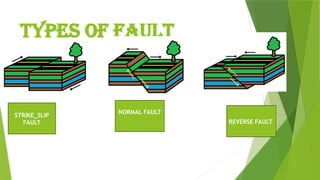
TYPES OF FAULT
STRIKE_SLIP
FAULT
NORMAL FAULT
REVERSE FAULT
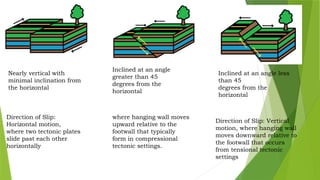
Nearly vertical with
minimal inclination from
the horizontal
Direction of Slip:
Horizontal motion,
where two tectonic plates
slide past each other
horizontally
Inclined at an angle
greater than 45
degrees from the
horizontal
where hanging wall moves
upward relative to the
footwall that typically
form in compressional
tectonic settings.
Inclined at an angle less
than 45
degrees from the
horizontal
Direction of Slip: Vertical
motion, where hanging wall
moves downward relative to
the footwall that occurs
from tensional tectonic
settings.
 Play the news about the magnitude 7.4 earthquake that
happened in Surigao Del Sur last December 2, 2023.
 Video link:
https://www.youtube.com/watch?v=3_x4gICJOXI&t=1s
 After watching the video clip, ask the learners the
following questions:
 What did you observe in the video?
 Who among you have experienced an earthquake?
 What are the things that can happen during an earthquake?
 Are you familiar with the fault lines in the Philippines
WORD PUZZLES
 The learners will look for the following words inside the
puzzle.
 It could be horizontal, vertical, diagonal, or reverse.
 1. FOCUS
 2. EPICENTER
 3. MAGNITUDE
 4. INTENSITY
 5. WAVE
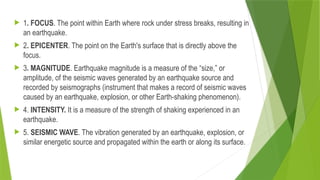
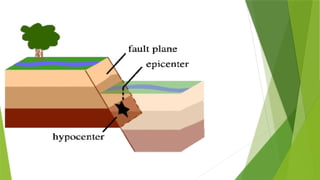
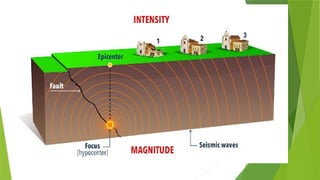
 1. FOCUS. The point within Earth where rock under stress breaks, resulting in
an earthquake.
 2. EPICENTER. The point on the Earth's surface that is directly above the
focus.
 3. MAGNITUDE. Earthquake magnitude is a measure of the “size,” or
amplitude, of the seismic waves generated by an earthquake source and
recorded by seismographs (instrument that makes a record of seismic waves
caused by an earthquake, explosion, or other Earth-shaking phenomenon).
 4. INTENSITY. It is a measure of the strength of shaking experienced in an
earthquake.
 5. SEISMIC WAVE. The vibration generated by an earthquake, explosion, or
similar energetic source and propagated within the earth or along its surface.
BRING TOMMOROW
Materials Needed:
FAULT FINDER APPS
gadget with internet access,
access to Fault Finder,

EARTHQUAKE module 2.pptxxxxxxxxxxxxxxxxx

  • 1.
  • 2.
    REVIEW Matching the Faults Matchthe picture of the type of fault to their correct name and description.
  • 3.
  • 4.
  • 5.
    Nearly vertical with minimalinclination from the horizontal Direction of Slip: Horizontal motion, where two tectonic plates slide past each other horizontally Inclined at an angle greater than 45 degrees from the horizontal where hanging wall moves upward relative to the footwall that typically form in compressional tectonic settings. Inclined at an angle less than 45 degrees from the horizontal Direction of Slip: Vertical motion, where hanging wall moves downward relative to the footwall that occurs from tensional tectonic settings.
  • 6.
     Play thenews about the magnitude 7.4 earthquake that happened in Surigao Del Sur last December 2, 2023.  Video link: https://www.youtube.com/watch?v=3_x4gICJOXI&t=1s  After watching the video clip, ask the learners the following questions:  What did you observe in the video?  Who among you have experienced an earthquake?  What are the things that can happen during an earthquake?  Are you familiar with the fault lines in the Philippines
  • 7.
    WORD PUZZLES  Thelearners will look for the following words inside the puzzle.  It could be horizontal, vertical, diagonal, or reverse.  1. FOCUS  2. EPICENTER  3. MAGNITUDE  4. INTENSITY  5. WAVE
  • 8.
     1. FOCUS.The point within Earth where rock under stress breaks, resulting in an earthquake.  2. EPICENTER. The point on the Earth's surface that is directly above the focus.  3. MAGNITUDE. Earthquake magnitude is a measure of the “size,” or amplitude, of the seismic waves generated by an earthquake source and recorded by seismographs (instrument that makes a record of seismic waves caused by an earthquake, explosion, or other Earth-shaking phenomenon).  4. INTENSITY. It is a measure of the strength of shaking experienced in an earthquake.  5. SEISMIC WAVE. The vibration generated by an earthquake, explosion, or similar energetic source and propagated within the earth or along its surface.

  • 11.
    BRING TOMMOROW Materials Needed: FAULTFINDER APPS gadget with internet access, access to Fault Finder,