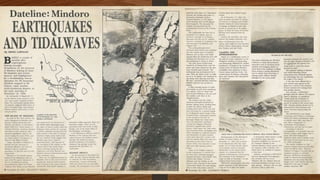
Have you experienced an earthquake?
Goals:
Define what earthquake is.
Identify the parts of an earthquake.
Explain how earthquakes and faults are related.
Earthquakes
& Faults
How do earthquakes occur?
Earthquakes
• a natural phenomenon that is characterized by sudden,
violent shifting of massive plates underneath Earth’s
surface.
• are forms of wave energy that are transmitted through
bedrock.
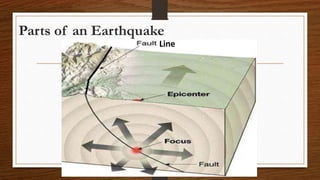
Parts of an Earthquake
Line
Parts of an Earthquake
1. Focus – the point within the Earth along the geological faults where the
earthquake originated
2. Epicenter – point on the earth’s surface directly above the focus.
3. Fault - a crack or break in Earth’s crust along which rocks have moved.
4. Fault line – is a long and wide fault.
Active and Inactive Faults
• Active Faults
- a fault is classified as active when movement of rock layers
has been recorded in the recent past or displacement of rock
layers is expected because of the buildup of energy in the
area.
Active and Inactive Faults
• Inactive Faults
- are faults that moved in the distant past but do not have any
recent records of movements and have no indication of
possible movement in the future.
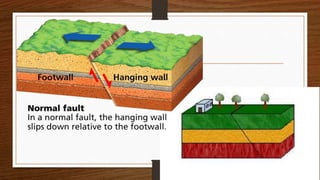
Types of Faults
1. Normal Fault – a fault in which the hanging wall
moves down relative to the footwall as a result of
extension.
Types of Faults
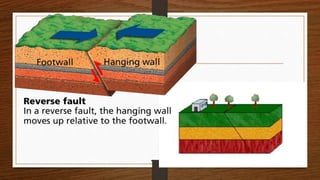
2. Reverse Fault – a fault in which the hanging
wall moves up relative to the footwall as a result
of compression.
Types of Faults
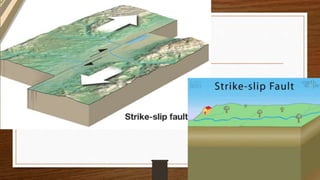
3. Strike-slip Fault – a fault in which two blocks
of crust slide past each other on the same plane.
How do earthquakes occur?
Directions: Identify the following. Write your answer on a ¼ sheet of paper.
1. The sudden shaking of the ground that we feel when rock layers of Earth
suddenly moves.
2. The point within the Earth along the geological faults where the earthquake
originated
3. A fault in which the hanging wall moves down relative to the footwall as a
result of extension.
4. A fault in which the hanging wall moves up relative to the footwall as a
result of compression.
5. A fault in which two blocks of crust slide past each other on the same plane
Directions: Identify the following. Write your answer on a ¼ sheet of paper.
1. The sudden shaking of the ground that we feel when rock layers of Earth
suddenly moves. Answer: Earthquake
2. The point within the Earth along the geological faults where the earthquake
originated. Answer: Focus
3. A fault in which the hanging wall moves down relative to the footwall as a
result of extension. Answer: Normal Fault
4. A fault in which the hanging wall moves up relative to the footwall as a
result of compression. Answer: Reverse Fault
5. A fault in which two blocks of crust slide past each other on the same
plane. Answer: Strike-slip Fault
Assignment:
• Directions: Answer the following questions. Write
your answer on a ½ crosswise paper.
• Why is it important to study earthquakes?
• How can you prepare yourself for an earthquake?

Earthquakes & Faults

  • 1.
    Have you experiencedan earthquake?
  • 2.
    Goals: Define what earthquakeis. Identify the parts of an earthquake. Explain how earthquakes and faults are related.
  • 3.
  • 4.
  • 5.
    Earthquakes • a naturalphenomenon that is characterized by sudden, violent shifting of massive plates underneath Earth’s surface. • are forms of wave energy that are transmitted through bedrock.
  • 6.
    Parts of anEarthquake Line
  • 7.
    Parts of anEarthquake 1. Focus – the point within the Earth along the geological faults where the earthquake originated 2. Epicenter – point on the earth’s surface directly above the focus. 3. Fault - a crack or break in Earth’s crust along which rocks have moved. 4. Fault line – is a long and wide fault.
  • 8.
    Active and InactiveFaults • Active Faults - a fault is classified as active when movement of rock layers has been recorded in the recent past or displacement of rock layers is expected because of the buildup of energy in the area.
  • 9.
    Active and InactiveFaults • Inactive Faults - are faults that moved in the distant past but do not have any recent records of movements and have no indication of possible movement in the future.
  • 10.
    Types of Faults 1.Normal Fault – a fault in which the hanging wall moves down relative to the footwall as a result of extension.
  • 12.
    Types of Faults 2.Reverse Fault – a fault in which the hanging wall moves up relative to the footwall as a result of compression.
  • 14.
    Types of Faults 3.Strike-slip Fault – a fault in which two blocks of crust slide past each other on the same plane.
  • 16.
  • 19.
    Directions: Identify thefollowing. Write your answer on a ¼ sheet of paper. 1. The sudden shaking of the ground that we feel when rock layers of Earth suddenly moves. 2. The point within the Earth along the geological faults where the earthquake originated 3. A fault in which the hanging wall moves down relative to the footwall as a result of extension. 4. A fault in which the hanging wall moves up relative to the footwall as a result of compression. 5. A fault in which two blocks of crust slide past each other on the same plane
  • 20.
    Directions: Identify thefollowing. Write your answer on a ¼ sheet of paper. 1. The sudden shaking of the ground that we feel when rock layers of Earth suddenly moves. Answer: Earthquake 2. The point within the Earth along the geological faults where the earthquake originated. Answer: Focus 3. A fault in which the hanging wall moves down relative to the footwall as a result of extension. Answer: Normal Fault 4. A fault in which the hanging wall moves up relative to the footwall as a result of compression. Answer: Reverse Fault 5. A fault in which two blocks of crust slide past each other on the same plane. Answer: Strike-slip Fault
  • 21.
    Assignment: • Directions: Answerthe following questions. Write your answer on a ½ crosswise paper. • Why is it important to study earthquakes? • How can you prepare yourself for an earthquake?

Editor's Notes

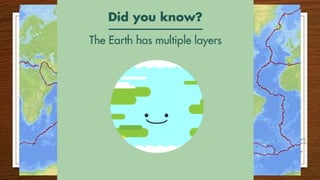
  • #5 The Earth is made of an inner core, an outer core, a mantle, and a thin crust covering the mantle, which is the surface of the Earth including all the oceans and continents. The crust is made of separate rocky portions called tectonic plates, which lie on the mantle like pieces of a jigsaw puzzle.
  • #17 Earthquakes develop when tectonic plates, the massive "jigsaw pieces" that make up the crust of the earth, move suddenly, sending shockwaves through neighboring area.
  • #19 The Mindoro province experienced a 7.1 magnitude and category VII intensity earthquake at 3:15 am on November 15, 1994 that killed 78 people and destroyed 7,566 houses.