Heat is energy in motion (or transit).
• It is the transfer of energy from a place of
higher temperature to a place of lower
temperature.
• Heat only moves toward the lower-temperature
body.
• It is incorrect to say an object contains heat.
NOTHING contains heat.
• Heat is a process (that’s used as a verb not a
noun)
• Heat is not a “thing” but an energy transfer.
Thermal energy: the sum of energy
within an object.
• It has to do with the kinetic and potential
energy within a system of molecules.
• An object contains thermal energy.
• When that thermal energy moves from
object to object, that’s when we can say
heat.
• Thermal energy is the noun, whereas heat is
the verb
Heat Transfer
• Heat always moves from a warmer place to
a cooler place.
• Hot objects in a cooler room will cool to
room temperature.
• Cold objects in a warmer room will heat up
to room temperature.
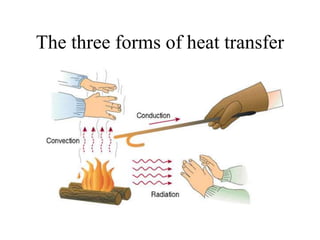
The three forms of heat transfer
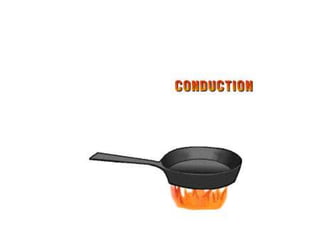
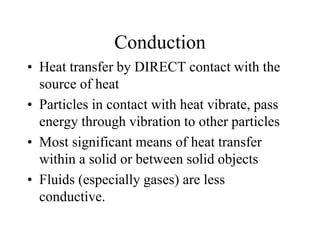
Conduction
• Heat transfer by DIRECT contact with the
source of heat
• Particles in contact with heat vibrate, pass
energy through vibration to other particles
• Most significant means of heat transfer
within a solid or between solid objects
• Fluids (especially gases) are less
conductive.
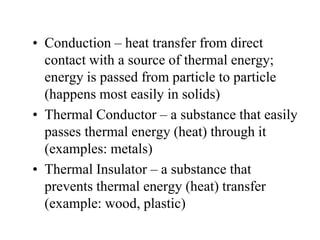
• Conduction – heat transfer from direct
contact with a source of thermal energy;
energy is passed from particle to particle
(happens most easily in solids)
• Thermal Conductor – a substance that easily
passes thermal energy (heat) through it
(examples: metals)
• Thermal Insulator – a substance that
prevents thermal energy (heat) transfer
(example: wood, plastic)
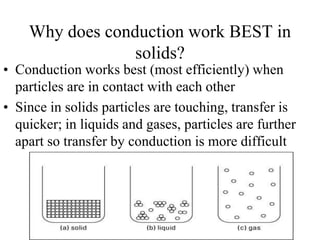
Why does conduction work BEST in
solids?
• Conduction works best (most efficiently) when
particles are in contact with each other
• Since in solids particles are touching, transfer is
quicker; in liquids and gases, particles are further
apart so transfer by conduction is more difficult
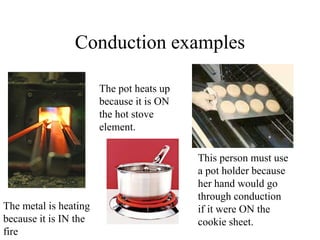
Conduction examples
The metal is heating
because it is IN the
fire
The pot heats up
because it is ON
the hot stove
element.
This person must use
a pot holder because
her hand would go
through conduction
if it were ON the
cookie sheet.
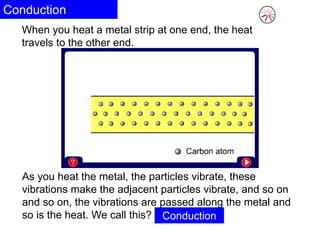
Conduction
When you heat a metal strip at one end, the heat
travels to the other end.
As you heat the metal, the particles vibrate, these
vibrations make the adjacent particles vibrate, and so on
and so on, the vibrations are passed along the metal and
so is the heat. We call this? Conduction
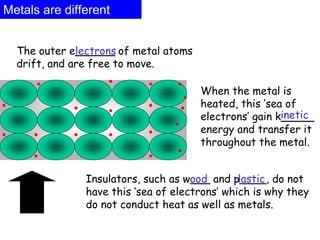
Metals are different
The outer e______ of metal atoms
drift, and are free to move.
When the metal is
heated, this ‘sea of
electrons’ gain k_____
energy and transfer it
throughout the metal.
Insulators, such as w___ and p____, do not
have this ‘sea of electrons’ which is why they
do not conduct heat as well as metals.
lectrons
inetic
ood lastic
To summarize:
• Conduction
– Heat transfer from
direct contact
– Particles vibrate and
transfer energy from
particle to particle
– Example: cooking on a
stove

Heat_Transfer_methods_grade7sciencephysics

  • 1.
    Heat is energyin motion (or transit). • It is the transfer of energy from a place of higher temperature to a place of lower temperature. • Heat only moves toward the lower-temperature body. • It is incorrect to say an object contains heat. NOTHING contains heat. • Heat is a process (that’s used as a verb not a noun) • Heat is not a “thing” but an energy transfer.
  • 2.
    Thermal energy: thesum of energy within an object. • It has to do with the kinetic and potential energy within a system of molecules. • An object contains thermal energy. • When that thermal energy moves from object to object, that’s when we can say heat. • Thermal energy is the noun, whereas heat is the verb
  • 3.
    Heat Transfer • Heatalways moves from a warmer place to a cooler place. • Hot objects in a cooler room will cool to room temperature. • Cold objects in a warmer room will heat up to room temperature.
  • 4.
    The three formsof heat transfer
  • 6.
    Conduction • Heat transferby DIRECT contact with the source of heat • Particles in contact with heat vibrate, pass energy through vibration to other particles • Most significant means of heat transfer within a solid or between solid objects • Fluids (especially gases) are less conductive.
  • 7.
    • Conduction –heat transfer from direct contact with a source of thermal energy; energy is passed from particle to particle (happens most easily in solids) • Thermal Conductor – a substance that easily passes thermal energy (heat) through it (examples: metals) • Thermal Insulator – a substance that prevents thermal energy (heat) transfer (example: wood, plastic)
  • 8.
    Why does conductionwork BEST in solids? • Conduction works best (most efficiently) when particles are in contact with each other • Since in solids particles are touching, transfer is quicker; in liquids and gases, particles are further apart so transfer by conduction is more difficult
  • 9.
    Conduction examples The metalis heating because it is IN the fire The pot heats up because it is ON the hot stove element. This person must use a pot holder because her hand would go through conduction if it were ON the cookie sheet.
  • 10.
    Conduction When you heata metal strip at one end, the heat travels to the other end. As you heat the metal, the particles vibrate, these vibrations make the adjacent particles vibrate, and so on and so on, the vibrations are passed along the metal and so is the heat. We call this? Conduction
  • 11.
    Metals are different Theouter e______ of metal atoms drift, and are free to move. When the metal is heated, this ‘sea of electrons’ gain k_____ energy and transfer it throughout the metal. Insulators, such as w___ and p____, do not have this ‘sea of electrons’ which is why they do not conduct heat as well as metals. lectrons inetic ood lastic
  • 12.
    To summarize: • Conduction –Heat transfer from direct contact – Particles vibrate and transfer energy from particle to particle – Example: cooking on a stove