Faster Practical Block Compression
for Rank/Select Dictionaries
Yusaku Kaneta | yusaku.kaneta@rakuten.com
Rakuten Institute of Technology, Rakuten, Inc.
2
Background
§ Compressed data structures in Web companies.
• Web companies generate massive amount of logs in text formats.
• Analyzing such huge logs is vital for our decision making.
• Practical improvements of compressed data structures are important.
§ RRR compression [Raman, Raman, Rao, SODA’02]
• Basic building block in many compressed data structures.
• Rank/Select queries on compressed bit strings in constant time:
‣ Rankb(B, i): Number of b’s in B’s prefix of length i.
‣ Selectb(B, i): Position of B’s i-th b.
B is an input bit string
b: a bit in {0, 1}
3
RRR = Block compression + succinct index
§ Represents a block B of w bits into a pair (class(B), offset(B)).
• class(B): Number of ones in B.
• offset(B): Number of preceding blocks of class same as B for some
order (e.g., lexicographical order of bit strings).
§ log w bits for class(B) and log2
w
class(B)
bits for offset(B).
§ Two practical approaches to block compression:
• Blockwise approach [Claude and Navarro, SPIRE’09]
• Bitwise approach [Navarro and Providel, SEA’12]
4
Block compression in practice
Good: O(1) time.
Bad: Low compression ratio.
§The tables limit use of larger w.
§log w bits for class(B) become non-
negligible.
§Ex) 25% overhead for w = 15.
1. Blockwise approach
[Claude and Navarro, SPIRE’09]
2. Bitwise approach
[Navarro and Providel, SEA’12]
Idea: O(2ww)-bit universal tables. Idea: O(w3)-bit binomial coefficients.
Good: High compression ratio.
Bad: O(w) time.
§Count bit strings lexicographically
smaller than block B bit by bit.
§In practice, heuristics of encoding
and decoding blocks with a few
ones in O(1) time can be used.
Less flexible in practice
5
Main result
§ Practical encoder/decoder for block compression
• Generalization of existing blockwise and bitwise approaches.
• Idea: chunkwise processing with multiple universal tables.
• Faster and more stable on artificial data.
Method Encode Decode Space (in bits)
Blockwise [Claude and Navarro, SPIRE’09] O(1) O(1) O(2ww)
Bitwise [Navarro and Provital, SEA’12] O(w) O(w) O(w3)
Chunkwise (This work) O(w/t) O((w/t) log t) O(w3 + 2t t)
This talk uses w and t for block and chunk lengths, respectively.
6
Our algorithm
7
Overview of our algorithm
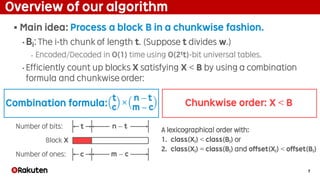
§ Main idea: Process a block B in a chunkwise fashion.
• Bi: The i-th chunk of length t. (Suppose t divides w.)
‣ Encoded/Decoded in O(1) time using O(2tt)-bit universal tables.
• Efficiently count up blocks X satisfying X < B by using a combination
formula and chunkwise order:
A lexicographical order with:
1. class(Xi) < class(Bi) or
2. class(Xi) = class(Bi) and offset(Xi) < offset(Bi)
t
c
×
n − t
m − c
c m − c
n − tt
Number of ones:
Number of bits:
Block X
Combination formula: Chunkwise order: X < B
8
Block encoding in O(w/t) time
Lemma: Block encoding can be implemented in
O(w/t) time with O(w3+2tt)-bit universal tables.
` 1
oi+1
B0···Bi-1
oi
2
X[0, i) X[i] •••
Blocks X of class same as B
in descending order of offset(X)
from top to bottom.
oi = X 	X0···Xi-1 < B0···Bi-1
ci
ni
class(B)
− ci − class(Bi)
w − ni − t#bits
#ones
Bi Bi+1···Bw/t-1
• w−	ni − t is in {0, t, 2t, …, (w/t)t=w}.
• class(B) − ci − c ranges in [0, w).
• class(Bi) ranges in [0, t).
• Each value can be represented in w bits.
2. class(Xi) = class(Bi) and offset(Xi) < offset(Bi)
Idea:
Multiplication
offset(Bi)×
w − ni − t
class(B) − ci − class(Bi)
1. class(Xi) < class(Bi):
Idea:
Summation
%
t
c
×
w − ni − t
class(B) − ci − c
class(Bi)&1
c = 0
9
Block decoding in O((w/t)log t) time
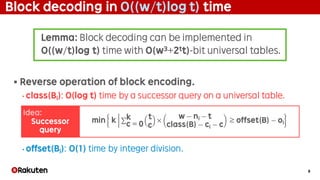
§ Reverse operation of block encoding.
• class(Bi): O(log t) time by a successor query on a universal table.
• offset(Bi): O(1) time by integer division.
min k	 ∑ t
c
×
w − ni − t
class(B) − ci − c
	≥ offset(B) − oi
k
c = 0
Lemma: Block decoding can be implemented in
O((w/t)log t) time with O(w3+2tt)-bit universal tables.
Idea:
Successor
query
10
Experimental results
11
Experiment 1: Encoding/Decoding
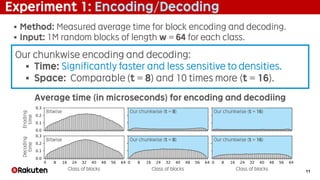
§ Method: Measured average time for block encoding and decoding.
§ Input: 1M random blocks of length w = 64 for each class.
Our chunkwise encoding and decoding:
§ Time: Significantly faster and less sensitive to densities.
§ Space: Comparable (t = 8) and 10 times more (t = 16).
Average time (in microseconds) for encoding and decodiing
Bitwise
Bitwise
Our chunkwise (t = 8)
Our chunkwise (t = 16)
Class of blocks Class of blocks Class of blocks
Decoding
time
Enoding
time
12
Experiment 2: Rank/Select queries
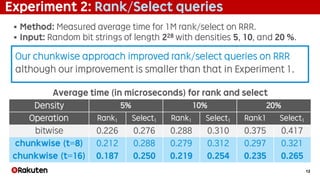
§ Method: Measured average time for 1M rank/select on RRR.
§ Input: Random bit strings of length 228 with densities 5, 10, and 20 %.
Density 5% 10% 20%
Operation Rank1 Select1 Rank1 Select1 Rank1 Select1
bitwise 0.226 0.276 0.288 0.310 0.375 0.417
chunkwise (t=8) 0.212 0.288 0.279 0.312 0.297 0.321
chunkwise (t=16) 0.187 0.250 0.219 0.254 0.235 0.265
Average time (in microseconds) for rank and select
Our chunkwise approach improved rank/select queries on RRR
although our improvement is smaller than that in Experiment 1.
13
Conclusion
§ Practical block encoding and decoding for RRR
• New time-space tradeoff based on chunkwise processing:
‣ O(w/t) encoding
‣ O((w/t)log t) decoding
‣ O(w3 + 2tt) bits of space.
• Generalize previous blockwise and bitwise approaches.
• Fast and stable on artificial data with various densities.
§ Future work:
• More experimental evaluation on real data.
THANK YOU

Faster Practical Block Compression for Rank/Select Dictionaries

  • 1.
    Faster Practical BlockCompression for Rank/Select Dictionaries Yusaku Kaneta | yusaku.kaneta@rakuten.com Rakuten Institute of Technology, Rakuten, Inc.
  • 2.
    2 Background § Compressed datastructures in Web companies. • Web companies generate massive amount of logs in text formats. • Analyzing such huge logs is vital for our decision making. • Practical improvements of compressed data structures are important. § RRR compression [Raman, Raman, Rao, SODA’02] • Basic building block in many compressed data structures. • Rank/Select queries on compressed bit strings in constant time: ‣ Rankb(B, i): Number of b’s in B’s prefix of length i. ‣ Selectb(B, i): Position of B’s i-th b. B is an input bit string b: a bit in {0, 1}
  • 3.
    3 RRR = Blockcompression + succinct index § Represents a block B of w bits into a pair (class(B), offset(B)). • class(B): Number of ones in B. • offset(B): Number of preceding blocks of class same as B for some order (e.g., lexicographical order of bit strings). § log w bits for class(B) and log2 w class(B) bits for offset(B). § Two practical approaches to block compression: • Blockwise approach [Claude and Navarro, SPIRE’09] • Bitwise approach [Navarro and Providel, SEA’12]
  • 4.
    4 Block compression inpractice Good: O(1) time. Bad: Low compression ratio. §The tables limit use of larger w. §log w bits for class(B) become non- negligible. §Ex) 25% overhead for w = 15. 1. Blockwise approach [Claude and Navarro, SPIRE’09] 2. Bitwise approach [Navarro and Providel, SEA’12] Idea: O(2ww)-bit universal tables. Idea: O(w3)-bit binomial coefficients. Good: High compression ratio. Bad: O(w) time. §Count bit strings lexicographically smaller than block B bit by bit. §In practice, heuristics of encoding and decoding blocks with a few ones in O(1) time can be used. Less flexible in practice
  • 5.
    5 Main result § Practicalencoder/decoder for block compression • Generalization of existing blockwise and bitwise approaches. • Idea: chunkwise processing with multiple universal tables. • Faster and more stable on artificial data. Method Encode Decode Space (in bits) Blockwise [Claude and Navarro, SPIRE’09] O(1) O(1) O(2ww) Bitwise [Navarro and Provital, SEA’12] O(w) O(w) O(w3) Chunkwise (This work) O(w/t) O((w/t) log t) O(w3 + 2t t) This talk uses w and t for block and chunk lengths, respectively.
  • 6.
  • 7.
    7 Overview of ouralgorithm § Main idea: Process a block B in a chunkwise fashion. • Bi: The i-th chunk of length t. (Suppose t divides w.) ‣ Encoded/Decoded in O(1) time using O(2tt)-bit universal tables. • Efficiently count up blocks X satisfying X < B by using a combination formula and chunkwise order: A lexicographical order with: 1. class(Xi) < class(Bi) or 2. class(Xi) = class(Bi) and offset(Xi) < offset(Bi) t c × n − t m − c c m − c n − tt Number of ones: Number of bits: Block X Combination formula: Chunkwise order: X < B
  • 8.
    8 Block encoding inO(w/t) time Lemma: Block encoding can be implemented in O(w/t) time with O(w3+2tt)-bit universal tables. ` 1 oi+1 B0···Bi-1 oi 2 X[0, i) X[i] ••• Blocks X of class same as B in descending order of offset(X) from top to bottom. oi = X X0···Xi-1 < B0···Bi-1 ci ni class(B) − ci − class(Bi) w − ni − t#bits #ones Bi Bi+1···Bw/t-1 • w− ni − t is in {0, t, 2t, …, (w/t)t=w}. • class(B) − ci − c ranges in [0, w). • class(Bi) ranges in [0, t). • Each value can be represented in w bits. 2. class(Xi) = class(Bi) and offset(Xi) < offset(Bi) Idea: Multiplication offset(Bi)× w − ni − t class(B) − ci − class(Bi) 1. class(Xi) < class(Bi): Idea: Summation % t c × w − ni − t class(B) − ci − c class(Bi)&1 c = 0
  • 9.
    9 Block decoding inO((w/t)log t) time § Reverse operation of block encoding. • class(Bi): O(log t) time by a successor query on a universal table. • offset(Bi): O(1) time by integer division. min k ∑ t c × w − ni − t class(B) − ci − c ≥ offset(B) − oi k c = 0 Lemma: Block decoding can be implemented in O((w/t)log t) time with O(w3+2tt)-bit universal tables. Idea: Successor query
  • 10.
  • 11.
    11 Experiment 1: Encoding/Decoding §Method: Measured average time for block encoding and decoding. § Input: 1M random blocks of length w = 64 for each class. Our chunkwise encoding and decoding: § Time: Significantly faster and less sensitive to densities. § Space: Comparable (t = 8) and 10 times more (t = 16). Average time (in microseconds) for encoding and decodiing Bitwise Bitwise Our chunkwise (t = 8) Our chunkwise (t = 8) Our chunkwise (t = 16) Our chunkwise (t = 16) Class of blocks Class of blocks Class of blocks Decoding time Enoding time
  • 12.
    12 Experiment 2: Rank/Selectqueries § Method: Measured average time for 1M rank/select on RRR. § Input: Random bit strings of length 228 with densities 5, 10, and 20 %. Density 5% 10% 20% Operation Rank1 Select1 Rank1 Select1 Rank1 Select1 bitwise 0.226 0.276 0.288 0.310 0.375 0.417 chunkwise (t=8) 0.212 0.288 0.279 0.312 0.297 0.321 chunkwise (t=16) 0.187 0.250 0.219 0.254 0.235 0.265 Average time (in microseconds) for rank and select Our chunkwise approach improved rank/select queries on RRR although our improvement is smaller than that in Experiment 1.
  • 13.
    13 Conclusion § Practical blockencoding and decoding for RRR • New time-space tradeoff based on chunkwise processing: ‣ O(w/t) encoding ‣ O((w/t)log t) decoding ‣ O(w3 + 2tt) bits of space. • Generalize previous blockwise and bitwise approaches. • Fast and stable on artificial data with various densities. § Future work: • More experimental evaluation on real data.
  • 14.