Fast Wavelet Tree Construction
in Practice
2018/10/10
Yusaku Kaneta
Rakuten Institute of Technology
Rakuten, Inc.
2
Background
§ Wavelet tree [Grossi+,SODA’03] / Wavele matrix [Claude+,SPIRE’12]
• Fundamentaltoolsinmodernstringprocessing.
• Fastaccess,rank,andselectonanarrayofnintegersin[0,σ).
10 1 1 0 1 1 000 10 10 01
11 0 01 1 0100 11 00 0 1
1 0 100 01 1 00 0 11 1 10
00 101 10 1 10 1 01 00 1
Awavelettreeson[6,8,9,4,14,11,1,0,5,7,12,13,15,2,3,10]
3
Fast WT construction has attracted much attension!!
Papers
Sequential?
Parallel?
Impl.?
[Fuentes-Sepúlveda+,SEA’14] P Yes
[Shun+,DCC’15] P Yes
[Labeit+,DCC’16] P Yes
[Fischer+,ALENEX’18] S+P Yes
[Munro+,SPIRE’14][Babenko+,SODA’15](Bestupperbound) S No
[Shun+,DCC’17](Bestupperbound) P No
§ Gap between theory and practice:
• Nopracticalimplementationof[Munro+,SPIRE’14][Babenko+,
SODA’15]:Thecurrentfastestwavelettreeconstructionalgorithm.
4
First* practical implementation of wavelet tree construction
based on [Munro+, SPIRE’14][Babenko+, SODA’15]
Main result
§ Our idea: Replace precomputed tables w/
• SpecialCPUinstruction:PEXTin(BMI2)orPSHUFB(inSSSE3).
• Broadwordcomputation(omitted).
§ Experiments on real datasets:
• Wavelettree:ourswerecompetitivetoSOTA[Fischer+,ALENEX'18]
• Waveletmatrix:ourswere1.1–1.9xfasterthanSOTA.
*SzymonGrabowskikindlypointedthatTuukkaNorrialsotriedsimilarapproaches:
github.com/tsnorri/wt-construct-gn
5
Our Techniques
for Practical Implementation
6
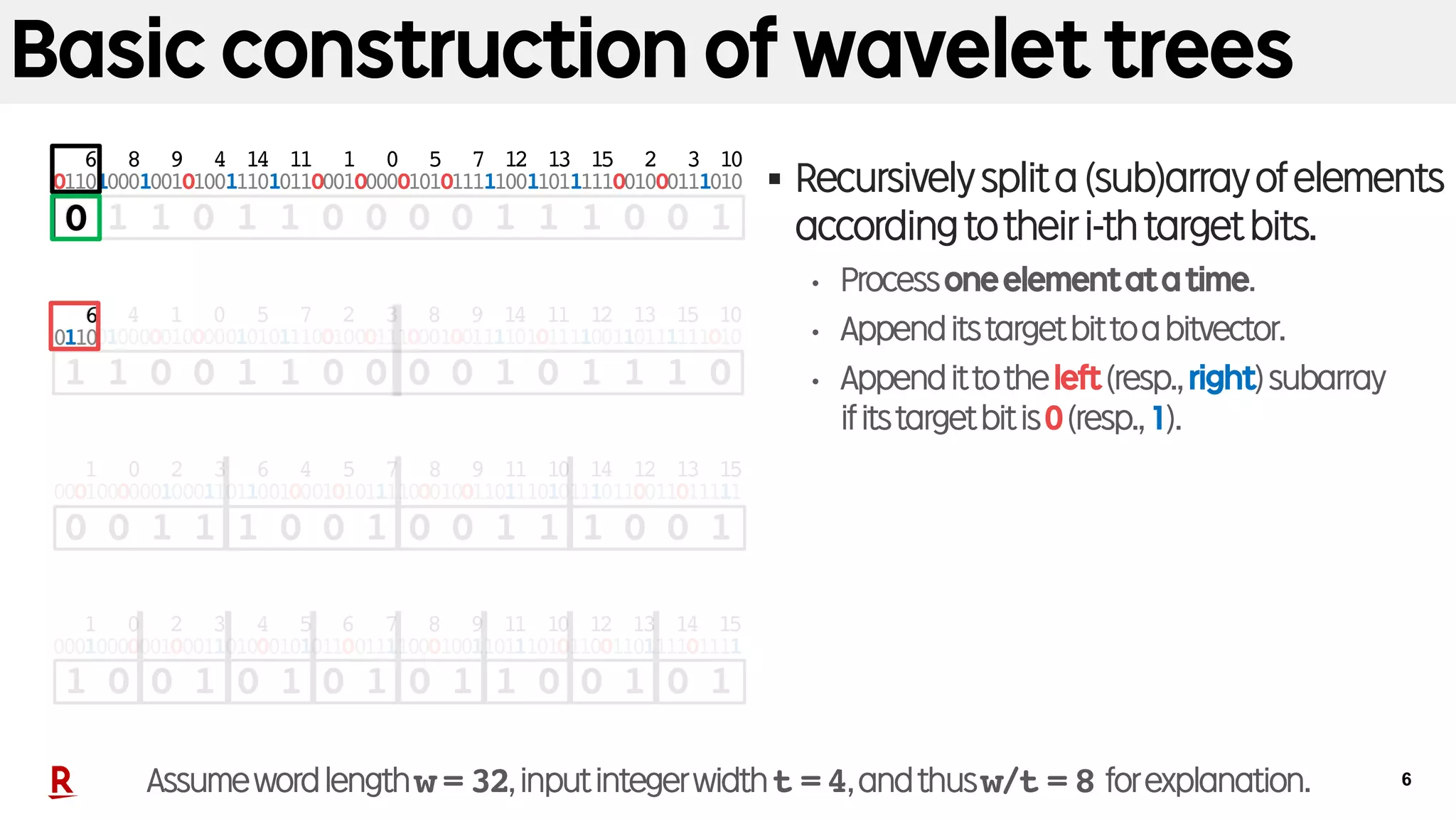
Basic construction of wavelet trees
§ Recursivelysplita(sub)arrayofelements
accordingtotheiri-thtargetbits.
• Processoneelementatatime.
• Appenditstargetbittoabitvector.
• Appendittotheleft(resp.,right)subarray
ifitstargetbitis0(resp.,1).
Assumewordlengthw = 32,inputintegerwidtht =4,andthusw/t = 8 forexplanation.
6
0110
8
1000
9
1001
4
0100
14
1110
11
1011
1
0001
0
0000
5
0101
7
0111
12
1100
15
1111
13
1101
2
0010
3
0011
10
1010
7
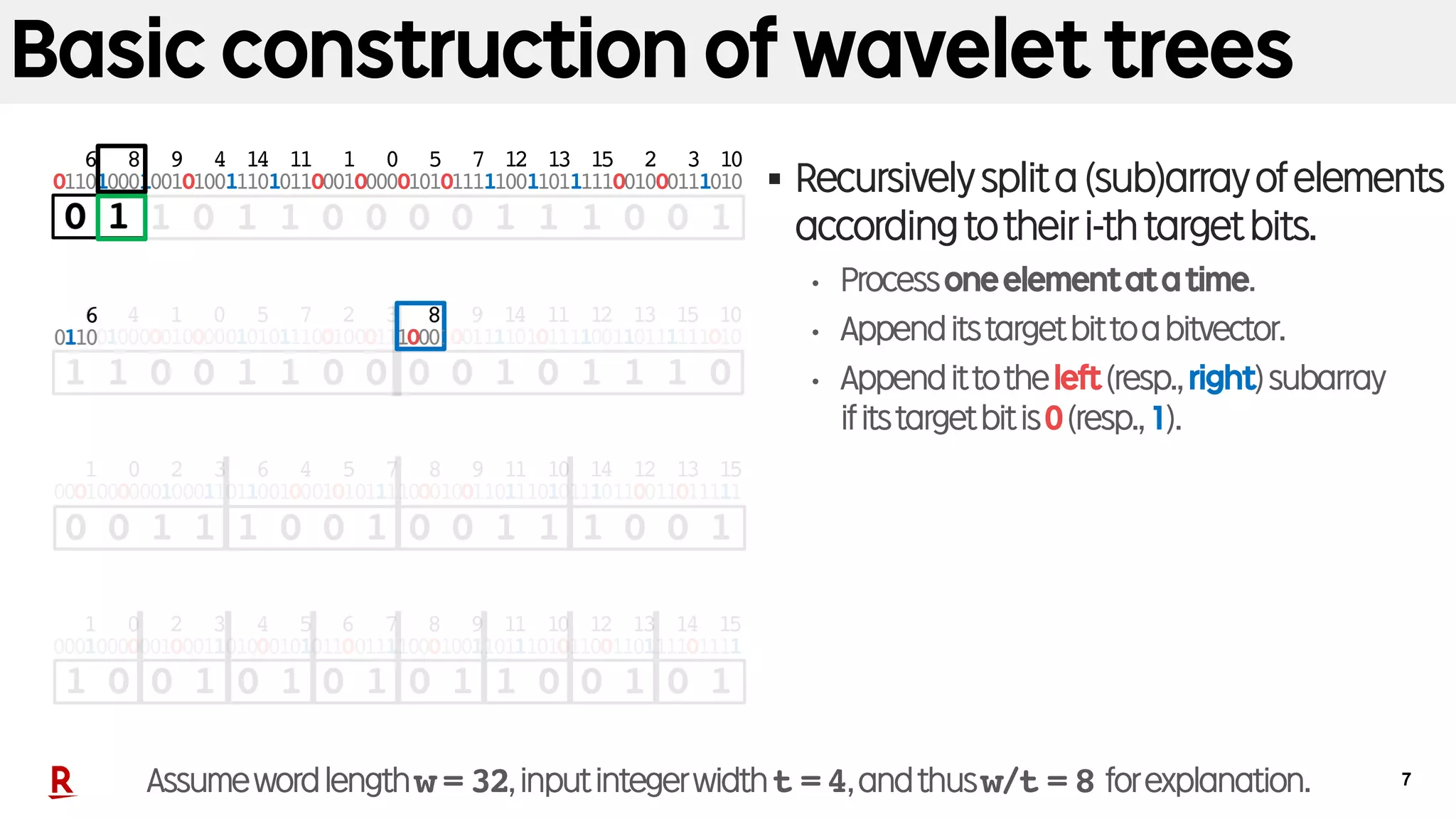
Basic construction of wavelet trees
§ Recursivelysplita(sub)arrayofelements
accordingtotheiri-thtargetbits.
• Processoneelementatatime.
• Appenditstargetbittoabitvector.
• Appendittotheleft(resp.,right)subarray
ifitstargetbitis0(resp.,1).
Assumewordlengthw = 32,inputintegerwidtht =4,andthusw/t = 8 forexplanation.
6
0110
8
1000
9
1001
4
0100
14
1110
11
1011
1
0001
0
0000
5
0101
7
0111
12
1100
15
1111
13
1101
2
0010
3
0011
10
1010
8
6
0110
8
1000
9
1001
4
0100
14
1110
11
1011
1
0001
0
0000
5
0101
7
0111
12
1100
15
1111
13
1101
2
0010
3
0011
10
1010
6
0110
8
1000
9
1001
4
0100
14
1110
11
1011
1
0001
0
0000
Fast construction of wavelet trees
§ Fastwavelettreeconstruction
[Munro+, SPIRE’14][Babenko+,SODA’15]
• Processmultipleelementsatatime.
• w/toft-bitelementscanbereadtogether.
§ Primitiveoperations:
X Bbitpack ( ,i)=
X X0listsplit( ,i)=( , )X1
X1
A subarray consisting of
X’s elements whose 0th bit 1
A subarray consisting of
X’s elements whose 0th bit 0
X0
First w/t elements in a word of w bits (e.g., w = 32 and t = 4)
X
Packed 0th bits of elements contained in X.
B
Assumewordlengthw = 32,inputintegerwidtht =4,andthusw/t = 8 forexplanation.
Assumption:
• ThestandardwordRAM
• w:wordlength(inbits)
• t:inputintegerwidth(inbits)
• t≤w justforexplanation.
(Thisconditioncanbeeliminated.)
9
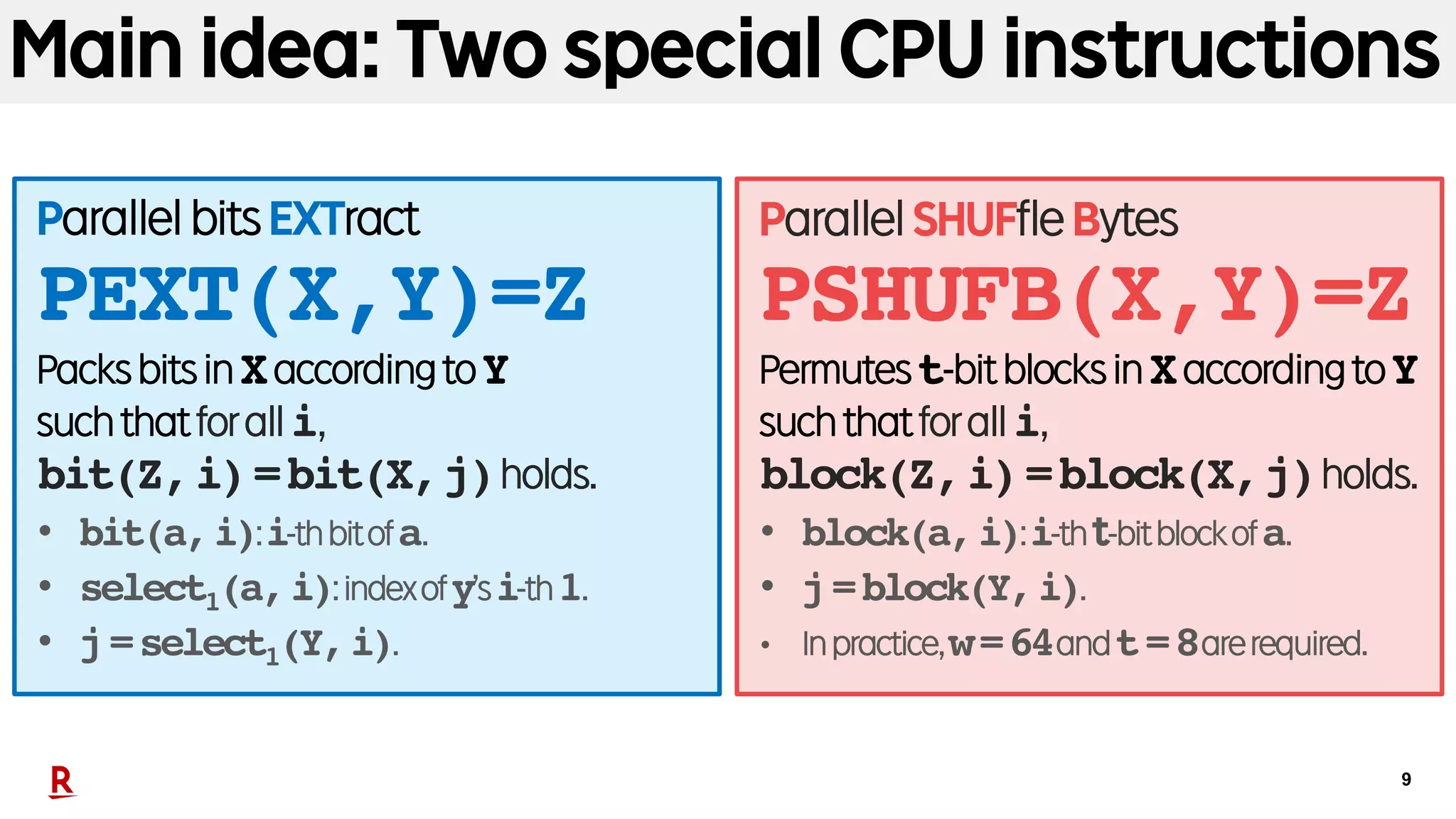
Main idea: Two special CPU instructions
ParallelbitsEXTract
PEXT(X,Y)=Z
PacksbitsinXaccordingtoY
suchthatforalli,
bit(Z,i)=bit(X,j)holds.
• bit(a,i):i-thbitofa.
• select1(a,i):indexofy’si-th1.
• j=select1(Y,i).
ParallelSHUFfleBytes
PSHUFB(X,Y)=Z
Permutest-bitblocksinXaccordingtoY
suchthatforalli,
block(Z,i)=block(X,j)holds.
• block(a,i):i-tht-bitblockofa.
• j=block(Y,i).
• Inpractice,w=64andt=8arerequired.
10
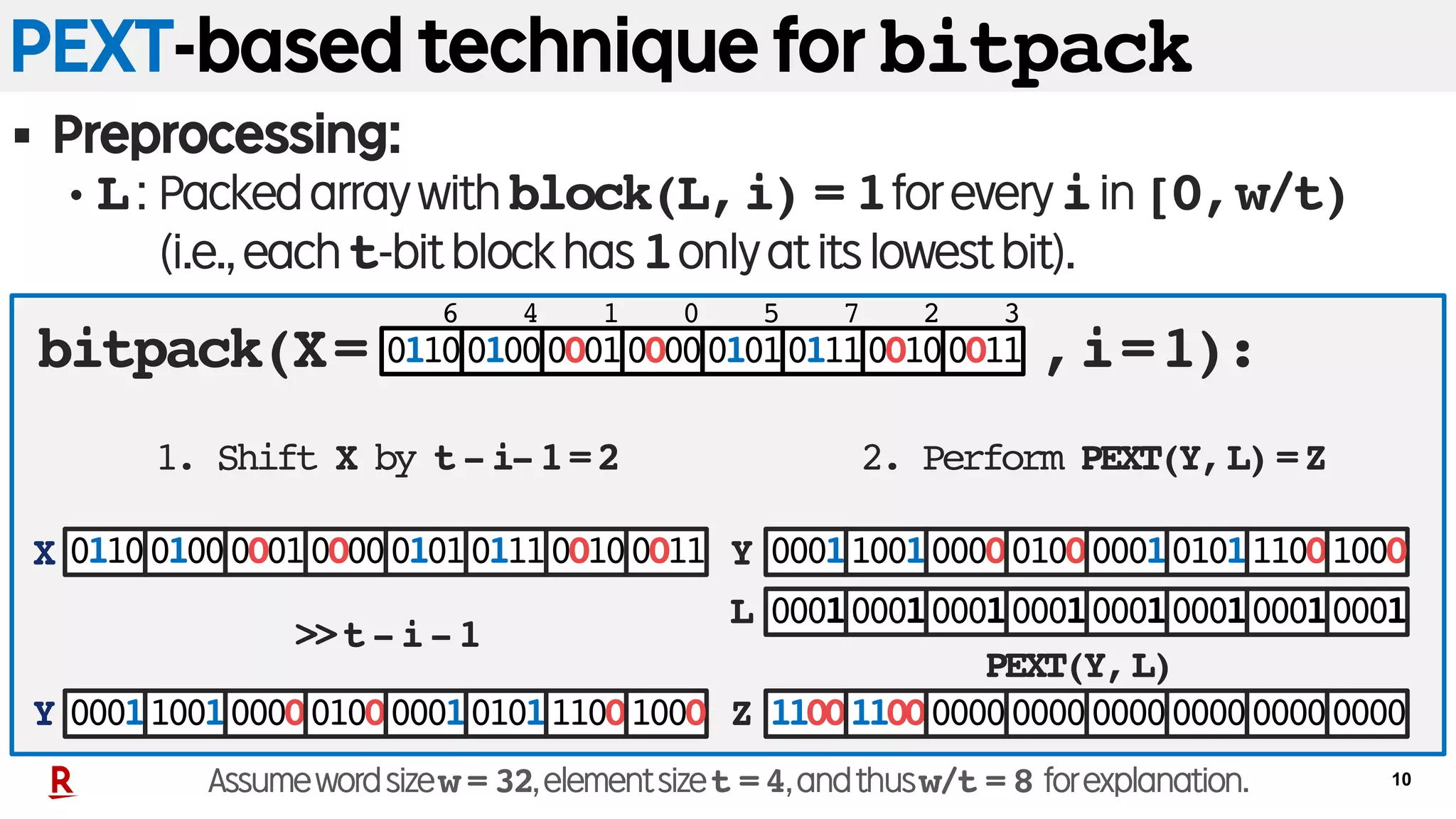
PEXT-based technique for bitpack
§ Preprocessing:
• L: Packedarraywithblock(L,i) = 1foreveryiin[0,w/t)
(i.e.,eacht-bitblockhas1onlyatitslowestbit).
Assumewordsizew = 32,elementsizet =4,andthusw/t = 8 forexplanation.
01100100000100000101011100100011
00011001000001000001010111001000
>>t-i-1
00011001000001000001010111001000
00010001000100010001000100010001L
Z
Y
Y
X
11001100000000000000000000000000
1. Shift X by t-i-1=2 2. Perform PEXT(Y,L)=Z
PEXT(Y,L)
bitpack(X= ,i=1):01100100000100000101011100100011
6 4 1 0 5 7 2 3
11
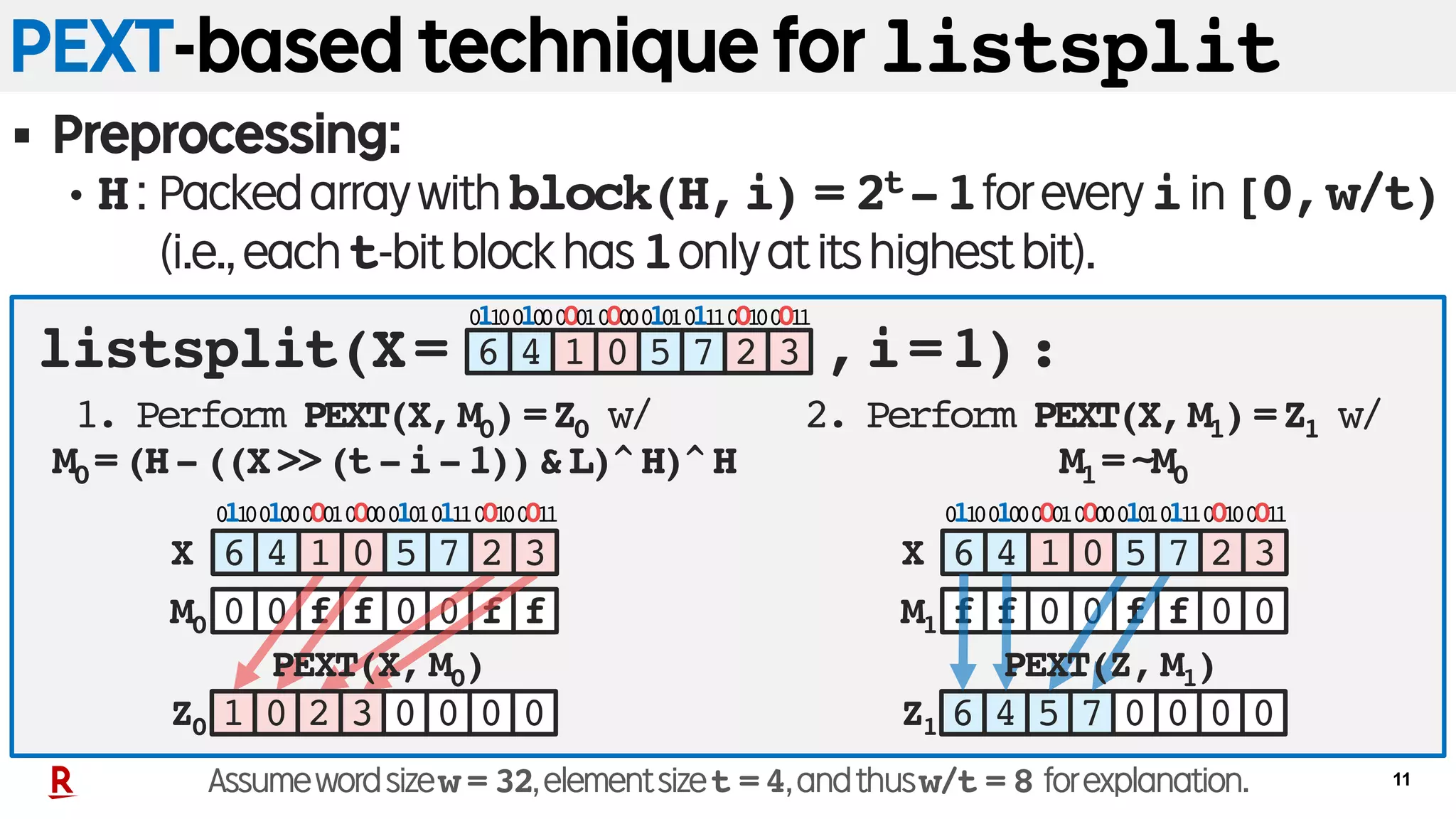
PEXT-based technique for listsplit
§ Preprocessing:
• H: Packedarraywithblock(H,i) = 2t-1foreveryiin[0,w/t)
(i.e.,eacht-bitblockhas1onlyatitshighestbit).
2. Perform PEXT(X,M1)=Z1 w/
M1=~M0
6 4 01 2 3
0 0 046 05 7
f f 0ff 00 0
75
M1
Z1
X
1. Perform PEXT(X,M0)=Z0 w/
M0=(H-((X>>(t-i-1))&L)^H)^H
0 0 f00 ff f
6 4 701 5 2 3
0 0 001 02 3
M0
Z0
X
listsplit(X= ,i=1):
PEXT(X, M0) PEXT(Z, M1)
6 4 701 5 2 3
01100100000100000101011100100011
Assumewordsizew = 32,elementsizet =4,andthusw/t = 8 forexplanation.
01100100000100000101011100100011 01100100000100000101011100100011
12
PSHUFB-based technique for listsplit
§ Preprocessing: Let m=2w/t be # of blocks in a word.
• T[a]forallain[0,m):Packedarraycontaininginascendingorder
(1)allindexesof0’sfollowedby(2)allindexesof1’sin a.
2. Extract each part from Y.
|a|1: Number of ones in a.
<<t|a|1
6 4 701 52 3
0 0 001 02 3Z0
Y 6 4 701 52 3
0 0 046 05 7Z1
Y
00010000001000110110010001010111 00010000001000110110010001010111
1. Perform PSHUFB(X,T[a]) w/
a=bitpack(X,i)=11001100
0 1 532 46 7
01100100000100000101011100100011
6 4 701 5 2 3
6 4 701 52 3
T[a]
Y
X
Assumewordsizew = 32,elementsizet =4,andthusw/t = 8 forexplanation.
>>t|a|1
<<w-t|a|1PSHUFB(X,T[a])
6 4 701 5 2 3
01100100000100000101011100100011
listsplit(X= ,i=1):
13
Experiments
14
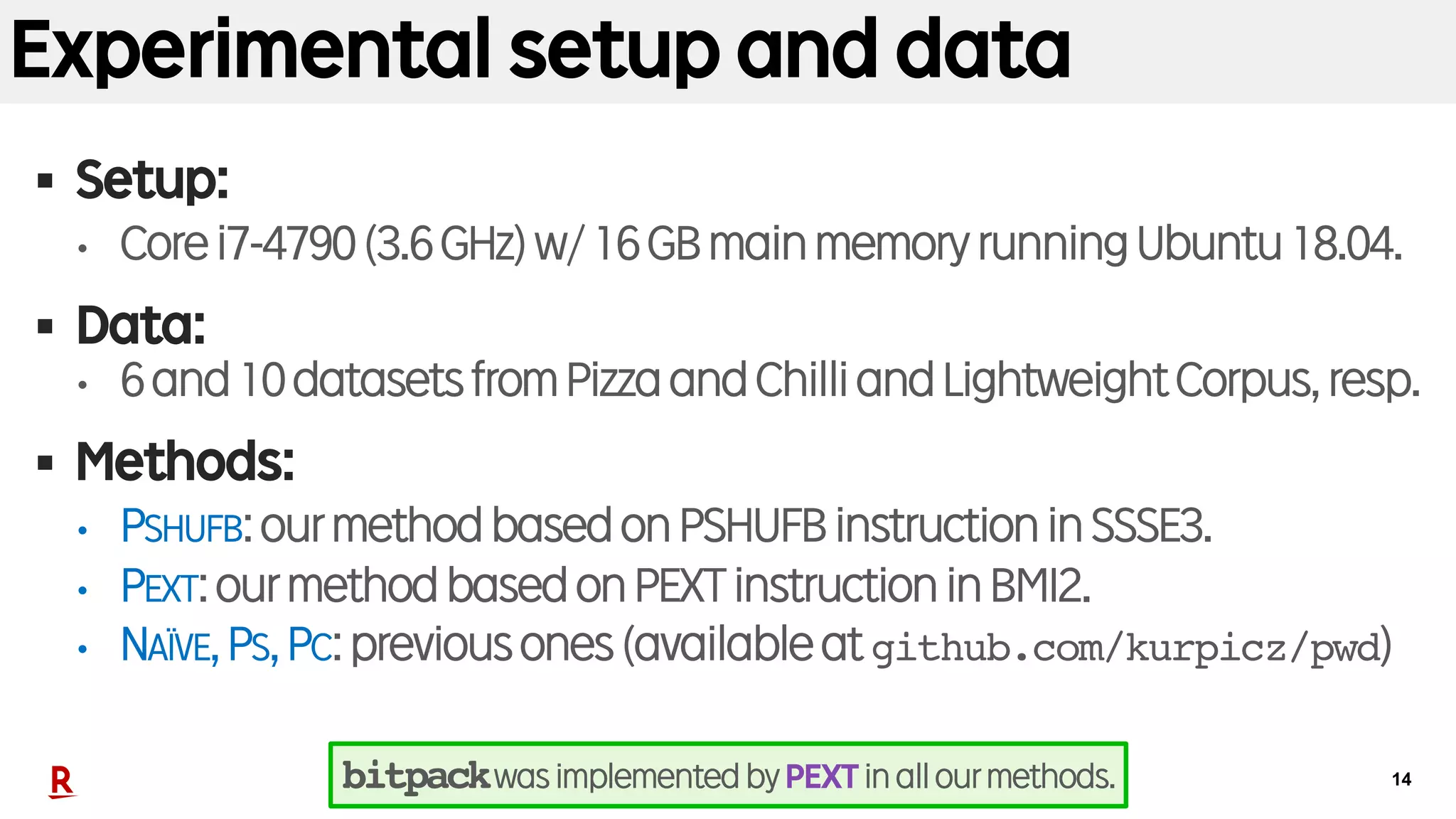
Experimental setup and data
§ Setup:
• Corei7-4790(3.6GHz)w/16GBmainmemoryrunningUbuntu18.04.
§ Data:
• 6and10datasetsfromPizzaandChilliandLightweightCorpus,resp.
§ Methods:
• PSHUFB:ourmethodbasedonPSHUFBinstructioninSSSE3.
• PEXT:ourmethodbasedonPEXTinstructioninBMI2.
• NAÏVE,PS,PC:previousones(availableatgithub.com/kurpicz/pwd)
bitpackwas implemented by PEXT in allour methods.
15
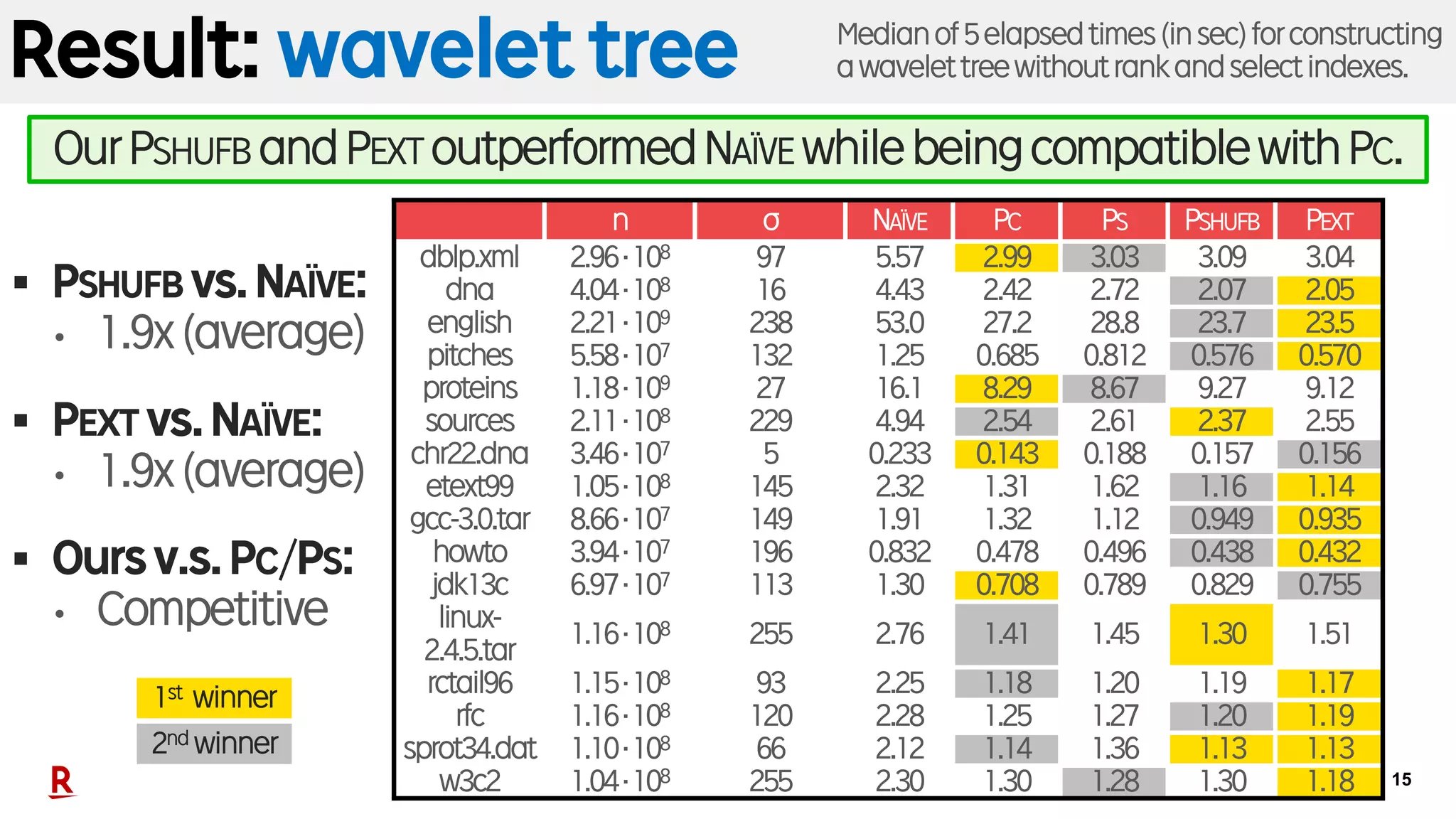
Result: wavelet tree
§ PSHUFB vs.NAÏVE:
• 1.9x(average)
§ PEXT vs.NAÏVE:
• 1.9x(average)
§ Oursv.s.PC/PS:
• Competitive
1st winner
2nd winner
Medianof5elapsedtimes(insec)forconstructing
awavelettreewithoutrankandselectindexes.
n σ NAÏVE PC PS PSHUFB PEXT
dblp.xml 2.96·108 97 5.57 2.99 3.03 3.09 3.04
dna 4.04·108 16 4.43 2.42 2.72 2.07 2.05
english 2.21·109 238 53.0 27.2 28.8 23.7 23.5
pitches 5.58·107 132 1.25 0.685 0.812 0.576 0.570
proteins 1.18·109 27 16.1 8.29 8.67 9.27 9.12
sources 2.11·108 229 4.94 2.54 2.61 2.37 2.55
chr22.dna 3.46·107 5 0.233 0.143 0.188 0.157 0.156
etext99 1.05·108 145 2.32 1.31 1.62 1.16 1.14
gcc-3.0.tar 8.66·107 149 1.91 1.32 1.12 0.949 0.935
howto 3.94·107 196 0.832 0.478 0.496 0.438 0.432
jdk13c 6.97·107 113 1.30 0.708 0.789 0.829 0.755
linux-
2.4.5.tar
1.16·108 255 2.76 1.41 1.45 1.30 1.51
rctail96 1.15·108 93 2.25 1.18 1.20 1.19 1.17
rfc 1.16·108 120 2.28 1.25 1.27 1.20 1.19
sprot34.dat 1.10·108 66 2.12 1.14 1.36 1.13 1.13
w3c2 1.04·108 255 2.30 1.30 1.28 1.30 1.18
OurPSHUFB andPEXT outperformedNAÏVE whilebeingcompatiblewithPC.
16
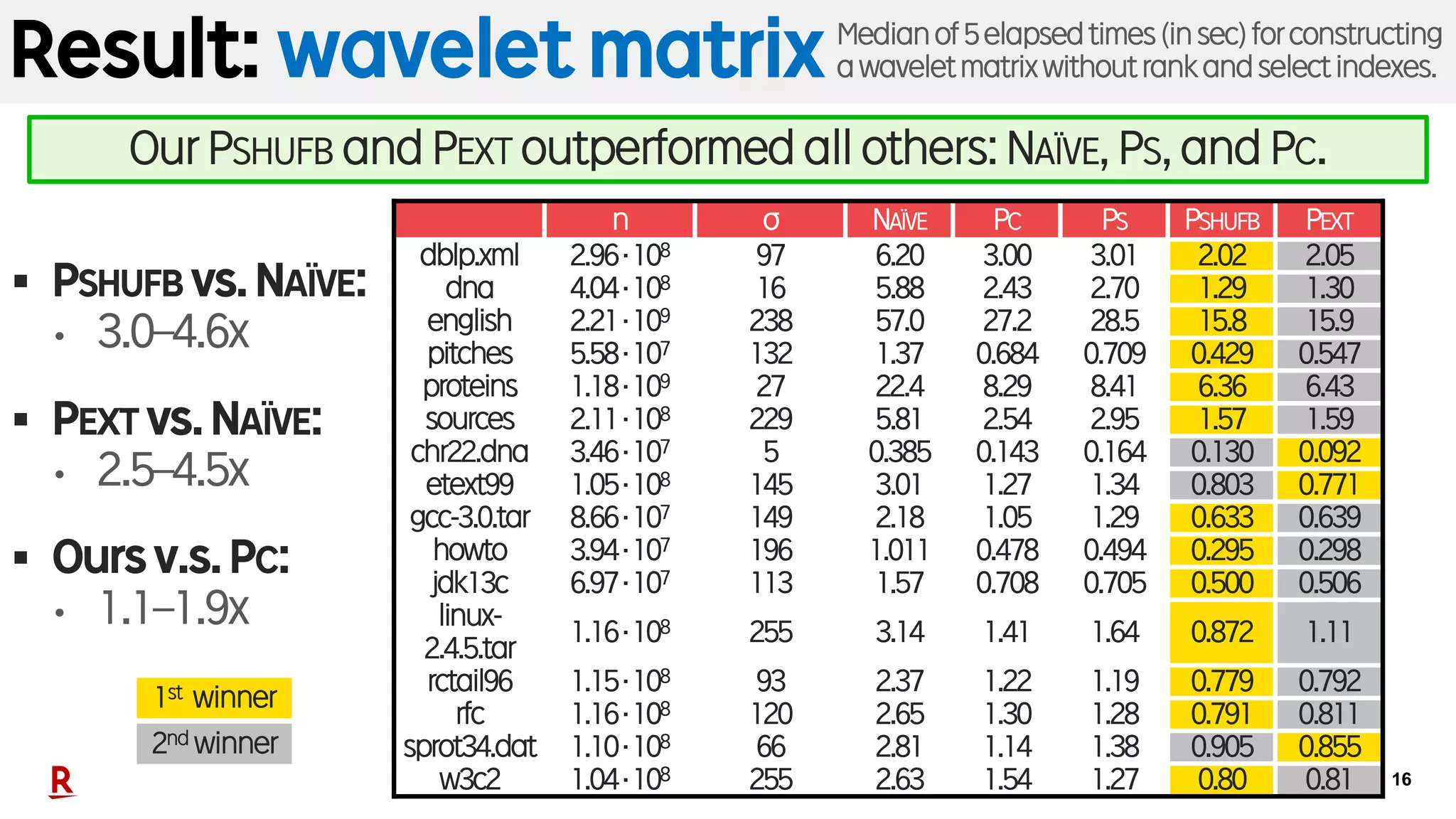
Result: wavelet matrix
§ PSHUFB vs.NAÏVE:
• 3.0–4.6x
§ PEXT vs.NAÏVE:
• 2.5–4.5x
§ Oursv.s.PC:
• 1.1–1.9x
1st winner
2nd winner
n σ NAÏVE PC PS PSHUFB PEXT
dblp.xml 2.96·108 97 6.20 3.00 3.01 2.02 2.05
dna 4.04·108 16 5.88 2.43 2.70 1.29 1.30
english 2.21·109 238 57.0 27.2 28.5 15.8 15.9
pitches 5.58·107 132 1.37 0.684 0.709 0.429 0.547
proteins 1.18·109 27 22.4 8.29 8.41 6.36 6.43
sources 2.11·108 229 5.81 2.54 2.95 1.57 1.59
chr22.dna 3.46·107 5 0.385 0.143 0.164 0.130 0.092
etext99 1.05·108 145 3.01 1.27 1.34 0.803 0.771
gcc-3.0.tar 8.66·107 149 2.18 1.05 1.29 0.633 0.639
howto 3.94·107 196 1.011 0.478 0.494 0.295 0.298
jdk13c 6.97·107 113 1.57 0.708 0.705 0.500 0.506
linux-
2.4.5.tar
1.16·108 255 3.14 1.41 1.64 0.872 1.11
rctail96 1.15·108 93 2.37 1.22 1.19 0.779 0.792
rfc 1.16·108 120 2.65 1.30 1.28 0.791 0.811
sprot34.dat 1.10·108 66 2.81 1.14 1.38 0.905 0.855
w3c2 1.04·108 255 2.63 1.54 1.27 0.80 0.81
Medianof5elapsedtimes(insec)forconstructing
awaveletmatrixwithoutrankandselectindexes.
Our PSHUFB and PEXT outperformed all others: NAÏVE, PS, and PC.
17
Conclusion
§ Practical wavelet tree construction using PEXT/PSHUFB.
• Based on [Munro+, SPIRE’14] and [Babenko+, SODA’15]
§ Experiments on real datasets:
• Wavelet tree: Faster than NAÏVE and competitive w/ SOTA:
prefix sorting (PS) and prefix counting (PC).
• Wavelet matrix: Faster than NAÏVE, PS, and PC.
§ Future work
• Exploit moreparallelismin CPUcoresand/orSIMD registers.
Fast Wavelet Tree Construction in Practice

Fast Wavelet Tree Construction in Practice

  • 1.
    Fast Wavelet TreeConstruction in Practice 2018/10/10 Yusaku Kaneta Rakuten Institute of Technology Rakuten, Inc.
  • 2.
    2 Background § Wavelet tree[Grossi+,SODA’03] / Wavele matrix [Claude+,SPIRE’12] • Fundamentaltoolsinmodernstringprocessing. • Fastaccess,rank,andselectonanarrayofnintegersin[0,σ). 10 1 1 0 1 1 000 10 10 01 11 0 01 1 0100 11 00 0 1 1 0 100 01 1 00 0 11 1 10 00 101 10 1 10 1 01 00 1 Awavelettreeson[6,8,9,4,14,11,1,0,5,7,12,13,15,2,3,10]
  • 3.
    3 Fast WT constructionhas attracted much attension!! Papers Sequential? Parallel? Impl.? [Fuentes-Sepúlveda+,SEA’14] P Yes [Shun+,DCC’15] P Yes [Labeit+,DCC’16] P Yes [Fischer+,ALENEX’18] S+P Yes [Munro+,SPIRE’14][Babenko+,SODA’15](Bestupperbound) S No [Shun+,DCC’17](Bestupperbound) P No § Gap between theory and practice: • Nopracticalimplementationof[Munro+,SPIRE’14][Babenko+, SODA’15]:Thecurrentfastestwavelettreeconstructionalgorithm.
  • 4.
    4 First* practical implementationof wavelet tree construction based on [Munro+, SPIRE’14][Babenko+, SODA’15] Main result § Our idea: Replace precomputed tables w/ • SpecialCPUinstruction:PEXTin(BMI2)orPSHUFB(inSSSE3). • Broadwordcomputation(omitted). § Experiments on real datasets: • Wavelettree:ourswerecompetitivetoSOTA[Fischer+,ALENEX'18] • Waveletmatrix:ourswere1.1–1.9xfasterthanSOTA. *SzymonGrabowskikindlypointedthatTuukkaNorrialsotriedsimilarapproaches: github.com/tsnorri/wt-construct-gn
  • 5.
  • 6.
    6 Basic construction ofwavelet trees § Recursivelysplita(sub)arrayofelements accordingtotheiri-thtargetbits. • Processoneelementatatime. • Appenditstargetbittoabitvector. • Appendittotheleft(resp.,right)subarray ifitstargetbitis0(resp.,1). Assumewordlengthw = 32,inputintegerwidtht =4,andthusw/t = 8 forexplanation. 6 0110 8 1000 9 1001 4 0100 14 1110 11 1011 1 0001 0 0000 5 0101 7 0111 12 1100 15 1111 13 1101 2 0010 3 0011 10 1010
  • 7.
    7 Basic construction ofwavelet trees § Recursivelysplita(sub)arrayofelements accordingtotheiri-thtargetbits. • Processoneelementatatime. • Appenditstargetbittoabitvector. • Appendittotheleft(resp.,right)subarray ifitstargetbitis0(resp.,1). Assumewordlengthw = 32,inputintegerwidtht =4,andthusw/t = 8 forexplanation. 6 0110 8 1000 9 1001 4 0100 14 1110 11 1011 1 0001 0 0000 5 0101 7 0111 12 1100 15 1111 13 1101 2 0010 3 0011 10 1010
  • 8.
    8 6 0110 8 1000 9 1001 4 0100 14 1110 11 1011 1 0001 0 0000 5 0101 7 0111 12 1100 15 1111 13 1101 2 0010 3 0011 10 1010 6 0110 8 1000 9 1001 4 0100 14 1110 11 1011 1 0001 0 0000 Fast construction ofwavelet trees § Fastwavelettreeconstruction [Munro+, SPIRE’14][Babenko+,SODA’15] • Processmultipleelementsatatime. • w/toft-bitelementscanbereadtogether. § Primitiveoperations: X Bbitpack ( ,i)= X X0listsplit( ,i)=( , )X1 X1 A subarray consisting of X’s elements whose 0th bit 1 A subarray consisting of X’s elements whose 0th bit 0 X0 First w/t elements in a word of w bits (e.g., w = 32 and t = 4) X Packed 0th bits of elements contained in X. B Assumewordlengthw = 32,inputintegerwidtht =4,andthusw/t = 8 forexplanation. Assumption: • ThestandardwordRAM • w:wordlength(inbits) • t:inputintegerwidth(inbits) • t≤w justforexplanation. (Thisconditioncanbeeliminated.)
  • 9.
    9 Main idea: Twospecial CPU instructions ParallelbitsEXTract PEXT(X,Y)=Z PacksbitsinXaccordingtoY suchthatforalli, bit(Z,i)=bit(X,j)holds. • bit(a,i):i-thbitofa. • select1(a,i):indexofy’si-th1. • j=select1(Y,i). ParallelSHUFfleBytes PSHUFB(X,Y)=Z Permutest-bitblocksinXaccordingtoY suchthatforalli, block(Z,i)=block(X,j)holds. • block(a,i):i-tht-bitblockofa. • j=block(Y,i). • Inpractice,w=64andt=8arerequired.
  • 10.
    10 PEXT-based technique forbitpack § Preprocessing: • L: Packedarraywithblock(L,i) = 1foreveryiin[0,w/t) (i.e.,eacht-bitblockhas1onlyatitslowestbit). Assumewordsizew = 32,elementsizet =4,andthusw/t = 8 forexplanation. 01100100000100000101011100100011 00011001000001000001010111001000 >>t-i-1 00011001000001000001010111001000 00010001000100010001000100010001L Z Y Y X 11001100000000000000000000000000 1. Shift X by t-i-1=2 2. Perform PEXT(Y,L)=Z PEXT(Y,L) bitpack(X= ,i=1):01100100000100000101011100100011 6 4 1 0 5 7 2 3
  • 11.
    11 PEXT-based technique forlistsplit § Preprocessing: • H: Packedarraywithblock(H,i) = 2t-1foreveryiin[0,w/t) (i.e.,eacht-bitblockhas1onlyatitshighestbit). 2. Perform PEXT(X,M1)=Z1 w/ M1=~M0 6 4 01 2 3 0 0 046 05 7 f f 0ff 00 0 75 M1 Z1 X 1. Perform PEXT(X,M0)=Z0 w/ M0=(H-((X>>(t-i-1))&L)^H)^H 0 0 f00 ff f 6 4 701 5 2 3 0 0 001 02 3 M0 Z0 X listsplit(X= ,i=1): PEXT(X, M0) PEXT(Z, M1) 6 4 701 5 2 3 01100100000100000101011100100011 Assumewordsizew = 32,elementsizet =4,andthusw/t = 8 forexplanation. 01100100000100000101011100100011 01100100000100000101011100100011
  • 12.
    12 PSHUFB-based technique forlistsplit § Preprocessing: Let m=2w/t be # of blocks in a word. • T[a]forallain[0,m):Packedarraycontaininginascendingorder (1)allindexesof0’sfollowedby(2)allindexesof1’sin a. 2. Extract each part from Y. |a|1: Number of ones in a. <<t|a|1 6 4 701 52 3 0 0 001 02 3Z0 Y 6 4 701 52 3 0 0 046 05 7Z1 Y 00010000001000110110010001010111 00010000001000110110010001010111 1. Perform PSHUFB(X,T[a]) w/ a=bitpack(X,i)=11001100 0 1 532 46 7 01100100000100000101011100100011 6 4 701 5 2 3 6 4 701 52 3 T[a] Y X Assumewordsizew = 32,elementsizet =4,andthusw/t = 8 forexplanation. >>t|a|1 <<w-t|a|1PSHUFB(X,T[a]) 6 4 701 5 2 3 01100100000100000101011100100011 listsplit(X= ,i=1):
  • 13.
  • 14.
    14 Experimental setup anddata § Setup: • Corei7-4790(3.6GHz)w/16GBmainmemoryrunningUbuntu18.04. § Data: • 6and10datasetsfromPizzaandChilliandLightweightCorpus,resp. § Methods: • PSHUFB:ourmethodbasedonPSHUFBinstructioninSSSE3. • PEXT:ourmethodbasedonPEXTinstructioninBMI2. • NAÏVE,PS,PC:previousones(availableatgithub.com/kurpicz/pwd) bitpackwas implemented by PEXT in allour methods.
  • 15.
    15 Result: wavelet tree §PSHUFB vs.NAÏVE: • 1.9x(average) § PEXT vs.NAÏVE: • 1.9x(average) § Oursv.s.PC/PS: • Competitive 1st winner 2nd winner Medianof5elapsedtimes(insec)forconstructing awavelettreewithoutrankandselectindexes. n σ NAÏVE PC PS PSHUFB PEXT dblp.xml 2.96·108 97 5.57 2.99 3.03 3.09 3.04 dna 4.04·108 16 4.43 2.42 2.72 2.07 2.05 english 2.21·109 238 53.0 27.2 28.8 23.7 23.5 pitches 5.58·107 132 1.25 0.685 0.812 0.576 0.570 proteins 1.18·109 27 16.1 8.29 8.67 9.27 9.12 sources 2.11·108 229 4.94 2.54 2.61 2.37 2.55 chr22.dna 3.46·107 5 0.233 0.143 0.188 0.157 0.156 etext99 1.05·108 145 2.32 1.31 1.62 1.16 1.14 gcc-3.0.tar 8.66·107 149 1.91 1.32 1.12 0.949 0.935 howto 3.94·107 196 0.832 0.478 0.496 0.438 0.432 jdk13c 6.97·107 113 1.30 0.708 0.789 0.829 0.755 linux- 2.4.5.tar 1.16·108 255 2.76 1.41 1.45 1.30 1.51 rctail96 1.15·108 93 2.25 1.18 1.20 1.19 1.17 rfc 1.16·108 120 2.28 1.25 1.27 1.20 1.19 sprot34.dat 1.10·108 66 2.12 1.14 1.36 1.13 1.13 w3c2 1.04·108 255 2.30 1.30 1.28 1.30 1.18 OurPSHUFB andPEXT outperformedNAÏVE whilebeingcompatiblewithPC.
  • 16.
    16 Result: wavelet matrix §PSHUFB vs.NAÏVE: • 3.0–4.6x § PEXT vs.NAÏVE: • 2.5–4.5x § Oursv.s.PC: • 1.1–1.9x 1st winner 2nd winner n σ NAÏVE PC PS PSHUFB PEXT dblp.xml 2.96·108 97 6.20 3.00 3.01 2.02 2.05 dna 4.04·108 16 5.88 2.43 2.70 1.29 1.30 english 2.21·109 238 57.0 27.2 28.5 15.8 15.9 pitches 5.58·107 132 1.37 0.684 0.709 0.429 0.547 proteins 1.18·109 27 22.4 8.29 8.41 6.36 6.43 sources 2.11·108 229 5.81 2.54 2.95 1.57 1.59 chr22.dna 3.46·107 5 0.385 0.143 0.164 0.130 0.092 etext99 1.05·108 145 3.01 1.27 1.34 0.803 0.771 gcc-3.0.tar 8.66·107 149 2.18 1.05 1.29 0.633 0.639 howto 3.94·107 196 1.011 0.478 0.494 0.295 0.298 jdk13c 6.97·107 113 1.57 0.708 0.705 0.500 0.506 linux- 2.4.5.tar 1.16·108 255 3.14 1.41 1.64 0.872 1.11 rctail96 1.15·108 93 2.37 1.22 1.19 0.779 0.792 rfc 1.16·108 120 2.65 1.30 1.28 0.791 0.811 sprot34.dat 1.10·108 66 2.81 1.14 1.38 0.905 0.855 w3c2 1.04·108 255 2.63 1.54 1.27 0.80 0.81 Medianof5elapsedtimes(insec)forconstructing awaveletmatrixwithoutrankandselectindexes. Our PSHUFB and PEXT outperformed all others: NAÏVE, PS, and PC.
  • 17.
    17 Conclusion § Practical wavelettree construction using PEXT/PSHUFB. • Based on [Munro+, SPIRE’14] and [Babenko+, SODA’15] § Experiments on real datasets: • Wavelet tree: Faster than NAÏVE and competitive w/ SOTA: prefix sorting (PS) and prefix counting (PC). • Wavelet matrix: Faster than NAÏVE, PS, and PC. § Future work • Exploit moreparallelismin CPUcoresand/orSIMD registers.