Dynamic Memory Allocation I
Topics
 Basic representation and alignment (mainly for static memory
allocation, main concepts carry over to dynamic memory
allocation)
 Simple explicit allocators
 Data structures
 Policies
 Mechanisms
Readings
 Bryant & O’Hallaron textbook
 section 10.9: Dynamic Memory Allocation
– 2 –
Data Representations
Sizes of C Objects (in Bytes)
 C Data Type Intel IA32
 int 4 (1 word)
 long int 4
 char 1
 short 2
 float 4
 double 8 (2 words)
 char * 4
» Or any other pointer
 A word is 4 bytes
– 3 –
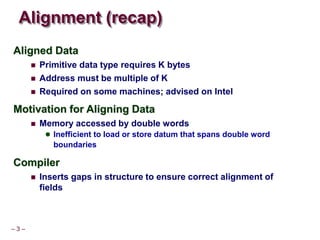
Alignment (recap)
Aligned Data
 Primitive data type requires K bytes
 Address must be multiple of K
 Required on some machines; advised on Intel
Motivation for Aligning Data
 Memory accessed by double words
 Inefficient to load or store datum that spans double word
boundaries
Compiler
 Inserts gaps in structure to ensure correct alignment of
fields
– 4 –
struct rec {
int i;
int a[3];
int *p;
};
Structures
Concept
 Contiguously-allocated region of memory
 Refer to members within structure by names
 Members may be of different types
Memory Layout
i a p
0 4 16 20
– 5 –
Specific Cases of Alignment
Size of Primitive Data Type:
 1 byte (e.g., char)
 no restrictions on address
 2 bytes (e.g., short)
 lowest 1 bit of address is 0(2)
 4 bytes (e.g., int, float, char *, etc.)
 lowest 2 bits of address - 00(2)
 8 bytes (e.g., double)
 lowest 3 bits of address 000(2)
– 6 –
Satisfying Alignment with Structures
Offsets Within Structure
 Must satisfy element’s alignment requirement
Overall Structure Placement
 Each structure has alignment requirement K
 Largest alignment of any element
 Initial address & structure length must be
multiples of K
– 7 –
Example (under Linux)
 K = 4, due to int element
struct S1 {
char c;
int i[2];
} *p;
c i[0] i[1]
p+0 p+4 p+8
Multiple of 4 Multiple of 4
Multiple of 4
p+12
– 8 –
Overall Alignment Requirement
struct S2{
float x[2];
int i[2];
char c;
} *p;
c
i[0] i[1]
p+0 p+12
p+8 p+16 p+20
x[0] x[1]
p+4
p must be multiple of 4
– 9 –
Arrays of Structures
Principle
 Allocated by repeating allocation
for array type
a[0]
a+0
a[1] a[2]
a+12 a+24 a+36
• • •
a+12 a+20
a+16 a+24
struct S3 {
short i;
float v;
short j;
} a[10];
a[1].i a[1].j
a[1].v
– 10 –
Misc: Boolean (“Bitwise”) Operators
Operate on numbers as Bit Vectors
 Operations applied bitwise
01101001
& 01010101
01000001
01101001
| 01010101
01111101
01101001
^ 01010101
00111100
~ 01010101
10101010
– 11 –
– 12 –
Dynamic Memory Allocation
Explicit vs. Implicit Memory Allocator
 Explicit: application allocates and frees space
 E.g., malloc and free in C
 Implicit: application allocates, but does not free space
 E.g. garbage collection in Java
Application
Dynamic Memory Allocator
Heap Memory
– 13 –
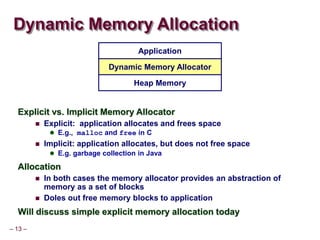
Dynamic Memory Allocation
Explicit vs. Implicit Memory Allocator
 Explicit: application allocates and frees space
 E.g., malloc and free in C
 Implicit: application allocates, but does not free space
 E.g. garbage collection in Java
Allocation
 In both cases the memory allocator provides an abstraction of
memory as a set of blocks
 Doles out free memory blocks to application
Will discuss simple explicit memory allocation today
Application
Dynamic Memory Allocator
Heap Memory
– 14 –
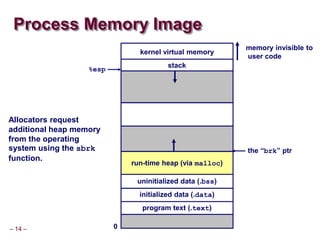
Process Memory Image
kernel virtual memory
run-time heap (via malloc)
program text (.text)
initialized data (.data)
uninitialized data (.bss)
stack
0
%esp
memory invisible to
user code
the “brk” ptr
Allocators request
additional heap memory
from the operating
system using the sbrk
function.
– 15 –
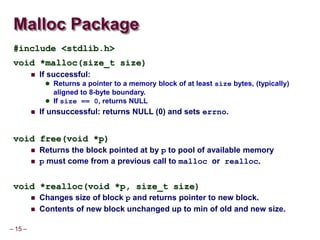
Malloc Package
#include <stdlib.h>
void *malloc(size_t size)
 If successful:
 Returns a pointer to a memory block of at least size bytes, (typically)
aligned to 8-byte boundary.
 If size == 0, returns NULL
 If unsuccessful: returns NULL (0) and sets errno.
void free(void *p)
 Returns the block pointed at by p to pool of available memory
 p must come from a previous call to malloc or realloc.
void *realloc(void *p, size_t size)
 Changes size of block p and returns pointer to new block.
 Contents of new block unchanged up to min of old and new size.
– 16 –
Malloc Example
– 17 –
Assumptions
Assumptions made in this lecture
 Memory is word addressed
Allocated block
(4 words)
Free block
(3 words)
Free word
Allocated word
– 18 –
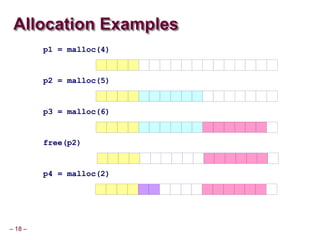
Allocation Examples
p1 = malloc(4)
p2 = malloc(5)
p3 = malloc(6)
free(p2)
p4 = malloc(2)
– 19 –
Constraints
Applications:
 Can issue arbitrary sequence of allocation and free requests
 Free requests must correspond to an allocated block
– 20 –
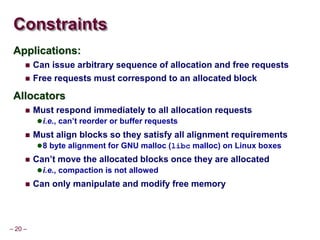
Constraints
Applications:
 Can issue arbitrary sequence of allocation and free requests
 Free requests must correspond to an allocated block
Allocators
 Must respond immediately to all allocation requests
i.e., can’t reorder or buffer requests
 Must align blocks so they satisfy all alignment requirements
8 byte alignment for GNU malloc (libc malloc) on Linux boxes
 Can’t move the allocated blocks once they are allocated
i.e., compaction is not allowed
 Can only manipulate and modify free memory
– 21 –
Goals of Good malloc/free
Primary goals
 Good time performance for malloc and free
 Ideally should take constant time (not always possible)
 Should certainly not take linear time in the number of blocks
 Good space utilization
 Want to minimize “fragmentation”.
Some other goals
 Good locality properties
 Structures allocated close in time should be close in space
– 22 –
Performance Goals: Throughput
Given some sequence of malloc and free requests:
 R0, R1, ..., Rk, ... , Rn-1
Want to maximize throughput and peak memory
utilization.
 These goals are often conflicting
Throughput:
 Number of completed requests per unit time
 Example:
 5,000 malloc calls and 5,000 free calls in 10 seconds
 Throughput is 1,000 operations/second.
– 23 –
Performance Goals:
Peak Memory Utilization
Def: Aggregate payload Pk:
 malloc(p) results in a block with a payload of p bytes..
 Aggregate payload Pk is the sum of currently allocated
payloads.
Def: Current heap size is denoted by Hk
Def: Peak memory utilization:
 After k requests, peak memory utilization is:
 Uk = ( maxi<k Pi ) / Hk
– 24 –
Internal Fragmentation
Poor memory utilization caused by fragmentation.
 Comes in two forms: internal and external fragmentation
Internal fragmentation
 Depends only on the pattern of previous requests, and thus
is easy to measure.
payload
Internal
fragmentation
block
Internal
fragmentation
– 25 –
External Fragmentation
p1 = malloc(4)
p2 = malloc(5)
p3 = malloc(6)
free(p2)
p4 = malloc(7)
oops!
Occurs when there is enough aggregate heap memory, but no single
free block is large enough
External fragmentation depends on the pattern of future requests, and
thus is difficult to measure.
– 26 –
Implementation Issues
 How do we know how much memory to free just
given a pointer?
 How do we keep track of the free blocks?
 What do we do with the extra space ?
 How do we pick a block to use ?
 How do we reinsert freed block?
p0
– 27 –
Knowing How Much to Free
Standard method
 Keep the length of a block in the word preceding the block.
This word is often called the header
 Requires an extra word for every allocated block
free(p0)
p0 = malloc(4) p0
Block size data
5
– 28 –
Boolean (“Bitwise”) Operators
Operate on numbers as Bit Vectors
 Operations applied bitwise
01101001
& 01010101
01000001
01101001
| 01010101
01111101
01101001
^ 01010101
00111100
~ 01010101
10101010
– 29 –
Keeping Track of Free Blocks
Method 1: Implicit list using lengths -- links all blocks
Method 2: Explicit list among the free blocks using
pointers within the free blocks
Method 3: Segregated free list
 Different free lists for different size classes
Method 4: Blocks sorted by size
 Can use a balanced tree (e.g. Red-Black tree) with pointers
within each free block, and the length used as a key
5 4 2
6
5 4 2
6
– 30 –
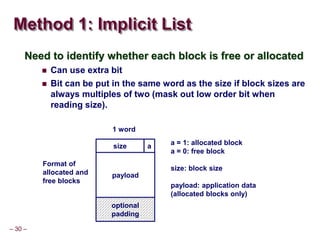
Method 1: Implicit List
Need to identify whether each block is free or allocated
 Can use extra bit
 Bit can be put in the same word as the size if block sizes are
always multiples of two (mask out low order bit when
reading size).
size
1 word
Format of
allocated and
free blocks
payload
a = 1: allocated block
a = 0: free block
size: block size
payload: application data
(allocated blocks only)
a
optional
padding
– 31 –
Implicit List: Finding a Free Block
First fit:
 Search list from beginning, choose first free block that fits
 Can take linear time in total number of blocks (allocated and free)
 In practice it can cause “splinters” at beginning of list
– 32 –
– 33 –
Implicit List: Finding a Free Block
Next fit:
 Like first-fit, but search list from location of end of previous search
 Research suggests that fragmentation is worse
Best fit:
 Search the list, choose the free block with the closest size that fits
 Keeps fragments small --- usually helps fragmentation
 Will typically run slower than first-fit
– 34 –
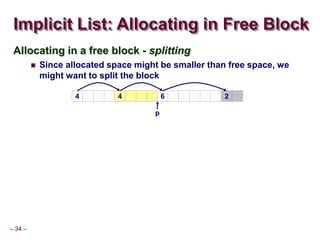
Implicit List: Allocating in Free Block
Allocating in a free block - splitting
 Since allocated space might be smaller than free space, we
might want to split the block
4 4 2
6
p
– 35 –
Implicit List: Allocating in Free Block
4 4 2
6
4 2
p
4
addblock(p, 2)
– 36 –
– 37 –
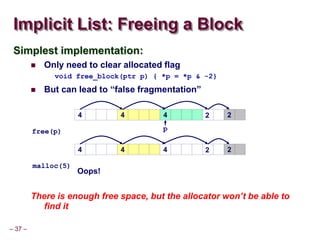
Implicit List: Freeing a Block
Simplest implementation:
 Only need to clear allocated flag
void free_block(ptr p) { *p = *p & -2}
 But can lead to “false fragmentation”
There is enough free space, but the allocator won’t be able to
find it
4 2
4 2
free(p) p
4 4 2
4
4 2
malloc(5)
Oops!
– 38 –
Implicit List: Coalescing
Join (coalesce) with next and/or previous block
if they are free
 Coalescing with next block
4 2
4 2
p
4 4 2
4
– 39 –
Implicit List: Coalescing
Join (coalesce) with next and/or previous block
if they are free
 Coalescing with next block
 But how do we coalesce with previous block?
4 2
4 2
free(p) p
4 4 2
4
– 40 –
– 41 –
Implicit List: Bidirectional Coalescing
Boundary tags [Knuth73]
4 4 4 4 6 4
6 4
– 42 –
Implicit List: Bidirectional Coalescing
Boundary tags [Knuth73]
size
1 word
Format of
allocated and
free blocks
payload and
padding
a = 1: allocated block
a = 0: free block
size: total block size
payload: application data
(allocated blocks only)
a
size a
Boundary tag
(footer)
4 4 4 4 6 4
6 4
Header
– 43 –
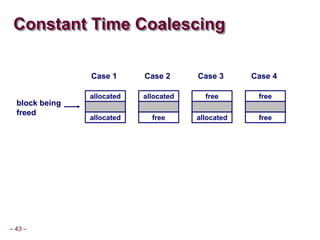
Constant Time Coalescing
allocated
allocated
allocated
free
free
allocated
free
free
block being
freed
Case 1 Case 2 Case 3 Case 4
– 44 –
m1 1
Constant Time Coalescing (Case 1)
m1 1
n 1
n 1
m2 1
m2 1
m1 1
m1 1
n 0
n 0
m2 1
m2 1
– 45 –
m1 1
Constant Time Coalescing (Case 2)
m1 1
n+m2 0
n+m2 0
m1 1
m1 1
n 1
n 1
m2 0
m2 0
– 46 –
m1 0
Constant Time Coalescing (Case 3)
m1 0
n 1
n 1
m2 1
m2 1
n+m1 0
n+m1 0
m2 1
m2 1
– 47 –
m1 0
Constant Time Coalescing (Case 4)
m1 0
n 1
n 1
m2 0
m2 0
n+m1+m2 0
n+m1+m2 0
– 48 –
Summary of Key Allocator Policies
Placement policy:
 First fit, next fit, best fit, etc.
 Trades off lower throughput for less fragmentation
 Interesting observation: segregated free lists (next lecture)
approximate a best fit placement policy without having to
search entire free list.
– 49 –
Summary of Key Allocator Policies
Placement policy:
 First fit, next fit, best fit, etc.
 Trades off lower throughput for less fragmentation
 Interesting observation: segregated free lists (next lecture)
approximate a best fit placement policy without having to
search entire free list.
Coalescing policy:
 Immediate coalescing: coalesce adjacent blocks each time
free is called
 Deferred coalescing: try to improve performance of free by
deferring coalescing until needed. e.g.,
 Coalesce as you scan the free list for malloc.
 Coalesce when the amount of external fragmentation reaches
some threshold.
– 50 –
Implicit Lists: Summary
 Implementation: very simple
 Allocate: linear time worst case
 Free: constant time worst case -- even with coalescing
 Memory usage: will depend on placement policy
 First fit, next fit or best fit
Not used in practice for malloc/free because of linear
time allocate. Used in many special purpose
applications.
However, the concepts of splitting and boundary tag
coalescing are general to all allocators.

Dynamic memory allocation Dynamic Memory Allocation I. Topics. Basic representation and alignment (mainly for static memory allocatioDMA in C

  • 1.
    Dynamic Memory AllocationI Topics  Basic representation and alignment (mainly for static memory allocation, main concepts carry over to dynamic memory allocation)  Simple explicit allocators  Data structures  Policies  Mechanisms Readings  Bryant & O’Hallaron textbook  section 10.9: Dynamic Memory Allocation
  • 2.
    – 2 – DataRepresentations Sizes of C Objects (in Bytes)  C Data Type Intel IA32  int 4 (1 word)  long int 4  char 1  short 2  float 4  double 8 (2 words)  char * 4 » Or any other pointer  A word is 4 bytes
  • 3.
    – 3 – Alignment(recap) Aligned Data  Primitive data type requires K bytes  Address must be multiple of K  Required on some machines; advised on Intel Motivation for Aligning Data  Memory accessed by double words  Inefficient to load or store datum that spans double word boundaries Compiler  Inserts gaps in structure to ensure correct alignment of fields
  • 4.
    – 4 – structrec { int i; int a[3]; int *p; }; Structures Concept  Contiguously-allocated region of memory  Refer to members within structure by names  Members may be of different types Memory Layout i a p 0 4 16 20
  • 5.
    – 5 – SpecificCases of Alignment Size of Primitive Data Type:  1 byte (e.g., char)  no restrictions on address  2 bytes (e.g., short)  lowest 1 bit of address is 0(2)  4 bytes (e.g., int, float, char *, etc.)  lowest 2 bits of address - 00(2)  8 bytes (e.g., double)  lowest 3 bits of address 000(2)
  • 6.
    – 6 – SatisfyingAlignment with Structures Offsets Within Structure  Must satisfy element’s alignment requirement Overall Structure Placement  Each structure has alignment requirement K  Largest alignment of any element  Initial address & structure length must be multiples of K
  • 7.
    – 7 – Example(under Linux)  K = 4, due to int element struct S1 { char c; int i[2]; } *p; c i[0] i[1] p+0 p+4 p+8 Multiple of 4 Multiple of 4 Multiple of 4 p+12
  • 8.
    – 8 – OverallAlignment Requirement struct S2{ float x[2]; int i[2]; char c; } *p; c i[0] i[1] p+0 p+12 p+8 p+16 p+20 x[0] x[1] p+4 p must be multiple of 4
  • 9.
    – 9 – Arraysof Structures Principle  Allocated by repeating allocation for array type a[0] a+0 a[1] a[2] a+12 a+24 a+36 • • • a+12 a+20 a+16 a+24 struct S3 { short i; float v; short j; } a[10]; a[1].i a[1].j a[1].v
  • 10.
    – 10 – Misc:Boolean (“Bitwise”) Operators Operate on numbers as Bit Vectors  Operations applied bitwise 01101001 & 01010101 01000001 01101001 | 01010101 01111101 01101001 ^ 01010101 00111100 ~ 01010101 10101010
  • 11.
  • 12.
    – 12 – DynamicMemory Allocation Explicit vs. Implicit Memory Allocator  Explicit: application allocates and frees space  E.g., malloc and free in C  Implicit: application allocates, but does not free space  E.g. garbage collection in Java Application Dynamic Memory Allocator Heap Memory
  • 13.
    – 13 – DynamicMemory Allocation Explicit vs. Implicit Memory Allocator  Explicit: application allocates and frees space  E.g., malloc and free in C  Implicit: application allocates, but does not free space  E.g. garbage collection in Java Allocation  In both cases the memory allocator provides an abstraction of memory as a set of blocks  Doles out free memory blocks to application Will discuss simple explicit memory allocation today Application Dynamic Memory Allocator Heap Memory
  • 14.
    – 14 – ProcessMemory Image kernel virtual memory run-time heap (via malloc) program text (.text) initialized data (.data) uninitialized data (.bss) stack 0 %esp memory invisible to user code the “brk” ptr Allocators request additional heap memory from the operating system using the sbrk function.
  • 15.
    – 15 – MallocPackage #include <stdlib.h> void *malloc(size_t size)  If successful:  Returns a pointer to a memory block of at least size bytes, (typically) aligned to 8-byte boundary.  If size == 0, returns NULL  If unsuccessful: returns NULL (0) and sets errno. void free(void *p)  Returns the block pointed at by p to pool of available memory  p must come from a previous call to malloc or realloc. void *realloc(void *p, size_t size)  Changes size of block p and returns pointer to new block.  Contents of new block unchanged up to min of old and new size.
  • 16.
  • 17.
    – 17 – Assumptions Assumptionsmade in this lecture  Memory is word addressed Allocated block (4 words) Free block (3 words) Free word Allocated word
  • 18.
    – 18 – AllocationExamples p1 = malloc(4) p2 = malloc(5) p3 = malloc(6) free(p2) p4 = malloc(2)
  • 19.
    – 19 – Constraints Applications: Can issue arbitrary sequence of allocation and free requests  Free requests must correspond to an allocated block
  • 20.
    – 20 – Constraints Applications: Can issue arbitrary sequence of allocation and free requests  Free requests must correspond to an allocated block Allocators  Must respond immediately to all allocation requests i.e., can’t reorder or buffer requests  Must align blocks so they satisfy all alignment requirements 8 byte alignment for GNU malloc (libc malloc) on Linux boxes  Can’t move the allocated blocks once they are allocated i.e., compaction is not allowed  Can only manipulate and modify free memory
  • 21.
    – 21 – Goalsof Good malloc/free Primary goals  Good time performance for malloc and free  Ideally should take constant time (not always possible)  Should certainly not take linear time in the number of blocks  Good space utilization  Want to minimize “fragmentation”. Some other goals  Good locality properties  Structures allocated close in time should be close in space
  • 22.
    – 22 – PerformanceGoals: Throughput Given some sequence of malloc and free requests:  R0, R1, ..., Rk, ... , Rn-1 Want to maximize throughput and peak memory utilization.  These goals are often conflicting Throughput:  Number of completed requests per unit time  Example:  5,000 malloc calls and 5,000 free calls in 10 seconds  Throughput is 1,000 operations/second.
  • 23.
    – 23 – PerformanceGoals: Peak Memory Utilization Def: Aggregate payload Pk:  malloc(p) results in a block with a payload of p bytes..  Aggregate payload Pk is the sum of currently allocated payloads. Def: Current heap size is denoted by Hk Def: Peak memory utilization:  After k requests, peak memory utilization is:  Uk = ( maxi<k Pi ) / Hk
  • 24.
    – 24 – InternalFragmentation Poor memory utilization caused by fragmentation.  Comes in two forms: internal and external fragmentation Internal fragmentation  Depends only on the pattern of previous requests, and thus is easy to measure. payload Internal fragmentation block Internal fragmentation
  • 25.
    – 25 – ExternalFragmentation p1 = malloc(4) p2 = malloc(5) p3 = malloc(6) free(p2) p4 = malloc(7) oops! Occurs when there is enough aggregate heap memory, but no single free block is large enough External fragmentation depends on the pattern of future requests, and thus is difficult to measure.
  • 26.
    – 26 – ImplementationIssues  How do we know how much memory to free just given a pointer?  How do we keep track of the free blocks?  What do we do with the extra space ?  How do we pick a block to use ?  How do we reinsert freed block? p0
  • 27.
    – 27 – KnowingHow Much to Free Standard method  Keep the length of a block in the word preceding the block. This word is often called the header  Requires an extra word for every allocated block free(p0) p0 = malloc(4) p0 Block size data 5
  • 28.
    – 28 – Boolean(“Bitwise”) Operators Operate on numbers as Bit Vectors  Operations applied bitwise 01101001 & 01010101 01000001 01101001 | 01010101 01111101 01101001 ^ 01010101 00111100 ~ 01010101 10101010
  • 29.
    – 29 – KeepingTrack of Free Blocks Method 1: Implicit list using lengths -- links all blocks Method 2: Explicit list among the free blocks using pointers within the free blocks Method 3: Segregated free list  Different free lists for different size classes Method 4: Blocks sorted by size  Can use a balanced tree (e.g. Red-Black tree) with pointers within each free block, and the length used as a key 5 4 2 6 5 4 2 6
  • 30.
    – 30 – Method1: Implicit List Need to identify whether each block is free or allocated  Can use extra bit  Bit can be put in the same word as the size if block sizes are always multiples of two (mask out low order bit when reading size). size 1 word Format of allocated and free blocks payload a = 1: allocated block a = 0: free block size: block size payload: application data (allocated blocks only) a optional padding
  • 31.
    – 31 – ImplicitList: Finding a Free Block First fit:  Search list from beginning, choose first free block that fits  Can take linear time in total number of blocks (allocated and free)  In practice it can cause “splinters” at beginning of list
  • 32.
  • 33.
    – 33 – ImplicitList: Finding a Free Block Next fit:  Like first-fit, but search list from location of end of previous search  Research suggests that fragmentation is worse Best fit:  Search the list, choose the free block with the closest size that fits  Keeps fragments small --- usually helps fragmentation  Will typically run slower than first-fit
  • 34.
    – 34 – ImplicitList: Allocating in Free Block Allocating in a free block - splitting  Since allocated space might be smaller than free space, we might want to split the block 4 4 2 6 p
  • 35.
    – 35 – ImplicitList: Allocating in Free Block 4 4 2 6 4 2 p 4 addblock(p, 2)
  • 36.
  • 37.
    – 37 – ImplicitList: Freeing a Block Simplest implementation:  Only need to clear allocated flag void free_block(ptr p) { *p = *p & -2}  But can lead to “false fragmentation” There is enough free space, but the allocator won’t be able to find it 4 2 4 2 free(p) p 4 4 2 4 4 2 malloc(5) Oops!
  • 38.
    – 38 – ImplicitList: Coalescing Join (coalesce) with next and/or previous block if they are free  Coalescing with next block 4 2 4 2 p 4 4 2 4
  • 39.
    – 39 – ImplicitList: Coalescing Join (coalesce) with next and/or previous block if they are free  Coalescing with next block  But how do we coalesce with previous block? 4 2 4 2 free(p) p 4 4 2 4
  • 40.
  • 41.
    – 41 – ImplicitList: Bidirectional Coalescing Boundary tags [Knuth73] 4 4 4 4 6 4 6 4
  • 42.
    – 42 – ImplicitList: Bidirectional Coalescing Boundary tags [Knuth73] size 1 word Format of allocated and free blocks payload and padding a = 1: allocated block a = 0: free block size: total block size payload: application data (allocated blocks only) a size a Boundary tag (footer) 4 4 4 4 6 4 6 4 Header
  • 43.
    – 43 – ConstantTime Coalescing allocated allocated allocated free free allocated free free block being freed Case 1 Case 2 Case 3 Case 4
  • 44.
    – 44 – m11 Constant Time Coalescing (Case 1) m1 1 n 1 n 1 m2 1 m2 1 m1 1 m1 1 n 0 n 0 m2 1 m2 1
  • 45.
    – 45 – m11 Constant Time Coalescing (Case 2) m1 1 n+m2 0 n+m2 0 m1 1 m1 1 n 1 n 1 m2 0 m2 0
  • 46.
    – 46 – m10 Constant Time Coalescing (Case 3) m1 0 n 1 n 1 m2 1 m2 1 n+m1 0 n+m1 0 m2 1 m2 1
  • 47.
    – 47 – m10 Constant Time Coalescing (Case 4) m1 0 n 1 n 1 m2 0 m2 0 n+m1+m2 0 n+m1+m2 0
  • 48.
    – 48 – Summaryof Key Allocator Policies Placement policy:  First fit, next fit, best fit, etc.  Trades off lower throughput for less fragmentation  Interesting observation: segregated free lists (next lecture) approximate a best fit placement policy without having to search entire free list.
  • 49.
    – 49 – Summaryof Key Allocator Policies Placement policy:  First fit, next fit, best fit, etc.  Trades off lower throughput for less fragmentation  Interesting observation: segregated free lists (next lecture) approximate a best fit placement policy without having to search entire free list. Coalescing policy:  Immediate coalescing: coalesce adjacent blocks each time free is called  Deferred coalescing: try to improve performance of free by deferring coalescing until needed. e.g.,  Coalesce as you scan the free list for malloc.  Coalesce when the amount of external fragmentation reaches some threshold.
  • 50.
    – 50 – ImplicitLists: Summary  Implementation: very simple  Allocate: linear time worst case  Free: constant time worst case -- even with coalescing  Memory usage: will depend on placement policy  First fit, next fit or best fit Not used in practice for malloc/free because of linear time allocate. Used in many special purpose applications. However, the concepts of splitting and boundary tag coalescing are general to all allocators.