Faraday's laws of electrolysis
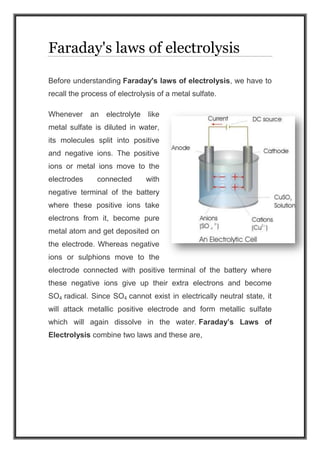
Before understanding Faraday's laws of electrolysis, we have to
recall the process of electrolysis of a metal sulfate.
Whenever an electrolyte like
metal sulfate is diluted in water,
its molecules split into positive
and negative ions. The positive
ions or metal ions move to the
electrodes connected with
negative terminal of the battery
where these positive ions take
electrons from it, become pure
metal atom and get deposited on
the electrode. Whereas negative
ions or sulphions move to the
electrode connected with positive terminal of the battery where
these negative ions give up their extra electrons and become
SO4 radical. Since SO4 cannot exist in electrically neutral state, it
will attack metallic positive electrode and form metallic sulfate
which will again dissolve in the water. Faraday’s Laws of
Electrolysis combine two laws and these are,
Faraday's First Law of Electrolysis
From the brief explanation above, it is clear that the flow of current
uit fully depends upon how manyexternal battery circthrough the
electrons get transferred from negative electrode or cathode to positive
then++metallic ion or cations. If the cations have valency of two like Cu
red from cathodefor every cation, there would be two electrons transfer
−to cation. We know that every electron has negative electrical charge
e. So for disposition of every Cu-Coulombs and say it is19−
1.602 X 10
2.e charge transfers from cathode-atom on the cathode, there would be
say for t time there would be total n number of copperNowto cation.
-atoms deposited on the cathode, so total charge transferred, would be
2.n.e Coulombs. Mass m of the deposited copper is obviously function of
the mass of thenumber of atoms deposited. So, it can be concluded that
deposited copper is directly proportional to the quantity of electrical
charge that passes through the electrolyte. Hence mass of deposited
Q quantity of electrical charge passes through the∝copper m
electrolyte.
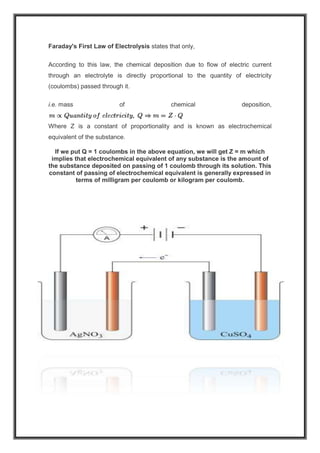
Faraday's First Law of Electrolysis states that only,
According to this law, the chemical deposition due to flow of electric current
through an electrolyte is directly proportional to the quantity of electricity
(coulombs) passed through it.
i.e. mass of chemical deposition,
Where Z is a constant of proportionality and is known as electrochemical
equivalent of the substance.
If we put Q = 1 coulombs in the above equation, we will get Z = m which
implies that electrochemical equivalent of any substance is the amount of
the substance deposited on passing of 1 coulomb through its solution. This
constant of passing of electrochemical equivalent is generally expressed in
terms of milligram per coulomb or kilogram per coulomb.
Faraday's Second Law of Electrolysis
So far we have learned that the mass of the chemical, deposited due to
electrolysis is proportional to the quantity of electricity that passes through the
electrolyte. The mass of the chemical, deposited due to electrolysis is not only
proportional to the quantity of electricity passes through the electrolyte, but it also
depends upon some other factor. Every substance will have its own atomic
weight. So for same number of atoms, different substances will have different
masses. Again, how many atoms deposited on the electrodes also depends upon
their number of valency. If valency is more, then for same amount of electricity,
number of deposited atoms will be less whereas if valence is less, then for same
quantity of electricity, more number of atoms to be deposited. So, for same
quantity of electricity or charge passes through different electrolytes, the mass of
deposited chemical is directly proportional to its atomic weight and inversely
proportional to its valency.
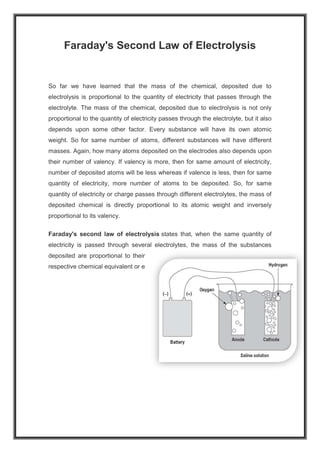
Faraday's second law of electrolysis states that, when the same quantity of
electricity is passed through several electrolytes, the mass of the substances
deposited are proportional to their
respective chemical equivalent or e
Chemical Equivalent or Equivalent Weight
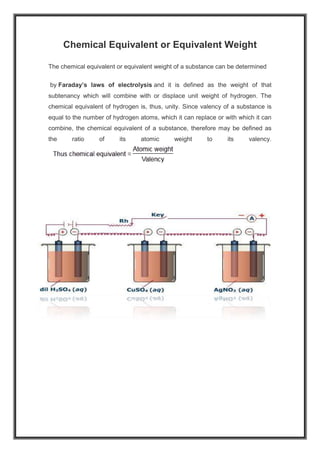
The chemical equivalent or equivalent weight of a substance can be determined
by Faraday’s laws of electrolysis and it is defined as the weight of that
subtenancy which will combine with or displace unit weight of hydrogen. The
chemical equivalent of hydrogen is, thus, unity. Since valency of a substance is
equal to the number of hydrogen atoms, which it can replace or with which it can
combine, the chemical equivalent of a substance, therefore may be defined as
the ratio of its atomic weight to its valency.

Faraday

  • 1.
    Faraday's laws ofelectrolysis Before understanding Faraday's laws of electrolysis, we have to recall the process of electrolysis of a metal sulfate. Whenever an electrolyte like metal sulfate is diluted in water, its molecules split into positive and negative ions. The positive ions or metal ions move to the electrodes connected with negative terminal of the battery where these positive ions take electrons from it, become pure metal atom and get deposited on the electrode. Whereas negative ions or sulphions move to the electrode connected with positive terminal of the battery where these negative ions give up their extra electrons and become SO4 radical. Since SO4 cannot exist in electrically neutral state, it will attack metallic positive electrode and form metallic sulfate which will again dissolve in the water. Faraday’s Laws of Electrolysis combine two laws and these are,
  • 2.
    Faraday's First Lawof Electrolysis From the brief explanation above, it is clear that the flow of current uit fully depends upon how manyexternal battery circthrough the electrons get transferred from negative electrode or cathode to positive then++metallic ion or cations. If the cations have valency of two like Cu red from cathodefor every cation, there would be two electrons transfer −to cation. We know that every electron has negative electrical charge e. So for disposition of every Cu-Coulombs and say it is19− 1.602 X 10 2.e charge transfers from cathode-atom on the cathode, there would be say for t time there would be total n number of copperNowto cation. -atoms deposited on the cathode, so total charge transferred, would be 2.n.e Coulombs. Mass m of the deposited copper is obviously function of the mass of thenumber of atoms deposited. So, it can be concluded that deposited copper is directly proportional to the quantity of electrical charge that passes through the electrolyte. Hence mass of deposited Q quantity of electrical charge passes through the∝copper m electrolyte.
  • 3.
    Faraday's First Lawof Electrolysis states that only, According to this law, the chemical deposition due to flow of electric current through an electrolyte is directly proportional to the quantity of electricity (coulombs) passed through it. i.e. mass of chemical deposition, Where Z is a constant of proportionality and is known as electrochemical equivalent of the substance. If we put Q = 1 coulombs in the above equation, we will get Z = m which implies that electrochemical equivalent of any substance is the amount of the substance deposited on passing of 1 coulomb through its solution. This constant of passing of electrochemical equivalent is generally expressed in terms of milligram per coulomb or kilogram per coulomb.
  • 4.
    Faraday's Second Lawof Electrolysis So far we have learned that the mass of the chemical, deposited due to electrolysis is proportional to the quantity of electricity that passes through the electrolyte. The mass of the chemical, deposited due to electrolysis is not only proportional to the quantity of electricity passes through the electrolyte, but it also depends upon some other factor. Every substance will have its own atomic weight. So for same number of atoms, different substances will have different masses. Again, how many atoms deposited on the electrodes also depends upon their number of valency. If valency is more, then for same amount of electricity, number of deposited atoms will be less whereas if valence is less, then for same quantity of electricity, more number of atoms to be deposited. So, for same quantity of electricity or charge passes through different electrolytes, the mass of deposited chemical is directly proportional to its atomic weight and inversely proportional to its valency. Faraday's second law of electrolysis states that, when the same quantity of electricity is passed through several electrolytes, the mass of the substances deposited are proportional to their respective chemical equivalent or e
  • 5.
    Chemical Equivalent orEquivalent Weight The chemical equivalent or equivalent weight of a substance can be determined by Faraday’s laws of electrolysis and it is defined as the weight of that subtenancy which will combine with or displace unit weight of hydrogen. The chemical equivalent of hydrogen is, thus, unity. Since valency of a substance is equal to the number of hydrogen atoms, which it can replace or with which it can combine, the chemical equivalent of a substance, therefore may be defined as the ratio of its atomic weight to its valency.