


Name
                 Class
               Teacher
                School
_____________________________________
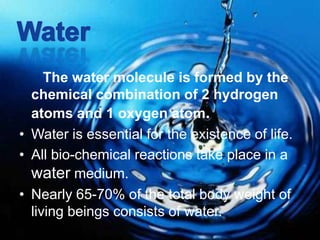
The water molecule is formed by the
  chemical combination of 2 hydrogen
  atoms and 1 oxygen atom.
• Water is essential for the existence of life.
• All bio-chemical reactions take place in a
  water medium.
• Nearly 65-70% of the total body weight of
  living beings consists of water.
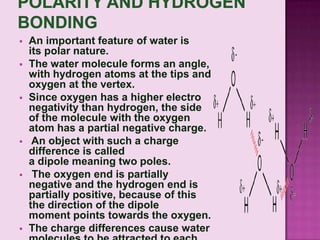
   An important feature of water is
    its polar nature.
   The water molecule forms an angle,
    with hydrogen atoms at the tips and
    oxygen at the vertex.
   Since oxygen has a higher electro
    negativity than hydrogen, the side
    of the molecule with the oxygen
    atom has a partial negative charge.
    An object with such a charge
    difference is called
    a dipole meaning two poles.
    The oxygen end is partially
    negative and the hydrogen end is
    partially positive, because of this
    the direction of the dipole
    moment points towards the oxygen.
   The charge differences cause water
MOLECULAR STRUCTURE
    OF WATER
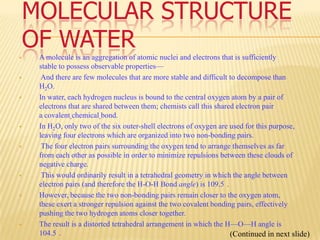
    A molecule is an aggregation of atomic nuclei and electrons that is sufficiently
     stable to possess observable properties—
     And there are few molecules that are more stable and difficult to decompose than
     H2O.
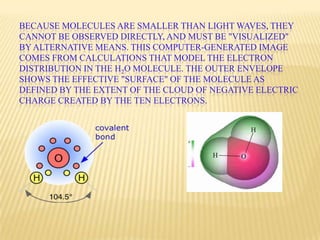
    In water, each hydrogen nucleus is bound to the central oxygen atom by a pair of
     electrons that are shared between them; chemists call this shared electron pair
     a covalent chemical bond.
    In H2O, only two of the six outer-shell electrons of oxygen are used for this purpose,
     leaving four electrons which are organized into two non-bonding pairs.
     The four electron pairs surrounding the oxygen tend to arrange themselves as far
     from each other as possible in order to minimize repulsions between these clouds of
     negative charge.
     This would ordinarily result in a tetrahedral geometry in which the angle between
     electron pairs (and therefore the H-O-H Bond angle) is 109.5 .
    However, because the two non-bonding pairs remain closer to the oxygen atom,
     these exert a stronger repulsion against the two covalent bonding pairs, effectively
     pushing the two hydrogen atoms closer together.
    The result is a distorted tetrahedral arrangement in which the H—O—H angle is
     104.5 .                                                         (Continued in next slide)
BECAUSE MOLECULES ARE SMALLER THAN LIGHT WAVES, THEY
CANNOT BE OBSERVED DIRECTLY, AND MUST BE "VISUALIZED"
BY ALTERNATIVE MEANS. THIS COMPUTER-GENERATED IMAGE
COMES FROM CALCULATIONS THAT MODEL THE ELECTRON
DISTRIBUTION IN THE H2O MOLECULE. THE OUTER ENVELOPE
SHOWS THE EFFECTIVE "SURFACE" OF THE MOLECULE AS
DEFINED BY THE EXTENT OF THE CLOUD OF NEGATIVE ELECTRIC
CHARGE CREATED BY THE TEN ELECTRONS.
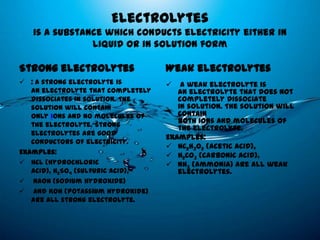
Electrolytes
   is a substance which conducts electricity either in
               liquid or in solution form

Strong electrolytes                 Weak electrolytes
 : A strong electrolyte is            A weak electrolyte is
   an electrolyte that completely      an electrolyte that does not
   dissociates in solution. The        completely dissociate
   solution will contain               in solution. The solution will
   only ions and no molecules of       contain
   the electrolyte. Strong
                                       both ions and molecules of
                                       the electrolyte.
   electrolytes are good
                                    Examples:
   conductors of electricity.
                                     HC2H3O2 (acetic acid),
Examples:                            H2CO3 (carbonic acid),
 HCl (hydrochloric                  NH3 (ammonia) are all weak
   acid), H2SO4 (sulfuric acid),       electrolytes.
 NaOH (sodium hydroxide)
 and KOH (potassium hydroxide)
   are all strong electrolyte.
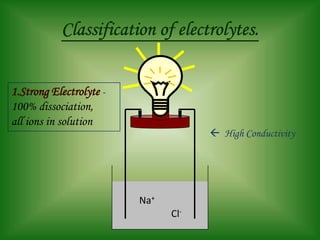
1.Strong Electrolyte -
100% dissociation,
all ions in solution
                                      High Conductivity


                         Na+
                               Cl-
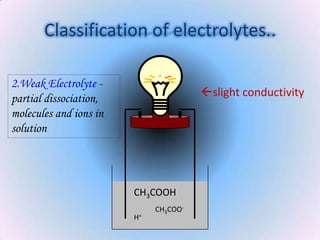
Classification of electrolytes..

2.Weak Electrolyte -
partial dissociation,                  slight conductivity
molecules and ions in
solution


                        CH3COOH
                             CH3COO-
                        H+
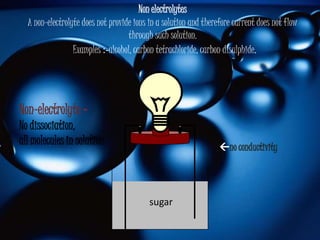
Non electrolytes
  A non-electrolyte does not provide ions in a solution and therefore current does not flow
                                   through such solution.
                 Examples :-alcohol, carbon tetrachloride, carbon disulphide.


Non-electrolyte -
No dissociation,
all molecules in solution
                                                                 no conductivity


                                          sugar
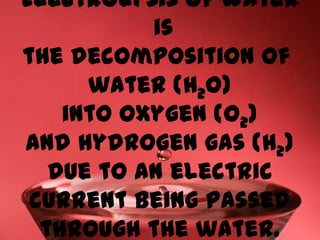
Electrolysis of water
           is
the decomposition of
      water (H2O)
    into oxygen (O2)
and hydrogen gas (H2)
   due to an electric
 current being passed
  through the water.
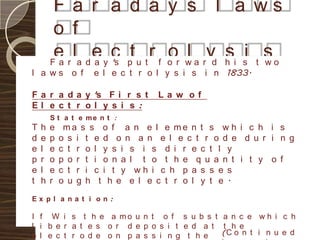
F a r a d a y s l a ws
        o f
        e r la d e y c pt u t r f o r w a ryd h i si t s o
        Fa       a 's
                                  o l         s        w
l a ws o f         e l e c t r o l y s i s i n 1833.

F a r a d a y 's F i r s t      La w of
El e c t r ol y s i s :
        S t a t e me n t :
T   h   e    ma s s o f a n e l e me n t s w h i c h i s
d   e   p   o s i t e d o n a n e l e c t r o d e d u r i n g
e   l   e   c t r o l y s i s i s d i r e c t l y
p   r   o   p o r t i o n a l t o t h e q u a n t i t y o f
e   l   e   c t r i c i t y wh i c h p a s s e s
t   h   r   o u g h t h e e l e c t r o l y t e .
Ex pl a na t i on :

I f W i s t h e a mo u n t o f s u b s t a n c e w h i c h
l i b e r a t e s o r d e p o s i t e d a t t h e
e l e c t r o d e o n p a s s i n g t h e   (C o n t i n u e d
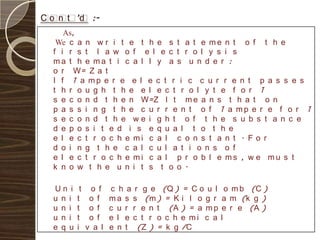
C o n t ’d :-
     As,
   We c a n w r i t e t h e s t a t e m e n t o f t h e
  f i r s t l a w o f e l e c t r o l y s i s
  ma t h e ma t i c a l l y a s u n d e r :
  o r W= Z a t
  I f 1 a mp e r e e l e c t r i c c u r r e n t p a s s e s
  t h r o u g h t h e e l e c t r o l y t e f o r 1
  s e c o n d t h e n W=Z I t m e a n s t h a t o n
  p a s s i n g t h e c u r r e n t o f 1 a mp e r e f o r 1
  s e c o n d t h e we i g h t o f t h e s u b s t a n c e
  d e p o s i t e d i s e q u a l t o t h e
  e l e c t r o c h e mi c a l c o n s t a n t . F o r
  d o i n g t h e c a l c u l a t i o n s o f
  e l e c t r o c h e mi c a l p r o b l e ms , w e mu s t
  k n o w t h e u n i t s t o o .

  Un i     t    o f    c h a r g e (Q ) = C o u l     o m b (C )
  u n i   t     o f    m a s s (m ) = K i l o g r   a m (k g )
  u n i   t     o f    c u r r e n t (A ) = a m p   e r e (A )
  u n i   t     o f    e l e c t r o c h e mi c a   l
  e q u   i    v a l   e n t (Z ) = k g /C
FARADAYS LAWS OF ELECTROLYSIS
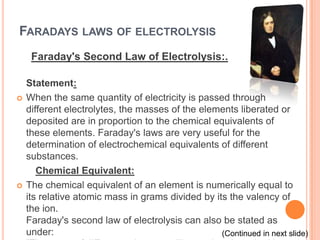
     Faraday's Second Law of Electrolysis:.

    Statement:
   When the same quantity of electricity is passed through
    different electrolytes, the masses of the elements liberated or
    deposited are in proportion to the chemical equivalents of
    these elements. Faraday's laws are very useful for the
    determination of electrochemical equivalents of different
    substances.
       Chemical Equivalent:
   The chemical equivalent of an element is numerically equal to
    its relative atomic mass in grams divided by its the valency of
    the ion.
    Faraday's second law of electrolysis can also be stated as
    under:                                         (Continued in next slide)
EXPLANATION:
TAKE THREE SOLUTIONS OF ELECTROLYTES: AGNO3, CUSO4 AND
AL(NO3)3 IN A SERIES, PASS SOME QUANTITY OF ELECTRICITY
THROUGH THEM FOR THE SAME TIME. NOW AG CU AND AL METALS
COLLECT AT THE CATHODE. THEIR MASSES ARE DIRECTLY
PROPORTIONAL TO THEIR EQUIVALENT MASSES.

ACCORDING TO FARADAY, IF 96,500 COULOMBS (OR 1 FARADAY) IS
PASSED THROUGH THESE ELECTROLYTES,

WE GET WHICH ARE THE EQUIVALENT MASSES OF

AG, CU AND AL RESPECTIVELY.
Applications of Electrolysis
                                          Industrial uses
                                         Production
                                          of aluminum, lithium, sodium, potassium, mag
                                          nesium, calcium
                                         Coulometric techniques can be used to
                                          determine the amount of matter transformed
                                          during electrolysis by measuring the amount of
                                          electricity required to perform the electrolysis
                                         Production of chlorine and sodium hydroxide
                                         Production of sodium chlorate and potassium
                                          chlorate
                                         Production of per fluorinated organic
                                          compounds such as trifluoroacetic acid
                                         Production of electrolytic copper as a cathode,
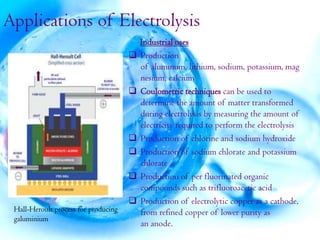
 Hall-Heroult process for producing       from refined copper of lower purity as
 galuminium
                                          an anode.
Electrolysis has many other uses:
     Electrometallurgy is the process of reduction of metals from metallic
 compounds to obtain the pure form of metal using electrolysis. For example,
 sodium hydroxide in its molten form is separated by electrolysis into sodium
 and oxygen, both of which have important chemical uses. (Water is produced
                                  at the same time.)
Anodization is an electrolytic process that makes the surface of metals resistant
 to corrosion. For example, ships are saved from being corroded by oxygen in
    the water by this process. The process is also used to decorate surfaces.
               A battery works by the reverse process to electrolysis.
         Production of oxygen for spacecraft and nuclear submarines.
Electroplating is used in layering metals to fortify them. Electroplating is used
 in many industries for functional or decorative purposes, as in vehicle bodies
                                   and nickel coins.
  Production of hydrogen for fuel, using a cheap source of electrical energy.
  Electrolytic Etching of metal surfaces like tools or knives with a permanent
                                    mark or logo.
   Electrolysis is also used in the cleaning and preservation of old artifacts.
Because the process separates the non-metallic particles from the metallic ones,
         it is very useful for cleaning old coins and even larger objects.
Electrolytic refining

   The purest copper is obtained by
 an electrolytic process, undertaken using a slab of
 impure copper as the anode and a thin sheet of
 pure copper as the cathode. The electrolyte is an
 acidic solution of copper sulphate. By
 passing electricity through the cell, copper is
 dissolved from the anode and deposited on the
 cathode. However impurities either remain in
 solution or collect as an insoluble sludge. This
 process only became possible following the
 invention of the dynamo; it was first used in
 South Wales in 18
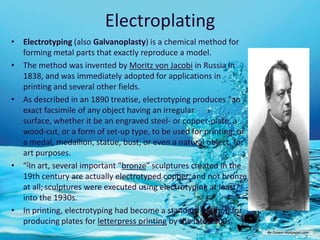
Electroplating
• Electrotyping (also Galvanoplasty) is a chemical method for
  forming metal parts that exactly reproduce a model.
• The method was invented by Moritz von Jacobi in Russia in
  1838, and was immediately adopted for applications in
  printing and several other fields.
• As described in an 1890 treatise, electrotyping produces "an
  exact facsimile of any object having an irregular
  surface, whether it be an engraved steel- or copper-plate, a
  wood-cut, or a form of set-up type, to be used for printing; or
  a medal, medallion, statue, bust, or even a natural object, for
  art purposes.
• "[In art, several important "bronze" sculptures created in the
  19th century are actually electrotyped copper, and not bronze
  at all; sculptures were executed using electrotyping at least
  into the 1930s.
• In printing, electrotyping had become a standard method for
  producing plates for letterpress printing by the late 1800s.
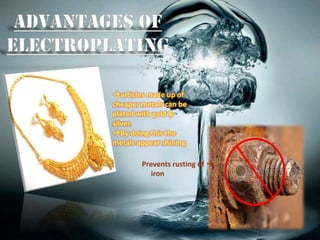
articles made up of
cheaper metals can be
plated with gold &
silver.
By doing this the
metals appear shining

        Prevents rusting of 
           iron
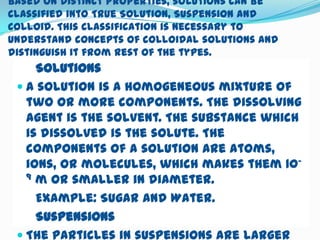
Based on distinct properties, solutions can be
classified into True Solution, Suspension and
Colloid. This classification is necessary to
understand concepts of colloidal solutions and
distinguish it from rest of the types.
     Solutions
  A solution is a homogeneous mixture of
   two or more components. The dissolving
   agent is the solvent. The substance which
   is dissolved is the solute. The
   components of a solution are atoms,
   ions, or molecules, which makes them 10-
   9 m or smaller in diameter.

     Example: Sugar and Water.
     Suspensions
  The particles in suspensions are larger
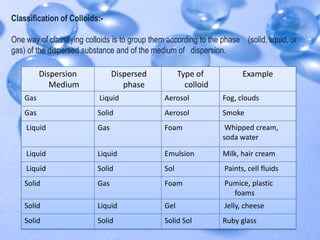
Classification of Colloids:-

One way of classifying colloids is to group them according to the phase (solid, liquid, or
gas) of the dispersed substance and of the medium of dispersion.

          Dispersion             Dispersed            Type of            Example
             Medium                 phase               colloid
    Gas                    Liquid               Aerosol           Fog, clouds
    Gas                    Solid                Aerosol           Smoke
    Liquid                 Gas                  Foam               Whipped cream,
                                                                  soda water

    Liquid                 Liquid               Emulsion          Milk, hair cream
    Liquid                 Solid                Sol                Paints, cell fluids
    Solid                  Gas                  Foam               Pumice, plastic
                                                                     foams
    Solid                  Liquid               Gel                Jelly, cheese
    Solid                  Solid                Solid Sol         Ruby glass
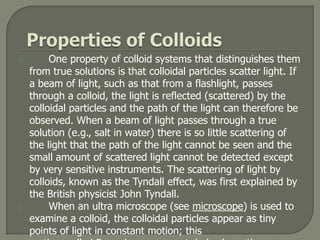
o        One property of colloid systems that distinguishes them
    from true solutions is that colloidal particles scatter light. If
    a beam of light, such as that from a flashlight, passes
    through a colloid, the light is reflected (scattered) by the
    colloidal particles and the path of the light can therefore be
    observed. When a beam of light passes through a true
    solution (e.g., salt in water) there is so little scattering of
    the light that the path of the light cannot be seen and the
    small amount of scattered light cannot be detected except
    by very sensitive instruments. The scattering of light by
    colloids, known as the Tyndall effect, was first explained by
    the British physicist John Tyndall.
o        When an ultra microscope (see microscope) is used to
    examine a colloid, the colloidal particles appear as tiny
    points of light in constant motion; this
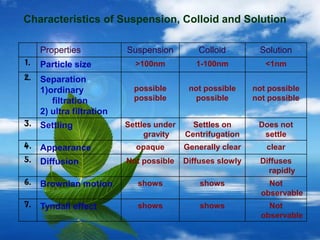
Characteristics of Suspension, Colloid and Solution

     Properties            Suspension         Colloid         Solution
1.   Particle size           >100nm           1-100nm           <1nm
2.   Separation
     1)ordinary              possible       not possible     not possible
        filtration           possible        possible        not possible
     2) ultra filtration
3.   Settling              Settles under     Settles on       Does not
                                gravity    Centrifugation      settle
4.   Appearance              opaque        Generally clear      clear
5.   Diffusion             Not possible    Diffuses slowly    Diffuses
                                                                rapidly
6.   Brownian motion          shows            shows             Not
                                                               observable
7.   Tyndall effect           shows            shows             Not
                                                               observable
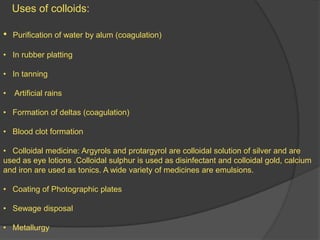
Uses of colloids:

•   Purification of water by alum (coagulation)

• In rubber platting

• In tanning

•   Artificial rains

• Formation of deltas (coagulation)

• Blood clot formation

• Colloidal medicine: Argyrols and protargyrol are colloidal solution of silver and are
used as eye lotions .Colloidal sulphur is used as disinfectant and colloidal gold, calcium
and iron are used as tonics. A wide variety of medicines are emulsions.

• Coating of Photographic plates

• Sewage disposal

• Metallurgy
Water

Water

  • 1.
    Name Class Teacher School _____________________________________
  • 2.
    The water moleculeis formed by the chemical combination of 2 hydrogen atoms and 1 oxygen atom. • Water is essential for the existence of life. • All bio-chemical reactions take place in a water medium. • Nearly 65-70% of the total body weight of living beings consists of water.
  • 3.
    An important feature of water is its polar nature.  The water molecule forms an angle, with hydrogen atoms at the tips and oxygen at the vertex.  Since oxygen has a higher electro negativity than hydrogen, the side of the molecule with the oxygen atom has a partial negative charge.  An object with such a charge difference is called a dipole meaning two poles.  The oxygen end is partially negative and the hydrogen end is partially positive, because of this the direction of the dipole moment points towards the oxygen.  The charge differences cause water
  • 5.
    MOLECULAR STRUCTURE OF WATER  A molecule is an aggregation of atomic nuclei and electrons that is sufficiently stable to possess observable properties—  And there are few molecules that are more stable and difficult to decompose than H2O.  In water, each hydrogen nucleus is bound to the central oxygen atom by a pair of electrons that are shared between them; chemists call this shared electron pair a covalent chemical bond.  In H2O, only two of the six outer-shell electrons of oxygen are used for this purpose, leaving four electrons which are organized into two non-bonding pairs.  The four electron pairs surrounding the oxygen tend to arrange themselves as far from each other as possible in order to minimize repulsions between these clouds of negative charge.  This would ordinarily result in a tetrahedral geometry in which the angle between electron pairs (and therefore the H-O-H Bond angle) is 109.5 .  However, because the two non-bonding pairs remain closer to the oxygen atom, these exert a stronger repulsion against the two covalent bonding pairs, effectively pushing the two hydrogen atoms closer together.  The result is a distorted tetrahedral arrangement in which the H—O—H angle is 104.5 . (Continued in next slide)
  • 6.
    BECAUSE MOLECULES ARESMALLER THAN LIGHT WAVES, THEY CANNOT BE OBSERVED DIRECTLY, AND MUST BE "VISUALIZED" BY ALTERNATIVE MEANS. THIS COMPUTER-GENERATED IMAGE COMES FROM CALCULATIONS THAT MODEL THE ELECTRON DISTRIBUTION IN THE H2O MOLECULE. THE OUTER ENVELOPE SHOWS THE EFFECTIVE "SURFACE" OF THE MOLECULE AS DEFINED BY THE EXTENT OF THE CLOUD OF NEGATIVE ELECTRIC CHARGE CREATED BY THE TEN ELECTRONS.
  • 7.
    Electrolytes is a substance which conducts electricity either in liquid or in solution form Strong electrolytes Weak electrolytes  : A strong electrolyte is  A weak electrolyte is an electrolyte that completely an electrolyte that does not dissociates in solution. The completely dissociate solution will contain in solution. The solution will only ions and no molecules of contain the electrolyte. Strong both ions and molecules of the electrolyte. electrolytes are good Examples: conductors of electricity.  HC2H3O2 (acetic acid), Examples:  H2CO3 (carbonic acid),  HCl (hydrochloric  NH3 (ammonia) are all weak acid), H2SO4 (sulfuric acid), electrolytes.  NaOH (sodium hydroxide)  and KOH (potassium hydroxide) are all strong electrolyte.
  • 8.
    1.Strong Electrolyte - 100%dissociation, all ions in solution  High Conductivity Na+ Cl-
  • 9.
    Classification of electrolytes.. 2.WeakElectrolyte - partial dissociation, slight conductivity molecules and ions in solution CH3COOH CH3COO- H+
  • 10.
    Non electrolytes A non-electrolyte does not provide ions in a solution and therefore current does not flow through such solution. Examples :-alcohol, carbon tetrachloride, carbon disulphide. Non-electrolyte - No dissociation, all molecules in solution no conductivity sugar
  • 11.
    Electrolysis of water is the decomposition of water (H2O) into oxygen (O2) and hydrogen gas (H2) due to an electric current being passed through the water.
  • 12.
    F a ra d a y s l a ws o f e r la d e y c pt u t r f o r w a ryd h i si t s o Fa a 's o l s w l a ws o f e l e c t r o l y s i s i n 1833. F a r a d a y 's F i r s t La w of El e c t r ol y s i s : S t a t e me n t : T h e ma s s o f a n e l e me n t s w h i c h i s d e p o s i t e d o n a n e l e c t r o d e d u r i n g e l e c t r o l y s i s i s d i r e c t l y p r o p o r t i o n a l t o t h e q u a n t i t y o f e l e c t r i c i t y wh i c h p a s s e s t h r o u g h t h e e l e c t r o l y t e . Ex pl a na t i on : I f W i s t h e a mo u n t o f s u b s t a n c e w h i c h l i b e r a t e s o r d e p o s i t e d a t t h e e l e c t r o d e o n p a s s i n g t h e (C o n t i n u e d
  • 13.
    C o nt ’d :- As, We c a n w r i t e t h e s t a t e m e n t o f t h e f i r s t l a w o f e l e c t r o l y s i s ma t h e ma t i c a l l y a s u n d e r : o r W= Z a t I f 1 a mp e r e e l e c t r i c c u r r e n t p a s s e s t h r o u g h t h e e l e c t r o l y t e f o r 1 s e c o n d t h e n W=Z I t m e a n s t h a t o n p a s s i n g t h e c u r r e n t o f 1 a mp e r e f o r 1 s e c o n d t h e we i g h t o f t h e s u b s t a n c e d e p o s i t e d i s e q u a l t o t h e e l e c t r o c h e mi c a l c o n s t a n t . F o r d o i n g t h e c a l c u l a t i o n s o f e l e c t r o c h e mi c a l p r o b l e ms , w e mu s t k n o w t h e u n i t s t o o . Un i t o f c h a r g e (Q ) = C o u l o m b (C ) u n i t o f m a s s (m ) = K i l o g r a m (k g ) u n i t o f c u r r e n t (A ) = a m p e r e (A ) u n i t o f e l e c t r o c h e mi c a l e q u i v a l e n t (Z ) = k g /C
  • 14.
    FARADAYS LAWS OFELECTROLYSIS Faraday's Second Law of Electrolysis:. Statement:  When the same quantity of electricity is passed through different electrolytes, the masses of the elements liberated or deposited are in proportion to the chemical equivalents of these elements. Faraday's laws are very useful for the determination of electrochemical equivalents of different substances. Chemical Equivalent:  The chemical equivalent of an element is numerically equal to its relative atomic mass in grams divided by its the valency of the ion. Faraday's second law of electrolysis can also be stated as under: (Continued in next slide)
  • 15.
    EXPLANATION: TAKE THREE SOLUTIONSOF ELECTROLYTES: AGNO3, CUSO4 AND AL(NO3)3 IN A SERIES, PASS SOME QUANTITY OF ELECTRICITY THROUGH THEM FOR THE SAME TIME. NOW AG CU AND AL METALS COLLECT AT THE CATHODE. THEIR MASSES ARE DIRECTLY PROPORTIONAL TO THEIR EQUIVALENT MASSES. ACCORDING TO FARADAY, IF 96,500 COULOMBS (OR 1 FARADAY) IS PASSED THROUGH THESE ELECTROLYTES, WE GET WHICH ARE THE EQUIVALENT MASSES OF AG, CU AND AL RESPECTIVELY.
  • 16.
    Applications of Electrolysis Industrial uses  Production of aluminum, lithium, sodium, potassium, mag nesium, calcium  Coulometric techniques can be used to determine the amount of matter transformed during electrolysis by measuring the amount of electricity required to perform the electrolysis  Production of chlorine and sodium hydroxide  Production of sodium chlorate and potassium chlorate  Production of per fluorinated organic compounds such as trifluoroacetic acid  Production of electrolytic copper as a cathode, Hall-Heroult process for producing from refined copper of lower purity as galuminium an anode.
  • 17.
    Electrolysis has manyother uses: Electrometallurgy is the process of reduction of metals from metallic compounds to obtain the pure form of metal using electrolysis. For example, sodium hydroxide in its molten form is separated by electrolysis into sodium and oxygen, both of which have important chemical uses. (Water is produced at the same time.) Anodization is an electrolytic process that makes the surface of metals resistant to corrosion. For example, ships are saved from being corroded by oxygen in the water by this process. The process is also used to decorate surfaces. A battery works by the reverse process to electrolysis. Production of oxygen for spacecraft and nuclear submarines. Electroplating is used in layering metals to fortify them. Electroplating is used in many industries for functional or decorative purposes, as in vehicle bodies and nickel coins. Production of hydrogen for fuel, using a cheap source of electrical energy. Electrolytic Etching of metal surfaces like tools or knives with a permanent mark or logo. Electrolysis is also used in the cleaning and preservation of old artifacts. Because the process separates the non-metallic particles from the metallic ones, it is very useful for cleaning old coins and even larger objects.
  • 18.
    Electrolytic refining The purest copper is obtained by an electrolytic process, undertaken using a slab of impure copper as the anode and a thin sheet of pure copper as the cathode. The electrolyte is an acidic solution of copper sulphate. By passing electricity through the cell, copper is dissolved from the anode and deposited on the cathode. However impurities either remain in solution or collect as an insoluble sludge. This process only became possible following the invention of the dynamo; it was first used in South Wales in 18
  • 19.
    Electroplating • Electrotyping (alsoGalvanoplasty) is a chemical method for forming metal parts that exactly reproduce a model. • The method was invented by Moritz von Jacobi in Russia in 1838, and was immediately adopted for applications in printing and several other fields. • As described in an 1890 treatise, electrotyping produces "an exact facsimile of any object having an irregular surface, whether it be an engraved steel- or copper-plate, a wood-cut, or a form of set-up type, to be used for printing; or a medal, medallion, statue, bust, or even a natural object, for art purposes. • "[In art, several important "bronze" sculptures created in the 19th century are actually electrotyped copper, and not bronze at all; sculptures were executed using electrotyping at least into the 1930s. • In printing, electrotyping had become a standard method for producing plates for letterpress printing by the late 1800s.
  • 21.
    articles made upof cheaper metals can be plated with gold & silver. By doing this the metals appear shining Prevents rusting of  iron
  • 22.
    Based on distinctproperties, solutions can be classified into True Solution, Suspension and Colloid. This classification is necessary to understand concepts of colloidal solutions and distinguish it from rest of the types. Solutions  A solution is a homogeneous mixture of two or more components. The dissolving agent is the solvent. The substance which is dissolved is the solute. The components of a solution are atoms, ions, or molecules, which makes them 10- 9 m or smaller in diameter. Example: Sugar and Water. Suspensions  The particles in suspensions are larger
  • 24.
    Classification of Colloids:- Oneway of classifying colloids is to group them according to the phase (solid, liquid, or gas) of the dispersed substance and of the medium of dispersion. Dispersion Dispersed Type of Example Medium phase colloid Gas Liquid Aerosol Fog, clouds Gas Solid Aerosol Smoke Liquid Gas Foam Whipped cream, soda water Liquid Liquid Emulsion Milk, hair cream Liquid Solid Sol Paints, cell fluids Solid Gas Foam Pumice, plastic foams Solid Liquid Gel Jelly, cheese Solid Solid Solid Sol Ruby glass
  • 25.
    o One property of colloid systems that distinguishes them from true solutions is that colloidal particles scatter light. If a beam of light, such as that from a flashlight, passes through a colloid, the light is reflected (scattered) by the colloidal particles and the path of the light can therefore be observed. When a beam of light passes through a true solution (e.g., salt in water) there is so little scattering of the light that the path of the light cannot be seen and the small amount of scattered light cannot be detected except by very sensitive instruments. The scattering of light by colloids, known as the Tyndall effect, was first explained by the British physicist John Tyndall. o When an ultra microscope (see microscope) is used to examine a colloid, the colloidal particles appear as tiny points of light in constant motion; this
  • 27.
    Characteristics of Suspension,Colloid and Solution Properties Suspension Colloid Solution 1. Particle size >100nm 1-100nm <1nm 2. Separation 1)ordinary possible not possible not possible filtration possible possible not possible 2) ultra filtration 3. Settling Settles under Settles on Does not gravity Centrifugation settle 4. Appearance opaque Generally clear clear 5. Diffusion Not possible Diffuses slowly Diffuses rapidly 6. Brownian motion shows shows Not observable 7. Tyndall effect shows shows Not observable
  • 28.
    Uses of colloids: • Purification of water by alum (coagulation) • In rubber platting • In tanning • Artificial rains • Formation of deltas (coagulation) • Blood clot formation • Colloidal medicine: Argyrols and protargyrol are colloidal solution of silver and are used as eye lotions .Colloidal sulphur is used as disinfectant and colloidal gold, calcium and iron are used as tonics. A wide variety of medicines are emulsions. • Coating of Photographic plates • Sewage disposal • Metallurgy