Redox Reactions and
Electrochemistry
By Aktr
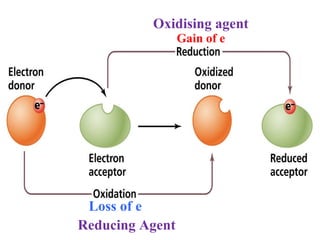
Loss of e
Gain of e
Reducing Agent
Oxidising agent
Oxidation
Reduction
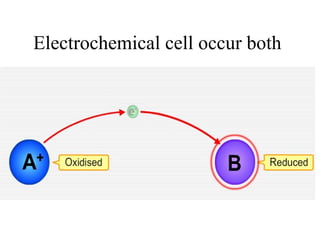
Electrochemical cell occur both
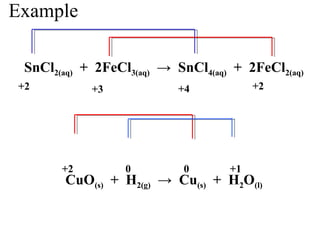
SnCl2(aq) + 2FeCl3(aq) → SnCl4(aq) + 2FeCl2(aq)
CuO(s) + H2(g) → Cu(s) + H2O(l)
Example
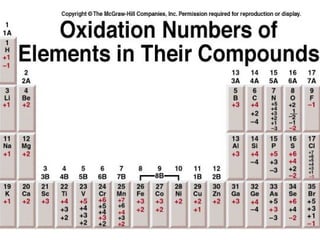
+2 +3 +4 +2
+100+2
Conductance in electrolytic
solution
Also act as a conductor
Conductance in electrolytic
solutions
Metallic conductor depend upon
• Nature and structure of metal.
• No. of valence electron per atom.
• Temperature of the sample.
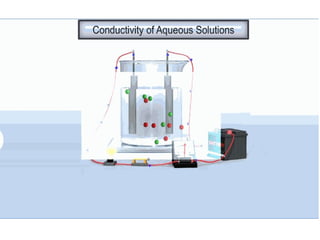
conductivity aqueous solution
depend upon
• Nature of electrolyte.
• Size of ion.
• Solvation of ion.
• Concentration of electrolytic.
• Temperature.
One cell const. and resistivity
Known then we can find value
Easily.
Molar conductivity
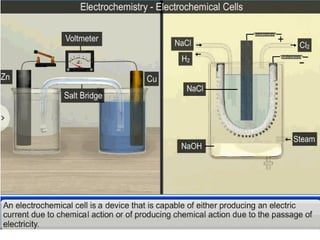
Electrochemical cell
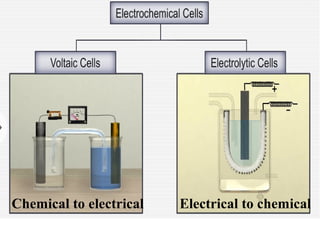
Chemical to electrical Electrical to chemical
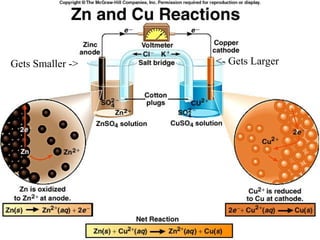
2. Voltaic or Galvanic cells-
An electrochemical cell in which a spontaneous
reaction produces electricity.
Eg. Dry cell, lead storage cell etc.
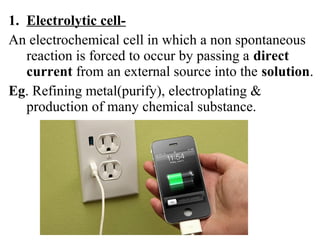
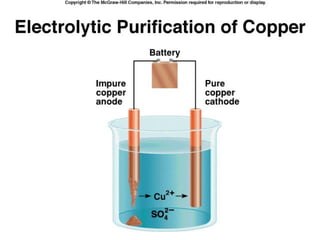
1. Electrolytic cell-
An electrochemical cell in which a non spontaneous
reaction is forced to occur by passing a direct
current from an external source into the solution.
Eg. Refining metal(purify), electroplating &
production of many chemical substance.
Gets Smaller -> <- Gets Larger
Cell Notation
1. Anode
2. Salt Bridge
3. Cathode
Anode | Salt Bridge | Cathode
| : symbol is used whenever there is a different phase
19.2
Cell Notation
Zn (s) + Cu2+
(aq) Cu (s) + Zn2+
(aq)
[Cu2+
] = 1 M & [Zn2+
] = 1 M
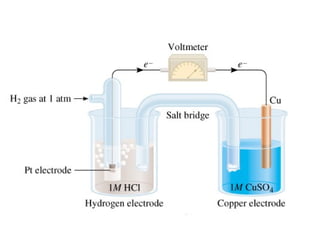
Zn (s) | Zn2+
(1 M) || Cu2+
(1 M) | Cu (s)
anode cathode
Zn (s)| Zn+2
(aq, 1M)| K(NO3) (saturated)|Cu+2
(aq, 1M)|Cu(s)
anode cathodeSalt bridge
More detail..
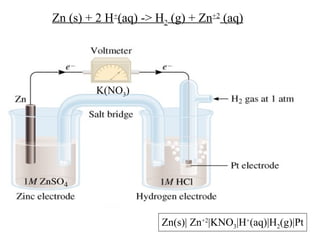
K(NO3)
Zn (s) + 2 H+
(aq) -> H2 (g) + Zn+2
(aq)
Zn(s)| Zn+2
|KNO3|H+
(aq)|H2(g)|Pt
Electrochemical Cells
19.2
The difference in electrical
potential between the anode and
cathode is called:
• cell voltage
• electromotive force (emf)
• cell potential
000
reductionoxidationCell EEE +=
UNITS: Volts Volt (V) = Joule (J)
Coulomb, C
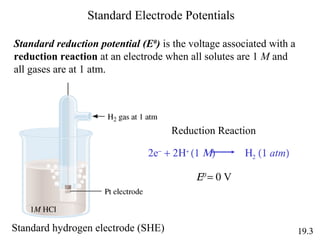
Standard Electrode Potentials
19.3
Standard reduction potential (E0
) is the voltage associated with a
reduction reaction at an electrode when all solutes are 1 M and
all gases are at 1 atm.
Ε0
= 0 V
Standard hydrogen electrode (SHE)
2e−
+ 2Η+
(1 Μ) Η2 (1 atm)
Reduction Reaction
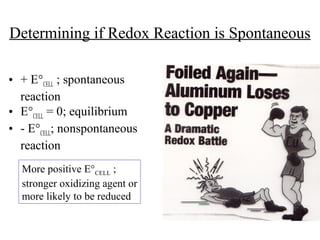
Determining if Redox Reaction is Spontaneous
• + E°CELL ; spontaneous
reaction
• E°CELL = 0; equilibrium
• - E°CELL; nonspontaneous
reaction
More positive E°CELL ;
stronger oxidizing agent or
more likely to be reduced
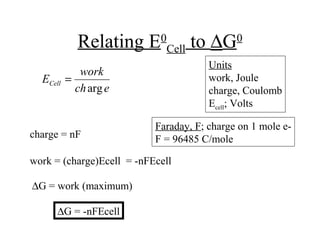
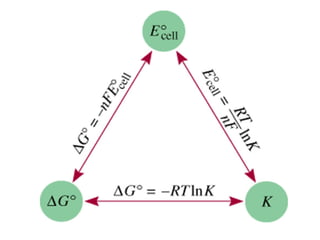
Relating E0
Cell to ∆G0
ech
work
ECell
arg
=
Units
work, Joule
charge, Coulomb
Ecell; Volts
charge = nF
Faraday, F; charge on 1 mole e-
F = 96485 C/mole
work = (charge)Ecell = -nFEcell
∆G = work (maximum)
∆G = -nFEcell
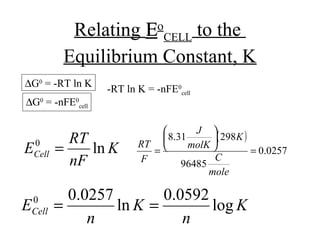
Relating Εο
CELL to the
Equilibrium Constant, K
∆G0
= -RT ln K
∆G0
= -nFE0
cell
-RT ln K = -nFE0
cell
K
nF
RT
ECell ln0
=
( )
0257.0
96485
29831.8
=






=
mole
C
K
molK
J
F
RT
K
n
K
n
ECell log
0592.0
ln
0257.00
==
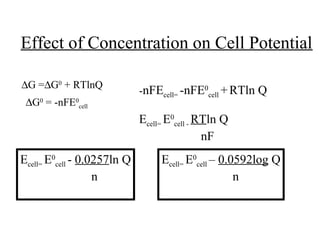
Effect of Concentration on Cell Potential
∆G =∆G0
+ RTlnQ
∆G0
= -nFE0
cell
-nFEcell= -nFE0
cell +RTln Q
Ecell= E0
cell - RTln Q
nF
Ecell= E0
cell - 0.0257ln Q
n
Ecell= E0
cell – 0.0592log Q
n
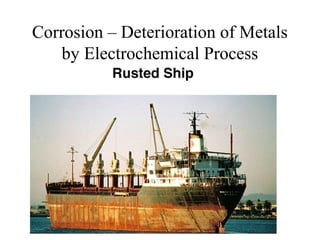
Corrosion – Deterioration of Metals
by Electrochemical Process
Corrosion – Deterioration of Metals
by Electrochemical Process
Corrosion – Deterioration of Metals
by Electrochemical Process
Cathodic Protection
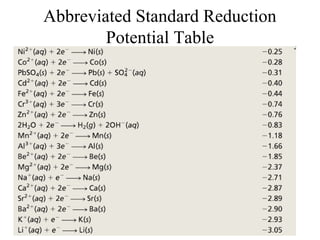
Abbreviated Standard Reduction
Potential Table
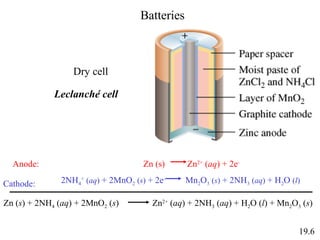
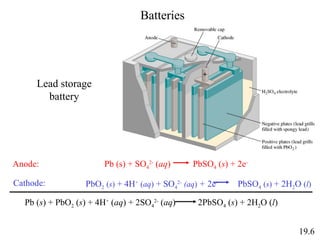
Batteries
19.6
Leclanché cell
Dry cell
Zn (s) Zn2+
(aq) + 2e-
Anode:
Cathode: 2NH4
+
(aq) + 2MnO2 (s) + 2e-
Mn2O3 (s) + 2NH3 (aq) + H2O (l)
Zn (s) + 2NH4 (aq) + 2MnO2 (s) Zn2+
(aq) + 2NH3 (aq) + H2O (l) + Mn2O3 (s)
Batteries
Zn(Hg) + 2OH-
(aq) ZnO (s) + H2O (l) + 2e-
Anode:
Cathode: HgO (s) + H2O (l) + 2e-
Hg (l) + 2OH-
(aq)
Zn(Hg) + HgO (s) ZnO (s) + Hg (l)
Mercury Battery
19.6
Batteries
19.6
Anode:
Cathode:
Lead storage
battery
PbO2 (s) + 4H+
(aq) + SO4
2-
(aq) + 2e-
PbSO4 (s) + 2H2O (l)
Pb (s) + SO4
2-
(aq) PbSO4 (s) + 2e-
Pb (s) + PbO2 (s) + 4H+
(aq) + 2SO4
2-
(aq) 2PbSO4 (s) + 2H2O (l)
Fuel Cell vs. Battery
• Battery; Energy storage device
– Reactant chemicals already in device
– Once Chemicals used up; discard (unless rechargeable)
• Fuel Cell; Energy conversion device
– Won’t work unless reactants supplied
– Reactants continuously supplied; products continuously
removed
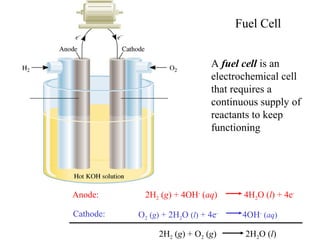
Fuel Cell
A fuel cell is an
electrochemical cell
that requires a
continuous supply of
reactants to keep
functioning
Anode:
Cathode: O2 (g) + 2H2O (l) + 4e-
4OH-
(aq)
2H2 (g) + 4OH-
(aq) 4H2O (l) + 4e-
2H2 (g) + O2 (g) 2H2O (l)
Types of Electrochemical Cells
• Voltaic/Galvanic Cell; Energy released
from spontaneous redox reaction can be
transformed into electrical energy.
• Electrolytic Cell; Electrical energy is used
to drive a nonspontaneous redox reaction.
Faraday’s Constant
Redox Eqn
Molar Mass
Charge =(Current)(Time)

Electrochemistry 12

  • 1.
  • 4.
    Loss of e Gainof e Reducing Agent Oxidising agent
  • 5.
  • 6.
  • 7.
  • 11.
    SnCl2(aq) + 2FeCl3(aq)→ SnCl4(aq) + 2FeCl2(aq) CuO(s) + H2(g) → Cu(s) + H2O(l) Example +2 +3 +4 +2 +100+2
  • 12.
  • 27.
    Also act asa conductor
  • 32.
  • 36.
    Metallic conductor dependupon • Nature and structure of metal. • No. of valence electron per atom. • Temperature of the sample.
  • 40.
    conductivity aqueous solution dependupon • Nature of electrolyte. • Size of ion. • Solvation of ion. • Concentration of electrolytic. • Temperature.
  • 48.
    One cell const.and resistivity Known then we can find value Easily.
  • 49.
  • 63.
  • 65.
    Chemical to electricalElectrical to chemical
  • 66.
    2. Voltaic orGalvanic cells- An electrochemical cell in which a spontaneous reaction produces electricity. Eg. Dry cell, lead storage cell etc.
  • 67.
    1. Electrolytic cell- Anelectrochemical cell in which a non spontaneous reaction is forced to occur by passing a direct current from an external source into the solution. Eg. Refining metal(purify), electroplating & production of many chemical substance.
  • 68.
    Gets Smaller -><- Gets Larger
  • 69.
    Cell Notation 1. Anode 2.Salt Bridge 3. Cathode Anode | Salt Bridge | Cathode | : symbol is used whenever there is a different phase
  • 70.
    19.2 Cell Notation Zn (s)+ Cu2+ (aq) Cu (s) + Zn2+ (aq) [Cu2+ ] = 1 M & [Zn2+ ] = 1 M Zn (s) | Zn2+ (1 M) || Cu2+ (1 M) | Cu (s) anode cathode Zn (s)| Zn+2 (aq, 1M)| K(NO3) (saturated)|Cu+2 (aq, 1M)|Cu(s) anode cathodeSalt bridge More detail..
  • 71.
    K(NO3) Zn (s) +2 H+ (aq) -> H2 (g) + Zn+2 (aq) Zn(s)| Zn+2 |KNO3|H+ (aq)|H2(g)|Pt
  • 72.
    Electrochemical Cells 19.2 The differencein electrical potential between the anode and cathode is called: • cell voltage • electromotive force (emf) • cell potential 000 reductionoxidationCell EEE += UNITS: Volts Volt (V) = Joule (J) Coulomb, C
  • 73.
    Standard Electrode Potentials 19.3 Standardreduction potential (E0 ) is the voltage associated with a reduction reaction at an electrode when all solutes are 1 M and all gases are at 1 atm. Ε0 = 0 V Standard hydrogen electrode (SHE) 2e− + 2Η+ (1 Μ) Η2 (1 atm) Reduction Reaction
  • 75.
    Determining if RedoxReaction is Spontaneous • + E°CELL ; spontaneous reaction • E°CELL = 0; equilibrium • - E°CELL; nonspontaneous reaction More positive E°CELL ; stronger oxidizing agent or more likely to be reduced
  • 76.
    Relating E0 Cell to∆G0 ech work ECell arg = Units work, Joule charge, Coulomb Ecell; Volts charge = nF Faraday, F; charge on 1 mole e- F = 96485 C/mole work = (charge)Ecell = -nFEcell ∆G = work (maximum) ∆G = -nFEcell
  • 77.
    Relating Εο CELL tothe Equilibrium Constant, K ∆G0 = -RT ln K ∆G0 = -nFE0 cell -RT ln K = -nFE0 cell K nF RT ECell ln0 = ( ) 0257.0 96485 29831.8 =       = mole C K molK J F RT K n K n ECell log 0592.0 ln 0257.00 ==
  • 80.
    Effect of Concentrationon Cell Potential ∆G =∆G0 + RTlnQ ∆G0 = -nFE0 cell -nFEcell= -nFE0 cell +RTln Q Ecell= E0 cell - RTln Q nF Ecell= E0 cell - 0.0257ln Q n Ecell= E0 cell – 0.0592log Q n
  • 81.
    Corrosion – Deteriorationof Metals by Electrochemical Process
  • 82.
    Corrosion – Deteriorationof Metals by Electrochemical Process
  • 83.
    Corrosion – Deteriorationof Metals by Electrochemical Process
  • 85.
  • 86.
  • 88.
    Batteries 19.6 Leclanché cell Dry cell Zn(s) Zn2+ (aq) + 2e- Anode: Cathode: 2NH4 + (aq) + 2MnO2 (s) + 2e- Mn2O3 (s) + 2NH3 (aq) + H2O (l) Zn (s) + 2NH4 (aq) + 2MnO2 (s) Zn2+ (aq) + 2NH3 (aq) + H2O (l) + Mn2O3 (s)
  • 89.
    Batteries Zn(Hg) + 2OH- (aq)ZnO (s) + H2O (l) + 2e- Anode: Cathode: HgO (s) + H2O (l) + 2e- Hg (l) + 2OH- (aq) Zn(Hg) + HgO (s) ZnO (s) + Hg (l) Mercury Battery 19.6
  • 90.
    Batteries 19.6 Anode: Cathode: Lead storage battery PbO2 (s)+ 4H+ (aq) + SO4 2- (aq) + 2e- PbSO4 (s) + 2H2O (l) Pb (s) + SO4 2- (aq) PbSO4 (s) + 2e- Pb (s) + PbO2 (s) + 4H+ (aq) + 2SO4 2- (aq) 2PbSO4 (s) + 2H2O (l)
  • 91.
    Fuel Cell vs.Battery • Battery; Energy storage device – Reactant chemicals already in device – Once Chemicals used up; discard (unless rechargeable) • Fuel Cell; Energy conversion device – Won’t work unless reactants supplied – Reactants continuously supplied; products continuously removed
  • 92.
    Fuel Cell A fuelcell is an electrochemical cell that requires a continuous supply of reactants to keep functioning Anode: Cathode: O2 (g) + 2H2O (l) + 4e- 4OH- (aq) 2H2 (g) + 4OH- (aq) 4H2O (l) + 4e- 2H2 (g) + O2 (g) 2H2O (l)
  • 93.
    Types of ElectrochemicalCells • Voltaic/Galvanic Cell; Energy released from spontaneous redox reaction can be transformed into electrical energy. • Electrolytic Cell; Electrical energy is used to drive a nonspontaneous redox reaction.
  • 95.
    Faraday’s Constant Redox Eqn MolarMass Charge =(Current)(Time)

Editor's Notes

  • #5 Oxidation means the loss of electrons (it does not always involve oxygen). Reduction means the gain of electrons (gaining of negatives, that is electrons, reduces the oxidation number of an atom. 
  • #8 When something oxidise another reduce. Electron one loose one accept. Oxidation cannot occure without reduction. Same aa ulta. I nan electrochemical cell both oxidation and reduction occur.
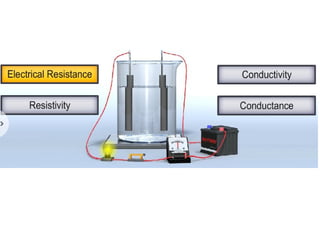
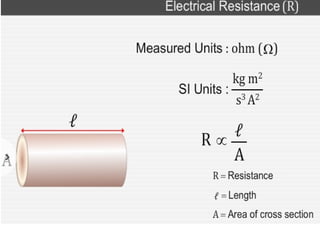
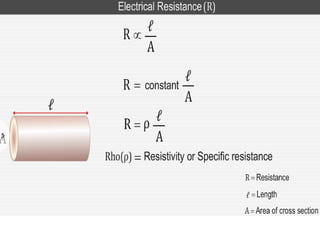
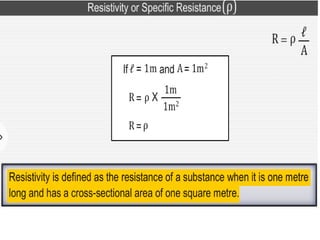
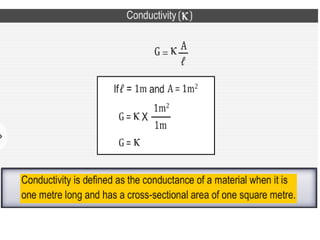
  • #13 Resistivity (ρ) is defined as the electrical resistance when a sample is 1metre long with a cross-section of 1square metre. Resistivity is measured in ohm-metres. R = ρ l/AIf l = 1m and A = 1m2   R = ρ 1m/1m2  R = ρ Conductivity (κ) is the conductance of a material when it is 1metre long with a cross section of 1square metre. Conductivity is 
  • #14 Rbefore going to study conductivity of chemical cell first understand some key term.If l = 1m and A = 1m2   R = ρ 1m/1m2  R = ρ Conductivity (κ) is the conductance of a material when it is 1metre long with a cross section of 1square metre. Conductivity is 
  • #15 Electrical resistance of any current is directly proportional to l and A.
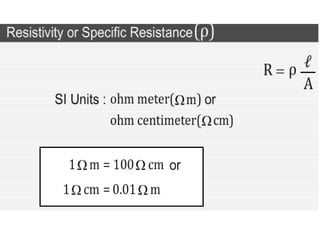
  • #17 SI unit of resistivity is given 2nd point.
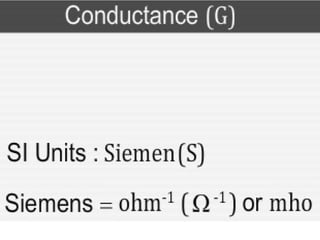
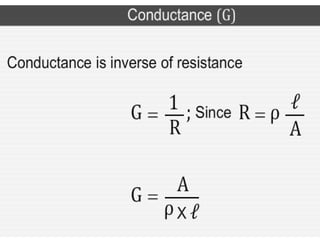
  • #20 Conductance is inverse of resisitance.
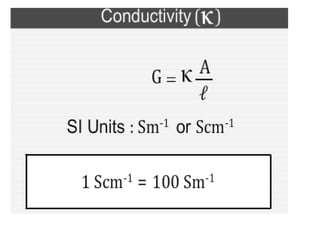
  • #21 Conductivity is donted by k called kappa. Greek
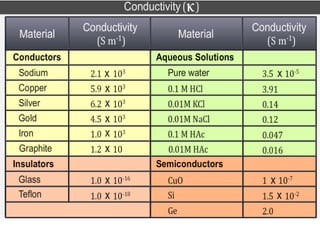
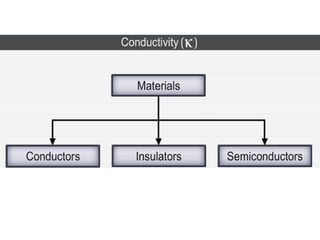
  • #25 Denpending on there conductivity material are classified as conductore insulator semiconductor
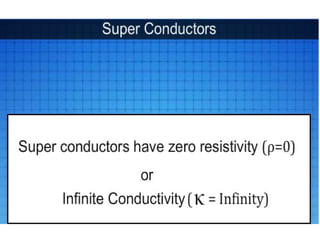
  • #31 Apart from this conductor there is one more conductor is called zero conductor.
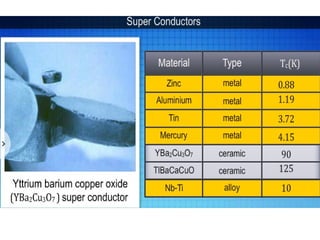
  • #32 Some metal alloy become super conductor at lower temperature. And some mix oxide at high temperature show super conductor.
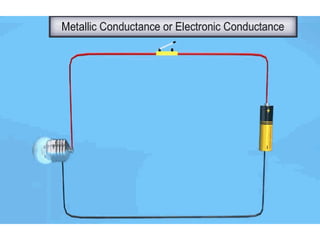
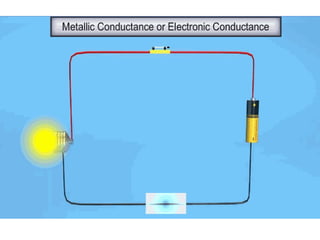
  • #35 Let us discuss about conductance electric conductance thrugh metal.
  • #37 Metallic conductor depend upon
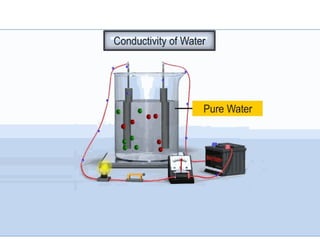
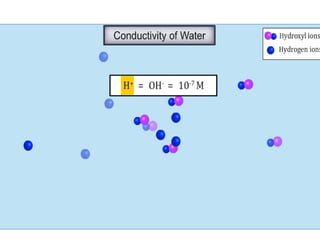
  • #38 Conductivity also occure in pure water.
  • #39 Pure water contain very less oh ion bcose of this pure water is very low conductivity.
  • #40 By putting ioin concductivity increase.
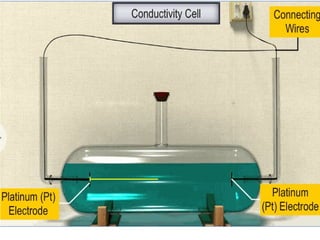
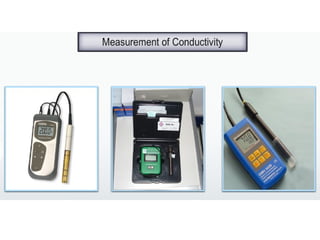
  • #42 To measure the ionic conductivity cell we use cell .
  • #43 To calculate the distance btween two area is very difiicult. The column of the solution seperating the two electrode then has a resistance describe by eqn givwen.
  • #44 G star show there cross section area.
  • #45 If there is no conductivity we measure by resistance of the condcutivity.
  • #47 Measurement of conductivity we can use witston bridge. Variable resistance R1. p detector show current flow. R2 is unknown resistance. O show AC power supply. When the bridge balance no flow though the detector. At this condition equation is R2=
  • #48 Measure conductivity of solution and resistance of cell. One cell constant and resistivity known then.
  • #51 We converting the unit result gets second equation.
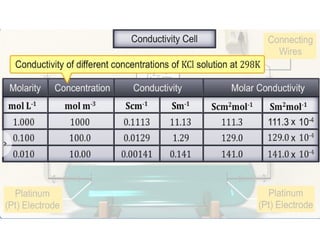
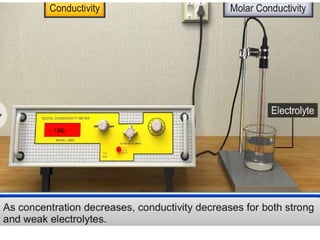
  • #52 As solution diluted only few ions remain that’s why decrease conductivity.
  • #54 Strong electrolyte kam ion se bhi electricity conduct karega. But weak electrolyte already weak hai to wo electiricity conduct nahi karpayga.
  • #57 You can clasiffy electrode based on charges form.
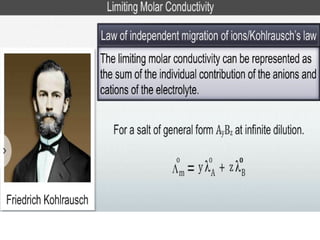
  • #58 Limiting molar condivity = anion limiting molar condivity + cation liminting molar condivity z.
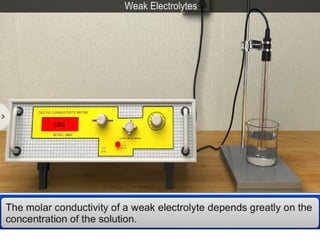
  • #61 Weak electrolyte mean diluted solution so conductivity low. Only measure by kohrausch law or limiting conductivity.
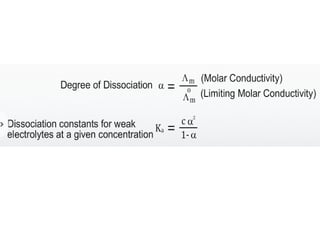
  • #62 For a weak electroly or disscociation const. alpha. If molar and limiting molar conductivity known then we find
  • #66 Our fully focus on this chapter is voltaic cell.