 Introduction
 Types Of Battery
 Characteristics Of Battery
 Ni-MH Battery
 Lithium Ion Battery
Energy Storage Systems-
Battery Technology
By
Mr. Chethan S G
Asst. Professor.
Department Of Chemistry
JNNCE, Shimoga
Introduction
 It is a device consisting of two or more galvanic cells
connected in series or parallel or both to obtain higer
potential
 An active Chemical Material which Convert into an
Electrical Energy.
 The size & design of battery varies from w.r.t. the
applications.
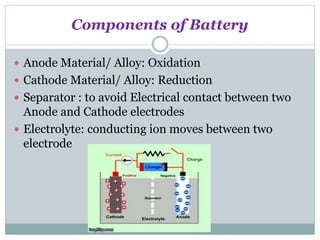
Components of Battery
 Anode Material/ Alloy: Oxidation
 Cathode Material/ Alloy: Reduction
 Separator : to avoid Electrical contact between two
Anode and Cathode electrodes
 Electrolyte: conducting ion moves between two
electrode
Types of Battery
Batteries are Classified into Three types:
1. Primary Cells
2. Secondary Cells
3. Reserved Battery
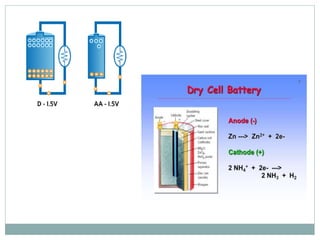
Primary Cells: the potential of battery as use of Free
energy of active material as long as present inside
the battery. These cell reaction are not reversible
and not rechargeable.
Ex: Dry cell (Zn-MnO2)
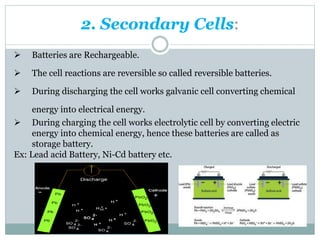
2. Secondary Cells:
 Batteries are Rechargeable.
 The cell reactions are reversible so called reversible batteries.
 During discharging the cell works galvanic cell converting chemical
energy into electrical energy.
 During charging the cell works electrolytic cell by converting electric
energy into chemical energy, hence these batteries are called as
storage battery.
Ex: Lead acid Battery, Ni-Cd battery etc.
3. Reserve Battery
 Reserve batteries are high current battery and long
shelf life.
 The electrolyte component of battery is
isolated(missing)
 These battery activated by contacting active isolated
component when ever need high potential.
 Used to deliver high potential for shorter periods of
time such as missiles, military applications etc.
 Ex: Zn-Ag2O- active material water.
 Mg-AgCl activated by water
Characteristics Of Battery:
 EMF
 Current: Current is a measure of the rate at which the
battery is discharging. Higher the surface area of the
electrodes, higher is the rate of reaction. Current is
measured in A.
 Capacity: total energy obtained until the end of battery
failure
 Efficiency
 Cycle life
 Power Density (w/Kg)
 Shelf Life
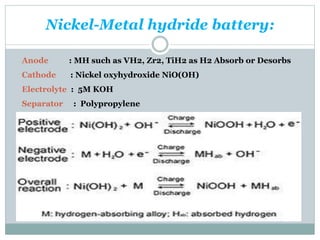
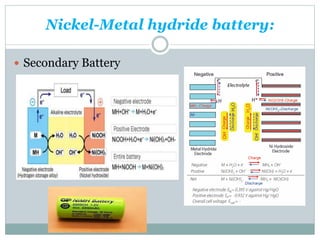
Nickel-Metal hydride battery:
Anode : MH such as VH2, Zr2, TiH2 as H2 Absorb or Desorbs
Cathode : Nickel oxyhydroxide NiO(OH)
Electrolyte : 5M KOH
Separator : Polypropylene
Nickel-Metal hydride battery:
 Secondary Battery
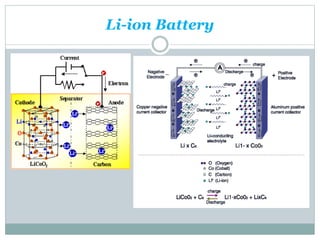
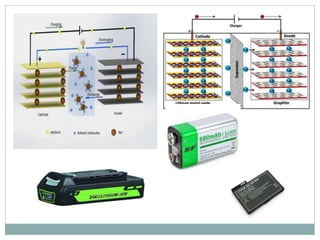
Li-ion Battery
Engineering chemistry battery- Module 1

Engineering chemistry battery- Module 1

  • 1.
     Introduction  TypesOf Battery  Characteristics Of Battery  Ni-MH Battery  Lithium Ion Battery Energy Storage Systems- Battery Technology By Mr. Chethan S G Asst. Professor. Department Of Chemistry JNNCE, Shimoga
  • 2.
    Introduction  It isa device consisting of two or more galvanic cells connected in series or parallel or both to obtain higer potential  An active Chemical Material which Convert into an Electrical Energy.  The size & design of battery varies from w.r.t. the applications.
  • 3.
    Components of Battery Anode Material/ Alloy: Oxidation  Cathode Material/ Alloy: Reduction  Separator : to avoid Electrical contact between two Anode and Cathode electrodes  Electrolyte: conducting ion moves between two electrode
  • 4.
    Types of Battery Batteriesare Classified into Three types: 1. Primary Cells 2. Secondary Cells 3. Reserved Battery Primary Cells: the potential of battery as use of Free energy of active material as long as present inside the battery. These cell reaction are not reversible and not rechargeable. Ex: Dry cell (Zn-MnO2)
  • 6.
    2. Secondary Cells: Batteries are Rechargeable.  The cell reactions are reversible so called reversible batteries.  During discharging the cell works galvanic cell converting chemical energy into electrical energy.  During charging the cell works electrolytic cell by converting electric energy into chemical energy, hence these batteries are called as storage battery. Ex: Lead acid Battery, Ni-Cd battery etc.
  • 7.
    3. Reserve Battery Reserve batteries are high current battery and long shelf life.  The electrolyte component of battery is isolated(missing)  These battery activated by contacting active isolated component when ever need high potential.  Used to deliver high potential for shorter periods of time such as missiles, military applications etc.  Ex: Zn-Ag2O- active material water.  Mg-AgCl activated by water
  • 8.
    Characteristics Of Battery: EMF  Current: Current is a measure of the rate at which the battery is discharging. Higher the surface area of the electrodes, higher is the rate of reaction. Current is measured in A.  Capacity: total energy obtained until the end of battery failure  Efficiency  Cycle life  Power Density (w/Kg)  Shelf Life
  • 9.
    Nickel-Metal hydride battery: Anode: MH such as VH2, Zr2, TiH2 as H2 Absorb or Desorbs Cathode : Nickel oxyhydroxide NiO(OH) Electrolyte : 5M KOH Separator : Polypropylene
  • 10.
  • 11.