





HOME
AUTOMATION
TEMPRATURE CONTROL
SUBMITTED BY:AJITESH PAL SINGH
INTRODUCTION
The goal of our project is to design a user-friendly
home automation system which can be easily
integrated into existing homes and businesses.
 It is automation of the home, housework or household
activity.
 Home automation may include centralized control of
lighting, HVAC (heating, ventilation and air
conditioning), appliances, security locks of gates and
doors and other systems, to provide improved
convenience, comfort, energy efficiency and security.

How it works?


Basically it is used to control temperature.



At 30°C temp it will work normally but when the
temperature above 30°C the fan will start moving.




Temperature will show in the LCD display.
Connector is connected with the motor driver and it will
help to rotate the fan.
Advantages


Increasing safety System.



Lighting Control (Centralized).



Heat and Cool Control system.



Video systems.
Applications





Low-cost Program Control of Industrial Furnaces.
Ideal for Increasing the Control Performance of Industrial
Hot Air Blowers

High Resolution Temperature Measurement.
Power supply


This is used to control the voltage and current coming from the main
supply.



We use step down center tap transformer with fullwave rectifier and
7805 voltage regulator.
Fullwave Rectifier


A bridge is simply two fullwave circuits... So. fullwave has
the advantage of having half the diode drop.



The PIV is one half that of the center tap circuit.
MICROCONTROLLER (AT89S52)


It has inbuilt ram, rom, timer or we can say that it is a
small cpu which is used for performing specific task.



AT89S52 microcontroller is made up with c mos
technology with operation form 2.7 to 5.5v.



It has 256 B ram and 8k rom,32 i/o lines,16 bit
counter/timer,6 interrupts.



It has one full duplex UART.
LCD(Liquid Crystal Display)


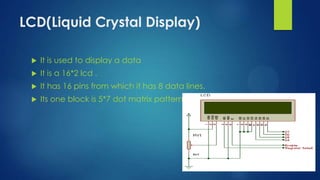
It is used to display a data



It is a 16*2 lcd .



It has 16 pins from which it has 8 data lines.



Its one block is 5*7 dot matrix pattern.
Temperature Sensor LM35


It is precision temperature sensor in celcius.



Its sensitivity is linear + 10 mV/°C.



It can measure from -55°C and 150°C.



Can be used to detect ambient air temperature



LM35 Linear Temperature Sensor is based on the
semiconductor LM35 temperature sensor.



The output voltage is proportional to the temperature.
ADC0808 (ANOALG
TO DIGITAL
CONVERTOR )



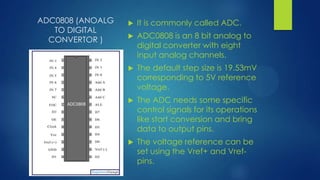
It is commonly called ADC.



ADC0808 is an 8 bit analog to
digital converter with eight
input analog channels.



The default step size is 19.53mV
corresponding to 5V reference
voltage.



The ADC needs some specific
control signals for its operations
like start conversion and bring
data to output pins.



The voltage reference can be
set using the Vref+ and Vrefpins.
Motor Driver(L293D)



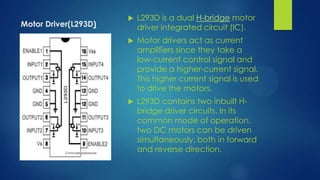
L293D is a dual H-bridge motor
driver integrated circuit (IC).



Motor drivers act as current
amplifiers since they take a
low-current control signal and
provide a higher-current signal.
This higher current signal is used
to drive the motors.



L293D contains two inbuilt Hbridge driver circuits. In its
common mode of operation,
two DC motors can be driven
simultaneously, both in forward
and reverse direction.
Program


#include<reg51.h>



#include"lcd.h"



#define MYDATA P3



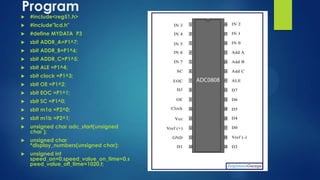
sbit ADDR_A=P1^7;



sbit ADDR_B=P1^6;



sbit ADDR_C=P1^5;



sbit ALE =P1^4;



sbit clock =P1^3;



sbit OE =P1^2;



sbit EOC =P1^1;



sbit SC =P1^0;



sbit m1a =P2^0;



sbit m1b =P2^1;



unsigned char adc_start(unsigned
char );



unsigned char
*display_numbers(unsigned char);



unsigned int
speed_on=0,speed_value_on_time=0,s
peed_value_off_time=1020,t;
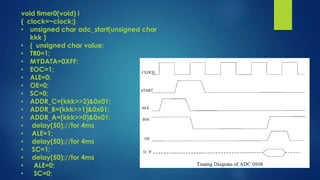
void timer0(void) i
{ clock=~clock;}
• unsigned char adc_start(unsigned char
kkk )
• { unsigned char value;
• TR0=1;
• MYDATA=0XFF;
• EOC=1;
• ALE=0;
• OE=0;
• SC=0;
• ADDR_C=(kkk>>2)&0x01;
• ADDR_B=(kkk>>1)&0x01;
• ADDR_A=(kkk>>0)&0x01;
• delay(50);//for 4ms
• ALE=1;
• delay(50);//for 4ms
• SC=1;
• delay(50);//for 4ms
•
ALE=0;
•
SC=0;
•
•
•
•
•
•
•
•
•
•
•
•
•
•
•
•
•
•
•
•
}

delay(50);//for 4ms
while(EOC==1);
while(EOC==0);
OE=1;
delay(10);//for 4ms
value=MYDATA;
OE=0;
TR0=0;
return(value);
}
unsigned char *display_numbers(unsigned char abbc)
{
unsigned char kkk[3],ttt=0;
while(ttt<3)
{
kkk[ttt]=abbc%10;
ttt++;
abbc=abbc/10;
}
return(kkk);
void main()
{
unsigned char *bb,temp_resister;
initialize();
m1a=0;
m1b=0;
cmd(0x80);
ptr("Temperature= ");
TMOD=0X02; //mode 2
TH0=0xfb;
IE=0X82;
TR0=0;
//timer stop
cmd(0xc0);
bb[0]=0;
bb[1]=0;
bb[2]=0;
•
•
•
•
•
•
•
•
•
•
•
•
•
•
•
•
•
•
•
•

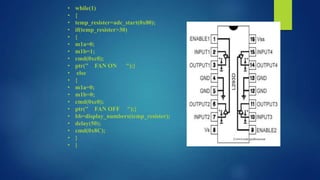
while(1)
{
temp_resister=adc_start(0x00);
if(temp_resister>30)
{
m1a=0;
m1b=1;
cmd(0xc0);
ptr(" FAN ON ");}
else
{
m1a=0;
m1b=0;
cmd(0xc0);
ptr(" FAN OFF ");}
bb=display_numbers(temp_resister);
delay(50);
cmd(0x8C);
}
}
Fan automation

Fan automation

  • 1.
  • 2.
    INTRODUCTION The goal ofour project is to design a user-friendly home automation system which can be easily integrated into existing homes and businesses.  It is automation of the home, housework or household activity.  Home automation may include centralized control of lighting, HVAC (heating, ventilation and air conditioning), appliances, security locks of gates and doors and other systems, to provide improved convenience, comfort, energy efficiency and security. 
  • 3.
    How it works?  Basicallyit is used to control temperature.  At 30°C temp it will work normally but when the temperature above 30°C the fan will start moving.   Temperature will show in the LCD display. Connector is connected with the motor driver and it will help to rotate the fan.
  • 4.
    Advantages  Increasing safety System.  LightingControl (Centralized).  Heat and Cool Control system.  Video systems.
  • 5.
    Applications    Low-cost Program Controlof Industrial Furnaces. Ideal for Increasing the Control Performance of Industrial Hot Air Blowers High Resolution Temperature Measurement.
  • 6.
    Power supply  This isused to control the voltage and current coming from the main supply.  We use step down center tap transformer with fullwave rectifier and 7805 voltage regulator.
  • 7.
    Fullwave Rectifier  A bridgeis simply two fullwave circuits... So. fullwave has the advantage of having half the diode drop.  The PIV is one half that of the center tap circuit.
  • 8.
    MICROCONTROLLER (AT89S52)  It hasinbuilt ram, rom, timer or we can say that it is a small cpu which is used for performing specific task.  AT89S52 microcontroller is made up with c mos technology with operation form 2.7 to 5.5v.  It has 256 B ram and 8k rom,32 i/o lines,16 bit counter/timer,6 interrupts.  It has one full duplex UART.
  • 9.
    LCD(Liquid Crystal Display)  Itis used to display a data  It is a 16*2 lcd .  It has 16 pins from which it has 8 data lines.  Its one block is 5*7 dot matrix pattern.
  • 10.
    Temperature Sensor LM35  Itis precision temperature sensor in celcius.  Its sensitivity is linear + 10 mV/°C.  It can measure from -55°C and 150°C.  Can be used to detect ambient air temperature  LM35 Linear Temperature Sensor is based on the semiconductor LM35 temperature sensor.  The output voltage is proportional to the temperature.
  • 11.
    ADC0808 (ANOALG TO DIGITAL CONVERTOR)  It is commonly called ADC.  ADC0808 is an 8 bit analog to digital converter with eight input analog channels.  The default step size is 19.53mV corresponding to 5V reference voltage.  The ADC needs some specific control signals for its operations like start conversion and bring data to output pins.  The voltage reference can be set using the Vref+ and Vrefpins.
  • 12.
    Motor Driver(L293D)  L293D isa dual H-bridge motor driver integrated circuit (IC).  Motor drivers act as current amplifiers since they take a low-current control signal and provide a higher-current signal. This higher current signal is used to drive the motors.  L293D contains two inbuilt Hbridge driver circuits. In its common mode of operation, two DC motors can be driven simultaneously, both in forward and reverse direction.
  • 13.
    Program  #include<reg51.h>  #include"lcd.h"  #define MYDATA P3  sbitADDR_A=P1^7;  sbit ADDR_B=P1^6;  sbit ADDR_C=P1^5;  sbit ALE =P1^4;  sbit clock =P1^3;  sbit OE =P1^2;  sbit EOC =P1^1;  sbit SC =P1^0;  sbit m1a =P2^0;  sbit m1b =P2^1;  unsigned char adc_start(unsigned char );  unsigned char *display_numbers(unsigned char);  unsigned int speed_on=0,speed_value_on_time=0,s peed_value_off_time=1020,t;
  • 14.
    void timer0(void) i {clock=~clock;} • unsigned char adc_start(unsigned char kkk ) • { unsigned char value; • TR0=1; • MYDATA=0XFF; • EOC=1; • ALE=0; • OE=0; • SC=0; • ADDR_C=(kkk>>2)&0x01; • ADDR_B=(kkk>>1)&0x01; • ADDR_A=(kkk>>0)&0x01; • delay(50);//for 4ms • ALE=1; • delay(50);//for 4ms • SC=1; • delay(50);//for 4ms • ALE=0; • SC=0;
  • 15.
    • • • • • • • • • • • • • • • • • • • • } delay(50);//for 4ms while(EOC==1); while(EOC==0); OE=1; delay(10);//for 4ms value=MYDATA; OE=0; TR0=0; return(value); } unsignedchar *display_numbers(unsigned char abbc) { unsigned char kkk[3],ttt=0; while(ttt<3) { kkk[ttt]=abbc%10; ttt++; abbc=abbc/10; } return(kkk);
  • 16.
    void main() { unsigned char*bb,temp_resister; initialize(); m1a=0; m1b=0; cmd(0x80); ptr("Temperature= "); TMOD=0X02; //mode 2 TH0=0xfb; IE=0X82; TR0=0; //timer stop cmd(0xc0); bb[0]=0; bb[1]=0; bb[2]=0;
  • 17.