Name : Mihika Shah
Roll No: 09BIT059
Surveillance


• The word ‘surveillance’ means to observe a specific area
or to monitor the activities of individual or a group.

• It is very useful to the government to maintain social
control, monitor and recognize threats, and investigate
criminal activity.
History

• The first CCTV system was installed by Siemens AG at
Test Stand VII to observe the launching of rockets. And
later on, it was used for observing public area.

• During 1990, digital multiplexing allowed more than
one camera to record at once which has increased the
use of CCTV.

• It was commonly used in Banks to record the evidence
of criminal activity.
Manual Surveillance

•   Impractical

•Very costly

• Lack of attention

• needs situational awareness
Video Surveillance Automation

• Have   computers catch the video

• More channels can be used by buying more servers and
licenses.

• Cheaper than the manual surveillance

• People still have to deal with alarms
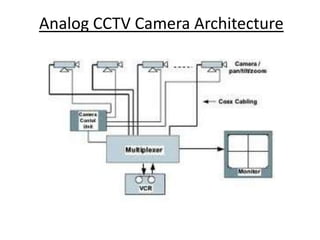
Analog CCTV Camera Architecture
Components of Analog CCTV Cameras
1. Camera
   - starting point of the CCTV systems
   - night vision technology based cameras are used for
   low light conditions.

2. Monitor
   - Operators view footage from central location on the
   monitor.
   - dedicated monitor : display video from a single
   camera
   - call up monitor : access multiple cameras at the
   same video
( Contd…)


3. Cable
      - coaxial cable : for transmitting video footage from
      cameras
      - expensive and difficult to install

4. DVR ( Digital Video Recorder )
      - Convert the analog footage to digital which
      extends the storage capacity
      - makes it easy to search archived footage
      - allows users to stream video over a network for
      remote viewing from multiple locations.
Types of CCTV Camera

1. Fixed Cameras

   - points in a single direction
   - monitors specific area of interest
   - mostly installed in clearly visible areas
   - effective in capturing footage of suspicious activity
   - direction of camera is set during installation
2. PTZ Cameras ( Pan Tilt Zoom Cameras )

      - ideal for wide-area surveillance
      - gives the ability to remotely control pan, tilt, and
      zoom functions to follow activity and to zoom in
      for detailed monitoring
      - an area where analog CCTV cameras fall behind
      their IP camera counterparts.
Advantages of analog CCTV

Lower initial cost - In most cases, analog cameras cost
less up front than IP network cameras.
-Analog cameras tend to handle low-light situations
better than IP cameras on average

Wide-spread compatibility - Mixing and matching
camera models and surveillance equipment from
different manufacturers is easy with an analog CCTV
setup.
Disadvantages of analog CCTV

Expensive cabling - For large-scale surveillance
applications, analog cameras require complicated
cabling schemes that can be quite expensive and also
challenging to install.

Limited features - Many of the advanced features now
available with IP cameras (for instance: megapixel
resolution, digital zoom, and video analytics), aren't
available in analog CCTV models.
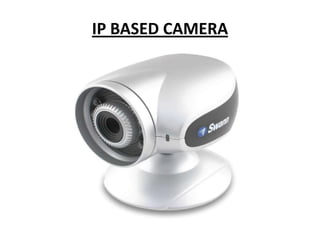
IP BASED CAMERA
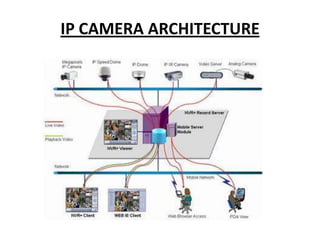
IP CAMERA ARCHITECTURE
(Contd…)

1. IP Camera
   - Front part of the system
   - Available with different levels of image quality.

2. Network Video Recorder ( NVR )
   - a very crucial component of IP system
   - responsible for video monitoring, event
   management and storage
   - various compression techniques are used to
   optimize the storage like MPEG-4
(Contd…)
3. Power over Ethernet ( PoE )
   - With PoE, data transmissions from the camera
     and power to the camera are all relayed through a
     single Ethernet cable
   - allows the installation of a camera in such area
     where power outlets are not available

4. Image sensor
   (i) CCD ( Charge Coupled Device ) :
       - specially used for low light situation as they are
       very sensitive
       - more expensive than others
       - consumes 100 times more power than CMOS
        sensor
(Contd…)

   (ii) CMOS (Complimentary metal oxide semiconductor)
       - produces high resolution images
       - uses less power than CCD

5. Monitor
   - placed at central location to view a footage
   - can be used to view the footage from single camera
   or multiple cameras
ADVANTAGES OF IP CAMERA

• Flexibility: It can be moved anywhere in the IP network
• high resolution of the captured images
•Encryption and authentication : transmission of data is
done through encryption
• Remote access : cameras can be viewed from any
computer anywhere in the world
• PoE : Cameras can operate without additional power. PoE
protocol is used to feed them through internet cable
DISADVANTAGES OF IP CAMERA

• Higher initial price for the camera
• Lack of standards : various IP camera can encode the
video differently
• Technical barrier : Installation of IP camera, router
requires a technician who knows CCTV technology
• System becomes open to hackers via internet.
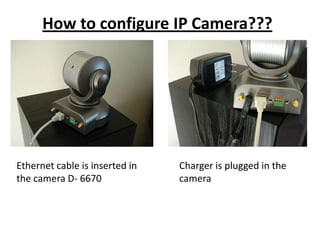
How to configure IP Camera???


Ethernet cable is inserted in   Charger is plugged in the
the camera D- 6670              camera
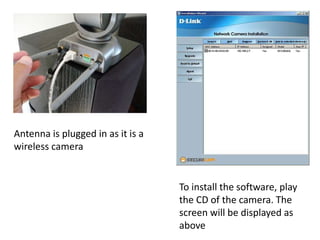
Antenna is plugged in as it is a
wireless camera


                                   To install the software, play
                                   the CD of the camera. The
                                   screen will be displayed as
                                   above
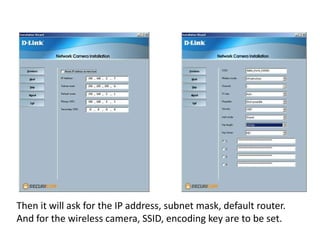
Then it will ask for the IP address, subnet mask, default router.
And for the wireless camera, SSID, encoding key are to be set.
Application of Video Surveillance

• Airports
• Railway Station
• Military
• Retails
• Government
• Home and residential
• Industrial
• Entertainment
• Healthcare
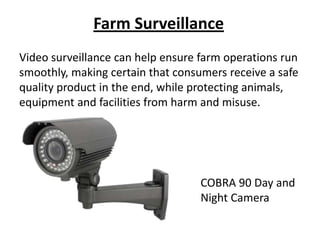
Farm Surveillance
Video surveillance can help ensure farm operations run
smoothly, making certain that consumers receive a safe
quality product in the end, while protecting animals,
equipment and facilities from harm and misuse.


                                   COBRA 90 Day and
                                   Night Camera
BENEFITS OF FARM SURVEILLANCE

• Monitor for intruders
• Protect for water supply
• Prevent break-ins
• Prevent theft
• Monitor daily operation
• Employee monitoring
• Remote playback and monitoring
References
1. http://www.videosurveillance.com/cctv-
   technology/intro-to-cctv.asp

2. http://www.wikipedia.com/surveillance

3. Stephen Russo, Director of Security and Privacy
   Technology, IBM Corporation : Digital Video
   Surveillance

4. http://homeowner.hubpages.com/hub/Video-
   surveillance-cameras-for-farms-and-agriculture
5. http://www.videosurveillance.com/farms.asp
(Contd…)

 6. http://www.farmcameras.com/
Thank you

Video Surveillance

  • 1.
    Name : MihikaShah Roll No: 09BIT059
  • 2.
    Surveillance • The word‘surveillance’ means to observe a specific area or to monitor the activities of individual or a group. • It is very useful to the government to maintain social control, monitor and recognize threats, and investigate criminal activity.
  • 3.
    History • The firstCCTV system was installed by Siemens AG at Test Stand VII to observe the launching of rockets. And later on, it was used for observing public area. • During 1990, digital multiplexing allowed more than one camera to record at once which has increased the use of CCTV. • It was commonly used in Banks to record the evidence of criminal activity.
  • 4.
    Manual Surveillance • Impractical •Very costly • Lack of attention • needs situational awareness
  • 5.
    Video Surveillance Automation •Have computers catch the video • More channels can be used by buying more servers and licenses. • Cheaper than the manual surveillance • People still have to deal with alarms
  • 6.
    Analog CCTV CameraArchitecture
  • 7.
    Components of AnalogCCTV Cameras 1. Camera - starting point of the CCTV systems - night vision technology based cameras are used for low light conditions. 2. Monitor - Operators view footage from central location on the monitor. - dedicated monitor : display video from a single camera - call up monitor : access multiple cameras at the same video
  • 8.
    ( Contd…) 3. Cable - coaxial cable : for transmitting video footage from cameras - expensive and difficult to install 4. DVR ( Digital Video Recorder ) - Convert the analog footage to digital which extends the storage capacity - makes it easy to search archived footage - allows users to stream video over a network for remote viewing from multiple locations.
  • 9.
    Types of CCTVCamera 1. Fixed Cameras - points in a single direction - monitors specific area of interest - mostly installed in clearly visible areas - effective in capturing footage of suspicious activity - direction of camera is set during installation
  • 10.
    2. PTZ Cameras( Pan Tilt Zoom Cameras ) - ideal for wide-area surveillance - gives the ability to remotely control pan, tilt, and zoom functions to follow activity and to zoom in for detailed monitoring - an area where analog CCTV cameras fall behind their IP camera counterparts.
  • 11.
    Advantages of analogCCTV Lower initial cost - In most cases, analog cameras cost less up front than IP network cameras. -Analog cameras tend to handle low-light situations better than IP cameras on average Wide-spread compatibility - Mixing and matching camera models and surveillance equipment from different manufacturers is easy with an analog CCTV setup.
  • 12.
    Disadvantages of analogCCTV Expensive cabling - For large-scale surveillance applications, analog cameras require complicated cabling schemes that can be quite expensive and also challenging to install. Limited features - Many of the advanced features now available with IP cameras (for instance: megapixel resolution, digital zoom, and video analytics), aren't available in analog CCTV models.
  • 13.
  • 14.
  • 15.
    (Contd…) 1. IP Camera - Front part of the system - Available with different levels of image quality. 2. Network Video Recorder ( NVR ) - a very crucial component of IP system - responsible for video monitoring, event management and storage - various compression techniques are used to optimize the storage like MPEG-4
  • 16.
    (Contd…) 3. Power overEthernet ( PoE ) - With PoE, data transmissions from the camera and power to the camera are all relayed through a single Ethernet cable - allows the installation of a camera in such area where power outlets are not available 4. Image sensor (i) CCD ( Charge Coupled Device ) : - specially used for low light situation as they are very sensitive - more expensive than others - consumes 100 times more power than CMOS sensor
  • 17.
    (Contd…) (ii) CMOS (Complimentary metal oxide semiconductor) - produces high resolution images - uses less power than CCD 5. Monitor - placed at central location to view a footage - can be used to view the footage from single camera or multiple cameras
  • 18.
    ADVANTAGES OF IPCAMERA • Flexibility: It can be moved anywhere in the IP network • high resolution of the captured images •Encryption and authentication : transmission of data is done through encryption • Remote access : cameras can be viewed from any computer anywhere in the world • PoE : Cameras can operate without additional power. PoE protocol is used to feed them through internet cable
  • 19.
    DISADVANTAGES OF IPCAMERA • Higher initial price for the camera • Lack of standards : various IP camera can encode the video differently • Technical barrier : Installation of IP camera, router requires a technician who knows CCTV technology • System becomes open to hackers via internet.
  • 20.
    How to configureIP Camera??? Ethernet cable is inserted in Charger is plugged in the the camera D- 6670 camera
  • 21.
    Antenna is pluggedin as it is a wireless camera To install the software, play the CD of the camera. The screen will be displayed as above
  • 22.
    Then it willask for the IP address, subnet mask, default router. And for the wireless camera, SSID, encoding key are to be set.
  • 23.
    Application of VideoSurveillance • Airports • Railway Station • Military • Retails • Government • Home and residential • Industrial • Entertainment • Healthcare
  • 24.
    Farm Surveillance Video surveillancecan help ensure farm operations run smoothly, making certain that consumers receive a safe quality product in the end, while protecting animals, equipment and facilities from harm and misuse. COBRA 90 Day and Night Camera
  • 25.
    BENEFITS OF FARMSURVEILLANCE • Monitor for intruders • Protect for water supply • Prevent break-ins • Prevent theft • Monitor daily operation • Employee monitoring • Remote playback and monitoring
  • 26.
    References 1. http://www.videosurveillance.com/cctv- technology/intro-to-cctv.asp 2. http://www.wikipedia.com/surveillance 3. Stephen Russo, Director of Security and Privacy Technology, IBM Corporation : Digital Video Surveillance 4. http://homeowner.hubpages.com/hub/Video- surveillance-cameras-for-farms-and-agriculture 5. http://www.videosurveillance.com/farms.asp
  • 27.
  • 28.