


Nation and Nationalism
Josefino Tulabing Larena Jr, CPS,MPA
Learning Objectives
• Define nationalism in relation to
the concept of nation,state and
nation state
• Appraise the development of
nationalism and naation-building
at present
KEYWORDS
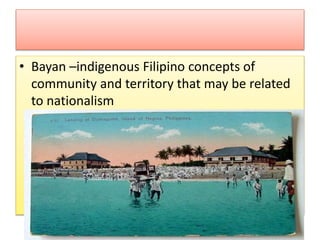
• Bayan –indigenous Filipino concepts of
community and territory that may be related
to nationalism
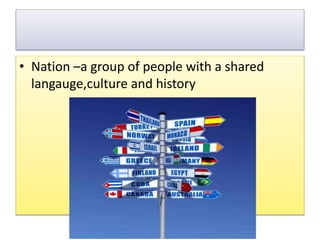
• Nation –a group of people with a shared
langauge,culture and history
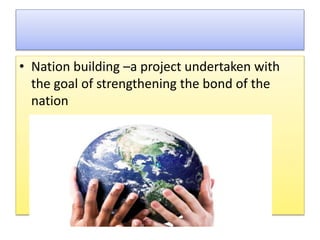
• Nation building –a project undertaken with
the goal of strengthening the bond of the
nation
•Nation –state- a
state ruling over
governing a nation
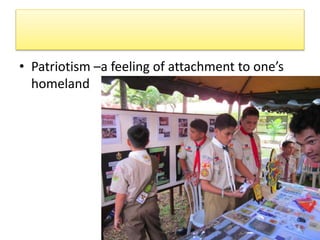
• Patriotism –a feeling of attachment to one’s
homeland
• Sovereignty-the authority to govern a polity
without external interference /incursions.
Nation -State
• Nation ( People/ Community)
• State ( Territory )
Nation and Nationalism
• Primordialism- it argues that a national
identity has always existed and nations have “
ethnic cores”
• Modernity –this line of thinking suggests that
nationalism and national identify are
necessary products of the social structure and
culture brought about by the emergence of
capitalism ,industrialization, secularization,
urbanization and bureaucratization.
“imagined communities”
• Benedict Anderson argues that nations
imagined communities (2003).He traces the
history of these imagined communities to the
enlightenment when European society began
challenging the supposed divinely-ordained
dynastic regimes of the monarchies.This idea
was starkly exemplified by the industrial
revolution and the French revolution
Nation and Bayan
• Nation-building is a continuing struggle up to
the present.
• First anti-colonial revolution in Asia led by
Andres Bonifacio and the Katipunan.scholars
note the important work of the propagandists
like Rizal in the sustained efforts to build the
nation and enact change in the Spanish
colony.
• The indigenous intellect movement like
Sikolohiyang Pilipino and Bagong Kasaysayan
• Introduced the concept of Kapwa and bayan
Thank you so much

Nation and Nationalism

  • 1.
    Nation and Nationalism JosefinoTulabing Larena Jr, CPS,MPA
  • 2.
    Learning Objectives • Definenationalism in relation to the concept of nation,state and nation state • Appraise the development of nationalism and naation-building at present
  • 3.
  • 4.
    • Bayan –indigenousFilipino concepts of community and territory that may be related to nationalism
  • 5.
    • Nation –agroup of people with a shared langauge,culture and history
  • 6.
    • Nation building–a project undertaken with the goal of strengthening the bond of the nation
  • 7.
    •Nation –state- a stateruling over governing a nation
  • 8.
    • Patriotism –afeeling of attachment to one’s homeland
  • 9.
    • Sovereignty-the authorityto govern a polity without external interference /incursions.
  • 10.
    Nation -State • Nation( People/ Community) • State ( Territory )
  • 11.
    Nation and Nationalism •Primordialism- it argues that a national identity has always existed and nations have “ ethnic cores” • Modernity –this line of thinking suggests that nationalism and national identify are necessary products of the social structure and culture brought about by the emergence of capitalism ,industrialization, secularization, urbanization and bureaucratization.
  • 12.
    “imagined communities” • BenedictAnderson argues that nations imagined communities (2003).He traces the history of these imagined communities to the enlightenment when European society began challenging the supposed divinely-ordained dynastic regimes of the monarchies.This idea was starkly exemplified by the industrial revolution and the French revolution
  • 13.
    Nation and Bayan •Nation-building is a continuing struggle up to the present. • First anti-colonial revolution in Asia led by Andres Bonifacio and the Katipunan.scholars note the important work of the propagandists like Rizal in the sustained efforts to build the nation and enact change in the Spanish colony.
  • 14.
    • The indigenousintellect movement like Sikolohiyang Pilipino and Bagong Kasaysayan • Introduced the concept of Kapwa and bayan
  • 16.